

Nearly half of organizations that outsource a core business function have, at some point, terminated the contract and walked away and the trigger is rarely price. It is service quality that was never properly defined on paper. Recruitment is no exception to that pattern.
Buyers routinely spend weeks comparing vendors, shortlisting a recruitment outsourcing provider, and checking references, then sign a service level agreement they skimmed in a single afternoon. That imbalance is precisely where RPO contract negotiation quietly decides whether the partnership compounds value or unravels in month four.
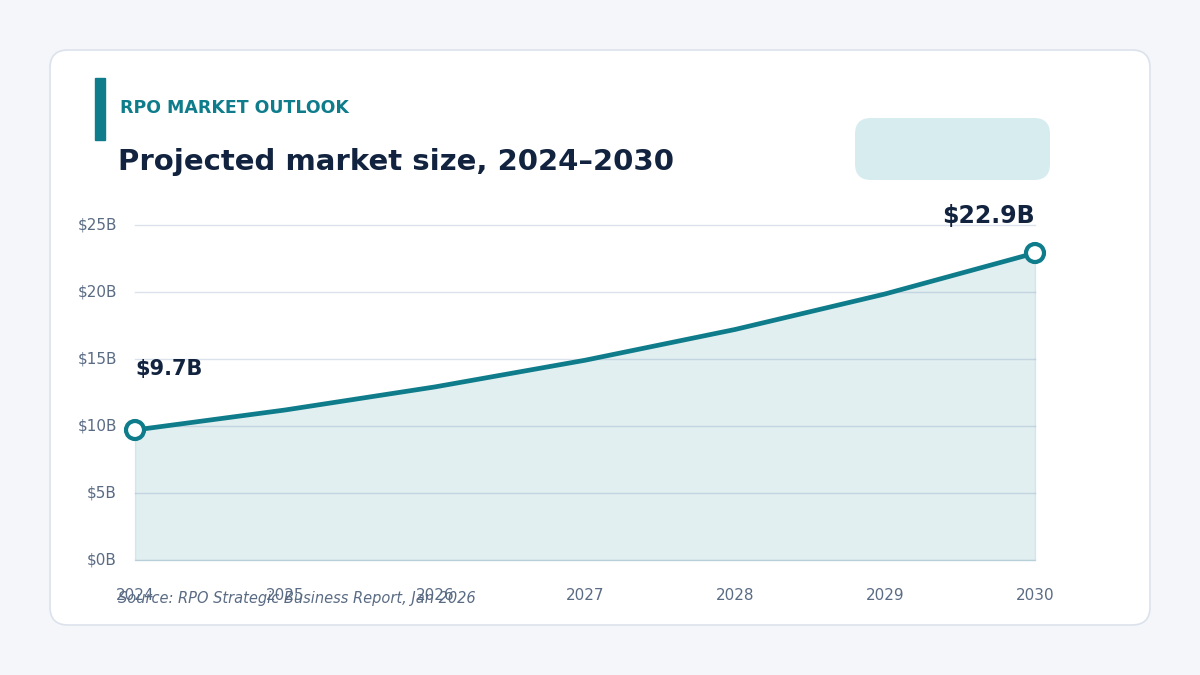
The global RPO market is forecast to grow from about $9.7 billion in 2024 to $22.9 billion by 2030 at a 15.4% CAGR meaning many more organizations will be signing multi-year recruitment contracts, with far more riding on the fine print. Source: RPO Strategic Business Report, January 2026
The uncomfortable truth is that most of the leverage a buyer will ever hold exists in the two weeks before signing. Once the ink is dry, the guarantee period, the notice window, and the data-ownership clause are locked for the length of the term, often 12 to 36 months. Renegotiating mid-contract, from a position of operational dependence, is far harder than getting the language right up front.
This is not provider-selection advice. It is about the specific clauses termination, guarantees, candidate replacement policy, service credits that separate an enforceable agreement from an expensive one. The red flags are almost never hidden. They sit in plain sight in the SLA, in language that reads as standard until the first critical role goes unfilled for 90 days and you learn what “commercially reasonable efforts” actually means in practice.
What RPO Contract Negotiation Actually Covers
RPO contract negotiation is the process of reviewing and revising a recruitment process outsourcing agreement its service levels, guarantee periods, termination rights, candidate replacement policy, and data ownership before signing, so that performance expectations become enforceable obligations rather than assumptions, and so the buyer keeps a realistic, low-friction path to exit if delivery falls short.
Everything else in this article is a practical breakdown of that definition, clause by clause.
RPO Contract Terms to Watch: Where Buyers Lose Leverage
Most buyers treat the agreement as boilerplate, and that assumption is expensive. A well-run RPO contract negotiation starts by separating three things vendors deliberately blur: the commercial rate card, the operational SLA, and the legal exit terms. Providers tend to invest their sharpest language in the parts you scrutinize least.
Term length is the first pressure point. A typical RPO agreement runs 12 to 36 months, frequently with an auto-renewal clause and a 60 to 90 day notice window. Miss that window by a week and you are committed for another full cycle.
The second is the guarantee period. A “90-day replacement guarantee” sounds generous until you read the carve-outs resignations attributed to “role fit,” restructuring, or client-side delays often void it entirely.
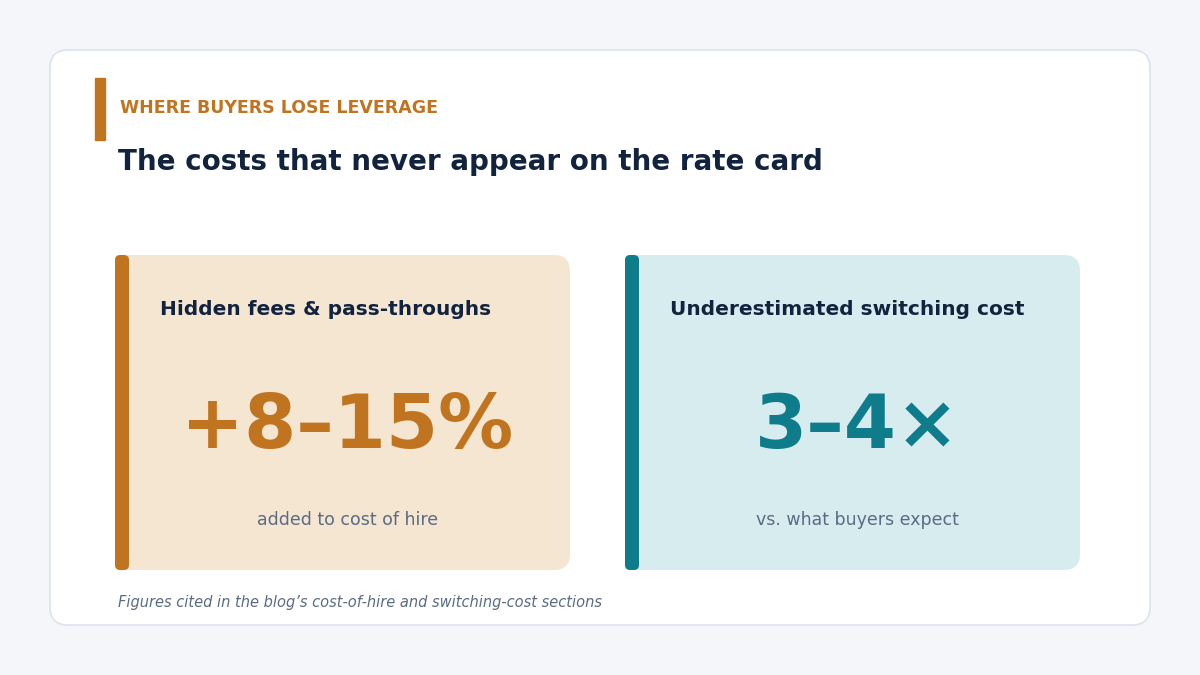
The third is volume. Volume commitments that penalize you during a hiring freeze convert a downturn into a double cost: fewer hires and a shortfall fee. Teams that skip a structured review routinely underestimate their true switching cost by three to four times, because migration, knowledge loss, and pipeline disruption never appear on the rate card. That gap is why a disciplined RPO contract negotiation should begin with switching cost, not headline rate.
RPO SLA Clauses That Decide the Relationship
This is the section that repays close reading. RPO SLA clauses are where the commercial relationship is actually defined, and where the most consequential red flags live. The clauses below are the ones worth slowing down for during any serious RPO contract negotiation.
What to look for in an RPO service level agreement
An SLA is only as strong as its remedies. A metric without a consequence is a marketing line, not a commitment. Look for named key performance indicators (KPIs) time-to-fill, submittal-to-interview ratio, offer-acceptance rate, quality-of-hire each tied to a measurable target and a defined service credit if the target is missed.
Watch for soft language: “endeavour to,” “target,” and “aim for” are not obligations. Insist that at least the two metrics that matter most to your business are hard commitments with financial teeth; this is the part of RPO contract negotiation where enforceability is won or lost.
RPO contract termination and notice period
Termination for convenience is the single clause most worth fighting for. Many drafts grant the provider a clean exit while binding the client to cause-based termination only, meaning you can leave only if you can prove a material breach, which is slow and contestable.
Push for a symmetric right to terminate for convenience with a reasonable notice period, commonly 30 to 90 days. Confirm that notice can be served by email, and that the notice clock does not reset on renewal. Securing this symmetry early is often the highest-leverage move in the entire RPO contract negotiation.
RPO replacement guarantee period explained
The candidate replacement policy should specify three things: the length of the guarantee, what triggers it, and what the remedy is. A strong guarantee period runs 60 to 90 days and offers a free replacement search, not a partial fee credit that still leaves you paying twice.
Scrutinise exclusions carefully. If the guarantee excludes voluntary resignation, it protects almost nothing, since most early departures are voluntary making this clause a priority in any RPO contract negotiation.
Hidden costs in RPO agreements
The rate card is rarely the whole cost. Common surprises include background-check pass-throughs, job-board licensing, technology “platform fees,” and charges for transition assistance at the end of the term. Left unaddressed in the RPO contract negotiation, these can add 8 to 15% to the effective cost of hire.
Before you sign, run this sequence:
- Map every metric in the SLA to a specific service credit or it does not count.
- Confirm a symmetric termination for convenience clause with a defined notice period.
- Pin down the guarantee period length, triggers, and exclusions in writing.
- Cap or remove volume commitments and shortfall penalties tied to your hiring forecast.
- Establish who owns the candidate database and pipeline data on exit.
- Require documented transition assistance data handover, in-flight candidates, and 30 days of overlap.
- List every pass-through and platform fee, with a not-to-exceed ceiling.
- Verify data protection and GDPR compliance, including data return and deletion obligations.
Real-World Application: When the Clause Language Mattered
A mid-market SaaS company signed a 24-month agreement with a strong rate but a one-sided RPO exit clause. When hiring slowed, the volume commitment triggered a shortfall penalty that erased two quarters of projected savings; a symmetric convenience clause negotiated up front would have capped the exposure at a 60-day notice.
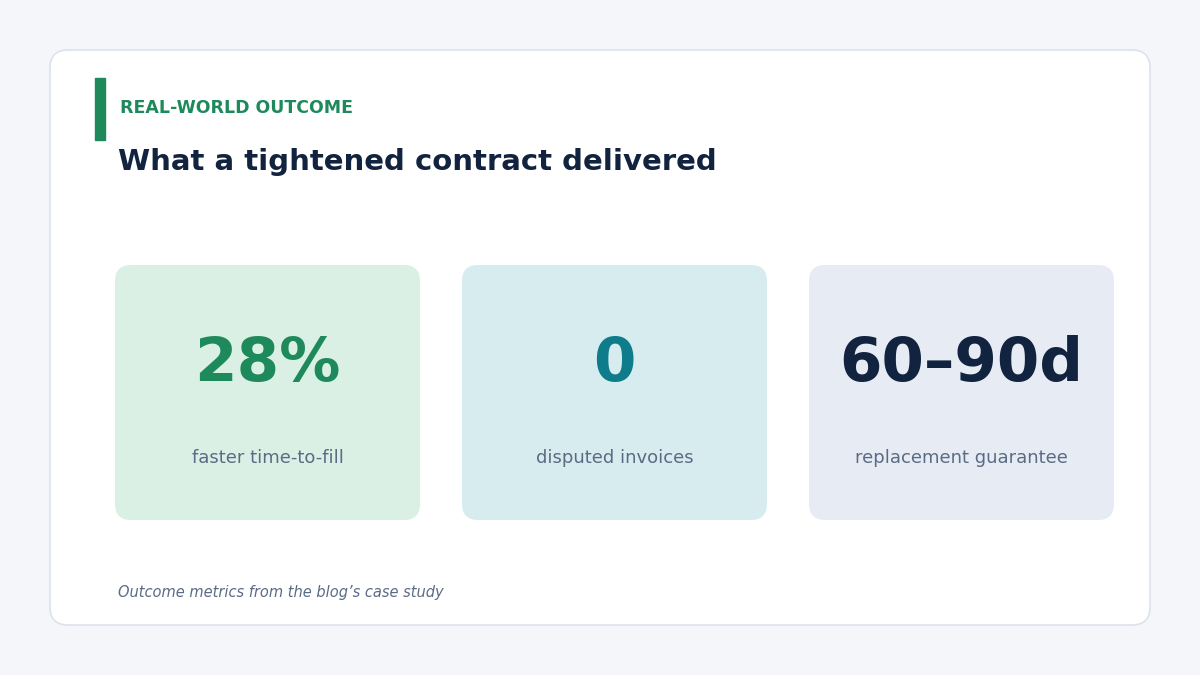
In a contrasting engagement supported by Supersourcing, a fintech scaling of its engineering team fixed three items before signing a hard time-to-fill KPI with service credits, a 90-day replacement guarantee covering voluntary departures, and explicit data-ownership language. The result over the first year was a 28% reduction in time-to-fill and zero disputed invoices, because every expectation had a defined remedy attached. The difference was not the provider; it was a disciplined RPO contract negotiation that attached a remedy to every promise.
An RPO Service Level Agreement Checklist for Decision-Makers
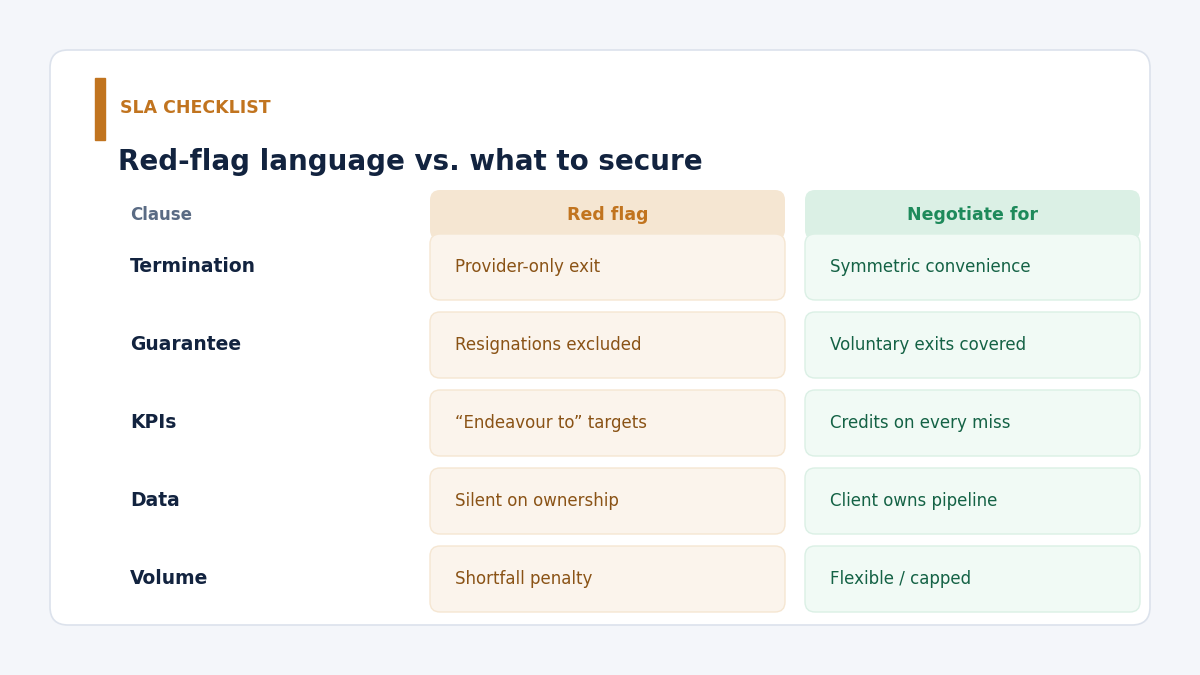
A short comparison is often clearer than prose. The RPO service level agreement checklist below contrasts the language that signals risk with what a defensible RPO contract negotiation should secure.
| Clause | Red-flag language | Negotiate for |
| Termination | Provider may exit; client “for cause” only | Symmetric termination for convenience, 30–90 day notice |
| Guarantee | “Replacement at our discretion,” resignations excluded | 60–90 day guarantee, free re-search, voluntary exits included |
| KPIs | “Endeavour to meet target time-to-fill” | Named KPIs with service credits on miss |
| Data | Silent on ownership and deletion | Client owns pipeline data; return and deletion on exit |
| Volume | Minimum spend with shortfall penalty | Flexible volumes, capped or removed penalties |
Treat any row where the current draft sits in the middle column as an open item, not a detail to clean up later.
What Most Teams Get Wrong About the RPO Exit Clause
Here is the pattern seen across engagement after engagement: dedicated teams over-negotiate the price and under-negotiate the RPO exit clause. They win a 5% rate reduction and lose the ability to leave without penalty, a trade that looks smart on the signing-day spreadsheet and painful eighteen months later.
The deeper error is treating the exit terms as a sign of distrust rather than basic operational hygiene. A capable recruitment outsourcing provider expects a mature client to ask who owns the data, how in-flight candidates transfer, and what a clean handover looks like. Vendors that resist those questions during RPO contract negotiation are telling you something.
The best time to design your exit is before you have any reason to use it. Negotiating transition assistance and data ownership while the provider is still competing for your business gives you leverage you will never have again once you are dependent on their pipeline. Skip that conversation and you are not buying a partnership, you are buying a lock-in.
Before You Sign
If you are evaluating a recruitment partnership and want to pressure-test the agreement before committing to a term, the highest-return move in any RPO contract negotiation is to walk the SLA clause by clause against the checklist above termination, guarantees, KPIs, data ownership, and volume terms while you still hold negotiating leverage.
Supersourcing has run this contract review across a range of engagements and can help you separate standard language from the clauses that quietly shift risk onto the buyer. To pressure-test your draft before signing, reach out at supersourcing.com/contact-us or email mayank@engineerbabu.com.
Frequently Asked Questions
What should be included in an RPO SLA?
At minimum, named KPIs such as time-to-fill and offer-acceptance rate, each tied to a defined target and a service credit if missed. It should also specify the guarantee period, the candidate replacement policy, data-ownership and deletion terms, escalation paths, and reporting cadence. During RPO contract negotiation, anything described only as a “target” or “aim” carries no remedy and should be reworded as a firm commitment.
How long is a typical RPO contract term?
Most sit between 12 and 36 months, with 24 months common for enterprise engagements. Longer terms usually buy a lower rate, but they also raise the cost of a bad fit. If you are new to a provider, a shorter initial term with a renewal option, plus a symmetric termination for convenience clause, gives you room to verify performance before committing for years.
Can you exit an RPO contract early?
Only if the contract lets you. Many drafts allow termination for cause alone, which forces you to prove a material breach. A stronger position is a mutual convenience clause with a 30 to 90 day notice period. This is one of the highest-value items in any RPO contract negotiation, because it converts a locked commitment into a manageable one.
What happens to candidate data when an RPO contract ends?
That depends entirely on what the agreement says, which is why silence on the point is a red flag. Specify that the client owns the candidate database and active pipeline, that the provider returns all data in a usable format, and that they delete their copies in line with data protection and GDPR compliance obligations. Add a transition-assistance clause covering in-flight candidates.
What is a reasonable RPO replacement guarantee?
A defensible replacement guarantee period explained in plain terms runs 60 to 90 days and offers a free replacement search rather than a partial credit. The critical detail is the exclusions: a guarantee that excludes voluntary resignations protects little, since most early departures are voluntary. Insist that the trigger covers the departures you actually worry about.
How are RPO service credits calculated?
Service credits are the financial consequence when a KPI is missed, usually a percentage of the monthly fee scaled to the size of the shortfall. Well-drafted terms define the metric, the measurement window, and the exact credit formula, with no ambiguity about who reports the data. If a provider resists attaching credits to metrics during RPO contract negotiation, treat that as a signal about how the relationship will run.
