

A 300-seat capability centre signing a nine-year built-to-suit lease and a 30-person team taking a coworking membership are frequently making the same mistake: locking in an occupancy model before modelling how their headcount will actually behave over the next 24 months. The real estate decision gets framed as a cost question. It is really a flexibility question wearing a cost disguise.
That distinction carries more weight in 2026 than it did even two years ago, because the sheer volume of capital now moving through Indian commercial real estate has made the penalty for choosing wrong considerably larger.
This guide breaks down the GCC office space options India offers across those four variables, so the model you commit to still fits the year after you sign it.
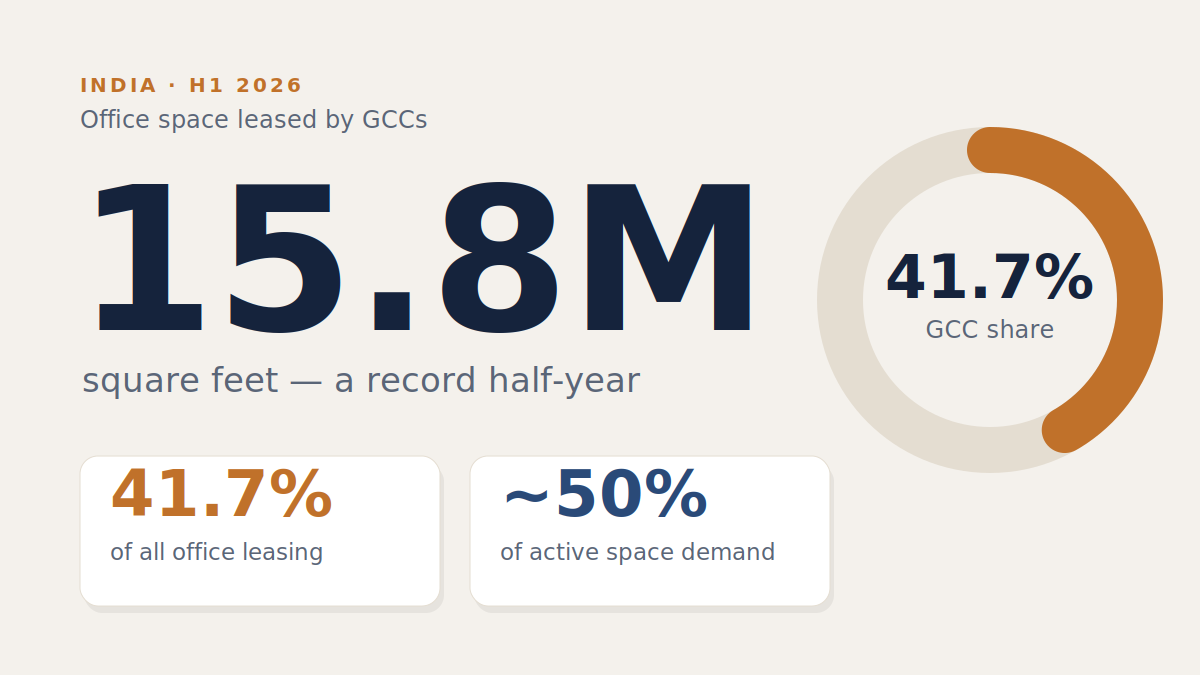
Global Capability Centres leased a record 15.8 million square feet in the first half of 2026 alone a 41.7% share of all office leasing in India and now account for roughly half of all active space requirements in the country, on track to surpass their 2025 full-year record.
For the facilities and operations leads who own this line item, the choice narrows to three structures: managed office, built-to-suit, and coworking, each optimised for a different mix of speed, control, capital exposure, and team size. Picking well is less about which model is objectively “best” and more about matching the structure to where the centre genuinely sits on its growth curve.
What Are GCC Office Space Options in India?
GCC office space options India are the range of commercial real estate models a Global Capability Centre uses to occupy space in the country chiefly managed offices, built-to-suit facilities, and coworking or flex space. They differ across four decision variables: setup speed, lock-in period, capital outlay, and how easily the footprint scales with headcount.
The Real Problem: The Model Breaks 18 Months After You Sign
Across GCC real estate India decisions, the failure point is rarely the day-one term sheet. Teams evaluating the GCC office space options India offers tend to solve for month one and forget month fifteen the point when the centre has either outgrown a fixed footprint or is paying for empty desks it committed to during an optimistic planning cycle.
Most teams underestimate two things by a wide margin. The first is the total cost. A conventional lease looks cheaper per square foot, but the real number includes a security deposit of six to twelve months’ rent, upfront fit-out capital, and the overhead of managing seven to ten separate vendor contracts across construction, IT, facilities, and security.
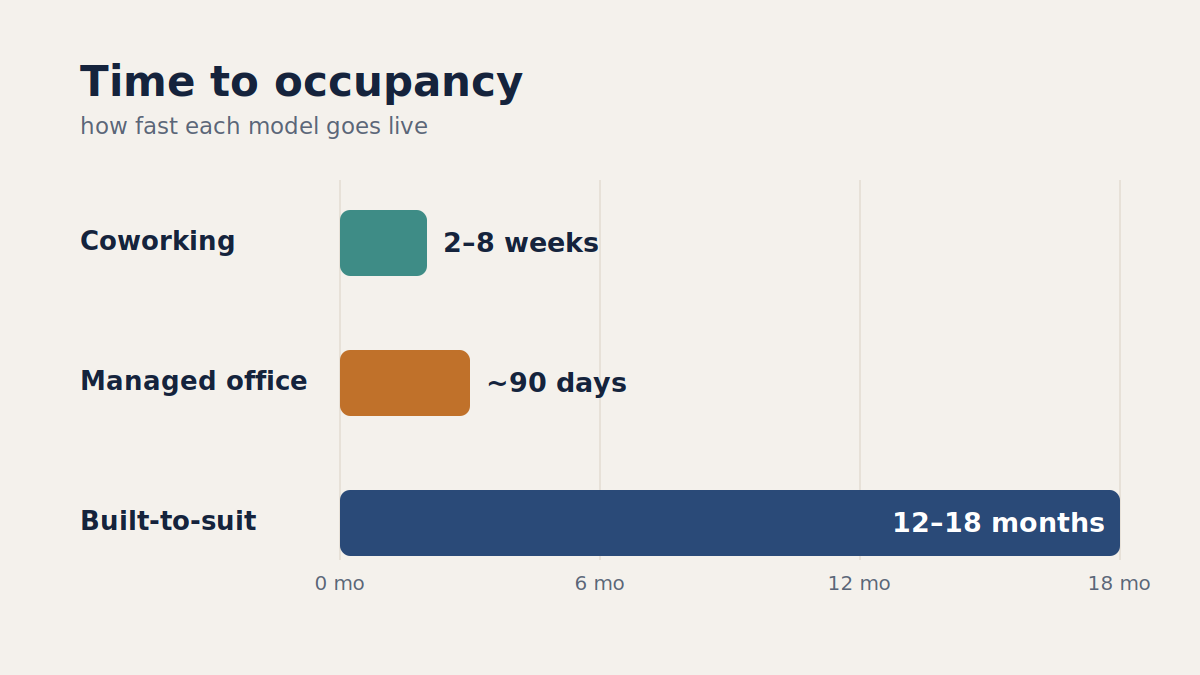
The second is the timeline. A bare-shell or built-to-suit build typically runs 12 to 18 months from site selection to occupancy, a schedule that collides directly with a parent company expecting the India team to be productive within a quarter.
Then there is headcount volatility. New centres routinely revise their 24-month recruitment plan within the first year of operation. When the footprint is locked and the plan moves, the mismatch shows up as either capital stranded in unused space or a scramble for overflow desks at premium rates.
Comparing GCC Office Space Options India Across Four Variables
The three models are not competitors so much as different answers to the same question: how much certainty do you have about your headcount, your compliance perimeter, and your India commitment? The evaluation below maps each structure to the conditions where it is genuinely the right call.
Coworking GCC Setup: Speed and Optionality at Small Scale
A coworking GCC setup puts a team into a shared, operator-run building on a membership basis, usually within two to eight weeks. There is no fit-out capital, no meaningful deposit, and minimal lock-in which makes it the rational choice for a pilot team, a market-entry beachhead, or a function still proving its India thesis.
The constraint is structural, not cosmetic. In a shared building, the security perimeter includes every other occupant on the floor: shared networks, shared server rooms, shared physical access. For any centre handling regulated data under ISO 27001, SOC 2, or GDPR, that shared perimeter is not a specification trade-off; it is a compliance non-starter, because auditors assess controls at the edge of your environment, and in coworking that edge is not yours to define.
Coworking works best under roughly 30 seats, where the priority is optionality and the data being handled is non-sensitive. Of the GCC office space options India provides, it is the lowest-commitment entry point and the easiest to outgrow.
Managed Workspace GCC: The Scaling Default
A managed workspace GCC is a private, dedicated team or building built to one occupier’s specification and operated end-to-end by a single provider under one monthly fee. It compresses the setup timeline to roughly 90 days, reduces the deposit to one to two months, eliminates fit-out capital, and collapses seven-to-ten vendor relationships into one point of accountability.
Crucially, it delivers a dedicated network perimeter and documented access controls from day one which is why it has become the structural default for regulated GCCs that cannot wait 18 months but also cannot operate in shared space. Lease terms typically run one to three years rather than the five-to-nine of a conventional deal, so the footprint can flex as the mandate firms up.
This is the model that fits most centres in the 30-to-500 seat range, especially those entering India for the first time or scaling without a dedicated internal real estate function. For that profile, it is usually the strongest of the GCC office space options India offers. Within managed workspace, a plug-and-play configuration goes live in two to eight weeks, while a custom fit-out with server rooms and brand-specific security typically takes 60 to 90 days.
Built to Suit GCC Office: Control and Long-Run Economics
A built to suit GCC office is a warm-shell or bare space designed and constructed to the occupier’s exact requirements layout, labs, demo centres, security architecture usually on a five-to-nine-year lease. It carries the highest upfront capital and the longest timeline, but it also delivers the most control and, at scale, the best per-seat economics.
The counterintuitive part: with volume and long tenure, built-to-suit can produce a lower per-seat cost than a managed arrangement, because the centre negotiates leverage on both the base rent and the fit-out amortisation. Per-seat costs generally improve above 100 seats and drop meaningfully once a team crosses 200, where negotiating position strengthens materially.
This is the right structure for a stable, predictable operation, typically 300-plus seats on a five-to-seven-year horizon where the India commitment is confirmed and physical control of the environment is a board-level preference. Among the GCC office space options India offers, it rewards certainty more than any other model.
A Five-Step Way to Shortlist Your Model
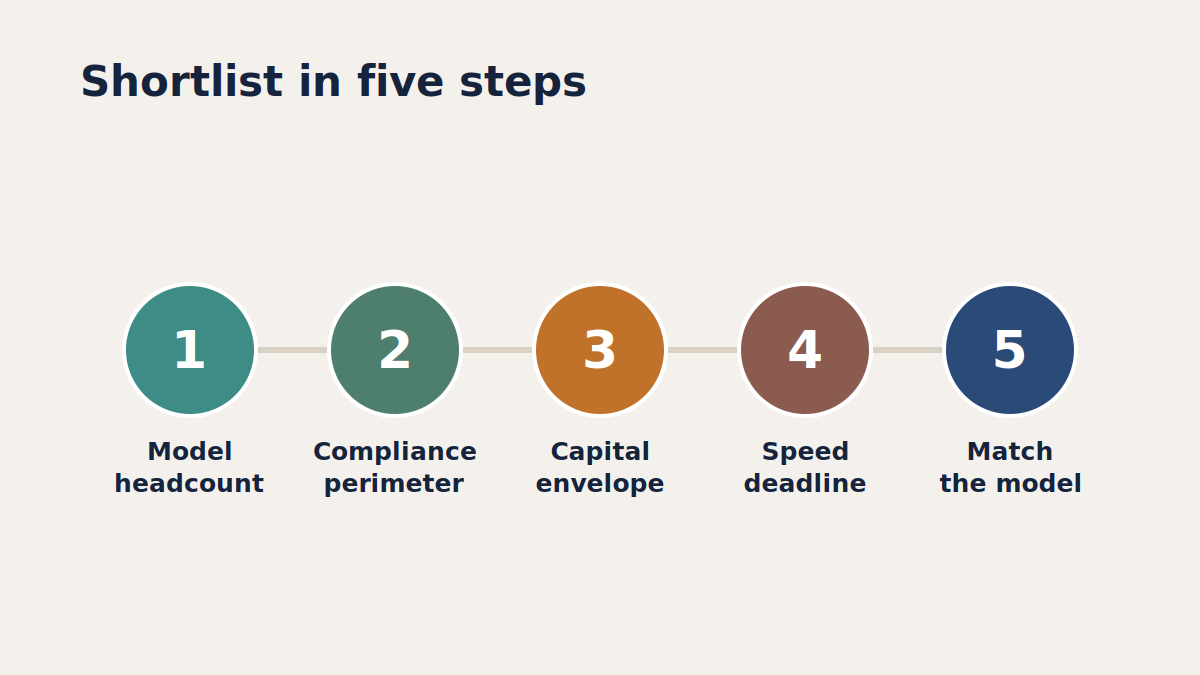
Before comparing providers or submarkets, work through the GCC office space options India offers in this order:
- Model headcount 24 months out across best-case, expected, and worst-case scenarios. If the spread is wide, favour flexibility over ownership.
- Fix your compliance perimeter. If you handle regulated data, a shared perimeter is disqualifying rule out coworking immediately.
- Set your capital envelope. Decide whether capital must flow to talent and technology, or whether the board will absorb a six-to-twelve-month deposit plus fit-out.
- Define your speed-to-occupancy deadline. A 90-day mandate and an 18-month build are mutually exclusive.
- Match the profile to the model coworking for small, unconfirmed, non-regulated teams; managed for scaling and compliance-bound centres; built-to-suit for large, stable, control-driven operations.
Case Studies: How the Model Choice Plays Out
The GCC office space options India offers look similar on paper; the difference shows in execution. A global professional- IT services firm entered India through a managed office, starting with a 400-seat pilot in the Delhi-NCR region and scaling to roughly 8,000 seats across three cities.
Each successive location was delivered in 50 to 90 days and consistently below the capital the firm had budgeted for a self-managed build-out, the compression in timeline and capital being the entire point.
A European automotive engineering centre took a similar path, scaling from 100 to 700 seats in Pune in about 120 days on managed infrastructure. In both cases the deciding factor was not rent per square foot; it was the ability to move at the speed the parent company demanded while keeping the environment private and compliant.
Decision Framework: Which Model Fits Which Profile
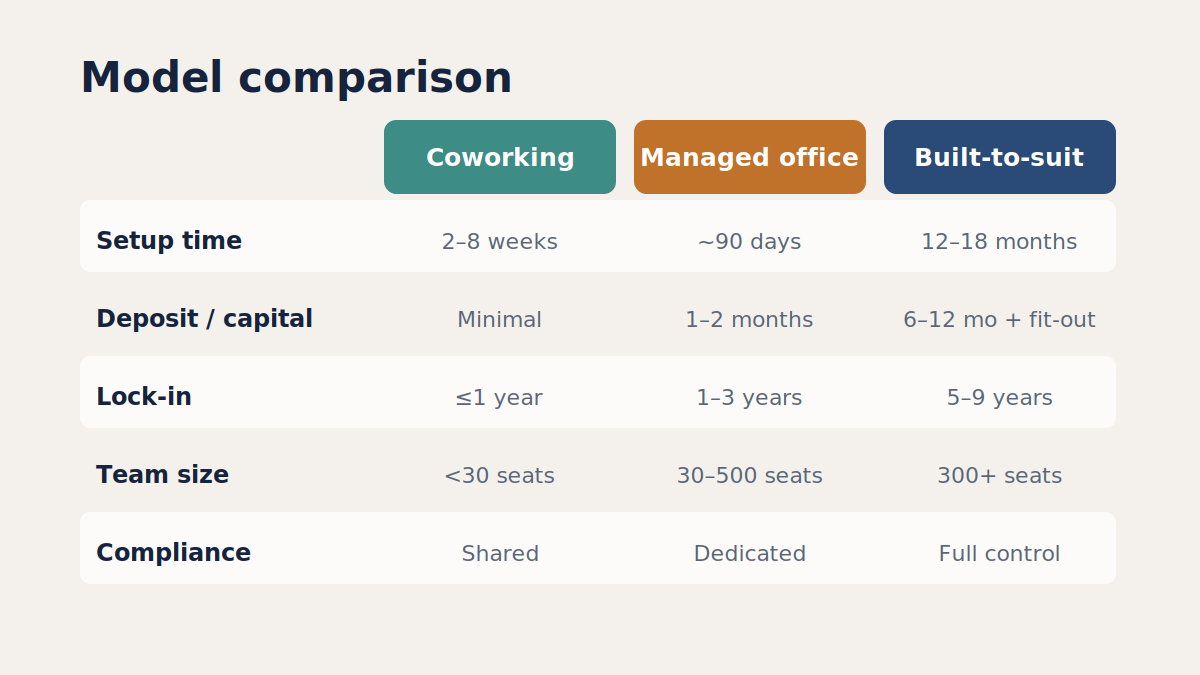
Among the GCC office space options India presents, the table below is the fastest way to sanity-check a shortlist against the four variables that actually move the decision.
| Variable | Coworking | Managed office | Built-to-suit |
| Setup time | 2–8 weeks | ~90 days | 12–18 months |
| Deposit / capital | Minimal | 1–2 months, no fit-out capital | 6–12 months + fit-out |
| Lock-in / term | Monthly to 1 year | 1–3 years | 5–9 years |
| Best team size | Under ~30 seats | ~30–500 seats | 300+ seats |
| Compliance perimeter | Shared (non-starter for regulated data) | Dedicated | Fully controlled |
What Most Teams Get Wrong
The most expensive error is treating coworking as a cost-saving decision when it is actually a compliance decision. A team picks flex space to protect the budget, then discovers during the first security audit that a shared perimeter cannot pass and the “cheap” option becomes an unplanned mid-year migration that costs far more than choosing correctly on day one.
The second error runs the other way: assuming built-to-suit is always the premium, most expensive option. At 300-plus seats over a long tenure, the per-seat fare frequently inverts, and the built-to-suit route ends up cheaper than a managed alternative. Teams that skip that calculation over-pay for flexibility they no longer need.
The third is the quiet trap of extending a coworking membership past its useful life adding 20 seats at a time until a team that should have moved to a managed workspace GCC eight months ago is paying membership rates on 120 desks.
This is the pattern most facilities leads recognise only in hindsight, and where an external partner such as Supersourcing is most often brought in to reset the model before the next renewal locks it in again. It is also the clearest argument for evaluating all the GCC office space options India offers up front rather than defaulting to whichever one was fastest to sign.
Before You Commit
If you are weighing the GCC office space options India offers and want to pressure-test the model against your real 24-month headcount and compliance picture before a lease locks it in, it helps to run the numbers with someone who has watched this decision play out across many centres. Supersourcing has supported companies through exactly this evaluation mapping team size, capital, and speed constraints to the right structure before a vendor conversation starts.
Send the specifics to mayank@engineerbabu.com or start at supersourcing.com/contact-us, and get a second read on the model before you sign, not after.
Frequently Asked Questions
What is the best office space model for a GCC in India?
There is no single best model; the right choice among the GCC office space options India offers depends on headcount certainty, compliance requirements, capital flexibility, and speed. As a rule, coworking suits small unconfirmed teams, managed offices suit scaling and regulated centres between roughly 30 and 500 seats, and built-to-suit suits large, stable operations above 300 seats on a multi-year horizon.
How much does it cost to set up a GCC office in India?
Cost across the GCC office space options India offers is driven less by rent than by structure. A conventional or built-to-suit route front-loads a six-to-twelve-month deposit plus fit-out capital, while a managed office reduces the deposit to one to two months and eliminates fit-out capital entirely. Per-seat cost also improves with scale, dropping meaningfully once a team crosses 100 to 200 seats.
How long does it take to set up a GCC office?
Setup speed is where the GCC office space options India offers diverge most sharply. Coworking or a plug-and-play managed suite can be operational in two to eight weeks. A custom managed fit-out runs about 60 to 90 days. A full built-to-suit build typically takes 12 to 18 months from site selection to occupancy, the single biggest reason speed-constrained centres avoid it.
Is coworking suitable for a GCC?
For a small, non-regulated pilot team, yes. For any centre handling regulated or client data under ISO 27001, SOC 2, or GDPR, on the shared network and physical perimeter of a coworking floor cannot satisfy the access-control requirements auditors assess at the edge of your environment.
What is a built-to-suit office?
A built to suit GCC office is a shell space designed and constructed to the occupier’s exact specification layout, labs, security architecture, and branding usually on a five-to-nine-year lease. It offers maximum control and, at volume, the best per-seat economics, at the cost of the highest upfront capital and the longest timeline.
When should a GCC move from coworking to a managed office?
The trigger is usually a combination of crossing roughly 30 to 50 seats, the arrival of a compliance requirement, or a confirmed India mandate. If you are adding desks in a shared space every quarter and handling anything sensitive, you have almost certainly already passed the point where a managed model is cheaper and safer and it is worth re-running the full GCC office space options India comparison before you renew.
