

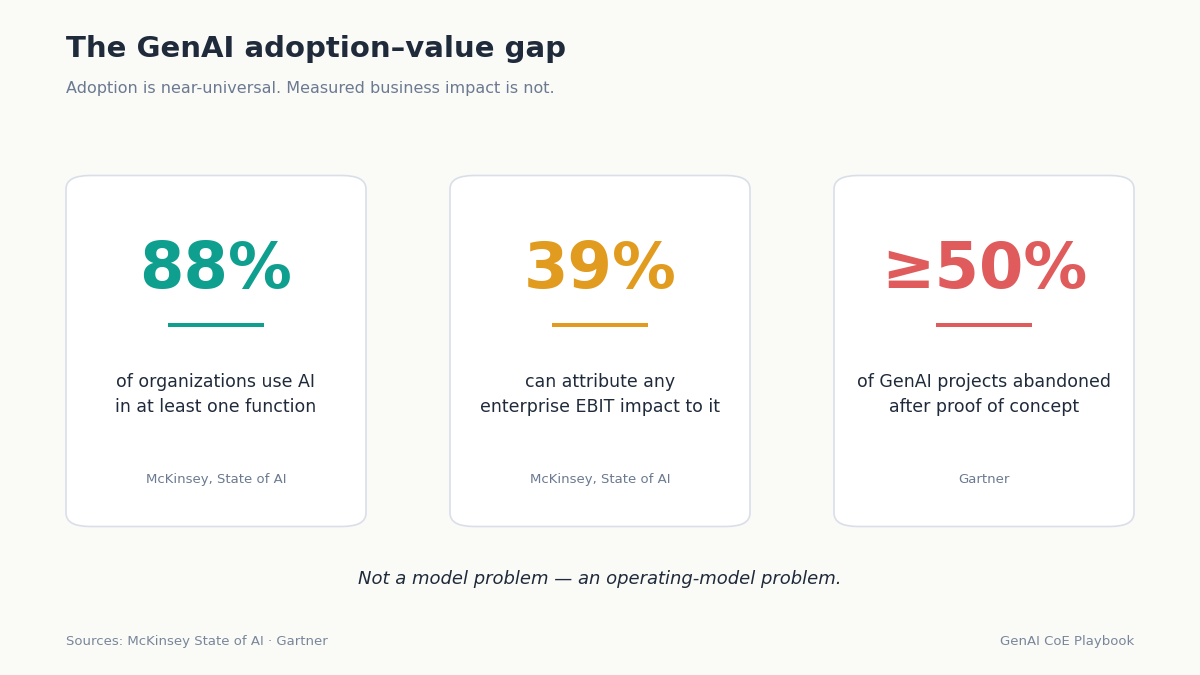
Enterprises are running GenAI pilots at record volume and killing them at record volume too. Gartner found that at least 50% of generative AI projects are abandoned after proof of concept not because the models fail, but because of poor data quality, weak risk controls, runaway costs, and unclear business value. McKinsey’s State of AI research shows the same gap from the other side: 88% of organizations now use AI in at least one function, yet only 39% can attribute any enterprise EBIT impact to it.
That gap near-universal adoption, rare measurable value is not a model problem. It is an operating-model problem, and the emerging answer is a GenAI Center of Excellence inside the GCC. Global Capability Centers are where the gap is closing fastest, because they already own the three ingredients a scaled GenAI program needs: engineering talent density, enterprise data access, and 24×5 delivery discipline.
India’s GCC ecosystem generated $64.6 billion in FY2024 and is projected to reach $99–105 billion in revenue with 2.5–2.8 million professionals by 2030, per the NASSCOM–Zinnov India GCC Landscape Report. More than half of these centers now run transformation mandates, not just cost mandates and GenAI capability is the fastest-growing of those mandates.
The problem is that most GCC leaders are being asked to “stand up a GenAI capability” with no charter, no funding mechanics, no role blueprint, and no governance model, just a board-level expectation and a deadline. This guide is the missing playbook: everything from writing the charter to hiring the first twelve people to deciding, eighteen months later, whether the CoE should even continue to exist in its current form.
TL;DR
This guide is a start-to-finish playbook for building a genoa center of excellence gcc leaders can actually fund, staff, and defend to the board. It is written for GCC site heads, CTOs, and transformation leaders who have been handed a GenAI mandate and need to turn it into a working team.
The single most important number in it: a functional first CoE pod is 8–12 people, costs roughly ₹3.5 -- 8 crore ($420k–$960k) per year in fully loaded talent cost, and should ship its first production use case within 120–180 days. Teams that miss those bands usually miss them by 2–3x in both directions overstaffed and underdelivering.
By the end, you will be able to write a one-page CoE charter, choose between centralized, hub-and-spoke, and federated operating models, budget a realistic gcc genoa team, and set the governance gates that keep your projects out of Gartner's abandonment statistics.
What Is a GenAI Center of Excellence in the GCC?
A GenAI Center of Excellence (CoE) is a dedicated team inside a Global Capability Center that owns the enterprise’s generative AI strategy execution selecting use cases, building shared platforms and guardrails, delivering production applications, and setting the governance standards every other team must follow when using large language models.
What it is not:
- Not an innovation lab. Labs demo; a CoE ships to production and is accountable for business KPIs.
- Not a data science team with a new name. Classic ML teams optimize predictive models; a GenAI CoE also owns LLMOps, prompt/evaluation infrastructure, inference cost management, and responsible-AI governance.
- Not a permanent org structure by default. A well-run CoE plans its own evolution typically federating into business units once maturity spreads (covered in Phase 6).
Why a GenAI CoE Belongs Inside Your GCC
The case for placing the generative AI capability center in the GCC rather than at headquarters is not sentimental, it is arithmetic and structural. The concrete outcomes this decision affects:
- Talent cost and depth. A senior GenAI engineer in India typically lands at ₹30–60 lakh/year ($36k–72k) fully loaded, versus $180k–280k+ base for equivalent talent in the US or Western Europe a 3–4x cost differential at comparable seniority, in the world’s deepest AI-skilled labor pool.
- Speed of team formation. In metro Indian hubs, a vetted GenAI pod can be interview-ready in 7–10 working days through specialized talent partners, versus 8–16 week search cycles common in US/EU markets.
- Follow-the-sun delivery. A GCC-based CoE gives HQ product teams overnight iteration: evaluation runs, fine-tuning jobs, and red-teaming cycles complete while home-market teams sleep.
- Data and platform adjacency. Most enterprise GCCs already run the data engineering, cloud platform, and security operations the CoE depends on. Co-locating removes the cross-org friction that kills PoCs elsewhere.
- Risk containment. Centralizing GenAI work inside one governed entity makes model risk management, audit trails, and regulatory response (EU AI Act, India’s DPDP Act) enforceable versus chasing shadow-AI usage across 40 business units.
The strategic kicker: GCCs that build a credible air code india capability change their own charter. Centers that ship enterprise GenAI platforms move from “delivery arm” to “transformation hub” in the parent org’s eyes which changes budget conversations, leadership hiring, and the center’s long-term survivability.
Why Most GenAI Programs in GCCs Stall
Before the playbook, the failure math. Across GenAI hiring and team-build engagements we have supported, the same four patterns account for most stalled programs:
- The pilot graveyard. Enterprises routinely run 15–30 concurrent GenAI pilots with no intake gate. Typical conversion to production: 10–20%. The cost is not just the wasted builds, it is 12–18 months of organizational credibility burned before the “real” program starts.
- The hiring mismatch. Most teams underestimate the difference between a classic ML profile and a GenAI/LLM profile. Job descriptions ask for “10 years of AI experience” for a discipline that is barely 3–4 years old in production form, while missing the skills that actually matter: retrieval architecture, evaluation design, inference cost engineering. Result: 4–6 month searches for candidates who don’t exist, while buildable candidates get screened out.
- The governance vacuum. Legal and security teams asked to approve GenAI systems with no framework to approve them will default to “no.” Programs without a pre-agreed responsible-AI policy and model-approval workflow typically lose 8–12 weeks per use case to ad-hoc reviews.
- The inference-cost surprise. PoCs run on free-tier tokens; production runs on millions of requests. Teams that never modeled token economics see run-rate costs come in 3–5x over estimate, and the CFO conversation that follows often freezes the roadmap for a quarter.
Every phase in the walkthrough below exists to close one of these four gaps.
The Walkthrough: Standing Up a GenAI CoE From Scratch
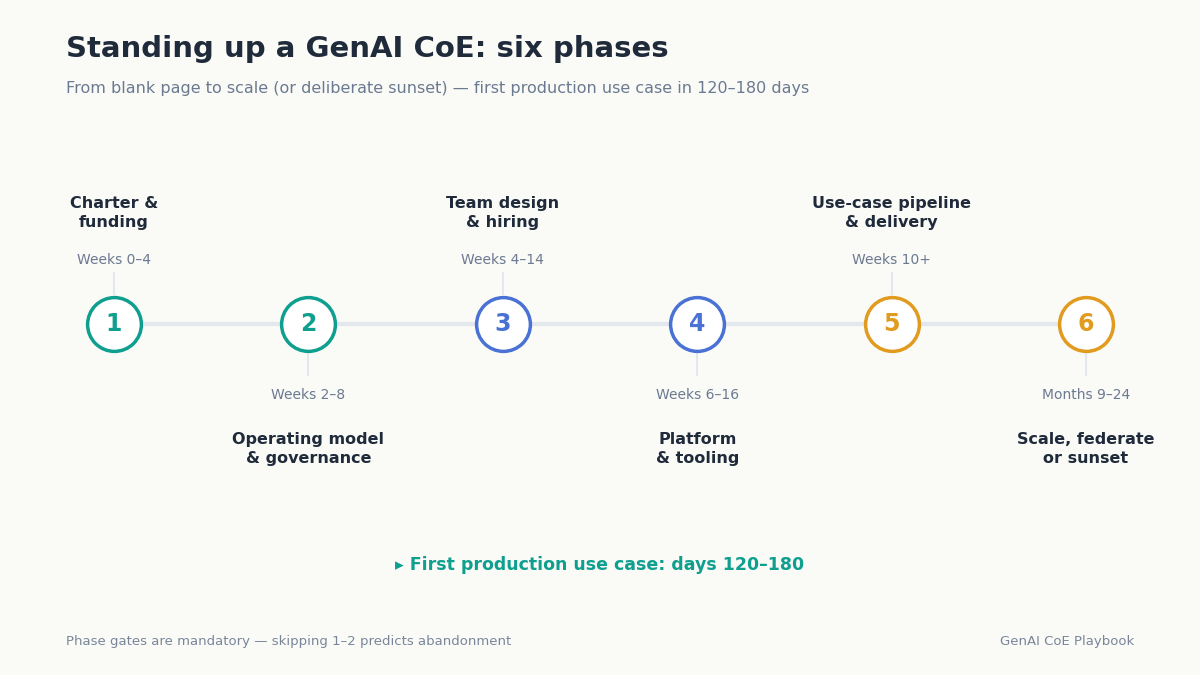
This is the full lifecycle of six phases, from a blank page to a scaled (or deliberately dissolved) capability. Treat each phase gate as mandatory: skipping Phase 1 or Phase 2 to “start building faster” is the single most reliable predictor of joining the abandonment statistics.
Phase 1 Charter, Mandate & Funding Model (Weeks 0–4)
The charter is a one-to-three page document, signed by an executive sponsor, that answers five questions before a single hire is made. Programs that skip it spend months relitigating scope in steering meetings.
The charter must define:
- Mission and scope. Which business domains the CoE serves first (pick 2–3, not “the enterprise”), and which GenAI work it explicitly does not own (e.g., vendor-embedded copilots managed by IT procurement).
- Mandate strength. Advisory (teams may use the CoE), gated (teams must pass CoE review to ship LLM features), or exclusive (only the CoE ships GenAI). Most successful programs start gated and loosen over time; advisory-only CoEs get ignored.
- Funding model. Three workable options:
- Corporate-funded (recommended for year one): HQ transformation budget pays for the team and platform; use cases are free to business units. Fastest adoption, weakest cost discipline.
- Chargeback: business units pay per use case or per token consumed. Strong discipline, but slows early adoption introduced in year two.
- Hybrid: platform and governance corporate-funded; delivery pods charged back. The most common steady-state model.
- Success metrics, with numbers. Examples that survive board scrutiny: “3 production use cases in 6 months,” “PoC-to-production conversion above 40%,” “measured cycle-time or cost reduction in each deployed workflow,” “100% of production models registered and evaluated.” Avoid vanity metrics (number of pilots, number of prompts written).
- Decision rights. Who approves use cases, who can kill them, who owns the model-risk sign-off. Name roles, not committees.
Budget bands to socialize at this stage: a first-year CoE (one platform pod + one delivery pod, 8–12 people) typically runs ₹3.5–8 crore ($420k–960k) in fully loaded talent cost, plus ₹60 lakh–2.5 crore ($72k–300k) in cloud, model API, and tooling spend depending on workload. Anchor these numbers now; retrofitting them after hiring starts is far harder.
Red flag: if you cannot get a named executive sponsor to sign the charter in four weeks, you do not have a CoE mandate, you have a science project. Pause hiring until you do.
Phase 2 Operating Model & Governance (Weeks 2–8, overlaps Phase 1)
Choose your operating model deliberately. The three viable structures:
- Centralized: all GenAI talent sits in the CoE; business units submit requests. Best for year one maximizes scarce talent, enforces standards. Risk: becomes a bottleneck by month 12–18.
- Hub-and-spoke: a central hub owns platform, governance, and standards; “spoke” engineers embed in business units but report (solid or dotted line) to the hub. The most durable model for GCCs serving multiple functions.
- Federated: business units own their GenAI teams; the CoE is a thin standards body. Appropriate only at high maturity, federating too early recreates the shadow-AI chaos the CoE was built to end.
Stand up governance as a product, not a police force. The minimum viable governance stack:
- A responsible-AI policy (5–10 pages max) covering approved model providers, prohibited use cases, human-in-the-loop requirements, and data classes that may never enter a prompt.
- A model registry every model, version, and system prompt in production, with an owner and an approval date.
- An evaluation gate no use case ships without a documented evaluation harness: task accuracy, hallucination rate on a golden dataset, red-team results for injection and data-leakage attacks.
- A risk-tiering matrix is a two-axis grid (data sensitivity × decision autonomy) that routes low-risk use cases through a 5-day fast lane and high-risk ones to a full review. Without tiering, everything gets the heavy process and velocity dies.
- An AI governance board CoE head, security, legal/compliance, data protection officer, and one rotating business-unit leader. Meets fortnightly, decisions logged.
Compliance anchors for India-based centers: map data flows against India’s DPDP Act, the EU AI Act’s risk categories (if you serve EU markets), and sector rules (RBI guidance for fintech workloads, HIPAA/ABDM considerations for health data). Do this mapping in Phase 2, not when legal blocks your first launch.
Phase 3 Team Design & Hiring (Weeks 4–14)
This is where most timelines die, so be precise. A first CoE is two pods, not an org chart of 40.
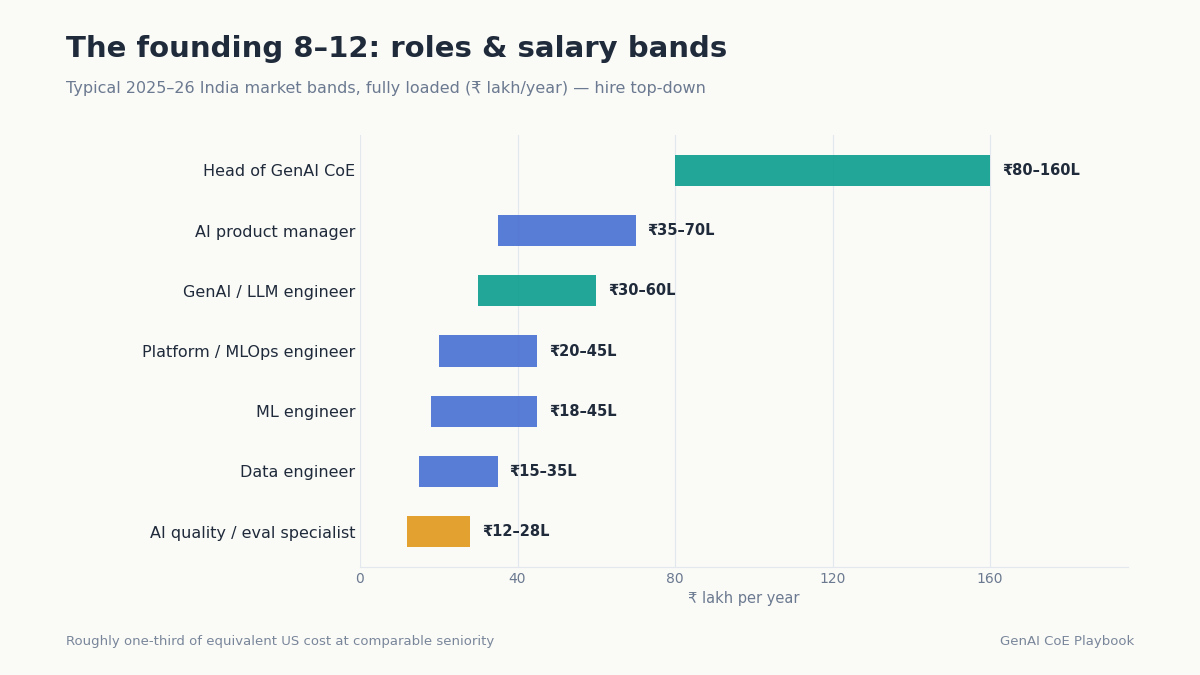
The founding 8–12, in hiring order:
- Head of GenAI CoE (1) part architect, part diplomat. Owns the charter, the board, and the roadmap. Typical band: ₹80 lakh–1.6 crore ($96k–190k). Hire first; everything else calibrates to this person.
- GenAI/LLM engineers (2–4) RAG pipelines, agentic workflows, fine-tuning, prompt/eval systems. ₹30–60 lakh ($36k–72k). The scarcest profile on this list.
- ML engineers (1–2) classical ML plus model serving and optimization. ₹18–45 lakh ($22k–54k).
- Platform/MLOps engineer (1–2) LLMOps tooling, CI/CD for models, observability, cost telemetry. ₹20–45 lakh ($24k–54k).
- Data engineer (1–2) the unglamorous role that determines whether retrieval actually works. ₹15–35 lakh ($18k–42k).
- AI product manager (1) use-case intake, prioritization, benefit measurement. ₹35–70 lakh ($42k–84k).
- AI quality/evaluation specialist (1, can start fractional) golden datasets, evaluation harnesses, red-teaming. ₹12–28 lakh ($14k–34k).
Defer until scale (months 9+): dedicated AI security engineer, prompt-ops specialists, additional delivery pods, design/UX for AI interfaces.
What good screening looks like for GenAI roles:
- Test for systems, not trivia. A strong candidate can design a retrieval pipeline for messy enterprise documents and explain its failure modes; a weak one recites transformer architecture.
- Demand evaluation literacy. Ask how they would prove a summarization feature is safe to ship. If the answer lacks a golden dataset and measurable criteria, pass.
- Probe cost instinct. “Your inference bill tripled last month. Walk me through your diagnosis.” Production-experienced candidates answer in caching, routing, model-size tiering, and batching; pilot-only candidates go quiet.
- Red flags: portfolios that are 100% demos with zero production traffic; “prompt engineer” titles with no engineering foundation; candidates who cannot name a project that failed and why.
Sourcing reality: the vetted-GenAI-talent pool moves fast, strong candidates hold 3–4 concurrent offers and decide in days. Compressed, decision-ready processes win; six-round panels lose. This is where specialized sourcing pays for itself:
AI-driven vetting that surfaces the top 2% of candidates can put an interview-ready shortlist in front of you in 7–10 working days, versus the 8–12 weeks in-house teams typically spend per senior AI role. If you are building this muscle from zero, it is usually faster to hire Generative AI engineers and hire machine learning engineers through a partner for the first pod while your internal recruiting engine spins up.
Build the blend deliberately: a pragmatic first-year mix is 50–60% permanent hires (institutional knowledge), 25–35% contract specialists (scarce skills like fine-tuning or evaluation), and 10–15% internal transfers from the GCC’s existing data teams (domain context). All-permanent teams form too slowly; all-contract teams retain nothing.
Onboarding & ramp-up: the first two weeks decide the first two quarters. GenAI hires are expensive; every idle week of a ₹40-lakh engineer waiting on access requests costs roughly ₹75,000 in dead payroll and multiplied across a pod, sloppy onboarding quietly burns a month of budget. Run it as a checklist, prepared before day one:
- Day 0 (before joining): cloud accounts, repo access, model-gateway keys, and data-classification training assigned; NDA and IP-assignment paperwork executed non-negotiable when contract talent will touch proprietary data and prompts.
- Days 1–3: environment fully working (a “hello-RAG” pipeline runs end to end), responsible-AI policy read and acknowledged, buddy assigned from the platform pod.
- Days 4–10: first shippable ticket on a live workstream an evaluation-suite addition or retrieval improvement, not a slide deck. Production contact in week one is the strongest retention signal for this profile.
- Day 14: ramp review with the CoE head access friction logged and fixed for the next joiner, so onboarding cost drops with every hire.
Communication cadence to set on day one: daily async standup in the delivery pod, a weekly 30-minute demo open to business-unit stakeholders (demos recruit your next use cases), and a fortnightly governance-board slot.
Dedicated account management matters on the contract side too, pods staffed with shared-bandwidth contractors, split across multiple clients, ramp 2–3x slower than dedicated ones and should be screened out at contracting, not discovered at sprint three.
Phase 4 Platform & Tooling (Weeks 6–16, parallel to hiring)
The CoE’s first engineering deliverable is not a chatbot, it is a paved road: a shared platform that makes every subsequent use case 5–10x cheaper to build safely.
Minimum viable GenAI platform:
- Model gateway one governed API endpoint fronting all approved model providers (commercial APIs plus any self-hosted open-weight models), with logging, PII redaction, and rate limits built in.
- Retrieval infrastructure vector database, chunking/embedding pipelines, and connectors to the 3–5 enterprise systems your first use cases need.
- Evaluation harness automated test suites, golden datasets per use case, regression runs on every prompt or model change.
- Observability and cost telemetry per-use-case token consumption, latency, and quality dashboards from day one. This is what prevents the Phase-0 “inference-cost surprise.”
- A sandbox environment is a governed space where business-unit teams can experiment without touching production data, which converts shadow AI into a pipeline.
Build-vs-buy rule of thumb: buy commodity layers (vector stores, observability, gateway tooling), build only what encodes your proprietary advantage (domain evaluation datasets, retrieval logic over your own data, workflow integrations).
Teams that build everything ship their platform in month 10; teams that buy the commodity layers ship in month 3. If your GCC lacks platform-engineering depth, this phase is a legitimate place to bring in IT consulting services for a fixed 8–12 week platform build rather than diverting your scarce GenAI engineers into infrastructure work.
Phase 5 Use-Case Pipeline & Delivery (Weeks 10 onward)
Run intake like a portfolio, not a suggestion box. The mechanics:
- Structured intake form problem, affected workflow, volume (transactions/month), data sources, current cost or cycle time. No form, no evaluation.
- Two-axis prioritization business value (cost/revenue/risk impact, quantified) versus feasibility (data readiness, integration complexity, risk tier). Score, rank, publish the ranking. Transparency kills lobbying.
- Portfolio balance for every moonshot, fund 3–4 “boring” high-volume workflow automations (document processing, support drafting, code assistance, report generation). The boring ones pay for the program.
- Stage gates with kill authority Discovery (1–2 weeks) → PoC (3–6 weeks, defined success threshold) → Pilot with real users (4–8 weeks) → Production. Pre-commit the kill criteria at each gate. A CoE that never kills a project is not prioritizing; it is queuing.
Delivery cadence and KPIs to report monthly:
- PoC-to-production conversion rate (target: 40%+ once intake matures)
- Cycle time from intake approval to production (target trend: shrinking toward 90–120 days)
- Per-use-case business metric (hours saved, cost per document, resolution time) measured against a pre-launch baseline, or it will be disputed later
- Platform adoption: % of enterprise GenAI traffic flowing through the governed gateway (this is your shadow-AI gauge)
- Unit economics: inference cost per transaction, trending down via caching and model routing
The first-90-days-of-delivery rule: ship one visibly useful, low-risk internal use case fast (weeks 12–20 of the overall program). Political capital compounds; a CoE with one live win negotiates its second year from strength.
Phase 6 Scaling, Federating, or Sunsetting (Months 9–24)
A CoE that cannot articulate its own end-state becomes a permanent bottleneck. Plan the evolution explicitly:
- Scale trigger: demand pipeline consistently exceeds capacity by 2x and conversion stays above 40% → add delivery pods (each new pod: 4–6 people, ₹1.5 — 3 crore/$180k–360k per year) and begin the hub-and-spoke transition.
- Federation trigger: 2–3 business units each have 5+ production use cases and trained champions → move delivery into those units, shrink the CoE to platform + governance + advanced R&D (often 40–50% of peak headcount).
- Sunset trigger: GenAI development becomes a standard competency of every product team, fully served by the platform → the “CoE” dissolves into a platform team and a standards council. This is success, not failure.
- Offboarding hygiene for contract talent: knowledge-transfer sessions and documentation as a contractual deliverable, access revocation within 24 hours of exit, and IP assignment verified before final invoices are clear. Replacement mechanics matter too with the right staffing partner, a mis-fit hire on a contract pod should be swappable within 7–10 days, not renegotiated over a quarter.
Case Studies: What This Looks Like in Practice
Three patterns from Supersourcing’s delivery history, chosen because each maps to a specific CoE-building problem: speed at scale, screening rigor, and talent-mix flexibility.
100+ engineers in a compressed window for a fintech scale-up. When Paytm needed to scale its engineering organization rapidly, the constraint was not candidate volume, it was vetted-quality at speed. An AI-driven sourcing pipeline delivering pre-vetted shortlists compressed a hiring motion that normally spans quarters into a program-managed sprint, sustaining a 98% joining rate across offers. The same mechanics apply directly to a gcc genai team build, where the founding pod’s quality determines the program’s ceiling.
Recruitment automation for a healthtech platform. Somnoware’s engineering hiring shifted from manual screening to an automated, criteria-driven vetting workflow cutting screening effort dramatically while raising shortlist precision. For CoE leaders, the transferable lesson is the evaluation-gate mindset: define pass/fail criteria before you look at candidates (or use cases), and throughput plus quality both rise.
Engineering ramp for a high-growth lending product. OkCredit’s engineering hiring through structured, pre-vetted pipelines demonstrated the contract-to-conversion pattern that suits GenAI CoEs: start scarce specialists on contract terms with sub-1% drop-off, convert proven performers to permanent roles at month 9–12, and avoid betting permanent headcount on a discipline whose skill requirements shift every two quarters.
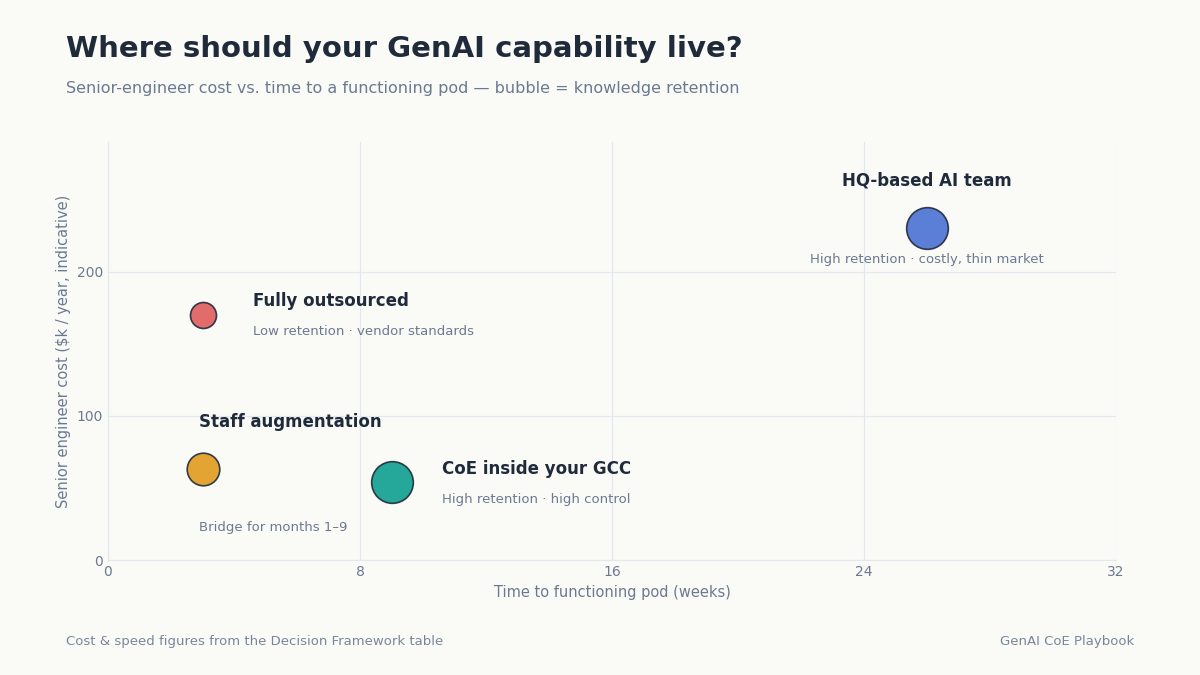
Decision Framework: Where Should Your GenAI Capability Live?
Four viable paths, compared to the dimensions that actually drive the decision. Use this before Phase 1 the charter reads very differently depending on the row you choose.
| Dimension | CoE inside your GCC | HQ-based AI team | Fully outsourced to a vendor | Staff augmentation into existing teams |
| Fully loaded senior-engineer cost/yr | ₹30–60L ($36k–72k) | $180k–280k+ | Blended $50–120/hr | ₹35–70L ($42k–84k) equivalent |
| Time to functioning pod | 6–12 weeks (with a sourcing partner) | 4–8 months | 2–4 weeks | 2–4 weeks |
| IP & knowledge retention | High stays in-house | High | Low–medium, contract-dependent | Medium leaves with contractors unless managed |
| Governance control | High one governed entity | High but far from delivery scale | Low vendor’s standards | Fragmented across teams |
| Scaling elasticity | High deep talent market | Low thin, expensive market | High but costly at volume | High |
| Best when | Multi-year mandate, existing GCC, 3+ business domains | Regulatory bar forbids offshore data work | One-off use case, no lasting ambition | Bridging gaps while CoE forms |
How to read it: if you already operate a GCC and the GenAI mandate spans more than one business unit and more than one year, the GCC-based CoE dominates on cost, elasticity, and control. If you have no GCC yet, the calculus often flips the sequencing several enterprises now use the GenAI mandate itself as the anchor use case to justify GCC setup services, standing up the center and the CoE in one motion. Staff augmentation is not a competing end-state; it is the bridge most teams use for months 1–9.
What Most Teams Get Wrong
Pattern-level observations from GenAI team builds we have run and rescued the opinionated list:
They hire the head of AI last instead of first. Teams assemble engineers, run six months of drift, then hire a leader who inherits an unaligned roadmap. Reverse it: the leader’s first job is to not start ten things.
They confuse a GenAI CoE with their old analytics CoE. The analytics CoE playbook (dashboards, model handoffs, quarterly releases) fails here. GenAI systems are software products with probabilistic components; they need product managers, evaluation pipelines, and weekly release discipline, not report calendars.
They treat governance as a launch-blocker instead of a launch-enabler. The fastest programs we have seen are the most governed because a pre-approved risk-tiering fast lane clears low-risk use cases in days, while ungoverned programs renegotiate every launch with legal from scratch.
They measure activity, not arithmetic. “22 pilots launched” is a warning sign, not a KPI. The only numbers that defend next year’s budget: production use cases live, measured hours or cost removed per workflow, and inference cost per transaction trending down.
They staff for training models when the job is deploying them. Under 10% of enterprise CoE workloads involve training or heavy fine-tuning; 90% is retrieval, integration, evaluation, and workflow redesign. Hiring PhD-heavy research profiles for an integration-heavy mission burns budget and frustrates everyone; the sharpest single correction is rebalancing toward strong engineers who can hire-grade LLM systems into production rather than research them.
They let the CoE become immortal. A CoE with no federation or sunset criteria optimizes for its own perpetuation. Write the dissolution triggers into the charter on day one.
Cost & Timeline Reality Check
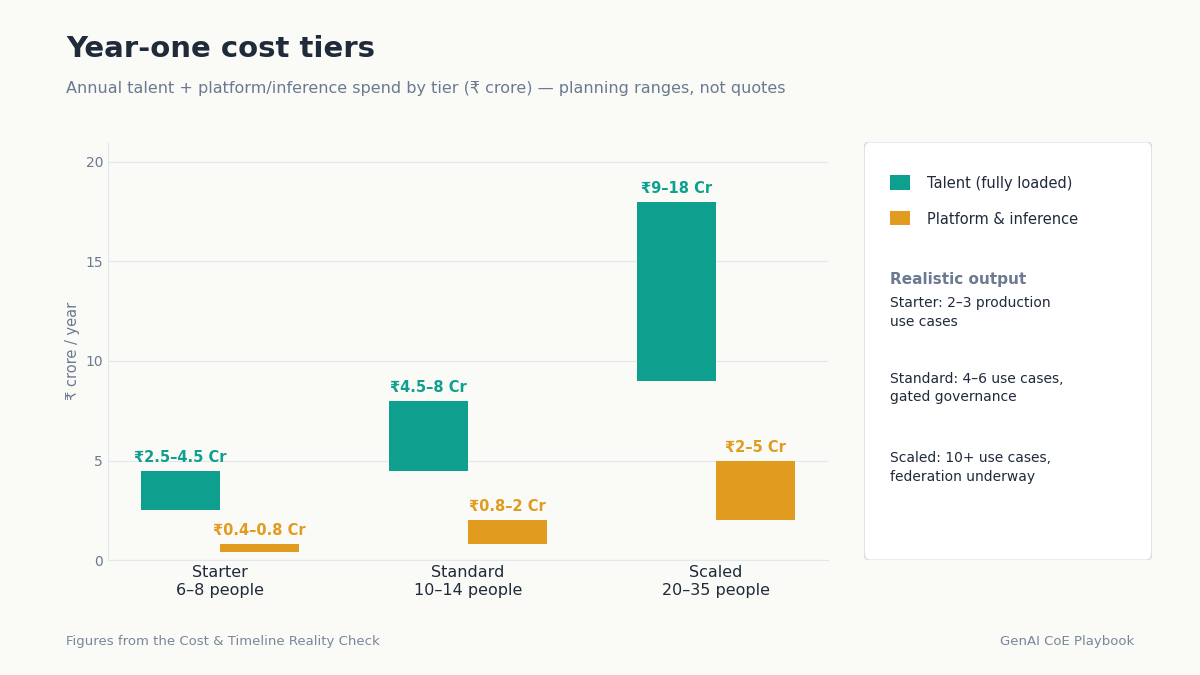
The section with the most content on this topic skips. All figures are typical 2025–26 market bands for India-based builds; treat them as planning ranges, not quotes.
Year-one cost tiers:
| Tier | Team | Talent cost/yr | Platform & inference/yr | Realistic output |
| Starter | 6–8 people, single pod | ₹2.5–4.5 Cr ($300k–540k) | ₹40–80L ($48k–96k) | Platform v1 + 2–3 production use cases |
| Standard | 10–14 people, platform + delivery pods | ₹4.5–8 Cr ($540k–960k) | ₹80L–2 Cr ($96k–240k) | Platform + 4–6 production use cases, gated governance |
| Scaled | 20–35 people, hub + spokes | ₹9–18 Cr ($1.1M–2.2M) | ₹2–5 Cr ($240k–600k) | 10+ use cases, chargeback model, federation underway |
What drives cost up: self-hosting open-weight models before you have volume to justify it (GPU commitments of ₹1.5–4 Cr/yr), regulated-data use cases (add 20–30% for security and compliance engineering), all-permanent hiring in a bidding-war market, and unmanaged inference (no caching/routing can multiply token spend 3–5x).
What drives cost down: commercial model APIs behind a gateway until volume proves out, a 60/30/10 permanent/contract/internal-transfer talent mix, buying commodity platform layers, and aggressive model-routing (small models for simple tasks routinely cut inference bills 40–60%).
The four hidden line items nobody budgets:
- Evaluation datasets. Building golden datasets with domain-expert labeling typically consumes 100–300 hours of business-SME time per serious use case. It never appears in the CoE budget because the hours belong to another department and it becomes the schedule bottleneck by month four. Negotiate SME time into each use-case approval.
- Change management. A working GenAI workflow that users route around delivers zero ROI. Plan 10–15% of each use case’s budget for training, workflow redesign, and adoption tracking, or the “hours saved” number in your board deck will not survive an audit.
- Attrition premium. GenAI-skilled engineers in India see aggressive counter-offer pressure; annual attrition of 20–30% is common at market-median pay. Budget either above-median compensation or a standing backfill pipeline a replacement guarantee measured in 7–10 days versus a 90-day open seat is worth 2–3% of annual pod cost on its own.
- Governance tooling and audits. Model-registry tooling, red-team exercises, and (for regulated sectors) external audits add ₹15–40 lakh ($18k–48k) per year at Standard tier. Cheap relative to one compliance incident; invisible in most first drafts of the budget.
A realistic master timeline:
- Weeks 0–4: charter signed, sponsor named, operating model chosen, budget socialized.
- Weeks 4–10: CoE head hired; governance stack v1 (policy, risk tiers, registry) drafted in parallel.
- Weeks 6–14: founding pod hired 7–10 working days per role to shortlist with a specialized partner; 3–4 weeks per role including panels and notice-period negotiation.
- Weeks 8–16: minimum viable platform live; sandbox opened to business units.
- Weeks 12–20: first production use case shipped (the political-capital milestone).
- Months 6–9: 3–5 use cases live; conversion and unit-economics reporting begins; year-two funding case built on measured numbers.
- Months 12–18: scale or federate decision per the Phase 6 triggers.
The honest benchmark: charter-to-first-production-use-case in 120–180 days is strong execution. Anyone promising 30 days is describing a demo; anyone budgeting 12 months is describing a committee.
Your Next Step
If you are mid-decision mandate in hand, charter unwritten, first hires undefined, the highest-leverage move is not another internal workshop. It is pressure-testing your role plan, cost bands, and timeline against teams that have already been built.
Supersourcing has spent a decade doing exactly that: standing up GCC teams and AI pods for companies like Swiggy, Razorpay, Yellow.ai, and Apollo Hospitals, with a 98% joining rate and shortlists in 7–10 working days. Bring your draft charter or just the mandate email to a working session and leave with a validated team plan, salary bands for your city, and a realistic 180-day launch calendar.
Book a GenAI CoE planning consultation →
FAQ
What is the difference between an AI CoE and a GenAI CoE?
A traditional AI/ML CoE centers on predictive modeling forecasting, classification, and recommendation with data scientists as the core role. A GenAI CoE adds LLM-specific disciplines: retrieval architecture, prompt and evaluation engineering, LLMOps, inference cost management, and content-risk governance. Many enterprises run them as one center with two practices, but budgeting and hiring for GenAI as if it were classic ML is a common and expensive category error.
How many people do you need to start a GenAI CoE?
Eight to twelve: a CoE head, 2–4 GenAI/LLM engineers, 1–2 ML engineers, 1–2 platform/MLOps engineers, 1–2 data engineers, an AI product manager, and a fractional evaluation specialist. Smaller than six and you cannot run platform and delivery in parallel; larger than fifteen before your first production launch usually signals scope sprawl rather than ambition.
How much does it cost to build a GenAI team in India?
Plan ₹2.5–8 crore ($300k–960k) per year in fully loaded talent cost for a starter-to-standard CoE, plus ₹40 lakh–2 crore ($48k–240k) for cloud, model APIs, and tooling. Senior GenAI engineers band at ₹30–60 lakh; the CoE head at ₹80 lakh–1.6 crore. These bands run roughly a third of equivalent US costs at comparable seniority.
Should the GenAI CoE report to the GCC head or to headquarters?
The durable pattern is dual-keyed: administratively housed in the GCC (talent, delivery discipline, cost base) with a solid functional line to a global CTO/CDO sponsor (mandate, budget, air cover). CoEs reporting only locally struggle for enterprise legitimacy; CoEs reporting only to HQ lose the GCC’s talent and platform adjacency that justified the location.
How long does it take to set up a GenAI CoE?
With decisive sponsorship: charter in a month, founding pod hired by weeks 6–14, minimum platform by week 16, first production use case by days 120–180. Talent acquisition is the pacing item, which is why teams that compress sourcing to a 7–10 day shortlist cycle consistently beat teams running traditional multi-quarter searches.
How do you measure the ROI of a GenAI CoE?
Three layers: use-case ROI (hours saved, cost per transaction, revenue influenced against pre-launch baselines), portfolio ROI (PoC-to-production conversion, cycle time, cost per delivered use case), and strategic ROI (share of GenAI traffic on the governed platform, audit readiness, incidents avoided). Report all three monthly; boards fund programs whose arithmetic they can check.
When should a GenAI CoE be dissolved or federated?
When business units each run 5+ production use cases with trained champions, and platform adoption is high enough that standards hold without central delivery. At that point the CoE contracts into a platform team plus a governance council. Building those triggers into the original charter is the difference between planned evolution and a turf war.
Can we run a GenAI CoE without an existing GCC?
Yes and increasingly, enterprises invert the sequence, using the GenAI mandate as the founding use case for a new capability center. The CoE playbook above still applies; you simply run it inside a broader center-setup program covering entity, compliance, workspace, and leadership hiring. If you are weighing that path, a scoping conversation with a partner that has run both motions will compress months of internal debate.
