

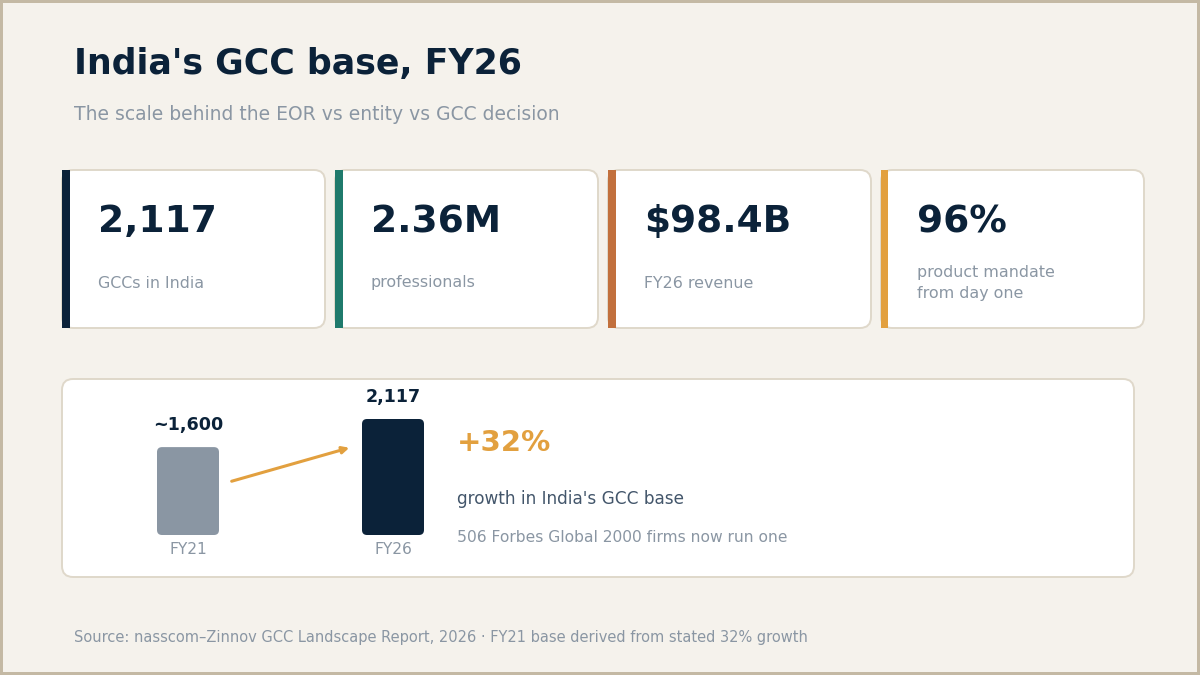
India crossed 2,117 Global Capability Centers in FY26. That number matters less than a second one buried in the same report: 96% of GCCs established after FY21 launched with a product or portfolio mandate from day one, not a support desk that graduated into one. The crawl-walk-run model is dead, and it has quietly rewritten how the EOR vs entity vs GCC decision should be made.
India now hosts 2,117 GCCs across 3,728 units, employing roughly 2.36 million professionals and generating $98.4 billion in revenue as of FY26 32% growth since FY2021, with 506 Forbes Global 2000 companies operating a centre in the country.
Meanwhile, at the other end of the market, a seed-stage company can have a compliant engineer working in Bengaluru in nine days without incorporating anything. Both facts are true at once, and that is exactly why the EOR vs entity vs GCC question gets answered badly. Teams pattern-match to whichever story they heard most recently.
Here is the framing error underneath almost every bad decision in this space. The choice is presented as a three-item menu pick one. It is not. It is two questions asked in sequence, and answering them out of order is what produces the expensive mistakes: entities incorporated for four engineers, EOR arrangements carrying forty people and a broken IP chain, GCC programmes greenlit before anyone defined what the centre would own.
This guide answers both questions in the right order, with the numbers attached. What an EOR actually costs at 5, 15 and 40 heads. What an Indian entity costs to run, not to open. Where the breakeven genuinely sits. What changes when a subsidiary becomes a capability centre. And the contract clauses that decide, years later, whether your offshore team’s code is legally yours.
TL;DR
The EOR vs entity vs GCC choice comes down to three legal and operational ways to employ people offshore: an employer of record, your own registered entity, and a full global capability center. It is written for founders, CTOs, COOs and heads of engineering who have already decided to hire outside their home market and now need to pick a structure without over-engineering it or under-building it.
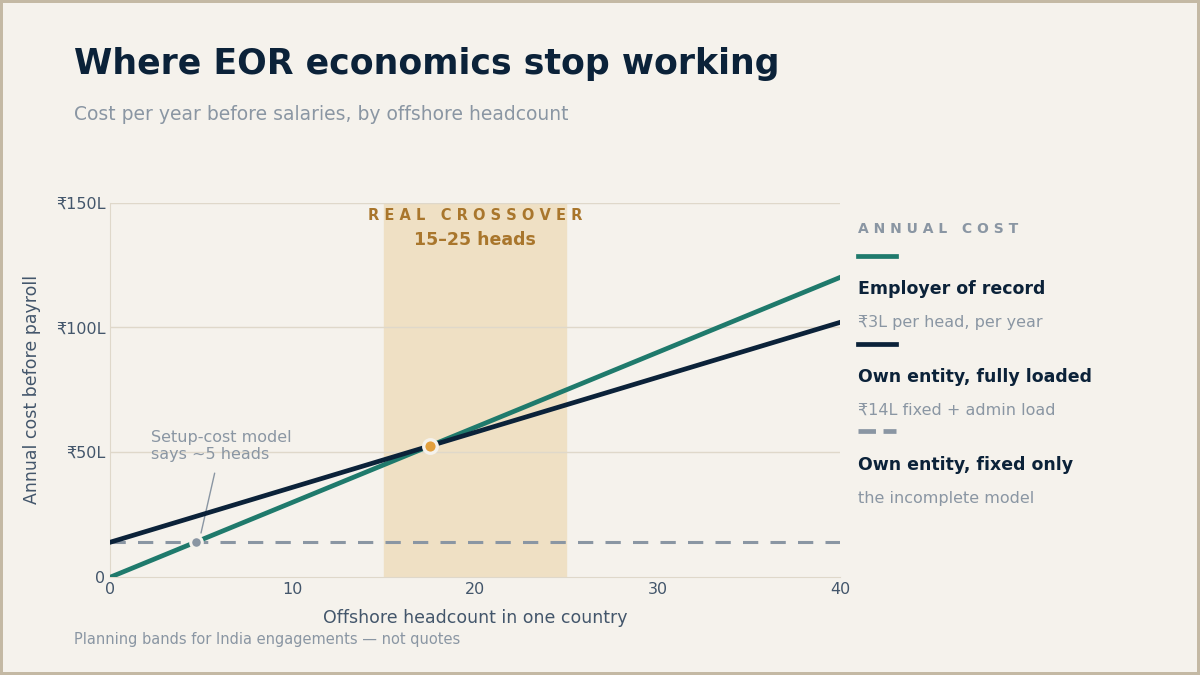
The single number worth carrying away: in most engagements we run, the crossover from employer of record vs entity economics lands somewhere between 15 and 25 offshore employees in one country not the 3–5 heads that setup-cost calculators suggest, because those calculators ignore the ₹8–20 lakh a year an Indian entity costs to keep compliant before you pay a single salary. Below that band, an EOR is usually cheaper and always faster. Above it, you are paying a tax on convenience.
By the end you will be able to place your own situation on that curve, model the fully-loaded cost of each option in your currency, run a six-phase setup process from mandate definition to first payroll, and recognise the five failure patterns that cost teams the most money.
EOR vs Entity vs GCC: What Each Global Employment Model Actually Is
The EOR vs entity vs GCC decision is the choice of how a company legally employs and operationally organises offshore staff: through an employer of record that hires on its behalf, through its own registered local subsidiary, or through a global capability center an owned entity built as a strategic capability hub with its own leadership and mandate.
Three clarifications that prevent most of the confusion around global employment models:
- A GCC is not a third type of legal structure. It is an operating model that sits on top of a legal entity. Every GCC has a subsidiary underneath it. The difference between “we have an India entity” and “we have a GCC” is mandate, leadership and ownership of outcomes not paperwork. If you want the fuller treatment, we’ve written separately on what a global capability center actually is.
- An EOR is not a staffing agency or an outsourcing vendor. The EOR employs a person you selected and you manage day to day. A staffing firm sources and supplies people; an outsourcing vendor owns the work product and delivers against a statement of work. Different risk, different economics, different contract.
- A GCC is not a shared services center. SSCs standardise transactional processes at lowest cost; GCCs own product, engineering and decision rights. The distinction drives location choice, salary bands and seniority mix; we break it down in a shared services center vs GCC.
The clean way to hold it: EOR and entity answer “who is the legal employer?” GCC answers “what is this team for?” You must answer the first before the second is even meaningful.
Why This Decision Costs More Than Teams Expect
The employment model is not an HR formality. It sets four things that are expensive to reverse:
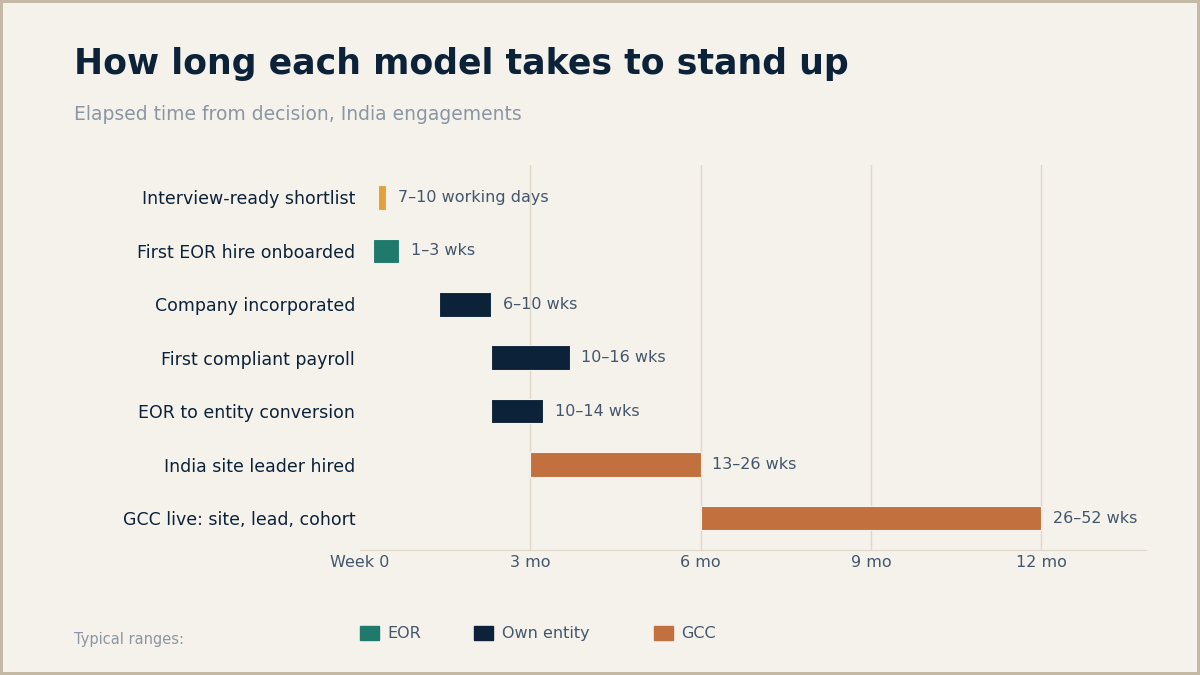
- Speed to first productive hire. EOR: typically 1–3 weeks from signed offer to compliant start date. Own entity in India: realistically 10–16 weeks from decision to first legally compliant payroll run, of which incorporation is only the first 6–10 weeks.
- Fully-loaded cost per head. EOR fees commonly run $199–$599 per employee per month on platform-led models, or 10–20% of gross payroll on full-service ones. An entity replaces that variable fee with a fixed compliance run-rate of roughly ₹8–20 lakh ($10,000–$24,000) per year flat, whether you employ four people or forty.
- Control over talent brand and retention. Under an EOR, the offer letter carries the EOR’s name, not yours. In competitive markets this measurably affects who accepts, and it complicates equity grants, internal mobility and long-tenure career narratives.
- Legal and tax exposure. Misclassification, permanent establishment risk and a broken IP assignment chain are the three exposures that surface late usually during a funding round, an acquisition or a tax assessment, when they are most expensive to fix.
There is a fifth, less obvious cost: optionality. Choosing a model is easy. Unwinding one is not. An EOR-to-entity conversion of 30 people is a re-hiring exercise with notice periods, tenure resets, benefit-continuity negotiations and a real risk of losing people mid-transfer.
The Core Problem: Teams Model Setup Cost and Ignore Run-Rate
The single most common analytical error we see is a spreadsheet that compares an EOR’s monthly fee against the one-time cost of incorporating a company. That comparison makes an entity look like a bargain at five heads. It is wrong by a wide margin.
The 3-4x rule: in most first-time offshore builds we’ve been brought into, the team’s estimate of ongoing entity cost is short by three to four times, because they budgeted incorporation and forgot operations.
What gets left out of the model, consistently:
- Statutory audit required regardless of revenue or size. Typically ₹1–3 lakh per year.
- Company secretarial and ROC compliance annual filings, board meetings, statutory registers, minutes. ₹1–2.5 lakh per year.
- Payroll and accounting operations monthly payroll processing, TDS, PF/ESIC challans, bookkeeping. ₹1.5–4 lakh per year.
- Transfer pricing documentation and Form 3CEB mandatory the moment your parent pays your Indian entity for services. ₹1.5–4 lakh per year.
- Registered office, insurance, banking, and a resident director India requires at least one director who has stayed in the country 182 days or more in the financial year. If you have nobody, you are recruiting or appointing one, and that is a cost and a governance decision.
- Someone’s time. The most underpriced line. A lean India entity consumes 10–20% of a finance lead’s month, indefinitely.
Add them up and the fixed floor is ₹8–20 lakh a year before payroll. Against an EOR fee of roughly ₹2.5 — 4 lakh per head per year, the maths only flips somewhere in the mid-teens of headcount not at four people.
Red flag: if your model shows an entity paying for itself at fewer than eight heads, you have almost certainly omitted the transfer pricing study, the statutory audit, or both.
The Walkthrough: How to Employ Offshore Talent, Phase by Phase
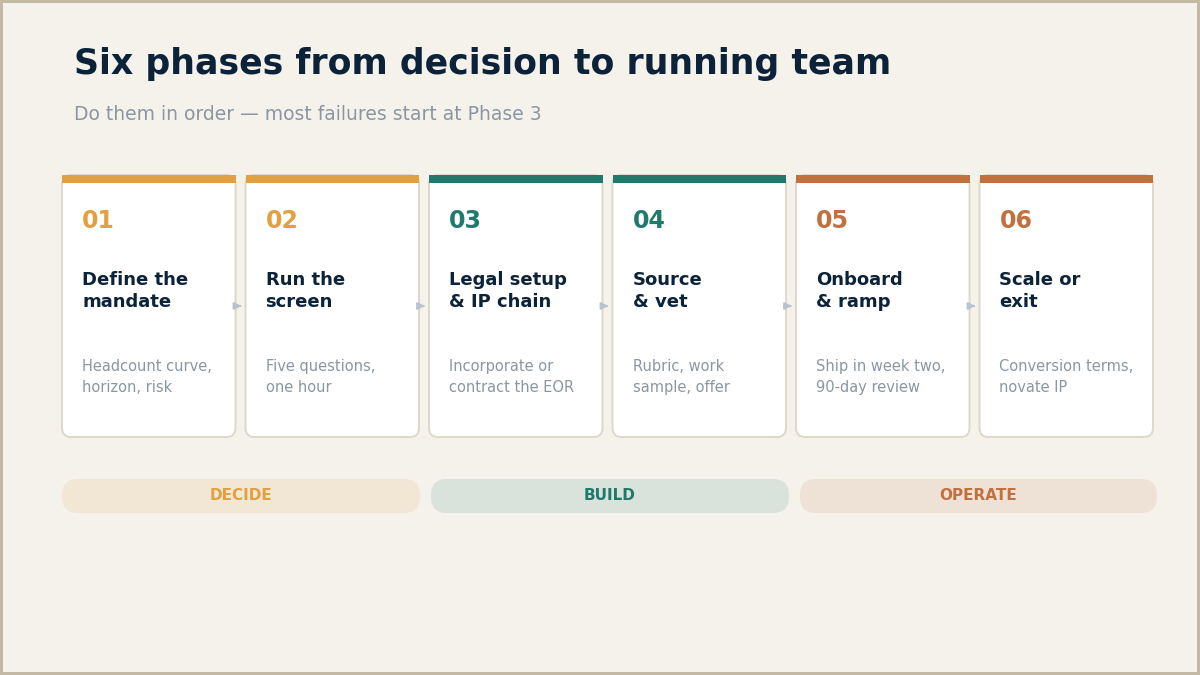
This is the full sequence, from the moment someone says “we should hire in India” to a functioning team you can scale or shut down cleanly. Six phases. Do them in order; the most expensive mistakes come from skipping Phase 1 and starting at Phase 3.
Phase 1 Define the mandate before you choose the model
You cannot pick a structure for a team whose purpose is undefined. Before comparing any vendor, write down four things.
The four inputs that determine the model:
- Headcount curve, not headcount. Not “we want five engineers.” Rather: 5 by Q1, 12 by Q4, 25–30 by end of year two or 5 and flat. These produce opposite answers.
- Time horizon. Under 18 months of expected presence, an entity is very hard to justify. Over 36 months with growth, it is very hard to avoid.
- Mandate depth. Are you buying execution capacity (build what HQ specifies) or capability ownership (own a product surface, roadmap and on-call)? Ownership requires seniority, and seniority requires an employer brand which pushes toward an entity.
- Risk profile. Regulated data, healthcare records, payment flows, defence-adjacent work or a near-term M&A event all raise the cost of structural ambiguity and pull toward direct employment.
Budget bands to anchor Phase 1 (typical FY26 ranges, tier-1 India, product/GCC roles):
| Level | Annual gross (INR) | Annual gross (USD) |
| Engineer, 0–2 yrs | ₹6–12 lakh | $7,000–14,000 |
| Engineer, 3–6 yrs | ₹18–35 lakh | $21,000–41,000 |
| Senior / Staff, 7–12 yrs | ₹35–70 lakh | $41,000–82,000 |
| Engineering leadership | ₹70 lakh–₹1.8 crore | $82,000–210,000 |
Two adjustments people forget. Fully-loaded cost runs 1.10 — 1.20× gross once employer provident fund, gratuity accrual, statutory bonus, insurance and payroll cost are included budget on loaded, not gross. And tier-2 cities such as Indore, Jaipur, Coimbatore and Ahmedabad typically run 20–30% below tier-1 bands for equivalent seniority, with materially lower attrition, though a thinner pool at staff-plus levels.
Phase 2 Run the three-model screen
With Phase 1 written down, the screen takes about an hour. Answer five questions honestly.
The five-question model screen:
- Will you exceed 15 employees in this country within 18 months? No → EOR. Yes → keep going.
- Will the team own a product surface, a P&L or a global function? No → entity is sufficient; you do not need a GCC. Yes → keep going.
- Will a senior leader be based in-country with real decision rights? No → you are building a delivery annexe with a GCC label on it. Fix this before proceeding.
- Is there a defined 3-year mandate with an executive sponsor at HQ? No → the centre will drift into a cost line and get cut in the first downturn.
- Can you fund 6–12 months of setup before meaningful output? No → start on EOR, build the case, convert later.
Three or more “yes” answers past questions point to a global capability center. One or two point to a plain entity. A “no” at question one points to an EOR, and that is a perfectly good answer. Plenty of companies run 8–12 offshore engineers on EOR for years and are correct to.
Practitioner note: the question that predicts failure best is number three. We have seen more GCC programmes stall in the absence of a credible India site leader than on any legal or financial constraint. That hire takes 3–6 months and should start before incorporation, not after.
Phase 3 Legal setup, contracts and the IP chain
This is where the three paths physically diverge. GCC setup in India and plain subsidiary setup share the same first half; the EOR path replaces it entirely.
Path A Standing up an EOR arrangement (1–3 weeks):
- Confirm the provider owns its own entity in your target country rather than sub-contracting to a local partner. Ask this in writing. It is the single highest-signal diligence question in the category.
- Review the employment agreement the EOR will issue to your candidate, not just your MSA with the EOR. Check notice period, probation, non-solicit and, critically, IP.
- Verify the IP assignment chain end to end: employee → EOR → your company. The employee assigns to the EOR under their contract; the EOR must assign onward to you under yours, with a present assignment (“hereby assigns”), not a promise to assign in future.
- Confirm confidentiality and data-handling terms flow through to the individual, and that they can be bound directly to your NDA where required.
- Agree termination mechanics up front: who bears severance, what notice applies, and what happens to the employee if you exit the contract.
- Nail down the fee structure flat per-employee-per-month versus percentage of payroll and what is excluded (statutory benefits, 13th-month equivalents, deposit requirements, FX spread).
Path B Incorporating a wholly-owned subsidiary in India (6–10 weeks to incorporated):
- Structure decision private limited company is the default for a captive; LLP and branch/liaison office each carry constraints that usually disqualify them for employment at scale.
- Digital signatures and DIN for proposed directors (2–5 working days).
- Name reservation and SPICe+ filing with the MCA a single form that bundles incorporation with PAN, TAN, EPFO, ESIC and professional tax registration (typically 7–15 working days once documentation is clean).
- Bank account opening and share capital inflow under the FDI automatic route, followed by FC-GPR filing with the RBI within 30 days of share allotment. Missing this window triggers penalties and is one of the most common early compliance failures.
- Form INC-20A (declaration of commencement of business) within 180 days.
- GST registration and Shops & Establishments registration state-dependent, typically 1–4 weeks.
- Intercompany services agreement and transfer pricing policy decide the cost-plus markup before the first invoice, not at year-end.
That last point deserves emphasis, because the ground shifted recently. Draft Income-tax Rules, 2026 consolidate software development, ITeS, KPO and contract R&D into a single “IT services” safe harbour category at a 15.5% margin, down from a prescribed 17–24% range, and raise the transaction-value threshold from ₹300 crore to roughly ₹2,000 crore with five-year validity (KPMG summary of the draft rules, February 2026). Practical effect: captives that previously sat outside safe harbour on threshold grounds now have a realistic route to pricing certainty. Model your markup against this, and get local tax advice before you lock it. The rules were in draft at the time of writing and final form matters.
Path C Adding the GCC layer. Everything in Path B, plus site selection, leadership hiring, real estate or managed office contracting, IT and security architecture, and a governance charter defining what the centre decides versus what HQ decides. The legal work is the easy half. Our fuller operational sequence is in the guide on how to set up a GCC in India.
Red flag: an EOR that cannot produce its local entity registration number on request, or that describes its in-country arrangement as a “partner network,” is an aggregator. Your employment relationship, your liability and your IP chain then run through a company you have never contracted with and cannot audit.
Phase 4 Sourcing and vetting inside your chosen model
The model changes who signs the offer. It should not change your hiring bar but in practice it quietly does, and that is worth guarding against.
What good screening looks like, regardless of model:
- Structured technical evaluation with a consistent rubric across candidates not an unstructured conversation with whoever is free that afternoon.
- A work-sample or paired debugging session on code resembling your actual stack, scored blind where possible.
- Communication assessment under ambiguity offshore roles fail on asynchronous written clarity far more often than on algorithmic skill.
- Reference checks on the last two managers, not the two candidate volunteers.
- Compensation and counter-offer conversation before the final round, not after. In Indian tech hiring, counter-offers are routine; surfacing the number early is what protects your joining rate.
Red flags in candidate pipelines:
- Resumes with overlapping full-time tenures moonlighting is a live issue and a contractual problem under most employment agreements.
- Notice periods stated as “negotiable” without a buyout figure. India’s standard 30–90 day notice is the single biggest source of start-date slippage.
- A candidate who has never worked with a distributed team above 15 people, being hired to anchor one.
- Vendors who present the same profile through multiple channels are a sign of a shared, non-exclusive bench rather than dedicated sourcing.
The 3-day rule: if a shortlist takes longer than three working days to produce after a clear job description, the sourcing engine is not working. A well-run process delivers an interview-ready shortlist in 7–10 working days end to end, and that timeline holds whether the eventual employer is an EOR or your own entity.
Phase 5 Onboarding and the first 90 days
Offshore onboarding fails quietly. Nobody reports a problem; velocity is just lower than expected for a quarter, and everyone blames “ramp-up.”
Week 1 access and context:
- All tooling access provisioned before day one SSO, repo, ticketing, CI, staging, on-call rota (view-only), expense and payroll portals.
- Hardware delivered and imaged in advance. Under an EOR, confirm who procures and who owns the asset; this is a routine source of week-one delay.
- A named buddy in the home-market team with an explicit weekly 1:1 for the first six weeks.
- A written “how this team works” document: decision rights, escalation path, review expectations, meeting norms, working-hours overlap commitment.
Weeks 2–4 first meaningful output:
- Ship one small, real change to production in week two. Not a training task, a genuine, reviewed, deployed change. It is the fastest way to expose every broken link in access, environment and review flow.
- Assign a scoped, non-critical-path feature for weeks three and four with a named reviewer.
- Hold a structured 30-day check-in covering blockers, clarity of expectations and tooling gaps.
Weeks 5–12 integration:
- Move onto the on-call rotation with a shadow period first.
- Give ownership of a defined component or service.
- Run a 90-day performance conversation against the expectations set in week one the last honest moment to correct a mis-hire before sunk cost takes over.
Onboarding friction you will only find by doing this: timezone overlap tends to get agreed in principle and violated in practice. Teams commit to “four hours of overlap,” then schedule every architecture decision inside the home market’s morning. Within two months the offshore engineers are implementing decisions they never participated in, and senior candidates start leaving. Write the overlap window into the team charter and audit the calendar against it monthly.
Phase 6 Scaling, converting or exiting
Every model needs a defined exit. Design it at the start, when nobody is emotional about it.
EOR to entity conversion the sequence:
- Decide at least one quarter ahead of the trigger. Incorporation takes 6–10 weeks; you want the entity to live before the transfer, not during.
- Check your EOR contract for conversion terms. Many providers charge a conversion or buyout fee per employee, and some impose non-solicit clauses that make direct hiring contractually awkward. Negotiate this at signature, not at exit.
- Communicate to employees early and in writing. The transfer is legally a resignation-and-rehire in most cases. People notice tenure resets, gratuity eligibility (which vests at five years in India) and benefit changes. Silence here loses people.
- Preserve continuity of service explicitly where you can, and compensate where you cannot.
- Novate or re-execute IP assignments to the new entity. Do not assume they travel automatically. This is the step most often skipped and the one that shows up in diligence.
- Run parallel payroll for one cycle before cutting over.
Scaling within a model: an EOR scales linearly in cost and sub-linearly in control. An entity scales the opposite way fixed cost amortises, but every additional 20 heads adds HR, finance and facilities load that someone must own. The point at which you need a dedicated India HR resource is usually around 30–40 employees, and it arrives faster than people plan for.
Offboarding and replacement. Set the replacement standard contractually rather than hoping. A workable benchmark: if a hire is not a fit, a replacement shortlist within 7–10 days is achievable in a well-run pipeline. Under an EOR, confirm who bears the notice-period cost of the exiting employee; under your own entity, budget full and final settlement including accrued leave encashment and, where applicable, gratuity.
Case Studies
Real engagements, metric first.
Paytm 100+ engineers hired into a scaling fintech org. The constraint was not sourcing volume; it was maintaining a consistent technical bar while hiring at that pace across multiple squads. Supersourcing ran structured, rubric-driven evaluation across the pipeline rather than delegating standards to individual hiring managers. The relevant portable lesson: at hiring rates above roughly ten engineers a month, evaluation consistency not candidate supply becomes the binding constraint on quality.
Swiggy engineering hiring scale-up under demand pressure. A high-growth consumer platform needed to expand engineering capacity faster than an internal talent function could absorb, without loosening the bar. The engagement ran as an embedded extension of the in-house team rather than a transactional vendor relationship, with dedicated account ownership instead of shared bandwidth. Across engagements of this type, a 98% candidate joining rate and under 1% drop-off on contract roles are the metrics we hold ourselves to both are functions of managing the counter-offer conversation early, not of sourcing volume.
OkCredit and Somnoware early-stage engineering hiring and recruitment automation. Two different problems, one shared answer. OkCredit needed senior engineering hires at a stage where the employer brand does not yet do the selling; Somnoware needed the recruitment process itself systematised rather than run ad hoc. In both cases the fix was process design: a defined rubric, a defined cadence, a defined shortlist SLA of 7–10 working days from job description to interview-ready candidates rather than adding recruiter headcount.
EOR vs Subsidiary vs GCC: The Decision Framework
Use the table to orient, then the scoring test to decide.
| Dimension | EOR | Own entity (subsidiary) | GCC |
| Time to first hire | 1–3 weeks | 10–16 weeks to compliant payroll | 6–12 months to functioning centre |
| One-time setup cost | Effectively nil | ₹1–4 lakh professional fees | ₹25 lakh–₹1.5 crore+ (site, leadership, IT, advisory) |
| Fixed annual run-rate | None | ₹8–20 lakh before payroll | ₹20–60 lakh+ before payroll |
| Variable cost per head | $199–$599/month or 10–20% of payroll | None beyond payroll | None beyond payroll |
| Best headcount range | 1–15 in-country | 15–75 | 50+ (or 25+ with a strategic mandate) |
| Employer brand | EOR’s name on the offer | Yours | Yours, with local market presence |
| Equity grants | Complex, often workaround-dependent | Direct | Direct |
| IP position | Contractual chain must be verified | Direct assignment to you | Direct, plus local IP infrastructure |
| Tax/TP exposure | Low; PE risk if control is mismanaged | Transfer pricing compliance required | Full TP regime; safe harbour available |
| Exit cost | Low terminate contract | Moderate strike-off takes 6–12 months | High real estate, severance, wind-down |
| Best for | Testing a market, small distributed teams, contractors converting to employees | Committed presence, direct employment, cost control at scale | Owning capability, product mandate, long-horizon investment |
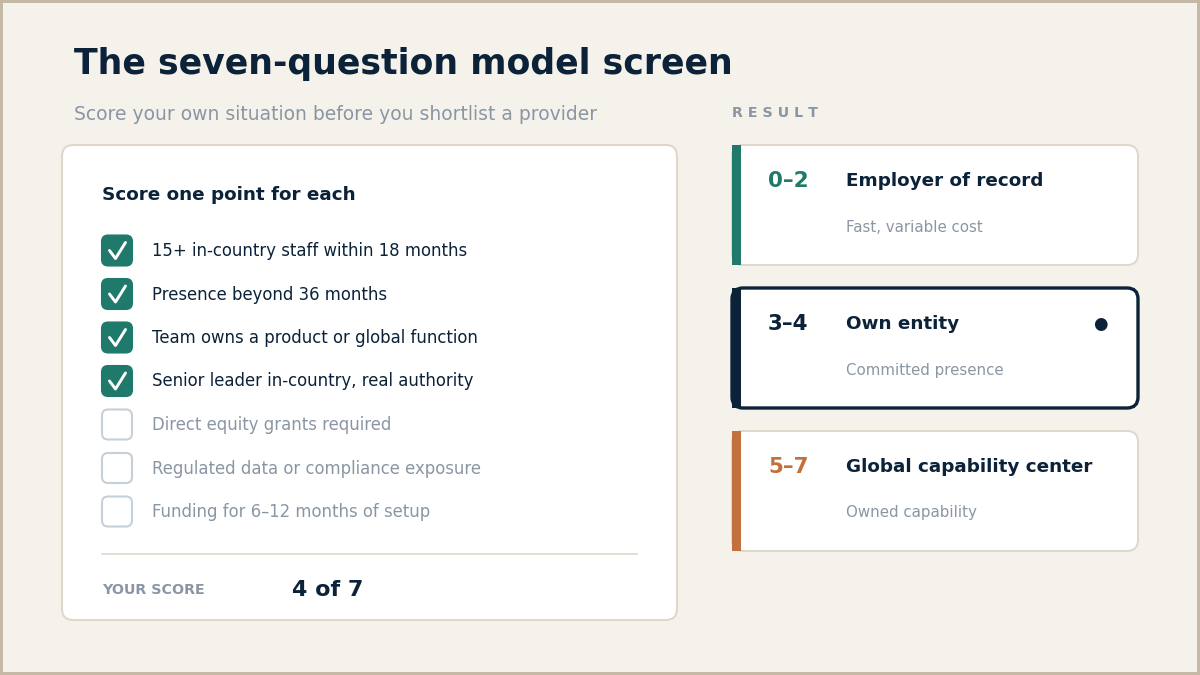
The scoring test. Give yourself one point for each true statement:
- We will exceed 15 in-country employees within 18 months.
- Our expected presence exceeds 36 months.
- The team will own a product surface, platform or global function.
- A senior leader will be based in-country with real decision rights.
- We need to grant equity directly to these employees.
- Our data or regulatory profile makes indirect employment a compliance concern.
- We have executive sponsorship and can fund 6–12 months before meaningful output.
If you score 5+ but fail question 4, do not proceed to a GCC. Build the entity, hire the leader, then declare the centre. The order matters more than the label.
What Most Teams Get Wrong
Five patterns, in rough order of how much they cost.
- Treating the EOR fee as the only variable and the entity as the only fixed cost. It is the reverse of how the decision should be modelled. The right comparison is total three-year cost at your projected headcount curve, not your current headcount. A team at 8 heads growing to 30 should be modelling the entity, because by the time the maths flips they are already 6–10 weeks behind where they need to be.
- Assuming the IP chain holds because the contract mentions IP. Under an EOR, the engineer’s employment contract is with the EOR, not with you. If that contract assigns IP to the EOR, and your MSA contains only a covenant to assign rather than a present assignment, there is a gap between the two documents where your product lives. Nobody notices until a data room. This is the most consequential unexamined risk in the entire category, and it takes one lawyer two hours to check.
- Calling a delivery annexe a GCC. A centre with no in-country leader, no decision rights and no owned product surface is a subsidiary with better branding. It will be managed as a cost line, budgeted as a cost line, and cut as a cost line during the first downturn. The Nasscom–Zinnov FY26 data is blunt about where the market has moved: 96% of centres established after FY21 launched with a product or portfolio mandate from day one. Starting as a support function and hoping to graduate is now the exception, not the path.
- Deferring the transfer pricing decision to year-end. The intercompany services agreement and markup should be set before the first invoice. Retrofitting a TP position after twelve months of undocumented intercompany flows is expensive, and the FY2026 safe harbour reset is only useful to companies whose documentation and structure were built to qualify for it.
- Optimising the model and ignoring the overlap window. The structure decision gets weeks of executive attention; the working-hours commitment gets a line in a Slack message. Then every meaningful architectural decision happens outside the overlap, and within two quarters the offshore team is executing rather than owning regardless of what the org chart says. Structure does not create ownership. Calendar discipline does.
Negotiation point worth knowing: EOR conversion fees and post-termination non-solicit clauses are almost always negotiable at signature and almost never negotiable at exit. Ask for a defined conversion path fee-capped or fee-free after 12 months in the first contract. Providers concede it routinely when asked early, because at that point they are competing for your business rather than defending a renewal.
Cost and Timeline Reality Check
Ranges below reflect what we typically see for India engagements. Treat them as planning bands, not quotes actual figures move with city, seniority mix, advisory choices and provider.
Timeline by scenario
| Scenario | Realistic elapsed time |
| First EOR employee onboarded | 1–3 weeks from signed offer |
| Shortlist to interview-ready candidates | 7–10 working days from job description |
| Indian private limited company incorporated | 6–10 weeks from decision |
| First compliant payroll run in own entity | 10–16 weeks from decision |
| GCC with leadership, site and first cohort | 6–12 months |
| India site leader hired | 3–6 months |
| EOR-to-entity conversion of an existing team | 10–14 weeks, overlapping incorporation |
| Voluntary strike-off of an unused entity | 6–12 months |
Cost bands
| Line item | Typical range |
| EOR fee, platform-led | $199–$599 per employee per month |
| EOR fee, full-service | 10–20% of gross payroll |
| Entity incorporation (professional fees) | ₹40,000–₹1.5 lakh |
| Statutory audit | ₹1–3 lakh/year |
| Company secretarial & ROC compliance | ₹1–2.5 lakh/year |
| Payroll & accounting operations | ₹1.5–4 lakh/year |
| Transfer pricing study & Form 3CEB | ₹1.5–4 lakh/year |
| Total entity fixed run-rate | ₹8–20 lakh/year before payroll |
| Managed office seat, tier-1 | ₹8,000–20,000 per seat/month |
| Managed office seat, tier-2 | ₹5,000–12,000 per seat/month |
| Statutory loading on gross salary | 10–20% (PF, gratuity accrual, bonus, insurance) |
Where the breakeven actually sits
Work it in three lines:
- Entity fixed cost per year ÷ EOR fee per head per year = breakeven headcount on pure cash.
- At ₹14 lakh fixed and ₹3 lakh per head, that is roughly 5 heads which is the number most vendor calculators stop at.
- Now add the management overhead an entity creates but an EOR absorbs: HR administration, statutory registers, POSH Act compliance, DPDP Act obligations, payroll edge cases, terminations. Priced at even a modest internal cost, real crossover lands at 15–25 heads in one country.
What drives the number up: multiple countries (fixed cost repeats per jurisdiction), high seniority mix (EOR percentage fees scale with salary, so percentage-based providers get expensive fast at staff-plus levels), and equity requirements.
What drives it down: a single concentrated location, a flat headcount plan, a short horizon, and a percentage-based EOR fee on low salary bands.
Where to Go Next
If you are mid-decision, the useful next step is not choosing a provider. It is pressure-testing your own numbers.
Take the seven-question scoring test above, apply it to your actual 24-month headcount plan, and model the three-year fully-loaded cost of each path EOR fee plus payroll, versus payroll plus fixed entity run-rate, versus the GCC build including leadership and site. If the answer is obvious, act on it. Most teams find it is obvious once the run-rate line is in the model, and that they were about six months later to the decision than they should have been.
If it is not obvious, usually because the headcount curve is uncertain, the mandate is still being negotiated internally, or you are weighing India against a second location that is worth an hour with people who have built all three structures. Supersourcing has spent a decade on this side of the problem, across staffing, RPO and end-to-end global capability center builds for companies at every stage of that curve.
One next step: book a consultation and bring your headcount plan. No deck required, the conversation is more useful when it starts from your numbers.
FAQ
What is the difference between an EOR and a legal entity?
An employer of record is a third-party company that legally employs your workers in a country where you have no presence, handling contracts, payroll, tax and statutory benefits while you direct the work. Your own legal entity means you incorporate locally and employ people directly. The EOR is faster and variable-cost; the entity is slower, fixed-cost and gives you full control.
Is a GCC the same as a subsidiary?
No. Every GCC operates through a subsidiary, but not every subsidiary is a GCC. The subsidiary is the legal wrapper. A global capability center is the operating model layered on top: in-country leadership, defined decision rights, and ownership of a product, platform or global function rather than execution of tasks specified elsewhere.
At what headcount should I stop using an EOR?
In most engagements, the economics turn between 15 and 25 employees in a single country. Below that, the EOR fee is usually cheaper than an entity’s fixed compliance run-rate. Start the incorporation process a quarter before you expect to cross the line, since setup takes 10–16 weeks to first compliant payroll.
Does using an employer of record create permanent establishment risk?
It reduces it substantially compared with engaging contractors directly, but does not eliminate it. PE risk rises when the offshore person concludes contracts, negotiates deals or acts with authority to bind the parent. Engineers building products are low risk; a country manager closing sales through an EOR is a live exposure. Get jurisdiction-specific tax advice for any commercial or client-facing role.
Who owns the IP created by an EOR-employed engineer?
It depends entirely on two contracts working together. The engineer assigns IP to the EOR under their employment agreement, and the EOR must assign it onward to you under your service agreement ideally with a present assignment rather than a promise to assign. Verify both documents before the first line of code. A broken chain surfaces during fundraising or acquisition diligence, which is the worst possible time.
How long does it take to set up an entity in India?
Incorporating a private limited company typically takes 6–10 weeks with clean documentation, via the SPICe+ filing that bundles PAN, TAN, EPFO, ESIC and professional tax registration. Add bank account opening, FDI inflow, FC-GPR filing with the RBI within 30 days of share allotment, and GST plus Shops and Establishments registration. Budget 10–16 weeks to your first compliant payroll run.
Can I convert EOR employees to my own entity later?
Yes, and it is a common path but treat it as a project, not a formality. Check your EOR contract for conversion fees and non-solicit clauses before signing, communicate tenure and benefit implications to employees in writing well ahead of the transfer, re-execute IP assignments to the new entity, and run one parallel payroll cycle before cutting over.
What is the minimum team size for a GCC to make sense?
Roughly 50 people on cost grounds alone, or around 25 where the mandate is genuinely strategic owning a product surface or a global function rather than supplying capacity. Below that, a plain subsidiary delivers the same legal and cost benefits without the site, leadership and governance overhead. If you are unsure which side of that line you sit on, a short structured review against your headcount curve and mandate usually settles it in one conversation.
