

India now hosts 2,117 Global Capability Centers, employing 2.36 million professionals and generating $98.4 billion in annual revenue, a 32% jump in center count, according to the Nasscom–Zinnov GCC Landscape Report.
Every one of those centers now reports a diversity number to headquarters. Very few can explain why that number stops improving the moment it reaches the leadership layer.
That’s the actual story behind diversity hiring GCC India as a search term and as a boardroom problem. Women’s representation across Indian GCCs climbed from 31.4% to 38.3% between 2020 and 2024.
Over the same four years, women’s share of senior leadership positions moved from 11.43% to just 13.60%, a two-point gain, while overall representation rose by seven points. The pipeline is filling. The exit ramp at the top isn’t widening at anywhere near the same rate.
This is not a hiring-volume problem. Most GCCs clear their entry-level diversity targets without much strain. 51% of entry-level hiring in India’s IT-BPM sector already goes to women.
The failure sits three to five years in, at the point where technical ICs are supposed to become tech leads, then engineering managers, then site leadership. That’s where global companies setting up or scaling a GCC in India consistently underinvest, and it’s the gap this guide is built to close.
TL;DR
This guide is for HR and D&I leaders, GCC heads, and HQ talent acquisition teams evaluating how to build (or fix) a diversity hiring program for an India-based Global Capability Center. It covers the full lifecycle: why programs stall, how to structure sourcing and panels, what a realistic budget looks like, and how to measure whether it's actually working not just at the point of hire, but three years in.
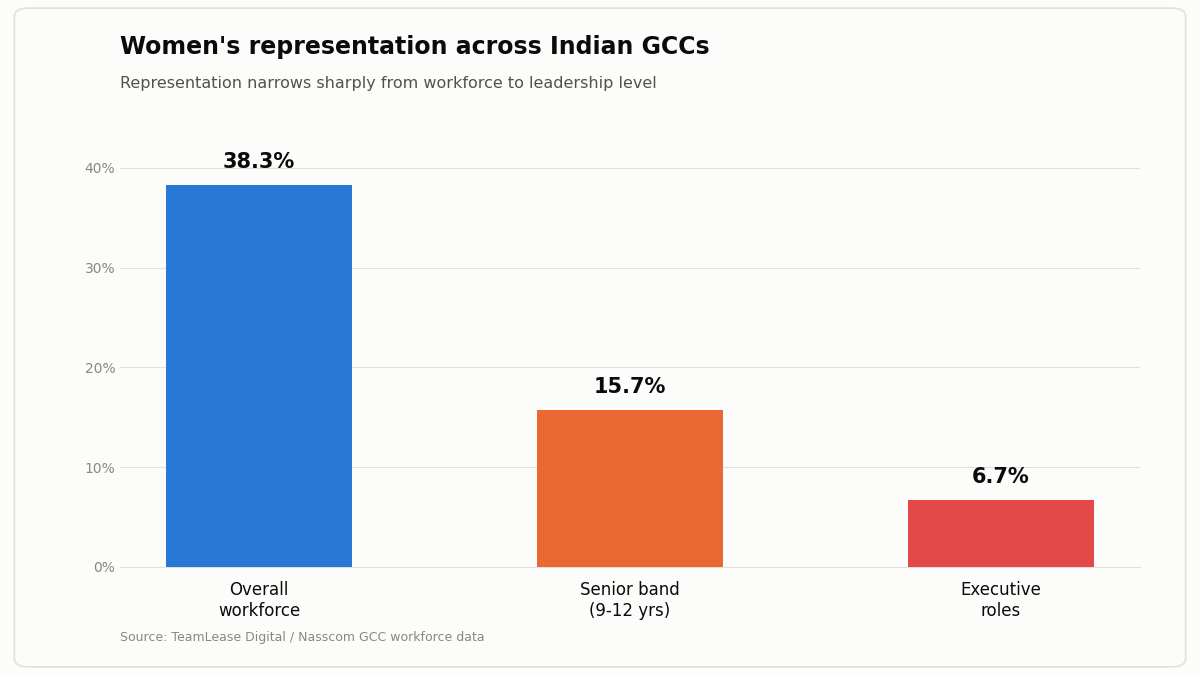
The single number to hold onto: Indian GCCs now average 38.3% women in the overall workforce, but only 6.7% in executive roles and 15.7% at the senior (9-12 year) band. Inclusive hiring GCC programs that only track the top-line number are measuring the part of the funnel that was never the problem.
By the end of this guide, you'll be able to build a diversity hiring plan that accounts for sourcing, panel design, contract terms, onboarding, and critically the retention and promotion mechanics that determine whether your representation number holds up past year one.
What Is Diversity Hiring in a GCC Context?
Diversity hiring GCC India is the deliberate design of sourcing, screening, and selection processes at an India-based Global Capability Center to build a workforce and leadership bench that reflects gender, regional, disability, and background diversity measured not just at entry level but at every seniority band, including site leadership.
It is not:
- A headcount quota applied only to junior roles while leadership hiring stays “merit-based” by default.
- A CSR-adjacent initiative runs separately from core talent acquisition.
- A one-time campus or Tier 2 city sourcing push that isn’t paired with a retention and promotion plan.
Why It Matters: The Business Case
The case for GCC DEI India isn’t sentiment; it’s a set of measurable outcomes tied directly to hiring quality, retention cost, and delivery risk.
- Attrition cost avoidance. Post-maternity and mid-career attrition among women in Indian tech remains a recognized retention risk; a structured re-entry and sponsorship track costs a fraction of a repeat hiring cycle at the same seniority band.
- Global mandate compliance. Multinational parent companies increasingly tie India-GCC leadership scorecards to global DEI targets set at headquarters; a center that can’t produce credible representation data at the leadership layer creates a compliance and reporting problem for the CHRO, not just an optics one.
- Employer brand in a candidate-tight market. Centers with visible, credible inclusion practices report faster time-to-fill on senior technical roles because they’re pulling from a wider, less-contested candidate set including experienced women re-entering the workforce and talent based outside Tier 1 metros.
- The aspiration-to-opportunity gap is real and measurable, not anecdotal. A 2026 survey by the All India Management Association and KPMG found 79% of women professionals aspire to leadership roles, yet barely 1% currently hold board-level positions and identified the mid-career stage as the point 65% of respondents flagged as when women are most likely to leave the workforce, often just as leadership trajectories would otherwise begin to accelerate.
A GCC that isn’t deliberately intervening at the mid-career band is losing exactly the cohort it will need for its own leadership pipeline three to five years out.
Taken together, these numbers point to a specific, addressable gap rather than a vague cultural problem: the leak isn’t at the front door of the funnel, it’s at the mid-career and promotion stage which is precisely where Phase 5 of this guide focuses.
The Core Problem Most Buyers Face
Here’s the pattern across most GCCs we’ve seen scale from 50 to 500+ employees: the representation number that gets reported to HQ is the entry-level number, not the leadership one and most HR teams don’t realize the gap until an internal audit or a board-level DEI review forces the split.
Three specific failure points show up repeatedly:
- Panel composition drift. A center might launch with mixed-gender interview panels for its first 50 hires, then quietly default to whichever panelists have calendar availability once hiring scales past a few hundred roles; a quarter panel diversity becomes the first casualty of hiring velocity.
- Leadership pipeline math that doesn’t add up. If entry-level hiring is 38% women but internal promotion rates into tech-lead and EM roles aren’t tracked separately by gender, a center can hit its overall representation target for years while leadership representation stays flat because the denominator at the top is tiny and every non-representative promotion decision shows up immediately in the ratio.
- Sourcing channels that only reach Tier 1 metro networks. Referral-heavy sourcing (which is efficient and cheap) tends to replicate the existing network’s composition. Without a deliberate secondary channel Tier 2/3 city partnerships, returnship programs, community-specific job boards referral-only sourcing plateaus diversity ratios exactly where they started.
Most teams underestimate how long it takes to correct panel and pipeline drift once it sets in a center that lets panel composition slip for 18 months typically needs 9-12 months of deliberate correction before the interview-stage diversity ratio recovers, because interviewer habits and referral networks don’t reset the moment a policy changes.
The Walkthrough: Building a Diversity Hiring Program From Scratch
This is the full lifecycle from the point a GCC decides diversity hiring needs to be a formal program, through to the ongoing management that keeps the numbers from drifting back down.
Phase 1 Defining Requirements and Setting Real Targets
Before any sourcing starts, get specific about what “diverse” means for this center and what’s realistic within the timeline.
- Set band-specific targets, not one blended number. A single “40% women” target across the whole org hides exactly the leadership gap described above. Set separate targets for entry-level, mid-level (3-7 years), senior IC, and leadership bands.
- Budget for the program itself, not just the roles. A structured DEI hiring layer panel training, sourcing partnerships, reporting dashboards typically adds ₹8-15 lakhs/year ($10k-18k/year) in direct program cost for a 200-500 person center, separate from recruiter or agency fees.
- Decide what “diversity” covers beyond gender. Persons with Disabilities (PwD) hiring, LGBTQIA+ inclusion, and neurodivergent hiring each need their own sourcing and accommodation plan bundling them into a single generic “diversity” line item is how PwD and neurodivergent hiring specifically get deprioritized once gender targets absorb the budget.
- Map roles to realistic talent availability. Highly specialized roles for example, if you’re building out an AI or infrastructure function and need to hire cloud engineers or hire data scientists draw from a narrower, more male-skewed talent pool today than generalist software engineering roles. Build that into the timeline expectation rather than treating every open role as equally reachable.
Setting targets against real benchmarks, not aspiration. Pull the current industry baseline before setting internal targets as of the latest sector data, overall GCC representation sits near 38.3%, senior-band (9-12 years) representation sits near 15.7%, and executive-level representation sits near 6.7%.
A center setting a leadership target of “40% by next year” when the industry baseline is under 16% at that band isn’t setting an ambitious target, it’s setting an unachievable one that will quietly get abandoned by month nine.
Set the first-year target as a realistic step change from the center’s own current number, typically 3-5 percentage points at the senior/leadership band, is an aggressive but credible one-year move and set a three-year target that closes the gap to the best-in-class centers in the same sector.
Phase 1 checklist:
- Band-specific representation targets (entry / mid / senior / leadership) signed off by both India HR and HQ D&I
- Separate line-item budget for program cost, not folded into general recruiting spend
- Explicit scope beyond gender (PwD, LGBTQIA+, neurodivergent, regional) with named owners
- Role-by-role realistic timeline based on actual talent-pool composition, not aspirational parity
Phase 2 Sourcing and Vetting
This is where most of the actual diversity outcome gets decided not at the offer stage.
- Diversify the channel mix deliberately. Referral networks alone will replicate what already exists. Pair them with: women-in-tech community partnerships, Tier 2/3 city campus tie-ups, returnship program pipelines for women re-entering after a career break, and PwD-focused hiring platforms.
- Rewrite job descriptions before sourcing, not after. Gender-coded language (“aggressive,” “ninja,” “rockstar”) measurably suppresses application rates from women candidates. This is a 30-minute JD audit, not a project.
- Build a diverse slate requirement into every search. For roles at senior IC and above, require that at least one qualified candidate from an underrepresented group reaches the final panel round before an offer decision is made not as a quota on the hire, but as a check on whether sourcing did its job.
- Red flag in vetting: a shortlist that’s diverse at the resume-screen stage but homogenizes by the technical-round stage usually means the technical assessment itself timed live-coding under observation, ambiguous rubrics, informal “culture fit” scoring is filtering people out for reasons unrelated to the skill being tested.
- Structure the technical + cultural evaluation separately. Score technical competency against a fixed rubric before any panel discussion happens, then evaluate collaboration/communication fit as a distinct, separately-scored step this single change is one of the highest-leverage fixes we’ve seen for panel bias, because it stops a strong personal rapport from silently overriding a weak technical score.
What a well-structured interview panel actually looks like. This is more specific than “have diverse interviewers.” For roles above associate level, aim for at least one panelist who isn’t the hiring manager’s direct report and at least one panelist from outside the immediate team, so a single manager’s preferences don’t fully determine the outcome.
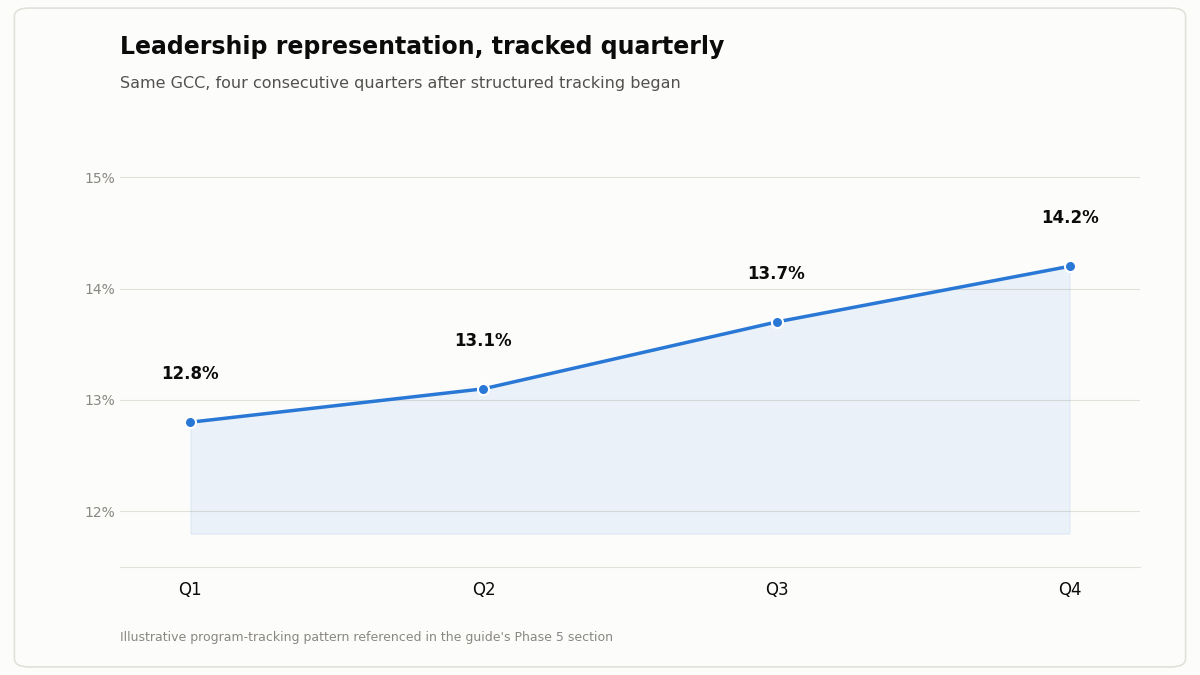
Rotate panel composition on a fixed schedule (monthly, not per-req) so the same two or three people aren’t unconsciously calibrating every hire the same way. Track, per quarter, what share of interview panels included at least one woman or underrepresented-group panelist this is a leading indicator that moves months before the hiring-outcome ratio does.
More vetting red flags worth watching for: a live-coding round with no written rubric shared with the interviewer beforehand (informal rubrics are where bias enters unnoticed); “culture fit” used as a standalone pass/fail gate rather than a scored, defined competency; and candidate feedback forms that are optional rather than mandatory, since mandatory structured feedback is what actually surfaces inconsistent scoring across panelists.
Phase 2 checklist:
- At least two non-referral sourcing channels active per open role
- JD language audited for gender-coded terms before posting
- Diverse-slate check applied at senior IC level and above
- Technical and cultural evaluation scored as two separate, sequential steps
Phase 3 Engagement Models and Contracts
How you structure the hiring relationship affects diversity outcomes as much as sourcing does.
| Engagement Model | Diversity Control | Speed | Typical Use Case |
| Dedicated recruiter/team | High full visibility into panel and pipeline data | 7-10 working days to shortlist | Ongoing, high-volume GCC hiring |
| Staff augmentation | Medium depends on staffing partner’s own bench diversity | Fast for niche skills | Specialized/contract roles |
| Project-based agency | Low one-off, limited data continuity | Variable | Short-term or one-time hiring spikes |
| Pure in-house TA | High potential, but resource-constrained at scale | Slower past ~50 roles/quarter | Early-stage or small centers |
- NDA and IP terms matter for diversity data too, not just code and product IP if a staffing partner is handling sourcing, the contract should specify that anonymized panel-diversity and pipeline-diversity data stays reportable to the GCC, not just final-hire demographics.
- Replacement guarantees should not undermine diversity targets. A 7-10 day replacement guarantee is a reasonable, standard term but confirms the replacement process doesn’t default to the fastest available candidate over a diverse slate when a hire doesn’t work out.
- Ask any staffing or RPO partner directly how they vet for diversity hiring commitments; a credible partner should be able to describe their own sourcing-channel mix and panel-composition practices, not just quote a completion percentage. At Supersourcing, this is a standard part of the account-setup conversation with any GCC client, precisely because a partner that can’t answer it in specifics usually can’t deliver on it in practice either.
Legal and compliance considerations that belong in this phase, not left to HR to discover later:
- A functioning Internal Committee under the POSH Act (Prevention of Sexual Harassment) isn’t optional for any GCC with 10+ employees confirm it’s operational, not just documented, before scaling headcount.
- The Rights of Persons with Disabilities Act, 2016 sets accessibility and non-discrimination obligations that should shape both the physical workplace and the hiring process for PwD candidates, not just be addressed reactively after a candidate raises an accommodation need.
- Maternity Benefit Act provisions (26 weeks of paid leave for eligible employees) should be built into workforce planning at the offer stage for senior roles, not treated as a surprise cost when a hire later needs the benefit.
- If the GCC’s parent company reports globally against frameworks like the UK Gender Pay Gap reporting or EU pay-transparency rules, confirm India-GCC compensation data is being captured in a format that maps to those requirements from day one retrofitting pay-equity data after two years of hiring is significantly more expensive than capturing it correctly from the start.
Phase 4 Onboarding and Ramp-Up
The first two weeks determine whether a diverse hire becomes a diverse retained employee.
- Assign a peer buddy from a similar background where possible not mandatory, but consistently correlated with faster ramp and lower 90-day attrition in centers that track this.
- Set access and tooling parity on day one. Delayed system access disproportionately affects new hires without an existing informal network to route around IT bottlenecks.
- Communicating the promotion and review cadence explicitly in week one ambiguity about how advancement decisions get made is a documented driver of early attrition among women and underrepresented hires specifically, because informal, unwritten advancement paths tend to favor whoever already has the strongest internal network.
- Flag flexible-work and caregiving-leave policies during onboarding, not buried in an HR portal this is one of the most requested pieces of information among women joining GCC roles and one of the least proactively communicated.
- Check in at 30, 60, and 90 days with a structured question set, not just an open “how’s it going” specifically ask whether the new hire feels they have visibility into how advancement decisions get made and whether they’ve been included in the informal conversations (standups, hallway syncs, social channels) where a lot of real context gets shared. Isolation from those informal channels is a quieter, harder-to-spot driver of early attrition than any formal process gap.
- For PwD and neurodivergent hires specifically, confirm accommodations were actually implemented before day one, not just approved on paper a wheelchair-accessible workstation requested three weeks before start date and installed the morning of should be treated as a process failure, not a minor delay.
Phase 5 Managing Delivery and Ongoing Representation
Diversity hiring doesn’t end at offer acceptance; it has to be managed with the same operating rigor as delivery KPIs.
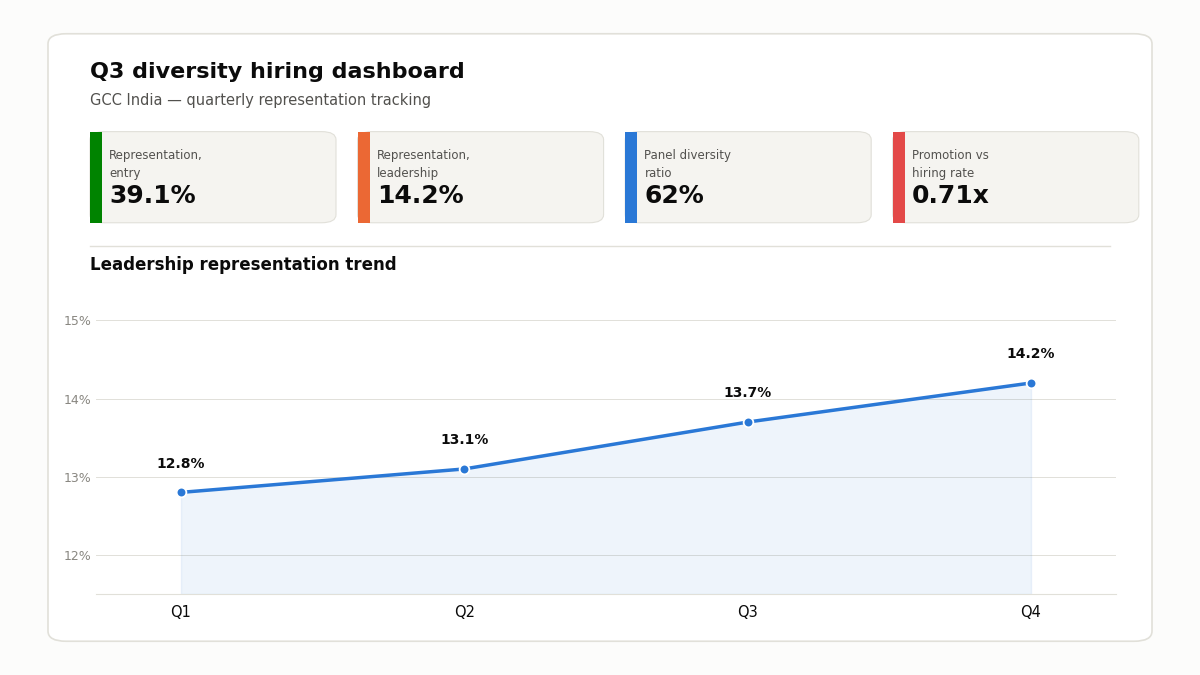
- Report representation by band, quarterly, not annually. Annual reporting hides mid-year drift; by the time it shows up in an annual report, the fix takes another two quarters.
- Track promotion rate by gender/group separately from hiring rate. This is the single most-skipped metric and the one that explains the leadership-gap pattern described earlier in this guide.
- Giving account/delivery managers a DEI line item in their own performance review, not just a hiring-volume target ownership without accountability rarely survives a busy quarter.
- Run an ERG (Employee Resource Group) with a real budget and executive sponsor, not a Slack channel ERGs with named budget and leadership sponsorship show materially higher retention impact than informal ones. A functioning ERG structure typically includes: a named executive sponsor who attends quarterly, not just launches the group; a small annual budget (even ₹1-3 lakhs is enough to run regular events and bring in outside speakers); and a direct feedback line into the quarterly representation review in Phase 5, so what the ERG hears from members actually reaches the people setting hiring and promotion policy.
- Pair every promotion cycle with a calibration review that includes someone outside the immediate reporting line. Promotion decisions made entirely within a single manager’s chain are where unconscious bias compounds fastest, because the same evaluator’s blind spots repeat every cycle without an external check.
- Run a pay-parity audit annually, not once. A single audit at program launch tells you where you started; without a recurring annual check, compensation drift between groups can reopen even after the initial gap is closed, particularly as market-rate adjustments and counter-offers get applied unevenly across a growing team.
Phase 5 KPI dashboard (minimum viable):
- Representation % by band (entry / mid / senior / leadership), quarterly
- Promotion rate by gender/group, compared against hiring rate by gender/group
- Attrition rate by group, with exit-interview theme tagging
- Panel diversity ratio, tracked per quarter, not per hire
Phase 6 Scaling or Exiting the Program
- Scaling headcount: re-run the Phase 1 target-setting exercise every time the center crosses a major size threshold (roughly every doubling) a target calibrated for a 100-person center is usually stale by the time the center hits 400.
- Offboarding and replacement policy: confirm that any replacement-guarantee clause with a staffing partner still applies diversity-slate requirements to the replacement search, not just the original one.
- Sunset criteria for a formal program: a center graduates from “active correction mode” to “maintenance mode” once leadership-band representation has held steady (not just improved) for four consecutive quarters improvement alone isn’t stability.
Case Studies
Fintech GCC, engineering hiring scale-up. A fintech GCC scaling its India engineering org needed to hire at volume without letting panel composition drift as headcount tripled. Structured panel-rotation rules and a dedicated account manager kept interview-panel diversity ratios stable through the scale-up, contributing to a 98% candidate joining rate on offers extended evidence that structured process, not just sourcing volume, is what holds a diversity number steady under hiring pressure.
Fintech GCC, engineering hiring at scale. In a large-volume engineering hiring push for a fintech GCC (comparable in scale to Paytm’s 100+ engineer hiring programs), splitting technical and cultural-fit scoring into two sequential, separately-recorded steps reduced late-stage homogenization of shortlists candidates who cleared a diverse initial screen were no longer disproportionately filtered out at the final panel round.
Recruitment automation for a healthtech GCC. A healthtech-adjacent GCC (in the pattern of Somnoware’s recruitment automation work) used structured, rubric-based screening to cut the <1% candidate drop-off rate on contract roles even while broadening its sourcing channel mix beyond referral networks showing that adding diversity-focused sourcing channels doesn’t have to come at the cost of process reliability.
Comparison / Decision Framework: Building In-House vs. Partnering
| Factor | Build fully in-house | Partner for sourcing + own the rest | Full RPO/dedicated-team partner |
| Cost | Lower per-hire at scale, high fixed cost | Moderate, scales with volume | Predictable, bundled into service fee |
| Speed to diverse shortlist | Slower building sourcing channels from zero | 7-10 working days once channels are live | 7-10 working days, established channels |
| Control over panel/process | Full | High | High, if data-sharing terms are set (see Phase 3) |
| Risk if program stalls | Sits entirely with internal HR bandwidth | Shared partner accountable for sourcing mix | Partner contractually accountable for pipeline diversity data |
| Best fit | Large, mature centers with dedicated D&I headcount | Mid-size centers wanting control + speed | Centers scaling fast or without in-house D&I bench strength |
Apply this framework by asking: does the center have dedicated internal bandwidth to own sourcing-channel diversification (Phase 2) and quarterly reporting (Phase 5) on top of its existing hiring load?
If not, the accountability needs to sit contractually with a partner not just get added informally to a recruiter’s existing workload. Supersourcing’s model dedicated account managers with no shared bandwidth across clients, and NDA-backed data terms that keep pipeline-diversity reporting visible to the GCC rather than locked inside the partner’s own systems is built specifically around that accountability gap.
What Most Teams Get Wrong
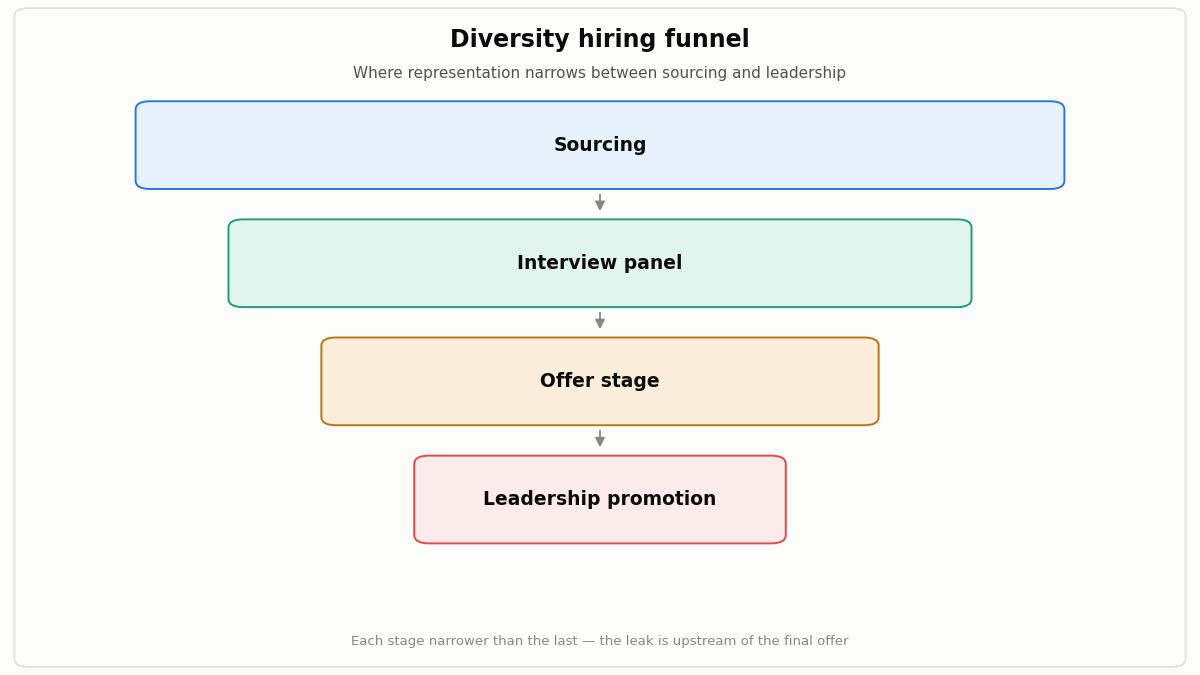
- They measure diversity at the offer stage, never at the panel stage. By the time a candidate gets an offer, most of the diversity attrition already happened earlier in the funnel at sourcing and at the technical-round filter described in Phase 2. Offer-stage-only measurement misses where the real leak is.
- They treat leadership diversity as a pipeline problem that will “solve itself” once entry-level numbers are strong enough. It won’t, on its own with women’s senior-leadership representation moving only from 11.43% to 13.60% over four years against a much larger entry-level gain, the promotion mechanism itself, not the incoming pipeline, is the bottleneck.
- They run diversity hiring and retention as two separate initiatives with two separate owners. A hiring dedicated team hitting its intake target while a retention team independently loses those same hires within 18 months isn’t a coincidence, it’s a sign the two functions aren’t talking, and it’s the single most common structural gap we see in centers that plateau after an initially strong first year.
- They over-index on gender and under-invest in PwD, LGBTQIA+, and regional diversity. Gender is the most-reported metric because it’s the easiest to track, not because it’s the only dimension that matters; centers that only report a gender number are usually not tracking the others at all.
- They assume a staffing or RPO partner’s overall placement metrics (like a high joining rate or low drop-off) automatically imply strong diversity outcomes. These are quality-of-process indicators, not diversity indicators that ask for the diversity-specific breakdown separately.
- They launch a program, see a quick early bump, and read that as proof the fix worked then stop measuring closely. The first two quarters of any new sourcing channel or panel policy tend to show the fastest visible movement, simply because the baseline was low. That initial slope almost always flattens once the easy wins (existing near-miss candidates, previously overlooked internal talent) are absorbed. Programs that get evaluated only in that early window look far more successful than they’ll prove to be a year later.
- They centralize accountability with HR alone and leave hiring managers with no stake in the outcome. A hiring manager who isn’t measured on panel diversity or promotion equity within their own team has no functional reason to change established habits and habits, not intentions, are what determine outcomes at scale.
Cost & Timeline Reality Check
Concrete ranges most competing guides skip:
Program setup cost (200-500 person center):
- Dedicated DEI hiring program layer (panel training, sourcing partnerships, reporting tooling): ₹8-15 lakhs/year ($10k-18k/year)
- Returnship/re-entry program (if run in-house): ₹5-10 lakhs/year ($6k-12k/year) for a cohort of 10-15
- PwD accommodation and accessibility retrofitting (one-time, per site): ₹10-25 lakhs ($12k-30k), highly variable by facility
Hiring timeline by scenario:
- Standard role, diverse-slate sourcing already active: 7-10 working days from JD to interview-ready shortlist
- New sourcing channel being stood up for the first time (e.g., first Tier 2/3 partnership): add 3-4 weeks to the first cohort, then back to standard timeline for subsequent hires through the same channel
- Senior IC/leadership role requiring executive-search-level diversity mandate: 6-10 weeks, driven by pool size at that seniority, not process inefficiency
What drives cost up:
- Running sourcing, panel training, and reporting as three uncoordinated efforts instead of one program
- Late-stage attrition of diverse hires forcing repeat searches at the same seniority band
- No shared data terms with an IT staffing partner, forcing internal HR to rebuild pipeline-diversity tracking manually
What drives cost down:
- Consolidating sourcing-channel relationships (community partnerships, campus ties) across multiple open roles instead of one-off per requisition
- A dedicated account manager who already has diversity-sourcing channels live, rather than starting from zero on every search
Cost by center size, as a rough planning band:
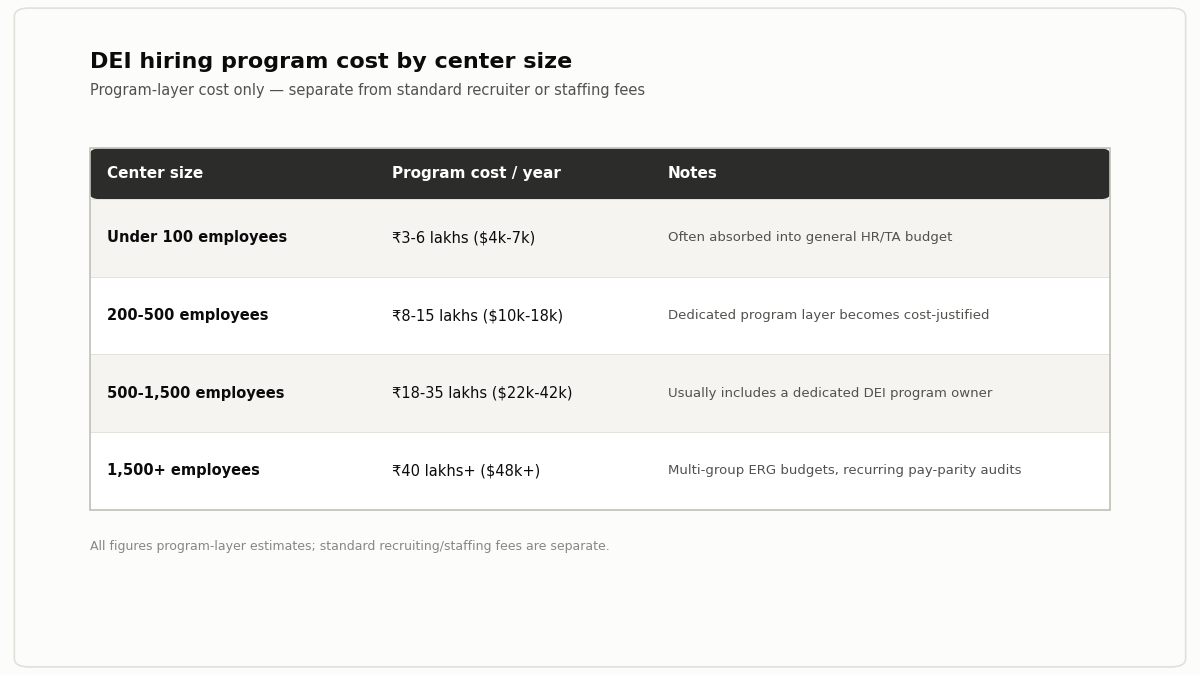
| Center Size | Program Layer Cost/Year | Notes |
| Under 100 employees | ₹3-6 lakhs ($4k-7k) | Often absorbed into general HR/TA budget rather than run as a separate line |
| 200-500 employees | ₹8-15 lakhs ($10k-18k) | Dedicated program layer becomes cost-justified at this scale |
| 500-1,500 employees | ₹18-35 lakhs ($22k-42k) | Usually includes at least one dedicated DEI program owner headcount |
| 1,500+ employees | ₹40 lakhs+ ($48k+) | Typically includes dedicated program owner, ERG budgets across multiple groups, and recurring pay-parity audit costs |
These are program-layer costs only they sit on top of, not instead of, standard sourcing, recruiter, or staffing-partner fees for the roles themselves.
Ready to see where your own GCC’s diversity funnel is actually leaking sourcing, panel, or promotion? That’s a conversation, not a checklist; talk to a specialist about your hiring plan.
What to Do Next
If your GCC’s diversity number looks healthy overall but you haven’t split it by seniority band, start there. It’s a one-afternoon data pull that usually reveals exactly where this guide’s Phase 5 tracking gaps sit. If the split confirms a leadership-layer gap, the fix isn’t more entry-level sourcing; it’s promotion-rate tracking and panel-structure discipline, applied consistently for at least two to three quarters before expecting the number to move.
Supersourcing works with GCC and enterprise HR teams on exactly this layer structuring sourcing, panel design, and reporting so representation holds up past the first hiring wave, backed by a 7-10 working day shortlist cycle and dedicated account management rather than shared bandwidth.
If you’re mid-decision on how to structure this for your own center, get in touch and we’ll walk through what’s realistic for your timeline and headcount.
Frequently Asked Questions
What is diversity hiring in the context of GCCs?
It’s the deliberate design of sourcing, screening, and panel processes at an India-based Global Capability Center to build representation across gender, disability status, background, and region tracked separately at every seniority band, not just as one blended organization-wide number.
Why do Indian GCCs plateau on senior-level diversity despite strong entry-level numbers?
Because promotion rate by group usually isn’t tracked separately from hiring rate. A center can hit 38%+ women at entry level for years while leadership representation barely moves, because the leadership pipeline problem is a promotion-mechanics issue, not a sourcing issue.
What percentage of GCC employees in India are women, and how has that changed?
Women’s representation in Indian GCCs rose from 31.4% in 2020 to 38.3% in 2024. Over the same period, representation in senior leadership moved from only 11.43% to 13.60%, a far smaller gain.
How long does it take to build a genuinely diverse hiring pipeline?
For a standard technical role with sourcing channels already active, 7-10 working days to an interview-ready shortlist. Standing up a brand-new sourcing channel (a Tier 2/3 city partnership or returnship pipeline) typically takes 3-4 weeks before it starts producing candidates at that same pace.
What is the NASSCOM DEI Charter, and is compliance mandatory?
It’s a voluntary industry framework that member organizations align to for measurable DEI progress; it isn’t a legal mandate, but many GCC parent companies now reference charter alignment in their own governance and reporting, making it a practical expectation even without formal enforcement.
How do you measure diversity hiring success beyond headcount ratios?
Track representation by band (not just overall), promotion rate by group against hiring rate by group, attrition rate by group with exit-theme tagging, and interview-panel diversity ratio headcount alone hides where the program is actually failing.
What’s the difference between diversity hiring and inclusive hiring?
Diversity hiring is about who gets hired representation across sourcing, shortlisting, and offers. Inclusive hiring is about the process itself whether the evaluation, panel structure, and onboarding are designed so that diverse candidates are assessed fairly and retained, not just recruited. One without the other doesn’t hold.
What does a structured DEI hiring program cost in India?
For a 200-500 person center, budget roughly ₹8-15 lakhs/year for the program layer itself (panel training, sourcing partnerships, reporting), separate from standard recruiter or staffing fees plus program-specific costs like returnship cohorts or accessibility retrofitting if those are in scope. Costs scale with center size, and smaller centers often absorb this into the general HR/TA budget rather than tracking it as a standalone line.
What red flags signal a staffing partner is doing “diversity theatre” rather than real diversity hiring?
Watch for partners who can quote an overall placement or joining-rate metric fluently but can’t answer a specific question about their sourcing-channel mix or interview-panel composition practices. Also watch for diversity data that’s only reported at the point of hire rather than tracked through the funnel sourcing, shortlist, panel, offer since that’s where the real attrition of diverse candidates usually happens.
Does hiring from Tier 2/Tier 3 cities actually move the diversity needle?
It can, but only as one channel among several Tier 2/3 sourcing expands the overall talent pool and often improves regional and socioeconomic diversity, but it isn’t a substitute for fixing panel structure or promotion-rate tracking. Centers that rely on Tier 2/3 hiring alone while leaving panel and promotion practices unchanged tend to see the same leadership-layer plateau described earlier in this guide, just with a larger entry-level funnel feeding into it.
