

A Global Capability Center can cut 35–40% off a function’s operating cost and still lose the room in a headquarters board review. The numbers are real. The problem is that most centers report the wrong ones upward.
That gap between what a center actually delivers and what its parent board perceives is where budgets freeze and mandates quietly shrink. GCC ROI reporting to leadership is not a finance formality; it is the mechanism that decides whether a center wins the next wave of investment or gets benchmarked against a cheaper vendor.
Most GCC directors are excellent at running the center and only average at reporting on it. They track utilization, attrition, ticket volumes, and SLA adherence with real precision. Then they carry those same operational metrics into a CFO conversation that runs on an entirely different currency: margin impact, revenue enablement, and risk reduction.
The result is predictable. A center that saved the parent ₹40–60 crore and shipped two product lines gets three slides on headcount and a question about why attrition ticked up 2 points. The value was created. It was never translated. This framework fixes the translation layer, the part between operating a center and defending it to the people who fund it.
McKinsey reports that global capability centers have moved decisively beyond labor arbitrage into innovation and value creation, reshaping the operating models of their parent enterprises rather than just their cost lines.
The stakes are rising because the sector is. India alone hosts more than 1,700 centers employing roughly 1.9 million professionals and generating about $65 billion annually, with the market widely projected to approach $100 billion by 2030. Boards are no longer asking whether to invest in centers; they are asking which ones earn more.
What GCC ROI reporting to leadership actually means
GCC ROI reporting to leadership is the disciplined practice of translating a global capability center’s operational output into the financial, strategic, and risk language a headquarters board and CFO use to allocate capital. It converts cost savings, delivery output, and risk reduction into enterprise value, presented on a cadence and format the parent’s leadership can act on.
The definition matters because it excludes what most reports actually contain. Internal dashboards, SLA scorecards, and team-level KPIs describe how the center runs. They are necessary for management, but they are not a report to the board. A board report answers one question: what return did the parent get on the capital and mandate it?
The core problem: activity metrics don’t survive a boardroom
Failure is rarely an effort. Directors over-report. A typical quarterly pack runs 25–40 slides, most of them operational, and the signal drowns.
A headquarters board gives a function 12–20 minutes. In that window, a CFO is comparing your center against every other use of the same capital: an acquisition, an automation program, a third-party vendor. If your narrative is “we hit 94% SLA and 82% utilization,” you have handed them numbers they cannot compare to anything on their agenda.
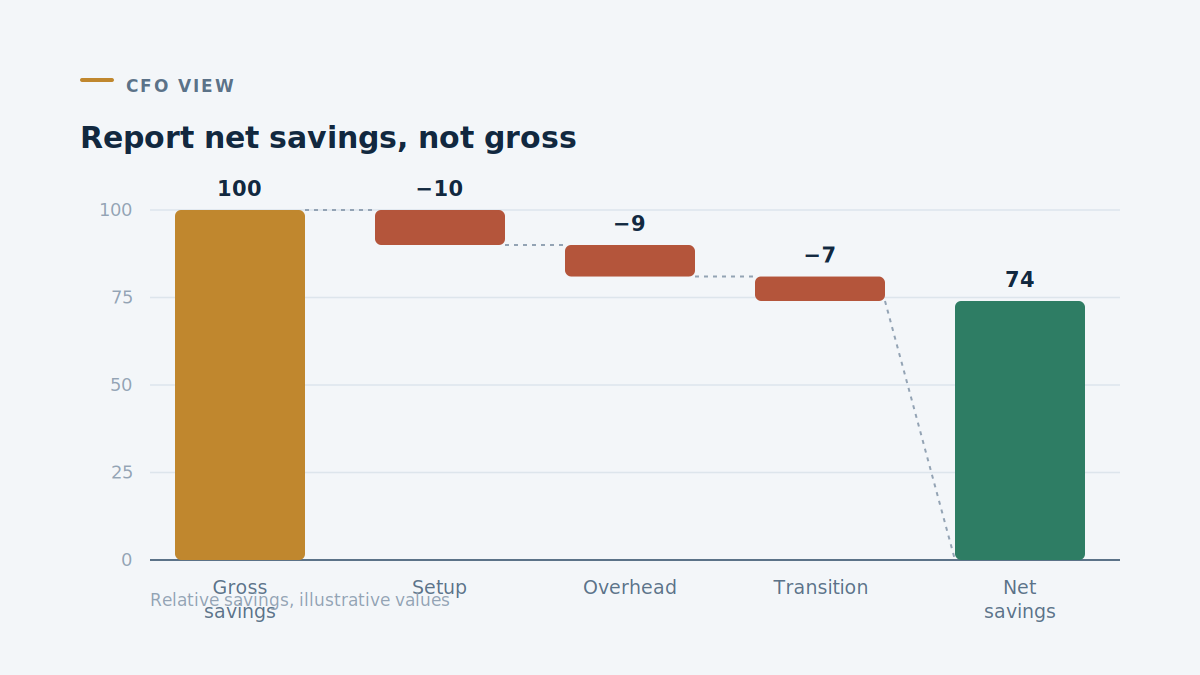
Three specific breakdowns recur across engagements. First, savings are reported gross, not netthe headline ignores setup cost, attrition-driven rehiring, and management overhead, so a sharp CFO discounts the whole figure.
Second, output is described as activity (“closed 4,200 tickets”) rather than outcome (“cut incident resolution time 31%, freeing the product team for two launches”). Third, risk is invisiblecenters almost never quantify the continuity, compliance, and concentration risk they absorb, so the board only notices risk when something breaks.
The cost of getting these wrong compounds. A center perceived as a cost line is managed like one: capped headcount, deferred capability investment, and periodic “can we do this cheaper elsewhere?” reviews.
A center perceived as a value engine gets mandated expansion. The reporting is what moves a center between those two categories often regardless of the underlying performance.
Building the GCC business case for a headquarters audience
The GCC business case you present upward is not the one you built to justify the center’s launch. The launch case was about cost arbitrage. The reporting case is about compounding value. Anchoring your quarterly narrative to the original savings promise alone is the single most common way mature centers cap their own ceiling.
A defensible reporting model rests on three value layers, presented in this order because it matches how a board metabolizes information.
How to present GCC savings to the CFO
Lead with net savings, not gross. Take the fully loaded cost the parent would pay to run the function onshore or through a vendor, subtract the total cost of ownership of the center’s salaries, real estate, technology, management overhead, transition cost amortized over 3 years and present the delta.
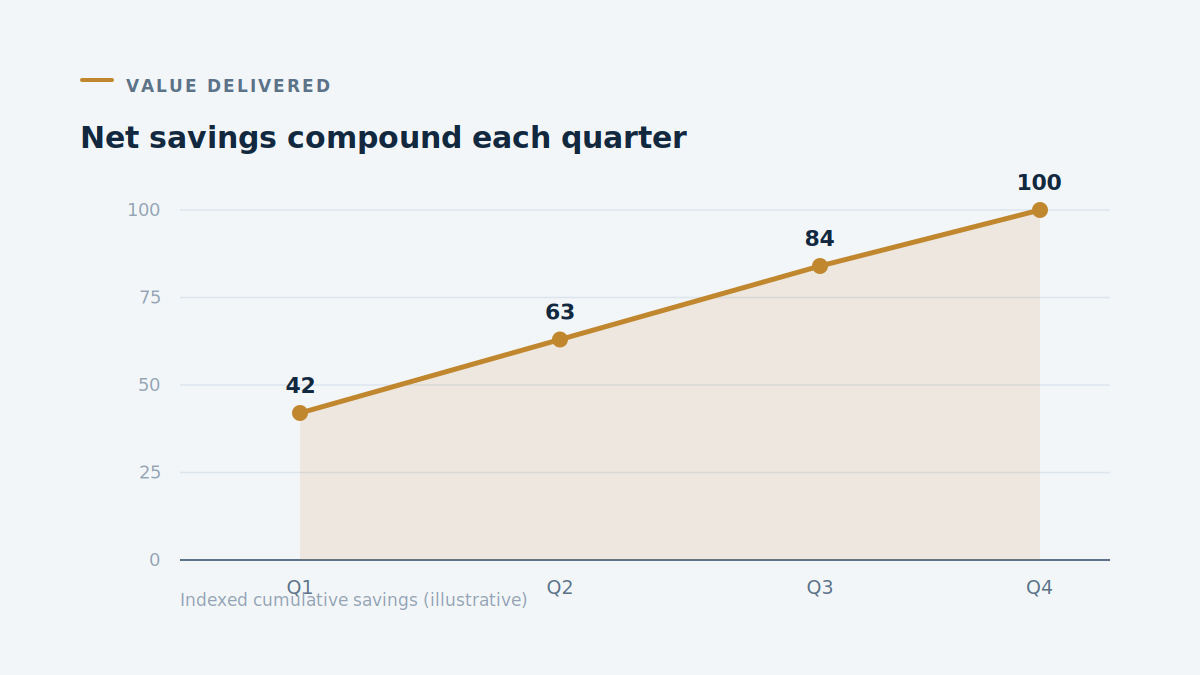
State it two ways: absolute (₹ or $ saved this period) and as margin contribution to the parent’s P&L. A CFO does not fund utilization; a CFO funds margin. If your center improved a business unit’s operating margin by 120–180 basis points, that sentence outperforms twenty slides of headcount efficiency. Show the trend line across four quarters so savings read as durable, not one-off.
What metrics matter to a HQ board
Boards care about a short list, and it is not your operational list. The five that consistently earn attention: margin contribution, revenue enabled or accelerated, time-to-market change, capability maturity (work the center now owns end-to-end that it previously only supported), and quantified risk reduction.
Map every internal metric to one of these five before it goes in the deck. Ticket volume maps to nothing a board cares about. Cycle-time reduction maps to time-to-marketkeep it, and attach the business consequence. The discipline is ruthless subtraction: a strong board report is defined by what you leave out.
Building a GCC performance dashboard for leadership
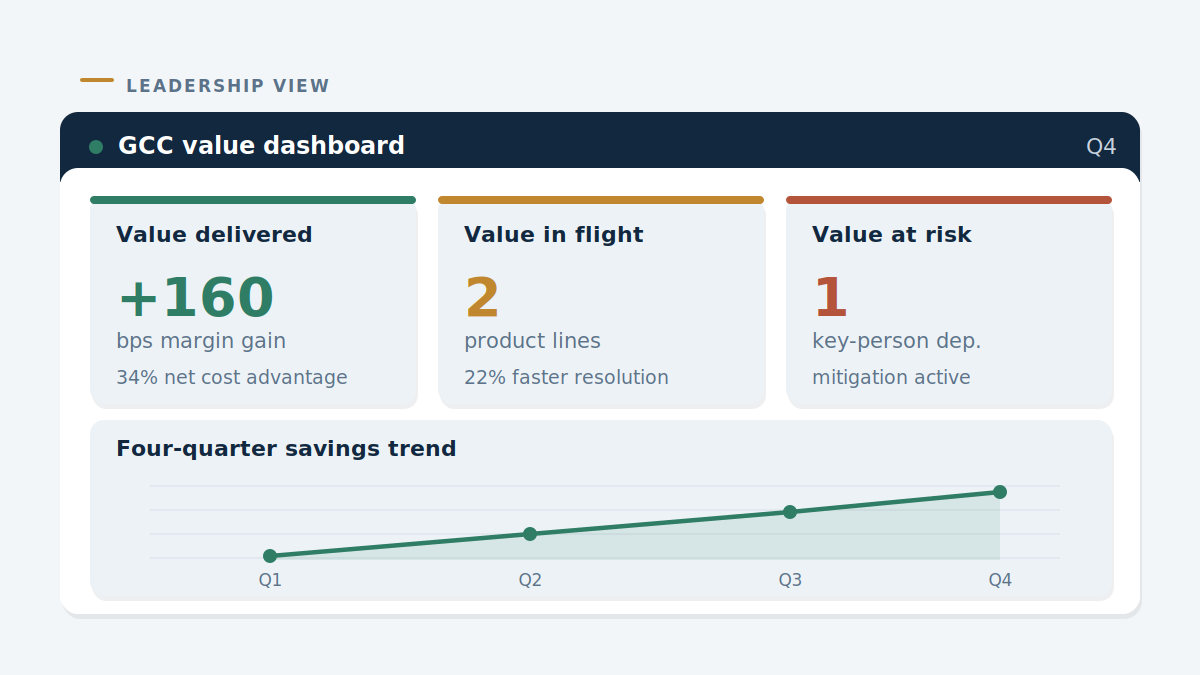
A GCC performance dashboard for leadership is a single view, not a deck. If it needs a walkthrough to be understood, it has already failed the room. Design it as one screen with three bandsvalue delivered, value in flight, and value at riskeach carrying no more than three numbers.
The dashboard’s job is to make the story legible in ten seconds and let questions pull detail on demand. Keep the underlying 30-slide operational pack as an appendix the board can drill into if they choose, but never lead with it.
Pair leading indicators (pipeline of transitioning work, capability ramp) with lagging ones (savings booked, margin impact) so leadership sees both the result and its trajectory.
What a GCC board report template should contain
A reusable GCC board report template compresses the whole narrative into a fixed structure so every quarter is comparable. Comparability is what builds board confidence/leadership trusts a center whose story tracks the same axes every time.
Use this five-part reporting sequence:
- Anchor to the mandate. One line restating what the center was funded to deliver this year and against what target.
- Value delivered. Net savings and margin contribution, shown as a four-quarter trend.
- Output translated. Two to three business outcomes enabled, each with a metric and a “so what” for the parent.
- Risk reduced. Continuity, compliance, and concentration risk the center absorbed, quantified where possible.
- The forward asks. The specific investment or mandate you want approved, with the return it unlocks.
That sequence is the backbone of durable GCC ROI reporting to leadership. It fits on five slides and survives a 15-minute slot.
Case study: reframing turned a cost line into a growth mandate
A US-headquartered BFSI firm ran a 900-person India center reporting quarterly on cost-per-seat and SLA compliance; the board had capped headcount for six straight quarters.
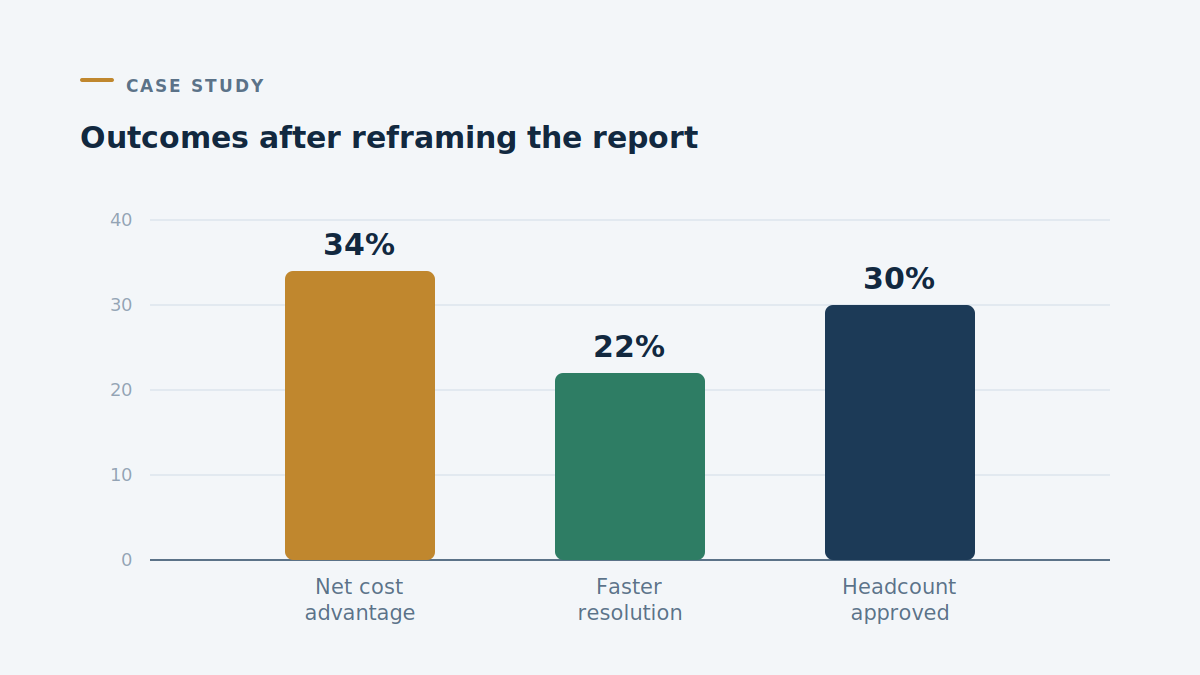
After restructuring the report around margin contribution and quantified operational-risk reduction, the center demonstrated a net 34% cost advantage plus a 22% cut in incident resolution time tied directly to a product launch. The board approved a 30% headcount expansion in the following cycle.
A European manufacturer’s engineering center faced a “why not outsource this?” review. It introduced a value-first dashboard tying its output to two product lines it had taken end-to-end, plus IP it now owned. The mandate shifted from support to full product ownership within two quarters the reporting reframed the center from vendor-replaceable to strategically embedded.
Cost-center framing vs. value-center framing
The same underlying performance reads completely differently depending on how it reaches the board. The reframe below is where GCC cost savings vs value creation stops being a slogan and becomes a reporting choice.
| Cost-center framing (what the center reports) | Value-center framing (what the board should hear) |
| Cost per FTE | Margin contribution to the parent P&L |
| Utilization rate | Capacity unlocked for revenue-generating work |
| Attrition percentage | Capability retention and delivery continuity |
| Tickets or tasks closed | Business outcomes and launches enabled |
| Headcount growth | Output and value created per head |
The left column is not wrongit is just not a board conversation. The right column is the same data, aimed at a decision.
Communicating GCC value to HQ: what most teams get wrong
The deepest mistake in communicating GCC value to HQ is reporting like an operations dedicated team when the audience thinks like an investor. Directors instinctively prove diligence, more metrics, more detail, more evidence of hard work. Boards read that density as a lack of clarity about what actually matters.
A second, quieter error: centers report success and hide risk, assuming a clean story wins funding. It does the opposite. A board that never hears about concentration risk, key-person dependency, or compliance exposure assumes the director either doesn’t see it or won’t disclose it both erode trust. Naming risk and showing you manage it is more persuasive than pretending it isn’t there.
The third pattern is treating reporting as a quarterly scramble rather than a standing discipline. The strongest centers maintain their value narrative continuously, so the quarterly business review is an assembly of known facts, not a new argument.
When reporting is improvised, the story changes every quarter and the board never builds conviction. Consistency of framing, quarter over quarter, is what converts a center from a line item into a trusted capability.
Before you present your next board pack
If you are preparing GCC ROI reporting to leadership and want to pressure-test the narrative before it reaches a CFO or board the framing, the metrics you’re leading with the forward ask it’s worth an external read from a team that has structured these reviews across multiple centers. Supersourcing has helped organizations rebuild the value story their centers were already delivering but not translating upward.
Send the current version of your board pack for a candid review of what a headquarters audience will and won’t respond to. Reach the team at mayank@engineerbabu.com or via https://supersourcing.com/contact-us/. Supersourcing works with GCC leaders on exactly this reframing vendor commitment required to have the conversation.
FAQ
How do you measure GCC ROI?
Measure it across three layers: net financial savings (fully loaded cost avoided, minus total cost of ownership), output value (revenue enabled, time-to-market improvement, capability the center now owns), and risk reduction (continuity, compliance, and concentration risk absorbed). Express the financial layer as a margin contribution to the parent, not just absolute savings, because that is the number leadership uses to compare investments.
What should a GCC report to headquarters?
Report the mandate, value delivered, output translated into business outcomes, risk reduced, and a specific forward ask. Leave operational metrics like utilization and ticket volume in an appendix. Headquarters funds outcomes and margin, so the report should lead with those and let detail surface only if the board pulls for it.
How do you present GCC value to the board?
Use a single dashboard, not a long deck, structured around value delivered, value in flight, and value at risk. Make the core story legible in ten seconds, attach a business consequence to every metric, and close with one clear investment task. A consistent GCC board report template keeps every quarter comparable, which is what builds board confidence over time.
What KPIs does a CFO care about for a GCC?
Margin contribution, revenue enabled or accelerated, time-to-market change, capability maturity, and quantified risk reduction. A CFO evaluates the center as a strategic investment with a payback and a return, not as a headcount pool, so cost-per-head and utilization rarely move the conversation on their own.
How often should a GCC report to leadership?
Formal board or CFO reporting typically runs quarterly, aligned to the parent’s business review cycle, with a lighter monthly operational update for functional sponsors. The cadence matters less than consistency of framing/reporting the same value axes every quarter is what lets leadership build conviction in the center.
What is a GCC business case?
A GCC business case is the structured justification for the capital and mandate committed to a center, originally built on cost arbitrage and later maintained on compounding value savings, output, and risk. The reporting version of the business case is what you defend quarterly; it should evolve well beyond the launch-era savings promise.
How do you avoid a GCC being treated as a cost center?
Report it as a value engine from the first quarter. Lead with margin and outcomes, quantify the risk it absorbs, and consistently tie its output to the parent’s growth. Centers treated as cost lines are the ones that are reported like cost lines.
