

Forty percent of enterprise applications will ship with task-specific AI agents by the end of 2026 up from less than 5% in 2025, according to Gartner. Recruiting software is at the front of that wave, and the marketing has outrun the reality by a comfortable margin.
Here is the pattern from evaluation calls every week: a talent leader watches a demo where an “autonomous agent” sources 400 candidates, personalizes outreach, and books interviews untouched. Then they sign and discover the agent needed human approval on every outreach batch and misread a third of non-linear resumes.
The gap isn’t because the technology is fake. AI recruiting agents RPO 2026 deployments are real, measurable, and in the right workflow slots dramatically faster than human-only recruiting. The gap exists because “automated” means three different things depending on who’s selling: a scripted ATS trigger, a copilot that drafts things for a recruiter to approve, or a genuinely agentic system that plans and executes multi-step work. Buyers who can’t tell these apart pay agentic prices for trigger-level automation.
Gartner projects that 40% of enterprise applications will integrate task-specific AI agents by the end of 2026, up from under 5% in 2025 the steepest single-year adoption curve Gartner has measured for an enterprise software capability. (Source: Gartner, August 2025 press release.)
This guide draws on a decade of running outsourced tech-hiring engagements 527+ delivered IT projects, a 98% candidate joining rate, and hiring cycles that consistently land interview-ready shortlists in 7–10 working days. It maps, stage by stage, what AI agents actually do unattended in 2026, where humans remain non-negotiable, what it all costs, and how to buy it without getting demo-washed.
TL;DR
This guide is for engineering, HR, and procurement leaders deciding whether to adopt agent-driven recruitment outsourcing in 2026, and how to evaluate providers who claim their hiring is "AI-powered." It walks the full lifecycle: defining requirements, vetting the AI stack, contracts, onboarding, delivery management, and exit.
The single most useful number in it: mature AI in recruitment outsourcing engagements now compress the job-description-to-shortlist window to 7–10 working days, versus the 30–45 days most in-house teams take for specialized tech roles but only when roughly 60–70% of the funnel is automated and the remaining 30–40% stays deliberately human.
By the end, you'll be able to classify any vendor's "AI agent" claim into one of three automation tiers, run a six-phase adoption process yourself, and pressure-test pricing against real 2026 cost bands instead of a sales deck.
What Are AI Recruiting Agents in RPO?
AI recruiting agents in RPO are autonomous software systems that plan and execute multi-step hiring tasks sourcing candidates, running screening conversations, scheduling interviews, and updating pipeline data inside a recruitment process outsourcing engagement, working toward a hiring goal with defined human checkpoints rather than waiting for step-by-step instructions.
What they are not:
- Not ATS automation. Rule-based triggers (“if status = rejected, send email X”) execute single pre-scripted steps. Agents plan sequences and adapt when a step fails.
- Not chatbots or copilots. A copilot drafts an outreach message for a recruiter to send. An agent decides who to contact, drafts, sends, reads the reply, and books the next step.
- Not a replacement for the RPO team. In every production deployment we’ve seen work, agents handle volume; humans handle judgment, negotiation, and final-round evaluation.
Why It Matters: The Business Case in Numbers
Before the lifecycle, the outcomes are at stake. Adopting agentic AI hiring inside an outsourced recruiting model moves four dials that a CFO actually tracks:
- Speed. Global average time-to-hire hovers around 44 days; agent-augmented outsourced pipelines routinely deliver interview-ready shortlists for tech roles in 7–10 working days, because sourcing, first-touch screening, and scheduling run in parallel around the clock instead of sequentially during recruiter hours.
- Cost per hire. SHRM benchmarks average US cost-per-hire near $4,700; automating the top of the funnel typically cuts total acquisition cost by 25–36% by reducing job-board spend, agency fees, and recruiter hours per requisition. For Indian tech hiring, that typically means landing in the ₹40,000–₹1,20,000 per-hire band via outsourced models instead of 8.33%+ of CTC through contingency agencies.
- Quality and conversion. LinkedIn’s Future of Recruiting research found recruiters using AI-assisted outreach are measurably more likely to make a quality hire than low-adoption peers. Downstream, disciplined agent-plus-human vetting is how joining rates reach 98% and contract-role drop-off stays under 1% numbers that are nearly impossible with volume-driven human-only sourcing.
- Risk. The 2026 compliance environment is unforgiving: EU AI Act obligations for high-risk hiring systems begin enforcement in August 2026, and NYC Local Law 144 already requires bias audits for automated employment decision tools. An RPO partner who owns audit trails and adverse-impact testing converts a legal exposure into a managed service.
The strategic point: none of these gains come from “using AI.” They come from correctly splitting the funnel between what agents do unattended and what humans must still own. That split is the entire subject of the walkthrough below.
The Core Problem: Why Most Buyers Get This Wrong
The failure mode is predictable, and it has numbers attached.
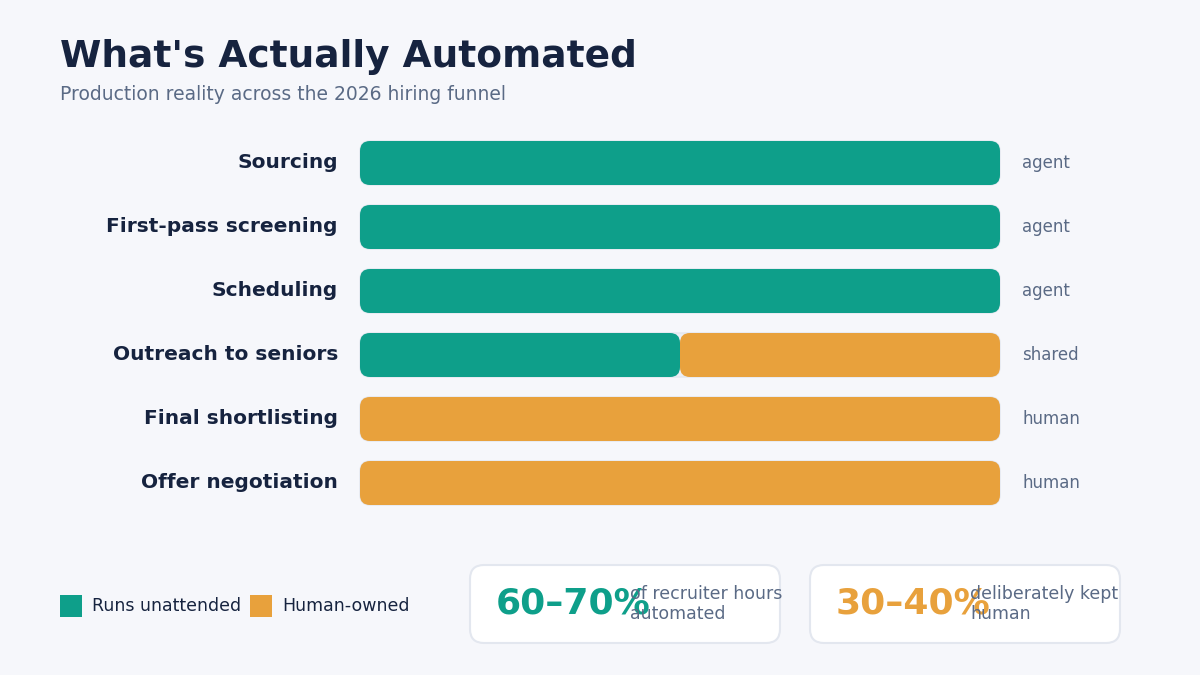
Teams overestimate automation coverage by roughly 2-3x. Vendor demos show end-to-end autonomy; production reality in 2026 is that agents reliably own the top and middle of the funnel sourcing, first-pass screening, scheduling, status updates which is roughly 60–70% of recruiter hours, not the 95%+ implied in demos. Gartner’s own hype-cycle survey data shows only 17% of organizations have deployed AI agents at all, while 60%+ intend to within two years: ambition is running far ahead of execution.
Teams underestimate governance until it breaks. Gartner predicts that by 2027, 40% of enterprises will demote or decommission autonomous AI agents because governance gaps surfaced only after a production incident. In recruiting, “production incident” means an agent that ghosted 200 candidates, sent outreach with hallucinated role details, or screened out a protected group all reputational and legal damage, discovered late.
Three costs balloon silently:
- Rework cost. Poorly configured screening agents pass through 2–3x more false positives, which senior engineers then burn interview hours rejecting. A panel hour for a senior engineer is ₹4,000–8,000 of loaded cost; multiply by 15–20 wasted interviews per role.
- Candidate-experience cost. Every automation misfire (double-booked interviews, tone-deaf messages) leaks into Glassdoor and LinkedIn. The impact of RPO on employer brand is real in both directions: a well-run engagement strengthens it, a badly automated one advertises your dysfunction at scale.
- Switching cost. Buyers who sign without data-portability terms discover at exit that their talent pool, screening history, and engagement data live inside the vendor’s agent platform and leave with them.
The rest of this guide is the antidote: a full walkthrough of doing it correctly, from first requirements to clean exit. But first, the classification system that makes every vendor conversation legible.
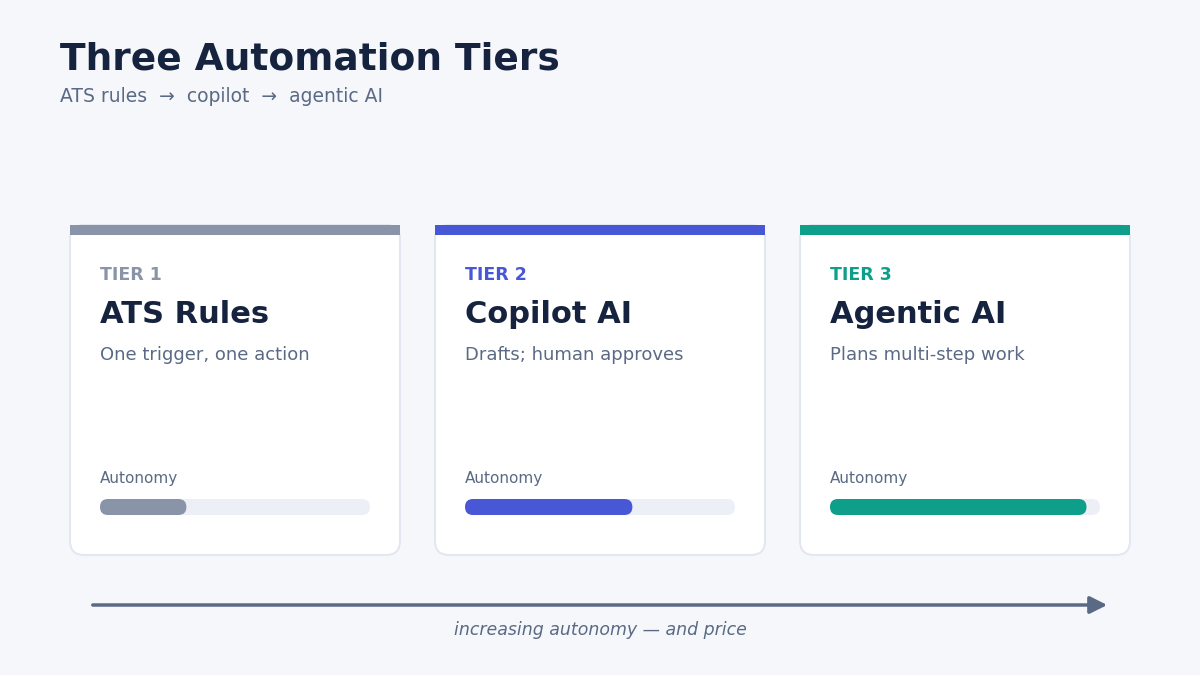
The Three Automation Tiers: How to Classify Any Vendor Claim
Every “AI-powered recruiting” claim you’ll hear in 2026 belongs to one of three tiers. Naming the tier out loud in a sales call changes the conversation instantly and it changes what you should pay.
Tier 1 Rule-based ATS automation. Deterministic triggers: status changes fire emails, keywords route resumes, forms auto-populate fields. This has existed since the 2010s. It’s genuinely useful, costs $500–3,000/month as tooling, and is not agentic no matter what the rebrand says.
The tell: the workflow breaks silently the moment anything unexpected happens.
Tier 2 Copilot / assistive AI. Generative models draft things for humans to approve: outreach messages, screening summaries, interview questions, JD copy. The human clicks send. This tier delivers real productivity recruiters report roughly 20% weekly workload reduction with assistive AI but throughput is still capped by human hours, because every action queues for approval.
The tell: headcount still scales linearly with requisition volume.
Tier 3 Agentic AI. Systems that hold a goal, plan multi-step sequences, execute across tools, handle unexpected responses, and escalate only at defined thresholds. Sourcing agents that run for days across channels; screening agents that conduct and score structured conversations; scheduling agents that negotiate calendar conflicts across time zones.
The tell: the provider can show you an exception log the record of when and why the agent escalated to a human because genuine autonomy produces one.
Three buying rules fall out of this classification:
- Never pay Tier 3 prices for Tier 2 delivery. Ask which specific pipeline steps run unattended in production; count them; anchor pricing to the answer.
- Tier-mixing is correct, not a compromise. The best 2026 pipelines run Tier 3 for sourcing and scheduling, Tier 2 for candidate-facing messaging to senior talent, and Tier 1 for status hygiene. A vendor pushing all-Tier-3 everywhere is optimizing for their compute economics, not your funnel.
- The tier boundary is a contract term. Per Phase 3 below, where autonomy starts and stops belongs in writing because vendors upgrade agent autonomy continuously, and you want notice before a model update moves a judgment call out of human hands.
The Complete Walkthrough: From First Requirement to Steady-State Delivery
This is the longest section deliberately. A reader starting from zero should be able to execute every phase below without prior RPO experience. Each phase ends with a checklist you can lift straight into a project doc.
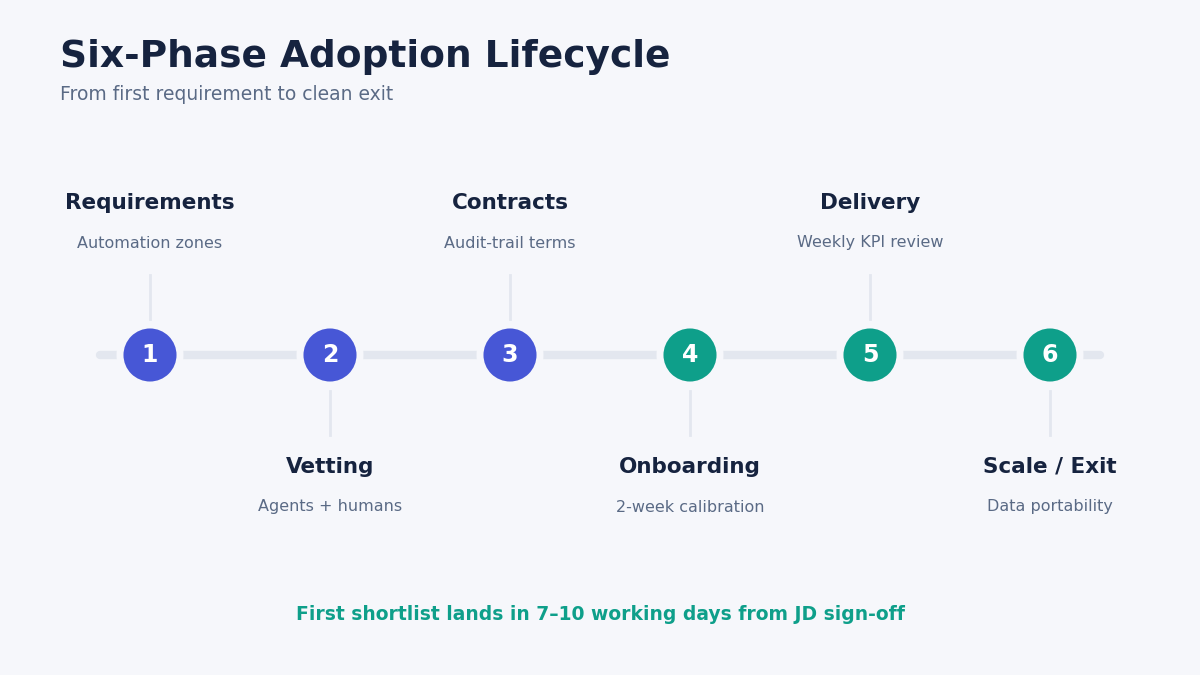
Phase 1 Defining Requirements (Week 0, Before Any Vendor Call)
Most engagements fail here, quietly, before a single agent runs. Requirements for automated recruiting workflows have two extra layers that traditional RPO scoping never needed: automation boundaries and data rules.
Scope the hiring demand first, in numbers:
- Role list with seniority bands (e.g., 4 backend engineers at 4–7 years, 2 data scientists at 3–5 years, 1 engineering manager).
- Monthly hiring velocity target (hires/month, not “aggressive hiring”).
- Budget bands per role for Indian tech hiring in 2026, typical annual CTC bands run ₹12–25 lakhs for mid-level engineers, ₹28–60 lakhs for senior/staff; US-remote equivalents commonly span $70k–160k. Write the bands down; agents source against them.
- Non-negotiables vs. trainables per role (e.g., Kubernetes required; Terraform trainable).
- Timeline: when does the first hire need to be in a seat, not just offered?
Then define your automation boundary the decision most buyers skip:
- Green zone (agent-autonomous): sourcing, resume parsing, knockout-question screening, scheduling, reminders, status updates.
- Yellow zone (agent-drafts, human-approves): personalized outreach at scale, screening summaries, rejection messages.
- Red zone (human-only): final shortlisting, compensation conversations, offer negotiation, any decision that legally counts as an “employment decision” under the EU AI Act or Local Law 144.
Phase 1 checklist:
- Role matrix with seniority, count, CTC band, and location policy
- Monthly velocity target agreed with hiring managers
- Green/yellow/red automation zones documented
- Data-residency and candidate-consent requirements listed (critical if hiring in the EU)
- Internal owner named one person, not a committee
The 3-day rule: if your hiring managers can’t turn around shortlist feedback within 3 working days, fix that before buying any automation. Agents compress vendor-side latency to hours; the bottleneck then moves to you, and no AI fixes an unresponsive panel.
Phase 2 Sourcing & Vetting: What Good Looks Like in 2026
Two things get vetted in this phase, and buyers routinely conflate them: the provider’s autonomous sourcing agents, and the provider’s humans. You need both to be excellent, and the evaluation methods are different.
What production-grade agentic sourcing actually does in 2026:
- Run continuous multi-channel search (job boards, GitHub/portfolio signals, internal talent pools, referral graphs) against your role matrix not one-time boolean searches.
- Ranks candidates on evidence (shipped work, verified skills, engagement history), not keyword density.
- Executes outreach sequences with reply-handling: reads responses, answers factual questions about the role, disqualifies or advances, and books screens.
- Runs structured first-pass screening knockout questions, async video or AI voice screening for high-volume roles, coding-screen orchestration for engineering roles.
- Feeds every action into an audit log with timestamps and decision rationale. If a vendor can’t show you this log, treat every autonomy claim as marketing.
What humans must still own in vetting and where elite providers differentiate:
- Technical deep-dives. Agents verify claims; senior engineers verify judgment. A screening layer that surfaces the top 2% of a talent pool is an agent+human artifact: the agent does breadth, the human does depth.
- Cultural and communication evaluation. Async video helps, but a 30-minute human conversation still predicts team fit better than any 2026 model.
- Career-narrative reading. Agents in 2026 still misread career breaks, founder stints, and non-linear paths at a meaningfully higher rate than experienced recruiters.
Red flags when vetting the provider itself (this mirrors a rigorous IT staffing agency vetting process, applied to AI claims):
- Can’t name which steps run fully unattended vs. human-approved. “It’s all AI-driven” is a non-answer.
- No adverse-impact testing on screening models, or no willingness to share methodology.
- Demo uses synthetic candidates only to ask to watch a live production pipeline (anonymized).
- Screening pass rates they can’t state. A provider that knows its funnel quotes conversion at every stage from memory.
- No named humans. If you can’t meet the account manager and lead recruiter pre-signature, bandwidth is shared and your requisitions will queue behind larger clients.
Benchmark to hold them to: for mainstream tech roles (backend, frontend, data), an agent-augmented pipeline should produce a vetted, interview-ready shortlist of 3–5 candidates in 7–10 working days from JD sign-off. Slower than 15 working days means the “agents” are mostly humans with a dashboard; faster than 5 days with no human screen means you’re getting keyword matches.
Phase 3 Engagement Models & Contracts
The commercial structure determines whether automation savings reach you or stay with the provider. Three dominant models in 2026, with the trade-offs that matter:
| Model | How you pay | Best for | Watch out for |
| Full RPO (managed funnel) | Monthly management fee + per-hire fee (typically $5k–15k/month management for a mid-market program, or bundled) | 5+ hires/month, sustained velocity | Minimum-volume commitments; agent-platform lock-in |
| Project / burst RPO | Fixed fee per hiring sprint (e.g., “12 engineers in 8 weeks”) | Funding-round scale-ups, GCC ramp-ups | Scope creep on role changes mid-sprint |
| Staff augmentation with AI sourcing | Monthly rate per deployed engineer | Trying talent before committing; contract roles | Rate opacity insist on a transparent split of engineer pay vs. margin |
Contingency agencies still price at 8.33 — 16% of annual CTC per hire in India (16–25% in Western markets). Agent-augmented models undercut that meaningfully at volume that’s the entire structural point of AI recruiting automation in outsourcing: the marginal cost of sourcing candidate #400 approaches zero, and a good contract passes that economics to you.
Contract clauses that are non-negotiable in 2026:
- Automation disclosure. The contract lists which pipeline steps run autonomously, which are human-reviewed, and requires notice before that boundary changes.
- Audit-trail access. You get exportable logs of agent decisions affecting your candidates, your evidence base for EU AI Act and Local Law 144 obligations.
- Bias-audit warranty. Provider warrants periodic adverse-impact testing on screening models and shares summary results.
- Data portability at exit. Candidate records, screening notes, and pipeline history export in a usable format within 15–30 days of termination, at no additional fee.
- NDA and IP protection covering role details, compensation data, and org design standard in serious engagements, still missing in cheap ones.
- Replacement guarantee. Mature providers replace a mis-hire within a defined window; a 7–10 day replacement commitment on contract roles is the strong end of the market. If a provider’s guarantee is 60–90 days “best effort,” their vetting confidence is telling you something.
Negotiation point from real engagements: providers price management fees assuming their agents cut their own labor cost 30–50%. Ask directly what percentage of your funnel runs autonomously then anchor the management fee against it. A provider automating 70% of top-of-funnel work should not charge 2019-era human-hours pricing.
Phase 4 Onboarding & Ramp-Up (Weeks 1–2)
Agent-driven engagements onboard faster than traditional RPO but only if the first two weeks are treated as calibration, not a waiting room.
Week 1 configuration and calibration:
- Kickoff with the named account manager and lead recruiter (day 1).
- Intake sessions per role: 45–60 minutes each with the actual hiring manager, not just HR. The agent’s sourcing profile is built from this vague intake produces confident, fast, wrong sourcing.
- Calibration batch: the provider runs agents against your first role and returns 8–10 sample profiles within 48–72 hours. You grade them. This feedback tunes ranking before real outreach begins.
- Access and tooling: ATS integration or provider-hosted pipeline, Slack/Teams channel, interview-panel calendars connected for scheduling agents.
- Messaging approval: you review and sign off the outreach sequences agents will send under your employer brand. Skipping this step is how companies end up with AI-drafted messages that misstate their own tech stack.
Week 2 first live cycles:
- First real shortlists land (the 7–10 working day clock started at JD sign-off).
- Daily async updates; one 30-minute sync mid-week to correct the course.
- Escalation thresholds agreed: e.g., agent auto-advances candidates scoring above threshold, auto-rejects below a floor, and routes the ambiguous middle band to humans. Deciding these numbers explicitly rather than accepting vendor defaults is the highest-leverage hour you’ll spend all quarter.
Onboarding friction we see repeatedly: calendar access. Scheduling agents are the single most reliable automation in the entire stack, and they’re routinely blocked for a week because panel members won’t connect calendars. Solve it on day 1 with an exec mandate; it’s worth 3–4 days of cycle time on every subsequent role.
Phase 5 Managing Delivery: Cadence, KPIs, and Who Watches the Agents
Steady-state management of AI screening RPO 2026 engagements is lighter than traditional RPO if you track the right numbers. Track activity metrics (candidates sourced, messages sent) and you’ll drown in vanity data agents generate effortlessly. Track conversion and quality instead.
The KPI set that matters (review weekly):
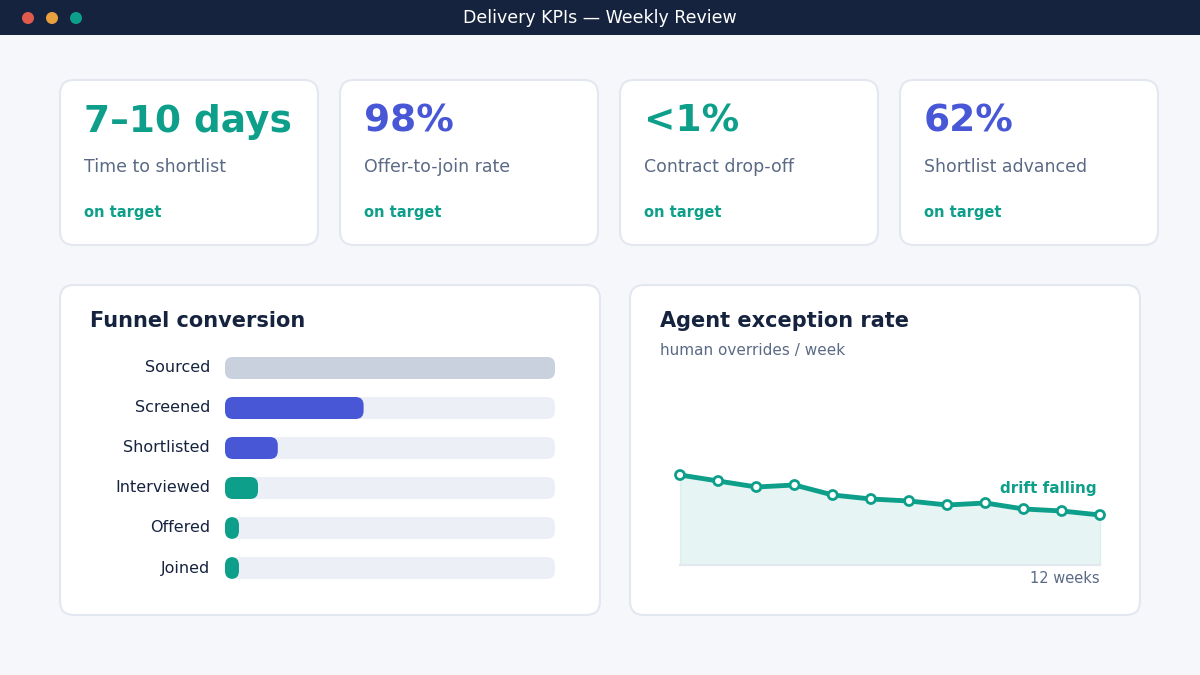
- Time-to-shortlist per role target 7–10 working days; investigate anything over 15.
- Shortlist-to-interview conversion hiring managers should advance 60%+ of shortlisted candidates. Below 40% means screening calibration has drifted; re-run Phase 4’s calibration batch.
- Interview-to-offer conversion healthy agent+human funnels run 3–5 interviews per offer for tech roles.
- Offer-to-join rate is the metric that exposes weak engagement practices; best-in-class engagements sustain 95%+ (our own benchmark across engagements is 98%).
- Early attrition / drop-off 90-day survival for contract roles; under 1% drop-off is achievable and should be contractual ambition, not fantasy.
- Agent exception rate how often humans overrode agent decisions this week, and why. A rising override rate is your earliest signal of model drift or a changed talent market.
Governance rhythm:
- Weekly: pipeline review (30 min), exception-log skim.
- Monthly: funnel-conversion review against targets; adverse-impact summary from the provider.
- Quarterly: re-validate the green/yellow/red automation boundary. Agent capability moves fast in 2026; a task that needed human review in Q1 may be safely autonomous by Q3 and occasionally the reverse, when a model update degrades a workflow.
Account structure to demand: one dedicated account manager as single-throat-to-choke, a named lead recruiter per role family, and no shared-bandwidth pooling where your requisitions compete with other clients for the same recruiter hours.
Dedicated structures cost slightly more and are worth it every time hiring is time-critical.
Phase 6 Scaling or Exiting
Scaling up is where the agentic model earns its keep: adding five more requisitions to a calibrated pipeline costs the provider marginal compute and modest recruiter hours, not five new headcount. Practical implications:
- Volume pricing should improve at scale renegotiate per-hire fees at 2–3x volume, because the provider’s marginal cost genuinely fell.
- New role families (say, expanding from backend into ML to the point where you’d hire machine learning engineers) need a fresh calibration batch. Budget 3–5 days; don’t let anyone skip it because “the agents already know your company.”
- GCC-scale ramps (30–100+ hires) should shift you from per-hire pricing to program pricing with quarterly hiring commitments and better unit economics.
Exiting cleanly the phase nobody plans and everybody eventually needs:
- Invoke the data-portability clause from Phase 3: full export of candidate records, screening histories, and pipeline states.
- Request the final audit-log archive you may need for compliance defense years later.
- Transfer in-flight candidates with named human handoffs; agent-only handoffs mid-process are where offer-stage candidates evaporate.
- Confirm deletion certification for candidate data the provider no longer has a lawful basis to hold.
- Exit interviews with the delivery team 60 minutes that captures why the engagement worked or didn’t, in detail no dashboard shows.
Replacement scenarios: if a hire fails inside the guarantee window, the pipeline that produced them still exists, a functioning agent-augmented provider re-runs it and delivers a replacement in 7–10 days, because sourcing intelligence was retained, not rebuilt.
That speed differential versus starting a new agency search (30–45 days) is the most underrated argument for the model.
Case Studies: What Agent-Augmented Outsourced Hiring Delivers
100+ engineers for a fintech scale-up (Paytm). Hiring at three-digit scale, the constraint wasn’t candidate volume, it was screening throughput and joining reliability. An AI-sourcing-plus-dedicated-recruiter model delivered 100+ engineering hires with shortlists landing in the standard 7–10 working day window per role family, while human-led offer management kept joining rates near the 98% benchmark rather than the 70–80% typical of high-volume Indian tech hiring.
Engineering team build-out at a credit platform (OkCredit). Early-stage velocity hiring across backend and data roles, where every mis-hire is expensive relative to team size. Agent-driven sourcing surfaced the top slice of a large applicant pool; founder-level interviews consumed hours only on pre-vetted candidates cutting hiring-manager interview load by more than half versus their prior agency-driven process.
Recruitment automation for a healthtech firm (Somnoware). A lean US-based team needed specialized engineering talent without building internal recruiting ops. The outsourced pipeline automated sourcing and screening, human technical vetting functioned as their entire talent function, demonstrating the model’s fit for companies below the headcount where an internal TA team makes economic sense.
Supersourcing ran each of these as a dedicated-bandwidth engagement one account manager, named recruiters, contractual replacement guarantees which is the delivery structure this guide assumes throughout.
Decision Framework: Which Model Actually Fits You
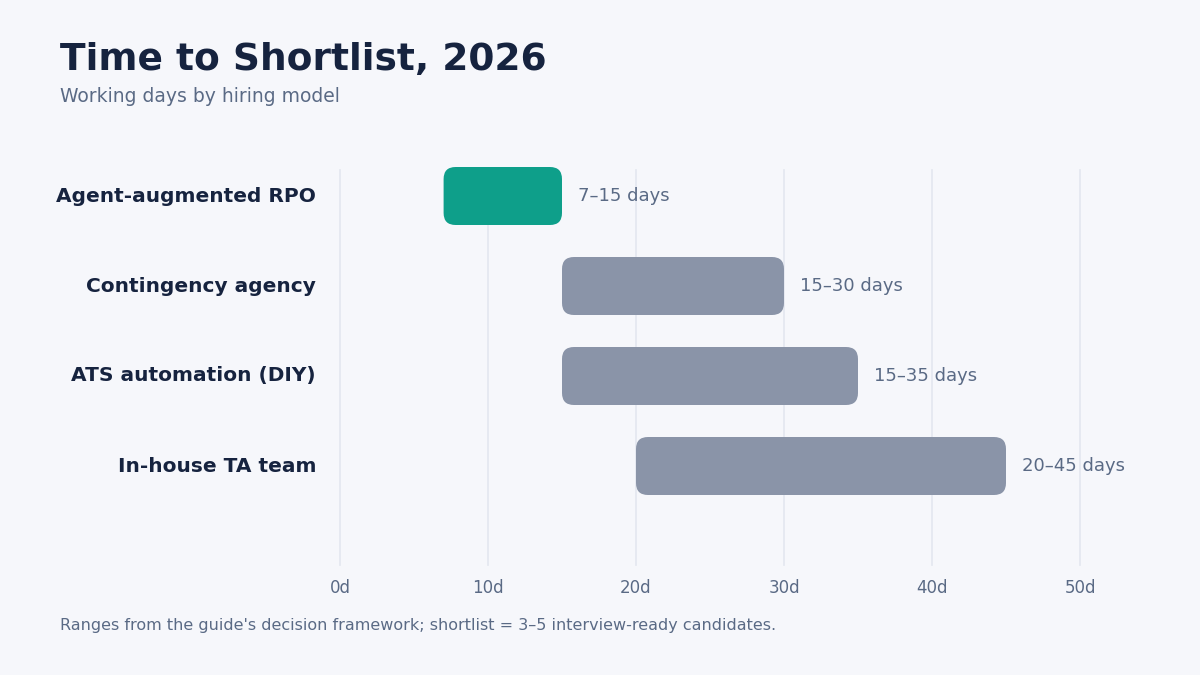
Score your situation against four factors. The table compares the realistic 2026 options for tech hiring:
| Factor | In-house TA team | Contingency agency | ATS automation (DIY tools) | Agent-augmented RPO |
| Speed to shortlist | 20–45 days | 15–30 days | 15–35 days (tool ≠ pipeline) | 7–15 days |
| Cost structure | Fixed salaries + tools (₹25–60L/yr for a 3-person team) | 8.33–25% of CTC per hire | $500–3,000/mo tooling + your team’s hours | Management fee + reduced per-hire fee |
| Quality control | Highest (your people) | Variable, incentive-misaligned | Depends entirely on your configuration skill | High if human checkpoints contractual |
| Compliance ownership | All yours | Mostly yours | All yours including AI-tool bias audits | Shared; provider owns audit trails |
| Scales with volume? | Linearly (hire more recruiters) | Yes, at linear cost | Somewhat | Yes, at falling marginal cost |
| Best when | 15+ hires/mo, permanent program | 1–3 senior/niche roles per year | Strong internal TA that needs leverage | 3–15 tech hires/mo, speed-critical |
The 60-second decision rule: count your next 12 months of planned tech hires. Under 10, use agencies for the senior roles and don’t buy a program. Ten to fifty, agent-augmented outsourcing is almost certainly your best unit economics.
Over 150 sustained, in-house TA and consider whether that belongs inside a GCC structure with its own embedded recruitment process outsourcing layer during the ramp.
What Most Teams Get Wrong
Pattern-level observations from evaluating and running these engagements the section to screenshot.
They buy autonomy as a feature instead of assigning it as a decision. The right question is never “how autonomous is your AI?” It’s “which of my funnel steps should run unattended, and what’s the evidence yours can?” Autonomy is a per-task risk decision that belongs to the buyer. Vendors who resist that framing are selling demos.
They automate the wrong end of the funnel first. The instinct is to automate screening (the judgment-heavy middle) because it’s the painful part. The correct sequence is the reverse: automate scheduling and status communication first (near-zero risk, instant candidate-experience gains), sourcing second, screening last and screening only with calibration and override tracking. Teams that invert this generate their worst candidate-experience incidents in month one.
They measure agent activity instead of funnel conversion. Ten thousand sourced profiles is not a KPI; it’s a computer bill. Shortlist acceptance rate and offer-to-join rate are the only numbers that can’t be gamed by an agent doing more of the wrong thing.
They treat compliance as the vendor’s problem. Under the EU AI Act’s high-risk classification for employment systems and NYC’s bias-audit law, the deploying employer holds obligations the vendor cannot absorb. If your provider can’t hand you decision logs and adverse-impact summaries on request, you are not the one exposed in August 2026.
They keep humans in the wrong loop. Human review gets spent approving individual outreach messages (low-stakes, high-volume exactly what agents do well) while nobody reviews the screening model’s rejection patterns (high-stakes, invisible). Flip it: audit the rejections monthly, let the messages flow.
They forget candidates can tell. By 2026, strong candidates receive dozens of AI-drafted messages weekly and have developed sharp detectors for it. Fully automated outreach to senior engineers converts measurably worse than agent-researched, human-sent outreach. The winning pattern for senior talent: agents do the research and drafting, a named human sends and owns the thread.
Cost & Timeline Reality Check
The section with the most competing content skips, so here it is in usable numbers. All figures are typical 2026 ranges for tech hiring; your quotes will vary with volume, seniority mix, and market.
Cost bands:
- Agent-augmented RPO, mid-market program (3–10 hires/month): management fee commonly $5,000–15,000/month (₹4–12L), plus per-hire fees typically 30–60% below contingency-agency percentages at equivalent volume.
- Per-hire economics, India tech roles: effective all-in cost per mid-level engineering hire typically lands at ₹40,000–1,20,000 through mature outsourced pipelines, versus ₹1–2L+ via 8.33% contingency on a ₹15–25L CTC.
- Burst/project pricing: a “10 engineers in 6–8 weeks” sprint is commonly quoted as a fixed package; sanity-check it against the per-hire math above plus a 15–25% urgency premium.
- What drives cost up: niche stacks (Rust, specialized ML infra), US/EU-remote sourcing, sub-5-day timelines, heavy human vetting layers, on-site requirements.
- What drives cost down: volume commitments, role standardization, your own fast feedback loops (every day of hiring-manager latency is money), multi-quarter contracts.
Timeline bands by scenario:
| Scenario | Realistic 2026 timeline |
| Single mid-level backend/frontend role | 7–10 working days to shortlist; 3–4 weeks to accepted offer |
| Senior/staff engineer, niche stack | 10–15 working days to shortlist; 5–7 weeks to offer |
| 10-engineer team build (mixed levels) | 6–9 weeks to fully staffed |
| 50+ hire GCC ramp | 2–4 months to steady-state velocity; first cohort in seat within 4–6 weeks |
| Replacement under guarantee | 7–10 days (pipeline already calibrated) |
Budget honestly for the hidden line items: internal panel hours (still 4–8 engineer-hours per hire even with maximal automation), 1–2 weeks of calibration on every new role family, and compliance review of the provider’s AI stack by your legal team before signature a half-day of counsel time that prevents the expensive version of that conversation later.
If You’re Mid-Decision: The Next Step
You now have the full playbook: the three automation tiers, the six-phase lifecycle, the KPI set, and the cost bands to negotiate against. If you’re actively evaluating providers, the highest-leverage move is a calibration test to give your top two contenders the same real job description and compare what comes back in 10 working days: shortlist quality, screening evidence, and how honestly they draw their own automation boundary.
If you’d rather run that test against a team that’s delivered 527+ IT projects on exactly this model dedicated bandwidth, contractual replacement guarantees, and shortlists in 7–10 working days Supersourcing will run a working session on your live role matrix, not a demo: book a consultation.
FAQ
What is an AI recruiting agent?
An AI recruiting agent is software that autonomously plans and executes multi-step hiring tasks searching for candidates, sending and responding to outreach, running structured screens, and scheduling interviews toward a defined hiring goal, with human checkpoints at decision points. It differs from ATS automation, which only fires single pre-scripted actions when a rule triggers.
What parts of recruiting are fully automated in 2026?
Reliably autonomous in production: multi-channel candidate sourcing, resume parsing, knockout-question screening, interview scheduling, reminders, and pipeline status updates roughly 60–70% of traditional recruiter hours. Still human-owned: final shortlisting, technical deep-dive evaluation, compensation negotiation, and any legally significant employment decision.
Is AI screening in recruitment outsourcing compliant with the EU AI Act?
It can be, but obligations fall heavily on you as the deploying employer. High-risk classification for employment AI means documented human oversight, decision logging, and bias testing. A credible RPO partner provides audit trails and adverse-impact summaries as standard deliverables; if yours can’t, the compliance gap is yours to close before enforcement tightens through 2026.
How much does an AI-powered RPO cost in 2026?
Typical mid-market programs run $5,000–15,000/month in management fees plus discounted per-hire fees; effective per-hire cost for Indian mid-level tech roles commonly lands at ₹40,000–1,20,000 all-in. That’s usually 25–36% below contingency-agency economics at volumes above 3–5 hires per month below that volume, agencies often remain cheaper.
Will AI agents replace recruiters?
The role is splitting rather than disappearing. Volume work (sourcing, scheduling, first-touch screening) is moving to agents; recruiter value is concentrating in intake quality, candidate persuasion, offer negotiation, and agent oversight. LinkedIn’s own data shows demand for recruiters with relationship-development skills rising sharply as routine tasks automate the humans moving up the funnel, not out of it.
How is agentic AI different from my ATS automation?
Your ATS executes rules you wrote: one trigger, one action. An agent is given a goal (“produce five interview-ready backend candidates”) and plans its own sequence searching, messaging, reading replies, adapting when a step fails. The practical test: if the workflow breaks the moment a candidate replies with an unexpected question, it’s automation, not an agent.
How long does implementation take?
For an outsourced engagement, two weeks: week one for intake, calibration batches, messaging approval, and calendar integration; week two for first live cycles. First shortlists land inside 7–10 working days of JD sign-off. Building equivalent agent workflows in-house on your own tooling typically takes 2–4 months to reach comparable reliability.
What should I ask a provider before signing?
Five questions separate real capability from demo-ware: Which pipeline steps run fully unattended in production today? What are your funnel conversion rates at each stage? How do you test screening models for adverse impact, and can I see summaries? What do I export at exit, and in what format? Who by name owns my account? If those answers come slowly, so will your hires. A working session against your actual role matrix will tell you more than any deck; that’s the conversation worth having next.
