

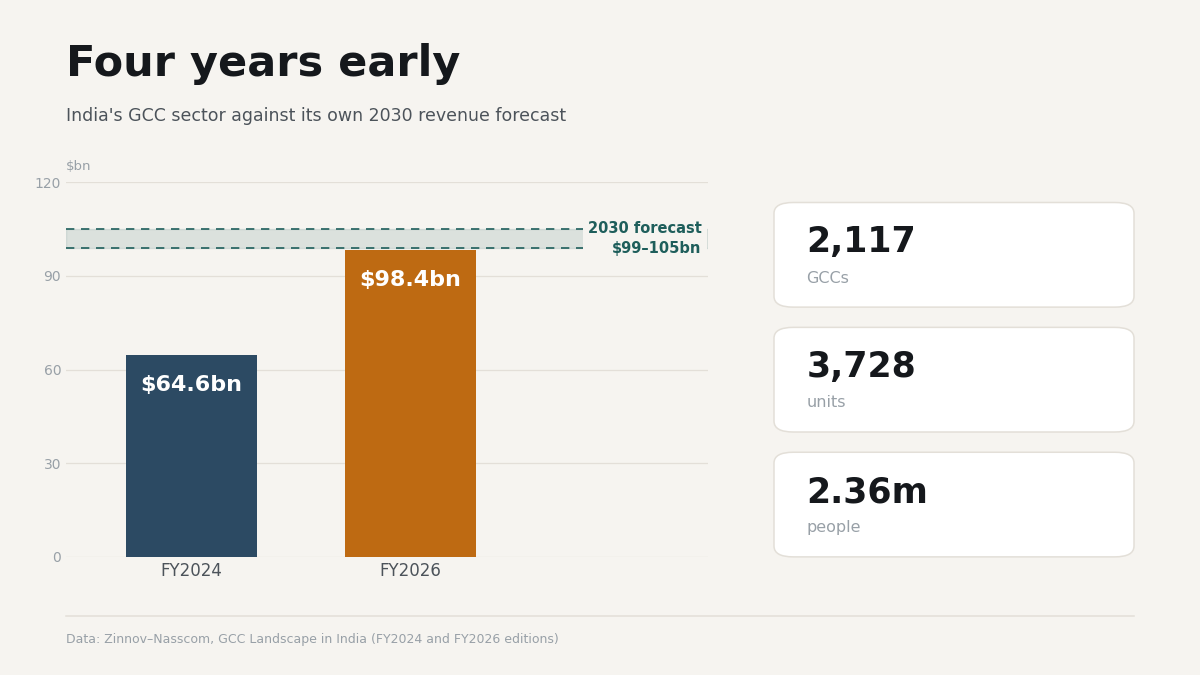
India’s captive sector just cleared its own 2030 forecast four years early. The Zinnov–Nasscom GCC Landscape in India 2026 puts the ecosystem at 2,117 GCCs, $98.4 billion in revenue and 2.36 million people as of March 2026 against a 2024 projection of $99–105 billion by 2030. The capability thesis was right. The gcc transfer pricing model sitting underneath it usually was not.
3,728 GCC units, 506 Forbes Global 2000 parents, and 32% growth in centre count. Every one of those centres is an associated enterprise with a mandatory annual arm’s length filing obligation in India.
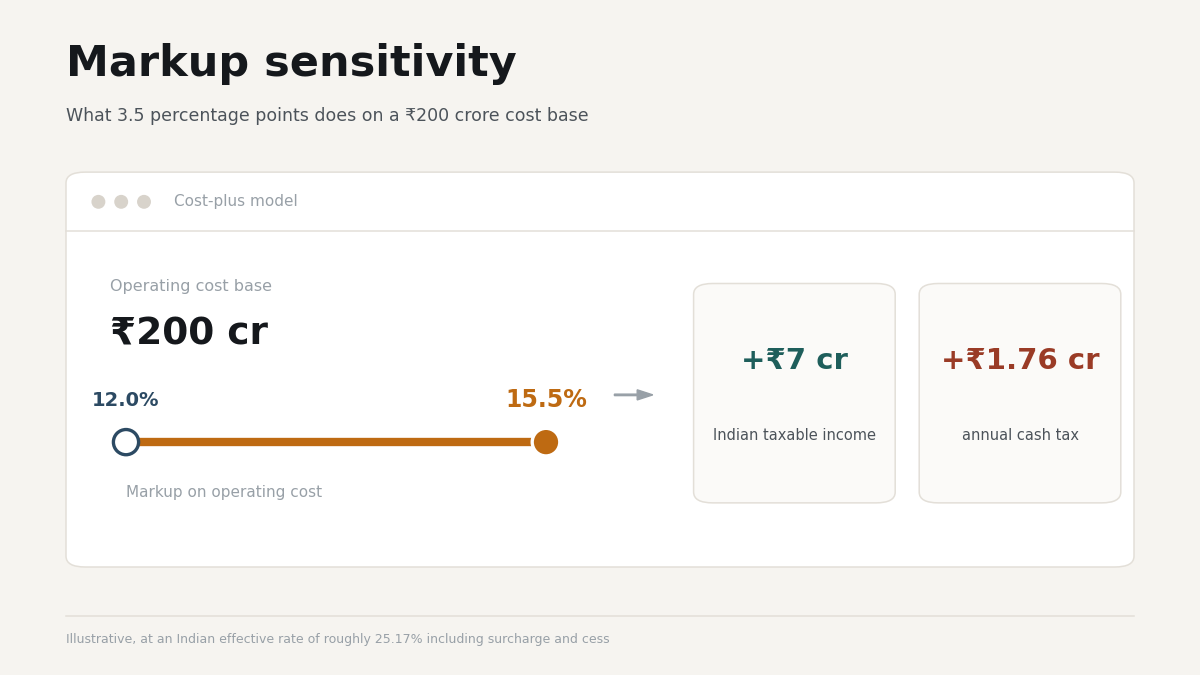
Here is the part that gets underestimated. For a captive, the single largest controllable driver of effective tax cost is not the city, not the entity form, and not the SEZ status. It is a percentage in one clause of an intercompany services agreement the markup applied to the operating cost base. On a ₹200 crore cost base, a 3.5-point difference in that percentage moves roughly ₹7 crore of taxable income across a border. Most parents set it once, in year one, using a number someone remembered from a different group.
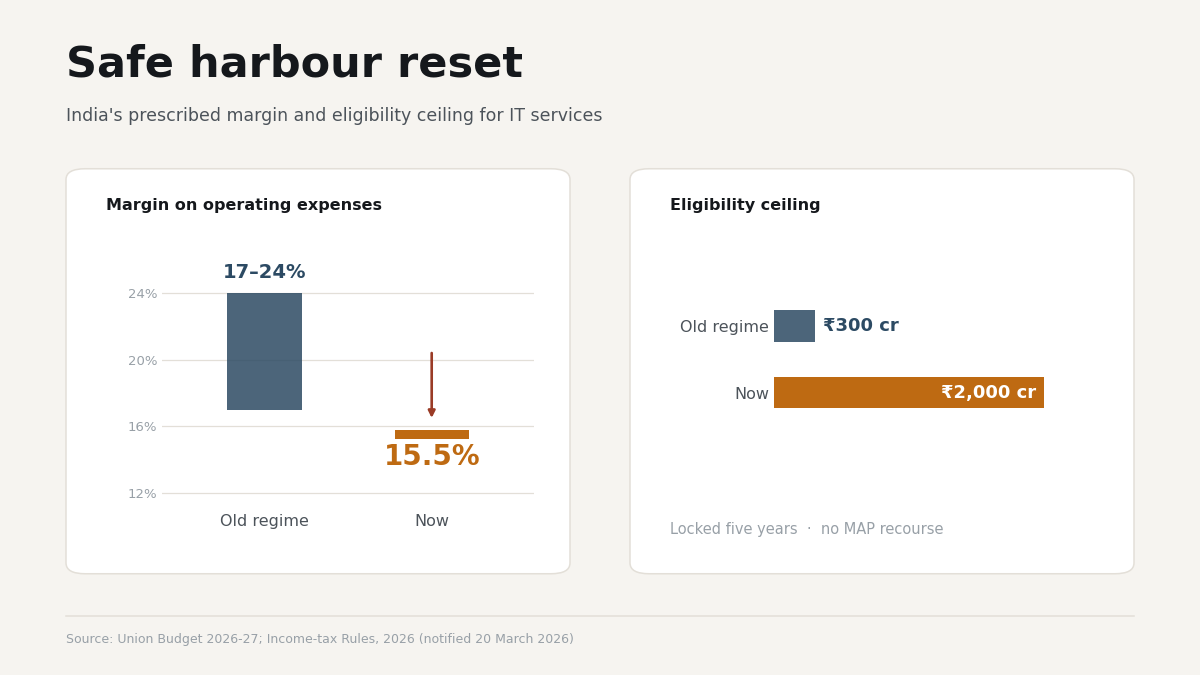
The ground has also just moved. Union Budget 2026-27 collapsed software development, ITeS, KPO and software contract R&D into a single “Information Technology Services” safe harbour category at a flat 15.5% margin on operating expenses, and lifted the eligibility ceiling from ₹300 crore to ₹2,000 crore, with automated approval valid for five years. The old regime ran 17%–24% with a ₹300 crore cap. For a large slice of the GCC population, the arithmetic that justified an annual benchmarking study in 2024 no longer holds in 2026.
This guide is written to be actionable, not advisory. It sets out how the cost-plus model actually works, what belongs in the cost base, how to choose between safe harbour, benchmarking and an Advance Pricing Agreement, and what the file needs to survive scrutiny. It is not a substitute for a qualified Indian tax advisor or chartered accountant section references, form numbers and margins change, and the numbers below should be confirmed against current CBDT notifications before you file anything.
TL;DR
This is a working guide to gcc transfer pricing for anyone who owns the intercompany charge between an Indian captive and its overseas parent: CFOs, group tax leads, GCC heads, and the finance teams who inherit the model in year two. It covers characterisation, cost base construction, markup selection, documentation, and audit defence, end to end.
The number to hold on to is 15.5%. That is India's new safe harbour margin on operating expenses for the consolidated IT services category, available up to ₹2,000 crore of transaction value and locked for five years once elected. It replaces a 17%–24% band that most captives quietly worked around with benchmarking studies. Whether 15.5% is a gift or a trap depends entirely on how your gcc cost plus markup compares today and on whether you can afford to give up Mutual Agreement Procedure relief for five years.
By the end, you should be able to build a defensible cost base line by line, pick a pricing route with reasons you can put in writing, run the monthly and year-end mechanics without a scramble in March, and recognise the four patterns that turn a routine captive into a litigated one.
What Is GCC Transfer Pricing?
GCC transfer pricing is the set of rules that determine how much an Indian Global Capability Centre may charge its overseas parent for services rendered. Because both entities are associated enterprises, Indian law requires the charge to reflect an arm’s length price in practice, a documented cost-plus markup applied to the GCC’s operating cost base.
Three things it is regularly confused with:
- It is not the same as your intercompany invoice. The invoice is the output. Transfer pricing is the analysis that justifies the number on it, and the two can diverge badly if invoicing runs on budget while the analysis runs on actuals.
- It is not a tax planning technique. For a captive there is very little to plan. The functional profile is narrow, the method is near-predetermined, and the realistic range of outcomes is a few percentage points wide.
- It is not the “Cost Plus Method.” Confusingly, the statutory method named Cost Plus Method (CPM) is a gross margin method almost nobody applies to a GCC. What captives actually use is the Transactional Net Margin Method (TNMM) with a net cost plus markup. Getting that label wrong in your own study is one of the fastest ways to invite a re-characterisation argument.
Why the Markup Number Decides More Than You Think
Cost arbitrage is why the centre exists; the markup is what determines how much of that arbitrage stays offshore versus lands in the Indian tax net. Three concrete consequences follow, and none of them are abstract:
- Direct cash tax. An Indian company taxed at roughly 25.17% (including surcharge and cess, under the concessional domestic rate) pays about ₹25 lakh more Indian tax for every additional ₹1 crore of markup income. Move a 500-person centre from a 12% to a 15.5% markup on a ₹200 crore cost base and you have added ~₹7 crore of Indian taxable income and ~₹1.76 crore of annual cash tax.
- Double taxation exposure. The parent’s own tax authority may not accept a markup that India insists on. A US or UK parent deducting a service fee at 15.5% when its own rules point lower creates a permanent difference that only a bilateral APA or a MAP settlement can clean up.
- Adjustment and penalty risk. India applies penalties of 2% of transaction value for documentation failures under the transfer pricing provisions, plus under-reporting penalties on the adjustment itself. On a ₹300 crore intercompany charge, a documentation slip is a ₹6 crore conversation before anyone argues about margins.
Two further outcomes are slower but larger:
- Exit and restructuring value. If you ever convert the captive into a full-risk entity, sell it, or fold it into a build-operate-transfer arrangement, the historical markup is the baseline a valuer and a tax officer will both reference.
- Group effective tax rate optics. With global minimum tax rules now in force across many parent jurisdictions, a captive sitting on an unusually thin margin invites questions from a second direction entirely.
The practical point: gcc transfer pricing is a recurring, compounding decision with a five-to-seven-year tail, being made once by whoever happened to be in the room during entity setup.
The Core Problem Most Buyers Face
What goes wrong is rarely the markup percentage. It is almost always the cost base, the paperwork, or the gap between what the agreement says and what the centre does.
Six failure patterns, in rough order of how often they surface:
- The cost base is never defined in writing. The agreement says “cost plus 15%” and stops. Nobody specifies whether that means total expenditure, operating expenditure, or operating expenditure excluding pass-throughs so the number changes whenever the controller changes.
- Markup is applied to pass-through costs. Group software licences, recruitment fees paid to third parties, travel rebilled to the parent. Marking these up inflates the charge and, in the reverse direction, marking up costs that should have carried a margin understates income. Both are adjustment candidates.
- Invoicing runs on budget with no true-up. Monthly invoices go out at budgeted cost, actual costs land 8–12% higher after a hiring push, and nobody reconciles until the statutory audit. The realised margin lands outside the range and the fix is now a prior-period adjustment.
- Stock-based compensation is ignored. ESOP and RSU charges pushed down from the parent are frequently left out of the cost base entirely, or included at book value with no view on whether a markup applies. This is one of the most commonly contested cost base items in Indian captive audits.
- Characterisation drifts and the pricing does not follow. The centre is documented as a routine service provider in year one. By year four it owns a product roadmap, holds patents in the parent’s name, and makes independent architecture decisions. The markup still says “routine.”
- Documentation is assembled after year-end. A study written in October to justify invoices raised in April is, by definition, not contemporaneous. It also cannot fix a cost base that was computed wrong twelve months earlier.
Every one of these is cheap to prevent in month one and expensive to unwind in year four.
The Walkthrough: Building a Defensible Cost-Plus Model, Phase by Phase
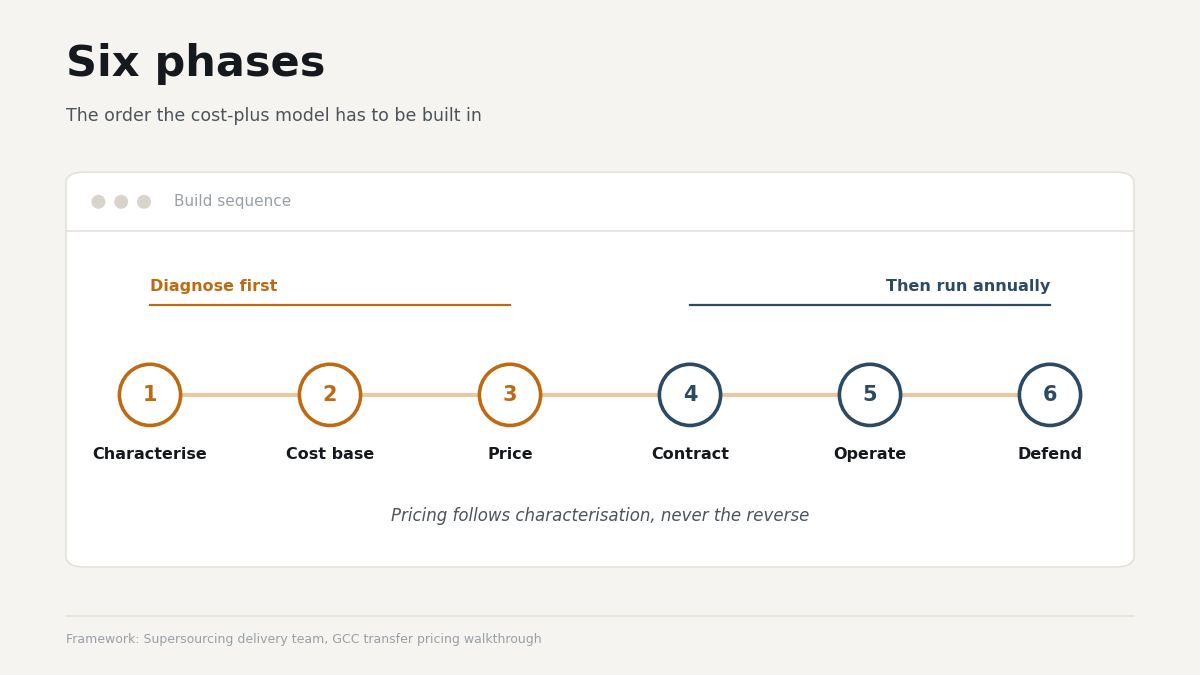
Six phases, in order. If you are standing up a new global capability center, run them in sequence. If you inherited an existing model, run Phases 1, 2 and 4 as a diagnostic first that is where the unexploded ordnance usually sits.
Phase 1 Characterise the entity before you price anything
Pricing follows characterisation, never the reverse. A captive’s markup is defensible only if the functional profile you documented matches what the centre actually does, and the fastest way to lose an audit is to price a routine service provider while operating a product organisation.
Run a genuine FAR analysis functions performed, assets employed, risks assumed and be honest about all three:
- Functions. List every workstream by headcount and cost. Application maintenance, platform engineering, data science, financial close support, customer operations, product management. Note which ones set direction versus execute against a spec.
- Assets. Identify who owns the IP created, where the patents and copyrights are registered, and the question that matters most is who controls the DEMPE functions (development, enhancement, maintenance, protection, exploitation) of that IP.
- Risks. Determine who bears market risk, credit risk, capacity risk and R&D failure risk. If the parent guarantees to pay cost plus a margin regardless of whether the project ships, the captive bears almost none.
- Decision rights. Who signs off on the roadmap, hiring plan, and technology choices. Written delegations of authority matter here more than org charts.
The routine-versus-entrepreneurial test: a routine service provider takes instructions, is reimbursed for costs, earns a stable margin, and has no upside if the product succeeds. An entrepreneurial entity funds its own development, absorbs failure, and expects returns above a service margin.
Cost-plus is the correct model only for the first. If the second describes your centre, TNMM on a cost base will understate Indian income and a Transfer Pricing Officer will eventually say so.
Red flag we see constantly: the TP study describes a “low-risk contract service provider” while the centre’s own careers page advertises end-to-end product ownership and its internal decks claim P&L accountability. Public-facing content is discoverable and it gets read.
Phase 2 Build the operating cost base, line by line
Setting gcc intercompany pricing starts with agreeing what “cost” means, in writing, before any invoice is raised. The markup percentage is a negotiation over a few points; the cost base can move the charge by 15–20% on its own.
What normally belongs in the base:
- Employee cost salaries, bonuses, employer PF and gratuity provisions, insurance, retention payments.
- Stock-based compensation recharged from the parent, at the charge recognised in the Indian books. Decide explicitly whether a markup applies and document the reasoning; this is a contested item, not a settled one.
- Facility and infrastructure rent, common area maintenance, power, security, facilities management.
- Technology laptops and depreciation, cloud consumption, per-seat tool licences, network and connectivity.
- Indirect and support finance, HR, legal, admin, and an allocated share of leadership time.
- Depreciation and amortisation on assets used to deliver the services.
What is normally excluded, or treated separately:
- True pass-throughs rebilled at cost with no value added third-party recruitment fees, specific travel incurred at the parent’s direction, statutory pass-through charges. Exclude from the marked-up base and invoice separately, with the treatment named in the agreement.
- Non-operating items interest income, dividend income, profit on asset sale, prior-period items, exceptional write-offs.
- Foreign exchange gains and losses, which need a stated, consistent policy on whether they are operating or non-operating in nature. Whichever you choose, apply it to both the tested party and the comparables set or the margin comparison is meaningless.
- One-time build costs entity incorporation, fit-out capitalised, pre-operative expenses. These need their own recovery mechanism rather than being smeared into a service margin.
Allocation keys, when costs are shared. Pick one per cost pool, document why, and do not change it mid-year:
| Cost pool | Defensible key | Weak key |
| Facilities, power, security | Seats occupied | Revenue share |
| IT infrastructure, licences | Active user count / device count | Headcount, undifferentiated |
| Leadership and admin time | Time-tracked FTE allocation | Flat percentage |
| Recruitment and L&D | Hires or trainees by function | Headcount at year-end |
A practical note on infrastructure-heavy centres: if your GCC runs its own data or platform infrastructure and you hire cloud engineers into a dedicated infra function, keep that cost pool and its headcount separately identifiable. Budget 2026-27 introduced a distinct safe harbour category for data centre services at a 15% margin on cost, and a blended cost base makes it impossible to claim.
Phase 3 Choose your pricing route: safe harbour, benchmarking, or an APA
Three routes exist, and the choice is a business decision with a five-year consequence, not a compliance formality.
The gcc safe harbour margin is now the reference point every captive is measured against, so start there even if you end up elsewhere.
Route A Safe Harbour (Section 167, Rule 89(2) read with Rule 91). Elect the prescribed margin, and the tax department accepts your declared price without a benchmarking argument.
- Single consolidated IT Services category covering software development, ITeS, KPO and software contract R&D.
- Margin: 15.5% of operating expenses (OP/OC).
- Eligibility ceiling: ₹2,000 crore of aggregate operating revenue from the foreign principal tested only in the first year of the block, which is a meaningful concession for a growing centre.
- Election is by filing the prescribed form (Form 49 under the 2026 Rules) with the Directorate of Income Tax (Systems) by the return due date; the system validates eligibility and responds within roughly two months, with no officer examination.
- Locked for five consecutive tax years. Withdrawal is possible only within six months of the end of Year 1.
- Unavailable for transactions with associated enterprises in Notified Jurisdictional Areas or in jurisdictions whose maximum income tax rate is below 15%.
- Electing safe harbour forfeits access to MAP for those transactions. This is the single most under-weighted term in the regime.
Route B Benchmarked TNMM. Build a comparable set of independent Indian service providers, compute the arm’s length range, and price inside it.
- Screen for functional comparability first a voice-based BPO is not comparable to a product engineering centre, and Indian tribunals have repeatedly said so.
- Apply quantitative filters consistently: turnover band, related-party transaction ratio, export earnings ratio, persistent losses, and functional dissimilarity.
- Use multiple-year data for the comparables where the rules permit, and make working capital adjustments where you can compute them reliably.
- Compute the arm’s length range as the 35th to 65th percentile of the dataset when you have six or more comparables. With fewer than six, the arithmetic mean applies with a 3% tolerance band. Fall outside the range and the median becomes your arm’s length price, not the nearest edge.
- Refresh annually. A study rolled forward without re-screening comparables is the weakest document in most files.
Route C Advance Pricing Agreement (Section 168). Negotiate the method and margin with CBDT in advance, for up to five prospective years plus a rollback of up to four prior years.
- India’s programme is now genuinely at scale: CBDT signed 219 APAs in FY 2025-26 the highest in any single year taking the cumulative total past 1,000 to 1,034, including 84 bilateral agreements, per the Ministry of Finance announcement. Bilateral APAs were concluded with 13 treaty partners, with first-ever agreements signed with France, Ireland, Indonesia and Sweden.
- A bilateral APA is the only route that eliminates double taxation risk on both sides of the border. A unilateral APA gives you Indian certainty only.
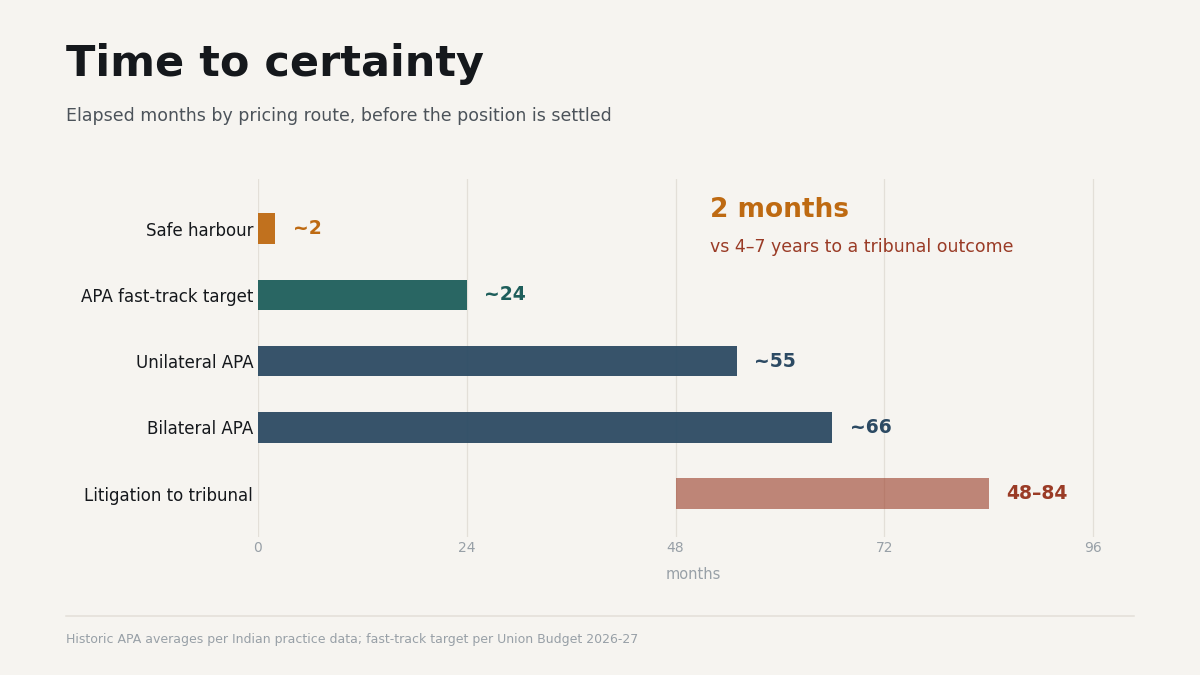
- Historic closure times were long averages around 55 months for unilateral and 66 months for bilateral cases. Budget 2026-27 introduced a fast-track unilateral APA mechanism for IT services with a two-year completion target, which materially changes the calculus for mid-sized centres.
- CBDT also issued a mechanism (via an Office Memorandum in March 2026) allowing taxpayers entering unilateral APAs to preserve the option of electing safe harbour for later years useful if you want APA certainty for open historical years and safe harbour simplicity going forward.
How to actually decide. Compare your current realised OP/OC against 15.5% and then stress-test three scenarios:
- Current margin comfortably above 15.5% safe harbour costs you nothing extra in tax (you are taxed on actual profits regardless) and buys certainty. Usually the easy yes.
- Current margin 12%–15.5% safe harbour means declaring additional income. Quantify the annual delta over five years and compare it against the cost of annual benchmarking plus expected audit and litigation spend.
- Current margin well below 15.5% with strong comparables supporting benchmarking or an APA is likely better, especially if the parent’s jurisdiction will not grant a corresponding deduction at 15.5%.
Phase 4 Paper it properly: the intercompany services agreement
The agreement is the first document a Transfer Pricing Officer reads and the last one most groups get around to drafting. In the GCC setup work Supersourcing supports, this is where the largest number of avoidable problems are found, usually a three-page template that was never updated after the centre tripled in size.
Clauses that carry real weight:
- Scope of services, described functionally rather than by project name, so it survives roadmap changes without amendment.
- Cost base definition, enumerating inclusions and exclusions explicitly with stock-based compensation, forex treatment and depreciation named, not implied.
- Markup and method, stating the percentage, the base it applies to (operating cost), and the method relied upon (TNMM).
- Pass-through mechanism, listing categories rebilled at cost and confirming no markup applies.
- Invoicing and true-up mechanics frequency, basis (budget or actual), reconciliation cadence, and the year-end adjustment clause. Without an express true-up right, a year-end correcting entry looks like an afterthought.
- Risk allocation, stating who bears capacity, delivery and market risk. This clause has to match Phase 1 or the whole file contradicts itself.
- IP ownership and assignment, with a clean chain from employee agreements through to the parent.
- Term, termination and compensation on termination, including notice period and treatment of wind-down costs.
Get the secondment structure right at the same time. Where parent employees are deputed to the Indian centre or Indian staff to the parent the arrangement’s substance decides whether you have a service arrangement, a manpower supply arrangement, or a permanent establishment of the parent in India.
Indian jurisprudence has consistently looked past the paperwork to who exercises control, who bears the employment risk, and whose payroll ultimately funds it. The safest structures put seconded staff on the Indian entity’s payroll for the duration, with the Indian entity exercising control and bearing the cost within the marked-up base.
For a full entity-level view of the corporate and regulatory documentation that sits alongside this, see the checklist of legal documents required for GCCs in India the TP file and the entity file need to tell the same story.
Phase 5 Run the monthly and year-end mechanics
Most margin failures are operational, not analytical. The model was right in April and wrong by March because nobody ran the loop.
The monthly cycle:
- Close the Indian books and compute actual operating cost for the month, split between markup-bearing and pass-through pools.
- Raise the intercompany invoice either on actual cost plus markup, or on budgeted cost with a tracked variance.
- Log the cumulative realised OP/OC against target in a single running schedule that finance, tax and the GCC head can all see.
- Confirm the invoice was actually settled. Unpaid intercompany receivables ageing past normal credit terms create a separate transfer pricing question about deemed interest.
The quarterly checkpoint:
- Recompute year-to-date OP/OC and project the full-year landing point.
- Flag any new cost category that entered the books: a new lease, a new tool, a first-time ESOP recharge and decide its treatment before it compounds.
- Confirm nothing has changed functionally: new function added, new decision rights granted, IP being created that was not contemplated.
The year-end true-up, done in the right order:
- Compute final actual operating cost for the year.
- Compute the target charge as actual cost × (1 + agreed markup).
- Compare to invoiced-to-date and raise a single debit or credit note before the books close.
- Ensure the adjustment is reflected in the statutory financials, not only in the tax computation. A tax-only adjustment with no book support is fragile.
- Confirm the settlement actually moves cash within normal credit terms.
The 90-day rule worth knowing: where a primary transfer pricing adjustment of ₹1 crore or more arises, India’s secondary adjustment provisions require the resulting excess money to be repatriated within a prescribed window (90 days from the relevant trigger date).
Miss it and the amount is treated as a deemed advance to the associated enterprise, attracting notional interest year after year. There is a one-time exit, an additional tax of 18% plus surcharge and cess, roughly 20.97% effective which is often cheaper than carrying perpetual imputed interest, but it is a decision to make deliberately rather than by default.
Phase 6 Document, file, and defend
Nobody enjoys this part, but gcc transfer pricing documentation is where penalties actually attach and it is assessed on transaction value rather than on any adjustment.
Annual compliance stack for a typical Indian GCC:
- Local File / TP study contemporaneous documentation covering the FAR analysis, method selection, comparables, computation and conclusion. Required regardless of whether you elected safe harbour.
- Accountant’s report on international transactions the report historically filed as Form 3CEB, renumbered under the 2026 Rules (commonly cited as Form 48; confirm the current form number before filing). Due one month ahead of the transfer-pricing-case return deadline.
- Master File required where consolidated group revenue exceeds ₹500 crore and the entity’s international transactions exceed ₹50 crore (or ₹10 crore for intangibles).
- Country-by-Country Report where consolidated group revenue exceeds roughly ₹6,400 crore, filed by or notified through the ultimate parent.
- Safe harbour election form, if applicable, plus the accountant’s certificate confirming the margin condition, and annual statements for years two through five of the block.
Penalty exposure, so the numbers are on the table: 2% of transaction value for failure to maintain or furnish prescribed documentation, 2% for failure to furnish information sought during proceedings, a fixed penalty for failure to file the accountant’s report, and under-reporting penalties of 50% (or 200% for misreporting) on tax on any adjustment. Documentation penalties bite on transaction value, not on the adjustment which is why a ₹300 crore captive with a thin file has more exposure from paperwork than from pricing.
Use the block assessment option. The Finance Act 2025 introduced a block transfer pricing assessment: once the TPO determines the arm’s length price for a base year, the taxpayer may elect to apply that determination to similar transactions for the following two years, with the TPO validating the election within one month. For a captive with a stable functional profile, this collapses three assessment cycles into one. It does not remove the annual documentation requirement you still benchmark and file every year but it removes two rounds of argument.
What an audit actually looks like. Expect the sequence: reference to the Transfer Pricing Officer, information requisitions, a show-cause on comparables selection or cost base composition, a TPO order, a draft assessment order, then either the Dispute Resolution Panel or the first appellate authority, then the Income Tax Appellate Tribunal. Realistic elapsed time from filing to tribunal outcome is four to seven years. That timeline is the strongest argument for safe harbour or an APA that most CFOs never model.
Three Build Patterns Worth Studying
These are anonymised composites of engagement patterns rather than named client disclosures, and the figures are illustrative bands, not published client metrics. Supersourcing’s GCC work spans hiring and building support for enterprises including Swiggy, Paytm, Razorpay, Chargebee, Adani and Apollo Hospitals; the transfer pricing patterns below are the recurring structural ones.
Pattern 1 The cost base that was 18% too small. A ~400-person engineering captive for a US SaaS parent was invoicing cost plus 14%, computed on payroll and rent only. Cloud consumption, tool licences, ESOP recharge and allocated leadership cost had never entered the base. Once rebuilt, the base grew by roughly a fifth and the same 14% markup produced a materially higher Indian charge meaning three prior years had been under-invoiced against the group’s own agreement. The remediation cost more in advisor time than five years of correct compliance would have.
Pattern 2 The characterisation that outgrew its markup. A fintech captive documented in year one as a routine maintenance provider had, by year four, taken over product management, architecture and a hiring plan it set itself. Nothing in the pricing had changed. The fix was not a higher markup applied retrospectively; it was splitting the entity’s cost base into a routine service pool and a higher-margin development pool with separate documentation for each, prospectively.
Pattern 3 The safe harbour election that saved four years of argument. A mid-sized healthtech GCC running a realised OP/OC comfortably above the prescribed margin had been spending on annual benchmarking studies and had two years under assessment. Electing safe harbour cost nothing in additional tax; actual profits exceeded the prescribed margin anyway and converted an open-ended dispute risk into a five-year settled position. The trade-off accepted knowingly: no MAP recourse for those years.
Decision Framework: Safe Harbour vs Benchmarking vs APA
Run your own model through this comparison rather than accepting a default. The right answer changes with transaction size, margin position, parent jurisdiction and appetite for open years.
A four-question shortcut. Answer these in order and the route usually declares itself:
- Is our realised OP/OC at or above 15.5% today, and likely to stay there? → If yes, safe harbour is the default.
- Is our transaction value under ₹2,000 crore in the first year of the intended block? → If not, the safe harbour is closed and you are choosing between benchmarking and an APA.
- Will the parent’s tax authority accept a deduction at the Indian margin? → If no, only a bilateral APA closes the gap.
- Do we have open assessment years we want to settle? → If yes, an APA with rollback does work that safe harbour cannot.
Where the functional profile itself is unclear, a centre doing a genuine mix of routine support and independent development the sequencing matters more than the route. Split the cost pools and document each separately before you elect anything; groups that need help structuring that split usually reach for external IT consulting services alongside their tax advisor, because the answer depends on operating reality as much as on tax law.
What Most Teams Get Wrong
The mistake is treating cost-plus as a formula rather than a system. Teams argue for weeks about whether the markup should be 14% or 16%, then compute it on a cost basis nobody defined, invoice it against a three-page agreement nobody updated, and reconcile it in a spreadsheet one person maintains. The percentage is the least contestable part of the model. The cost base, the agreement and the true-up mechanism are where adjustments actually come from.
Five more patterns, stated plainly:
- Calling it the “Cost Plus Method” in your own documentation. CPM is a gross-margin method. Captives apply TNMM with a net cost plus markup. Using the wrong statutory label in the study you filed hands the other side a free opening.
- Assuming 15.5% is automatically the cheap option. It is only cheap if your realised margin already sits above it. Below it, safe harbour is a five-year commitment to declare additional Indian income and it takes MAP off the table for the same period, which is precisely when you would want it.
- Treating the intercompany agreement as a formality. A TPO reads the agreement against the conduct. Where they diverge, conduct wins and the agreement becomes evidence against you rather than for you.
- Under-invoicing quietly and calling it conservatism. A captive charging below arm’s length is not being cautious; it is understating Indian taxable income, which is the exact thing the regime exists to catch. Conservatism means a well-supported margin, not a low one.
- Ignoring the secondment file entirely. Parent employees embedded in the Indian centre on parent payroll, with parent-controlled deliverables, is the classic fact pattern for a service permanent establishment argument. It sits outside the markup conversation and is often more expensive.
There is a reason transfer pricing captive structures generate more disputes than third-party outsourcing ever does: the pricing is set internally, by people with no counterparty pushing back. The uncomfortable common thread is that almost none of this requires a tax specialist to spot. It requires someone to read the agreement, the ledger and the org chart in the same week and notice they describe three different companies.
Cost & Timeline Reality Check
Indicative ranges from the Indian market. Advisor fees vary widely by firm tier, entity complexity and city, so treat these as planning bands and get quotes.
| Workstream | Typical cost band (India) | Typical timeline |
| First-year TP study for a single-transaction captive | ₹2.5–8 lakh | 3–6 weeks |
| Annual TP study refresh, stable profile | ₹2–5 lakh | 2–4 weeks |
| Accountant’s report on international transactions | ₹0.75–2 lakh | 1–2 weeks |
| Safe harbour election + accountant’s certificate | ₹1–3 lakh | Filing by return due date; system validation ~2 months |
| Master File (where thresholds crossed) | ₹2–6 lakh | 3–5 weeks |
| Cost base rebuild / model diagnostic | ₹3–10 lakh | 4–8 weeks |
| Unilateral APA (advisor fees, full cycle) | ₹25–75 lakh+ | Historically ~55 months; fast-track targets ~2 years |
| Bilateral APA (advisor fees, full cycle) | ₹50 lakh–1.5 crore+ | Historically ~66 months |
| TP audit defence through DRP/CIT(A) | ₹10–40 lakh per year under dispute | 2–4 years to first appellate outcome |
| Full litigation cycle to tribunal | Cumulative, often multiples of the above | 4–7 years from filing |
Treat gcc to compliance as a fixed annual line in the centre’s operating budget rather than a project cost, because it recurs for as long as the entity exists.
What drives cost and risk up:
- Multiple transaction types in one entity (services plus IP plus intra-group financing plus recharges).
- A cost base with contested items, significant stock-based compensation, large pass-throughs, capitalised build costs.
- Functional drift without corresponding documentation updates.
- Secondment arrangements with parent-payroll staff.
- Open assessment years stacking up before anyone seeks certainty.
- A margin sitting close to a range boundary, where a small cost base error changes the compliance outcome.
What drives cost and risk down:
- One clean transaction type, one method, one documented cost base.
- Safe harbour election where the realised margin already clears the prescribed threshold.
- A block assessment election on a stable profile.
- Monthly OP/OC tracking rather than an annual reconstruction.
- An agreement that matches conduct, refreshed whenever the functional profile changes.
Calendar to hold in your head: compute and lock the cost base definition in month one of the financial year; track OP/OC monthly; run the quarterly functional review; close the true-up before books close; file the safe harbour election and accountant’s report by the statutory dates in the following November. Nothing in that list can be done well in the last three weeks.
Where to Take This Next
If you are mid-decision, the useful next step is not a bigger deck. It is a two-hour review of three documents against each other: your intercompany services agreement, your last twelve months of intercompany invoices with the cost base behind them, and your current org chart with decision rights marked. If those three tell the same story, your model is probably fine and your remaining question is simply whether to elect safe harbour. If they do not, you have found your priority for this quarter before you have spent anything.
For groups still deciding on entity structure, location, first-wave hiring and the operating model the pricing has to describe that review works better before the centre scales than after. Supersourcing’s GCC practice covers the build side of this: entity and operating model design, first-wave technical hiring, and the delivery structure your transfer pricing file eventually has to document. Bring your tax advisor to the same table; the pricing question and the operating design question are the same question asked twice.
One next step: book a GCC structuring conversation and bring the three documents above. We will tell you what we would fix first, whether or not you work with us.
FAQ
What is transfer pricing for a GCC?
GCC transfer pricing is the requirement that the price your Indian captive charges its overseas parent reflects what independent parties would have agreed. In practice, the captive is remunerated on a cost-plus basis, with a markup on its operating cost base supported either by a benchmarking study, a prescribed safe harbour margin, or an Advance Pricing Agreement.
What markup do captive centres in India charge their parents?
Most Indian captives operate on a net markup applied to operating costs. India’s prescribed safe harbour margin for the consolidated Information Technology Services category is 15.5% of operating expenses, replacing an earlier 17%–24% band. Benchmarked outcomes for genuinely routine service providers commonly land in a similar region, with higher margins for true contract R&D profiles.
Do I still need a transfer pricing study if I elect safe harbour?
Yes. Safe harbour removes the benchmarking argument, not the documentation obligation. You must still maintain contemporaneous records, obtain the accountant’s report on international transactions, file annual statements across the five-year block, and meet Master File and Country-by-Country obligations where the group crosses those thresholds.
What happens if my GCC’s margin falls below the safe harbour rate after I elect?
You are required to declare income at the prescribed margin regardless of the actual outcome, which means paying tax on income you did not earn. Withdrawal is only available within six months of the end of the first year of the block, so the downside scenario has to be modelled before election not after a bad year.
Which costs go into a GCC’s cost base?
Operating costs incurred to deliver the services: employee cost including statutory provisions, recharged stock-based compensation, facilities, technology and cloud, allocated support functions, and depreciation on assets used. Excluded are non-operating items, prior-period and exceptional items, and genuine third-party pass-throughs rebilled at cost without a markup.
Can a GCC create a permanent establishment for its overseas parent?
It can, and secondment arrangements are the usual trigger. Where parent employees work in India under parent control, on parent payroll, delivering parent obligations, Indian authorities have argued successfully that a service permanent establishment exists. Structuring secondments so the Indian entity employs, controls and bears the cost is the standard mitigation.
How long does an APA take in India, and is it worth it?
Historically around 55 months for unilateral and 66 months for bilateral agreements, though Budget 2026-27 introduced a fast-track unilateral route for IT services targeting two years. It is worth it when the transaction is large, the parent jurisdiction is likely to contest the Indian margin, or you have several open years to settle a bilateral APA is the only mechanism that removes double taxation on both sides.
What are the penalties for GCC transfer pricing non-compliance?
Two percent of transaction value for failing to maintain or furnish prescribed documentation, a further 2% for failing to furnish information during proceedings, a fixed penalty for not filing the accountant’s report, and under-reporting penalties of 50% (or 200% for misreporting) on tax on any adjustment. Because documentation penalties apply to transaction value rather than to the adjustment, a large captive with a weak file carries meaningful exposure even where its pricing is defensible.
We are still deciding between a captive and an outsourced team. Does any of this apply?
Only the captive route creates an intercompany pricing obligation, because only there are you transacting with an associated enterprise. A third-party vendor contract is priced commercially and sits outside these rules. If you are genuinely undecided, model both: the compliance overhead described above is a real line item in the captive business case and is routinely left out of it. That comparison is a sensible thing to walk through with someone who has built both.
