

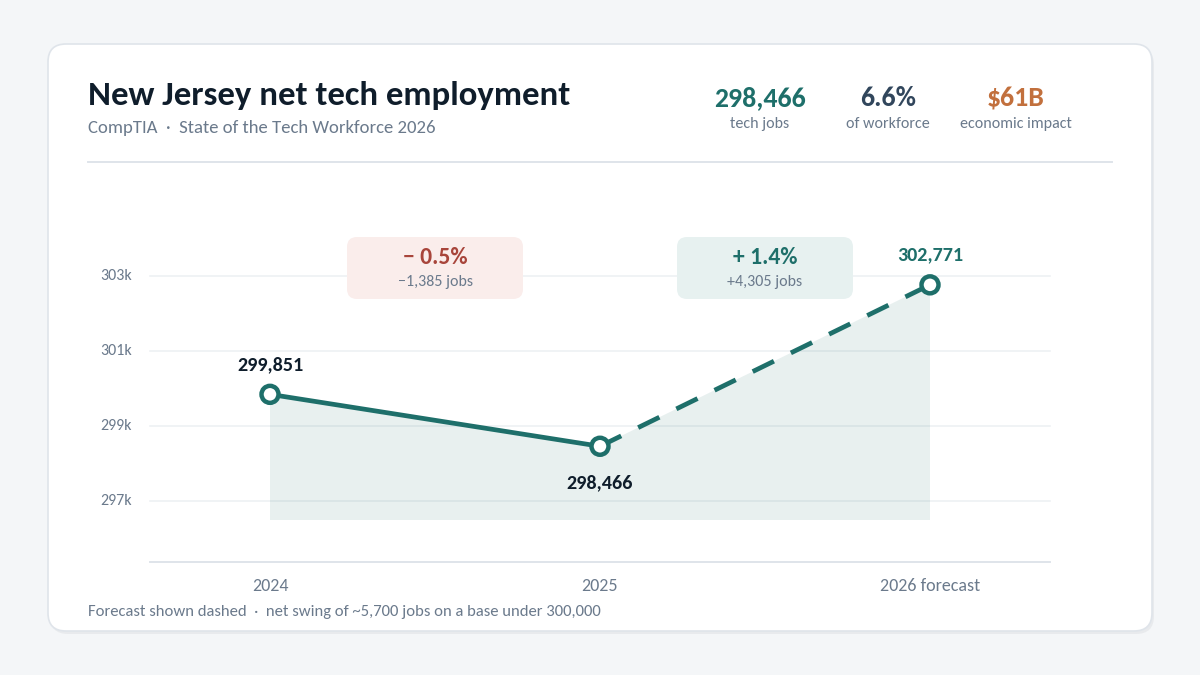
New Jersey lost an estimated 1,385 tech jobs in 2025. It is forecast to add 4,305 in 2026. Both numbers describe the same market and if your hiring plan treats them as a contradiction, you are going to misprice every offer you make this year.
CompTIA’s State of the Tech Workforce 2026 puts the state at 298,466 tech jobs, roughly 6.6% of the total workforce, generating about $61 billion in economic impact, with net tech employment projected to grow 1.4% and push the state past 303,000 workers. That is not a boom. It is a re-composition: roles are being retired and re-created at the same time, in different skill categories, at different price points.
New Jersey’s tech workforce contracted 0.5% in 2025 before an expected 1.4% rebound in 2026, a net swing of nearly 5,700 jobs on a base under 300,000.
The practical consequence is that headcount planning built on 2023 assumptions now fails in two directions at once. Generalist application-development roles have more available candidates than they did two years ago, so teams over-index on how easy those hires feel. Meanwhile, data platform, cloud infrastructure, and security engineering roles have fewer qualified local candidates than the job-board volume suggests, and those are the roles blocking your roadmap.
IT hiring in New Jersey now demands that you separate the two categories before you write a single job description, because they need entirely different sourcing motions, budgets, and timelines. Treating them the same is the single most expensive mistake we see in this state’s hiring cycles.
TL;DR
This guide covers how to hire technology talent in New Jersey in 2026 role mapping, sourcing models, salary bands, compliance, and vendor selection. It is written for engineering leaders, founders, and TA teams who own a headcount plan and a delivery date.
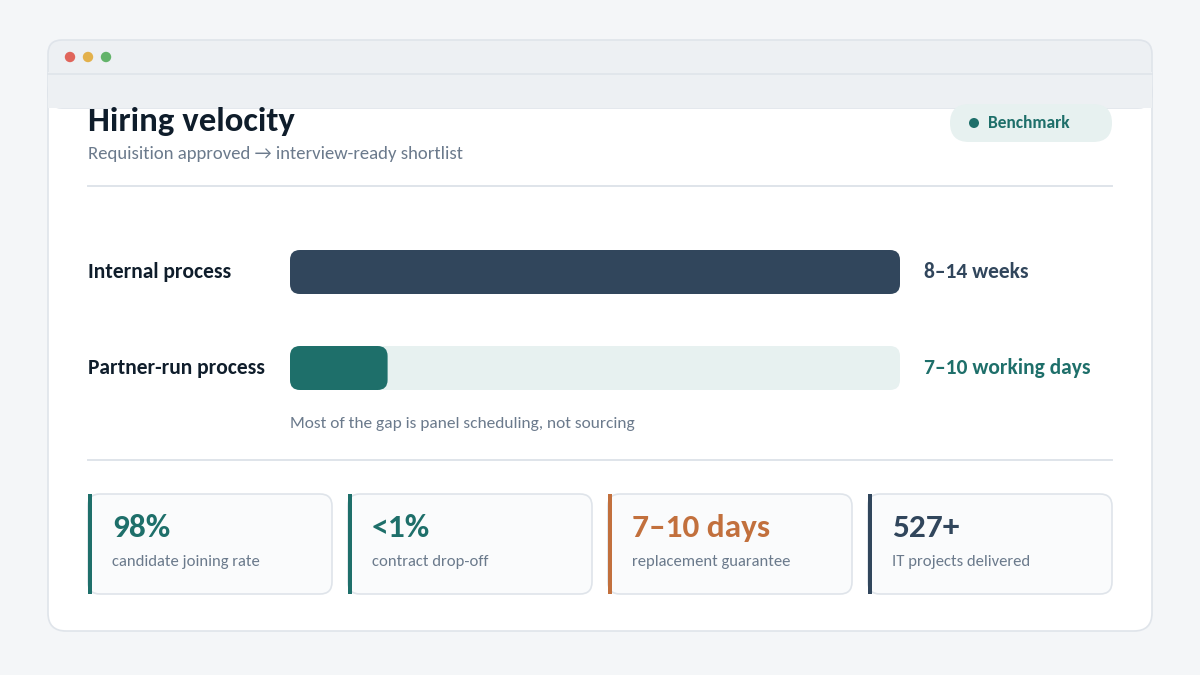
Here is the number that matters: the state has 298,466 tech jobs and is forecast to add only 4,305 this year. Supply is not expanding fast enough to fix a hiring plan that depends on local candidates alone, and a well-run process gets you to an interview-ready shortlist in 7–10 working days instead of the 8–14 weeks most internal teams average.
By the end, you will be able to decide which roles to hire locally, which to run through staff augmentation, and which belong in an offshore delivery centre and you will know what IT hiring in New Jersey should actually cost you per role.
What is IT hiring in New Jersey?
IT hiring in New Jersey is the process of sourcing, vetting, and onboarding technology talent inside a state labour market of roughly 298,000 tech workers, where compensation benchmarks track the New York metro, salary-range disclosure in job postings is legally mandatory, and demand concentrates in financial services, pharmaceutical and life sciences IT, logistics, and AI infrastructure.
That definition contains the whole problem. You are competing on New York pay scales, in a state with fewer than 300,000 tech workers, under disclosure rules that publish your comp band to every competitor before a candidate ever replies.
The real bottleneck in the NJ IT job market
Most dedicated development teams believe their constraint is candidate supply. In the majority of engagements we have run, it is actually time-to-fill compounded by offer competition; the candidate exists, but three other companies reached them first.
Here is the arithmetic that gets missed. A mid-level backend role posted in the Newark or Jersey City corridor typically pulls high applicant volume within 72 hours, of which a small single-digit percentage clears a real technical vetting screen. Internal teams then spend two to three weeks scheduling panels around engineering availability. By week five, your two finalists have competing offers.
The new jersey tech talent market compounds this with a geography problem. Candidates in Bergen, Hudson, and Essex counties can commute into Manhattan and price themselves accordingly, so a Jersey City role competes directly with a Midtown one on total compensation but often without the brand pull.
Meanwhile, the Princeton AI corridor is actively deepening. Princeton University, Microsoft, CoreWeave, and the NJEDA committed over $72 million to the NJ AI Hub, and that concentration is pulling ML and infrastructure engineers toward a small number of well-funded employers.
If you are hiring against them for the same profile, you are not running a recruiting problem. You are running a market-share problem, and successful IT hiring in New Jersey starts with admitting which one you have.
Building a hiring engine for the New Jersey tech talent market
This is where most guides stop at “write better job descriptions.” The teams that actually ship on schedule make four structural decisions before they source a single candidate.
Map roles to the three demand clusters, not to job titles
New Jersey’s technology demand is not evenly distributed, and pretending otherwise wrecks your timeline estimates. Three clusters absorb most of the qualified supply.
- Financial services and fintech concentrated in the Jersey City and Newark corridor. Heavy on Java, .NET, low-latency systems, and regulatory reporting. Deepest local supply, highest comp competition.
- Pharma, life sciences, and healthtech the Route 1 and central-NJ belt. Validated systems, GxP compliance, data engineering. Smaller pool, longer ramp, lowest attrition.
- AI, cloud, and data infrastructure Princeton corridor and remote-first employers. Thinnest local supply relative to demand; this is where you should expect to hire cloud engineers from outside the state or through a partner.
Front-end and product engineering sit across all three. If your roadmap needs you to hire ReactJS developers at volume, that is one of the few profiles where local supply is genuinely workable but only if your interview loop is fast.
Decide the delivery model before you write the job description
Four models are viable, and they are not interchangeable. Direct hire works for roles you will still need in three years. Staff augmentation works for roles tied to a funded project with a defined end. Contract-to-hire works when the role’s shape is still changing. An offshore delivery centre works when you need a durable team of eight or more.
The failure mode is defaulting to direct hire for everything, then discovering in month four that you have a permanent headcount attached to a nine-month project.
The 7-step process for hiring developers in New Jersey
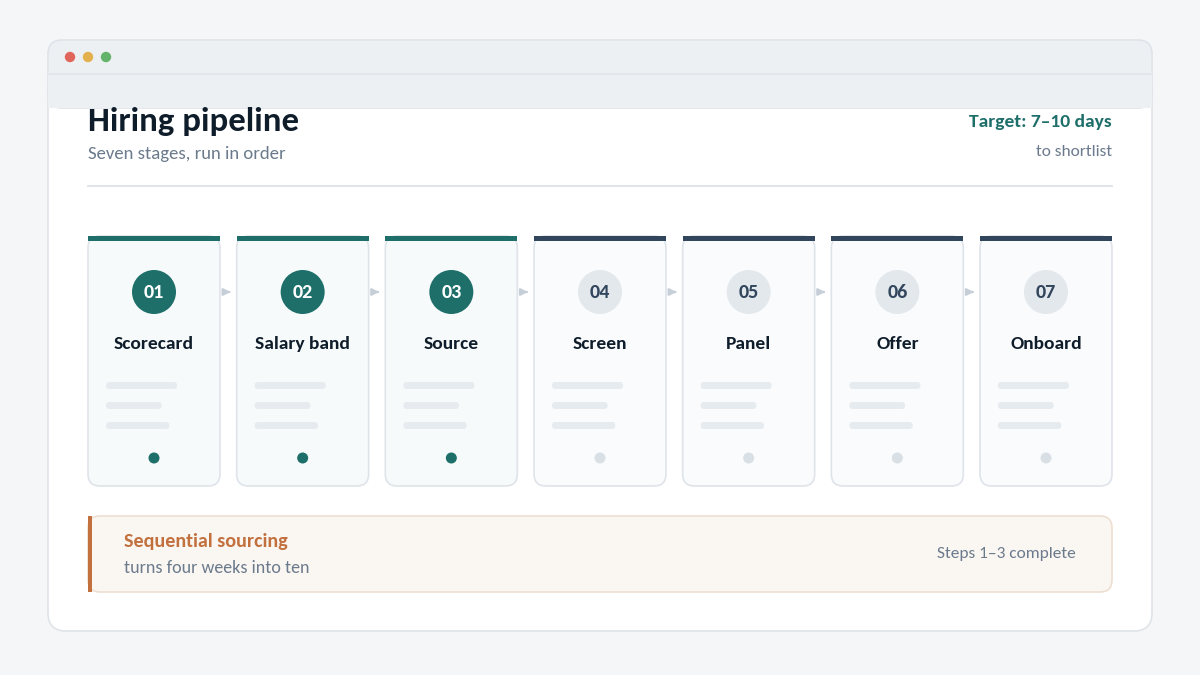
This is the sequence that compresses a 10-week cycle into roughly two weeks to shortlist. Run it in order.
- Write the scorecard before the job description. Three must-have competencies, one deal-breaker, one nice-to-have. If your engineering lead cannot name the deal-breaker, the role is not defined yet.
- Set the salary band and get it approved in writing. New Jersey law requires the range in the posting, so you cannot defer this decision to the offer stage.
- Source across three channels simultaneously inbound applicants, targeted outbound, and a vetted partner bench. Sequential sourcing is what turns four weeks into ten.
- Screen for evidence, not vocabulary. Ask for a decision the candidate made that they would now reverse. Résumé keyword matching predicts almost nothing about senior performance.
- Compress the panel into one day. Two technical rounds plus one team fit, scheduled as a single block. This alone offers an acceptance rate more than a comp bump of several thousand dollars.
- Make the offer within 48 hours of the final panel. Beyond 72 hours, expect to be a candidate’s second-choice conversation.
- Run structured onboarding with a 30-day checkpoint. Most early attrition traces to week-two ambiguity, not to the hire itself.
That numbered sequence is the operational spine of IT staffing in New Jersey, and it works whether you run it internally or through a partner.
What it actually costs to hire developers in New Jersey
Be precise here, because vague budgeting is why plans slip. BLS Occupational Employment and Wage Statistics put the national median for software developers at roughly $132,684. New Jersey postings generally need to clear that median rather than sit at it, because the same candidates are being recruited by New York metro employers.
On top of base salary, budget realistically for the load: employer taxes, benefits, and equipment typically add 20–30% to base for a direct W2 hire. Contract engagements price differently: you are buying an hourly rate with no benefits load but a margin on top, which is usually cheaper below nine months and more expensive beyond eighteen.
Contract-to-hire conversions deserve a specific warning. Negotiate the conversion fee and the conversion trigger at contract signature, not at month six. Once a contractor is embedded and productive, your leverage is gone, and the conversion fee becomes whatever the vendor says it is. This is the single most common commercial mistake we see in IT hiring in New Jersey, and it is entirely avoidable with one clause.
Compliance details that change how you post and classify
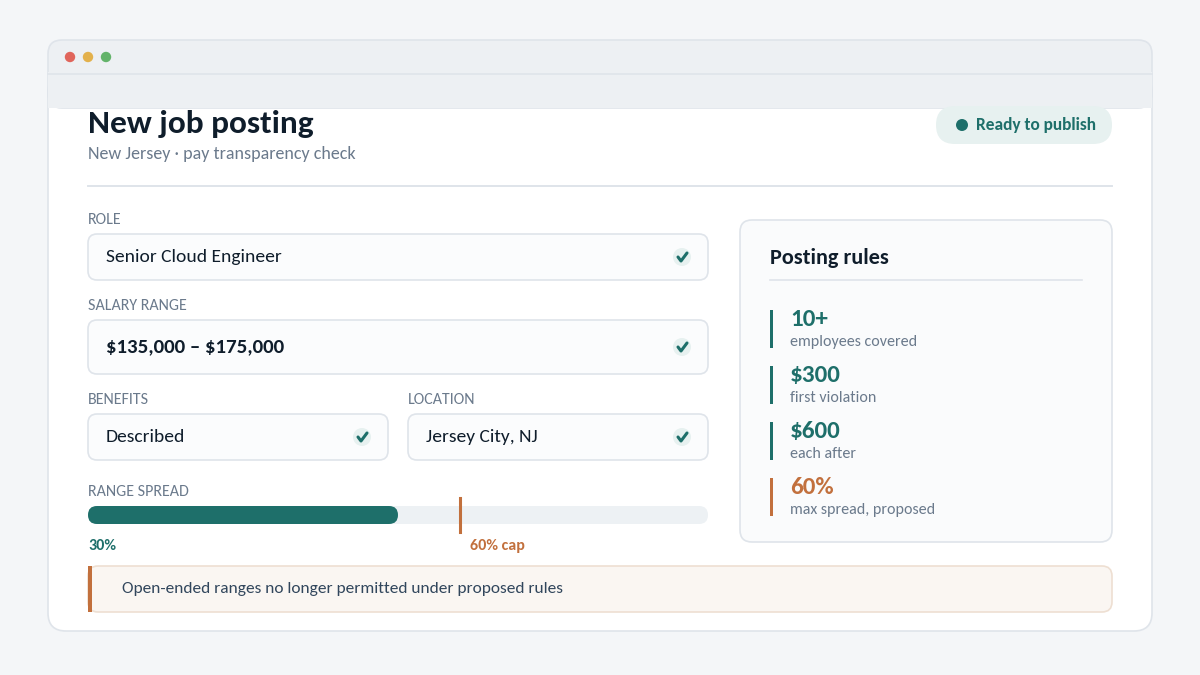
New Jersey employers with 10 or more employees must include a wage or salary range and a general description of benefits in job postings, internal and external, under the state’s pay and benefits transparency law. Civil penalties run to $300 for a first violation and $600 for each subsequent one.
Proposed NJDOL regulations not yet final at the time of writing would go further and cap the spread between the minimum and maximum of a posted range at 60% of the minimum, and prohibit open-ended ranges entirely. If those rules finalise as drafted, the “$120,000 and up” posting disappears as an option, and your band becomes a genuine commitment.
The second compliance layer is classification. W2 vs C2C engagement structures carry different tax and misclassification exposure, and New Jersey applies a strict test. Route this through counsel once and template it, rather than deciding role by role.
What this looks like in practice
Pattern one scaling a data platform team against a fixed launch date. A funded product team needed six data and backend engineers with a hard delivery deadline. Running three sourcing channels in parallel against a pre-approved band produced an interview-ready shortlist in 7–10 working days rather than the six-plus weeks their internal process had been averaging, and the launch date held.
Pattern two contract engineering with continuity risk. For contract roles across our engagements, candidate drop-off runs below 1% and the joining rate sits at 98%, with a replacement guarantee inside 7–10 days if a hire is not a fit. That matters more than headline rate cards: a single mid-engagement dropout on a six-person team typically costs more in lost sprint velocity than the entire margin difference between two vendors.
Onshore, offshore, or hybrid: a decision framework
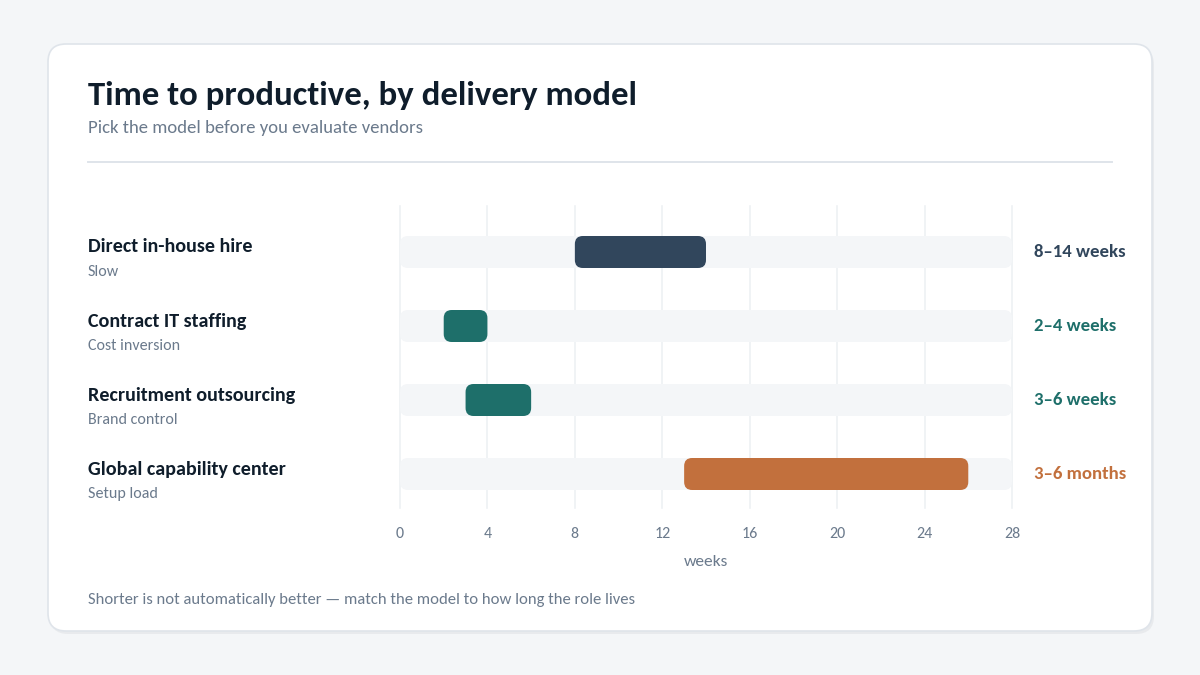
Pick a model before you evaluate vendors. Most teams do it in the wrong order: they shortlist vendors first, then let the vendor define the model, which is how IT hiring in New Jersey budgets gets set by whoever answers the phone fastest.
| Model | Best when | Time to productive | Main risk |
| Direct in-house hire | Role is permanent, domain-heavy, or client-facing | 8–14 weeks | Slow; loses candidates to faster competitors |
| Contract IT staffing | Funded project with a defined end date | 2–4 weeks | Cost inversion past ~18 months |
| Recruitment process outsourcing | Sustained hiring volume across many roles | 3–6 weeks to steady state | Weak employer-brand control if poorly governed |
| Global capability center | Durable team of 8+, multi-year roadmap | 3–6 months | Underestimated setup, legal, and management load |
The right answer is usually a blend: keep architecture, security, and client-facing engineering in the new jersey technology workforce, and move sustained build capacity QA, platform, data pipelines to a dedicated offshore team. Cost arbitrage is real, but the stronger argument is coverage: a distributed team gives you hiring access to a pool that is not capped at 300,000 people.
What most teams get wrong
The most common failure in IT hiring in New Jersey is optimising the requisition instead of the loop. Teams spend three weeks perfecting a job description, then take eleven days to schedule a first-round interview. The market clears in seven. Your job description quality has almost no effect on outcomes if your scheduling latency is longer than your competitors’ entire process.
Three more patterns worth naming, from engagements where the client was certain the problem was elsewhere:
Posting a wide range to preserve flexibility now backfires. Under NJ disclosure rules, a very wide band signals to strong candidates that you have not decided what the role is worth, and it anchors weaker candidates at the top. If the proposed 60% cap finalises, this stops being a strategy choice anyway.
Treating “5+ years of X” as a filter rather than a signal. Across this state’s talent pool, the years-of-experience filter disproportionately screens out career-changers from the state’s large pharma and financial services base, people who already understand your regulatory context and ramp faster than a pure-tech hire.
Buying shared bandwidth and calling it a team. If a vendor cannot tell you which named engineers are allocated to you and at what percentage, you are buying a queue position, not capacity. Ask for named allocation, a dedicated account manager, and NDA-backed IP terms in writing. A vendor that hesitates on any of the three is telling you something.
Before you commit to a vendor or a headcount plan
If you are budgeting IT hiring in New Jersey for the next two quarters and want to pressure-test the plan before you sign anything, it is worth running the numbers with a team that has done this at volume.
Supersourcing has delivered 527+ IT projects over 10+ years, maintains a 98% candidate joining rate, and typically moves from job description to interview-ready shortlist in 7–10 working days with a replacement guarantee inside the same window if a hire is not a fit.
Bring your role list and your deadline. We will tell you which roles are realistically local, which need staff augmentation or IT staffing services, and which belong in an offshore team including the ones where our answer is that you do not need a vendor at all.
Reach the team at mayank@engineerbabu.com or via supersourcing.com/contact-us.
FAQ
Is New Jersey a good state for tech jobs in 2026?
Yes, with qualifications. The state holds 298,466 tech jobs about 6.6% of total employment and CompTIA forecasts 1.4% growth in 2026 after a 0.5% contraction in 2025. Growth is concentrated in AI, cloud, data, and security rather than general application development, so the answer depends heavily on which role you are hiring for.
How long does it take to hire a software developer in New Jersey?
Timelines for IT hiring in New Jersey commonly run 8–14 weeks internally from approved requisition to signed offer, with most of that lost to panel scheduling rather than sourcing. A parallel-channel process with a pre-approved band and a single-day interview loop typically reaches an interview-ready shortlist in 7–10 working days.
Do New Jersey employers have to post salary ranges?
Yes. From June 1, 2025, employers with 10 or more employees must disclose a wage or salary range plus a general benefits description in all job postings, including internal ones. Penalties are $300 for a first violation and $600 for each subsequent violation. Proposed regulations may further restrict how wide a posted range can be.
Is it cheaper to hire IT talent in New Jersey than in New York City?
Modestly, and less than most budgets assume. Candidates in the northern counties can commute to Manhattan and price accordingly, so the discount is real but narrow, often smaller than the savings from shortening your hiring cycle by four weeks.
How to hire remote developers for a New Jersey company?
Remote is a genuine lever here: Stack Overflow’s 2025 survey found the US leads globally on remote work among developers, at 45% fully remote. The constraint is not candidate willingness but your own operating discipline. Remote hiring works when you have written specs, async review norms, and a named owner per workstream.
IT staffing agency vs in-house recruiting in New Jersey which should I choose?
Build in-house when you hire continuously for a narrow, well-understood profile. Use a partner when you need burst capacity, a role type you have not hired before, or coverage outside the state. Most teams need both, and the useful question is which specific roles justify which model worth pressure-testing with someone who has run both before you commit a budget.
