

Most companies assume that choosing between contract to hire vs direct hire is a hiring preference. It’s not. It’s a decision that directly impacts your cost structure, hiring speed, and project delivery timelines.
The reality is businesses that default to direct hiring for every IT role often end up paying for certainty they don’t actually get. Long hiring cycles, mismatched skill sets, and early attrition quietly inflate costs long after the offer letter is signed.
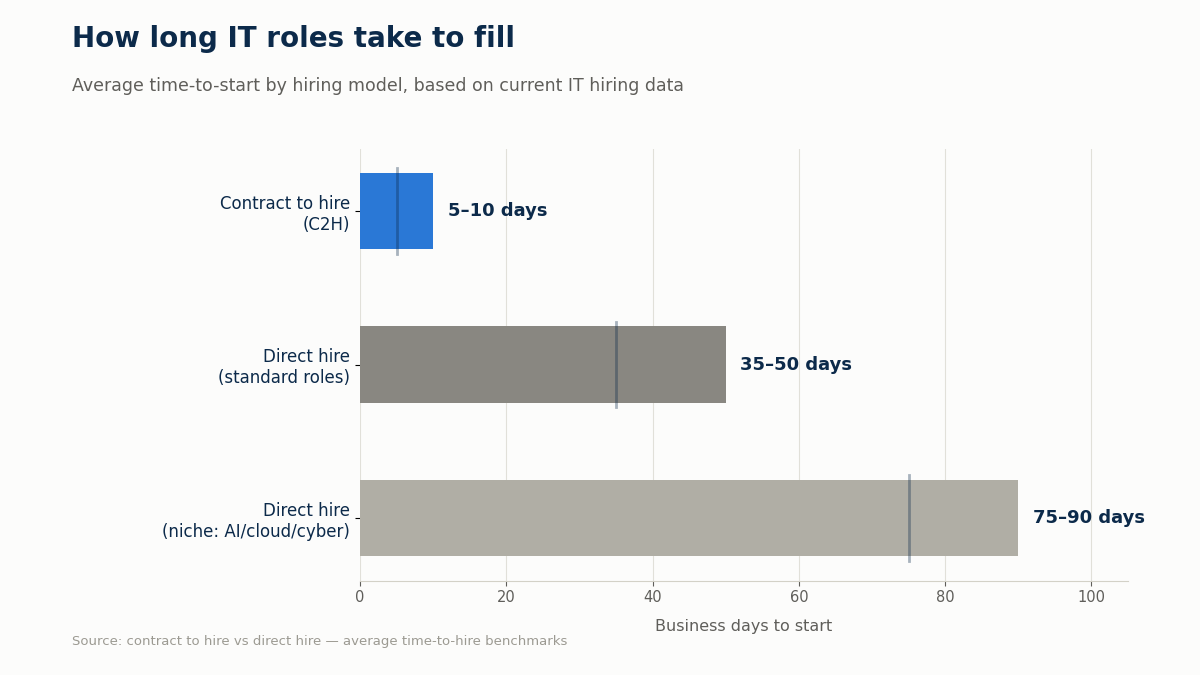
At the same time, the IT hiring landscape itself has changed. According to a recent report, the average time-to-hire for IT roles in India has stretched to 45–60 days and up to 75–90 days for niche skills like AI, cloud, and cybersecurity.
This delay is not just an HR problemist’s a business risk. Every unfilled role slows down product development, increases pressure on existing teams, and delays revenue outcomes.
That’s why the decision between contract to hire vs direct hire isn’t about what you prefer, it’s about how you manage risk, speed, and capital allocation in a competitive hiring market.
TLDR This blog breaks down the two dominant IT staffing models contract to hire and direct hire so you can stop defaulting to one and start choosing deliberately. You'll get a clear definition of both models, a hard look at what a wrong direct hire actually costs, and a step-by-step breakdown of how a well-run C2H engagement works. From there, we cover when direct hire is the smarter call, a side-by-side comparison table across cost, speed, and risk, two real-world case studies with outcome numbers, the three mistakes most teams make with hiring risk, and a seven-question FAQ covering duration, fees, conversion rates, and how to vet your staffing partner. By the end, you'll have a decision framework you can apply to your next open role before you post it.
What Is Contract to Hire vs Direct Hire?
Contract to hire vs direct hire refers to two distinct IT staffing models: contract to hire (C2H) places a professional on a fixed-term engagement typically 3–6 months with an option to convert to full-time employment based on performance, while direct hire places a candidate directly onto the company’s permanent payroll from day one.
The Real Cost of the Wrong Hiring Decision
Most hiring managers underestimate the total cost of a misfired direct hire by 3–4x. The visible cost is the recruiter fee usually 12–18% of first-year CTC. The invisible costs are the productivity drag during a 60–90 day notice period, the re-training investment, and the skills gap that widens while the role sits open again.
In IT specifically, the stakes are higher. A backend engineer hired into the wrong stack alignment, or a DevOps lead who can’t operate in your existing workforce planning structure, doesn’t just underperform, they create downstream bottlenecks that cascade across sprint cycles.requires
The pressure to hire fast further distorts decisions. When a project deadline is 8 weeks out, direct hire feels like the committed choice. But a 42-day average time-to-fill means you may be onboarding someone at week 6 with no buffer for ramp-up and no exit option if the fit is wrong.
Contract to Hire IT Staffing: How the Model Actually Works
Understanding contracts to hire IT services clarity on three operational layers: structure, evaluation, and conversion.
1. Engagement Structure
In a C2H arrangement, the IT professional is typically employed by the staffing agency for the duration of the contract, usually 3–6 months. The client company pays a billable headcount rate that covers the contractor’s compensation plus agency margin. This eliminates payroll burden, benefits liability, and statutory contributions during the evaluation period.
2. Technical Assessment in Real Conditions
Unlike a structured interview process, C2H gives you a live technical assessment over weeks. You observe how the candidate handles production issues, communicates with cross-functional teams, and adapts to your delivery cadence. Behavioral fit which is notoriously hard to assess in a 3-round interview becomes observable data.
3. Conversion and Retention Mechanics
At contract end, you have three options: convert to permanent, extend the contract, or release. The conversion fee charged by the c2h staffing agency typically ranges from 8–12% of CTC, significantly lower than a direct hire placement fee. Industry data suggests the retention rate post-C2H conversion runs 15–20% higher than direct hires in equivalent roles, primarily because both parties enter the permanent arrangement with confirmed fit.
The process for a well-run C2H engagement looks like this:
- Scope definition: Identify the role, required stack, project context, and expected conversion criteria
- Agency sourcing: A specialist c2h staffing agency surfaces pre-vetted candidates within 5–10 business days
- Onboarding: Contractor joins on agency payroll; full access to systems and project responsibilities from day one
- Mid-contract check: Formal or informal evaluation at the 6–8 week mark against defined performance criteria
- Conversion decision: At contract end, conversion offer issued, extended, or declined with 2–4 weeks notice
Permanent vs Contract Hiring: When Direct Hire Makes Strategic Sense
The Permanent vs contract hiring models for software developers compare C2H and direct hire debate isn’t one-sided. Direct hire remains the right call in specific scenarios and conflating all hiring into a C2H-first approach creates its own inefficiencies.
Direct hire is optimal when the role requires long-term institutional knowledge (e.g., a Principal Architect or CISO), when the onboarding time investment is substantial and non-transferable, or when the role involves strategic access that makes contractor engagement legally or structurally complex.
C2H wins when the requirement involves a skill set that’s hard to assess in interviews, when you’re scaling a new team and need workforce scalability without permanent headcount commitment, or when budget certainty is constrained in the near term.
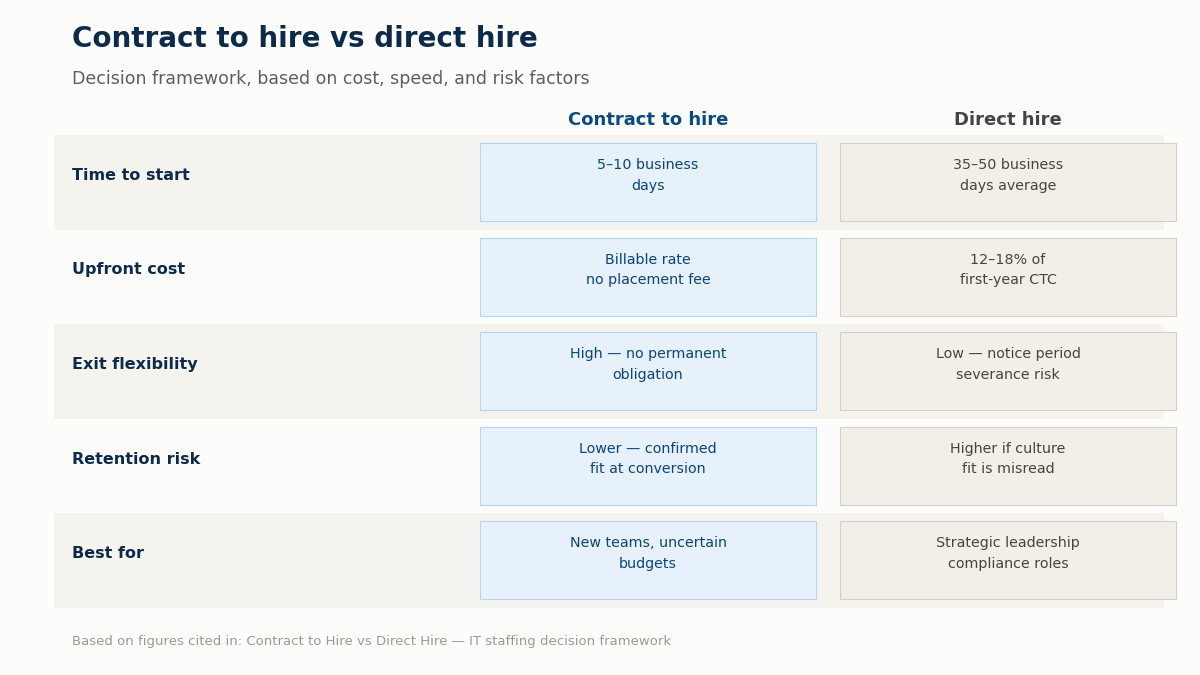
Decision Framework: Choosing the Right Model
| Factor | Contract to Hire | Direct Hire |
| Time to Start | 5–10 business days | 35–50 business days average |
| Upfront Cost | Billable rate (no placement fee upfront) | 12–18% of first-year CTC at placement |
| Exit Flexibility | High no permanent obligation during contract | Low notice periods, severance risk |
| Long-term Retention Risk | Lower post-conversion (confirmed fit) | Higher if onboarding and culture fit are misread |
| Best For | New teams, uncertain budgets, hard-to-assess roles | Strategic leadership, compliance-sensitive roles, long onboarding |
Real-World Application: Where the Model Makes the Difference
Mid-Size SaaS Company Engineering Scale-Up
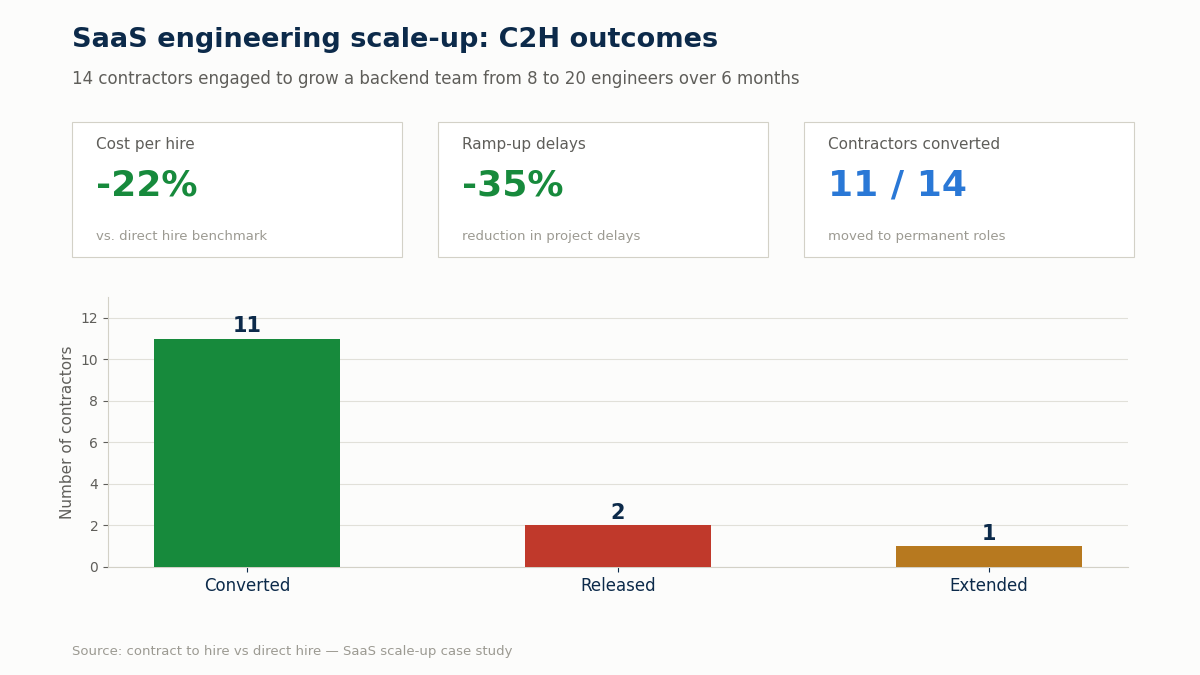
A 200-person SaaS platform needed to grow its backend engineering team from 8 to 20 developers over 6 months. Rather than committing to 12 direct hires upfront, the company engaged a c2h staffing agency and onboarded 14 contractors. After the first contract cycle, 11 were converted to permanent roles, 2 were released, and 1 contract was extended. Cost-per-hire came in 22% below the direct hire benchmark, and project delays from ramp-up were reduced by 35%.
Enterprise Fintech Compliance-Sensitive Roles
A regulated fintech firm needed a permanent Security Architect with specific regulatory exposure. The role required deep institutional knowledge and compliance authority conditions poorly suited to contractor arrangements. Direct hire was the right call. The position was filled in 38 days through a specialist search. IT talent acquisition and RPO solutions for regulated fintech and enterprise companies often find that certain roles demand the commitment signal that only a permanent offer conveys.
What Most Teams Get Wrong About Hiring Risk Reduction
Hiring risk reduction is often mis framed as a recruitment quality problem. It isn’t a model design problem.
The most common mistake is treating C2H as a “trial period” with implied employment at the end. This creates a false psychological contract. Contractors who expect conversion may disengage when it’s delayed or withheld; managers who assume conversion may avoid difficult performance conversations during the contract.
The second mistake is selecting a contingent workforce model because headcount is frozen, rather than because it’s the right structural fit. C2H under budget pressure without genuine conversion intent produces high turnover and damages your employer brand in specialist talent communities.
The third, and most costly, mistake is engaging a generalist staffing firm for IT-specific C2H requirements. Staffing flexibility in technology hiring requires domain-specific screening, understanding framework decisions, cloud architecture preferences, and delivery methodology alignment. Generalist firms screen for availability, not fit.
Evaluate Your Hiring Model Before the Next Role Opens
If you’re at an inflection point scaling a team, entering a new technology domain, or rebuilding after attrition the staffing model you choose will determine your velocity for the next 12–18 months. The choice between contract to hire vs direct hire isn’t permanent, but committing to the wrong one costs time and credibility that are hard to recover.
Our team has run IT talent acquisition across both models in high-compliance environments, fast-scaling product teams, and specialized technical functions. If you want a structured evaluation of which model fits your current hiring scenario, reach out for a no-obligation consultation. We’ll walk through your headcount plan, flag the risk exposure in your current approach, and identify the right structure before you commit. Schedule a free IT staffing consultation contract to hire vs direct hire advisory
Frequently Asked Questions
1. What is the typical duration of a contract to hire arrangement?
Most contracts to hire engagements run 3–6 months, though some technical roles particularly in architecture or security may have 6–9 month contracts before a conversion decision. The duration should reflect the minimum time needed to meaningfully evaluate the candidate’s performance in your specific environment.
2. How does a c2h staffing agency charge for its services?
A c2h staffing agency typically charges a billable hourly or monthly rate during the contract phase. Upon conversion, a placement fee of 8–12% of the candidate’s CTC is standard. Some agencies offer fee waivers after a defined contract duration typically 6–9 months as part of a volume partnership.
3. Is contract hire more expensive than direct hire overall?
Over a 12-month window, contracts to hire IT staffing and direct hire tend to reach cost parity but the risk profiles differ. C2H front-loads cost through the billable rate but eliminates severance and re-hire exposure. Direct hire has lower in-tenure cost but carries significantly higher exit cost if the hire doesn’t work out within the first 12 months.
4. When should a company choose permanent vs contract hiring for IT?
Choose permanent vs contract hiring for IT based on three factors: role stability (is the scope likely to change significantly in 12 months?), institutional access requirements (does the role need to hold vendor relationships or compliance authority?), and budget visibility (can you commit to permanent headcount now, or is flexibility more valuable than cost certainty?).
5. What is the conversion rate in C2H staffing, and why does it matter?
Conversion rates in IT talent acquisition through C2H typically range from 60–75%, depending on industry and role type. A high conversion rate suggests strong alignment between your evaluation process and long-term fit. A low conversion rate below 40% is usually a signal of misaligned job scoping, unrealistic performance criteria, or poor contractor sourcing, not a flaw in the model itself.
