

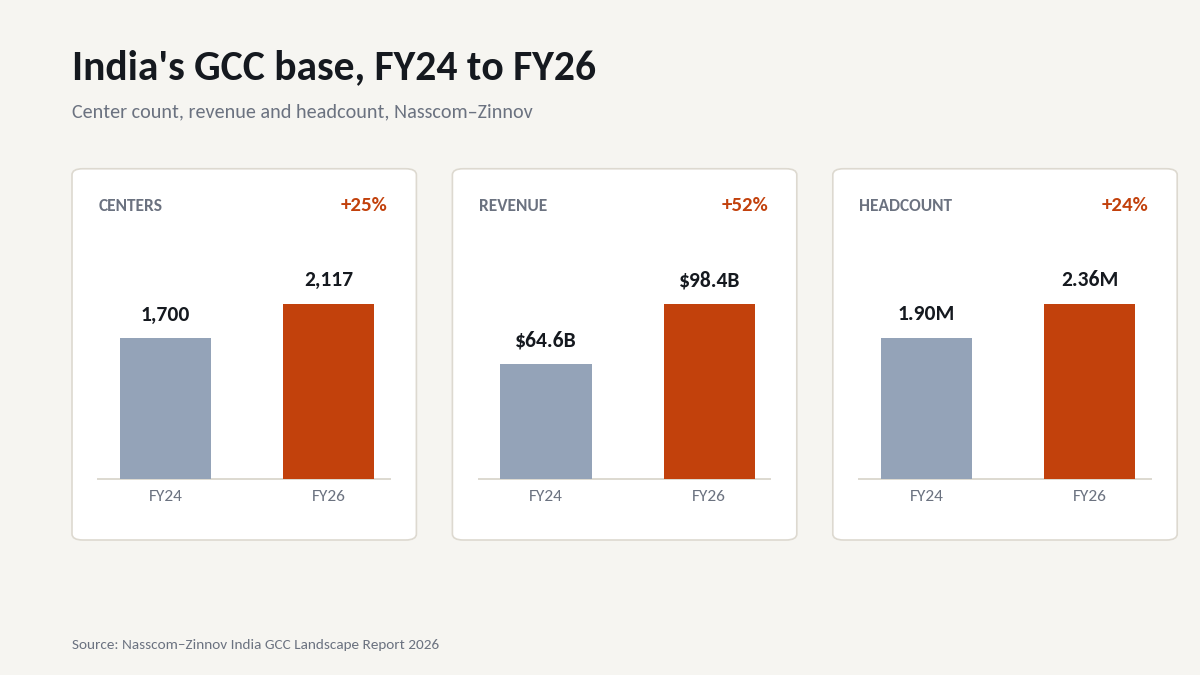
India crossed 2,117 global capability centers in FY2026, generating USD 98.4 billion and employing 2.36 million people, a 32% jump in center count since FY2021, according to the Nasscom–Zinnov India GCC Landscape Report 2026. Not one of those 2,117 entities is legally a “GCC.” They are private limited companies, wholly owned subsidiaries, LLPs. “GCC” is a category label the industry agreed on somewhere around 2021.
Which is exactly why the gcc vs gic difference confuses buyers. You will read that a GIC is the old thing and a GCC is the new thing, that one does back-office work and the other does innovation, that one is a cost center and the other is a value center. Most of that is marketing residue, not structural fact.
Here is the structural fact: a global in-house center and a global capability center are the same legal and operational animal: an offshore entity your company owns outright and staffs directly, instead of renting capacity from a vendor. What separates them is not incorporation, geography, or headcount. It is the charter the parent company writes on day one.
The gcc vs gic difference sounds academic until it shows up in your budget. Teams that scope a GIC-era mandate and then expect GCC-era outcomes end up with an expensive offshore ticket queue that leadership quietly stops routing work to. The costly version is a center sold internally on innovation and staffed on a support-cost budget: within nine to twelve months the senior engineers leave, because the work never arrived.
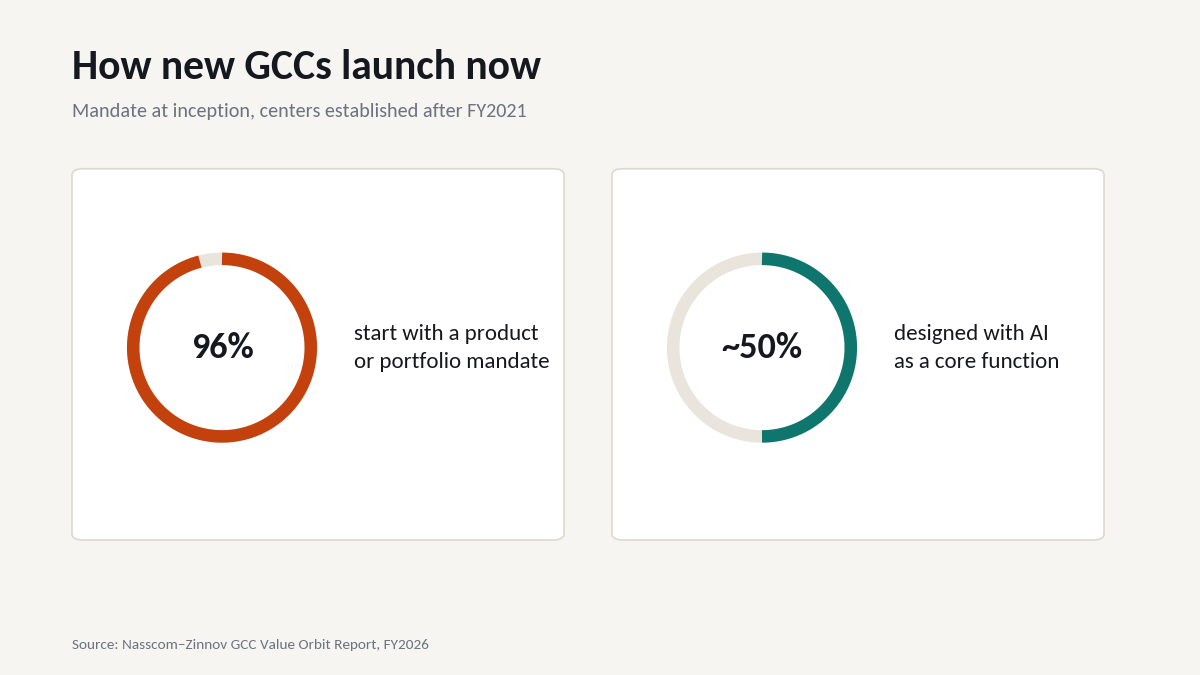
96% of Indian GCCs established after FY2021 launched with a product or portfolio mandate from day one, rather than climbing the old crawl-walk-run ladder from support work into ownership. Nearly half were designed with AI as a core function from inception.
This guide separates the terminology from the operating decision, and tells you which side of the gcc vs gic difference you are actually buying.
TL;DR
This guide is for founders, CTOs, and heads of global operations who are being pitched an offshore center and cannot tell whether "GIC" and "GCC" describe two options or one option with two names. It covers the definition, the cost and tax mechanics, the decision framework, and the failure patterns.
The short version: they are the same structure. India now hosts 2,117 of them, and 96% of the ones built after FY2021 skipped the support-work phase entirely and started with product ownership. The gcc vs gic difference is a difference in mandate and maturity, not in law, entity type, or paperwork.
By the end you will be able to tell which mandate your business case actually supports, what the revised 15.5% transfer pricing safe harbour means for your cost model, and when an owned center beats staff augmentation or does not.
What Is the GCC vs GIC Difference? A Direct Definition
The gcc vs gic difference is terminological, not structural. Both describe an offshore or nearshore entity wholly owned by a parent company and staffed with its own employees. “Global in-house center” is the older analyst term for what was previously called a captive; “global capability center” is the current term, signalling a broader mandate spanning product, engineering, and AI ownership.
That is the whole answer. The rest is about which mandate you can fund and defend.
Why “Is GIC Same as GCC?” Is the Wrong Question to Ask a Vendor
The question buyers ask is is gic same as gcc. The question that decides the outcome of the engagement is: what work is leaving my headquarters, and who owns the result when it ships?
The industry’s naming history explains the confusion. These entities were called captive centers first, a term Everest Group’s founder still uses when describing how the model started. “Captive” implied ownership without agency, so analysts moved to a global in-house center in the 2010s. When mandates expanded past cost arbitrage into product and R&D ownership, “capability” replaced “in-house.”
Three renames, one entity. Everest Group’s own research still writes the pair as “GCCs / GICs” in the same sentence, which tells you how much structural weight the distinction carries. The gcc vs gic difference survives in vendor decks mostly because a rename is easier to sell than a mandate.
The cost of getting this wrong is concrete. A support charter gets budgeted on headcount and measured on ticket closure and cost per FTE. A capability charter gets budgeted on roadmap and measured on release velocity. Those are not the same hire, the same salary band, or the same reporting line and you cannot retrofit one into the other without re-recruiting a third of the team.
Global In House Center Meaning: What the Term Actually Encodes
The global in house center meaning most people carry around is “offshore team we own.” Accurate, but incomplete. The term encodes four commitments, and each one has a cost line attached.
Legal ownership and IP
You incorporate a wholly owned subsidiary. All code, models, and documentation vest in the group by employment contract and inter-company agreement rather than through a vendor’s IP assignment clause. This is the single most common reason regulated businesses health, payments, defence-adjacent choose an owned center over outsourcing.
Direct employment
The people are on your payroll, your equity plan, your performance system. No vendor margin sits between your manager and your engineer, and no shared-bandwidth arrangement means your “dedicated” engineer is quietly split across three accounts.
A permanent cost structure
An owned entity carries fixed obligations that a contract does not: statutory compliance, gratuity and PF, facilities, local finance and HR, an annual transfer pricing study. This is why the model breaks below a certain scale.
A stated capability charter
The document that says what the center owns. Everything above is plumbing; this is the part that determines whether you built a GIC-era support unit or a GCC-era capability hub. The gcc vs gic difference lives entirely in this document.
The GIC Full Form Company Question and Why the Answer Changed
GIC full form in a company context is Global In-house Center. The rename to global capability center was not cosmetic. It tracked a genuine shift in what these entities were chartered to do, and the FY2026 data shows the shift is now the default rather than the exception.
Charter and mandate
A GIC-era charter reads like a scope of work: run these applications, staff this support tier, execute this migration. A GCC-era charter reads like a P&L: own this product line for the group, hit this release cadence, hold this quality bar.
Roughly nine in ten centers established after FY2021 started at the second version. If you are planning a global capability center setup in 2026, the crawl-walk-run sequence is no longer the market norm; it is a deliberate choice to move slower than your peers.
Reporting line
This is the tell no vendor deck mentions. If the India site leader reports into a global function head VP Engineering, Chief Product Officer you have a capability center. If they report into a shared services or operations lead who reports into finance, you have a support center, whatever the sign says.
The reporting line predicts the work the center gets offered over the following two years more reliably than the charter document does. It is also the cleanest field test of the gcc vs gic difference inside your own org chart.
Talent engine
Support mandates hire for process reliability and throughput. Capability mandates hire for judgment, and the senior 20% of that team is what makes the center work. This is where cost models break: teams budget offshore salary averages and then discover that platform and infrastructure leads price near global parity.
Plan for a barbell, not an average. Most builds we see need to hire cloud engineers and senior platform staff at close to market-leading bands while the mid-layer stays cost-advantaged.
Cost model and transfer pricing
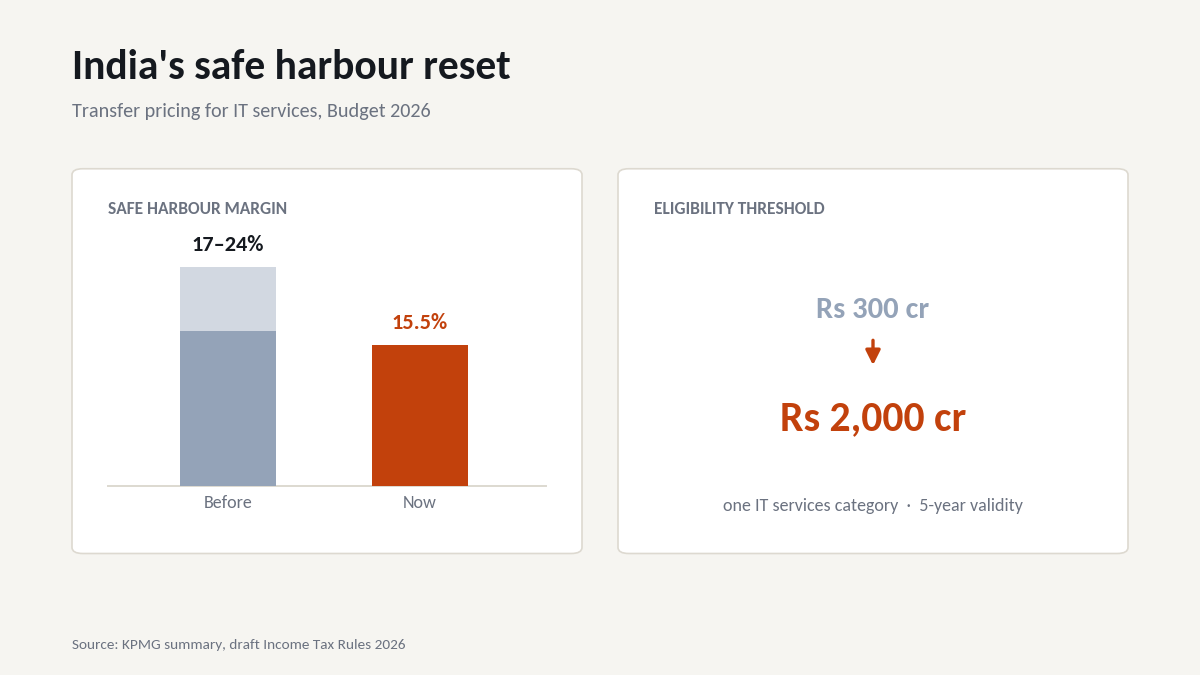
An owned center bills its parent on cost-plus, and India’s transfer pricing regime reset materially in Budget 2026. Per KPMG’s summary of the draft Income Tax Rules 2026, software development, ITeS, KPO, and software R&D were consolidated into a single Information Technology Services category carrying a 15.5% safe harbour margin on operating expenses, with the eligible transaction threshold raised from ₹300 crore to ₹2,000 crore and validity extended to five years.
Two practical consequences. First, the old category-labelling debate is this KPO or ITeS? largely disappears, which removes a recurring audit friction for mixed-mandate centers. Second, the margin is now close enough to commercial reality that opting in is a genuine decision rather than an automatic refusal. Neither side of the gcc vs gic difference changes this math; the entity’s tax profile follows the work, not the label. Model it against your projected operating margin over a five-year horizon, not one year, and get this reviewed alongside your entity structure, not after it. Any competent IT consulting services partner will insist on sequencing it that way.
Compliance and integration
Entity incorporation is fast weeks. Everything downstream is not: GST registration strategy across states, payroll and PF setup, secondment structures for expatriate leads, inter-company agreements, and identity and security integration into the parent’s stack. Facilities and approvals are typically the long pole. Budget in quarters, not weeks.
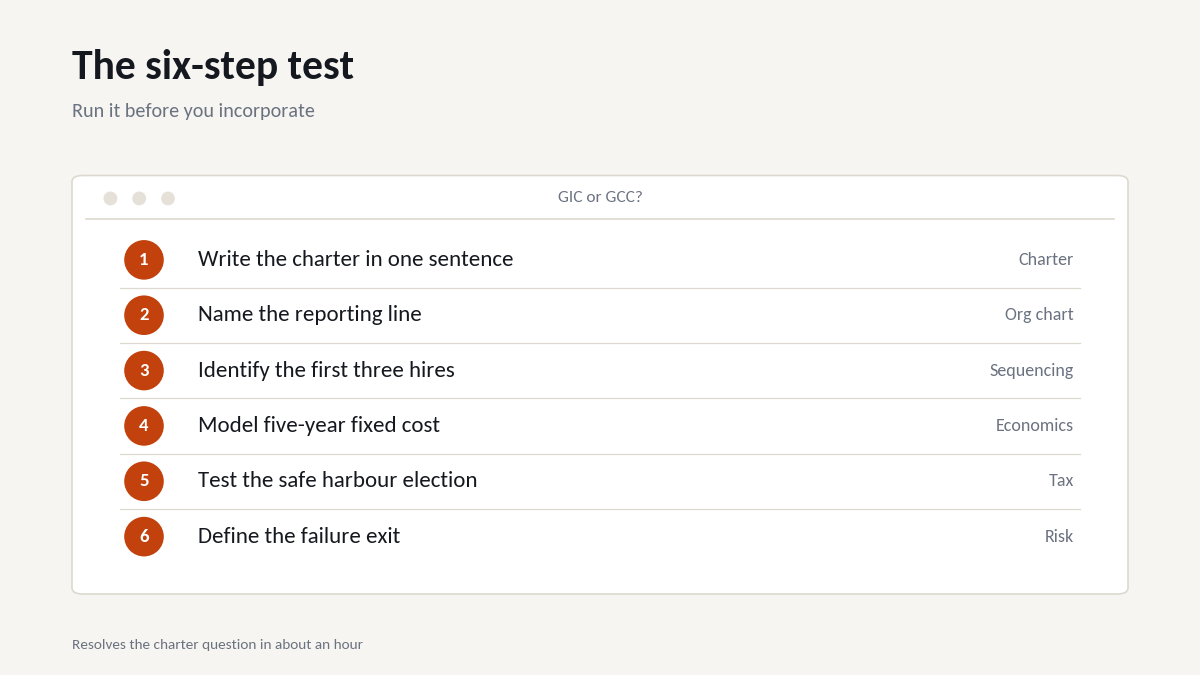
The six-step test: which one are you actually building?
Run this before you sign anything. It resolves the gcc vs gic difference for your specific case in about an hour.
- Write the charter in one sentence. If it names activities (“support X, maintain Y”), you are scoping a GIC-era mandate. If it names outcomes (“own the payments platform”), you are scoping a capability center.
- Name the reporting line. Write down the specific person the India lead reports to. If that person sits in shared services or finance, your charter is aspirational.
- Identify the first three hires. A capability mandate starts with an engineering leader. A support mandate starts with a delivery manager. Whichever you list first is what you are actually building.
- Model five-year fixed cost, not year-one savings. Include statutory, facilities, finance, HR, audit, and transfer pricing compliance.
- Test the safe harbour election. Compare the 15.5% margin against your projected operating margin across the block period, not a single year.
- Define the failure exit. If the center underperforms at month 18, what happens? An answer of “we’d wind it down” means you should test the thesis with a contract team first.
What This Looks Like in Practice
Across GCC and staffing engagements, two patterns recur often enough to be worth naming.
A funded fintech scaling its India engineering base wanted a product-owning center, not a support unit. The constraint was not capital, it was senior hiring velocity every month of leadership vacancy pushed the roadmap right. Running AI-assisted sourcing against the top 2% of vetted talent, the standard cycle from job description to interview-ready shortlist is 7–10 working days, with a 98% candidate joining rate across placements. The charter held because the senior layer landed before the mid-layer, not after.
The second pattern is the vendor-to-owned transition: an enterprise moving work out of a third-party ODC into its own entity, where the risk is a delivery gap during cutover. Running the transition with contract engineers on the existing scope while the owned entity recruits keeps continuity with under 1% drop-off on contract roles and a 7–10 day replacement guarantee if a hire is not a fit, the cutover stops being the highest-risk quarter of the program. In both, the gcc vs gic difference showed up as a sequencing problem rather than a naming one. Supersourcing has run both patterns across a client base spanning fintech, healthtech, and enterprise SaaS, including Razorpay, Apollo Hospitals, and Chargebee.
GIC vs GCC IT Industry Comparison: A Decision Framework
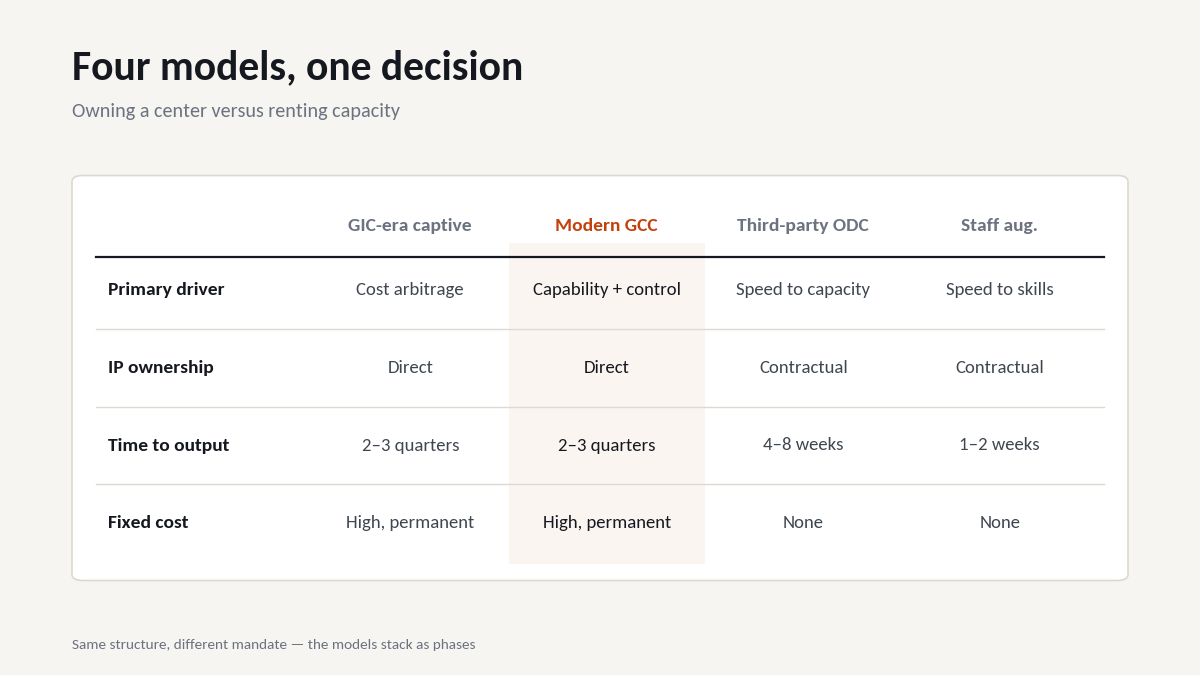
The gic vs gcc it industry debate matters less than the choice between owning a center and renting capacity. Compare all four options on the dimensions that actually drive the decision.
| Dimension | GIC-era captive | Modern GCC | Third-party ODC / outsourcing | Staff augmentation |
| Primary driver | Cost arbitrage | Capability + control | Speed to capacity | Speed to specific skills |
| IP ownership | Direct, via employment | Direct, via employment | Contractual assignment | Contractual assignment |
| Time to first output | 2–3 quarters | 2–3 quarters | 4–8 weeks | 1–2 weeks |
| Fixed cost exposure | High, permanent | High, permanent | None beyond contract | None beyond contract |
| Best fit | Stable, high-volume process work | Long-horizon product and AI ownership | Defined-scope delivery | Filling a named gap fast |
The sequencing insight: these are not mutually exclusive, and the strongest builds treat them as phases. Prove the thesis with contract engineers, convert the ones who work, incorporate once the roadmap justifies fixed cost. Companies that need to hire DevOps engineers or platform staff for a six-month proving period before committing to an entity consistently make better entity decisions than those that incorporate first and staff afterward. That sequencing, not the gcc vs gic difference itself, is what separates centers that get real work from centers that get org charts.
What Most Teams Get Wrong
The failure pattern is not getting the gcc vs gic difference wrong. It is treating the naming decision as the strategy decision. Teams spend weeks debating whether to call it a GIC or a GCC, then hand the center a charter written by a procurement team and a reporting line into shared services and are surprised eighteen months later when it behaves exactly like the support unit its structure predicted.
Three specific red flags, drawn from engagements that went sideways:
The center has no named internal customer. If no global function head has committed to moving specific work, the charter is a press release. Ask who loses their headcount when the center takes the work if nobody, nobody will send it. No reading of the gcc vs gic difference rescues a center with no internal customer.
The business case is built on cost per FTE alone. Cost arbitrage is real and it is also the weakest justification available in 2026. Centers justified purely on rate differentials lose their budget the moment a cheaper location appears in a board deck. Centers justified on capability ownership survive that conversation.
Senior hiring is scheduled last. The most common sequencing error we see is staffing the mid-layer first because it is faster and cheaper, then recruiting leadership into a team that has already formed its own habits. Reverse it. Whether you are building an owned entity or scaling through IT staffing services, the senior layer sets the ceiling for everything hired after it.
One more, quieter than the others: the parent company’s own engineering managers are rarely consulted before the entity is incorporated. They are the ones who must delegate real work to it. If they were not in the room, the center will spend its first year proving it deserves work that was already promised to it on a slide.
Before You Commit to an Entity
If you are working through the gcc vs gic difference because a board deck needs a recommendation next month, the useful next step is not a vendor demo. It is pressure-testing three things: whether a named global function head has committed to transferring specific work, what your five-year fixed cost actually looks like after statutory and transfer pricing compliance, and whether your senior hiring plan is sequenced first or last.
Supersourcing has run GCC setup, RPO, and IT staffing engagements across 527+ delivered projects and ten years of building India teams for enterprises and funded startups including the messy middle where a contract team becomes an owned entity. If it is useful to stress-test your model against builds that worked and builds that did not, that conversation is available without a proposal attached.
Reach the team at supersourcing.com/contact-us or mayank@engineerbabu.com.
FAQ
What does GIC stand for in a company?
GIC stands for Global In-house Center. It describes an offshore entity a company owns and staffs directly, rather than contracting to a vendor. In most current documentation the term has been replaced by GCC, though analyst firms and older enterprise policies still use GIC, and legal and tax documents typically use neither; they refer to the subsidiary by name.
Is GIC the same as GCC in the IT industry?
Functionally, yes. Both describe a wholly owned offshore entity staffed by direct employees. The gcc vs gic difference is one of era and implied mandate: GIC carries the connotation of support and cost work, GCC of product, engineering, and AI ownership. No legal or regulatory framework distinguishes them, so treat any vendor claiming a formal distinction with caution.
What is the difference between a GCC and a BPO?
Ownership. A GCC is your own legal entity with your own employees. A BPO or outsourcing provider is a separate company selling you capacity under contract, with its own margin, its own attrition, and its own competing accounts. The trade is control and IP certainty against speed and flexibility.
Why did the industry stop saying GIC?
Because the mandate changed and the label stopped describing it. “In-house” says where the work sits; “capability” says what the entity owns. With 96% of post-FY2021 Indian centers launching with product or portfolio mandates, the older term now describes a minority of new builds.
How many people do you need before a GCC makes sense?
There is no regulatory minimum, but the economics are what bind. An owned entity carries permanent fixed costs, statutory compliance, facilities, local finance and HR, annual transfer pricing work that a contract team does not. Below roughly 25–30 people, that overhead usually swamps the arbitrage. Model your own break-even rather than trusting a benchmark.
When should you convert a GIC into a GCC?
When a global function head is ready to transfer end-to-end ownership of something, not before. The trigger is demand-side, not maturity-side. Centers that “graduate” on a calendar schedule without a committed internal customer tend to acquire the title and not the work.
Should we test the model before incorporating?
Usually, yes and this is where the gcc vs gic difference stops being theoretical. Running a contract team on the intended scope for two or three quarters tells you whether the work genuinely transfers, what the real senior salary bands are, and whether your managers will delegate. That evidence makes the entity decision far cheaper to get right.
