

Most engineering manager panels evaluate the wrong artifact. They read team size, headcount grown, and systems shipped, then spend forty-five minutes debating an architecture the candidate will never personally write again. The resume gets scrutinised; the behaviour that actually determines whether twelve engineers ship on time goes unexamined.
That gap is expensive. A mis-hired senior IC costs a quarter of lost output. A mis-hired manager costs a quarter of lost output multiplied by the size of the team, plus the attrition it triggers on the way out. Behavioral interview questions for engineering managers exist to close that gap; they force a candidate to describe decisions they have already made under real constraints, rather than the decisions they believe they would make in a hypothetical.
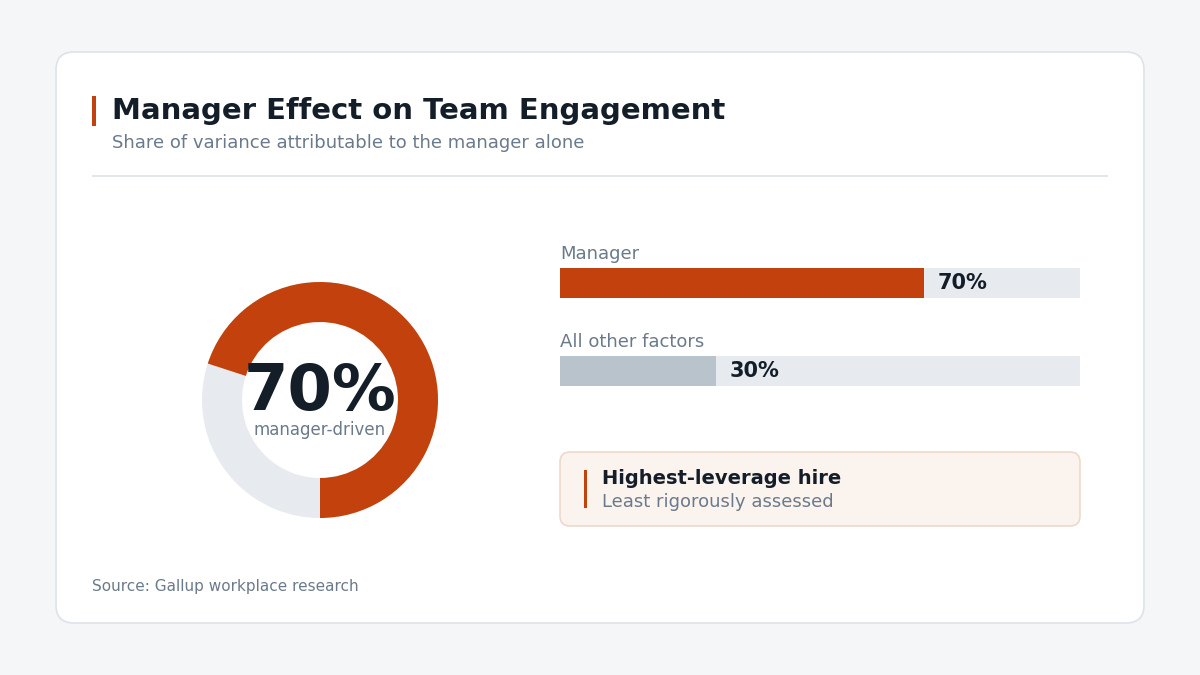
Gallup’s long-running workplace research attributes roughly 70% of the variance in team engagement to the manager alone. Separately, leader and manager development has repeatedly ranked as the number one priority for HR leaders in Gartner’s annual survey.
Two numbers, one implication: the manager layer is the highest-leverage and least-rigorously-assessed hire on an engineering org chart. Most companies interview it with a system-design round borrowed from the staff engineer loop and a culture chat borrowed from HR.
This guide is the interviewing playbook our delivery teams use when running engineering manager hiring for fintech, healthtech, and enterprise SaaS clients: the question banks, the follow-up probes that separate rehearsed answers from loved ones, the scoring rubric, and the failure patterns we see repeat across engagements.
TL;DR
This is a working guide to behavioral interview questions for engineering managers, written for founders, VPs of Engineering, and talent partners who own an EM requisition and cannot afford a bad hire. It assumes you already know what an EM does. It focuses on how to prove a candidate has done it.
The single biggest lever is not the question list. It is the probe. In our engagements, roughly four out of five candidates who fail an EM loop fail on the second or third follow-up question, not the first the opening answer is rehearsed, the detail underneath it is not. A well-run loop reaches a decision in 7–10 working days.
By the end, you will have a six-round interview structure, a five-competency scorecard, seven red-flag patterns, and the specific probes that surface each one. You will be able to run the loop yourself, or judge whether your current one is measuring anything at all.
What are behavioral interview questions for engineering managers?
Behavioral interview questions for engineering managers are structured, past-tense questions that ask a candidate to describe a specific situation in which they personally handled a missed deadline, an underperformer, a cross-team conflict and are scored against a fixed rubric. They measure demonstrated leadership behaviour rather than hypothetical intent or technical recall.
The word doing the work in that definition is personally. Hypothetical questions (“how would you handle a struggling engineer?”) test how well someone reads management books. A manager competency interview tests what they actually did the last time it happened, with names, dates, and consequences.
The real problem: EM loops measure seniority, not judgment
Two failure modes dominate. The first is the loop that never left the IC template system design, coding, and values chat. It selects for a strong senior engineer who has also managed, which is not the same as a strong manager. The second is the loop that goes fully soft: rapport, philosophy, “tell me about your leadership style.” It selects for articulate people.
Neither loop is fixed by adding more interviewers. It is fixed by replacing hypotheticals with behavioral interview questions for engineering managers and scoring them consistently.
The cost is measurable. Regretted attrition following a bad engineering manager hire typically shows up 4–7 months in, not immediately, because the team absorbs the damage quietly first. By the time it surfaces, you are replacing the manager and backfilling one to three engineers, at a hiring cycle of 6–10 weeks per role in most Indian and US markets.
There is also a supply problem. The candidate pool for em interview questions to be applied to is thin at the top: the population of managers who have run a team of 8+ through at least one full performance cycle, one reorg, and one voluntary exit is far smaller than the population with “Engineering Manager” in their title. Screening for the title selects for the wrong thing.
A hiring loop that cannot distinguish between a manager with three years of experience and a manager with one year of experience repeated three times will hire the second one, because they interview better.
The five competencies worth interviewing for
Skip the twelve-competency frameworks. In practice, EM performance in the first year resolves to five areas. Score each independently; do not average them into one “good vibe” verdict.
1. People development and performance management
This is where behavioral interview questions for engineering managers earn their keep, and where candidates are most likely to have rehearsed. Ask for the hardest version of the story.
- “Walk me through the last time you told an engineer their performance was not meeting the bar. What was the first sentence you used?”
- “Describe someone you promoted who then struggled. What did you miss during the promotion decision?”
- “Tell me about a performance management plan you ran. What was the outcome, and what would you change?”
The probe matters more than the question. After the first answer, ask: what did they say back? Real managers remember the pushback verbatim because it was uncomfortable. Candidates describing someone else’s process do not.
2. Delivery and execution under constraint
Look for delivery predictability, not heroics. The strongest answers involve cutting scope early and telling stakeholders before they ask.
- “Tell me about a commitment your team missed. When did you know, and when did you tell?”
- “Describe a quarter where you deliberately shipped less. Who pushed back?”
The gap between “when did you know” and “when did you tell” is the single most diagnostic number in an EM interview. Anything beyond a week is a communication problem that will become your problem.
3. Technical judgment without hands-on coding
Managers do not need to out-code their staff engineers. They do need to detect when an estimate is fiction and when a rewrite proposal is boredom in disguise.
- “Tell me about a technical interview decision you overruled. What was your reasoning, and were you right?”
- “Describe the last time you pushed back on a rewrite. What did you propose instead?”
This is the section where leadership interview questions tech panels typically over-index on syntax. Test judgment: give a real architectural trade-off from your own backlog and ask what they would need to know before deciding. Watch what questions they ask.
4. Cross-functional influence and conflict
- “Describe a conflict with a product or design counterpart that you lost. What did you concede?”
- “Tell me about a time you escalated to your skip-level. What happened afterwards?”
Candidates who have never lost an argument have never had a real counterpart. This is one of the few places where behavioral interview questions for engineering managers reward the smaller story the concession, not the win. Stakeholder management is visible in what they gave up, not what they won.
5. Hiring, retention, and team design
- “Walk me through a hire you regretted. How long did it take you to act?”
- “Tell me about someone good who quit on you. What did they say in the exit conversation?”
The last question is the highest-yield one in this bank. Managers who have genuinely run teams have lost someone they wanted to keep and can articulate exactly why. Candidates who answer “attrition was mostly comp” have not looked closely enough and will not look closely at your team either. If the answer names span of control or unclear career paths, you are talking to someone who has done the diagnosis.
The six-round engineering manager interview loop
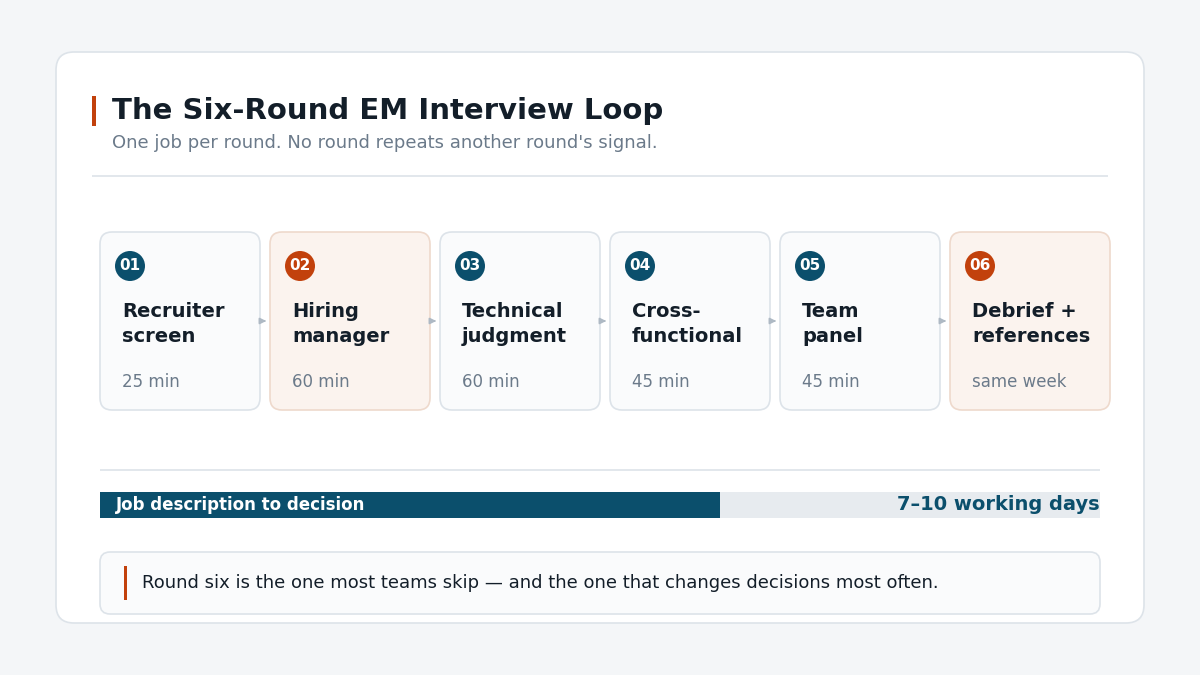
Run it in this order. Each round has one job, and no round repeats another round’s signal.
- Recruiter screen (25 min) motivation, scope of last role, compensation range, notice period. Establish team size, reporting line, and whether they wrote code in the last 12 months.
- Hiring manager round (60 min) competencies 1 and 2, using behavioral interview questions for engineering managers with two probes minimum per answer.
- Technical judgment round (60 min) a real trade-off from your backlog, run by a staff engineer. No whiteboard algorithms.
- Cross-functional round (45 min) a product manager and a peer EM. Competencies 3 and 4.
- Team panel (45 min) two engineers who would report to the candidate. They ask; you observe how the candidate handles being interviewed by future reports.
- Debrief and references (same week) written scores submitted before discussion, then two backchannel reference checks, at least one with a former direct report.
Round six is the one most teams skip and the one that changes decisions most often. A reference from a former report answers questions a candidate structurally cannot.
Scoring: the rubric that makes the loop repeatable
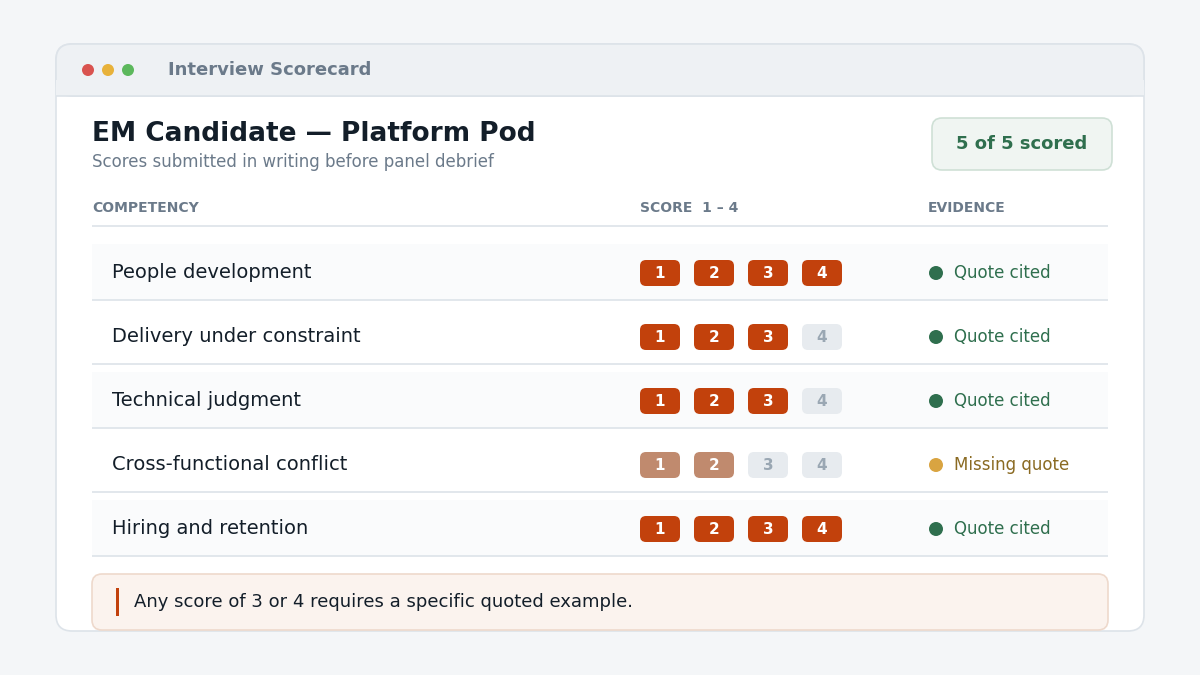
Score each competency 1–4 on a single interview scorecard, with anchors written before the loop opens. Google’s re:Work guidance on structured interviewing is the reference implementation: the same questions, the same anchors, the same order, for every candidate.
The rubric is what turns behavioral interview questions for engineering managers from a conversation into a measurement. Two rules make it stick. First, submit scores in writing before the panel debrief verbal-first debriefs converge on whoever speaks first. Second, require a specific quoted example next to any score of 3 or 4. If an interviewer cannot cite the moment, the score is a feeling.
What this looks like in practice
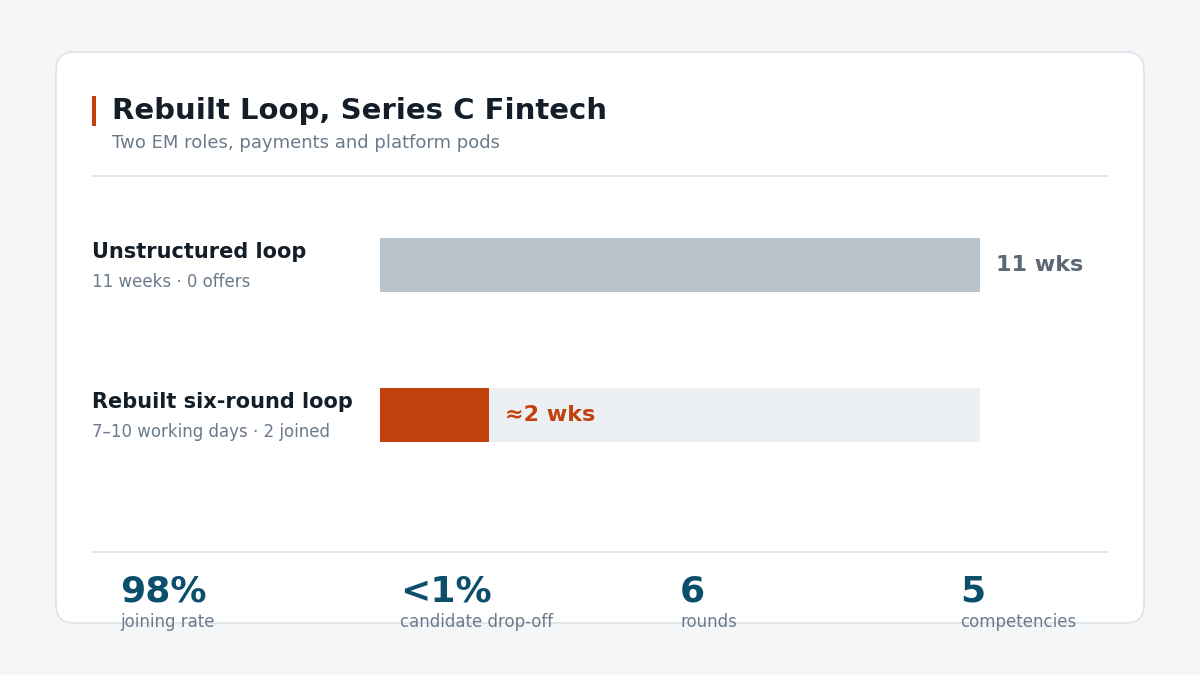
A Series C fintech client needed two EMs to take over payments and platform pods after an unplanned exit. Their prior loop had run 11 weeks and produced no offers, largely because each panelist improvised their own behavioral interview questions for engineering managers with no shared anchors. Rebuilt as the six-round structure above with a written rubric, the search moved from job description to interview-ready shortlist in 7–10 working days, with both roles closed and joined.
In a second engagement, a healthtech company setting up a global capability center in India needed a founding EM who could hire a team from zero. The differentiating round was competency five: shortlisting only candidates who could name a specific hire they regretted and describe how quickly they acted.
Across contract engagements run on this model, candidate drop-off has stayed under 1%, with a 98% joining rate. The same discipline that improves selection also improves closure, because candidates read a rigorous loop as a signal of a serious team.
How to choose your signal sources
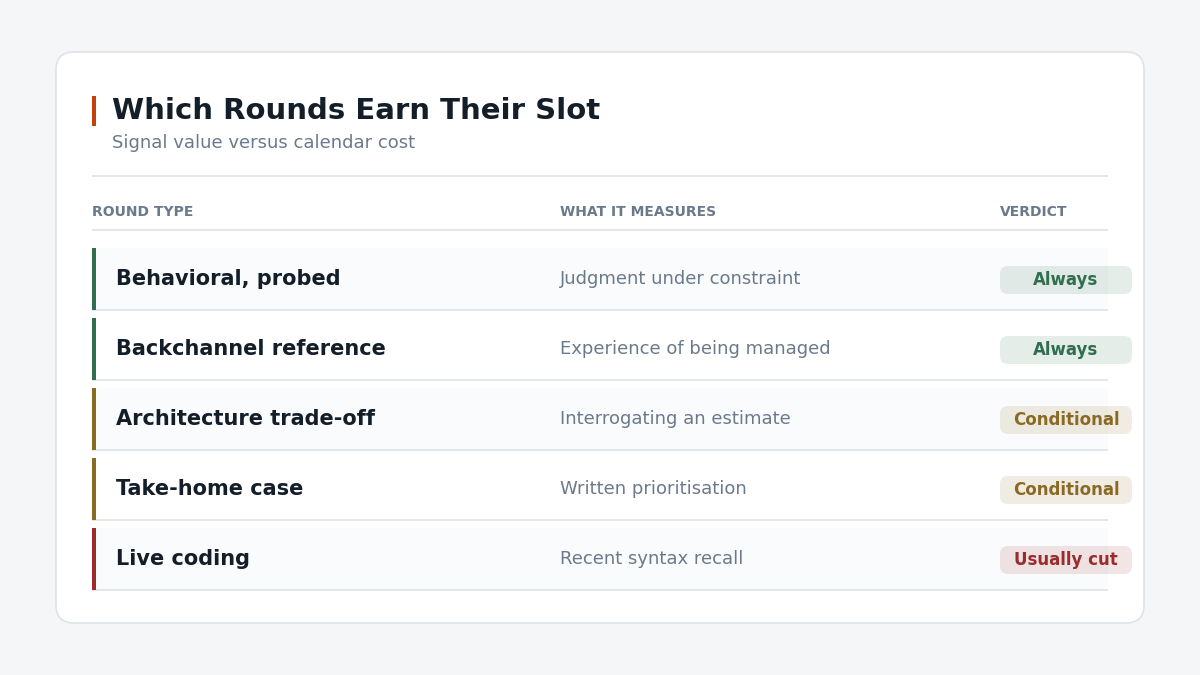
Not every round earns its slot. Behavioral interview questions for engineering managers stay in every version of the loop; the rest is negotiable against your calendar.
| Round type | What it actually measures | Keep it when | Cut it when |
| Behavioral (past-tense, probed) | Demonstrated judgment under constraint | Always this is the core signal | Never |
| Live coding | Recent hands-on syntax recall | The EM will code 30%+ of the time | The role is 8+ reports |
| Architecture trade-off discussion | Ability to interrogate an estimate | The team owns complex infra | A staff engineer already owns design |
| Take-home management case | Written communication and prioritisation | Remote-first, async-heavy org | Candidate pool is senior and passive |
| Backchannel reference (ex-report) | Lived experience of being managed | Always, for final two candidates | Never, if you can reach anyone |
What most teams get wrong
They treat the question bank as the product. It is not a probe. Dedicated development teams adopt a list of behavioral interview questions for engineering managers, ask each one cleanly, and stop after the first answer.
A candidate’s opening story is prepared; the second and third follow-ups are not. Ask what the other person said, what it cost, and what they would do differently in that order. Most failed hires in our engagements were candidates who passed the question and would have failed the probe.
Four more patterns worth naming, drawn from loops we have run and post-mortems on hires that did not work:
- The “we” tell. A candidate who narrates in “we” for a full story and never switches to “I” was usually adjacent to the decision, not making it. One clean probe: “who else could have made that call?”
- No firing, no losing. A manager who has never let someone go and never lost someone they wanted to keep has not held real ownership long enough. Treat it as a scope question, not a character one.
- The comp-only exit story. Attrition explained entirely by money is a diagnosis nobody did.
- Negotiation friction shows up at notice period, not salary. In the Indian market especially, the deal that breaks late is usually a 60–90 day notice with a buyout the candidate expects the new employer to cover and never asked about. Raise it explicitly in round one; ambiguity here is the most common cause of a slipped joining date we see.
Before you open the requisition
If you are rebuilding an EM loop or you have run one for six weeks and produced no offers the fix is usually two things: a written rubric agreed before the first screen, and a probe discipline that does not stop at the first answer.
Supersourcing has run this process across engagements spanning fintech, healthtech, e-commerce, and enterprise SaaS, including teams hiring their first EM and teams staffing an entire pod alongside hire remote developers and DevOps engineers requisitions.
If you want a second read on your scorecard before you commit to a vendor or a shortlist, send the loop structure to mayank@engineerbabu.com or start at supersourcing.com/contact-us. No pitch brings the rubric, and we will tell you which competency it is failing to measure.
FAQ
What are the best behavioral questions to ask a manager candidate?
The highest-signal three: tell me about someone good who quit on you; tell me about a commitment your team missed and when you told stakeholders; tell me about a hire you regretted and how long it took you to act. Each targets a different competency, and none can be answered credibly without having done the job.
How do you evaluate leadership skills in a technical interview?
Bring a real trade-off from your own backlog and ask what the candidate would need to know before deciding. Score the questions they ask, not the answer they give. Combine that with probed behavioral rounds; syntax tests measure something the role will not use.
How many rounds should an engineering manager interview loop have?
Six, including references, compressed into 7–10 working days. Fewer than four rounds usually means a competency is unmeasured. More than six adds calendar risk without adding signal, and strong passive candidates drop out of long loops.
How do you spot an engineering manager who has never actually managed?
Watch pronouns and specificity. Persistent “we,” no verbatim recall of difficult conversations, no named regretted hire, and no example of a decision they were overruled on. Any one is explainable; three together is a pattern.
Should engineering managers still be tested on coding?
Only if they will code meaningfully in the role. For an EM with eight or more reports, a coding round mostly measures interview preparation. Replace it with a code-review exercise: hand them a real pull request and ask what feedback they would leave.
What is the biggest red flag in an EM interview?
An unbroken record. Candidates who present no failed hire, no lost argument, and no missed commitment are either early in their management career or editing heavily. Behavioral interview questions for engineering managers are designed to find the edits, which is why the probe sequence matters more than the question bank.
Can we run this loop without a dedicated recruiting team?
Yes, though the constraint is usually pipeline rather than process. Teams that build the rubric internally but outsource sourcing through IT staffing services or a recruitment process outsourcing model tend to keep the decision quality and lose the calendar drag. If you want the loop pressure-tested against your specific org, that is a conversation worth having before you open the requisition.
