

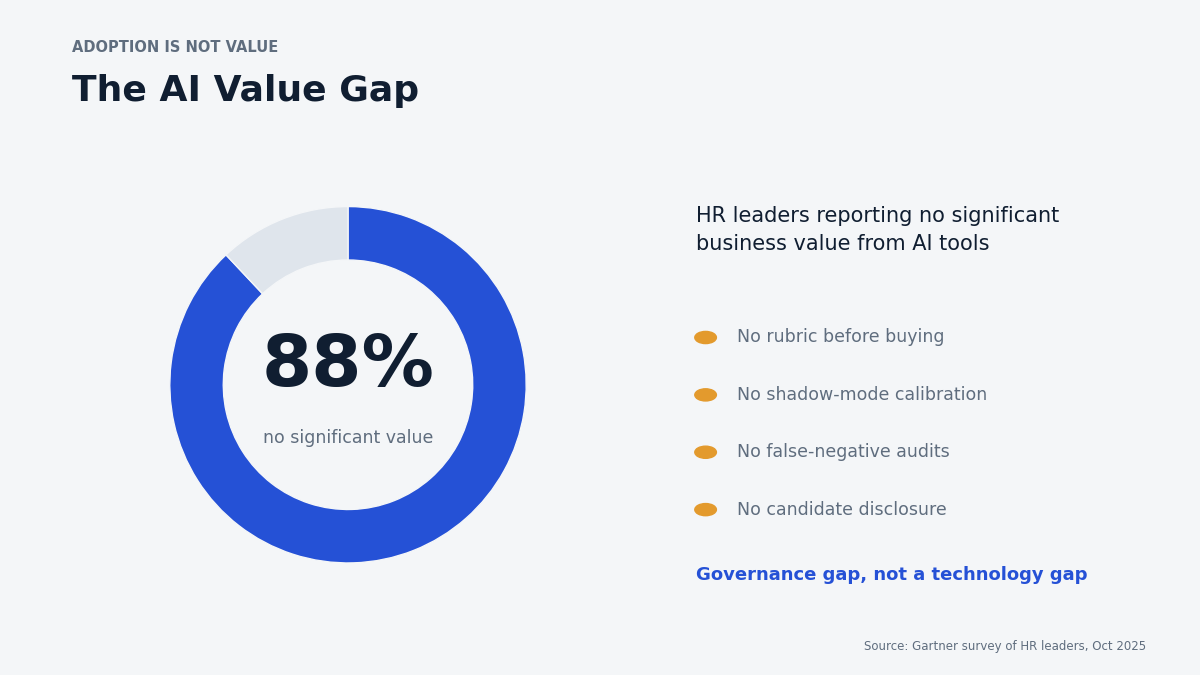
Eighty-eight percent of HR leaders say their organizations have not realized significant business value from AI tools, according to a Gartner survey published in October 2025. Read that against the buying frenzy of the last three years and the conclusion is uncomfortable: most teams evaluating AI tools for technical recruitment are about to repeat someone else’s expensive mistake buying software before fixing the process the software sits inside.
Technical hiring is where this gap hurts most. Developer roles attract the highest application volumes, carry the highest cost of a bad hire, and are the hardest to evaluate with pattern-matching alone. A resume screener that works acceptably for sales roles will silently reject strong engineers whose resumes don’t use the “right” keywords. A coding assessment that made sense in 2023 is now routinely completed by candidates with an LLM open in a second window.
And yet the upside is real. Teams that deploy AI on the right stages of the funnel sourcing, parsing, first-pass code screening, scheduling routinely cut screening effort by more than half and compress shortlist timelines from weeks to days. The difference between the 88% who see nothing and the minority who see compounding returns is not which vendor they picked. It is knowing exactly where AI helps, where it fails, and how to govern it.
Gartner named the AI revolution and cost pressure as the two forces shaping talent acquisition in 2026 and explicitly recommends telling candidates when AI is used and letting them opt out of AI interviews. Transparency is no longer a nice-to-have; it is a pipeline-retention strategy.
This guide is the playbook we use internally, made public.
TL;DR
This guide explains how to select, implement, and govern AI tools for technical recruitment, end to end. It is written for engineering leaders, talent heads, and founders who are deciding what to automate in developer hiring and what to keep human.
The single most important number in it comes from Gartner: 88% of HR leaders say AI tools have delivered no significant business value. The teams that beat that statistic run AI resume screening and code screening in shadow mode first, audit false negatives monthly, and keep humans on system design and values evaluation. Done that way, a job description can become an interview-ready shortlist in 7–10 working days instead of 4–8 weeks.
By the end, you will be able to map AI to the right funnel stages, run a vendor evaluation with a 15-point checklist, budget realistically (tool costs range from roughly $5,000 to $100,000+ per year depending on category), and stay ahead of bias and compliance obligations that became enforceable in 2026.
What Are AI Tools for Technical Recruitment?
AI tools for technical recruitment are software systems that use machine learning and large language models to automate or augment stages of developer hiring sourcing candidates, parsing resumes, screening code, scheduling interviews, and predicting role fit so recruiters and engineering managers spend their limited hours on judgement-heavy decisions instead of manual filtering.
What they are not:
- Not an ATS by itself. An applicant tracking system is the database and workflow layer; AI tools sit on top of (or inside) it to make decisions and predictions.
- Not a replacement for technical interviews. No current tool reliably evaluates system design depth, architectural trade-off reasoning, or collaboration under ambiguity.
- Not a bias-free oracle. Models trained on historical hiring data inherit historical hiring patterns including the bad ones unless actively audited.
Why AI in Developer Hiring Matters: The Business Case
The case for automating technical recruitment is not “AI is the future.” It is four measurable business outcomes, each of which shows up in the P&L:
- Speed to shortlist. Manual sourcing and screening for a mid-level backend role typically takes 4–8 weeks to produce an interview-ready shortlist. AI-assisted sourcing and screening pipelines the model we run compresses that to 7–10 working days from job description to shortlist. Every week saved is a week a critical seat isn’t empty; for a revenue-adjacent engineering role, seat vacancy commonly costs 1.5–3x the role’s weekly salary in delayed output.
- Screening cost. Recruiters report large efficiency gains from AI on repetitive stages 74% of talent professionals told LinkedIn that AI makes hiring more efficient. In our engagements, first-pass resume and code screening effort typically drops 60–70% once parsing and assessment automation are calibrated.
- Quality of hire. The same LinkedIn research found 89% of talent professionals say measuring quality of hire matters more than ever, but only 25% are confident they can. AI helps here indirectly: structured scoring, consistent rubrics, and funnel analytics make quality measurable at all. Well-instrumented pipelines let us maintain a 98% candidate joining rate and under 1% drop-off on contract roles numbers that are impossible to sustain on gut feel.
- Risk reduction. A mis-hire on a senior engineering role typically costs 6–12 months of fully loaded salary once you count ramp time, team drag, and re-hiring. Better screening signals earlier in the funnel is the cheapest place to buy down that risk.
The counter-case matters too: the AI in hiring pros and cons ledgers have a real cons column: compliance exposure, candidate distrust, and false negatives. Each gets its own section below.
The Core Problem: Why Technical Hiring Breaks Without a System
Application volume has exploded, and screening capacity has not. AI-assisted mass-applying means a single developer job posting at a known brand now routinely draws several hundred applications within days and in most of those stacks, well over half the applicants don’t meet the stated must-have requirements.
The 3–4x rule: Most teams underestimate first-pass screening load by 3–4x. A hiring manager budgets “a few hours” for a posting that actually requires 25–40 recruiter-hours of resume review, outreach, and scheduling before a single technical interview happens. That gap is where hiring timelines quietly die.
The failure pattern is consistent across the engagements we’ve seen:
- Week 1–2: Posting goes live. Applications flood in. Screening backlog builds.
- Week 3–4: Recruiters resort to crude keyword filtering to survive the volume. Strong candidates with non-standard resumes get cut by the classic false-negative problem of naive AI resume screening and manual skimming alike.
- Week 5–6: Engineering managers are pulled into screening calls, burning 8–12 senior-engineer hours per week per open role.
- Week 7+: The best candidates who are typically off the market in under 3 weeks have accepted elsewhere. The funnel refills with second-choice candidates, and time-to-fill blows past 60 days.
Meanwhile, the assessment layer has its own new problem: candidates completing take-home assignments with LLM assistance.
A take-home that screened effectively in 2023 now produces suspiciously uniform, suspiciously clean submissions. Teams that haven’t updated their evaluation design are passing candidates whose independent coding ability was never actually measured.
Red flag: If your pass rate on take-home assignments jumped noticeably between 2023 and today without a change in sourcing quality, you are almost certainly measuring AI fluency, not engineering ability.
None of this argues against automation. It argues for automating the right stages, with the right controls which is exactly what the walkthrough below covers.
The Full Walkthrough: Automating Technical Recruitment From Scratch
This is the complete lifecycle from the day you decide a role exists to the day you scale the process or shut it down. Skip no phase. The stages that feel “obvious” (requirements, onboarding) are where most implementations actually fail.
Phase 1 Defining Requirements (Days 1–3)
Every downstream AI decision inherits the quality of your role definition. A vague job description produces vague semantic matching, which produces a noisy shortlist. Nail this before touching any tool.
Build a role scorecard, not a job description. The scorecard is what your screening tools and interviewers will score against:
- Must-have skills (max 4–5). Each one must be screenable; “5+ years Node.js in production” is screenable; “rockstar mentality” is not.
- Nice-to-have skills (max 3–4), explicitly weighted lower so the matching engine doesn’t treat them as filters.
- Level and scope. Mid vs. senior changes both the compensation band and the assessment design.
- Compensation band, written down. Typical current bands: mid-level backend engineers in India run roughly ₹15–30 lakhs/year; senior engineers ₹35–60 lakhs/year; equivalent US-remote roles typically $110k–180k/year. Publishing a band internally prevents 2–3 weeks of late-stage offer renegotiation.
- Timeline commitment. Decide the target: e.g., shortlist in 10 working days, offer in 25, joined in 45–60 (including notice periods, which in India commonly run 30–90 days).
- Tooling budget. Decide now whether you’re buying point tools (typically $5k–30k/year each), a suite, or outsourcing the pipeline Phase 3 covers the trade-offs.
- Compliance owner. Name the person accountable for bias audits and candidate disclosures. If nobody owns it, it won’t happen.
The screenability test: For each must-have, ask “could a tool or a 30-minute exercise verify this?” If not, move it to the interview stage explicitly, don’t let it silently pollute your automated filters.
Phase 2 Sourcing & Vetting: What Good Screening Actually Looks Like (Days 3–10)
This is where AI earns its keep and where it does the most silent damage when misconfigured.
Sourcing. Modern candidate sourcing automation goes beyond boolean search: semantic matching engines read the meaning of a profile (a “platform engineer” who is really doing DevOps work), and talent intelligence platforms layer on signals like GitHub activity, open-source contributions, and inferred openness-to-switch.
The strongest pipelines source from a pre-vetted pool rather than the open web; our own AI-powered sourcing surfaces the top 2% of an already-vetted talent network, which is why shortlists arrive interview-ready rather than merely keyword-matched. If you need, say, to hire Node.js developers for a payments backend, a vetted-pool search beats a cold LinkedIn scrape on both speed and signal.
Resume parsing and screening. A well-run AI resume screening layer should:
- Parse into structured fields (skills, tenure, stack, domain) rather than scoring raw text.
- Score against the Phase 1 scorecard with visible, explainable reasoning per candidate.
- Rank, never auto-reject. Humans review the bottom of the ranking on a sample basis (see Phase 5’s false-negative audit).
- Ignore protected attributes and their proxies (name, photo, graduation year, address) at the model input level, not just in the UI.
Code screening. AI coding assessment tools are reliable for measuring syntax fluency, algorithmic correctness, debugging speed and unreliable as a proxy for real-world engineering. Design accordingly:
- Use short (45–90 min), role-relevant tasks: a bug-fix in a realistic codebase beats an abstract algorithm puzzle for most product roles.
- Assume LLM assistance. Either allow it openly and evaluate how well the candidate directs and verifies the AI, or move the decisive evaluation to a live pair-programming session where reasoning is visible.
- Turn on AI-generated code detection and plagiarism checks, but treat flags as conversation starters, not verdicts detection tools that produce false positives.
- Calibrate the bar by running 3–5 current team members through the assessment first. If your own engineers score 60–70%, don’t set the cutoff at 80%.
Red flags in candidates (pattern-based, from thousands of screenings): flawless take-home + inability to explain a single design decision live; tenure pattern of 6–9 months across 4+ companies without contract-role context; claimed architecture ownership at a scale the employer’s engineering blog contradicts.
For specialized roles e.g., when you hire machine learning engineers add a “explain your model’s failure modes” probe; genuine practitioners answer instantly, resume-embellishers stall.
Red flags in tools: vendors who won’t show per-candidate scoring rationale, won’t share adverse-impact statistics, or claim their model is “bias-free.” No model is.
Phase 3 Engagement Models & Contracts (Week 1–2, in parallel)
Three ways to run an AI-assisted technical hiring pipeline, and the contract terms that matter for each:
| Model | You manage | Typical cost | Best when |
| In-house stack (buy point tools, run internally) | Everything: tools, calibration, compliance | $15k–100k+/yr in tooling + recruiter time | Ongoing volume (15+ tech hires/yr), strong TA team |
| Staff augmentation / IT staffing | Interviews and final decisions; partner handles sourcing & vetting | Markup on salary or monthly fee per role | Speed matters, volume is spiky, roles are contract-friendly |
| AI-powered RPO (partner runs the funnel end to end) | Scorecards and hiring decisions only | Per-hire fee or monthly retainer, typically 8–15% of annual CTC equivalent | Scaling a function (10–50+ hires), no bandwidth to build internal machinery |
Dedicated IT staffing services and full recruitment process outsourcing both shift the AI tooling, calibration, and compliance burden onto the partner which is precisely why the vetting questions in the checklist later in this guide matter so much when choosing one.
Contract terms that actually matter (negotiate these, not the logo slide):
- NDA and IP protection covering candidate data and any code candidates write in assessments.
- Data processing agreement where candidate data lives, retention period (12 months is a sane default), deletion on request.
- Bias-audit cooperation clause vendor/partner must supply the selection-rate data you need for adverse impact analysis and (if you hire into NYC) Local Law 144 audits.
- Replacement guarantee for staffing/RPO models, a defined replacement window if a hire doesn’t stick. Ours is 7–10 days to a replacement candidate; anything vaguer than a number is a red flag.
- Exit and data-export terms you must be able to leave with your funnel data, rubrics, and candidate history in a usable format.
- No shared bandwidth (for dedicated models) named account manager, named recruiters, in writing.
Phase 4 Onboarding & Ramp-Up: The First 2 Weeks
Most AI recruiting deployments fail in the first fortnight, quietly. The tool goes live, nobody calibrates it, recruiters distrust its rankings within a week, and it becomes expensive shelfware, one more contributor to Gartner’s 88%.
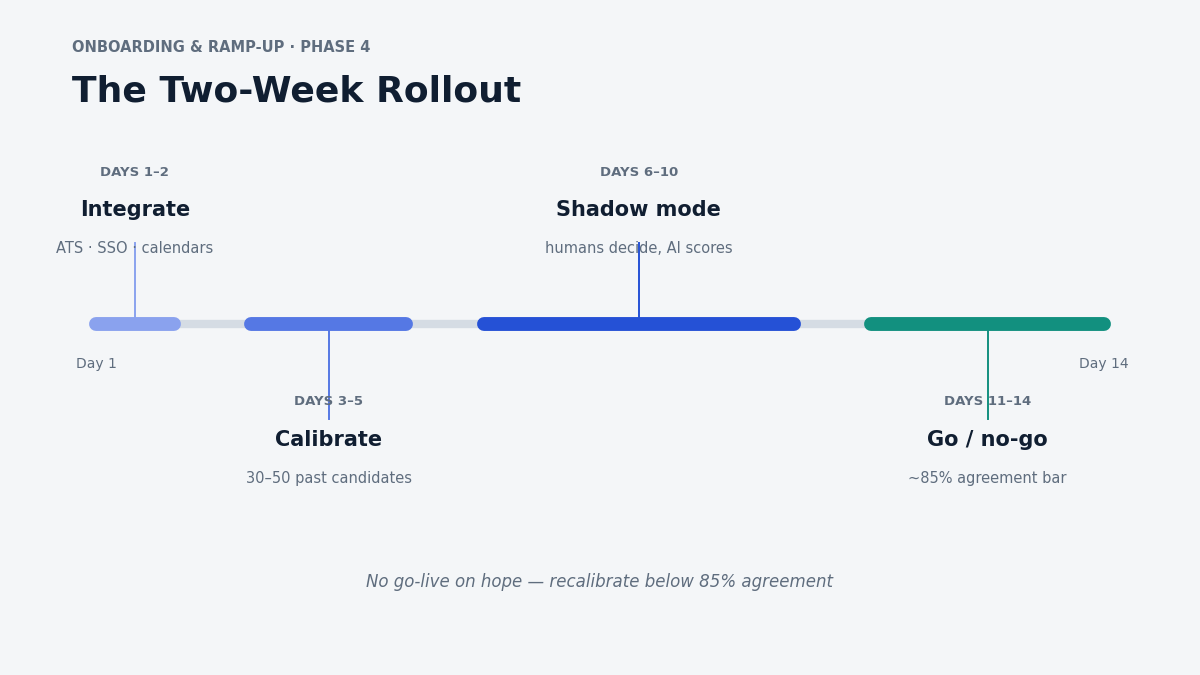
The 2-week rollout that works:
- Days 1–2: Access and integration. ATS connection, SSO, calendar integration for interview scheduling automation, Slack/Teams notifications. Verify data flows both ways.
- Days 3–5: Calibration set. Feed the tool 30–50 past candidates whose outcomes you know (hired-and-thrived, hired-and-failed, rejected). Compare its rankings with reality. Adjust scorecard weights until agreement is strong at the top of the ranking.
- Days 6–10: Shadow mode. The AI scores every live candidate, but humans still make every screening decision. Log disagreements daily.
- Days 11–14: Review and go-live decision. If human–AI agreement on “advance vs. reject” exceeds roughly 85% at the top of the funnel, switch to AI-first ranking with human review. If not, recalibrate and do not live on hope.
Onboarding friction we see in almost every engagement: interviewer calendars not actually connected (scheduling automation then silently books over standups), and recruiters never trained on overriding the AI.
Overrides are the point they’re your calibration data. Budget 2–3 hours of structured recruiter training, not a link to a help center.
Phase 5 Managing Delivery: Cadence, KPIs, and the Audits Nobody Runs
An AI-assisted funnel is a system under management, not a purchase. The operating rhythm:
Weekly (30 minutes):
- Funnel pass-through rates by stage (applied → screened → assessed → interviewed → offered).
- Time-in-stage any stage holding candidates >5 working days is leaking your best people.
- Offer acceptance rate and drop-off. Sub-90% acceptance on technical roles usually signals a compensation-band or process-speed problem, not a sourcing problem.
Monthly (2 hours):
- False-negative audit. Pull a random 20–30 AI-rejected resumes; have a human review blind. If more than ~5% were wrongly cut, your filters are too aggressive. This single audit is the highest-ROI governance habit in this entire guide.
- Selection-rate breakdown by demographic group where legally collectible, for adverse impact monitoring (the four-fifths rule is the standard yardstick).
- Quality-of-hire check-in on recent joiners at 30/60/90 days, fed back into scorecard weights.
Structure: one accountable owner per pipeline (in RPO/staffing models, a dedicated account manager), a shared dashboard, and a standing escalation path to engineering leadership. Reporting theater 40-slide monthly decks is a substitute for this rhythm, not a form of it.
Phase 6 Scaling or Exiting (Quarter 2 Onward)
Scaling up:
- Clone the calibrated pipeline per role family; a backend pipeline does not transfer to data science without re-calibration (different signals, different assessments).
- Re-run the Phase 4 calibration set for each new role family; budget 1–2 weeks each.
- Review models drift quarterly, the candidate pool changes (new frameworks, new AI-assisted application patterns), and a model calibrated 12 months ago degrades silently.
Exiting or switching:
- Trigger the data-export clause from Phase 3 before announcing the switch.
- Preserve rubrics, funnel metrics, and audit logs; they’re your compliance record and your next tool’s calibration set.
- For staffing/RPO exits, confirm replacement-guarantee and offboarding terms in writing, including knowledge transfer on in-flight candidates.
The sunset test: if two consecutive quarterly reviews show the tool’s ranking no longer beats a calibrated human on your false-negative audit, stop paying for it. Sunk cost keeps more bad tools alive than vendor lock-in does.
Where AI Genuinely Helps and Where Human Judgement Is Still Essential
The honest AI in hiring pros and cons breakdown, based on what has actually held up across hundreds of technical hiring engagements rather than vendor demos.
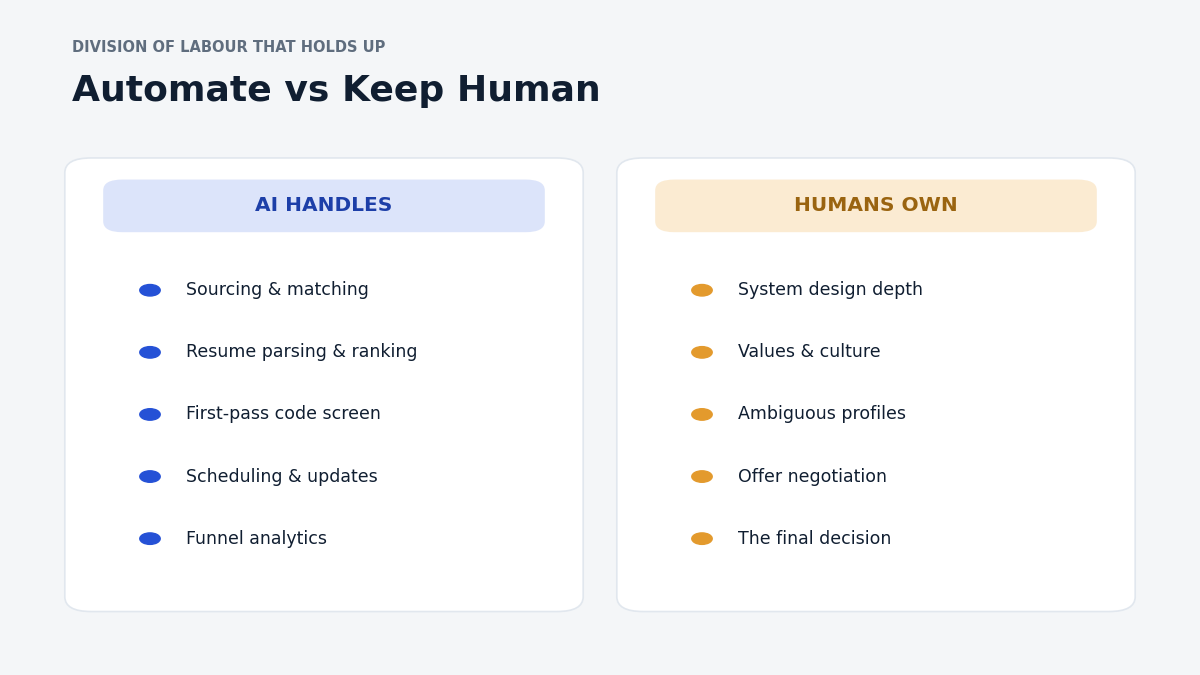
Where AI genuinely helps (deploy with confidence):
- Sourcing and talent-pool matching. Semantic search across millions of profiles is a task humans are strictly worse at. Best-in-class here is speed and precision: surfacing a small, pre-vetted top slice instead of a 400-name longlist.
- Resume parsing and first-pass ranking. Consistent, tireless, and when calibrated measurably fairer than a tired recruiter skimming resume #180 at 7 p.m.
- Initial code screening. Auto-graded assessments handle correctness, complexity, and code hygiene at scale, filtering the bottom half of the pool cheaply.
- Scheduling and candidate communication. Interview scheduling automation and status chatbots remove the #1 cause of candidate drop-off: silence. Response latency drops from days to minutes.
- Funnel analytics. Pass-through rates, stage bottlenecks, and source quality AI-instrumented pipelines make quality of hire measurable, which most teams have never had.
Where human judgement is still essential (do not delegate):
- System design depth. No tool today reliably evaluates how a candidate reasons about trade-offs consistency vs. availability, build vs. buy, when to shard. This is a senior-engineer-led conversation, full stop.
- Culture and values alignment. “Culture-fit AI” is where vendor claims most exceed evidence. Models trained on your current team optimize for sameness; the polite name for that is bias.
- Debugging ambiguous signals. Career gaps, unconventional paths, bootcamp-to-senior trajectories: exactly the profiles AI mis-scores and humans, given context, evaluate well.
- Closing. Offer negotiation and the final sale are relationship work. Companies that automate the close see acceptance rates say candidates can tell.
- The final decision. Legally and ethically, a human must own every reject/hire call. “The model decided” is not a defensible position anywhere, and after August 2, 2026 it is an actively dangerous one in the EU (next section).
Bias and Compliance: The Risks That Are Now Enforceable
The regulatory environment stopped being theoretical in 2026. Three obligations every buyer of AI recruiting tools for developers must plan around:
- EU AI Act. Employment-related AI systems (screening, ranking, evaluating candidates) are classified high-risk under Annex III, with obligations enforceable from August 2, 2026 risk management, human oversight, logging, and transparency, with penalties for high-risk violations reaching into the millions of euros or a percentage of global turnover. If you hire in or from the EU, this applies to your funnel even if your company doesn’t sit there.
- NYC Local Law 144. Automated employment decision tools used for NYC roles require an annual independent bias audit, published results, and advance candidate notice. Fines accrue per violation per day.
- Data protection regimes. GDPR (EU) and India’s DPDP Act both constrain candidate data retention, purpose, and consent. Your data processing agreement (Phase 3) is where this gets operationalized.
The bias mechanics to actually watch:
- Training-data bias: models learn from historical hires; if your history under-hired a group, the model encodes that as “signal.”
- Proxy variables: removing name and gender fields is not enough zip codes, university names, and even hobby keywords act as proxies.
- Adverse impact math: apply the four-fifths rule if any group’s selection rate falls below 80% of the highest group’s rate at any automated stage, investigate before regulators do.
- Feedback loops: an uncorrected biased filter produces biased hires, which become biased training data. Audit cadence (Phase 5) is the circuit breaker.
AI Recruiting Tool Evaluation Checklist
Put every vendor through all 15 before signing. A vendor who dodges more than two of these is telling you something.
Accuracy & fit:
- Can we run it in shadow mode against 30–50 of our own past candidates before go-live?
- Does it show per-candidate scoring rationale (explainability), not just a number?
- Does it rank rather than hard-reject and can we tune the thresholds?
- Is it calibrated for technical roles specifically (code, repos, stacks), not generic resumes?
Bias & compliance: 5. Will the vendor share adverse-impact statistics from existing deployments? 6. Does it support (or has it passed) an independent bias audit LL144-grade? 7. Are protected attributes and known proxies excluded at the model level? 8. Where is candidate data stored, for how long, and can we delete on request? 9. Does it log decisions with an audit trail we can export?
Operations: 10. Native integration with our ATS and calendar or “API available” hand-waving? 11. What does implementation actually take in weeks, with a named plan? 12. Can candidates be told AI is in use, and can they request human review or opt out of AI interviews?
Commercials: 13. Pricing model per seat, per assessment, per hire modeled at our volume, including year-2 renewal uplift? 14. Exit terms: full data export in a standard format? 15. Reference calls with two customers at our hiring volume, not their flagship logo?
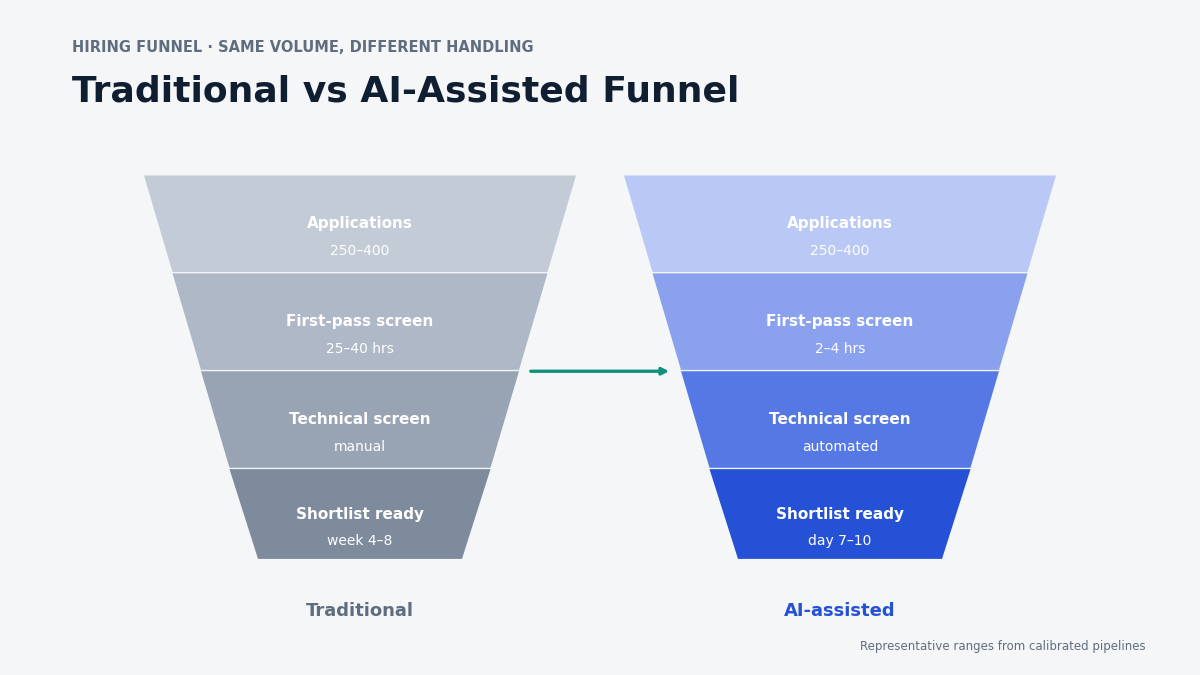
Infographic: AI-Assisted vs. Traditional Hiring Funnel
(Design note: render as a side-by-side funnel graphic; alt text: “AI-assisted hiring funnel for technical recruitment compared with a traditional developer hiring funnel.” The figures below are typical patterns from calibrated pipelines label them as representative ranges, not guarantees.)
| Funnel stage | Traditional funnel | AI-assisted funnel |
| Applications in | 250–400 per posting | 250–400 per posting (volume is the same handling isn’t) |
| First-pass screening | 25–40 recruiter-hours; 2–3 weeks | 2–4 hours of human review of AI-ranked list; 1–2 days |
| Technical screen | Manual scheduling; 10–14 days of back-and-forth | Auto-scheduled assessments; 3–5 days |
| Interview-ready shortlist | Week 4–8 | Working day 7–10 |
| Candidate communication | Ad-hoc; silence gaps of 5–10 days | Automated status updates; same-day responses |
| Engineering hours per hire | 20–30 senior-engineer hours | 8–12 hours, concentrated on design rounds and final loops |
| Decision audit trail | Scattered across inboxes | Logged, exportable, compliance-ready |
Case Studies: What This Looks Like in Production
Swiggy engineering scale-up under hyper-growth. During its rapid-growth phase, Swiggy needed to add engineering capacity far faster than a traditional funnel allows, across backend, data, and platform roles. Running an AI-sourced, pre-vetted pipeline with dedicated recruiters, shortlists landed in the standard 7–10 working-day window per role, letting engineering leaders spend their hours on design rounds instead of resume triage. The scale-up sustained the joining-rate discipline (98% across our engagements) that hyper-growth hiring usually destroys.
OkCredit early-stage engineering hiring without an internal TA team. As a fintech startup, OkCredit’s constraint was bandwidth: no internal recruiting machinery, founders in every loop. Outsourcing sourcing and vetting to an AI-assisted pipeline meant the internal team only saw interview-ready candidates scored against an agreed scorecard the Phase 1–2 playbook above, run as a service. Founder time per hire dropped to the final two interview rounds.
Somnoware recruitment automation in a compliance-heavy domain. For a healthtech platform, candidate quality and IP protection carried equal weight. The engagement paired automated technical screening with NDA-backed processes and named account management, demonstrating that the governance layer (Phases 3 and 5) is compatible with speed rather than opposed to its drop-off on contract roles stayed under 1%.
The pattern across all three, and across Supersourcing’s 527+ delivered projects: AI compressed the top of the funnel; humans owned the decisions; governance made it durable.
Decision Framework: In-House Stack vs. Point Tools vs. RPO vs. Traditional Agency
Score each option 1–5 on the four factors that matter for your situation, weight by what’s scarce for you (money, time, control, or compliance capacity), and the decision usually makes itself:
| Factor | In-house AI stack | Point tools + own team | AI-powered RPO | Traditional agency |
| Upfront cost | High ($50k–150k/yr tooling + team) | Medium ($15k–60k/yr) | Low (pay per hire/retainer) | Low (pay per hire, 15–25% of CTC) |
| Speed to first shortlist | Slow to stand up (2–3 months), fast after | Medium (3–6 weeks) | Fast (7–10 working days) | Variable (2–6 weeks) |
| Control & customization | Maximum | High | Medium-high (via scorecards) | Low |
| Compliance burden on you | All of it | Most of it | Shared/contractual | Opaque ask hard questions |
| Best for | 25+ tech hires/yr, mature TA org | 10–25 hires/yr, capable TA lead | Scaling functions, spiky demand, no TA bandwidth | One-off senior/confidential searches |
Decision shortcuts:
- Fewer than ~10 technical hires a year → buying and calibrating your own AI stack rarely pays back; use a partner.
- Hiring into the EU or NYC with no compliance owner → the shared-burden models (RPO/staffing) exist precisely for this.
- Already own a good ATS and a strong TA lead → point tools (one assessment platform + one sourcing layer) beat a suite; suites bundle mediocrity.
- Whatever you choose, the classic mistakes when choosing an IT staffing partner: no shadow-mode trial, no replacement guarantee, no data-export clause apply doubly when AI is in the loop.
What Most Teams Get Wrong
Six patterns show up so consistently across engagements that they’re closer to laws than observations. This section is deliberately opinionated, bookmark it, disagree with it, but check your own funnel against it first.
- They automate the top of the funnel while the bottleneck is the middle. Buying a sourcing tool when your interview loop takes 21 days is buying a faster on-ramp to a traffic jam. Measure time-in-stage first; automate the stage that’s actually bleeding candidates. In most technical funnels we audit, the bottleneck is interviewer availability, not candidate supply.
- They buy the tool before defining the rubric. An AI screener scoring against a vague job description is a random-number generator with a confident UI. The Phase 1 scorecard is 80% of screening quality; the tool is the other 20%. Teams reverse that ratio in their budgets almost every time.
- They trust assessment scores as if they were job performance. A 92nd-percentile algorithm score predicts algorithm-test performance. It weakly predicts shipping production software on a team. Use AI coding assessment tools to filter the bottom, never to rank the top the top of your funnel should be ranked by humans looking at design reasoning.
- They never audit false negatives. Everyone inspects who got through; almost nobody inspects who got cut. The monthly 20–30-resume blind audit from Phase 5 takes two hours and is the only mechanism that catches a mis-calibrated filter before it’s been silently rejecting your best candidates for two quarters.
- They hide the AI from candidates. Candidate trust in AI evaluation is low, and opacity makes it worse which is why Gartner explicitly advises disclosing AI use and offering opt-outs from AI interviews. Disclosure is now the pipeline-protective move, not the risky one: strong candidates increasingly abandon processes that feel like being graded by a vending machine.
- They treat the bias audit as a one-time procurement checkbox. Bias isn’t a property a tool has or lacks at purchase; it’s a property of the tool plus your data plus your funnel, and it drifts. One audit at signing and none afterward is how teams end up explaining a four-fifths-rule violation to a regulator with 18 months of unexamined logs.
The quotable version: AI recruiting fails not because the models are weak but because the process around them is unmanaged, no rubric, no shadow mode, no false-negative audits, no disclosure. The 88% who see no value from AI, per Gartner, mostly skipped governance, not technology.
Cost & Timeline Reality Check
The section with the most competing content skips. All figures are typical negotiated ranges we see in the market and in engagements; treat them as planning bands, not quoted technical-recruiting SaaS pricing is heavily volume- and negotiation-dependent.
Tool costs by category (annual, typical bands):
- AI coding assessment platforms: roughly $5,000–30,000/year for SMB-to-mid tiers; enterprise agreements higher. Some price per assessment ($10–50 each) model your real screening volume before choosing per-seat vs. per-use.
- AI sourcing / talent intelligence platforms: roughly $8,000–25,000 per recruiter seat per year at the premium end; lighter Chrome-extension-class tools from $2,000–6,000.
- ATS with embedded AI: $10,000–60,000+/year depending on company size; AI features are increasingly a paid add-on tier, so quote the tier you’ll actually need.
- AI interview/video screening layers: commonly $20,000–40,000+/year at enterprise tiers; check the compliance surface (these are the most regulated category).
- Independent bias audit (LL144-grade): typically $10,000–35,000 per audit per tool, annually. Budget it; it is not optional for NYC roles.
Fully-loaded comparison per hire (mid-level engineer):
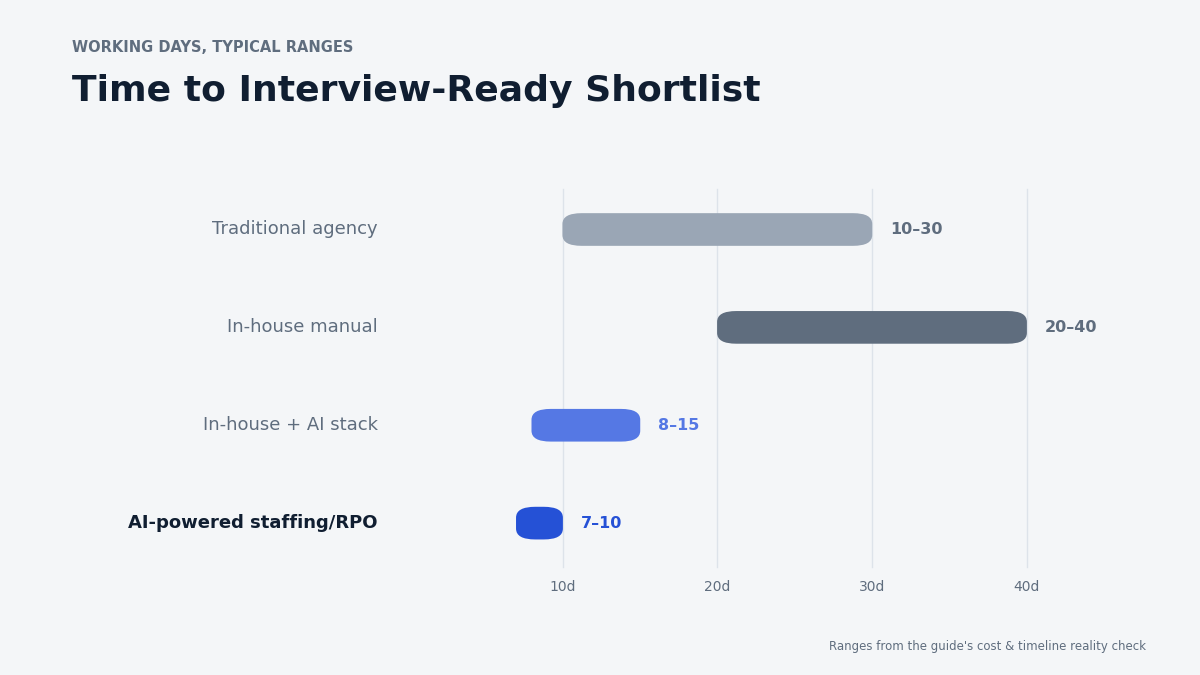
| Approach | Typical cost per hire | Typical time to shortlist |
| In-house manual | ₹1.5–3 lakhs / $3k–8k in recruiter + engineer time | 4–8 weeks |
| In-house + AI stack (amortized) | ₹1–2 lakhs / $2.5k–6k after calibration | 1.5–3 weeks |
| AI-powered staffing/RPO | Fee typically 8–15% of annual CTC equivalent | 7–10 working days |
| Traditional agency | 15–25% of annual CTC | 2–6 weeks |
What drives cost up: niche stacks (Rust, ML infra), senior/staff-level searches, multi-jurisdiction compliance, per-assessment pricing at high volume, and mid-contract seat expansion (negotiate expansion pricing at signing).
What drives cost down: pre-vetted talent pools, annual prepay (commonly 10–20% off), consolidating to fewer tools, and above all a calibrated funnel that doesn’t waste paid assessments on candidates a better scorecard would have filtered.
Implementation timelines, honestly:
- Point tool (assessment platform): 2–4 weeks to calibrate go-live.
- Sourcing + screening + scheduling stack: 6–10 weeks including shadow mode.
- Full RPO transition: 2–3 weeks to first live pipeline; first shortlists inside the first month.
- Anything a vendor promises “live in 48 hours” will be live in 48 hours and calibrated never.
Your Next Step
If you’re mid-evaluation right now, don’t start with a vendor demo. Start with the two artifacts this guide gave you: build the Phase 1 role scorecard for your single hardest-to-fill role, and run the 15-point evaluation checklist against whatever tool or partner is currently in your inbox. That exercise takes an afternoon and eliminates most bad options before they cost you a quarter.
And if what you actually need is the outcome interview-ready, pre-vetted engineers on your calendar within 7–10 working days, with the governance layer already built, talk to the Supersourcing team. Bring the scorecard; we’ll pressure-test it on the call.
FAQ
Do AI resume screeners reject good candidates?
Yes, mis-calibrated ones do it systematically. Naive keyword filters cut strong engineers with non-standard resumes (career changers, open-source-heavy profiles, non-target universities). The fixes are structural: rank instead of hard-reject, calibrate against past known-outcome candidates, and run a monthly blind audit of a sample of rejections. Screening quality is a governance outcome, not a product feature.
Are AI coding assessments reliable?
Reliable for what they measure: correctness, code hygiene, and debugging on bounded tasks. Unreliable as a proxy for system design ability or team performance, and increasingly confounded by LLM-assisted completion. Use them to filter the bottom of the funnel, pair them with a live session for anyone advancing, and re-validate the cutoff against your own engineers’ scores.
Is it legal to use AI in hiring?
Legal, but regulated and tightening. The EU AI Act treats employment AI as high-risk, with obligations enforceable from August 2, 2026; NYC’s Local Law 144 mandates annual independent bias audits and candidate notice; GDPR and India’s DPDP Act govern the candidate data underneath. The practical bar: human oversight of decisions, disclosure to candidates, audit logs, and annual bias testing.
How much do AI recruiting tools cost?
Point tools typically run $5,000–30,000 per year each; premium sourcing seats $8,000–25,000 per recruiter; enterprise suites and video-interview layers more. A realistic first-year budget for a self-managed mid-market stack is $25,000–75,000 including implementation time which is why teams making fewer than ~10 technical hires a year usually do better with a per-hire partner model.
Can AI replace technical recruiters?
No, it replaces the worst 60% of the job. Sourcing longlists, parsing resumes, scheduling, and status updates automate well. What’s left is the actual craft: calibrating with hiring managers, evaluating ambiguous profiles, selling offers, and owning decisions. Teams that cut recruiters and kept the software consistently see offer-acceptance rates fall; the leverage play is fewer, more senior recruiters running better-instrumented funnels.
How do candidates use AI to beat the process and what do we do about it?
Mass-tailored applications inflate top-of-funnel volume, and LLMs complete take-homes convincingly. Countermeasures: shorter live pair-programming rounds where reasoning is visible, assessments that permit AI and grade how well the candidate directs and verifies it, AI-generated-code detection used as a discussion prompt, and heavier weighting on verifiable history (production systems, repos, references).
What parts of technical hiring should never be automated?
System design evaluation, values/culture conversations, offer negotiation, and the final decision. These are judgement- and relationship-heavy, legally sensitive, and exactly where candidates decide whether they trust you. Automate everything that feeds these moments; never the moments themselves.
How do we know if we should build this in-house or bring in a partner?
Volume and bandwidth. Above roughly 25 technical hires a year with a capable TA team, an in-house stack amortizes well. Below that or when demand is spiky, timelines are brutal, or compliance capacity is thin, a vetted staffing or RPO partner running an already-calibrated AI pipeline gets you to interview-ready shortlists in 7–10 working days without you building the machinery. If you’re mid-decision, a 30-minute scorecard-and-funnel review is the fastest way to find out which side of that line you’re on.
