

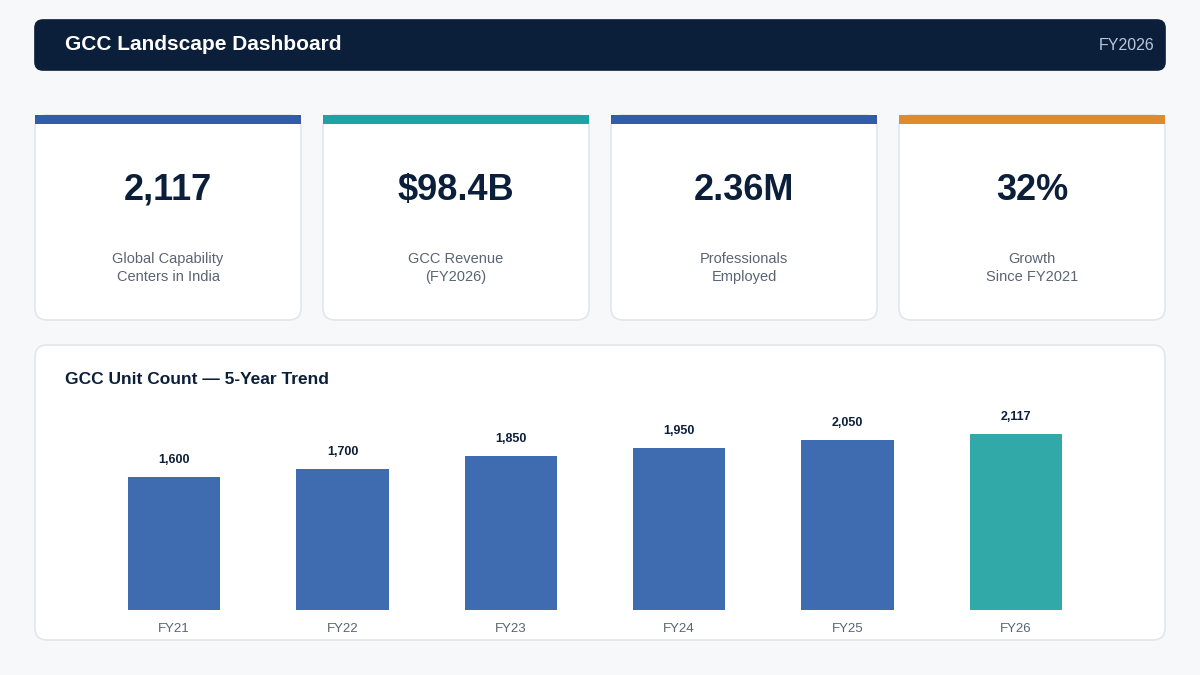
India now has 2,117 Global Capability Centers, generating close to $98.4 billion in revenue and employing 2.36 million professionals, a 32% jump since FY2021, according to the Zinnov-Nasscom India GCC Landscape Report 2026. That’s not a niche outsourcing trend anymore. It’s a parallel operating model that most enterprise leaders are being asked to build without ever having built one before.
Here’s the problem nobody talks about: the terminology gets in the way before the strategy does. A CFO hears “build-operate-transfer” and assumes it means the same thing as “staff augmentation.” A CHRO signs a contract with a “shared services center” clause and doesn’t realize it legally limits what work the center can own. A CTO approves a “GCC maturity” roadmap without knowing what maturity is actually measured against. These aren’t small semantic slips; they’re the root cause of scope disputes, budget overruns, and stalled transitions six months into a GCC build.
India is now home to 2,117 global capability centres employing 2.36 million professionals, with total revenue reaching $98.4 billion as of FY26. More strikingly, 96% of GCCs established after FY2021 launched with product or portfolio ownership mandates from day one skipping the old “crawl-walk-run” model entirely. That shift changes what the terminology in your first vendor conversation actually needs to mean.
This guide is not a dictionary. It’s a working glossary organized by where each term shows up in the real lifecycle of setting up and running a GCC, from the first requirements conversation to the exit clause in year three.
TL;DR
This guide is a practitioner's glossary of the 40 terms that actually come up when you're evaluating, setting up, or running a Global Capability Center (GCC) grouped by the stage of the process where they matter, not alphabetized for show. It's built for CHROs, CTOs, and operations leaders who are early in a GCC decision and need to stop nodding along in vendor meetings.
The single biggest number to remember: 96% of GCCs launched since FY2021 skipped the old cost-center phase entirely and started with product ownership from day one which means the contract terms, KPIs, and reporting terminology you use on day one now carry far more weight than they did five years ago.
By the end, you'll be able to read a GCC term sheet or delivery dashboard without translation help, spot which terms a vendor is using loosely as a red flag, and walk into your next capability-center conversation asking the right follow-up question instead of the generic one.
What Is a GCC Terminology Glossary?
A GCC terminology glossary is a structured reference of the vocabulary used across the lifecycle of setting up, staffing, and operating a Global Capability Center spanning legal/contract terms, delivery and reporting terms, HR and talent terms, and maturity/strategy terms.
It is not:
- A general outsourcing or BPO glossary GCCs are captive (owned) operations, not third-party vendor arrangements, so ownership, IP, and reporting terms differ materially.
- A one-time dictionary you read once the terms recur at different stages (contract, onboarding, quarterly business review) with slightly different practical weight each time.
- A substitute for legal review glossary fluency helps you ask sharper questions; it doesn’t replace counsel on an MSA or SOW.
Why Getting the Terminology Right Matters
Precise terminology isn’t pedantry; it changes the outcomes of the decisions built on top of it.
- Cost impact: Confusing “staff augmentation” with a “dedicated GCC team” in a proposal typically produces a budget gap of 15-25%, because dedicated teams carry infrastructure, compliance, and management overhead that augmentation contracts don’t.
- Speed impact: Vendors that use precise, consistent terminology in scoping documents cut requirement-gathering cycles by roughly a third ambiguous terms like “full ownership” or “managed delivery” without a defined SLA behind them are the single biggest cause of scope-clarification back-and-forth.
- Risk impact: IP and data-residency terms (e.g., NDA/IP assignment, data residency, DPDP compliance) that are glossed over in a term sheet are the most common source of post-signature legal disputes in India-based GCC contracts.
- Talent impact: Misreading “talent density” as headcount rather than skill concentration leads buyers to over-hire generalists when they need 6-8 specialists, a mistake that typically isn’t caught until the first delivery review, 8-10 weeks in.
The Core Problem Most Buyers Face
Most first-time GCC buyers underestimate how much of their early decision-making is actually a vocabulary problem disguised as a strategy problem. Three patterns show up repeatedly:
- Contract-stage confusion: Buyers sign a “build-operate-transfer” (BOT) agreement believing it means the vendor permanently manages delivery, when BOT specifically implies a transfer date and terms missing that clause typically costs 3-4 months of renegotiation later.
- Reporting-stage confusion: Buyers receive a “delivery dashboard” with KPIs they don’t recognize (e.g., offer-to-join ratio, bench strength, span of control) and can’t tell if performance is actually on track most first-time buyers underestimate the ramp-up-to-stable-delivery timeline by 2-3x because they don’t know what “stable state” is defined as in the contract.
- Maturity-stage confusion: Buyers hear “GCC maturity model” and assume its marketing language, missing that maturity level directly determines what work the center is legally and operationally allowed to own; a Zinnov-style maturity framework is now the industry standard classification, not an internal buzzword.
THE WALKTHROUGH: GCC Terminology Through the Full Lifecycle
This is the core of the 40 terms, grouped by the six phases where a GCC decision-maker actually encounters them. Each phase includes a numbered glossary block you can reference directly.
Phase 1 Defining Requirements: Scoping & Strategy Terms
Before you talk to a single vendor, these are the terms that shape your own internal scoping document.
- Global Capability Center (GCC) A captive (company-owned) offshore or nearshore unit that performs core business functions engineering, analytics, finance, R&D under direct ownership and control of the parent company, as opposed to a third-party vendor relationship.
- Captive Center Used interchangeably with GCC; emphasizes that the entity is wholly owned by the parent, not outsourced.
- Shared Services Center (SSC) A narrower structure focused on standardized, transactional functions (payroll, IT helpdesk, procurement) across business units often a predecessor stage to a full GCC, not a synonym for one.
- Center of Excellence (CoE) A specialized unit within (or adjacent to) a GCC focused on a specific capability e.g., an AI CoE or a cloud-architecture CoE usually smaller and more senior-heavy than the broader GCC.
- Build-Operate-Transfer (BOT) An engagement model where a partner builds and initially operates the center on the client’s behalf, with a contractually defined date/milestone to transfer full ownership and operations to the client’s in-house team.
- Global Operating Model (GOM) McKinsey’s term for how enterprises now distribute leadership, not just execution, across global centers; today, anywhere from 25% to 45% of enterprise headcount sits in the GOM, compared with 5-15% a decade ago.
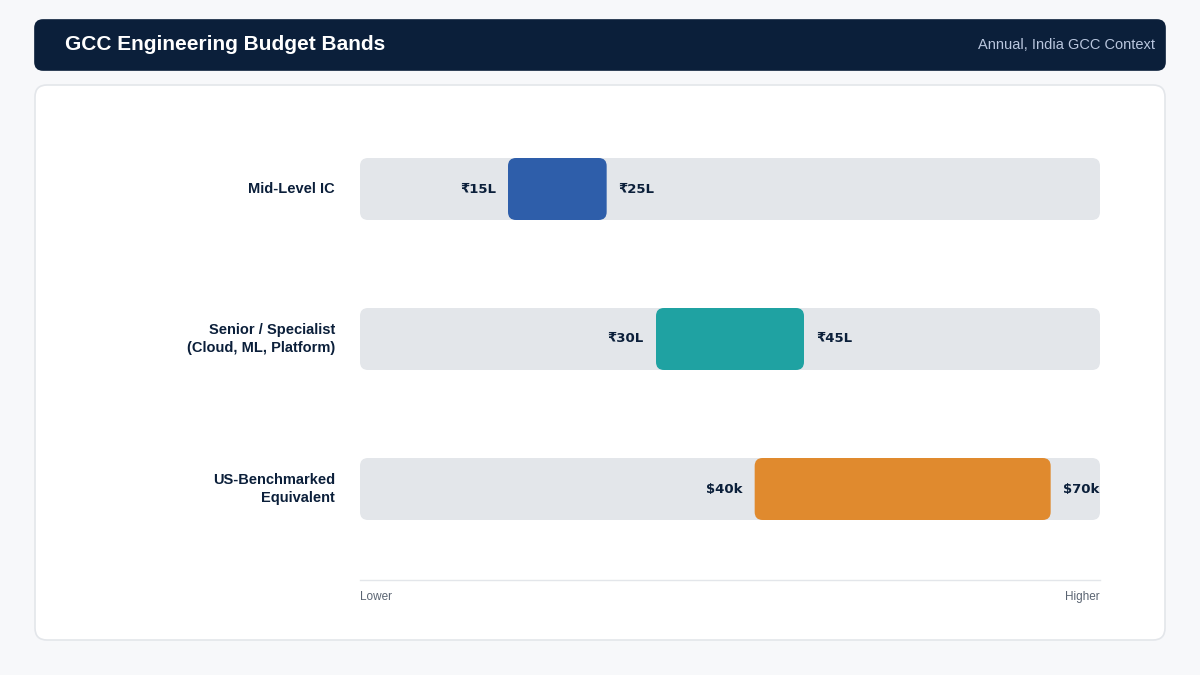
- Budget Band The salary/cost range set for a role or function before sourcing begins; in India, GCC engineering budget bands typically run ₹18-45 lakhs/year for mid-to-senior individual contributors depending on city and skill scarcity.
Requirements checklist for Phase 1:
- Have you defined whether you need a GCC, a shared services center, or staff augmentation (they are not interchangeable)?
- Do you have a budget band per role, not just a total headcount budget?
- Have you decided your target maturity level (see Phase 6) at 12 and 24 months?
- Have you named who owns the transfer decision if you’re structuring as BOT?
Phase 2 Sourcing & Vetting: Talent Terms
Once requirements are set, these terms describe how candidates and dedicated teams get evaluated.
- Talent Density The concentration of specialized, senior-level skill within a team, distinct from raw headcount; a 30-person team with high talent density can outperform a 60-person team with low density on complex product work.
- Bench Strength The depth of qualified backup talent a partner can deploy quickly if a role opens up or scales; a thin bench is a leading indicator of replacement delays.
- Offer-to-Join Ratio The percentage of extended offers that convert to actual joiners; industry-wide this hovers around 70-80%, so a partner promising “near 100%” without data to back it up is a red flag.
- Notice Period The contractual gap between a candidate resigning from their current role and being available to join yours typically 30, 60, or 90 days in India for mid-to-senior tech roles, and a major driver of your actual time-to-hire.
- Attrition Rate Annual percentage of the GCC’s workforce that leaves; India GCC attrition benchmarks generally sit in the 12-18% range for engineering roles, with anything meaningfully above that signaling management or compensation issues.
- Technical + Cultural Fit Screening A two-stage vetting process combining hands-on technical assessment (system design, live coding, architecture review) with structured evaluation of communication style and working-hours overlap skipping the cultural-fit stage is the single most common reason GCC hires don’t last past 90 days.
Red flag pattern from real engagements: when a staffing partner can quote you a headcount number and a start date in the first call but can’t tell you their offer-to-join ratio or average bench depth for that skill, they’re selling supply, not vetting quality this is a distinction that only becomes visible after you’ve watched a few cohorts actually ramp up.
Phase 3 Engagement Models & Contracts: Legal & Commercial Terms
This is where imprecise terminology gets expensive. These are the terms that belong in every term sheet review.
- Staff Augmentation Adding individual contractors or resources under the client’s direction and management, without the vendor taking delivery ownership cheapest and fastest model, but the client carries full management overhead.
- Dedicated Team Model A vendor-managed but client-exclusive team, with a dedicated account manager and no shared bandwidth across other clients, the most common structure for mid-stage GCC builds before a full BOT transfer.
- Project-Based Engagement Fixed-scope, fixed-timeline delivery against a defined deliverable, priced separately from ongoing GCC operations.
- Master Service Agreement (MSA) The overarching legal contract governing the relationship; individual work orders reference back to MSA terms rather than restating them.
- Statement of Work (SOW) A specific work order under the MSA defining scope, deliverables, timeline, and pricing for a particular engagement or phase.
- NDA / IP Assignment Non-disclosure plus intellectual-property assignment clauses that confirm all work product, code, and designs created by the GCC team belong to the client, not the vendor or individual contributor; this clause should be reviewed line-by-line, not assumed standard.
- Data Residency Contractual and technical commitment on where client data is physically stored and processed increasingly tied to sector-specific compliance (finance, healthcare) rather than a generic clause.
- DPDP Compliance Adherence to India’s Digital Personal Data Protection Act, now a standard requirement in GCC contracts handling personal data, alongside GDPR where EU data is involved.
- Transfer Pricing The intercompany pricing structure between the parent entity and the GCC subsidiary, governed by tax regulations in both jurisdictions, is a finance/legal term, but it directly affects how GCC costs get booked and reported internally.
- Replacement Guarantee A contractual commitment to replace a hire that isn’t working out within a defined window (commonly 7-10 days in well-structured contracts) at no additional cost is a genuinely useful clause to negotiate for, not a default.
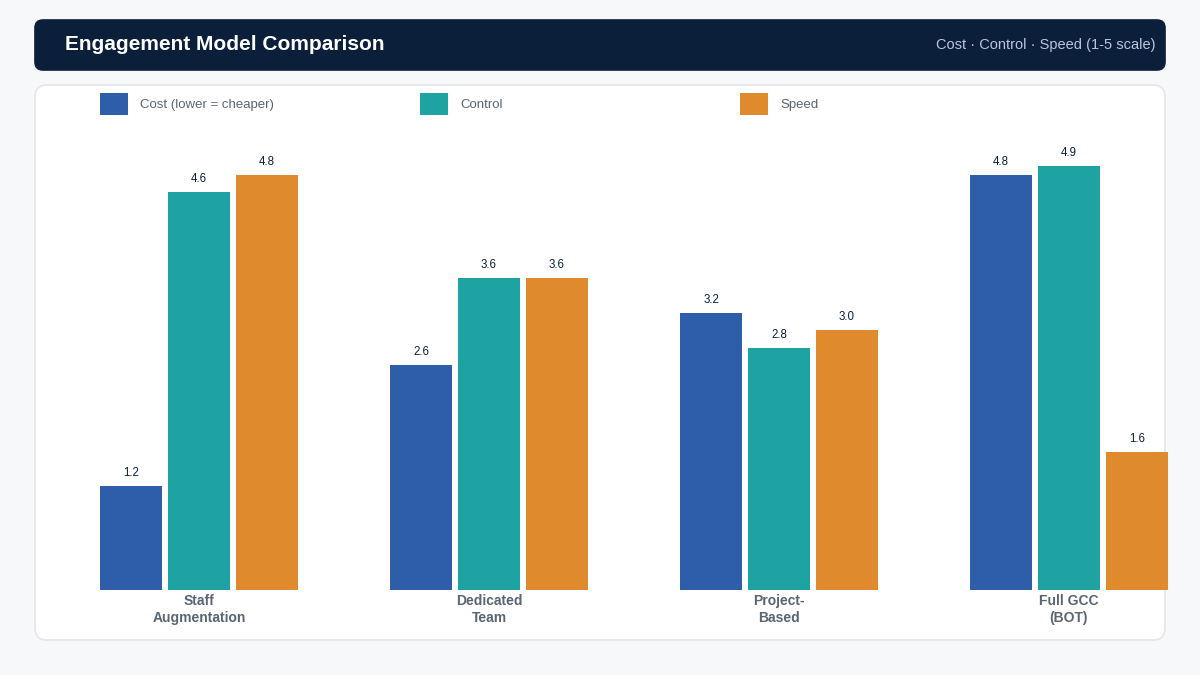
Engagement model comparison:
| Model | Cost | Control | Speed | Best For |
| Staff Augmentation | Lowest | High (client-managed) | Fastest (days-weeks) | Filling specific skill gaps short-term |
| Dedicated Team | Mid | Shared (vendor + client) | 7-10 working days to shortlist | Mid-stage GCC build, ongoing delivery |
| Project-Based | Mid-High | Vendor-owned during project | Fixed by SOW | Discrete deliverables, MVPs |
| Full GCC (BOT or direct) | Highest upfront | Full (post-transfer) | 3-6 months to stand up | Long-term captive capability |
Phase 4 Onboarding & Ramp-Up: Delivery Terms
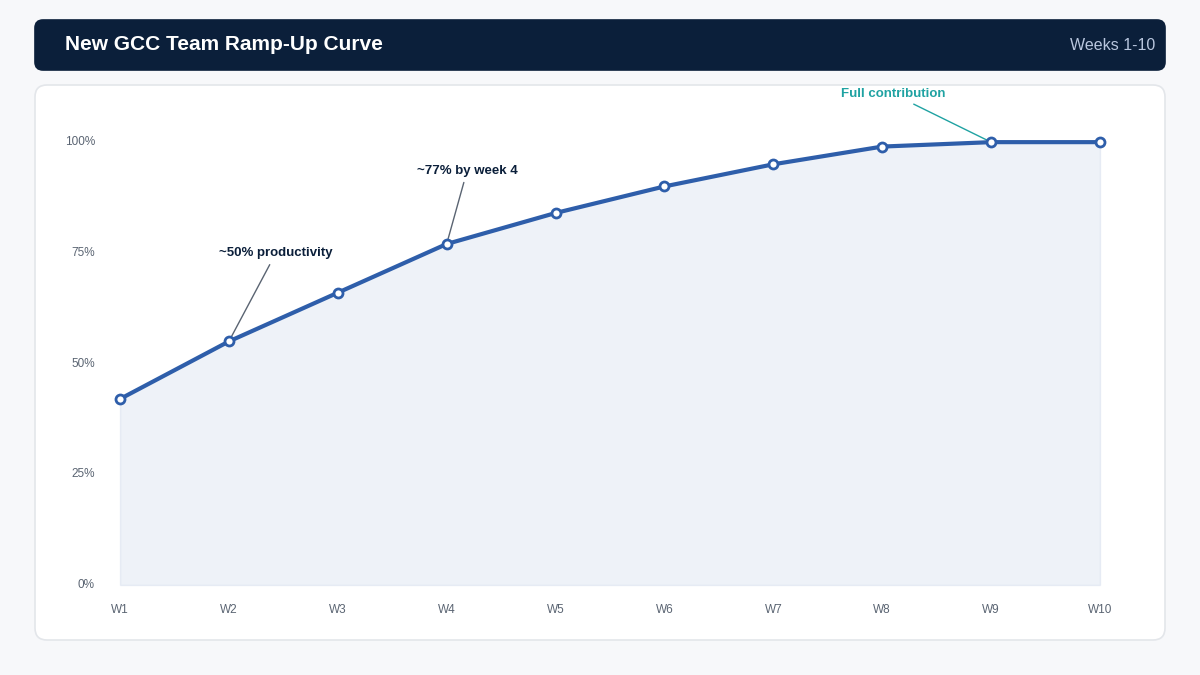
- Ramp-Up Curve The expected productivity trajectory of a new hire or team from day one to full contribution realistic curves show 40-60% productivity in weeks 1-2, 70-85% by week 4, and full contribution by week 8-10, not immediate output.
- Knowledge Transfer (KT) The structured process of moving domain, process, and system knowledge from the client (or incumbent team) to the new GCC team, typically runs over 2-4 weeks with documented sessions, not informal handoffs.
- Reverse KT The less common but increasingly important flow of knowledge back from the GCC to headquarters as the center takes on more strategic ownership, a marker of GCC maturity, not just onboarding hygiene.
- Access Provisioning The IT/security process of granting system, VPN, and tool access commonly the single biggest cause of week-one onboarding delay when not pre-planned with the client’s IT team.
- Communication Cadence The defined rhythm of syncs (daily standups, weekly delivery reviews, monthly business reviews) between the GCC team and headquarters stakeholders.
Onboarding checklist for the first two weeks:
- Access provisioning requested at least 5 business days before start date
- KT sessions scheduled and documented, not verbal-only
- Communication cadence and time-zone overlap windows confirmed in writing
- A named point of contact on both sides for escalations
Phase 5 Managing Delivery: Reporting & Performance Terms
- Service-Level Agreement (SLA) Contractually defined performance thresholds (response time, uptime, delivery velocity) with consequences if missed vague SLAs (“high quality delivery”) are unenforceable and should be rewritten with numbers.
- KPI Dashboard The recurring report tracking delivery metrics against SLA/targets; a functioning dashboard should update at least monthly and tie every metric back to a business outcome, not just activity volume.
- Span of Control The number of direct reports or team members a single manager oversees; GCCs generally target a 1:6 to 1:10 span for engineering managers; a span above 12-15 usually signals under-investment in management layers.
- Account Management Structure The org chart of who owns the relationship on the vendor/partner side a dedicated account manager (not a rotating point of contact) correlates strongly with faster issue resolution.
- Delivery Lead The senior individual accountable for day-to-day execution quality within the GCC, distinct from the account manager who owns the commercial relationship.
Phase 6 Scaling or Exiting: Maturity & Growth Terms
- GCC Maturity Model A staged framework (commonly cost center → shared services → center of excellence → portfolio/product owner) used to classify how much strategic ownership a GCC has earned the Zinnov GCC Maturity Framework is now the standard classification used across India’s GCC ecosystem .
- Portfolio Ownership The most mature stage, where the GCC owns a full product line or business outcome end-to-end rather than executing tasks assigned by headquarters.
- Vendor Consolidation The process of reducing the number of staffing/IT vendors a GCC works with as it matures, typically to cut coordination overhead and standardize quality.
- Offboarding Protocol The defined process for exiting individual contributors or winding down a specific engagement, covering IP handover, access revocation, and knowledge documentation.
- Scale-Up Ratio The rate at which a GCC adds headcount relative to its prior base, used to sanity-check whether growth is sustainable or outpacing management capacity.
- RPO (Recruitment Process Outsourcing) A model where an external partner manages some or all of the hiring function for the GCC, distinct from staff augmentation because RPO owns the process, not just individual placements.
- Employer of Record (EOR) A third party that legally employs workers on a client’s behalf in a jurisdiction where the client has no registered entity relevant for GCCs testing a market before committing to full legal incorporation.
If your team is building out engineering capacity as part of this lifecycle, the sourcing terminology above applies directly whether you’re trying to hire cloud engineers for infrastructure ownership or hire Python developers for a data or backend-heavy GCC mandate the vetting and contract terms in Phases 2 and 3 don’t change based on the specific role.
Case Studies: Terminology in Practice
Swiggy scaling engineering hiring without losing delivery velocity. As Swiggy scaled its technology organization, the terminology distinction between staff augmentation and a dedicated team model determined how quickly new engineering pods could reach full ramp-up. Structuring the engagement as a dedicated team with a defined ramp-up curve (rather than ad hoc augmentation) meant new hires reached full contribution inside the typical 8-10 week window instead of drifting past it.
OkCredit vetting precision over volume. OkCredit’s engineering hiring prioritized technical and cultural-fit screening as a two-stage process rather than a single technical round, directly reducing early attrition in critical backend and mobile roles, a case where getting the “screening” terminology and process right in the SOW prevented costly early replacements.
Somnoware RPO terminology clarifying process ownership. Somnoware’s recruitment automation engagement worked because the contract was explicit about RPO (process ownership) rather than a looser “recruiting support” framing that clarity meant accountability for pipeline metrics like offer-to-join ratio sat clearly with the outsourced team, not in a gray zone.
Comparison / Decision Framework: Which Terms Matter Most at Your Stage
Use this framework to prioritize which terms to get precise about, based on where you are:
| Your Stage | Terms to Master First | Why |
| Evaluating whether to build a GCC | GCC vs. SSC vs. staff augmentation, budget band, GOM | Prevents choosing the wrong structure entirely |
| Negotiating the contract | MSA, SOW, NDA/IP assignment, SLA, replacement guarantee | These clauses have direct legal and cost consequences |
| Onboarding the first cohort | Ramp-up curve, KT, access provisioning, communication cadence | Determines whether week one becomes a delay |
| Running steady-state delivery | KPI dashboard, span of control, attrition rate, delivery lead | These are what a healthy quarterly review actually tracks |
| Planning to scale or transfer | GCC maturity model, portfolio ownership, BOT transfer terms | Determines what the center is legally and strategically allowed to own next |
What Most Teams Get Wrong
The most common terminology mistake isn’t using the wrong word, it’s assuming a term means the same thing across every vendor conversation. “Dedicated team” from one IT staffing partner might mean truly exclusive resources with no shared bandwidth; from another, it might mean a resource pool that’s “primarily” assigned to you but pulled onto other accounts during crunch periods. Buyers who don’t ask the follow-up question “dedicated as in exclusive, or dedicated as in prioritized?” find out the difference during their first delivery slip, not before.
A second pattern: teams treat “GCC maturity” as aspirational marketing rather than a contractual boundary. In practice, a center’s maturity level determines what decisions it’s actually authorized to make without escalation. A shared-services-stage GCC that starts making product-roadmap calls without that authority baked into governance terms creates friction with headquarters that has nothing to do with the team’s actual capability.
A third, subtler pattern: buyers accept vague SLA language (“high-quality delivery,” “responsive support”) because negotiating specific numbers feels adversarial. A vendor confident in their delivery should have no issue committing to a measurable response-time or velocity SLA; hesitation there is itself diagnostic.
Where to Go From Here
If you’re mid-decision on a GCC build and this glossary just surfaced questions about your own scoping document, contract draft, or delivery dashboard, that’s the right moment to get a second set of eyes on it, not after the contract is signed.
Supersourcing works with enterprises across the full lifecycle covered here, from initial GCC setup services and IT consulting services through ongoing delivery management, and the fastest way to pressure-test your current terminology and assumptions against real engagement patterns is a direct conversation, not another glossary read. Talk to the team about where you are in the process and what’s actually unclear.
FAQ
What does GCC stand for in business?
GCC stands for Global Capability Center, a captive, company-owned unit set up in another country (commonly India) to perform core functions like engineering, analytics, or finance under direct parent-company ownership, distinct from a third-party outsourcing arrangement.
What’s the difference between a GCC and a captive center?
There isn’t a meaningful difference “captive center” and “GCC” are used interchangeably to describe a wholly-owned offshore or nearshore unit, as opposed to shared services centers (narrower, transactional scope) or third-party BPO vendors.
What is a build-operate-transfer (BOT) model in GCC setup?
BOT is an engagement model where a partner builds and initially operates the center, then transfers full ownership and operations to the client’s in-house team at a contractually defined milestone. The key detail buyers miss is that the transfer date and terms need to be explicit, not implied.
Is a GCC the same as a shared services center?
No. A shared services center typically handles standardized, transactional work (payroll, IT helpdesk) across business units, while a GCC has a broader mandate that can include engineering, product, and strategic ownership; an SSC is often an earlier maturity stage that can evolve into a full GCC.
What is talent density and why does it matter?
Talent density is the concentration of specialized, senior-level skill within a team, as distinct from raw headcount a smaller, high-density team often outperforms a larger, generalist-heavy one on complex product work, which is why headcount alone is a poor proxy for GCC capability.
What’s the difference between staff augmentation and a dedicated GCC team?
Staff augmentation adds individual contractors under the client’s direct management with no delivery ownership from the vendor; a dedicated team model includes vendor-side account management and delivery accountability, and is the more common structure for an evolving GCC build.
What does “portfolio ownership” mean for a GCC?
Portfolio ownership is the most mature stage in the GCC maturity model, where the center owns a full product line or business outcome end-to-end rather than executing discrete tasks assigned by headquarters reaching this stage typically requires 18-36 months of proven delivery and trust-building.
How long does it take to get fluent in GCC terminology as a first-time buyer?
Most first-time buyers are functionally fluent, able to read a term sheet or delivery dashboard without translation help within one full engagement cycle (roughly one contract negotiation plus one quarterly business review), faster if they go in with a structured reference like this one instead of learning terms reactively.
