

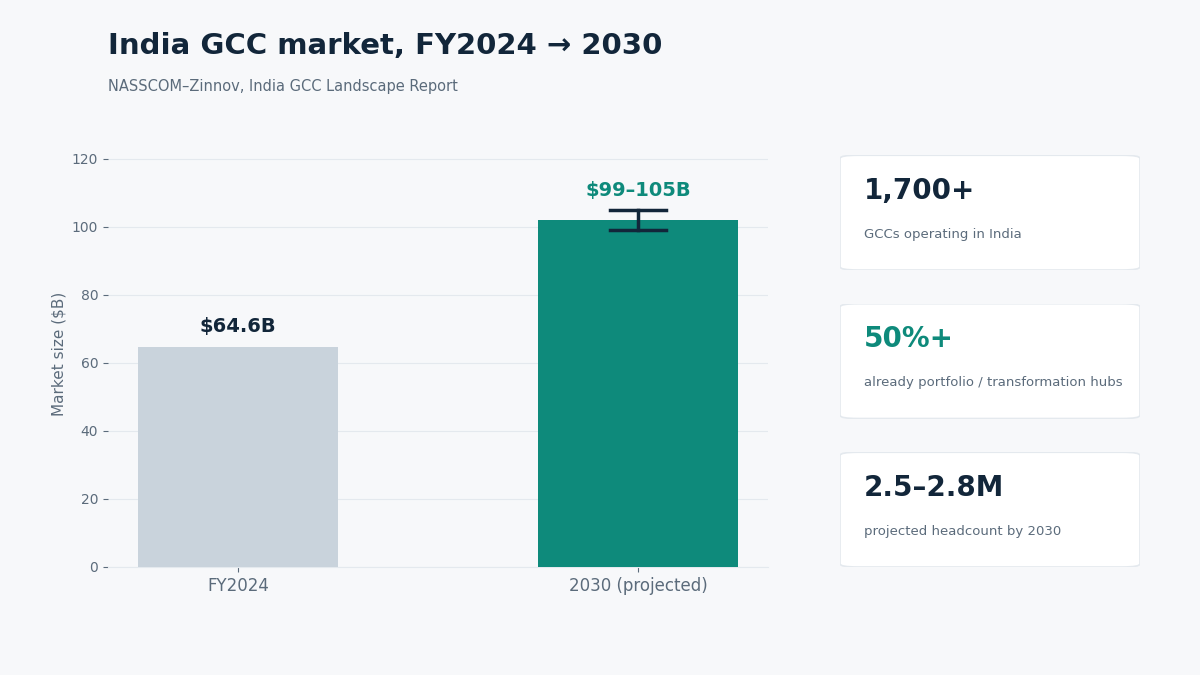
Half of India’s Global Capability Centers have already stopped being what most boards still think they are. According to the NASSCOM–Zinnov landscape report, more than 50% of India’s 1,700+ GCCs now operate as portfolio and transformation hubs owning products, filing IP, and running global functions not as back-office cost shops. Yet in most board decks, the GCC still shows up on one line: cost saved per FTE.
That gap between what GCCs actually do and how they’re governed, funded, and measured is the single biggest source of wasted enterprise value in global operating models today. A GCC value center closes that gap. It is a capability center that is chartered, staffed, and measured for the value it creates IP, revenue influence, product ownership, speed of innovation rather than the cost it avoids.
The stakes are no longer theoretical. EY’s 2025 GCC Pulse Survey found that 92% of GCC leaders say their centers already contribute beyond cost arbitrage, and 67% are building dedicated innovation teams to generate and globalize ideas. The centers that formalize this shift get disproportionate budgets, global roles, and board attention. The ones that don’t get benchmarked against BPO rate cards until they’re rationalized away.
India’s GCC market is projected to grow from $64.6 billion in FY2024 to $99–105 billion by 2030, with headcount rising to 2.5–2.8 million and the growth is concentrated in higher-value ER&D and transformation charters, which grew 1.3x faster than the overall GCC market.
This guide is the playbook for making that shift deliberately instead of accidentally. It covers the full arc: how to assess where your center sits today, how to write a value charter a board will fund, how to re-architect talent and governance, and how to prove value in numbers a CFO accepts.
TL;DR
This guide explains how to turn a Global Capability Center from a cost-savings operation into a GCC value center, a center that creates IP, owns products, and influences revenue. It is written for board members, CXOs, and GCC site leaders who are planning a new center or repositioning an existing one.
The single most important number to hold onto: transformation from cost center to value center typically takes 24–36 months, but centers that plan the value charter before hiring their first 50 people compress that to 12–18 months. The charter decision, not the hiring plan, is where GCC value creation is won or lost.
By the end, you will be able to place your center on a five-stage value ladder, run the six-phase transformation process yourself, budget it with realistic cost and timeline ranges, and defend the shift to a board with metrics that go beyond cost-per-FTE.
What Is a GCC Value Center?
A GCC value center is a Global Capability Center chartered and measured for the enterprise value it creates intellectual property, product ownership, revenue influence, and innovation velocity rather than the labor cost it avoids. It holds decision rights, global roles, and outcome-based KPIs, making it a strategic node in the enterprise, not a delivery outpost.
What a value center is not:
- Not a rebranded cost center. Renaming an offshore delivery team an “innovation hub” without changing charter, decision rights, or metrics changes nothing; the operating model defines the center, not the label.
- Not automatically a profit center. A GCC profit center books revenue directly (internal chargebacks at value-based rates, or external productized services). A value center may or may not show up as IP, speed, or product outcomes without a P&L.
- Not the same as a Center of Excellence. A CoE is a capability pocket (e.g., a GenAI CoE) inside a center; a value center is the operating model for the entire center.
Why the Value Center Shift Matters: The Business Case
The move from cost arbitrage to GCC strategic value is not a branding exercise. It changes four hard business outcomes:
- Budget resilience. Cost centers are the first line item cut in a downturn because their entire justification is a rate-card comparison. Value centers that own products or IP are treated like R&D protected, not rationalized. In most engagements we’ve run, centers with product ownership survived enterprise cost programs that cut 15–25% from pure delivery centers.
- Talent quality and retention. Senior engineers and product leaders don’t join ticket factories. Centers with genuine product charters routinely see attrition 5–10 percentage points below market, and can credibly recruit from top product companies. The employee value proposition (EVP) changes from “offshore role” to “global role based in India.”
- Speed of innovation. EY’s 2025 Pulse Survey found 67% of GCCs building dedicated innovation and incubation dedicated development teams because ideas generated next to the talent pool ship 30–50% faster than ideas thrown over the wall to a delivery team.
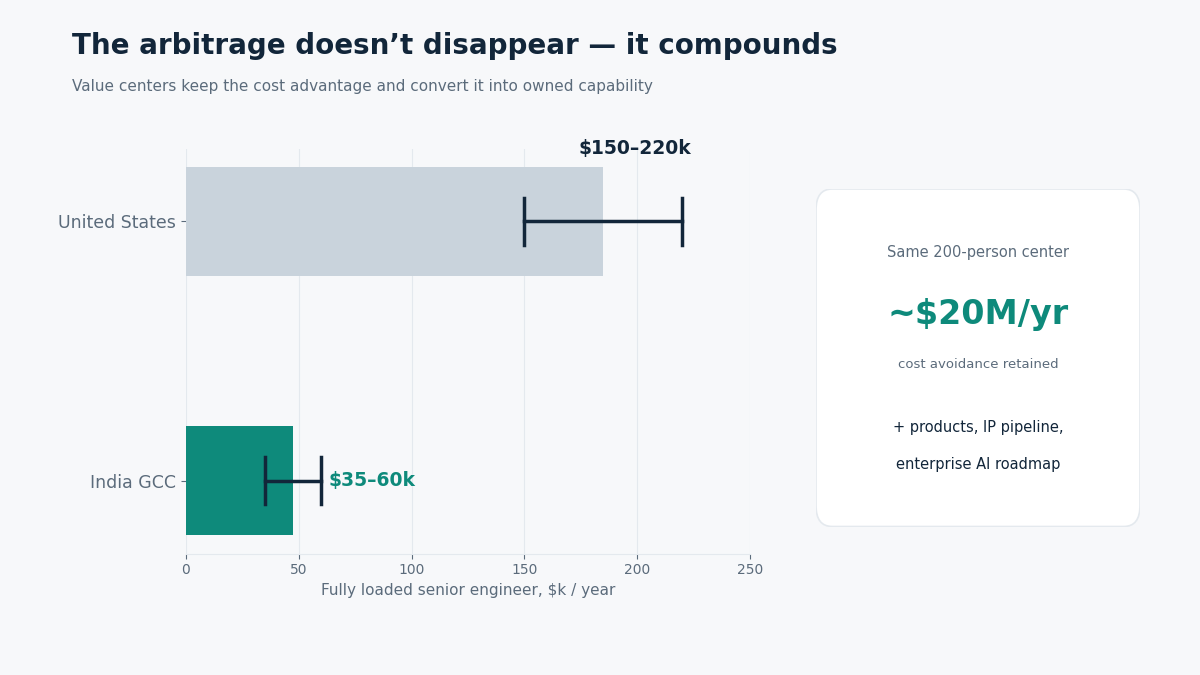
- Compounding cost advantage anyway. Counterintuitively, value centers still deliver the arbitrage: a fully loaded senior engineer in India typically runs $35k–60k/year versus $150k–220k in the US. The difference is that value centers convert the saved dollars into owned capability instead of reporting them as savings and stopping there.
The one-line business case for a board: the same 200-person center can either report ~$20M/year in cost avoidance, or own two product lines, a patent pipeline, and the enterprise AI roadmap while still delivering the $20M. Only the second version compounds.
The Core Problem: Why Most GCCs Stall at Cost Arbitrage
Most GCCs don’t fail loudly. They plateau quietly, usually within 3–4 years of setup, and the pattern is predictable.
The stall pattern, by the numbers:
- The charter was never written for value. The founding business case promised 40–60% cost savings, so every governance mechanism budgeting, KPIs, leadership hiring was built to prove savings. Five years later the center is trapped in the metric it was born with.
- Decision rights never moved. Teams execute specs written 10 time zones away. Most teams underestimate the cost of this by 3–4x: it’s not just latency, it’s that no senior product person will stay in a center with zero decision authority so the center structurally can’t accumulate the talent needed to climb the ladder.
- Leadership was hired for delivery, not strategy. A site leader chosen for operational excellence will optimize SLAs forever. Charter expansion requires a leader who can sell internally at HQ a fundamentally different profile, and one most centers hire for 2–3 years too late.
- “Cost-plus” transfer pricing caps ambition. Under a pure cost-plus model, the center’s financial identity is literally “cost + 8–15% markup.” There is no accounting line where value can even appear. Until the finance structure changes, the value narrative has nowhere to live.
- Innovation theater substitutes for innovation charter. Hackathons, innovation walls, and a “lab” with no path to production. Red flag: if the innovation team’s output is demos rather than shipped features or filed IP, the center is performing value, not creating it.
The compounding effect is severe. A center that stalls at cost arbitrage for five years doesn’t just miss the GCC value center upside; it accumulates a workforce, leadership bench, and HQ reputation optimized for the bottom rung, making the eventual climb 2–3x harder and more expensive than starting with the right charter.
The GCC Value Ladder: A Five-Stage Maturity Model
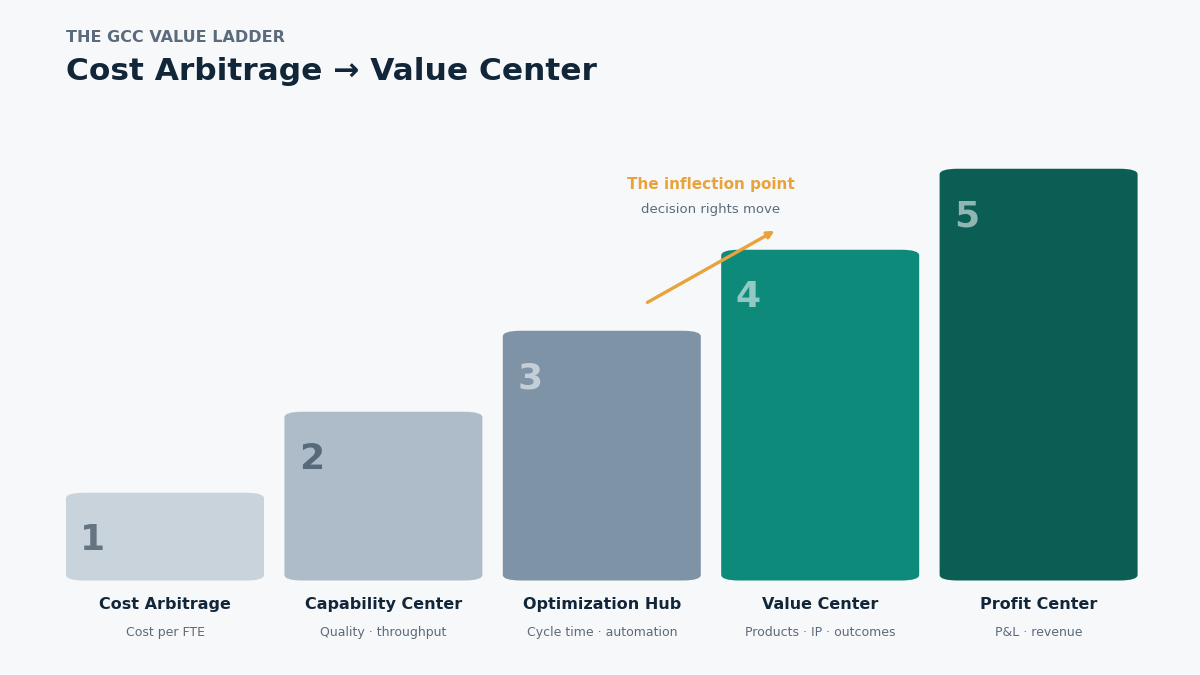
The GCC maturity model below is the value-ladder graphic this guide is built around. Every recommendation in the walkthrough maps to a rung, and Stage 4 is where the GCC value center label is genuinely earned. Place your center honestly before planning anything.
| Stage | Identity | What HQ asks of it | Primary metric | Typical share of India GCCs* |
| Cost Arbitrage | Offshore delivery / back office | “Do the same work cheaper” | Cost per FTE, SLA adherence | Shrinking minority |
| Capability Center | Skill hub (QA, cloud ops, data) | “Do specialist work we can’t hire for at home” | Quality, throughput, time-to-hire | Large mid-tier |
| Optimization Hub | Process owner | “Own the process end-to-end and improve it” | Productivity gains, automation %, cycle time | Common |
| Innovation / Value Center | Product & IP owner | “Build things we don’t have; own outcomes” | Product KPIs, IP filed, revenue influenced | 50%+ now operate at 3–4 (portfolio/transformation hubs, per NASSCOM–Zinnov) |
| Profit / Transformation Center | Revenue engine, global HQ for functions | “Run global P&L lines from here” | P&L, external revenue, global roles held | Rare but growing |
How to read the ladder:
- Each rung changes three things at once: the charter (what you’re asked to do), the talent mix (who you need), and the metric (how you’re judged). Climbing means changing all three centers that change only one stall between rungs.
- The inflection point is Stage 3 → 4. This is where a GCC innovation center identity becomes real: genuine product ownership, dedicated R&D teams, IP contribution. It is also where most transformations fail, because it’s the first rung that requires HQ to give up something (decision rights), not just delegate more work.
- Stage 5 is optional, not the goal. Not every enterprise wants its GCC booking external revenue; a Stage 4 value center with deep IP ownership can be the right end state. Chasing “profit center” status prematurely (before Stage 4 fundamentals) is a common and expensive vanity move.
The 3-year rule: in most engagements we’ve seen, one rung takes 12–18 months to climb properly. If a transformation plan promises Stage 1 to Stage 4 in a year, it’s a slideware plan.
The Walkthrough: Transforming a GCC Into a Value Center, From Scratch to Steady State
This is the full lifecycle usable whether you’re setting up a new center with a value charter from day one, or repositioning an existing cost-arbitrage center. Each phase includes the deliverable that proves the phase is actually done, because transformation programs die in the gap between “we discussed it” and “it’s operating.”
Phase 1 Baseline: Maturity Assessment and the Honest Audit (Weeks 1–6)
You cannot plan a climb without knowing your rung. The baseline phase produces one artifact: a maturity assessment the board has seen and accepted.
Run the audit across five dimensions:
- Charter reality vs. charter narrative. Pull the last 12 months of work items. What percentage is spec-execution vs. problem-ownership? If more than 70% of work arrives as pre-decided specs, you are Stage 1–2 regardless of what the town-hall slides say.
- Decision-rights inventory. List the last 10 significant product or architecture decisions affecting your center’s work. How many were made in the center? Zero to two means no real ownership.
- Talent architecture. Count product managers, architects with global scope, and researchers as a percentage of headcount. Value centers typically run 8–15% in these roles; cost centers run under 3%.
- Financial structure. Are you on pure cost-plus transfer pricing? Is there any mechanism to attribute product or revenue outcomes to the center? If value has no accounting line, note that Phase 4 fixes this.
- HQ perception. Interview 5–8 HQ stakeholders. Ask one question: “If the budget were cut 20%, what would you cut here first?” Their answers reveal your real position on the ladder faster than any internal survey.
Deliverable: a one-page ladder placement with evidence, plus the 3–5 gaps blocking the next rung.
Red flag: if the audit is run by the center about itself with no HQ input, it will overstate maturity by a full rung; this is the most consistent bias pattern we see.
Budget band: internally run, this costs mostly senior time; externally facilitated maturity assessments typically run $15k–40k depending on center size.
Phase 2 The Value Charter: Getting Board Sponsorship (Weeks 4–12)
The value charter is the founding document of GCC value creation, the equivalent of a product’s PRD. Most centers skip it and try to “earn” charter expansion through delivery excellence alone. That path takes 5+ years and usually stalls, because delivery excellence proves you’re a great Stage 2 center, which is exactly what HQ will keep using you as.
A fundable value charter contains six sections:
- The value thesis 2–3 specific domains where the center will create value HQ cannot easily create itself (e.g., “AI-led claims automation for the APAC book,” not “innovation”).
- Decision rights being transferred named decisions moving to the center, with dates. This is the section HQ will fight over; a charter without it is decorative.
- The metric contract which value metrics replace or sit alongside cost metrics on the board deck, and when (see Phase 6 for the menu).
- Talent plan the 12–24 month hiring architecture (Phase 3), with the first 5 strategic hires named by profile.
- The financial model changes the transfer-pricing and budgeting adjustments needed so value has an accounting line (Phase 4).
- Kill criteria that evidence, at 12 and 24 months, would prove the thesis wrong. Boards fund charters with kill criteria dramatically more readily, because it converts a leap of faith into a bounded bet.
The negotiation pattern that works: don’t ask for the whole charter at once. Secure one product domain with full ownership a “lighthouse” and pre-agree the expansion trigger (“if the lighthouse hits X by month 12, domains 2 and 3 transfer”).
A specific negotiation point from real engagements: get the expansion trigger in writing in the original charter. Verbal “we’ll revisit next year” commitments evaporate when HQ leadership changes and HQ sponsor turnover during a 24–36 month transformation is closer to certainty than risk.
Numbered checklist charter is done when:
- A named board-level sponsor owns it (not “the leadership team”)
- At least one decision-rights transfer has a calendar date
- Kill criteria are written and agreed
- The first-year budget delta is approved, not “noted”
Phase 3 Talent Re-Architecture: Hiring for the Next Rung, Not the Current One (Months 2–9)
Talent is where the ladder is actually climbed. The core principle: hire for the rung above you. A Stage 2 center that hires only excellent Stage 2 profiles will deliver Stage 2 work flawlessly forever.
The value-center talent stack (typical shape for a 150–300 person center):
- Product & strategy layer (8–15% of headcount): product managers with revenue-side experience, program leaders, 1–2 researchers or domain scientists. These roles convert capacity into ownership.
- Architecture & senior IC layer (10–15%): principal engineers and architects with global scope people HQ engineers ask for opinions, not assign tickets to.
- Specialist capability pods: this is where the innovation charter gets muscle. Centers building AI-led value theses typically need to hire machine learning engineers and applied data scientists early the NASSCOM–Zinnov report counts 120,000+ AI/ML professionals and 185+ dedicated AI/ML CoEs already inside India’s GCC ecosystem, so the talent exists, but the top decile is contested. Infrastructure-heavy charters similarly need to hire cloud engineers with platform (not just ops) backgrounds.
- Delivery core (55–70%): the engineering backbone still the majority, but no longer the whole story.
What good vetting looks like at this level:
- Test for ownership history, not stack familiarity. Ask candidates for a decision they made that HQ/leadership disagreed with, and what happened. Stage 4 talent has these stories; Stage 2 talent has escalation stories.
- Involve HQ product leaders in final-round interviews for the strategic layer it builds the internal credibility those hires will need on day one.
- Compress the cycle. The top 2% of product-minded engineering talent in India is typically off the market in under 3 weeks. A structured pipeline should get from job description to interview-ready shortlist in 7–10 working days; anything slower systematically loses the best candidates to product companies.
- Watch the drop-off metric. Offer-to-joining drop-off in India can run 20–30% at senior levels if the EVP is weak or the process drags. Sub-5% drop-off is achievable with a genuine product charter and tight process and drop-off rate is itself a leading indicator of whether your value story is credible to the market.
Red flag: hiring a “Head of Innovation” before the charter exists. Without decision rights and a funded thesis, this person becomes an events coordinator with a good title, and their visible failure poisons the next attempt.
Budget bands (India, fully loaded annual, typical ranges): senior product managers ₹50–90 lakhs; principal/staff engineers ₹60–1.1 crore; ML engineers (5–8 yrs) ₹35–70 lakhs; delivery-core engineers ₹12–35 lakhs depending on seniority and stack. Plan the strategic layer at 2.5–4x delivery-core cost per head and defend it as R&D spend, not IT staffing spend.
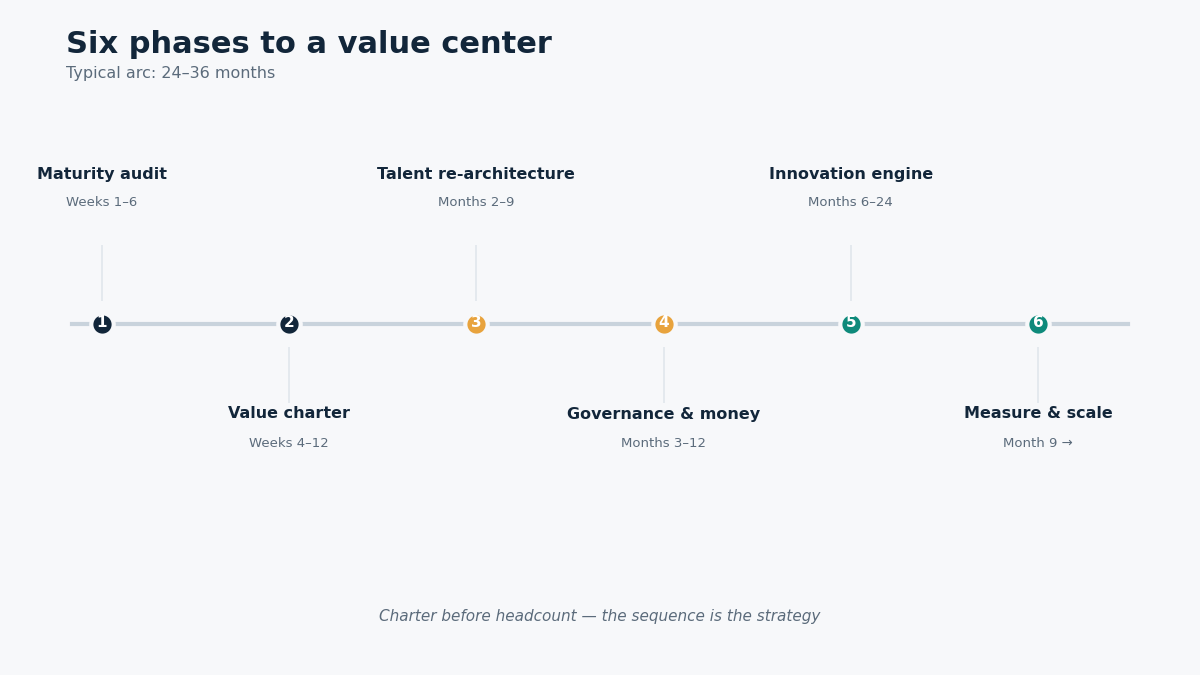
Phase 4 Operating Model, Governance, and the Money Plumbing (Months 3–12)
This is the least glamorous phase and the one that determines whether the transformation is real. Three structures have to change.
- Transfer pricing and financial identity.
- Pure cost-plus (cost + 8–15% markup) is the financial signature of a Stage 1–2 center. It is simple and compliant, but it makes value literally invisible in the accounts.
- Moving to Stage 4+ typically means layering in value-based or outcome-linked internal charging for product work, or carving specific IP-creating work into a separate cost pool with different treatment. For a Stage 5 GCC profit center, external or productized revenue booked by the India entity changes the tax and transfer-pricing posture materially.
- This is a specialist decision: transfer pricing on IP-creating GCC work is one of the most scrutinized areas in Indian international tax. Budget for specialist advice (typically $30k–100k for a restructuring exercise) and involve tax counsel before the center starts creating registrable IP, not after. Getting IP assignment and cost-sharing agreements wrong retroactively is 5–10x more expensive than doing it upfront.
- IP ownership and protection.
- Decide the IP regime explicitly: does IP vest in the parent (most common), the India entity, or under a cost-sharing arrangement? Each has different tax, valuation, and exit implications.
- Operationalize protection: NDA-backed engagement structures for any external talent partners, invention-disclosure processes, and a patent-filing pipeline with a named owner and a budget line (even a modest one 5–15 filings/year is a credible early target for a 200+ person ER&D-oriented center).
- Governance cadence.
- Monthly: center leadership + HQ product owners outcome review, not status review. The agenda test: if the meeting could be replaced by a dashboard, it’s a status meeting.
- Quarterly: sponsor-level review against the charter’s metric contract and decision-rights transfer calendar.
- Annually: ladder re-assessment (re-run Phase 1’s audit) and charter expansion/kill decision against the pre-agreed criteria.
Entity and setup mechanics (for new centers): entity incorporation, STPI/SEZ or GIFT City registration, banking, and compliance setup in India typically takes 8–16 weeks; many enterprises de-risk year one with a BOT (build-operate-transfer) structure through GCC setup services, then transfer the entity once the charter and team are proven. The BOT route typically adds a management fee but cuts time-to-first-hire by 30–50% and defers the fixed-cost commitment until the value thesis has evidence.
Phase 5 Building the Innovation and IP Engine (Months 6–24)
With charter, talent, and plumbing in place, this phase builds the machinery that makes a GCC innovation center more than a slogan.
The engine has four moving parts:
- A lighthouse product, owned end-to-end. One product or platform where the center owns roadmap, architecture, and outcomes. Everything else in the innovation system exists to feed and replicate this proof point.
- CoEs with production mandates. A GenAI or platform CoE is only real if its output ships. Set the mandate explicitly: every CoE initiative must name the production system it will land in within 2 quarters, or it doesn’t start. This single rule kills 80% of innovation theater.
- An incubation funnel with stage gates. Idea → 2-week validation → 6–8 week funded pilot → production or kill. Two-thirds of India GCCs now run dedicated innovation teams and incubation programs (EY GCC Pulse 2025) the differentiator is not having a funnel, it’s killing fast. Healthy funnels kill 60–80% of pilots; funnels that kill nothing are theater.
- An IP pipeline. Invention disclosures reviewed monthly, filings decided quarterly, and critically engineers rewarded for disclosures. A ₹50k–1.5 lakh disclosure/filing bonus is a rounding error that changes behavior measurably.
The first-90-days ramp pattern for the lighthouse team:
- Weeks 1–2: full access parity with HQ teams (repos, prod telemetry, customer data within compliance limits). Access asymmetry is the most common silent killer of ownership; a team that can’t see production metrics cannot own outcomes, and this friction surfaces in week one of nearly every engagement.
- Weeks 3–6: the team ships something small end-to-end to force every pipeline, approval, and access gap into the open early.
- Weeks 7–12: first owned-roadmap increment, demoed by the India team directly to HQ stakeholders not relayed through an HQ proxy. Who presents the work is a governance signal, not a logistics detail.
Phase 6 Measuring, Communicating, and Scaling Value (Month 9 onward, permanent)
Value that isn’t measured in HQ’s language doesn’t exist, and no GCC value center survives on narrative alone. This phase replaces the cost-only scorecard.
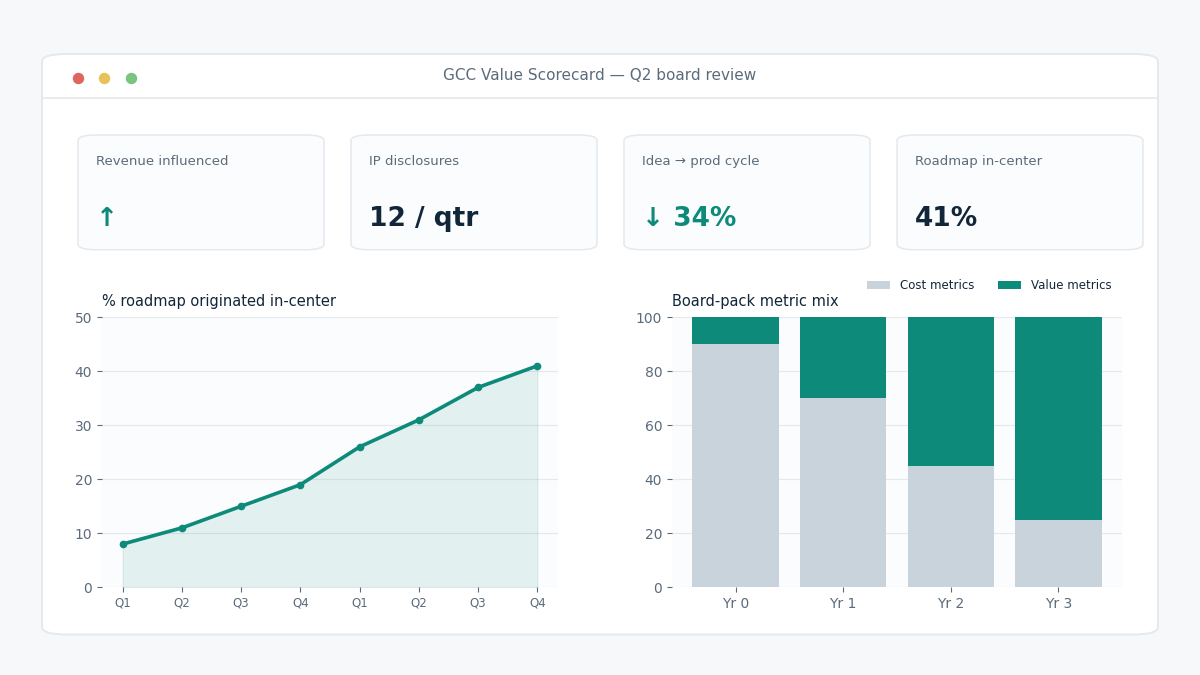
The value-center metric menu (pick 4–6, per the charter’s metric contract):
- Product metrics: revenue influenced or retained by center-owned products; feature adoption; NPS of center-owned surfaces
- IP metrics: invention disclosures, filings, grants; internal platform reuse (number of teams consuming center-built platforms)
- Speed metrics: idea-to-production cycle time; % of roadmap originated (not just executed) in-center
- Talent metrics: global roles held by center leaders; regretted attrition in the strategic layer; offer drop-off rate
- Financial metrics: cost avoidance retained as context, never as the headline
Scaling and exit mechanics:
- Scaling up: expand by charter domain, not by headcount target. “Add 100 people” recreates the cost-center dynamic; “take ownership of domain X, which needs ~60 people” compounds the ladder position.
- Replacement and quality control: for talent brought in through partners, contract for outcome protection replacement within 7–10 working days for misfit hires is a reasonable market standard to demand, and drop-off/replacement terms belong in the MSA, not in goodwill.
- Exiting or restructuring: if kill criteria trigger, the honest moves are to descend one rung deliberately (back to a well-run capability center) or consolidate domains not to keep the value branding while quietly reverting to spec execution. A center that claims Stage 4 and operates at Stage 2 loses HQ trust faster than one that never claimed it.
Case Studies: What GCC Value Creation Looks Like in Practice
Paytm engineering scale as a strategic capability. 100+ engineers hired into product-critical teams through a structured AI-driven pipeline, with shortlists delivered in 7–10 working days per role. The relevant outcome wasn’t headcount; it was that hiring velocity stopped being the constraint on product roadmap decisions, which is the precondition for any team to take ownership rather than take tickets. This is the Supersourcing engagement pattern most enterprises actually need first: fix throughput and quality of the strategic layer, then expand charter.
Swiggy compressing the top of the funnel at scale. During aggressive engineering scale-up, AI-assisted sourcing and vetting cut screening effort dramatically while holding a 98% candidate joining rate versus the 20–30% senior-level drop-off common in the Indian market. The lesson for value-center builders: joining rate and drop-off are leading indicators of whether your EVP and charter story are credible to the exact talent you need for the Stage 3→4 jump.
Somnoware (healthtech) recruitment automation as capability building. A specialized healthtech product company automated significant parts of its recruitment process, converting hiring from a founder-time bottleneck into a repeatable system. Small-scale, but it illustrates the ladder principle at any size: the value move is owning and systematizing the process, not just consuming its output.
Decision Framework: Cost Center vs. Value Center vs. Profit Center
Use this cost center vs value center framework cost center, GCC value center, or profit center to decide the right end state, not the most ambitious one.
| Dimension | Cost Center (Stage 1–2) | Value Center (Stage 4) | Profit Center (Stage 5) |
| Right when… | Work is truly commodity; parent needs capacity, not capability | Parent needs innovation velocity, IP, product ownership | Center’s output is productizable/sellable; parent wants a revenue node |
| Charter | Execute defined work | Own domains and outcomes | Own P&L lines |
| Metrics | Cost/FTE, SLA | Product KPIs, IP, cycle time | Revenue, margin |
| Financial model | Cost-plus | Cost-plus + outcome-linked pools | Revenue-booking entity |
| Talent premium | Low | 2.5–4x for strategic layer | Adds commercial roles |
| Setup/transition time | 4–8 months (new) | 12–18 months per rung climbed | +12–24 months beyond Stage 4 |
| Biggest risk | Rationalized in downturns | Charter without decision rights | Tax/transfer-pricing complexity; premature ambition |
Three-question shortcut:
- Would HQ pay an external vendor to do this work? If yes for most of your portfolio, you’re structurally a cost center climb or accept it deliberately.
- Can the center name three decisions it owns that HQ used to make? If not, “value center” is aspiration, not description.
- Does anyone outside the company pay for anything the center builds? Only if yes (or credibly soon) is profit-center status worth its complexity.
What Most Teams Get Wrong
The failure patterns below repeat across industries with remarkable consistency. This section is deliberately opinionated.
- They pitch values but keep reporting costs. The most common self-inflicted wound: leadership evangelizes the value narrative internally while the board pack still leads with cost-per-FTE, because that number is easy and always green. Whatever metric leads the board pack is the charter, whatever the slides say. If you want a value charter, change the board pack first; it costs nothing and forces every downstream conversation.
- They treat the Stage 3→4 jump as an HQ gift rather than an HQ loss. Every rung below 4 is delegation HQ gives more work. Rung 4 is the first that requires HQ to give up decision rights, which means someone at HQ loses scope. Transformations that don’t identify who loses, and handle it explicitly (usually by giving that leader the global role over the expanded domain), get quietly sabotaged in middle management regardless of board enthusiasm.
- They hire the strategic layer at delivery-layer prices. Attempting to fill product and principal roles at a 20–30% discount to Indian product-company benchmarks produces a strategic layer of people the product companies didn’t retain and the entire ladder rests on that layer. The strategic 10% of headcount deserves 30–40% of hiring attention and a genuine premium; the arbitrage math still works overwhelmingly at those rates.
- They confuse activity metrics with value metrics. Hackathons run, ideas logged, PoCs built all activity. Shipped features, filed IP, revenue influenced, cycle-time reduction value. A useful test we apply in maturity audits: delete every metric the CFO wouldn’t personally defend in a budget fight. What survives is your real value scorecard, and for most self-described innovation centers it’s 1–2 lines long.
- They under-invest in the HQ-facing function. A value center needs someone senior, spending 30–50% of their time managing HQ perception, sponsorship, and politics. Centers treat this as overhead; it is actually the transmission system between value created and value recognized. The best engineering center in the world with no HQ narrative gets budgeted like a vendor.
- They start the IP and tax work after the IP exists. By the time a center has built something patentable, the question “which entity owns this and at what price was it developed” already has a default answer buried in old agreements, usually the wrong one. Retroactive cleanup is slow, expensive, and occasionally deal-blocking in M&A. The paperwork is boring precisely because it’s cheap to do early.
Cost & Timeline Reality Check
The section most content on this topic omits entirely. All figures are typical ranges from real engagement patterns; specific cases vary with scale, city, and charter.
Setup and transformation cost tiers (India):
- New 50-seat center, cost-arbitrage charter: $0.8–1.5M one-time setup (entity, legal, facilities, initial recruitment) + $1.8–3M/year run-rate. Via BOT through a partner: lower upfront, 8–15% management layer.
- New 50–100 seat center, value charter from day one: add $0.5–1.2M/year for the strategic talent layer and $50k–150k one-time for charter/financial structuring typically a 15–25% premium on run-rate that removes 12–18 months from the ladder climb.
- Transforming an existing 200–300 person cost center to Stage 4: $1.5–4M incremental over 24–36 months (strategic hires, backfills, advisory, tooling), against a center run-rate of $8–15M/year i.e., a 10–20% investment premium for 2–3 years to reach genuine GCC value center operation.
Timeline by scenario:
| Scenario | Realistic timeline | What compresses it | What blows it up |
| New center to operational (Stage 2) | 4–8 months | BOT model; pre-committed hiring pipeline | Entity/compliance delays; leadership search dragging |
| Stage 2 → Stage 3 | 9–15 months | Process ownership transferred in writing | Metrics never updated |
| Stage 3 → Stage 4 (the big one) | 12–18 months | Lighthouse domain + named decision-rights transfers | HQ sponsor turnover; strategic hiring at discount rates |
| Stage 4 → Stage 5 | 12–24 months more | Existing productized asset; early tax structuring | Premature ambition without Stage 4 fundamentals |
What drives cost up: Tier-1 city premiums (Bengaluru/Gurugram senior talent runs 15–30% above Pune/Hyderabad for contested profiles), AI/ML talent competition, leadership search fees (30–35% of annual CTC via retained search), and retroactive legal/tax cleanup.
What drives cost down: BOT structures for year one, Tier-2 expansion for the delivery core, structured hiring pipelines that cut time-to-fill (every month a strategic role sits open costs roughly 1.5–2x that role’s monthly cost in stalled charter work), and honest kill criteria that stop failing initiatives at pilot stage instead of year two.
The Next Step If You’re Mid-Decision
If you’ve read this far, you’re likely in one of two places: planning a new center and deciding which charter to found it on, or sitting on an existing center that has plateaued at Stage 2–3 and wondering whether the GCC value center jump is worth the premium.
Either way, the highest-leverage next move is the same: run the Phase 1 maturity audit and pressure-test your value thesis before committing budget to headcount. Supersourcing’s GCC and delivery team has run this exact assessment across fintech, healthtech, and enterprise SaaS centers and will tell you honestly if a well-run capability center, not a value-center transformation, is the right answer for your situation.
Book a 30-minute GCC value-charter consultation: https://supersourcing.com/contact-us/ bring your current board metrics; that one artifact usually reveals your real position on the ladder in the first ten minutes.
FAQ
What is the difference between a cost center and a value center GCC?
A cost-center GCC is measured on the labor cost it avoids and executes work defined elsewhere. A GCC value center is measured on outcomes: it owns products, IP, innovation velocity and holds real decision rights. The financial arbitrage usually still exists in a value center; it just stops being the headline and becomes the byproduct.
How do GCCs create value beyond cost savings?
Through four main channels: owning products end-to-end (roadmap through operations), creating intellectual property (patents, platforms, reusable assets), housing global functional leadership (running worldwide functions from the center), and compressing innovation cycle time by putting decision-making next to the talent. The EY 2025 Pulse Survey found 92% of GCC leaders report contribution beyond cost arbitrage through exactly these channels.
Can a GCC own intellectual property?
Yes, but the ownership structure is a deliberate legal and tax decision, not a default. IP can vest in the parent, in the India entity, or under a cost-sharing arrangement each with different transfer-pricing and valuation consequences. The critical rule: decide the regime before the center creates registrable IP. Retroactive restructuring is typically 5–10x more expensive.
How long does it take to transform a GCC into an innovation center?
Plan 12–18 months per maturity rung, so a Stage 2 center reaching genuine Stage 4 innovation-center operation typically takes 24–36 months. New centers designed with a value charter from day one compress this to 12–18 months total. Any plan promising the full climb in under a year is underestimating the decision-rights and talent work.
How do you measure the value of a GCC?
Replace or supplement cost-per-FTE with a small set of charter-linked metrics: revenue influenced by center-owned products, IP disclosures and filings, idea-to-production cycle time, percentage of roadmap originated in-center, and global roles held by center leaders. The practical test: keep only metrics the CFO would defend in a budget fight.
Can a GCC become a profit center?
Yes by booking revenue through value-based internal chargebacks or by selling productized services externally. But profit-center status adds material tax, transfer-pricing, and commercial complexity, and it only makes sense after Stage 4 fundamentals (ownership, IP, strategic talent) are in place. Many excellent centers deliberately stop at value-center status.
What talent do you need to build a GCC innovation center and how do you get it?
A strategic layer of 8–15% of headcount: product managers with revenue-side experience, principal engineers with global scope, and specialist pods (AI/ML, platform, domain science) matched to the value thesis. This layer is contested talent with sub-3-week market availability, so most enterprises pair internal hiring with a specialist partner running structured sourcing and vetting if your current pipeline can’t produce interview-ready strategic-layer shortlists inside two weeks, that gap is usually the first thing worth an outside conversation.
