

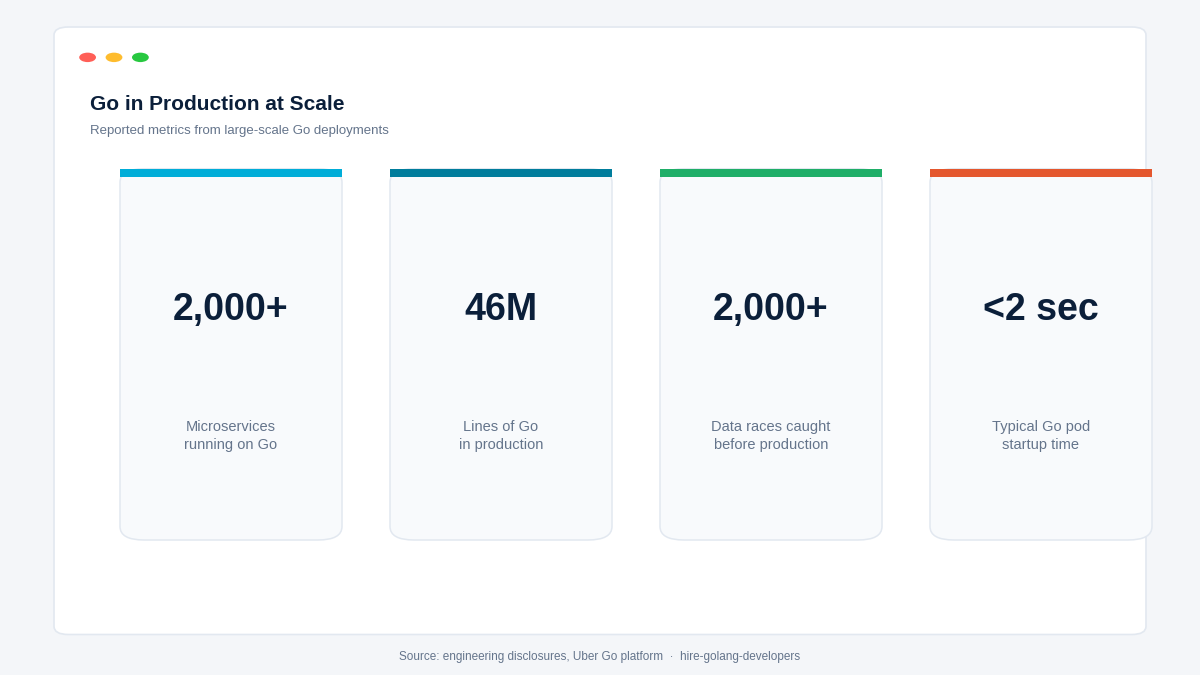
Uber runs more than 2,000 microservices on roughly 46 million lines of Go and its team credits Go’s built-in race detector with catching over 2,000 data races before they ever reached production. That is not a language experiment. That is a company betting its dispatch engine, the thing that connects a rider to a driver in milliseconds, on a runtime it trusts under extreme concurrent load.
That bet is now mainstream. When leaders decide to hire golang developers, they are usually reacting to one of three walls: a JVM service that eats memory in containers, a Python backend that stalls under concurrency, or a Node stack that has become hard to reason about at scale. Go was designed at Google to solve exactly those problems, and the market has noticed.
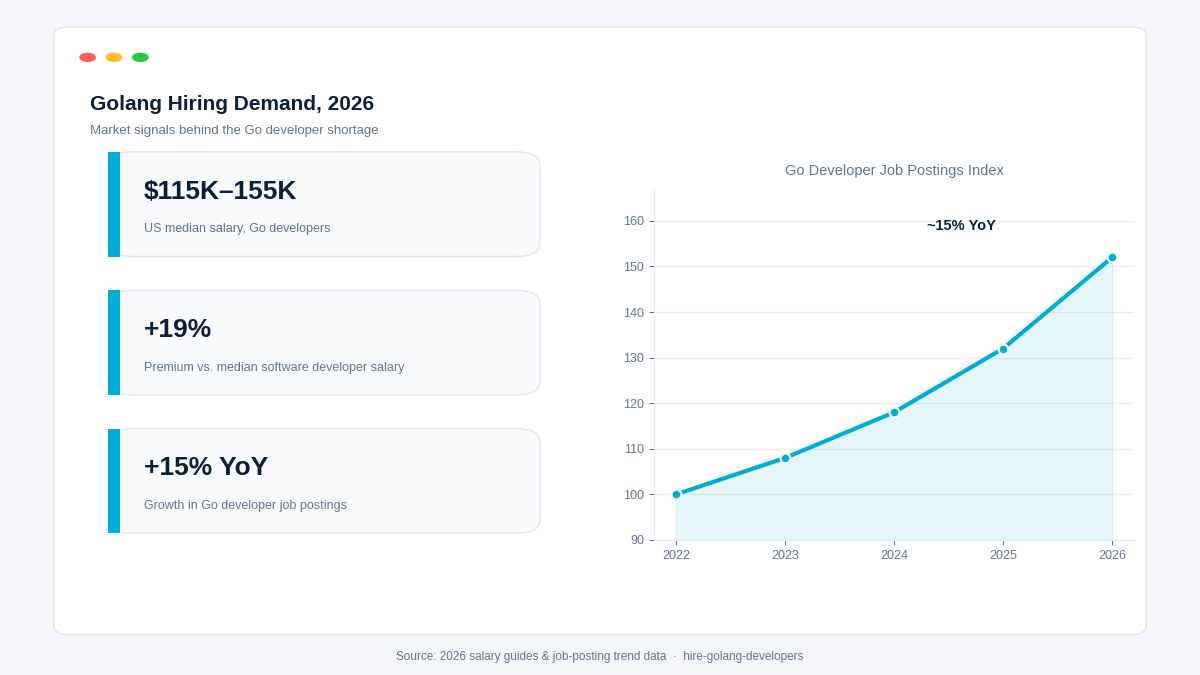
Go now pays like a senior specialty even at mid-level at roughly $115K–$155K US median salary and about a 19% premium over the median software developer, per 2026 salary guides precisely because the engineers worth hiring already run production Kubernetes and are expensive to pull. Tellingly, Go slipped on the TIOBE search-popularity index, yet it remains the dominant language for cloud-native infrastructure and backend microservices, with Go developer postings still growing ~15% year over year. The search rankings track tutorial queries; the paychecks track demand.
That supply-demand gap is the whole story of this guide. Choosing Go is the easy part; the technical case almost writes itself. The hard part is finding people who have run Go at scale, structuring the engagement so you own the IP, and getting them productive before the quarter slips. Below is the complete playbook: why the shift is happening, what the language actually buys you, and a phase-by-phase hiring process you can run yourself from first requirement to a shipping team.
This is written for the technical or semi-technical buyer who is impatient and skeptical. No filler. Every section should hand you something you can act on.
What Does It Mean to Hire Golang Developers?
Hiring Golang developers means bringing on engineers who build server-side systems in Go, the compiled, statically typed language Google open-sourced in 2009 to design APIs, microservices, and cloud-native infrastructure that must handle high concurrency with a small memory footprint. It covers full-time hires, dedicated teams, and staff augmentation.
It is often confused with three things it is not:
- Not generic backend hiring. A strong Java or Node engineer is not automatically a strong Go engineer; idiomatic Go (goroutines, channels, error handling, interfaces) is a distinct discipline.
- Not the same as DevOps hiring. Go powers Docker, Kubernetes, and Terraform, so the language overlaps with infra work but a Go application engineer and a Go-literate platform engineer are different roles.
- Not a freelancer stopgap. Production Go systems carry long-term ownership; the vetting bar and contract terms differ sharply from a one-off gig.
Why This Decision Matters: The Business Case
Golang benefits show up on the balance sheet, not just in the codebase which is why this is a leadership decision and not only an engineering preference. The reasons companies pick Go cluster around four measurable outcomes: infrastructure cost, speed to scale, reliability, and hiring efficiency.
Concrete outcomes this decision moves:
- Infrastructure cost. Go compiles to a single static binary with no runtime interpreter or JVM warm-up. Independent benchmarks put Go’s memory use at roughly 4–5× lower than comparable Java workloads in I/O-bound services, which translates directly into higher container density and smaller cloud bills.
- Startup and scale speed. Go service pods routinely start in under 2 seconds versus the 10–30-second range typical of JVM services, a real cost difference every time an autoscaler spins up during a traffic spike.
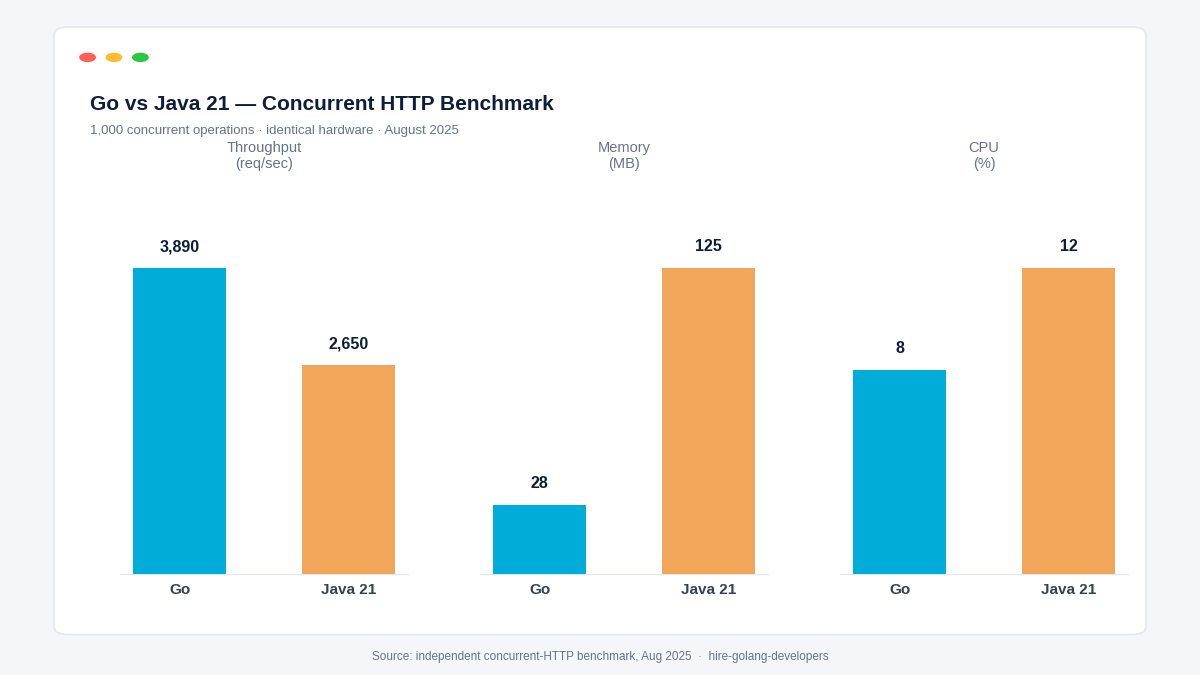
- Throughput per server. In head-to-head concurrent HTTP benchmarks published in August 2025, Go delivered on the order of 40–60% higher throughput than Java 21 in I/O-bound scenarios on identical hardware.
- Reliability under load. Go’s lightweight goroutines let a single service handle tens of thousands of concurrent connections without the thread-pool exhaustion that triggers cascading failures.
- Hiring math. A leaner runtime means fewer engineers babysitting infrastructure. Teams frequently report that a small Go squad maintains what previously took a larger polyglot team.
The catch is that every one of these benefits assumes you hired people who write idiomatic Go. Hire a Java developer who writes Java-in-Go, and you inherit the memory profile you were trying to escape.
Golang Adoption in 2026: What the Data Shows
The story behind Golang adoption 2026 is a demand-supply squeeze, not a hype cycle. Go is not the fastest-growing language by raw headcount, but it is consistently among the ones developers most want to move toward and the engineers who already know it are being absorbed by infrastructure-heavy teams faster than universities and bootcamps produce replacements.
The signals worth tracking, from primary sources:
- In the Stack Overflow Developer Survey, Go climbed year over year and sits in the cluster of most-desired languages alongside Python, Rust, and TypeScript chosen for performance, safety, and flexibility even while JavaScript remains the most-used at 66%.
- The official Go Developer Survey (go.dev), with 5,379 respondents, shows developers valuing Go as a holistic platform: the standard library, built-in tooling, and simplicity are cited more often than any single headline feature.
- Adoption compounds through the ecosystem. Docker, Kubernetes, Terraform, and Prometheus are all written in Go, so every team running cloud-native infrastructure has a standing reason to keep Go literacy in-house.
Where the demand concentrates. The roles that are hardest to fill are not “Go developer” in the abstract, they are Go engineers who also bring Kubernetes, gRPC, and real concurrency-debugging experience. That intersection is the scarce commodity, and it is exactly the profile that gets hired off the market within days of becoming available.
What this means for you: the pool of engineers with genuine production Go experience is expanding, but more slowly than demand. That gap is precisely why a structured, pre-vetted approach beats posting a role and waiting. The strongest candidates are rarely browsing job boards.
Go vs Java Performance: An Honest 2026 Comparison
The comparison driving most backend migration decisions is Go vs Java performance, and the honest 2026 answer is more balanced than either camp will tell you. Go wins decisively on some axes; modern Java has genuinely closed the gap on others. Anyone still quoting a 2019 benchmark is arguing with a version of Java that no longer exists.
Where Go leads:
- Memory floor. A Go process starts lean; a JVM commits a structurally higher baseline heap. In containerized, high-density deployments where OOM kills are a real operational risk, Go’s memory story is meaningfully better out of the box.
- Startup. No JVM warm-up and no interpreter means Go pods start in under two seconds versus 10–30 seconds for typical JVM services, a direct saving on every autoscale event.
- Concurrency simplicity. Goroutines make high-concurrency code straightforward to write and reason about, without reactive-programming gymnastics.
Where Java has caught up:
- Virtual threads (Project Loom). Java 21+ can run millions of virtual threads with familiar blocking-style code, narrowing the concurrency gap sharply for I/O-bound work.
- Tail latency. Generational ZGC in recent Java releases holds GC pauses under ~2ms even under load; Netflix moved to it and reported GC-related timeouts effectively disappearing. No stock Go GC config matches that tail-latency predictability without external throttling.
- Ecosystem depth. For complex domain models, Spring Data and Hibernate remain more mature than anything in the Go ecosystem.
An illustrative benchmark (identical concurrent-HTTP workload, same hardware, August):
| Metric 1,000 concurrent ops | Go | Java 21 |
| Throughput | ~3,890 req/sec | ~2,650 req/sec |
| Memory | ~28 MB | ~125 MB |
| CPU | ~8% | ~12% |
How to read this when hiring: choose Go for lightweight, high-concurrency, container-dense IT services API gateways, edge services, real-time systems where fast startup and a low memory floor compound into cost savings. Keep Java where a mature ORM and complex business logic dominate.
The emerging 2026 pattern is hybrid, which means the engineer you hire should understand why Go was chosen for a given service, not just how to write it.
The Core Problem Most Buyers Face
Here is what actually goes wrong, and it is rarely the language. The failure mode when companies hire golang developers is almost always in the process, and it is predictable.
Most teams underestimate the vetting depth by 3–4×. They screen for “5 years of backend experience” and assume Go transfers. It does not. A candidate can pass a generic system-design interview and still write goroutine code that leaks memory in production, the single most common defect we see validated in the first week of a Go engagement, where a context cancellation fails to propagate and goroutines block indefinitely, silently consuming RAM.
The three recurring traps:
- Scarcity misjudged. Because Go is younger than Java or Python, the pool of engineers with genuine production Go experience is smaller. Teams post a role expecting a two-week fill and are still interviewing three months later.
- Cost surprises late. Buyers anchor on a junior salary figure, then discover that engineers with real concurrency and Kubernetes depth command a premium and that the cheap hire costs more in rework.
- Timelines that slip. Sourcing, screening, and technical validation each stretch when done ad hoc, and the aggregate delay pushes a launch by a full quarter.
The rest of this guide is built to close exactly these gaps: what to define up front, how deep vetting really goes, what it costs, and how long it takes.
The A-to-Z Walkthrough: From First Requirement to a Shipping Go Team
This is the full lifecycle. Run it in order. Each phase ends with a checklist you can lift straight into a planning doc.
Phase 1 Defining Requirements (Scope, Skills, Timeline, Budget)
Before you talk to a single candidate or vendor, write the role down in a way an engineer would respect. Vague requirements are the number-one cause of mis-hires.
Scope the work, not the title. Are you building greenfield microservices, migrating a monolith off the JVM, or adding capacity to an existing Go codebase? Each implies a different seniority mix. Greenfield rewards a strong senior who can set conventions; a migration rewards someone who has done a JVM-to-Go move before and knows where the traps are; staff augmentation rewards adaptable mid-level engineers who slot into your existing patterns.
Getting this wrong is expensive: a brilliant greenfield architect can stall in a rigid legacy codebase, and a capable maintainer can flounder with a blank page.
Write an acceptance definition, not a wish list. For each must-have skill, note how you will verify it. “Knows concurrency” is untestable; “can explain and fix a goroutine leak in a live session” is. This one discipline eliminates most résumé-driven mis-hires before they start.
The Go skills checklist what to actually screen for:
- Idiomatic concurrency goroutines, channels, select, context propagation, and knowing when not to use concurrency.
- Standard library fluency net/http, encoding/json, sync; strong Go developers reach for stdlib before third-party frameworks.
- API and RPC REST with a router like Gin/Echo/Chi, plus gRPC + protobuf for internal service contracts.
- Data layer pgx/PostgreSQL, connection pooling, migrations, and Redis for caching.
- Cloud-native ops Docker, Kubernetes, Helm; the ability to reason about container memory limits and OOM behavior.
- Testing discipline table-driven tests, the race detector (go test -race), and benchmarks.
Set budget bands before you interview, using current market ranges (detailed in the cost section below):
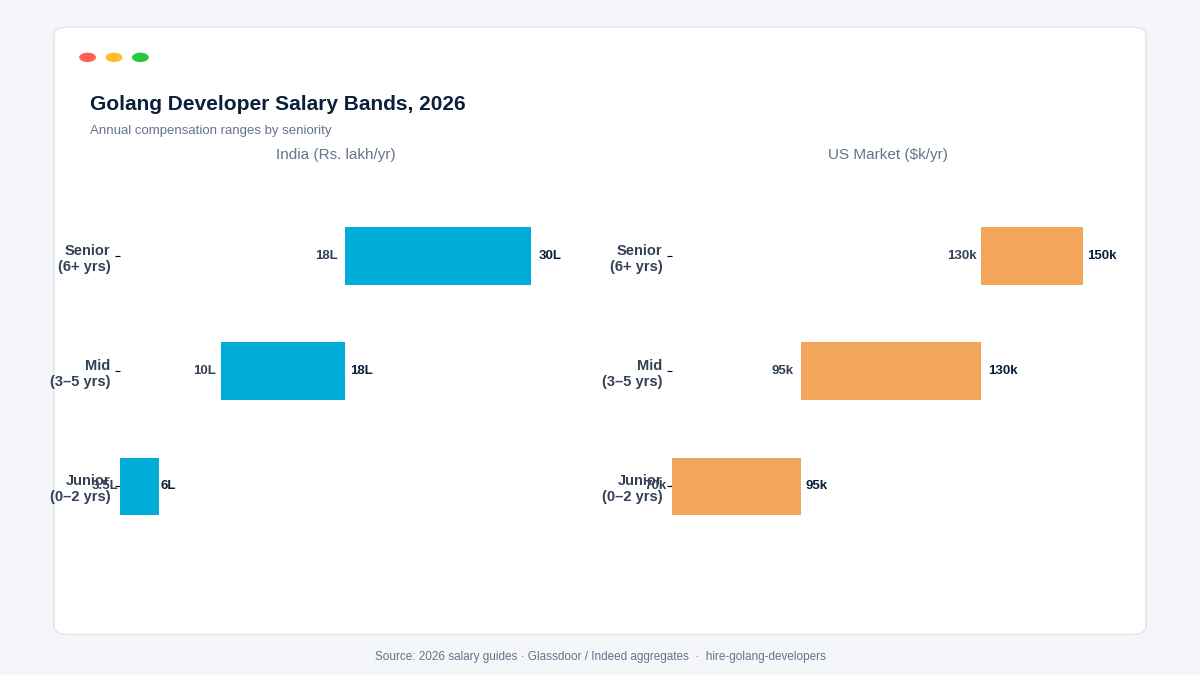
- Junior (0–2 yrs): ₹3.5–6 lakh/yr in India / $8k–25k/yr offshore.
- Mid (3–5 yrs): ₹10–18 lakh/yr / $30k–55k/yr.
- Senior (6+ yrs): ₹18–30 lakh/yr / $60k–120k+/yr depending on market.
Phase 1 checklist:
- One-paragraph scope statement (greenfield / migration / augmentation)
- Ranked must-have vs. nice-to-have skills
- Seniority mix and headcount
- Budget band per role, in your currency
- Target start date and hard deadline
Phase 2 Sourcing & Vetting (What Good Screening Looks Like)
This is where quality is won or lost. The goal is to surface the small fraction of engineers who have shipped Go in production and filter out confident generalists.
What strong technical vetting includes:
- A short, realistic take-home of a small concurrent service (e.g., a rate limiter or a fan-out aggregator), reviewed for idiomatic style, not just correctness.
- A live pairing round watches them debug a goroutine leak or a data race in real time. This one round predicts on-the-job performance better than any résumé.
- Standard-library reasoning asks why they’d choose channels vs. a mutex, or how context cancellation should propagate through a request.
- Systems design a high-throughput API under a stated latency budget, discussing backpressure and bounded concurrency.
- Culture and communication fit clear written English for cross-border teams and an ownership mindset for remote work.
Red flags to reject on:
- Cannot explain what a goroutine leak is or how to detect one.
- Reaches for a heavy framework to do what stdlib does in ten lines.
- Talks about Go only in the abstract, with no production war stories.
- Treats the race detector as optional.
The top-2% principle: AI-assisted sourcing narrows a large pool to the small set worth a human’s time, so your engineers interview candidates who are already technically pre-qualified, not a stack of maybes.
This matters more in Go than in higher-supply languages: because the qualified pool is smaller, the cost of your senior engineers burning hours on unqualified interviews is higher.
A short bank of questions that actually separate strong Go engineers:
- “Walk me through how context cancellation propagates through a request that fans out to three downstream calls.” (Tests real concurrency understanding.)
- “When would you reach for a channel versus a mutex, and why?” (Tests idiomatic judgment, not memorization.)
- “How do you detect and prevent a goroutine leak?” (The single highest-signal question.)
- “Why does Go favor composition and interfaces over inheritance?” (Tests whether they think in Go or in Java-with-Go-syntax.)
- “Show me how you’d bound concurrency to avoid overwhelming a downstream service.” (Tests backpressure awareness.)
A candidate who answers these fluently and can debug live is worth more than one with a longer résumé who cannot.
Phase 2 checklist:
- Take-home spec written and time-boxed (≤3 hours)
- Live pairing scenario prepared
- Scorecard with weighted criteria
- Two interviewers per candidate to reduce single-rater bias
- Reference or prior-work verification
Phase 3 Engagement Models & Contracts
How you contract matters as much as who you hire. There are three dominant models, and the right one depends on control, duration, and how much of the roadmap is yours.
- Dedicated team (dedicated developer/pod): Engineers work only on your product, embedded in your sprints and reporting to you. Best for ongoing product work where continuity and IP ownership matter. Highest control.
- Staff augmentation: You slot vetted Go engineers into your existing team to add capacity fast. Best when you have the management structure but not the headcount.
- Project-based / SOW: A fixed-scope build with defined deliverables and milestones. Best for a bounded piece of work with a clear finish line.
Contract terms to get right non-negotiables:
- IP assignment all code and derivatives assigned to you in writing.
- NDA signed before any code or system access.
- No shared bandwidth, the engineer is not splitting time across other clients.
- Replacement clause a named window (commonly 7–10 days) to swap a hire who is not a fit, at no extra cost.
- Notice period and exit clean offboarding, credential revocation, and knowledge transfer defined up front.
The 7-day rule: if a contract’s replacement window is longer than about ten days, you are the one absorbing the risk of a bad match. Push for a tight, written guarantee.
IP and NDA the details buyers skip until it hurts:
- The assignment clause should cover not just source code but derivatives, documentation, and any tooling built during the engagement.
- Confirm the engineer, not just the vendor, is bound by the NDA, a common gap in weak contracts.
- For regulated domains (fintech, healthtech), specify data-handling and access boundaries in writing, and confirm engineers never hold production data on local machines.
- Define, up front, what happens to credentials and access on the engineer’s last day. “We’ll sort it out later” is how orphaned access becomes a security finding.
Model selection in one line: if the roadmap and management are yours and you want continuity, choose a dedicated team; if you need capacity inside an existing structure, choose staff augmentation; if the scope is fixed and finite, choose project-based. Do not default to freelance for anything that will still be running in a year.
Phase 4 Onboarding & Ramp-Up (The First Two Weeks)
A great hire ramps slowly if onboarding is an afterthought. Treat the first two weeks as a project with its own checklist.
Day 0–2 Access and context:
- Repo access, CI/CD credentials, cloud/staging environment, and secrets management.
- Architecture walkthrough and a written README of the service map.
- Introductions to the on-call engineer and product owner.
Day 3–7 First contribution: 4. A small, real ticket merged to production behind a flag proves the full pipeline works for them. 5. Pairing session with a senior engineer on the codebase’s conventions.
Day 8–14 Owning a slice: 6. Assigned a bounded feature or service they own end to end. 7. First sprint-review demo.
Communication cadence to set on day one: a daily async standup, a weekly sync, and a single source of truth for tasks. For distributed teams, overlap hours matter more than total hours.
Phase 5 Managing Delivery
Once the team is ramped, delivery becomes a management problem, not a hiring one. The structure you put in place here determines whether velocity holds.
Reporting cadence and KPIs to track:
- Throughput story points or tickets shipped per sprint, trended.
- Cycle time first commit to production.
- Quality escaped-defect rate, PR review turnaround, test coverage on new code.
- Reliability service p99 latency and error rate for the systems the team owns.
- Health one-on-one signals on blockers and morale.
Account management structure: a single named account manager who owns the commercial relationship, plus a technical lead on the engineering side. One throat to choke on delivery, one on people. The failure mode is diffusion when “everyone” owns the relationship, no one does.
The escalation rule: define, in writing, what happens when a KPI slips two sprints running, who is notified, what the corrective plan looks like, and when replacement is triggered.
Phase 6 Scaling or Exiting
Good engagements are built to flex. Whether you are adding headcount or winding down, define the mechanics before you need them.
To scale up:
- Add engineers in the same model you validated, not a new one.
- Preserve a mentor-to-junior ratio so quality does not dilute.
- Re-run the same vetting bar for every addition, no waived screens because you are in a hurry.
To exit or replace cleanly:
- Trigger the replacement clause within its window if a hire underperforms; expect a vetted substitute in 7–10 days under a strong contract.
- Enforce knowledge transfer documentation, a recorded handover, and overlap time.
- Revoke access on the last day, not the week after.
- Retain IP and repo history; confirm nothing lives only on a departing engineer’s machine.
Full-lifecycle summary: define → source & vet → contract → onboard → manage → scale/exit. Skip a phase and it resurfaces later as cost, delay, or risk.
Case Studies: Go Hiring and Scaling in the Real World
Metrics first, story second.
Uber 2,000+ microservices on Go. Uber’s engineering teams run tens of millions of lines of Go across more than 2,000 microservices, using the built-in race detector to surface over 2,000 data races. The lesson for hiring: production Go at scale demands engineers fluent in concurrency safety, not just syntax.
Docker container images from ~300MB to ~6MB. By writing its core engine in Go and shipping static binaries, Docker collapsed image sizes dramatically and cut compile-and-deploy friction. The hiring takeaway: Go’s deployment model rewards engineers who think in terms of small, self-contained binaries.
High-growth Indian consumer tech scaling engineering headcount fast. Supersourcing’s client roster across fintech, healthtech, and e-commerce including names such as Swiggy, Paytm, OkCredit, and Razorpay has repeatedly needed to add vetted backend engineers on tight timelines without dropping the quality bar.
The pattern that works: a pre-qualified, top-2% shortlist delivered in 7–10 working days, a 98% offer-to-join rate, and under 1% drop-off on contract roles, so the headcount you plan for is the headcount you actually keep. Across a decade of delivery and 527+ IT projects, the constraint is almost never the language it is finding the right people fast enough.
A Decision Framework You Can Apply Yourself
Use this to choose your engagement model before you talk to anyone. Score your situation against the four levers that matter.
| Model | Cost | Control | Speed to Start | Best When |
| In-house full-time | Highest (salary + benefits + overhead) | Highest | Slowest (2–4 months) | Core, long-term product; you can wait and pay for it |
| Dedicated team (vetted) | Medium–high | High | Fast (7–10 days) | Ongoing product work; you want ownership without the hiring overhead |
| Staff augmentation | Medium | Medium–high | Fast (7–10 days) | You have management capacity, need bodies now |
| Freelance / marketplace | Low upfront | Low | Variable | One-off, bounded, low-risk tasks only |
| Project-based / SOW | Fixed | Low–medium | Medium | Clear scope, defined finish line |
How to read it: if the work is core and permanent, in-house or a dedicated team wins on control. If speed and flexibility dominate, a dedicated or augmented model gets vetted Go engineers working in days rather than months. Freelance is fine for a script; it is the wrong tool for a payments service.
What Most Teams Get Wrong
This is the section worth screenshotting, because these mistakes are pattern-consistent across projects and they are almost always self-inflicted.
They optimize for hourly rate instead of shipped value. The cheapest Go engineer who writes non-idiomatic, leak-prone code is the most expensive hire you will make. Rework, incidents, and rewrites dwarf the rate difference. Judge cost per shipped, reliable feature, not per hour.
They treat Go experience as interchangeable with backend experience. A senior Java engineer is a strong engineer but Go’s concurrency model, error handling, and stdlib-first culture are genuinely different. Skipping a Go-specific technical screen is how goroutine leaks reach production. The most outdated advice online is that “any good backend dev picks up Go in a week.” They pick up the syntax in a week; idiomatic, safe concurrency takes longer.
They under-invest in the first two weeks. Companies spend eight weeks hiring and then hand the new engineer a laptop and a Slack invite. Onboarding is where velocity is won; a structured two-week ramp (Phase 4) pays for itself in the first sprint.
They skip the replacement clause. Optimism bias makes buyers assume every hire will work out. The professional move is to assume some will not and to contract for a fast, written 7–10 day replacement so a single mismatch never costs a quarter.
They confuse activity with delivery. Standups and dashboards are not throughput. Track cycle time and escaped defects, not meeting attendance.
The contrarian summary: the language decision is easy and rarely the risk. Nearly every Go project that disappoints failed at hiring rigor, onboarding, or contract terms not at Go.
Cost & Timeline Reality Check
This is the section most competing articles skip, and it is the one buyers actually need. All figures below are current market ranges, not vendor quotes verified against your target market.
Salary / cost bands (annual, market ranges):
| Level | India (₹) | India (USD equiv.) | US market (USD) |
| Junior (0–2 yrs) | ₹3.5–6 lakh | ~$8k–20k | $70k–95k |
| Mid (3–5 yrs) | ₹10–18 lakh | ~$25k–45k | $95k–130k |
| Senior (6+ yrs) | ₹18–30 lakh | ~$55k–90k | $130k–150k+ |
India averages cluster around ₹7 lakh/year nationally and higher in hubs like Bangalore (typical range ~₹5.15–15.4 lakh), per public salary aggregators (Glassdoor, Indeed, 2026). Germany runs roughly €50k–70k for reference.
What drives cost up:
- Deep concurrency + Kubernetes + gRPC depth (the scarce combination)
- Domain expertise (fintech, healthtech compliance)
- Tight timelines and exclusivity (no shared bandwidth)
- Onsite or heavy time-zone overlap requirements
What drives cost down:
- Offshore or nearshore delivery in lower-cost markets
- Flexible time-zone overlap
- Longer engagements (better rates than short bursts)
- A pre-vetted pipeline (less of your engineers’ time burned on screening)
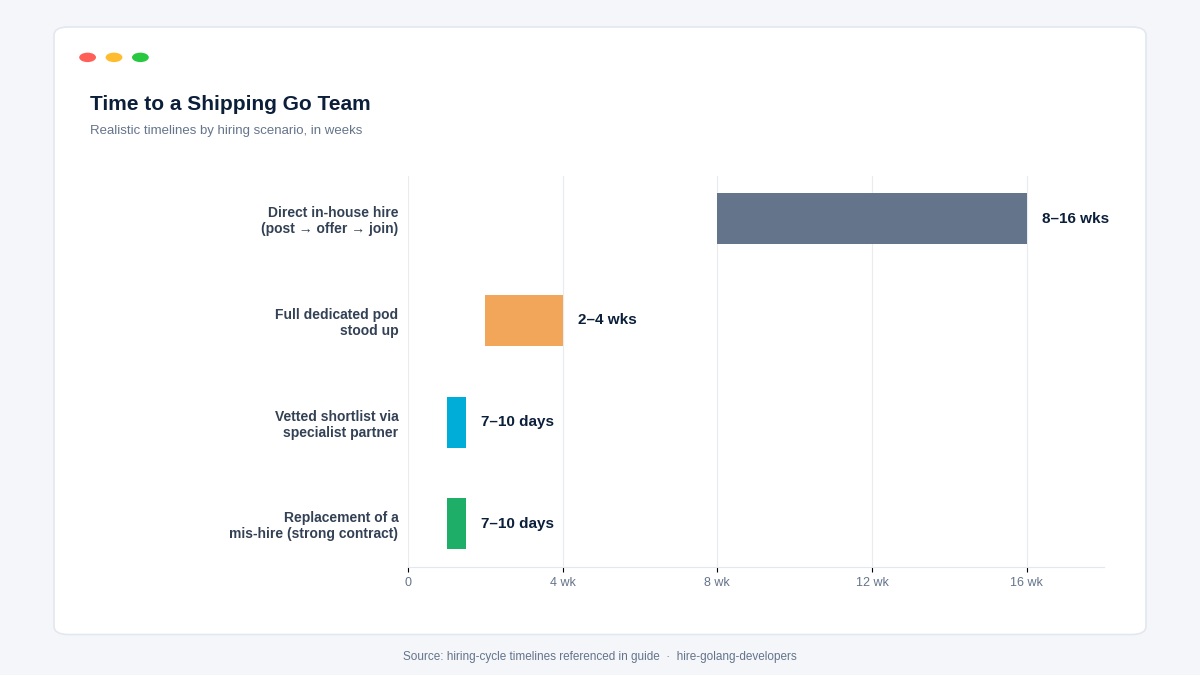
Typical timelines by scenario:
| Scenario | Realistic timeline |
| Direct in-house hire (post → offer → join) | 8–16 weeks |
| Vetted shortlist via specialist partner | 7–10 working days to interview-ready |
| Replacement of a mis-hire (strong contract) | 7–10 days |
| Full dedicated pod stood up | 2–4 weeks |
The single biggest hidden cost is delay: every week a critical backend role sits open, the roadmap slips and existing engineers absorb the overflow, which quietly raises burnout risk and attrition. A compressed, pre-vetted process is not a luxury; it is the cheapest line item in the whole exercise.
This is the specific gap specialist partners like Supersourcing are built to close: the sourcing and first-round technical screening happen before candidates ever reach your calendar, so the weeks you would have spent filtering become weeks of shipping instead.
A quick cost-vs-value gut check. Before you optimize for the lowest rate, price the alternative: a mis-hire on a payment or core service typically costs 3–6 months of salary once you count rework, the incident it may cause, and the re-hire.
Measured that way, a slightly higher rate for a properly vetted engineer with a fast replacement guarantee is almost always the cheaper decision.
Where to Go From Here
If you are mid-decision the technical case for Go is settled but you are staring at an empty backend role and a slipping roadmap the next move is small and concrete: define the one role you need most (using the Phase 1 checklist above), decide your engagement model from the framework table, and get a vetted shortlist in front of your engineers.
That last step is where specialist help earns its keep. Surfing the top 2% of Go engineers, running the concurrency-safe technical screen, and backing it with a 7–10 day replacement guarantee is the difference between a hire that ships and a quarter you cannot get back. Supersourcing works with dedicated account managers, no shared bandwidth, and NDA-backed IP protection so the engineer you meet is the engineer who ships, and the code they write is unambiguously yours.
If you want an interview-ready shortlist of production Go engineers built around your exact scope, start one conversation here:→ https://supersourcing.com/contact-us/
Bring the role definition. We’ll bring the talent.
Frequently Asked Questions
Is Golang good for backend development?
Yes, and increasingly it is the default for high-concurrency backends. Go compiles to a fast static binary, handles tens of thousands of concurrent connections through lightweight goroutines, and uses far less memory than JVM services. That is why Docker, Kubernetes, and large parts of Uber and Netflix’s infrastructure run on it. It is strongest for APIs, microservices, and cloud-native systems.
Is Go faster than Java?
It depends on the workload, and the honest 2026 answer is nuanced. In I/O-bound, high-concurrency services, independent benchmarks show Go delivering roughly 40–60% higher throughput and 4–5× lower memory use, with near-instant startup. Java 25’s virtual threads and ZGC have narrowed the gap significantly for many workloads, and Java still wins on ecosystem maturity for complex domain logic. For lightweight, container-dense services, Go usually wins.
What are the main Golang use cases in real companies?
The dominant Golang use cases are microservices, high-throughput APIs, cloud infrastructure and DevOps tooling, real-time systems, and data pipelines. Concrete examples: Uber’s dispatch and geofencing services, Docker and Kubernetes themselves, Twitch’s streaming backend, and payment and fraud systems at firms like PayPal and American Express.
How long does it take to hire a Go developer?
A direct in-house hire typically takes 8–16 weeks from job posting to a joined engineer. Working through a specialist partner with a pre-vetted pipeline, an interview-ready shortlist can arrive in 7–10 working days, because sourcing and first-round technical screening are already done before candidates reach you.
How much does it cost to hire a Golang developer?
In India, roughly ₹3.5–6 lakh/year for juniors up to ₹18–30 lakh/year for seniors; in the US market, roughly $70k–150k+ depending on seniority and location. The bigger variable is quality: an engineer fluent in concurrency, gRPC, and Kubernetes commands a premium and is worth it, because non-idiomatic Go costs more in rework than the rate ever saved.
What should I look for when I hire golang developers?
Prioritize idiomatic concurrency (goroutines, channels, context propagation), standard-library fluency, gRPC/protobuf, and real Kubernetes/Docker experience validated through a live pairing round, not a résumé. The single best predictor is watching a candidate debug a goroutine leak in real time. Communication and an ownership mindset matter equally for remote teams.
Dedicated team or staff augmentation which should I choose?
Choose a dedicated team when the work is ongoing product development and you want continuity plus IP ownership without carrying the hiring overhead. Choose staff augmentation when you already have the management structure and simply need vetted capacity fast. Both can put engineers to work in days; freelance marketplaces are only appropriate for bounded, low-risk tasks.
Can I hire Golang developers without setting up a local entity abroad?
Yes. Engagement models like dedicated teams and staff augmentation through a specialist partner let you access offshore Go talent, protect your IP through NDA and assignment clauses, and manage engineers directly without incorporating a foreign entity. If your ambition is a larger, permanent offshore team, a Global Capability Center setup is the structured path, and it is worth a short conversation to scope which model fits your stage.
