

OutSystems has quietly become a mission-critical platform across banking, insurance, and telecom, enabling enterprises to build and modernize applications faster without compromising on scalability or governance.
Hire OutSystems Developers in India is now a strategic move for enterprises looking to accelerate digital transformation using low-code platforms. OutSystems stands apart by supporting complex, enterprise-grade applications with deep integrations, cloud-native deployment, and full-stack development capabilities.
The shift is backed by strong future demand; by 2026, over 75% of new enterprise applications will be built using low-code or no-code technologies, significantly increasing demand for specialized developers like OutSystems experts.
However, the talent pool in India remains limited. Developers with 4+ years of real enterprise OutSystems experience are scarce and highly competitive to hire. This guide breaks down how to find, evaluate, and hire the right OutSystems developers for enterprise-scale delivery.
What Is OutSystems and What Makes It Enterprise-Grade Low-Code
OutSystems is a full-stack low-code application development platform meaning it covers the entire application development lifecycle from UI design through server-side logic, data modelling, integration, and deployment. Unlike tools focused on forms or simple workflows, OutSystems can build genuinely complex enterprise applications that would traditionally require custom development.
The platform has two active generations:
OutSystems 11 is the current-generation platform widely deployed across the enterprise customer base. It uses a modular architecture based on Applications and Modules, a server-side logic layer built on Actions and Aggregate queries, a client-side logic layer for reactive web and mobile apps, and a deployment infrastructure that can run on-premise, on AWS, or on Azure. OutSystems 11 development uses Service Studio (the visual IDE) and Integration Studio (for custom extensions using C# or Java).
OutSystems Developer Cloud (ODC) is the cloud-native next generation a redesigned platform built on a container-based architecture with a domain-driven design model that replaces the Module/Application hierarchy with Apps and Libraries, a new deployment model based on Kubernetes, and a revised integration approach using REST APIs and event-driven integration patterns. ODC is where OutSystems is investing its product roadmap.
Organizations starting new OutSystems programs today need to decide between OutSystems 11 (established, large talent pool) and ODC (modern architecture, smaller talent pool, future roadmap).
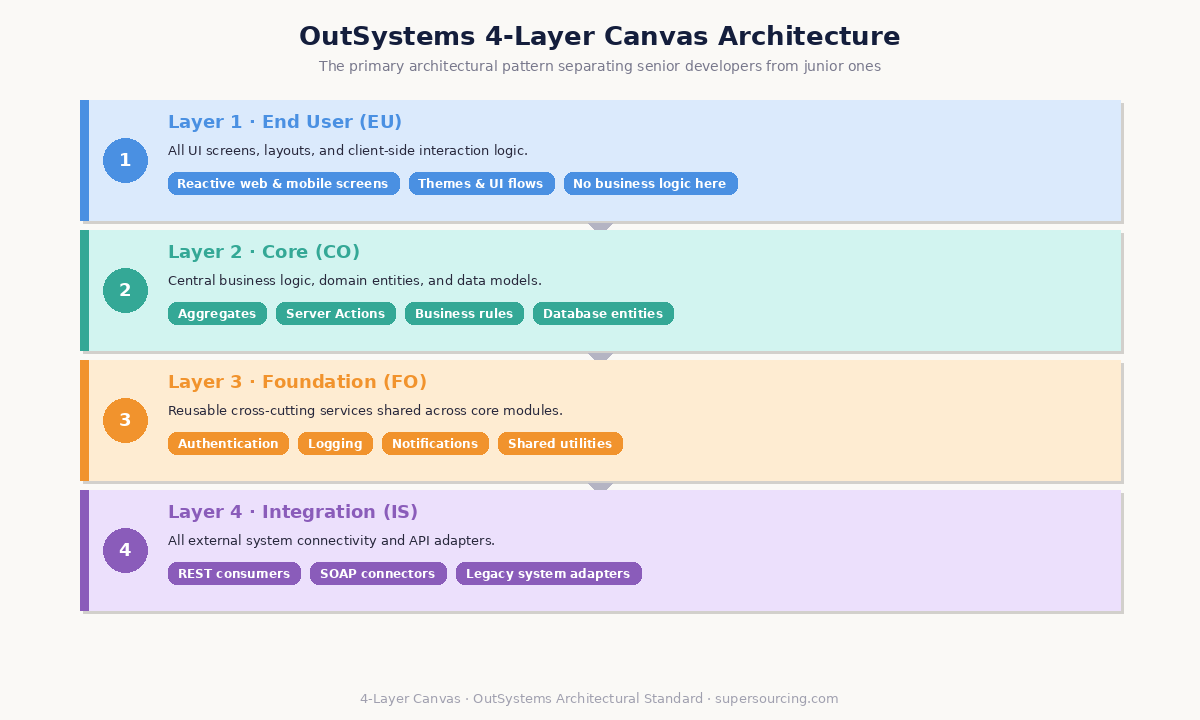
The architectural discipline that separates senior OutSystems developers from junior ones is 4-Layer Canvas design OutSystems’ architectural pattern that organizes applications into End User Modules (UI), Core Modules (business logic and data), Foundation Modules (reusable services), and Integration Modules (external system connectivity).
Applications built without 4-Layer Canvas architecture become monolithic, tightly coupled, and increasingly difficult to maintain as they grow. This is the most important assessment dimension for any senior OutSystems role.
The OutSystems Talent Market in India
OutSystems talent in India is concentrated in three areas: Persistent Systems’ OutSystems practice (one of India’s largest), Infosys and Wipro digital transformation teams, and a smaller independent developer community built through OutSystems University training.
OutSystems Professional Developer, Expert Developer, and Architect certifications are the credential path. As with every low-code platform, certification validates training not production application depth. The combination of OutSystems Expert Developer certification and 5+ years of complex enterprise application delivery is the profile that commands premium rates and has the shortest supply relative to demand.
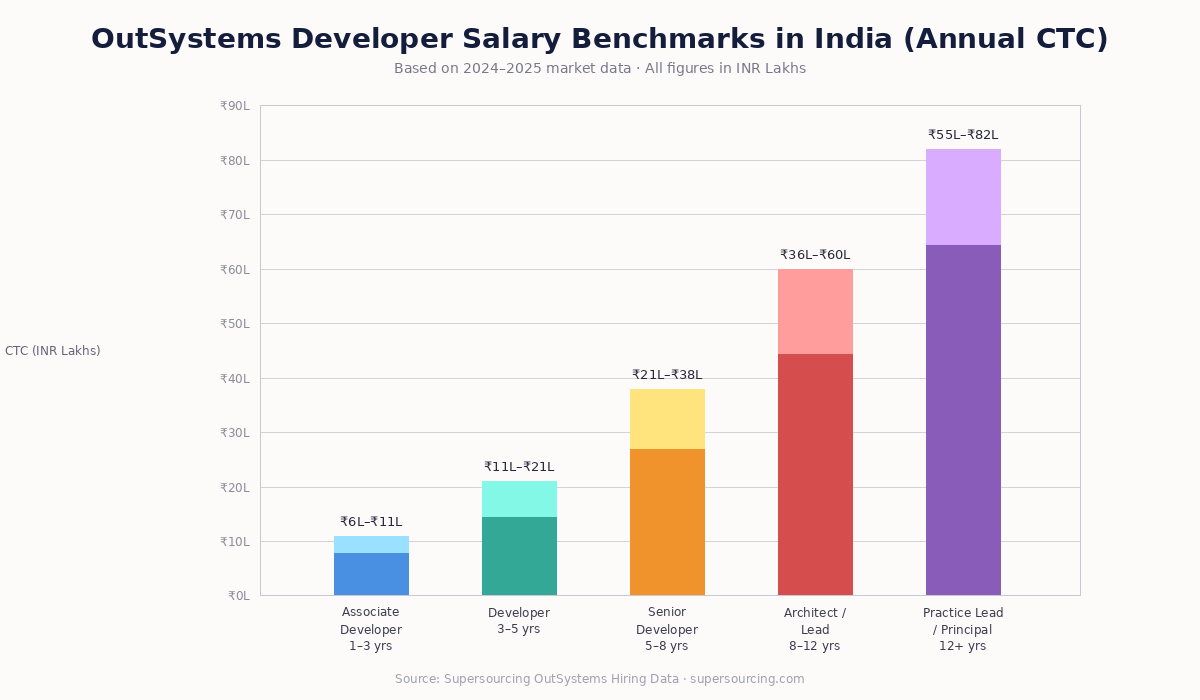
| Level | Experience | Annual CTC (INR) |
| OutSystems Associate Developer | 1–3 years | ₹6L – ₹11L |
| OutSystems Developer | 3–5 years | ₹11L – ₹21L |
| Senior OutSystems Developer | 5–8 years | ₹21L – ₹38L |
| OutSystems Architect / Lead | 8–12 years | ₹36L – ₹60L |
| OutSystems Practice Lead / Principal | 12+ years | ₹55L – ₹82L |
Contract and staff augmentation rates are customized to your platform version (OutSystems 11 vs ODC), application complexity, domain context (BFSI vs telecom vs healthcare), and seniority. Custom quote within 24 hours of receiving the JD.
What to Actually Assess in an OutSystems Developer Interview
4-Layer Canvas architecture understanding the primary senior developer filter.
Ask the candidate to explain how they would architect a customer-facing banking portal on OutSystems where the UI modules live, how the business logic is organized in core modules, what belongs in foundation modules, and how external system integrations are encapsulated.
A developer who cannot articulate the 4-Layer Canvas model, who has only built monolithic OutSystems applications where UI, logic, and integration are all in the same module, is not ready for senior enterprise application development. This is the single most important architecture assessment for any OutSystems senior or architect role.
Aggregate and server action performance optimization.
OutSystems queries are written as visual Aggregates not SQL. The performance of Aggregates particularly those with complex joins, filter conditions, and sort orders is entirely a design discipline.
Ask the candidate how they optimize an Aggregate that is retrieving too much data: use of MaxRecords, filter conditions pushed to the database layer versus applied in memory, the use of SQL nodes when Aggregate expressiveness is insufficient, and the identification of N+1 query patterns in screen preparation logic. Developers who have not debugged OutSystems performance issues will not know these patterns.
Service Actions and the service-oriented architecture model.
In OutSystems 11’s service architecture model, IT Service Actions are the mechanism for exposing module functionality to other modules in a loosely coupled way. Ask how the candidate designs Service Actions, what goes in a Service Action versus a Server Action, how they handle transaction scope across Service Action calls, and how they design the API for a Service Action that will be consumed by multiple upstream modules. Incorrect Service Action design creates coupling and transactional issues that manifest as data consistency problems in production.
REST API integration design.
Enterprise OutSystems applications integrate with multiple external systems. Ask the candidate to walk through a complex REST integration they have designed, how they configured the REST consumer, how they handled OAuth2 authentication token refresh, how they designed error handling for different HTTP response codes, and how they tested integration reliability before go-live.
For published REST services where OutSystems exposes data to external consumers ask about service endpoint design and versioning strategy.
ODC-specific architecture for next-generation programs.
If your program is on ODC, the architectural model changes significantly. Apps and Libraries replace Modules and Applications, the deployment model is container-based on Kubernetes, and integration uses a revised pattern with REST APIs and event-driven integration.
Ask ODC candidates to explain the difference between App architecture and Library design in ODC, and how the ODC deployment pipeline differs from OutSystems 11. On-premise OutSystems 11 experience does not automatically transfer to ODC.
Where OutSystems Delivers the Most Enterprise Value
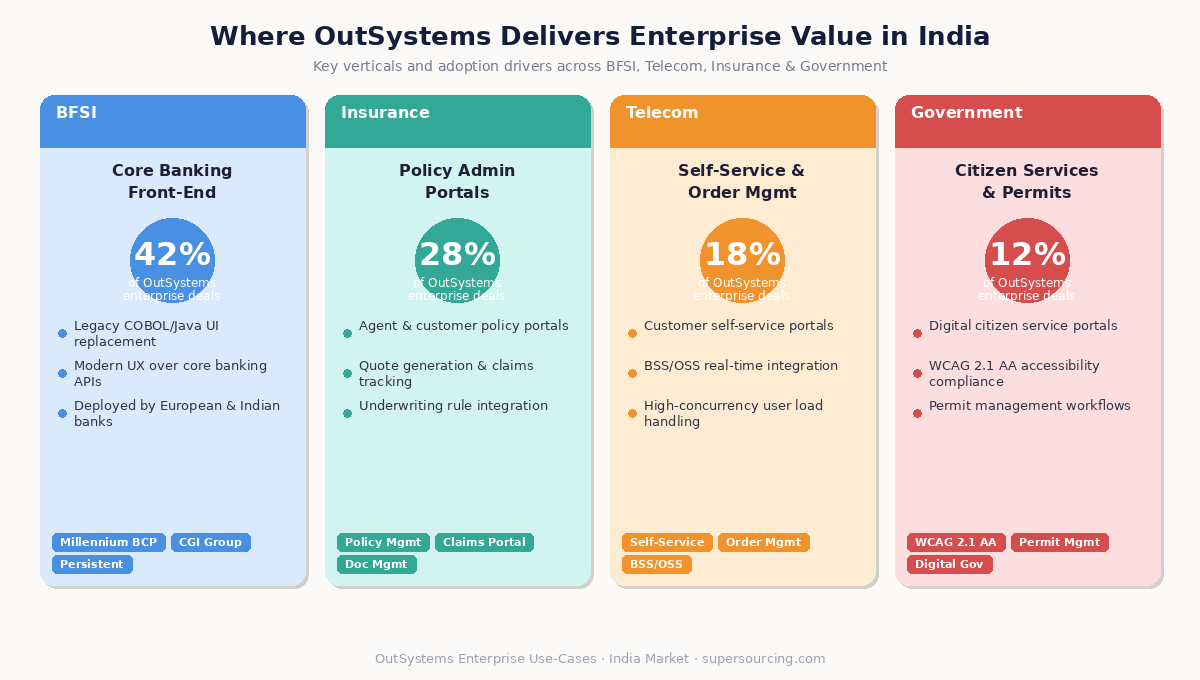
Core banking front-end replacement.
Legacy bank front-end systems built on COBOL or early Java frameworks are among the most expensive systems in financial services to maintain and modernize. OutSystems has been used extensively by European banks to build modern front-end applications on top of existing core banking infrastructure, delivering new UX without replacing the backend. OutSystems developers for these programs need financial services domain awareness and experience integrating with legacy system APIs.
Insurance policy administration portals.
Insurance companies use OutSystems to build agent and customer portals for policy management, quote generation, and claims status tracking. The complexity of multi-product policy structures, underwriting rule integration, and document management makes these genuinely challenging OutSystems programs that require senior architecture skills.
Telecom self-service and order management.
Telecom companies use OutSystems for customer self-service portals (plan changes, service requests, billing) and internal order management workflows. Real-time integration with BSS/OSS systems and high concurrent user load are the primary technical challenges.
Government digital services.
European government agencies have used OutSystems for citizen service portals and permit management applications. Government programs often have strict accessibility (WCAG 2.1 AA) and security requirements that OutSystems developers need to understand and configure.
The 3 Most Common OutSystems Hiring Mistakes
Not assessing 4-Layer Canvas architecture as the primary filter.
This is the single most important differentiator between developers who build maintainable enterprise applications and those who build monoliths. Every senior OutSystems interview must include an architecture design scenario that reveals whether the candidate applies 4-Layer Canvas or defaults to whatever module structure is easiest.
Treating OutSystems 11 and ODC experience as interchangeable.
They are not. ODC is an architectural redesign, not a version upgrade. Specify which platform you are building on in the JD and assess for that specific version.
Hiring developers without integration experience for enterprise programs.
Enterprise OutSystems applications are not standalone; they connect to CRM systems, core banking platforms, document management systems, and external APIs. An OutSystems developer without real REST and SOAP integration design experience will not be effective on the programs where OutSystems delivers the most enterprise value.
How Supersourcing Sources and Vets OutSystems Developers
Our senior application architects assess every OutSystems developer shortlist 4-Layer Canvas architecture design, Aggregate performance optimization, Service Action design, REST API integration quality, ODC-specific architecture for next-generation programs, and domain knowledge alignment for BFSI, telecom, and healthcare buyers.
Shortlist in 48 hours. Optional Barrister or interview.io technical interviews arranged by us. 5,000+ engineers placed. 8% attrition. 98% joining rate. 14-day free replacement.
FAQ
What is 4-Layer Canvas and why does it matter for OutSystems hiring?
4-Layer Canvas is OutSystems’ architectural pattern End User (UI), Core (business logic), Foundation (reusable services), and Integration (external systems) layers. Applications built without it become tightly coupled monoliths that are expensive to maintain and extend. It is the primary architectural assessment for every senior OutSystems role.
What is the difference between OutSystems 11 and ODC?
OutSystems 11 uses a Module/Application hierarchy, supports on-premise and cloud deployment, and has a large existing talent pool. ODC is cloud-native on Kubernetes, uses an App/Library model with domain-driven design, and represents OutSystems’ future roadmap. They have different architectures and require different skills. Specify which version you are building on in the JD.
What certifications should I require for OutSystems roles?
OutSystems Professional Developer for mid-level roles. OutSystems Expert Developer for senior developers and leads. OutSystems Architect for architecture and practice lead roles. Use certifications as a baseline combined with real 4-Layer Canvas architecture assessment in every senior interview.
Can someone outside Supersourcing technically interview the candidate?
Yes. Optional Barraiser, interview.io, or direct round with your own OutSystems lead arranged by us, zero coordination effort on your side.
What is your replacement policy?
Free replacement within 14 days. No charge, no questions.
Do I need a legal entity in India?
No. We act as Employer of Record payroll, PF, ESIC, TDS, all statutory compliance handled by us.
What is the realistic hiring timeline for a senior OutSystems developer in India without Supersourcing?
8–12 weeks through standard job postings. Through Supersourcing: 48-hour shortlist, hire within 7 days.
Talk to Us About Your OutSystems Requirement
If you are building an OutSystems team in India BFSI portal, telecom self-service, insurance policy management, or government digital services I am usually the one on those calls.
Email: mayank@supersourcing.com Or book a meeting directly at supersourcing.com
Tell us your OutSystems version (11 vs ODC), application domain, integration landscape, and team composition. Shortlist in 48 hours from there.
No retainer until you hire. Replacement clause on every engagement.
Mayank Pratap Singh · Co-founder, Supersourcing Google AI Accelerator · LinkedIn Top 20 Startups India · 5,000+ Engineers Placed · 1,000+ Companies · 17 Fortune 500s
