

UiPath is no longer just an automation tool it has become the execution layer of enterprise operations. From finance workflows and HR onboarding to IT service management and customer support, large organizations are increasingly relying on UiPath to automate high-volume, rule-based processes at scale.
The shift is not theoretical; it is already happening at the enterprise level. According to UiPath’s latest financial results, the company reached $1.85 billion in Annual Recurring Revenue (ARR) in 2026, reflecting sustained enterprise adoption and expansion of automation programs worldwide.
India sits at the center of this transformation. It is the global delivery hub for robotic process automation (RPA), where system integrators, global capability centers (GCCs), and enterprises build and scale UiPath automation programs. As a result, hiring demand for UiPath developers in India is not niche; it is high-volume, continuous, and business-critical.
UiPath development looks deceptively simple. Drag-and-drop workflows, record actions, deploy bots creates the illusion that anyone can build automation. In reality, poorly built automation leads to fragile selectors, broken workflows after UI changes, lack of exception handling, and rising maintenance costs that erode ROI.
What Is UiPath and Why the Depth Gap Is Large
UiPath is a robotic process automation platform that automates digital tasks by mimicking human interaction with software applications clicking, typing, reading data from screens, navigating menus, extracting data from documents, and transferring information between systems. It operates at the UI layer which means it can automate any application a human can interact with, regardless of whether that application has an API.
The platform has several major components that require specific expertise:
- UiPath Studio is the development environment where automations are designed and built using a workflow diagram approach. Studio supports three workflow types: Sequences (linear step-by-step automations), Flowcharts (branching logic automations), and State Machines (complex automations with defined state transitions). Studio also includes specialized tools: Studio X for citizen developer automations, and the full Studio for professional RPA developers.
- UiPath Orchestrator is the enterprise management platform where robots are deployed, scheduled, monitored, and managed. Orchestrator manages robot pools, job queues, triggers, assets (credentials and configuration values), and process packages. A UiPath developer who has only built Studio workflows and never administered an Orchestrator environment has a significant gap for enterprise-scale automation programs.
- UiPath Document Understanding is UiPath’s intelligent document processing capability using ML models for optical character recognition, layout analysis, and data extraction from unstructured documents (invoices, purchase orders, contracts, forms). Document Understanding automation is significantly more complex than standard UI automation; it requires understanding of ML model training and deployment, document taxonomy design, and the validation workflow for human-in-the-loop review of low-confidence extractions.
- UiPath AI Center is UiPath’s MLOps platform for deploying and managing machine learning models within automation workflows. AI Center integration requires understanding of ML model lifecycle management, model package deployment, and the skill invocation patterns that call ML models from within automation workflows.
- UiPath Test Suite is UiPath’s test automation capability using RPA technology to automate application testing. UiPath Test Suite developers need both RPA development skills and software testing methodology knowledge.
The depth gap in UiPath hiring is primarily between developers who build attended automations for individual desktop use cases and developers who design enterprise automation programs with Orchestrator-managed robot pools, queue-based processing, exception handling frameworks, reusable component libraries, and CI/CD pipelines for automation deployment. Both types call themselves UiPath developers. They are not the same hire.
 The UiPath Talent Market in India: Real Numbers
 The UiPath Talent Market in India: Real Numbers
UiPath developer demand in India is consistently high, driven by the volume of UiPath programs running across Global Capability Centers (GCCs), large Indian enterprises, and global SI delivery teams. Unlike more specialized platforms (Guidewire, Veeva), there is a meaningful supply of UiPath developers. The challenge is quality differentiation separating developers who build production-grade enterprise automation from those who have completed UiPath Academy courses and built simple attended automations.
Certified UiPath developers holding UiPath Certified RPA Associate (UiRPA), UiPath Certified Advanced RPA Developer (UiARD), or UiPath Certified Automation Developer Pro with 3+ years of real enterprise automation experience are the profiles that Supersourcing specifically vets for. Certification combined with Orchestrator administration experience, Document Understanding implementation, and framework-based development (REFramework) is the combination that predicts production-grade automation quality.
| Level | Experience | Annual CTC (INR) |
| RPA Associate / Junior Developer | 1–3 years | ₹5L – ₹10L |
| RPA Developer | 3–5 years | ₹10L – ₹18L |
| Senior RPA Developer | 5–8 years | ₹18L – ₹32L |
| RPA Lead / Solution Architect | 8–12 years | ₹30L – ₹55L |
| Automation Practice Lead / CoE Head | 12+ years | ₹50L – ₹80L |
Contract and staff augmentation rates are customized to your automation complexity, Orchestrator environment scale, Document Understanding scope, and seniority level. Custom quote within 24 hours of receiving the JD.
What to Actually Assess in a UiPath Developer Interview
REFramework (Robotic Enterprise Framework) design and use.
REFramework is UiPath’s best-practice automation framework template, a State Machine-based architecture that handles initialization, queue transaction processing, exception handling, and end-process states in a standardized way. Every enterprise UiPath developer should use REFramework as the basis for production automations. A developer who builds non-REFramework automations for enterprise queue-based processing, or who cannot explain the REFramework state transition model, is not building to production standards.
Ask specifically: have they used REFramework, how do they handle application exceptions versus business exceptions within it, and how do they design the InitAllApplications and CloseAllApplications states for multi-application automations.
Selector design and resilience strategy.
Selectors are how UiPath identifies UI elements and brittle selectors are the primary cause of automation failures in production. Ask the candidate to explain their selector design approach: when they use dynamic selectors versus static, how they handle applications that generate variable element IDs on each launch, and how they design anchor-based selectors for elements that cannot be identified uniquely by their own attributes.
Developers who cannot articulate a selector resilience strategy have not debugged enough production automation incidents to understand why it matters.
Orchestrator administration and job design.
For enterprise automations, Orchestrator is where the real operational management happens. Ask about the candidate’s Orchestrator experience: how they design queue-based automations with retry logic, how they configure robot pools for high-priority versus low-priority job types, how they manage assets and credentials securely in Orchestrator, and how they design triggers and schedules for dependency-sequenced automation jobs.
Candidates who have only used Orchestrator as a deployment target without understanding queue design, asset management, and robot pool configuration have a significant operational gap.
Exception handling architecture beyond basic try-catch.
Enterprise automations fail. The question is whether they fail gracefully or catastrophically. Ask the candidate to explain how they design exception handling in a multi-step automation the difference between application exceptions (the target application is unavailable) and business exceptions (the data being processed is invalid), how they handle retries for transient application exceptions, how they log exception details for operational diagnosis, and how they design the fallback behavior when an automation cannot complete a transaction after maximum retries.
Document Understanding pipeline design for document processing automations.
If your automation program includes invoice processing, contract extraction, or form data extraction, ask specifically about Document Understanding experience: how they have designed the digitization stage (OCR model selection), the classification stage (ML Classifier configuration), the extraction stage (ML Extractor with field scope), and the validation station configuration for human review.
Document Understanding automation has a significantly higher complexity ceiling than standard UI automation and developers who have not built real Document Understanding pipelines will struggle with the ML model lifecycle and validation workflow design.
RPA Program Models: What Level of UiPath Expertise You Need at Each Stage
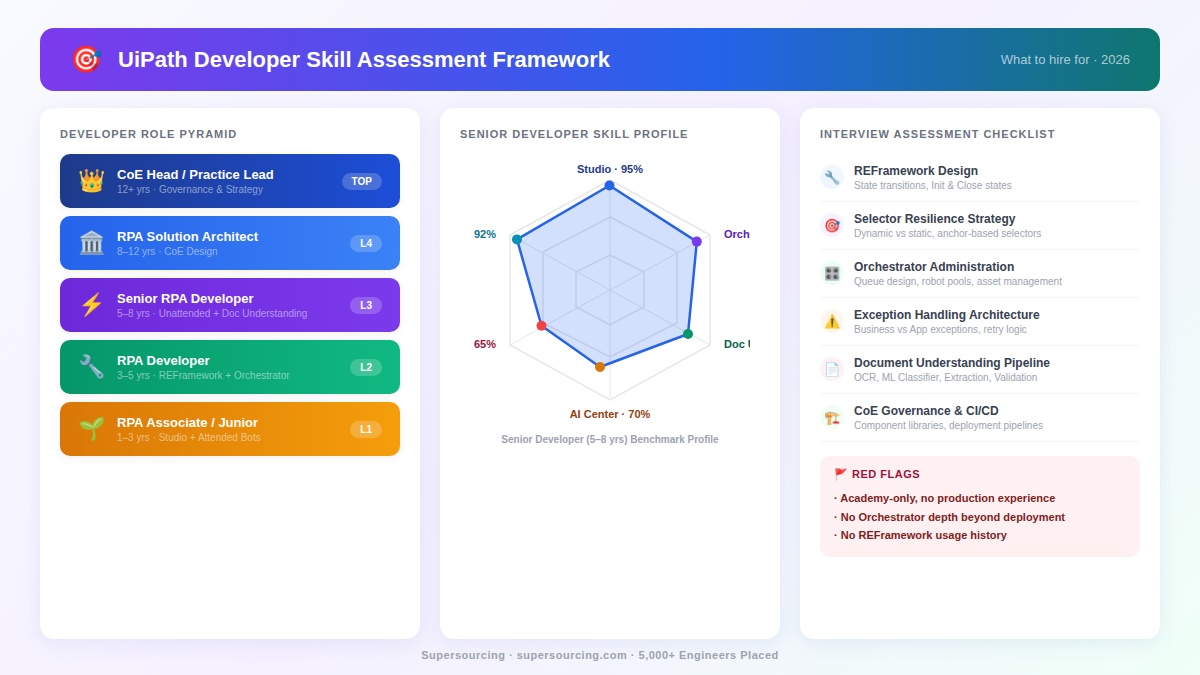 RPA Program Models: What Level of UiPath Expertise You Need at Each Stage
Automation discovery and assessment.
Before building, someone needs to assess which processes are automation candidates estimating effort, savings, and technical feasibility. This is a consulting and process analysis skill that some senior RPA developers have and many do not. If you need process discovery capability, assess for it explicitly; it is not automatic with technical development skills.
I attended automation development.
Individual desktop automations that run on a specific user’s machine, triggered by the user, processing data from applications the user has open. Lower complexity, faster to build, but limited scalability. Junior to mid-level developers with Studio proficiency and basic Orchestrator connectivity.
Unattended automation development.
Robot-driven automations running in the background on server machines, triggered by Orchestrator schedules or queues, processing high volumes of transactions without human involvement. Requires REFramework design, Orchestrator administration, queue management, and robust exception handling. Mid to senior developers.
Center of Excellence (CoE) architecture.
Large enterprises running 50+ automation processes need a CoE architecture component libraries for reusable automation blocks, governance frameworks for code standards and review, CI/CD pipelines for automation deployment, and performance monitoring dashboards. CoE architects are the most senior and scarcest UiPath profile; they combine deep technical expertise with automation program governance and business stakeholder management.
The 3 Most Common Mistakes When Hire UiPath Developers in India
Hiring UiPath Academy completers as developers.
UiPath Academy is an excellent training platform but completing training courses is not the same as building production automation. Many candidates who list UiPath on their resume have done Academy training but have never built an automation that processes real data at real volume in a production environment. Distinguish between Academy-trained candidates and production-experienced developers.
Ask for specific examples: which automations they have built, how many transactions they process per day, what their exception rate is, and what their most complex selector challenge was.
Not assessing Orchestrator depth for enterprise programs.
Many UiPath developers have Studio skills without meaningful Orchestrator administration experience. For enterprise automation programs running unattended robots against business-critical processes, orchestrator design is not optional; it determines whether the program scales, whether robots are managed securely, and whether operational teams can monitor and respond to automation incidents. Always assess Orchestrator depth for senior roles.
Hiring individual developers without a framework or governance design.
Automation programs that grow without governance create a maintenance nightmare: inconsistent selector strategies, duplicate component development, no shared libraries, variable exception handling patterns. Hiring an automation lead or architect who can design the framework, establish the component library, and set the development standards before individual developers are hired produces significantly better long-term outcomes than hiring a team of individual developers first.\
How Supersourcing Sources and Vets UiPath Developers
 How Supersourcing Sources and Vets UiPath Developers
Our senior technical architects assess every UiPath developer shortlist REFramework design, selector resilience strategy, Orchestrator administration depth, exception handling architecture, Document Understanding pipeline design, and CoE governance experience for leadership roles. We assess certification status as a baseline UiRPA and UiARD certifications are noted and then assess real production automation experience through scenario-based technical evaluation.
We maintain a continuously vetted bench of UiPath developers across all seniority levels from junior RPA developers through CoE architects. Shortlist in 48 hours. 14-day free replacement on every engagement. Optional Barrister or interview.io technical interviews arranged by us.
5,000+ engineers placed. 8% attrition. 98% joining rate.
FAQ
1. What is REFramework and why is it important for UiPath hiring?
REFramework (Robotic Enterprise Framework) is UiPath’s best-practice State Machine template for enterprise automations handling initialization, queue transaction processing, application and business exception management, and end states in a standardized, maintainable way. Every professional UiPath developer building queue-based enterprise automations should use REFramework. Developers who do not know it are not building to enterprise production standards.
2. What UiPath certifications should I require?
UiPath Certified RPA Associate (UiRPA) for junior to mid-level roles. UiPath Certified Advanced RPA Developer (UiARD) for senior developers and leads. UiPath Certified Automation Developer Pro for senior developers on complex programs. Certifications validate training combined with real production automation scenario assessment.
3. What is the difference between attended and unattended automation for hiring purposes?
Attended automations run on a user’s desktop, triggered by the user, using applications the user has open. Lower complexity, junior to mid-level development. Unattended automations run on server machines without human interaction, triggered by Orchestrator schedules or queues, processing high volumes. Higher complexity requires REFramework, robust Orchestrator design, and enterprise exception handling. Specify which you need in the JD.
4. Can you place UiPath developers who also understand Document Understanding for invoice processing?
Yes. Document Understanding is assessed separately from standard UI automation development ML model training, document taxonomy design, digitization, classification and extraction configuration, and validation station design for human-in-the-loop review. Specify Document Understanding as a requirement and we will assess it specifically.
5. What is your replacement policy?
Free replacement within 14 days. No charge, no questions.
6. Do I need a legal entity in India?
No. We act as Employer of Record payroll, PF, ESIC, TDS, all statutory compliance handled by us.
7. Can you build a full UiPath automation team of developers and an architect?
Yes. We build full automation teams regularly with a CoE architect or automation lead, senior and mid-level developers, and a QA engineer for automation testing shortlisted simultaneously.
8. What is the realistic hiring timeline for a senior UiPath developer in India without Supersourcing?
6–10 weeks through standard job posting for a senior developer with REFramework and Orchestrator depth. Through Supersourcing: 48-hour shortlist, hire within 7 days.
Talk to Us About Your UiPath Requirement
If you are building a UiPath automation program in India, a single automation pod, a CoE, or a GCC-wide automation team I am usually the one on those calls.
Email: mayank@supersourcing.com Or book a meeting directly at supersourcing.com
Tell us your automation scope, Orchestrator environment scale, Document Understanding requirements, and team composition. Shortlist in 48 hours from there.
No retainer until you hire. Replacement clause on every engagement.
Mayank Pratap Singh · Co-founder, Supersourcing Google AI Accelerator · LinkedIn Top 20 Startups India · 5,000+ Engineers Placed · 1,000+ Companies · 17 Fortune 500s
