

Most companies open their second GCC location for the wrong reason: because headcount at center one hit a ceiling. That’s a symptom, not a strategy. Real multi-city GCC expansion India decisions are driven by talent saturation, wage inflation crossing 12–15% year-on-year in a single city, or a board mandate to de-risk operations from one metro.
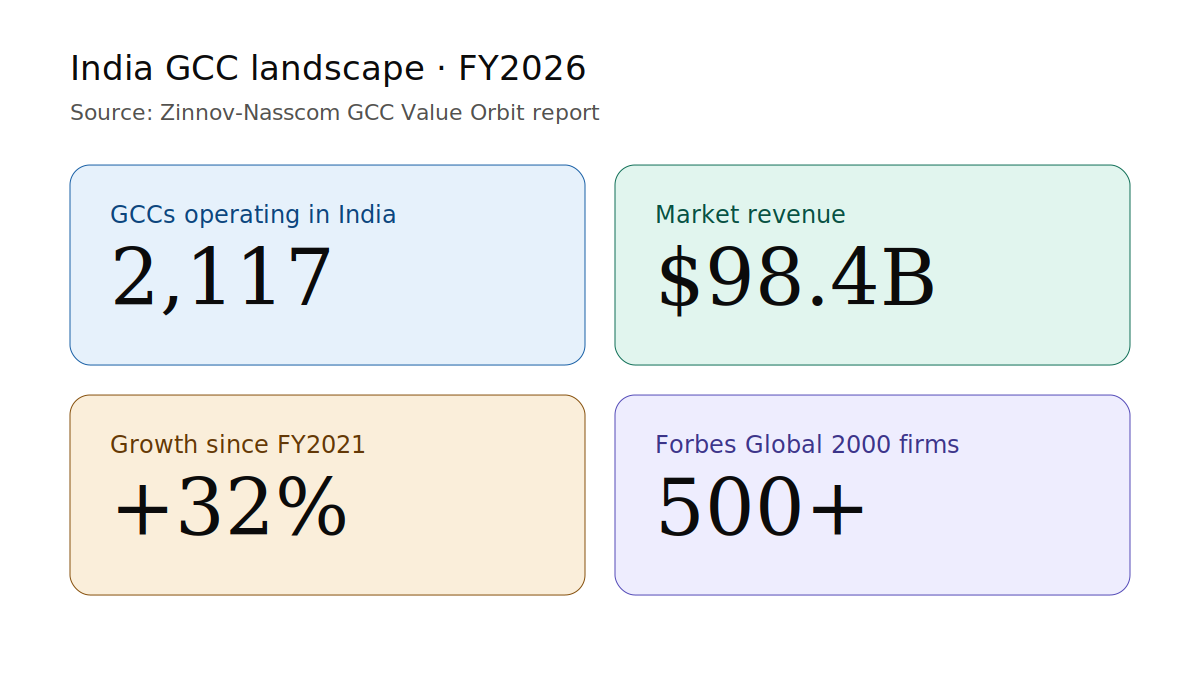
According to the Zinnov-Nasscom GCC Value Orbit report (FY2026), India now hosts 2,117 GCCs generating close to $98.4 billion in revenue, a 32% jump since FY2021, with over 500 Forbes Global 2000 companies now running centers here. That density means your first city is getting more crowded and more expensive every quarter you wait.
Companies that already run one GCC and are now evaluating a second GCC location face a different problem than first-time setup. You’re not proving the model works, you’re proving it can scale without fragmenting. This is the execution gap most playbooks skip: expanding GCC to new city operations without duplicating cost, diluting culture, or creating two centers that quietly compete for the same mandate.
This piece is built for that exact decision point after the business case is approved, before the lease is signed. It covers GCC location strategy India decisions on where to go, how to structure the second site, and what typically breaks in the first year of execution.
Why the Second Location Is a Different Problem Than the First
Setting up your first GCC is fundamentally a market-entry decision: you’re proving that captive delivery from India can match or beat your existing outsourcing or headquarters cost structure. Multi-city GCC expansion India is a scaling decision, and scaling decisions fail for different reasons than market-entry decisions do.
The first center had the advantage of a blank slate: no legacy reporting structures, no existing team culture to protect, no internal comparison point. The second center inherits all three. New hires at site two will benchmark their compensation, their manager’s seniority, and their scope of ownership against what colleagues in the first city already have often within the first month of joining.
This is why treating expanding GCC to new city work as a repeat of the original playbook consistently under-delivers. The second site needs its own change-management plan, not a recycled one.
What Is Multi-City GCC Expansion?
Multi-city GCC expansion India is the process of a company establishing a second or subsequent Global Capability Center in a different Indian city, beyond its original location, to access new talent pools, reduce cost concentration, and build operational resilience. It typically follows 18–36 months of stable operations at the first center and requires a distinct governance, hiring, and reporting model from day one.
The Core Problem: Underestimating Location Complexity
Companies planning multi-city GCC expansion India almost always underestimate the operational lift by 3–4x. The assumption is “we’ve done this once, we’ll just repeat it.” That assumption breaks within the first two quarters.
A second location isn’t a copy-paste of the first. Three specific realities complicate it:
Talent market maturity differs by city. Bengaluru’s engineering talent pool is deep but expensive; a tier-2 city like Coimbatore or Indore may offer 20–30% lower compensation benchmarks but a shallower senior-leadership bench, meaning your second center may need 6–9 months longer to staff director-level roles.
Governance splits before anyone notices. Without a defined reporting structure, teams at the new site start reporting informally to whichever center-one leader is most responsive, creating shadow hierarchies that HR only discovers during the first attrition spike.
Real estate and compliance timelines stack. A typical Grade-A office fit-out in a new city takes 4–6 months; state-level labor registrations and STPI/SEZ approvals (where applicable) add another 6–10 weeks if not initiated in parallel.
Most scaling GCC beyond first center failures trace back to treating these as sequential steps instead of parallel workstreams.
There’s a fourth complication companies rarely model upfront: internal competition for mandate. Once a second site exists, business unit leaders at headquarters start routing new projects to whichever center responds faster or has open capacity, not necessarily the center best positioned to own that work long-term. Without a clear mandate split defined before launch, multi-city GCC expansion India efforts tend to create two centers quietly bidding for the same work instead of two centers with distinct, complementary charters.
Deep Strategic Playbook: Executing the Second Location
This is where GCC location strategy India decisions get made and where most of the cost and timeline risk lives. Every decision here compounds into the next.
Choosing the Second City
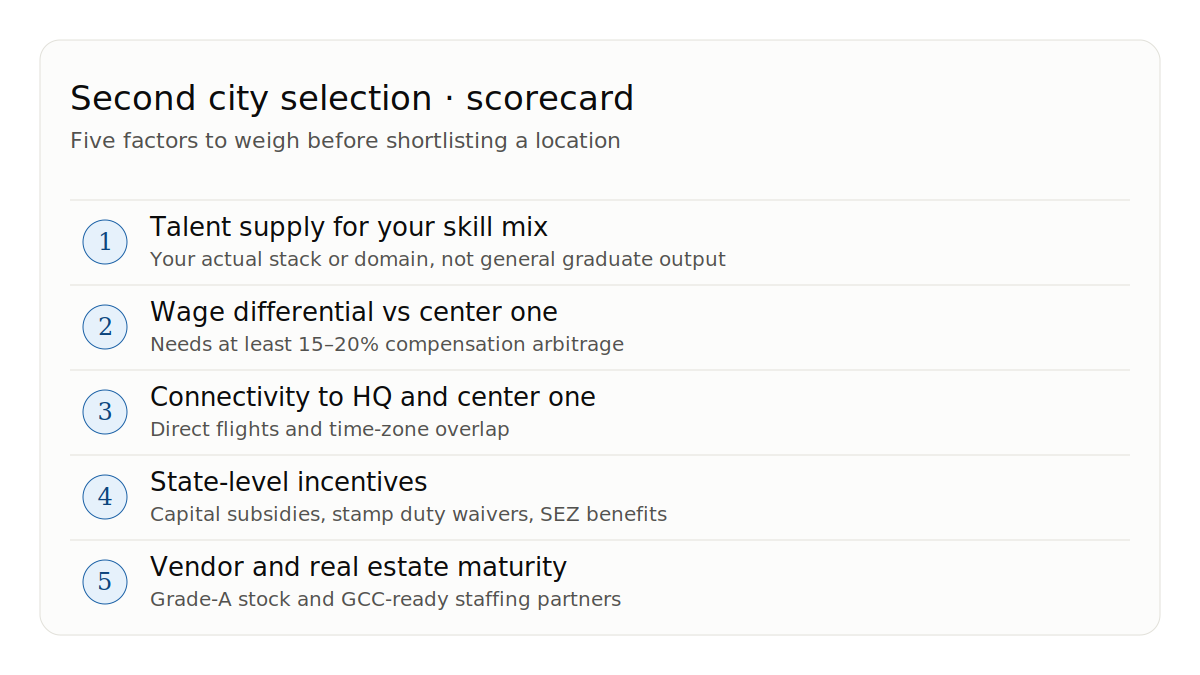
City selection for multi-city GCC expansion India should be scored against five weighted factors, not gut feel or a single site visit:
- Talent supply for your specific skill mix is not general IT graduate output, but graduates and lateral hires in your actual tech stack or domain (e.g., embedded systems, actuarial, GenAI research).
- Wage differential versus center one a meaningful second-city case needs at least a 15–20% compensation arbitrage to justify the setup cost.
- Connectivity to headquarters and center one direct flight routes and time-zone overlap for daily stand-ups matter more than most site-selection decks admit.
- State-level incentive structures several state governments now offer capital subsidies, stamp duty waivers, or SEZ-linked tax benefits specifically to attract GCCs to non-metro locations.
- Vendor and real estate ecosystem maturity availability of Grade-A commercial stock, IT-enabled facility management, and local staffing partners who already understand GCC hiring.
Choosing the Operating Model: Hub and Spoke vs. Independent Center
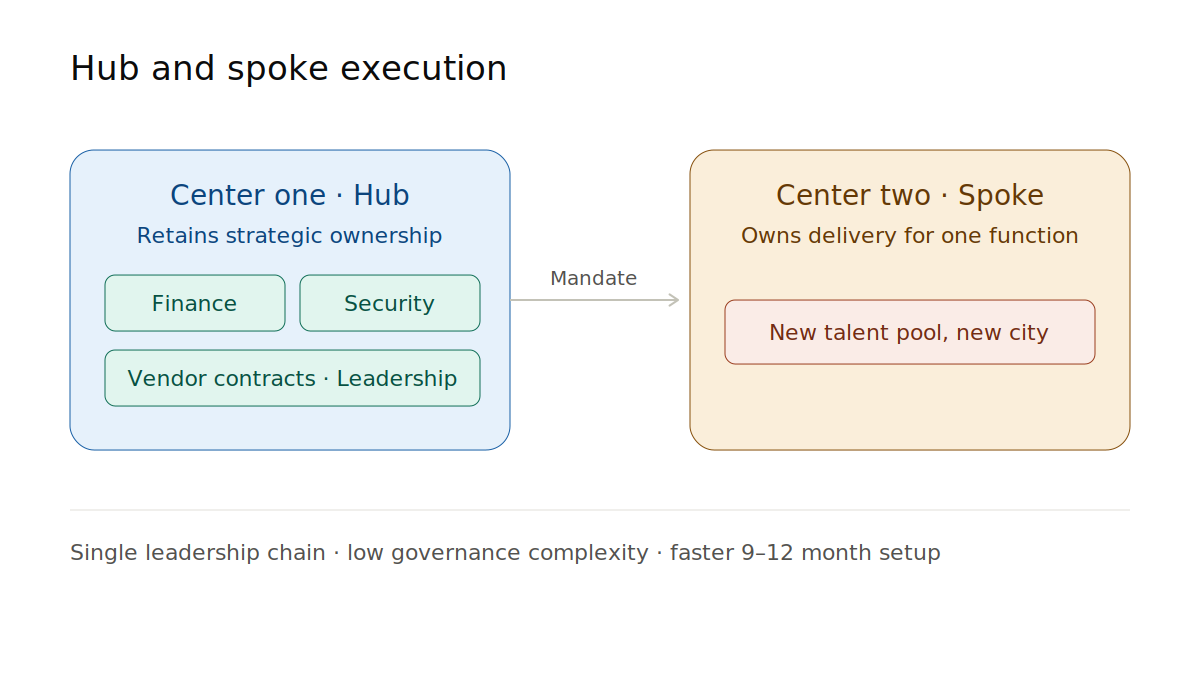
GCC hub and spoke execution is the model most companies default to, and for good reason: center one retains strategic ownership finance, security, vendor contracts, senior leadership while the second site owns delivery for a specific function or business unit. This avoids duplicating enterprise functions and keeps governance singular.
The alternative, a fully independent second center with its own P&L and leadership, works only when the second location is being built around an entirely different mandate (e.g., center one does engineering, center two does data science and AI research as a standalone charter).
Building the Cross-Location Team Structure
A cross-location team structure needs three things defined before the first hire is made at the new site:
- A single accountable leader for the new location who reports into the same chain as center-one leadership, not around it.
- Shared tooling and access provisioning (identity, VPN, ticketing) live before day one, not retrofitted after 50 people join.
- A rotation program even 10–15 people spending 4–8 weeks at center one to transplant culture and process before local hiring accelerates.
Timeline and Cost Reality
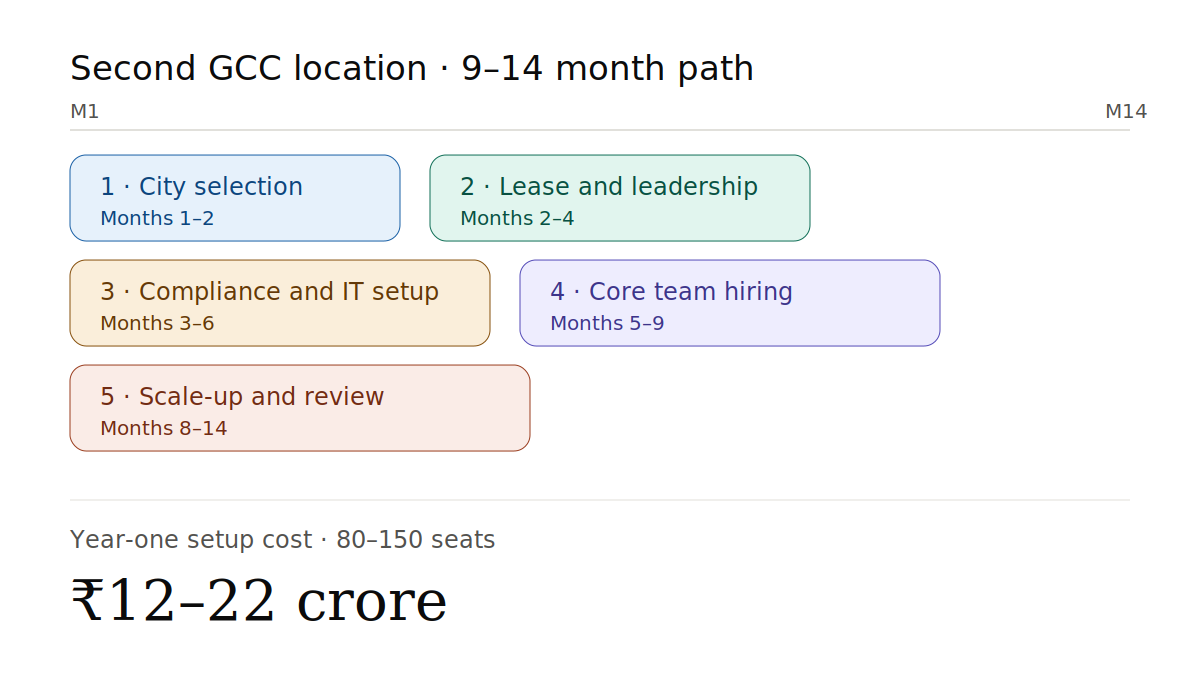
A realistic multi-city GCC expansion India timeline runs 9–14 months from board approval to first productive team:
- Months 1–2: City selection, entity/compliance structuring, real estate shortlisting
- Months 2–4: Lease finalization, fit-out design, leadership hire for new site
- Months 3–6: Compliance registrations (labor, STPI/SEZ, GST), IT infrastructure setup
- Months 5–9: Core team hiring (30–60 people), tooling rollout, governance documentation
- Months 8–14: Scale-up hiring, process maturity, first performance review cycle
Total setup cost for a mid-size second center (80–150 seats) typically runs ₹12–22 crore in year one, including fit-out, technology, and pre-productivity hiring cost before ongoing operating expense.
Compliance and Taxation Considerations
GCC compliance and taxation requirements shift meaningfully by state, and this is where most timeline slippage in multi-city GCC expansion India projects actually originates. A new legal entity or branch registration typically takes 6–8 weeks; STPI registration (if applicable to your delivery model) can run parallel but still needs 4–6 weeks of documentation lead time.
State-specific labor law registrations Shops and Establishments Act, Professional Tax, Provident Fund sub-code each carry their own processing windows, and several states now require in-person verification visits before approval. Companies that initiate these filings only after signing the lease routinely lose 6–10 weeks they hadn’t budgeted for.
Technology and Access Provisioning
The GCC operating model for a second site needs its identity, network, and security architecture designed before the first employee badge is issued, not retrofitted once 40 people are already using workarounds. This typically means extending existing SSO and VPN infrastructure to the new location rather than standing up a parallel stack, which both shortens setup time and avoids creating a second shadow-IT environment that security teams discover months later.
Case Study: Two Approaches to the Same Decision
A US-based fintech running a 400-person GCC in Pune opened a second, 90-person center in Ahmedabad specifically for compliance and risk operations, citing lower attrition rates in that talent segment. The hub-and-spoke model kept finance and security centralized in Pune, and the new site reached full productivity in 11 months against a 14-month plan.
A global manufacturing enterprise expanding from Chennai to Coimbatore skipped a formal governance structure at launch, assuming existing SOPs would transfer. Within eight months, the new site had built parallel reporting lines and a duplicate vendor panel, forcing a governance reset that added four months and roughly ₹3 crore in unplanned integration cost.
A European insurance company running its first GCC in Hyderabad chose Jaipur for its second site, prioritizing lower attrition in actuarial and analytics talent over pure cost savings. By running compliance registration and real estate fit-out in parallel from month one rather than sequentially the company reached a 70-person productive team in 10 months, roughly 30% faster than its original center’s ramp-up timeline.
Comparison: Hub and Spoke vs. Independent Second Center
| Factor | Hub and Spoke | Independent Second Center |
| Governance complexity | Low single leadership chain | High separate P&L and leadership |
| Setup speed | Faster (9–12 months) | Slower (14–18 months) |
| Best suited for | Same function, new talent pool | New mandate or business line |
| Cost duplication risk | Low | Moderate to high |
| Cultural consistency | Easier to maintain | Requires deliberate investment |
What Most Teams Get Wrong
The most common mistake in scaling GCC beyond first center work isn’t the city choice; it’s assuming the second location needs less oversight because “the model already works.” In practice, a second site needs more structured governance in the first year, not less, because there’s no institutional memory to fall back on when something breaks.
The second mistake: benchmarking the new city’s talent cost against center one’s current wage levels instead of its trajectory. Tier-2 cities that look 25% cheaper today can close that gap within 24–36 months once three or four other GCCs discover the same city.
The third, and most expensive: leadership assuming a strong center-one manager will automatically succeed running the second site remotely. Remote onboarding leadership of a new location without weekly in-person cadence for the first two quarters is one of the strongest predictors of early attrition among the new site’s senior hires.
A fourth, quieter mistake: measuring the new site’s success against center-one’s current maturity instead of center-one’s own year-one performance. A second location in month six should be compared to what the first center looked like in its own month six, not to a five-year-mature operation. Boards that make this comparison mistake tend to pull funding or headcount prematurely, right before the new site would have reached its own inflection point.
Making the Second Location Decision
If you’re evaluating multi-city GCC expansion India and want to pressure-test your city shortlist, governance model, or hiring timeline before committing to a lease or a vendor, Supersourcing has run this evaluation process across multiple GCC engagements. Reach out at mayank@engineerbabu.com or visit our contact page to walk through your specific city and headcount scenario.
Frequently Asked Questions
What is the best second city for a GCC in India?
There’s no universal answer; it depends on your skill requirements. Bengaluru and Hyderabad remain strong for AI and product engineering talent, while Coimbatore, Indore, Jaipur, and Kochi are gaining traction for cost-efficient delivery and operations roles with lower attrition.
How long does it take to set up a second GCC location?
A realistic timeline for multi-city GCC expansion India runs 9–14 months from approval to a productive team of 50–100 people, assuming real estate, compliance, and hiring workstreams run in parallel rather than sequentially.
What is a hub and spoke GCC operating model?
It’s a structure where the original center retains ownership of enterprise functions finance, security, vendor management while the new location owns delivery for a specific function or business unit, reporting into the same overall leadership chain.
How much does it cost to expand a GCC to a new Indian city?
A mid-size second center of 80–150 seats typically costs ₹12–22 crore in the first year, covering fit-out, technology, compliance registration, and pre-productivity hiring costs.
Should a company centralize or decentralize functions across GCC locations?
Most companies benefit from centralizing enterprise functions (finance, security, vendor contracts) while decentralizing delivery ownership; this is the core logic behind the hub and spoke model.
What are the biggest risks in multi-city GCC expansion?
The three recurring risks are ungoverned reporting lines forming organically, underestimating how fast tier-2 city wage arbitrage closes, and placing a remote leader at the new site without early in-person presence.
Does a second GCC location need its own leadership team?
Yes at minimum a single accountable site leader reporting into the existing chain, even under a hub and spoke model. A second location run without a named local leader is the fastest path to the shadow-governance problem described above.
Is a tier-2 city always cheaper for a second GCC location?
Not necessarily, and not for long. A tier-2 city may show a 20–30% cost advantage today, but that gap narrows quickly once two or three other companies establish GCCs there and start competing for the same graduate and lateral talent pool within 24–36 months.
