

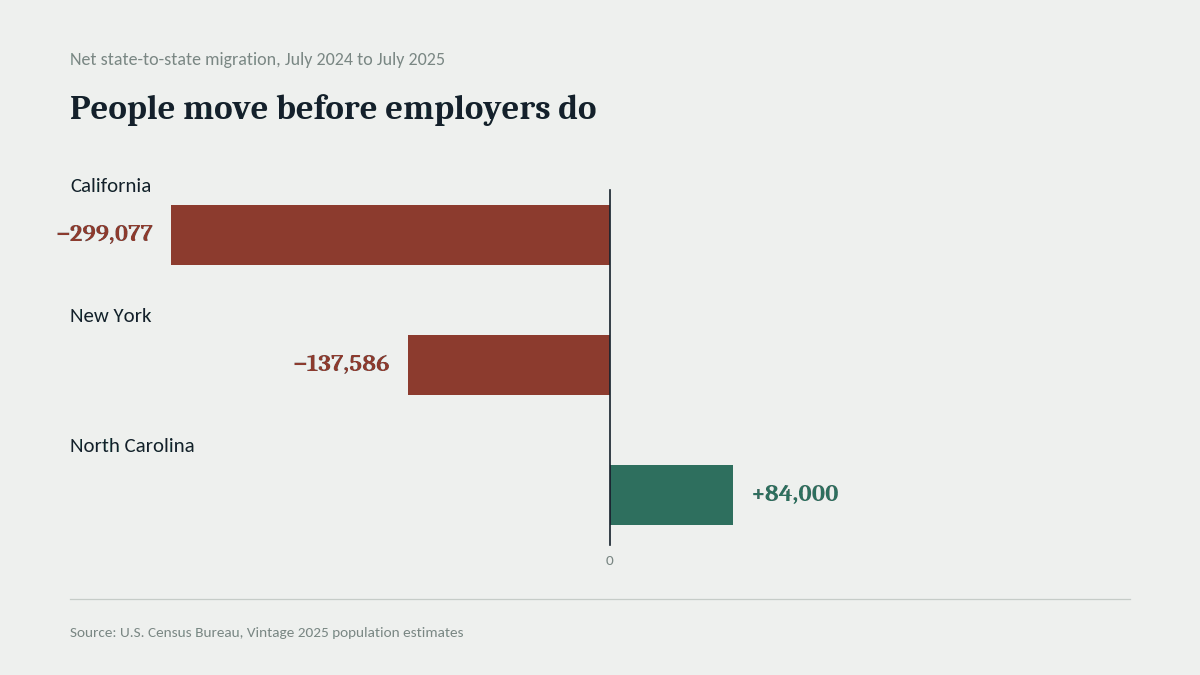
North Carolina took in about 84,000 more residents from other US states than it sent away the largest net domestic migration gain in the country. California lost 299,077 people. New York lost 137,586.
That is the number everyone quotes. Here is the one nobody does: over roughly the same window the San Francisco Bay Area’s tech workforce shrank by 23,900 jobs, and Raleigh-Durham appeared nowhere on CBRE’s 2026 list of markets climbing fastest up the tech talent scorecard. Nashville, Jacksonville, Pittsburgh and Montreal did.
The North Carolina tech relocation trend is real, then, but it is not the story in the press release. Companies are largely not lifting headquarters and setting them down in Wake County. People move first, employers follow the payroll, and most tech hiring in the state is being done by banks, insurers, health systems and consultancies rather than by software companies.
That distinction decides whether your model works or quietly fails in year two. Read the north carolina tech relocation trend as a Bay Area-quality engineering org available at Triangle wage bands and you will underprice offers, miss on acceptance rates, and spend the savings on backfills. Read it as what the state actually is: a deep, non-tech-dominated talent market with a falling tax base and a 2.5x occupancy advantage and the math holds for a decade.
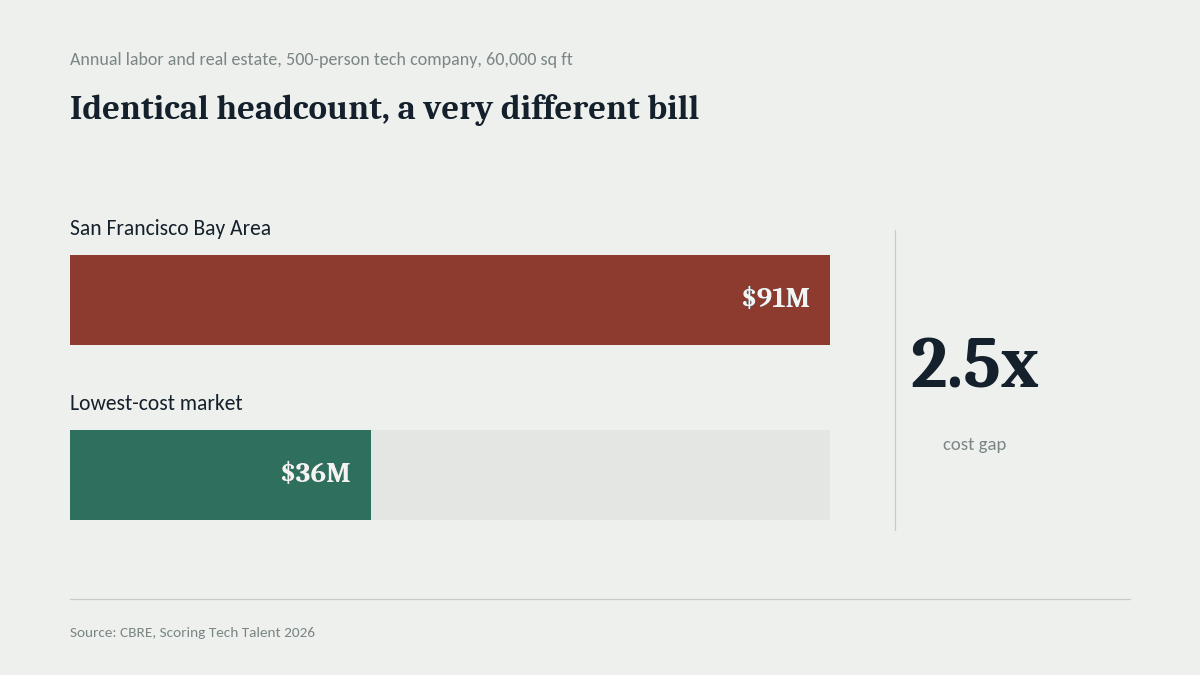
Total annual labor plus real estate cost for a typical 500-person tech company in 60,000 sq. ft. runs from roughly $36 million in the lowest-cost North American market to $91 million in the San Francisco Bay Area. Same headcount, same footprint, a 2.5x spread. The same report shows the tech industry accounting for a record 31% of all US job cuts through June 2026, up from 13% across all of 2025.
TL;DR
Written for the people who have to execute a southeast expansion: heads of engineering, talent leaders, and the finance partner who signs the site model. It covers what drives the North Carolina tech relocation trend, what a hub costs, how the state's incentives really pay, and when hiring remotely or offshore beats opening a building.
Hold onto the 2.5x figure. A 500-person engineering org costs about $91 million a year in labor and real estate in the Bay Area and roughly a third of that in the cheapest comparable markets. North Carolina's corporate income tax is legislated to hit zero by 2030. That gap is what everyone is chasing.
By the end you can price a Raleigh or Charlotte hub against three alternatives, spot the two failure patterns that kill these moves around month nine, and judge whether companies moving to north carolina are solving your problem or someone else's.
What is the North Carolina tech relocation trend?
The north carolina tech relocation trend is the sustained movement of technology headcount, engineering functions and corporate operations out of high-cost coastal metros into North Carolina chiefly the Research Triangle and Charlotte driven by labor cost differentials, a corporate income tax phasing to zero by 2030, and the largest state-to-state migration inflow in the United States.
Why tech companies relocate south, and where the model breaks
Finance approves this in one meeting. Wages are lower, rent is lower, the tax rate is falling, and talent shows up because everyone is already moving there. All four are true. The failures live in second-order effects.
Take tax first, the cleanest input. North Carolina’s corporate income tax rate is 2% for tax years beginning in 2026, falls to 1% in 2028, and reaches 0% from 2030 under the phase-out enacted in the 2021 state budget. The flat individual rate dropped to 3.99% in 2026 and is triggered to 3.49% in 2027 and 2.99% in 2028. No other state is currently legislating a full corporate income tax elimination.
Lower wage bands are the harder input, because they only lower cost per unit of output if you can hire the same calibre of engineer at the local band. Three things go wrong:
- You are not the highest bidder for local senior talent. The largest-volume tech hirers in the Triangle have repeatedly been non-tech employers, financial services firms, consultancies, IT services companies and they pay against their comp philosophy, not yours.
- Relocating staff price the move wrong. Acceptance holds right up until the candidate prices housing near Research Triangle Park, at which point a nominal 15–20% cut against a Bay Area base stops feeling lateral.
- Savings arrive after the costs. Build-out, dual-running payroll and 6–12 months of reduced velocity all land in year one. Occupancy savings compound from year two.
The recurring pattern in southeast expansions: a business case assuming 12–18 month payback delivers 24–36 months, because the cost model treated headcount as fungible and the hiring plan treated the north carolina tech relocation trend as a smaller copy of the market being left.
How to actually evaluate the move: a seven-step sequence
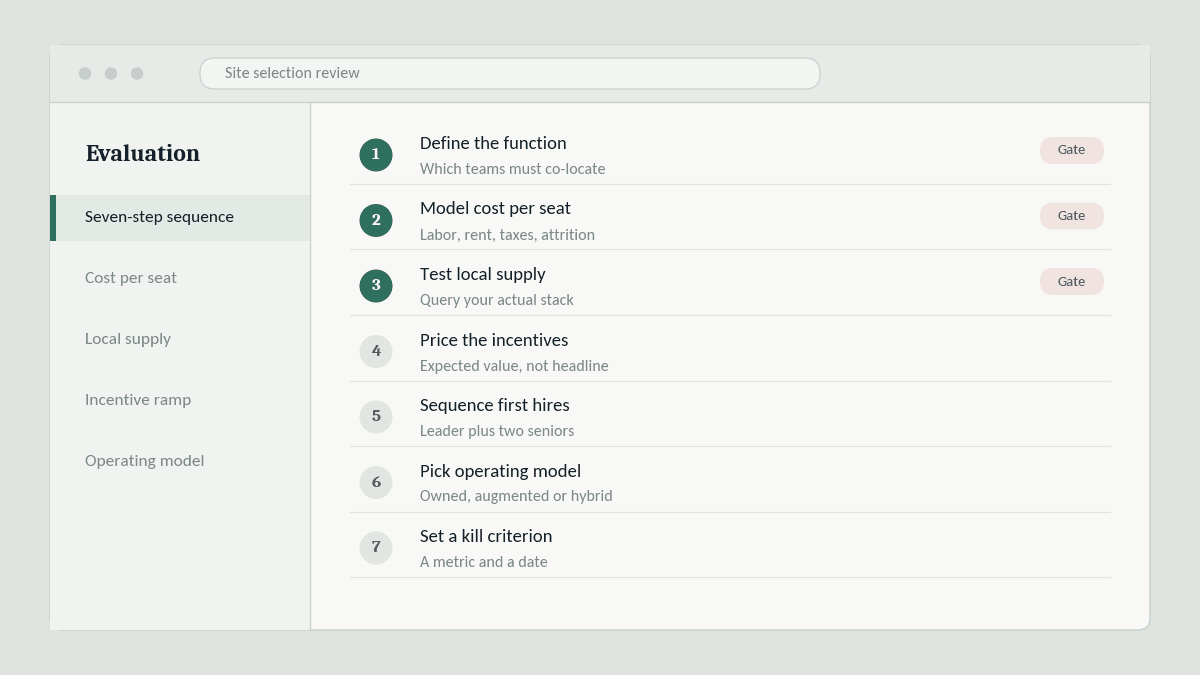
Most competing content on the North Carolina tech relocation trend stops at cost of living. What follows survives a CFO review, and the sequence matters: steps one to three disqualify a large share of candidate moves before anyone books a site tour.
- Define the function, not the location. Write down which teams must be co-located and why. Platform teams behave differently from product squads. If the answer is “collaboration,” you have not answered it.
- Model total annual cost per seat, not salary. Labor, real estate, employer taxes, attrition replacement. Benchmark against the published $36M–$91M band for a 500-person occupier so you know where you sit.
- Test local supply for your specific stack. Aggregate tech-talent counts are useless. Query the roles you will actually post: Kubernetes platform work, Databricks pipelines, embedded firmware, Salesforce, iOS. Depth varies enormously between Charlotte and Durham.
- Price incentives at expected value, not headline value. See the negotiation note below.
- Sequence the first twenty hires. Close the local leader and two senior engineers before signing a lease. If those three take over 90 days, the market is telling you something a lease will not fix.
- Pick the operating model. Wholly-owned site, staff augmentation, or a hybrid where a partner absorbs the first 12–24 months of hiring risk.
- Set a kill criterion. A named metric and a named date. Most moves have neither, which is why they drift.
Is Research Triangle Park still expanding?
Research Triangle Park remains the anchor: roughly 7,000 acres, hundreds of resident organisations, and a daily working population in the tens of thousands, fed by NC State, Duke and UNC Chapel Hill. The rtp expansion story is genuinely strong in life sciences and biomanufacturing, where multinationals have been onshoring production capacity.
Software is a different graph. The Triangle’s software engineering base is real but mid-sized, and its concentration inside the tech industry proper sits below Austin, Seattle and the Bay Area. No problem at all if you are a bank building a platform team. A serious constraint if you need forty engineers who have shipped consumer-scale distributed systems, this quarter.
Cost to open an engineering office in Raleigh vs the Bay Area
Three levers move at different speeds. Wages: average tech talent wages in the Triangle and Charlotte have historically run at roughly half to two-thirds of Bay Area levels, Charlotte the cheaper. Real estate: Triangle office and residential rent are a fraction of San Francisco’s, which is what makes relocation offers land at all. Tax: covered above, and it improves every two years without renegotiation.
Budget honestly for what does not get cheaper. Recruiting cycle time does not improve because you moved, and a cold employer brand lengthens it. Senior leadership hires cost roughly what they did on the coast, because that market is national. And the tech talent cost arbitrage underneath all of this narrows every year in-migration continues, as local bands converge upward.
What incentives does North Carolina offer tech companies?
The headline tool is the Job Development Investment Grant, a performance-based grant paid against actual personal income tax withholding from the jobs you create. Two implications get missed in board decks.
The grant pays on withholding, so hiring below your committed wage level shrinks the grant’s cash value even when job count is on target. Underpaying against a plan is not a saving. It is a direct reduction in incentive revenue.
Second, these agreements run long, are measured annually, and the state does reset them. In November 2025 North Carolina’s Economic Investment Committee granted Apple a four-year extension on its Research Triangle Park commitments, making 2027 the new “year one.” The enabling law required at least 1,000 existing employees in-state and no payments drawn, so most companies will never qualify. Negotiate a ramp you can actually hit, in the room, before signing.
North Carolina vs an offshore GCC for engineering headcount
For many teams the honest comparison is not Raleigh versus San Jose. It is Raleigh versus a global capability center in India, and the two buy different things. A domestic hub buys time-zone overlap, customer proximity, and easier handling of regulated or federal work. An offshore captive center buys a materially larger cost delta and deeper pools in specific disciplines: data engineering, QA automation, cloud infrastructure at scale.
What works in practice is a split. Keep roles that sit next to the customer or the compliance boundary inside the North Carolina tech relocation trend; push scaled delivery, the work you would hire cloud engineers for, and platform QA into a GCC. Teams that try to solve a headcount-cost problem purely with a domestic move usually end up doing both anyway, eighteen months later, having paid for the lease twice.
What this looks like in practice
The announcement-versus-hiring gap. Apple’s Research Triangle Park campus was announced in April 2021 as a $1 billion, 3,000-job commitment. Construction had still not begun when the company paused it in June 2024, and the state’s four-year reset in November 2025 moved the first measured hiring year to 2027, with an opening requirement of 126 positions. Apple meanwhile added roughly 600 people in the Raleigh area in leased space. Anyone modelling local wage inflation for the north carolina tech relocation trend off announced job counts has the wrong input: the campus is a real estate decision, the 600 hires are the labor market signal.
Who is actually hiring the engineers? Lists of the largest tech hirers in North Carolina and Raleigh-Durham have been dominated by non-tech companies: financial services, insurance, IT services, consulting. CBRE’s 2026 data makes the same point differently in Charlotte, 28% of all tech talent works in the finance, insurance and real estate sector, the highest concentration among the 50 ranked markets. Competing for a senior Java or data platform hire there means competing with a bank.
Across our own recruitment process outsourcing and IT staffing engagements 527+ IT projects delivered, a 98% candidate joining rate, and a job-description-to-shortlist cycle of 7–10 working days the consistent finding on US hub builds is that the constraint is almost never the size of the local talent pool. It is how many people in that pool have solved your specific problem at your scale and are not already inside one of five large local employers.
Decision framework: four routes to the headcount
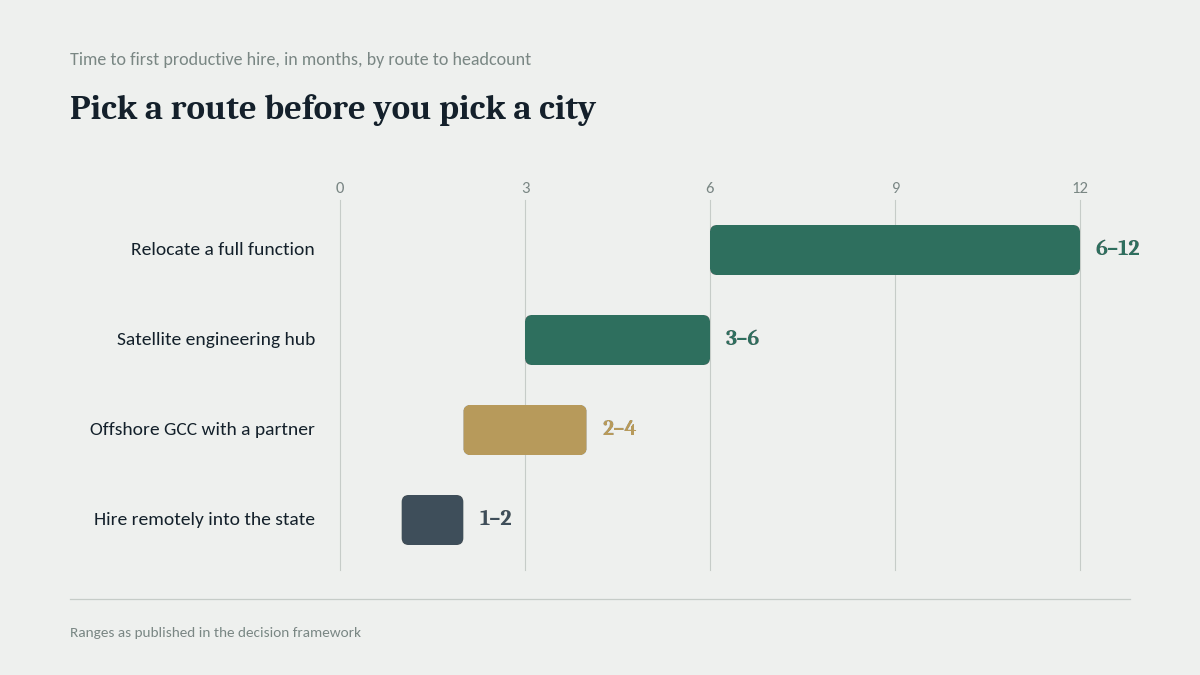
Pick a route before you pick a city. Each of these is a legitimate way to buy into the North Carolina tech relocation trend, or to decide against it. The failure-mode column is the one worth arguing about internally.
| Route | Best when | Time to first productive hire | Main cost lever | Biggest failure mode |
| Relocate a full function to NC | 200+ roles, five-year horizon, executives willing to move | 6–12 months | Occupancy plus corporate tax to 0% by 2030 | Incentive ramp missed in year 2–3; comp bands set too low |
| Satellite engineering hub (Triangle or Charlotte) | 20–80 engineers, need US time-zone overlap | 3–6 months | Wage differential vs coastal metros | Cold employer brand; first three hires take 2x as long as planned |
| Stay put, hire remotely into NC | Roles are individually contributable; comp policy is location-agnostic | 4–8 weeks | No real estate cost at all | Multi-state payroll and nexus complexity; no local leadership bench |
| Offshore GCC in India | Scaled delivery, data, QA or infrastructure depth | 8–16 weeks with a partner; 6–9 months standalone | Largest total cost delta | Run as a cost center instead of an owned capability |
What most teams get wrong
North Carolina is not winning tech relocations from tech companies. It is winning tech functions from non-tech companies. The state’s largest tech hirers are banks, insurers, consultancies and IT services firms, and in Charlotte 28% of tech talent sits inside the finance sector. Model comp, employer brand and competitive set against that, not against a Bay Area software peer group.
Two further patterns, from engagements rather than reports.
The first is a red flag we now check in week one: a relocation plan where the local hiring manager has not been hired yet. When the plan is “we will fly people down for panels until we find a site lead,” expect the first cohort to take twice as long and skew junior. Senior local candidates read the absence of a resident leader accurately, as a site head office might close.
The second friction surfaces around month four. Dedicated development teams spanning a new US hub and an existing coastal one fail on decision rights, not time zones. If the new site does not own a service end to end within two quarters, its best hires start interviewing. The fix is architectural rather than cultural: give the hub a bounded domain and its own on-call rotation on day one.
One macro caveat belongs on every nc tech growth slide, because the north carolina tech relocation trend sits inside a contracting national market. US tech talent employment grew just 1.8% in 2025 against 7.3% at the 2022 peak, AI-related roles now make up 31% of open tech postings, and non-AI postings have fallen roughly 60% nationally. A rising local population does not guarantee rising demand for the roles you are hiring.
Before you sign the lease
The most expensive assumption in any North Carolina tech relocation trend model is the one nobody tests: that the local market holds enough people who have solved your specific problem at your scale. Rent, tax and migration are public data. That is not.
Supersourcing has run technical searches of this kind including hire data scientists-class mandates across 527+ IT projects, and built dedicated teams and GCCs for Swiggy, Paytm, Razorpay, Chargebee and Apollo Hospitals. If you want that assumption stress-tested against live sourcing data before committing to a lease or an incentive agreement, that is a short conversation rather than a pitch.
Reach the team at mayank@engineerbabu.com or via supersourcing.com/contact-us. Bring your target metro, your top three role profiles and your intended start date. We will tell you what the market will actually give you in 30 days.
FAQ
Why are tech companies relocating to North Carolina?
Three inputs compound: a labor and occupancy base that can run near a third of the Bay Area’s for an equivalent 500-person footprint, a corporate income tax falling to 0% by 2030, and the strongest in-migration of any US state. Talent arrives ahead of employers, which lowers the execution risk of the move.
How long does it take to hire engineers in North Carolina?
For mid-level roles in common stacks, a well-run process reaches an interview-ready shortlist in 7–10 working days and closes in 4–8 weeks. Senior and niche roles staff-level platform, ML, embedded run 8–14 weeks, because for those candidates you are competing nationally rather than locally.
Is Charlotte or the Triangle better for a tech hub?
Charlotte if the problem is financial services engineering, data platform work, or lower wage bands; its tech workforce is heavily concentrated in banking and insurance. The Triangle if you need research-adjacent talent, life sciences software, or proximity to the NC State, Duke and UNC pipeline. Both beat coastal cost structures.
Do North Carolina’s tech incentives actually pay out?
The main grant is performance-based and paid against real payroll withholding, so it pays only as you hire and only in proportion to what you pay. Miss ramp targets and disbursement is reduced or withheld. Extensions happen, but the statutory conditions are narrow. Treat the headline figure as a ceiling, never a forecast.
Should we relocate or just hire remotely into the state?
Under about twenty people with a location-agnostic comp policy, hire remotely and skip the lease you will be productive in weeks rather than quarters. Cross to a physical site when you need co-located ownership of a service, or when hiring local leadership becomes a prerequisite rather than a nice-to-have.
How does a North Carolina hub compare with a GCC in India?
A domestic hub buys time-zone overlap and regulatory proximity. An offshore global in-house center buys a bigger cost delta and deeper pools for data, QA and infrastructure at scale. Most organisations past 100 engineers run both. Deciding that deliberately at the start costs far less than discovering it in year two.
What is the fastest way to pressure-test a North Carolina tech relocation trend business case?
Run a live sourcing test before committing capital. Post three real requisitions for your actual stack in the target metro and measure qualified applicant flow, comp expectations and time-to-shortlist across 30 days. Real market response beats any published index, including the ones cited above.
