

Sixty-three percent of Global Capability Centers report difficulty proving strategic value to headquarters within the first 24 months, even when cost targets are met. That single number should worry anyone who thinks a GCC succeeds simply because it launched on schedule and under budget.
Most conversations about why GCCs fail focus on the pre-launch mistakes picking the wrong city, underestimating real estate, and misjudging the talent market. Those problems are real, but they are not the ones that quietly kill a center in its second or third year. The centers that shut down rarely fail because of a bad launch. They fail because of what happens after the ribbon-cutting, when the operating model is supposed to mature and instead starts to erode.
India’s Global Capability Center (GCC) model is undergoing a major shift from cost efficiency to capability-driven growth, but that transition is not without challenges. Recent insights highlight that rising demand for AI and specialized talent is putting pressure on hiring pipelines, slowing down scalability for many GCCs. As competition intensifies, companies are finding it harder to maintain performance momentum beyond the initial setup phase. India’s GCC shift toward AI talent and capability-driven growth underscores why many centers struggle to sustain long-term value, making post-launch strategy and talent planning critical to success.
This piece is not about pre-launch planning. It is a post-mortem on GCC failure reasons that surface after the center is already operational leadership churn, scope creep, headquarters disengagement, and KPI drift and a practical framework for catching them before they become a GCC shutdown decision.
Understanding why GCCs fail after a clean launch requires looking past the metrics everyone tracks in year one. Cost variance and SLA adherence are lagging indicators of a launch plan executed well; they say almost nothing about whether the operating model underneath the center is built to survive its second and third years. That distinction is the entire premise of this piece.
What Is GCC Underperformance?
GCC underperformance is the gap between the operational output a Global Capability Center delivers and the strategic value its parent organization expects when funding the center. It shows up as stalled headcount growth, repeated escalations from business units, missed transformation milestones, or a center that is functioning but never asked to do more.
Understanding this gap is the first step toward answering why GCCs fail even when every launch-phase target was hit on schedule.
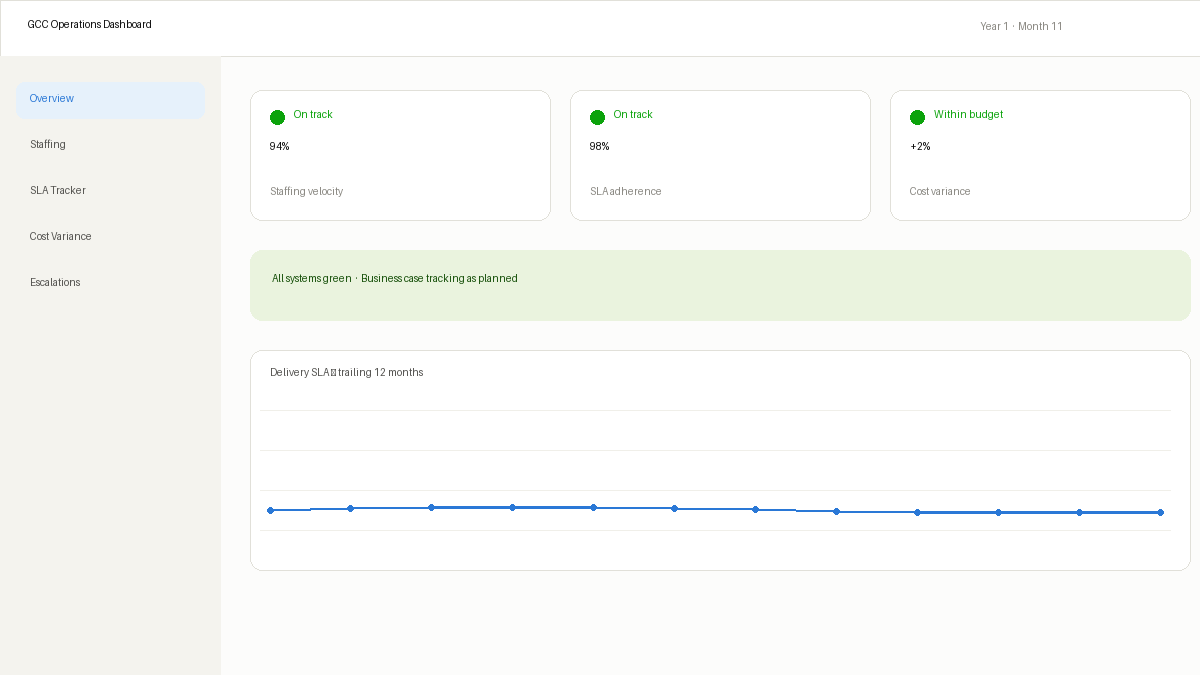
The Core Problem: Year One Success Doesn’t Predict Year Three Survival
Most GCCs clear their first 12 months without major incident. IT Staffing ramps on schedule, delivery SLAs are met, and the cost-arbitrage case looks exactly as promised in the original business case. Most teams underestimate how much harder year two is by 3–4x compared to year one, because year one is a staffing and infrastructure problem while year two is a governance and trust problem.
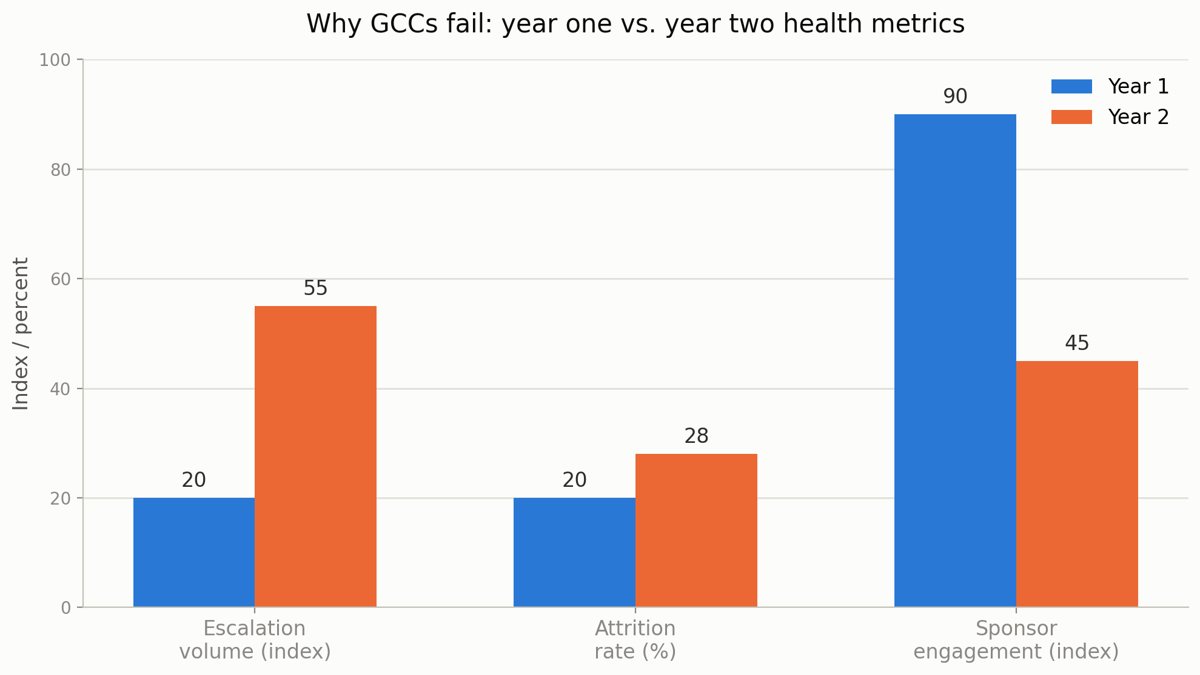
By month 18 to 24, three things typically happen at once. First, the founding leadership team often exposes or transplants who set up the center rotates out, taking institutional context with them. Second, business units at headquarters that sponsored the center’s original mandate shift priorities, leaving the GCC executing against a scope nobody re-validated. Third, the center’s KPIs, set during the pitch phase, no longer match what the business actually needs, but nobody owns updating them.
Data from India’s own GCC market bears this out. More than 1,700 GCCs now operate in the country, and industry trackers report over 25 shutdowns in a single year as centers fail to reinvent themselves beyond commoditized work. The pattern is consistent enough to name: centers that survive launch but fail to evolve past a cost-center identity are the ones most likely to face a GCC shutdown India decision within 36 months.
There is also a timing problem baked into how most parent organizations budget for GCCs. The original business case typically funds 18 to 24 months of runway, with a review baked in around that mark. If the center has not visibly matured beyond its launch-phase mandate by then, that review becomes the moment leadership starts asking why GCCs fail to graduate from cost arbitrage to genuine capability and the answer, in most cases, has been building quietly for a year already.
A second, less-discussed driver behind why GCCs fail after year one is talent-market pressure rather than internal dysfunction. Attrition among mid- to senior-level technology and data roles inside Indian GCCs runs 20–30% annually, well above the broader industry’s 15–25% benchmark, because more than 1,600 centers are now competing for the same specialized talent pool. A center that loses its senior bench to a competing GCC every 12 to 18 months is fighting an uphill battle regardless of how well governance is structured, which is why retention strategy has to sit inside the same course-correction plan as leadership succession.
Deep Dive: The Five Failure Patterns and How to Course-Correct Each
This is the operational core of common GCC problems after launching the patterns that show up repeatedly across sectors, center sizes, and geographies. Each pattern below answers a piece of why GCCs fail on its own, but in practice they compound: leadership churn accelerates scope creep, scope creep accelerates attrition, and attrition gives headquarters one more reason to disengage.
Pattern 1: Leadership Churn Without a Succession Plan
The single highest-correlation factor with post-launch GCC struggles is leadership turnover in the first 18 months. When the founding center head leaves typically for a role back at headquarters or a competing GCC institutional knowledge about why decisions were made leaves with them.
Course-correct: Build a two-deep leadership bench from month one, not month twelve. Document the rationale behind staffing ratios, vendor choices, and governance structures in a living charter, not just a launch deck. Budget ₹40–60 lakhs annually for a dedicated deputy or COO-level role whose entire job is continuity, even before the center needs one.
Pattern 2: Scope Creep Without Renegotiated Resourcing
A GCC launches to handle a defined set of functions, say, application support and Tier-1 finance operations. Eighteen months later, the same headcount is also running data engineering, a chunk of product QA, and ad hoc analytics requests from three different business units, none of which came with additional budget or headcount.
Course-correct: Every new function added to a GCC’s mandate should trigger a formal resourcing review, not a quiet absorption into existing capacity. A quarterly scope audit comparing current activity against the original charter catches this before it becomes a retention crisis.
Pattern 3: Headquarters Disengagement
Centers that were high-visibility during the launch phase, with monthly steering committee calls and executive sponsors, often see that attention drop to a quarterly check-in by year two. Without active sponsorship, the GCC becomes invisible until something breaks, at which point the conversation is about cutting losses rather than course-correcting.
Course-correct: Formalize a rotating executive sponsorship model that survives individual sponsor turnover. Tie sponsor engagement to a scorecard reviewed at the board level, not just the GCC’s internal leadership.
Pattern 4: KPI Drift and Governance Failure
KPIs set during the business case phase usually cost savings and SLA adherence rarely evolve to capture the strategic contributions a mature GCC should be making, like process innovation, IP generation, or product co-creation. When the only metrics tracked are the ones from the original pitch, a center that has genuinely matured still looks stagnant on paper.
Course-correct: Introduce a maturity-based KPI framework:
- Year 1 KPIs: staffing velocity, SLA adherence, cost variance against the original business case.
- Year 2 KPIs: process ownership transferred from headquarters, attrition against a 15–25% industry benchmark, escalation volume trend.
- Year 3 KPIs: innovation output (patents, process IP, product contributions), cross-functional project ownership, unsolicited expansion requests from business units.
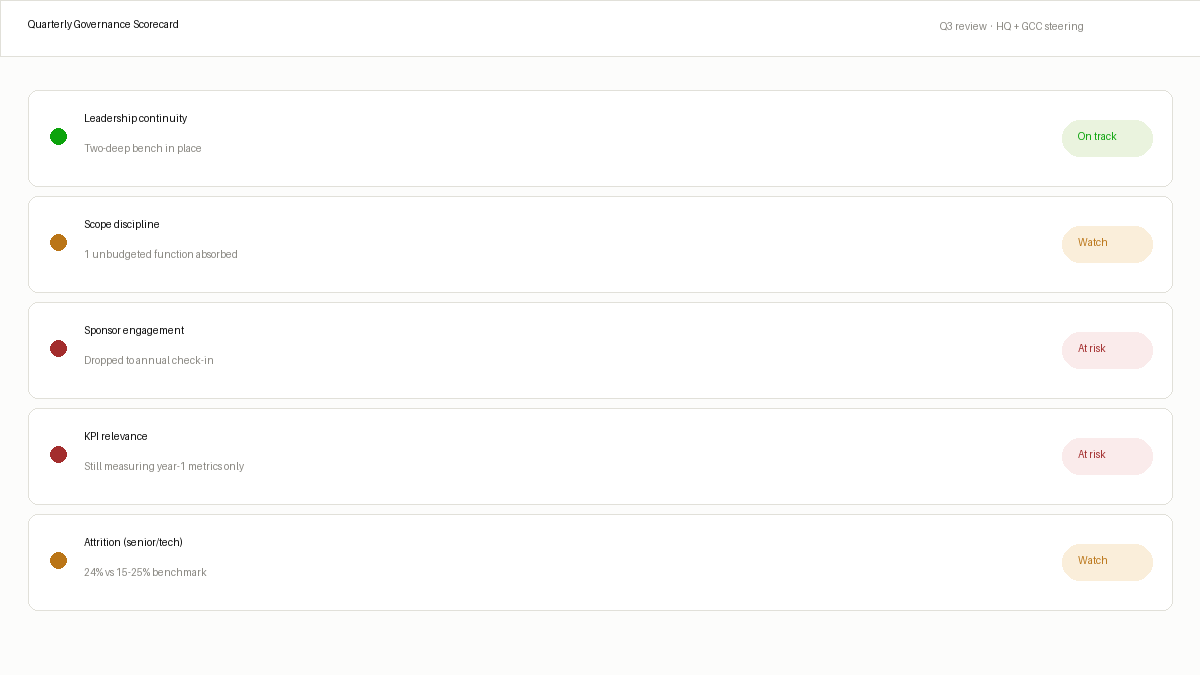
- Ongoing governance check: a joint HQ–GCC steering review every quarter, with a standing agenda item for scope, sponsorship, and leadership continuity, not just delivery metrics.
- Annual reset: a formal re-validation of the center’s charter against current business priorities, signed off by the original executive sponsor or their successor.
Pattern 5: Retention Strategy Treated as an Afterthought
Many centers build a hiring plan for launch and never build a retention plan for what comes after. Once the founding cohort’s growth trajectory flattens no new roles opening up because scope hasn’t expanded, the strongest performers leave for competing GCCs offering faster advancement, taking client-specific process knowledge with them.
Course-correct: Build a retention roadmap alongside the hiring plan, not after attrition spikes. Internal mobility across functions, visible career ladders tied to the maturity-based KPI framework below, and reskilling investment something roughly 70% of mature GCCs now budget for reducing the odds that this becomes another entry on the list of why GCCs fail to hold onto the talent they trained.
Underlying all five patterns is a governance model gap. Centers that build a formal escalation path, a documented decision-rights matrix, and a sourcing strategy that survives leadership turnover are the ones that avoid becoming a GCC shutdown headline three years in.
Case Studies: What Course-Correction Looks Like in Practice
A mid-size US insurance carrier’s Bengaluru center hit a wall at month 20 when its founding center head departed and business units began routing work around the GCC entirely. A restructured governance model with a documented decision-rights matrix and a rotating HQ sponsor restored business unit confidence within two quarters, and the center’s mandate expanded to include underwriting analytics within a year.
A European retail technology company’s Pune GCC absorbed three unbudgeted functions over 14 months without a resourcing review, driving attrition on the data engineering dedicated team to 34%. A quarterly scope audit, introduced after the fact, identified two functions that could be reassigned to a regional vendor, reducing attrition to 18% within three quarters and freeing capacity for the center’s original mandate.
A third example, a global manufacturing firm’s Hyderabad GCC illustrates why GCCs fail even when delivery metrics stay green. The center hit every SLA target through month 30, but headquarters sponsorship had quietly dropped from monthly to annual check-ins, and the center’s KPIs still reflected its original transactional mandate. A board-level scorecard tied to a rotating sponsor role restored visibility within two quarters, and the center avoided what internal reviews described as a near-certain scale-down decision.
Comparison: Reactive Fixes vs. Structural Course-Correction
| Approach | What It Addresses | Typical Timeline | Risk If Ignored |
| Ad hoc leadership backfill | Immediate coverage gap | 1–2 months | Institutional knowledge loss repeats |
| One-time scope negotiation | Current overload only | 1 quarter | Scope creep resumes within 6 months |
| KPI framework refresh | Metrics mismatch | 1–2 quarters | Center looks stagnant despite real progress |
| Structural governance model | Leadership, scope, sponsorship, KPIs together | 2–3 quarters | Center survives leadership and priority changes |
A structural governance model is the only approach on this list built to survive the next leadership change, not just the current one.
What Most Teams Get Wrong
Most parent organizations treat a GCC’s first-year success as proof the model works, then stop actively managing it. That is precisely backward. Year one measures execution. Year two and three measure governance and governance is the thing nobody budgeted for in the original business case.
The second mistake is treating leadership churn as an HR problem rather than a continuity risk to the entire operating model. A center that loses its founding leader without a documented charter is not one crisis away from failure; it is already in the early stages of one, whether or not anyone at headquarters has noticed yet.
The third mistake, and the most common one in our experience running this diagnostic across engagements, is assuming that a center delivering against its original KPIs is automatically healthy. Static KPIs measured against a static charter will always show green, right up until the business unit that funded the center stops calling.
Moving From Warning Signs to a Course-Correction Plan
A GCC that clears its first year has proven the model can work, not that it will keep working. The centers that avoid a shutdown decision are the ones where leadership continuity, scope discipline, sponsor engagement, and KPI relevance get the same active management as the original launch plan.
If you’re seeing any of these warning signs in a center you operate or oversee, and want to pressure-test the governance model before a leadership transition or budget review forces the issue, Supersourcing has run this diagnostic across multiple GCC engagements. Reach out at supersourcing.com/contact-us or write directly to mayank@engineerbabu.com to walk through where your center stands.
Frequently Asked Questions
Why do GCCs fail after the first year?
Most GCCs clear year one on staffing and delivery metrics alone. Failure in year two and beyond typically stems from leadership churn without succession planning, scope creep without renegotiated resourcing, headquarters disengagement, and KPIs that never evolved past the original business case.
What are the biggest warning signs of GCC failure?
Rising escalation volume from business units, attrition climbing past the 20–25% industry benchmark, a founding leader departing without a documented handover, and headcount growth that stalls despite stable delivery are the four clearest early indicators.
How long does it take for a GCC to become profitable?
Most centers hit cost-parity with the original business case within 12–18 months. Strategic value measured in process ownership, innovation output, or product contribution typically takes 24–36 months to materialize, if governance is actively managed.
Can an underperforming GCC be turned around?
Yes, in most cases. A structural governance model addressing leadership continuity, scope discipline, sponsorship, and KPI relevance can reverse underperformance within two to three quarters, based on patterns observed across multiple engagements.
What causes leadership churn in Indian GCCs?
Founding center heads are frequently expats or headquarters transplants on defined rotations, or local leaders recruited by competing GCCs offering faster growth paths. Without a two-deep bench, their departure removes institutional knowledge along with the role.
How much does a failed GCC cost a company?
Beyond the sunk real estate and severance costs, a shut-down GCC typically represents 18–36 months of accumulated investment in hiring, training, and process transfer often in the range of ₹15–25 crore for a mid-size center, excluding brand and business-continuity impact.
Is GCC shutdown in India becoming more common?
Industry tracking shows a rising number of India-based center closures in the past year, concentrated among centers that never moved past commoditized, easily automated work. Centers that reinvest in higher-value mandates are markedly less represented among recent shutdowns.
