

The number most companies quote when they say “we saved 60% by hiring in India” is almost always wrong — not fabricated, just incomplete. They’re comparing a US contractor’s fully-loaded rate against a raw India base rate. When you add management overhead, rework cycles, timezone friction, and attrition cost, that 60% frequently becomes 30%. Sometimes less. I’ve seen it flip negative.
What makes this more misleading is how fast the underlying market has evolved. India isn’t just a low-cost destination anymore — it’s operating at global scale. India’s offshore tech hubs hit $98.4 billion in revenue in FY2026, with global companies increasingly moving high-value engineering, R&D, and product work into Indian teams. That shift changes what you’re actually paying for — and what “cheap” really means in 2026.
I’ve been building software products for 14 years. Supersourcing has helped over 500 companies — from early-stage fintech startups to enterprise digital transformation programs at companies like Brillio — hire and retain engineering talent in India. The single question I get more than any other: what should I actually be paying?
This guide is my honest answer. Not a rate card. A breakdown of what drives the number, what the market really looks like in 2026, and where most companies leak money without realizing it.
India Software Developer Hourly Rate: The Real 2026 Range
India software developer hourly rate refers to the billing rate charged by Indian software engineers or the firms that employ them — ranging from approximately $12/hr for entry-level contract roles to $80+/hr for senior architects at premium IT services firms. The wide range isn’t noisy. It reflects genuine skill, experience, and delivery reliability differences.
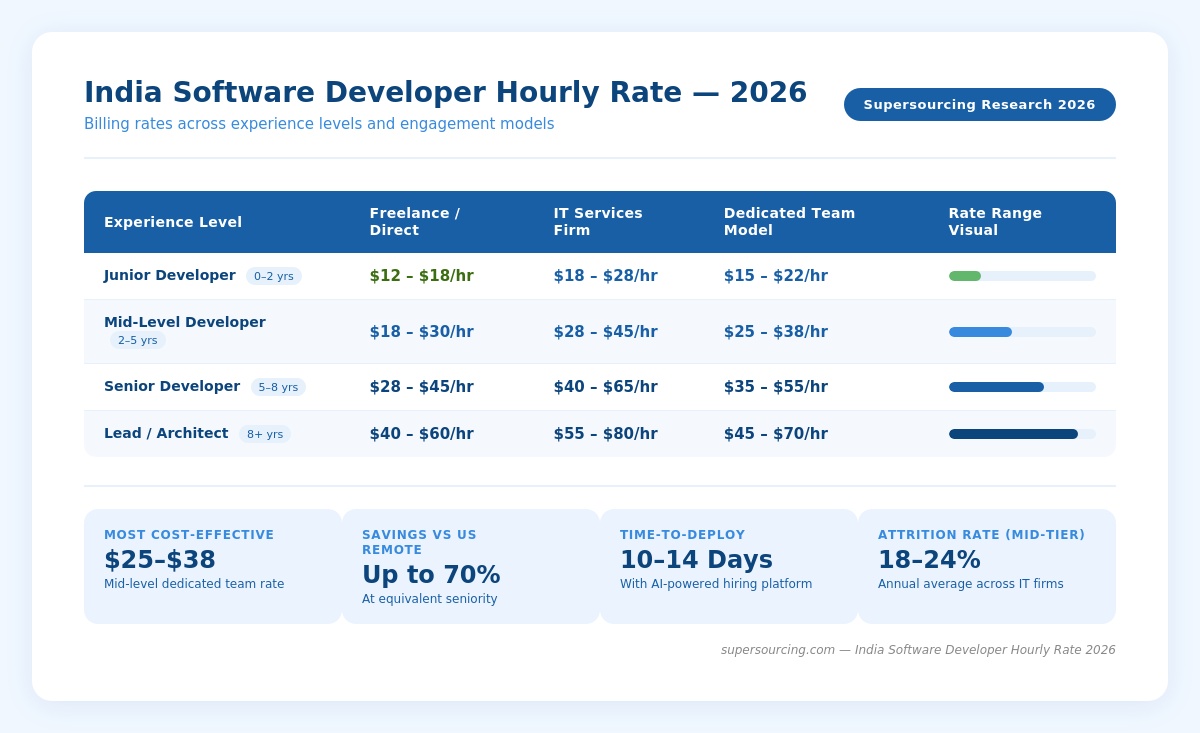
Here’s what the market actually looks like right now:
| Experience Level | Freelance / Direct | IT Services Firm | Dedicated Team Model |
| Junior (0–2 yrs) | $12–$18/hr | $18–$28/hr | $15–$22/hr |
| Mid-level (2–5 yrs) | $18–$30/hr | $28–$45/hr | $25–$38/hr |
| Senior (5–8 yrs) | $28–$45/hr | $40–$65/hr | $35–$55/hr |
| Lead / Architect (8+ yrs) | $40–$60/hr | $55–$80/hr | $45–$70/hr |
These are billing rates — what you pay, not what the developer takes home. The markup structure between those two numbers is where a lot of the variance lives, and I’ll get into that.
 What Drives the Hourly Rate Up (And Down)
 What Drives the Hourly Rate Up (And Down)
The most common mistake I see is treating India developer rates as a commodity pricing problem. Pick the lowest number that seems credible. This thinking costs companies more than they save.
- Technology stack specificity is the single largest driver of rate variance. A React developer and a Rust systems programmer in Bangalore are both “software developers.” The second one is 2.5–3x more expensive — and genuinely harder to find. When the Supersourcing team was building the fintech banking platform for Open Money, the core requirement wasn’t just good engineers. It was engineers who understood settlement rails, reconciliation logic, and RBI compliance — simultaneously. That combination is rare, and rare means expensive.
- Location within India still matters, though less than it did five years ago. Bangalore, Hyderabad, and Pune command the highest rates — 15–25% above Tier 2 cities like Jaipur, Indore, or Coimbatore. Post-pandemic remote normalization has compressed this gap, but it hasn’t eliminated it. Senior engineers in metro cities have more options, and that competition shows up in their rates.
- The engagement model changes the effective rate more than most people account for. A dedicated team model (where you have consistent team members working exclusively on your product) typically runs 10–20% higher than staff augmentation on paper, but delivers better output-per-dollar in most cases. The reason is simple: ramp time, context continuity, and attrition are all better managed.
- Urgency and specialization can push rates 30–40% above market. If you need 5 senior engineers in 3 weeks, you’re not hiring at standard rates. You’re paying for a firm’s existing bench and their ability to deploy fast. Supersourcing’s AI-powered hiring platform was built partly to solve this — reducing time-to-deploy for specialized roles from 6–8 weeks to 10–14 days. But even with better tooling, fast and specialized costs more.
The Hidden Costs That Never Show Up in the Hourly Rate Quote
I tell every founder I work with: multiply the quoted hourly rate by 1.3 to get the real cost. Here’s where that extra 30% goes.
- Ramp time is unbillable productivity loss. A new developer joining your product team takes 3–6 weeks to become net productive. You’re paying full rate during that window. On a $35/hr developer, that’s $5,000–$10,000 of cost that never shows up in any vendor comparison.
- Management overhead scales with team size. This one surprises people. A team of 3 offshore engineers requires roughly 5–7 hours per week of your team’s time for alignment — standups, async review, architecture calls, requirement clarifications. At a US engineering manager’s fully-loaded cost, that’s $2,000–$4,000/month of invisible cost.
- Attrition costs are real and frequent. Average attrition for software developers in India is 18–24% annually at most mid-tier IT firms. Every time a developer leaves your project, you absorb ramp time, knowledge transfer gaps, and a hiring lag. Dedicated team models have lower attrition because the engineers have a consistent engagement, but you have to negotiate this explicitly.
- Timezone-driven bug cycles. A bug raised at 4pm US time gets reviewed at 10am India time — 18 hours later in the worst case. For products in active development, this latency compounds. I’ve seen teams solve this with 2-hour daily overlap windows, which requires India-side developers to shift their hours — and some engineers charge a premium for consistent overlap hours.
Why the Same Rate Can Produce Wildly Different Outcomes
When Kargo.tech came to Supersourcing for product development and team scaling, they’d already spent six months with a previous vendor at a lower hourly rate. The output was technically running code that was architecturally unsalvageable — no test coverage, no documentation, tightly coupled components that made every new feature a crisis.
The hourly rate was $22. The true cost, after rebuilding, was closer to $85 per hour of useful output.
I’m not telling that story to make Supersourcing sound good. I’m telling it because the hiring and vetting process behind the rate is more important than the rate itself. Here’s what actually separates quality outcomes:
- Pre-screening depth is the first differentiator. Supersourcing’s AI-powered hiring platform runs technical assessments, code reviews, and behavioral evaluations before anyone meets a client. Most platforms list developers. Fewer actually vet them.
- Project context matching matters. A developer with 4 years of fintech experience is not interchangeable with a developer with 4 years of e-commerce experience, even at the same seniority level. The domain knowledge gap shows up within the first 2 weeks of a complex project.
- Communication calibration is chronically underweighted. English fluency, async communication discipline, and the ability to push back on bad requirements are not universal — they’re trained behaviors that some firms explicitly develop and others ignore entirely.
 How Engagement Structure Changes What You Pay
 How Engagement Structure Changes What You Pay
There are three primary models for hiring Indian software developers, and each has a different effective rate structure.
- Staff augmentation adds individual developers to your existing team. You pay per person, per hour, with minimal overhead from the vendor. Rates run $20–$60/hr depending on seniority and stack. This model works well when you have strong internal technical leadership. It falls apart when you don’t — developers without direction produce output, not results.
- Project-based / Fixed-price converts scope into a fixed cost. You’re not paying hourly — you’re paying for deliverables. This model sounds safer but typically prices in a 20–30% risk premium. If your requirements are well-defined and stable, you’re overpaying. If they’re fluid (and they usually are), you’re buying a change-order fight.
- A dedicated team model sits between the two. You hire a team — typically 3–8 people — that works exclusively on your product under your direction, but employed and managed by the vendor firm. Supersourcing’s dedicated teams for clients like Pennywise typically run $35–$55/hr per person, with no ramp fees and built-in attrition replacement. For product companies that need consistent velocity, this is usually the best cost structure.
The GCC (Global Capability Center) model is a fourth option — building your own captive engineering center in India rather than working through a vendor. Fully-loaded cost for a 20-person GCC in Bangalore runs ₹8–15 crore annually to establish, with 12–18 months before the center is operationally mature. Supersourcing has set up several of these. The economics make sense at 50+ engineers. Below that, you’re paying corporate overhead to have the same access you could get through a well-run dedicated team arrangement.
India vs. Other Outsourcing Destinations: Honest Rate Comparison
People ask me this constantly, especially as Eastern Europe and Latin America have matured as engineering markets.
| Location | Mid-Level Rate | Senior Rate | Timezone (vs US East) | Talent Pool Depth |
| India | $25–$45/hr | $40–$65/hr | +9:30 to +10:30 | Very Deep |
| Eastern Europe (Poland, Ukraine) | $35–$55/hr | $55–$80/hr | +6 to +7 | Deep |
| Latin America (Colombia, Brazil) | $30–$50/hr | $50–$75/hr | Same / +1–2 | Moderate-Deep |
| Southeast Asia (Philippines, Vietnam) | $20–$35/hr | $35–$55/hr | +12 to +13 | Moderate |
| US (Remote) | $80–$120/hr | $110–$160/hr | Same | Deep |
India still wins on talent pool size and depth — particularly for enterprise stacks (Java, SAP, Oracle), cloud-native architecture, and mobile development. The SAP and DevOps transformation work Supersourcing delivered for Brillio ran on a 40-person India-based team. That team depth simply isn’t replicable in most other markets at equivalent cost.
The timezone gap is real but manageable. I’ve seen it used as an excuse more than a genuine blocker. Teams that invest in async-first processes — detailed tickets, loom recordings for complex feedback, documented architecture decisions — overcome the timezone issue entirely.
 What Most Companies Get Wrong About India Developer Rates
 What Most Companies Get Wrong About India Developer Rates
Pattern I’ve seen across hundreds of hiring conversations: companies anchor on the rate and optimize for it. They’ll spend three weeks comparing $28/hr vs. $32/hr options and zero time evaluating the vetting process, the attrition history, or the project methodology of the vendor.
A $4/hr difference on a 3-person team over 6 months is $14,400. One month of unnecessary rebuild because of a misaligned hire costs more than that.
The other pattern: confusing cost arbitrage with value creation. Hiring in India is not just a cost reduction play. The best outcomes I’ve seen treat it as talent access — finding a senior architect with 10 years of fintech backend experience who doesn’t exist in your local market at any price, and building a long-term relationship with that person. That framing produces very different vendor selection decisions.
The third pattern: not accounting for what I call the “direction premium.” Indian developers — particularly at mid to senior levels — are technically excellent. Most are not trained to define scope, challenge requirements, or drive product decisions. If your engagement model requires the offshore team to operate with minimal direction, you’ll get output that is technically correct and directionally wrong. Building in technical leadership — either an internal product manager who owns the backlog or an experienced technical lead on the vendor side — is not optional. It’s the difference between a team that ships and a team that codes.
How to Evaluate a Developer Rate Quote
When a vendor sends you a rate card, here’s what I’d actually check:
- Ask for the vetting process in writing. What assessments do they run? What’s the rejection rate? A firm that hires 80% of applicants is not selective. Supersourcing’s platform rejects ~70% of engineers who apply before a client ever sees them.
- Request attrition data. What’s the 12-month retention rate on client-facing projects? Anything below 80% means you’re absorbing turnover cost.
- Understand the billing structure. Are you billed for holidays, sick leave, ramp time? Some firms bill full hours during developer leaves. Negotiate this upfront.
- Ask about the management layer. Who is accountable for delivery on the vendor side? A dedicated account manager is not a project manager. Find out who owns technical outcomes.
- Get references from similar-size projects. A vendor with great enterprise experience might struggle with a fast-moving 4-person startup team, and vice versa.
 FAQ: India Software Developer Hourly Rate
 FAQ: India Software Developer Hourly Rate
1. What is the average hourly rate for a software developer in India?
The average India software developer hourly rate in 2026 ranges from $15 to $65/hr depending on experience, technology stack, and engagement model. Mid-level developers with 3–5 years of experience typically bill at $25–$40/hr through IT Staffing firms, while freelance or direct-hire rates run slightly lower. Senior architects and specialized engineers command $50–$80/hr.
2. Why are Indian developer rates lower than US rates?
The difference reflects cost of living and labor market conditions, not skill gaps. A senior Java engineer in Bangalore earns 20–30% of what an equivalent engineer earns in San Francisco — but builds the same software. The salary arbitrage is real; the skill arbitrage narrative is not. Senior Indian engineers at product companies and tier-1 firms are globally competitive.
3. Is it cheaper to hire freelance developers in India or go through an agency?
Freelance rates are typically 20–30% lower per hour, but they carry hidden costs: no replacement guarantee if the developer leaves, no management layer, and significant coordination overhead on your side. For short, well-defined tasks, freelancers work. For ongoing product development, a dedicated team through a vetted firm almost always produces better cost-per-outcome.
4. How do India developer rates compare to Eastern Europe?
Eastern Europe (Poland, Romania, Ukraine) runs 15–30% higher than India for equivalent seniority. The timezone advantage for US East Coast teams is marginal — both require async discipline. India’s talent pool is significantly deeper, particularly for enterprise Java, cloud infrastructure, and mobile engineering.
5. What tech stacks command premium rates in India?
Blockchain, Rust, AI/ML infrastructure, and specialized fintech/regulatory engineering (RBI compliance, payment gateway integration, KYC/AML systems) consistently command 30–50% premiums above standard software development rates. Full-stack cloud-native architects with AWS/GCP certifications and DevOps experience also run above-average rates.
6. What’s the minimum team size that makes a dedicated team model cost-effective?
Dedicated teams make financial sense starting at 3 engineers. Below that, the overhead of managing a vendor relationship (alignment calls, onboarding, tooling access) erodes the model’s efficiency. For 1–2 developers, augmentation through a platform or direct freelance is usually more practical.
7. How should I structure contracts to control India developer costs?
Time-and-material contracts give you flexibility but reward slow output. Fixed-scope contracts create alignment on deliverables but price in risk premiums. The best structure I’ve seen for ongoing product development is a hybrid: a fixed monthly cost for the team (predictable) with a scope review every 4–6 weeks that defines the next milestone. This creates velocity incentives without fixed-price change-order fights.
If You’re Evaluating This Decision Right Now
Most people who find this article are at one of three points: they’ve gotten a rate quote that seems too low to be good or too high to justify, they’ve had a bad offshore experience and are trying to understand what went wrong, or they’re making this decision for the first time and trying to build a framework.
If any of those are you — and you want to talk through the specifics before you commit to a vendor — I’m usually the one who takes those calls at Supersourcing. Not a sales team. Me.
I’ll tell you honestly whether what you’re evaluating makes sense. If it does, great. If it doesn’t, I’ll tell you that too.
