

Three years ago, if you asked a CTO at a mid-size fintech company about Camunda, most would not have recognized the name. Today, Camunda is the fastest-growing business process management and process orchestration platform in the enterprise technology market — and the demand for experienced Camunda developers in India is outpacing supply by a significant margin.
The reason is simple. Legacy BPM platforms — Pega, IBM BPM, TIBCO — are expensive, complex, and increasingly difficult to integrate with modern cloud-native microservices architectures. Camunda is open-source, lightweight, developer-friendly, and built for the microservices era. It runs as an embedded process engine inside Java and Spring Boot applications (Camunda 7) or as a standalone cloud-native process orchestration platform (Camunda 8 / Camunda Platform SaaS) with a separate Zeebe workflow engine. It integrates with Kafka, REST APIs, and cloud-native infrastructure in ways that legacy BPM platforms cannot match.
This has made Camunda the platform of choice for a specific and growing buyer profile: financial services companies modernizing their loan origination, KYC, and claims processes; healthcare companies building patient care coordination workflows; logistics companies automating freight booking and customs clearance; and enterprise technology teams replacing legacy BPM installations that have become maintenance liabilities.
These buyers have real budgets, real program timelines, and a genuine shortage of Camunda-experienced developers to staff their programs. This guide covers how to hire Camunda developers in India — what depth actually looks like, what to pay, and how to avoid the most common mistakes.
TL;DR
Camunda is replacing legacy BPM tools fast — but experienced Camunda developers in India are scarce. Know the difference between Camunda 7 (Java/Spring Boot) and Camunda 8 (Zeebe/Kubernetes) — they're not interchangeable. Salaries range from ₹13L–₹42L for mid to senior profiles. Don't hire a Java dev and hope for the best — assess BPMN design skills, production debugging, and integration experience explicitly.
What Is Camunda and Why Does It Require Specialist Assessment
Camunda is an open-source Business Process Management (BPM) and workflow automation platform built around the BPMN 2.0 (Business Process Model and Notation) standard. Its core capability is allowing engineering teams to model business processes visually using BPMN diagrams and execute those processes as code — with full visibility into each process instance’s state, history, and performance metrics.
There are two major versions in active use, and they require different technical skills:
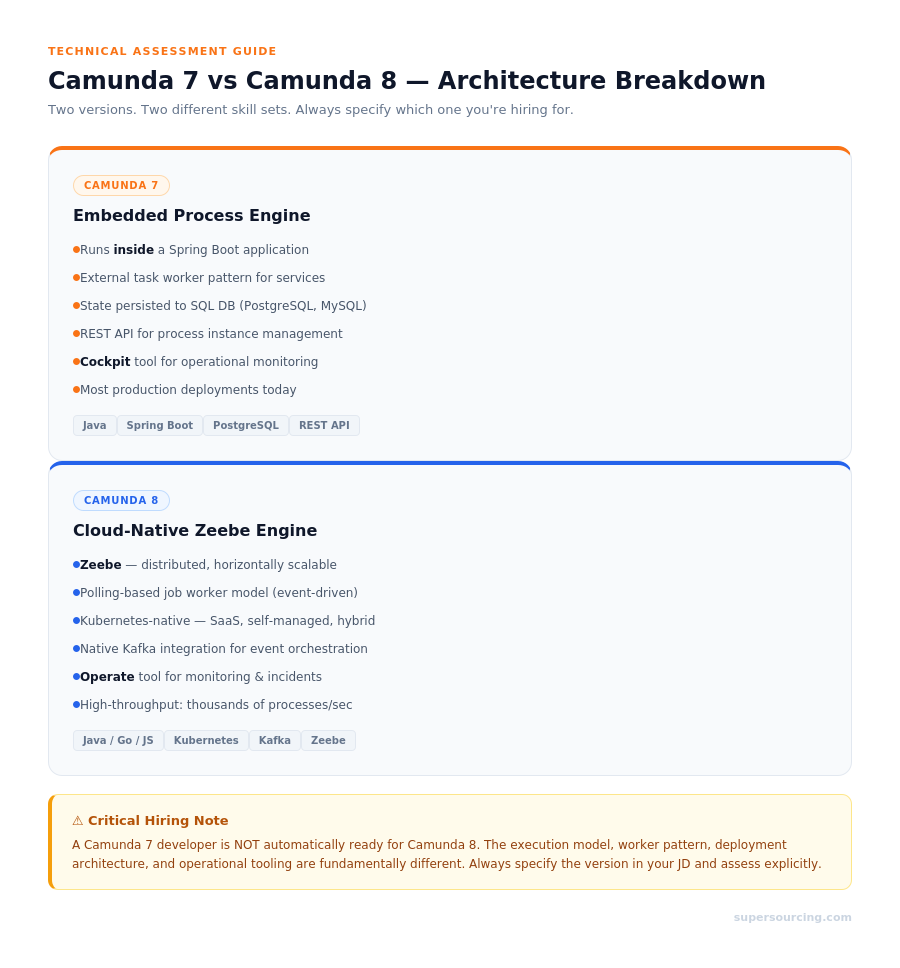
Camunda 7 is the embedded process engine — a Java library that runs inside an application and manages process execution within the application’s own runtime. Camunda 7 is deployed inside Spring Boot applications, uses REST APIs for external system interaction, and persists process state to a relational database (PostgreSQL, MySQL, Oracle). Most organizations currently running Camunda in production are on Camunda 7. Camunda 7 developers need Java development skills, Spring Boot integration knowledge, BPMN 2.0 process design, and experience with Camunda’s API for querying and managing process instances.
Camunda 8 (also known as Camunda Platform 8) is the cloud-native successor — built around the Zeebe workflow engine, which is a horizontally scalable, distributed workflow engine designed for high-throughput process orchestration. Zeebe processes communicate with service workers through a message broker rather than direct API calls — a fundamentally different execution model from Camunda 7. Camunda 8 runs on Kubernetes and is available as SaaS (Camunda 8 SaaS), self-managed, or hybrid. Camunda 8 developers need Java or Go or JavaScript development skills for Zeebe job worker implementation, understanding of Camunda 8’s event-driven architecture, Kafka integration knowledge, and Kubernetes deployment experience for self-managed installations.
The BPMN 2.0 standard is the common foundation — but a developer who knows Camunda 7 is not automatically ready for Camunda 8 without specific transition assessment. The execution model, the worker pattern, the scalability architecture, and the deployment model are all different.
Why Fintech and BFSI Are Driving Camunda Demand
The BFSI use case for Camunda is specific and compelling. Loan origination processes — credit bureau checks, document verification, KYC, underwriting decision, disbursement instruction — are naturally modelled as multi-step processes with parallel branches, human task assignments, timer events for SLA enforcement, and external system integrations. These are exactly the scenarios Camunda’s BPMN engine handles well.
For a fintech company building a lending platform, Camunda provides: full process state visibility (which step every loan application is at, in real time); SLA timer enforcement (escalate if the underwriting step has been pending more than 4 hours); human task management (assign document verification tasks to the ops team queue); and compensation transactions (if disbursement fails, trigger a reversal workflow). Building this capability without a process orchestration engine requires either a complex custom state machine implementation or a legacy BPM platform.
Camunda has specifically positioned against Pega for the mid-market fintech buyer — lower licensing cost (open-source core), easier integration with modern Java and Node.js applications, and a developer-first design philosophy that makes engineering teams significantly more productive than they are on Pega.
This positioning is working. Fintechs across India, the UK, Europe, the Middle East, and Southeast Asia are actively replacing legacy BPM or building new process orchestration capabilities on Camunda. The demand for Camunda developers from these buyers is real, growing, and significantly underserved by the current talent supply.
The Camunda Talent Market in India: Current Reality
Camunda talent in India is genuinely scarce relative to demand. The platform is younger than Pega and SAP and does not yet have the large SI practice ecosystem that creates training pipelines for enterprise platform skills. Most experienced Camunda developers in India built their skills through hands-on project work — there is no established certification path equivalent to Pega’s CSSA or SAP’s module certifications.
The talent that exists is concentrated in Java and Spring Boot development communities who picked up Camunda through project work. Mid-level and senior developers with 3+ years of real Camunda implementation experience — people who have designed BPMN process models for real enterprise workflows, built Spring Boot Camunda applications with external task workers, and debugged process instance issues in production — are a small pool actively competed for.
| Level | Experience | Annual CTC (INR) |
| Junior Camunda Developer | 1–3 years | ₹7L – ₹13L |
| Mid-Level Camunda Developer | 3–6 years | ₹13L – ₹24L |
| Senior Camunda Developer | 6–9 years | ₹24L – ₹42L |
| Camunda Architect / Tech Lead | 9–13 years | ₹40L – ₹65L |
| Camunda Practice Lead / Principal | 13+ years | ₹60L – ₹85L |
For contract and staff augmentation rates, Supersourcing researches the India market rate for your specific Camunda version (7 vs 8), domain context (fintech vs BFSI vs healthcare vs logistics), and seniority level — custom quote within 24 hours of receiving the JD.
What to Actually Assess in a Camunda Developer Interview
BPMN 2.0 process design quality — not just tool familiarity. BPMN 2.0 is a rich modeling standard with specific constructs for different process scenarios — service tasks, user tasks, send/receive tasks for message correlation, timer events for SLA enforcement, error boundary events for exception handling, compensation events for transactional rollback, sub-processes for organizational hierarchy, and parallel/exclusive gateways for branching logic. A developer who uses only a subset of these constructs — defaulting to service tasks and exclusive gateways for everything — is not using BPMN correctly. Ask the candidate to model a specific multi-step process — loan origination with parallel credit checks, a timer-based escalation if underwriting takes more than 2 hours, and a compensation path if disbursement fails. How they approach this reveals real BPMN depth versus surface familiarity.
Camunda 7 vs Camunda 8 depth — assessed for the version you are using. If your program is on Camunda 7, assess Spring Boot embedded engine integration, external task worker patterns, process variable management, and REST API usage for process instance management. If your program is on Camunda 8, assess Zeebe job worker design, message correlation patterns for long-running processes, Kafka integration for event-driven process orchestration, and the distinction between polling-based and push-based worker architectures. Do not assume that version-agnostic BPMN knowledge transfers to either platform without explicit assessment.
Process instance debugging and operational monitoring. Production Camunda implementations create incidents — process instances that stall at a step because an external service returned an error, timer events that did not fire because of a configuration issue, message correlation failures that leave process instances waiting indefinitely. A developer who cannot describe how they would use Camunda’s Operate tool (Camunda 8) or Cockpit tool (Camunda 7) to identify stalled instances, resolve incidents, and restart process steps has not managed a Camunda implementation in production.
Integration design — how external systems connect to Camunda. Camunda process models are the orchestrators — the actual business logic lives in external service workers that Camunda calls. The design of these integration points — how service tasks call external APIs, how error handling in external services propagates back into the Camunda process as BPMN errors versus technical incidents, how message correlation works for asynchronous processes where responses arrive out of order — determines the reliability and maintainability of the implementation. Ask the candidate to walk through how they designed a specific external system integration and how they handled failure scenarios.
Performance and scalability design for high-volume processes. For BFSI and fintech buyers processing thousands of loan applications or transactions per day, Camunda performance is not theoretical. Ask about process variable optimization — minimizing the size of process variables stored in the engine to prevent performance degradation, using local variables versus global process variables correctly, designing process models that avoid unnecessary waiting states. For Camunda 8, ask about Zeebe partition configuration and horizontal scaling design for high-throughput scenarios.
The 3 Most Common Camunda Hiring Mistakes
Hiring Java developers and assuming they can learn Camunda on the job. Camunda is Java-friendly — it runs in a Spring Boot application and uses a Java API. This leads many hiring managers to assume that any strong Java developer can pick up Camunda quickly. The BPMN modeling discipline, the process engine lifecycle management, the operational monitoring mindset, and the specific Camunda API patterns for external tasks, message correlation, and signal events are not obvious from Java experience alone. A Java developer picking up Camunda on a production implementation will make the same mistakes a developer learning any new platform on the job makes — the kind that create technical debt you find six months later.
Not distinguishing between Camunda 7 and Camunda 8 when screening. The two versions have different architectures, different worker models, and different operational tooling. A developer who has worked exclusively on Camunda 7 embedded engine implementations will need specific assessment and potentially significant ramp-up time before they can contribute effectively on a Camunda 8 Zeebe-based platform. Specify the version in the JD and assess for it explicitly.
Underinvesting in BPMN process design skills versus development skills. Camunda implementations fail most commonly not at the Java development level but at the BPMN process design level — processes that are technically executable but operationally unmaintainable, processes that use compensating transactions incorrectly, processes that have no error handling at the boundary event level. The most valuable Camunda team members are those who can both model BPMN processes correctly for complex business scenarios and implement the Java workers that execute those processes. Both skills need to be assessed.
How Supersourcing Sources and Vets Camunda Developers
Our senior process orchestration architects assess every Camunda developer shortlist personally. We evaluate BPMN 2.0 process design quality, Camunda 7 versus Camunda 8 platform depth, production operational experience including incident management and process debugging, integration design for external service workers, and performance optimization thinking for high-volume scenarios.
For BFSI and fintech buyers, we also assess domain knowledge alignment — whether the developer understands lending process flows, KYC requirements, financial transaction compensation patterns, and the regulatory context for process audit trail requirements.
We maintain a continuously vetted bench of Camunda developers — a smaller pool than mainstream enterprise platform skills, but assessed to a higher standard. That is why the shortlist lands in 48 hours rather than the 8–12 weeks a standard job posting produces for a specialized profile like this.
For clients who want independent validation, we arrange optional Barraiser or interview.io technical interviews. We coordinate scheduling — zero effort on your side.
5,000+ engineers placed. 8% attrition against 22% industry average. 98% joining rate. 14-day free replacement clause on every engagement.
FAQ
1. What is the difference between Camunda 7 and Camunda 8 for hiring?
Camunda 7 is an embedded Java process engine — it runs inside a Spring Boot application, uses an external task pattern for service worker integration, and persists process state to a relational database. Camunda 8 uses the Zeebe distributed workflow engine — it runs as a separate process orchestration service, uses a polling-based job worker model, is designed for horizontal scalability on Kubernetes, and integrates natively with Kafka for event-driven architectures. The two require different technical skills and should be specified explicitly in the JD.
2. Does Camunda have official certifications for developers?
Camunda offers training and some certification programs, but there is no established certification path comparable to Pega CSSA or SAP module certification. Assessment of real Camunda depth relies on technical interview scenarios — BPMN process modeling, integration design, and production operations experience — rather than certification verification.
3. What industries is Camunda most commonly used in?
Financial services (loan origination, KYC, claims, trade finance), insurance (underwriting, claims), healthcare (patient care coordination, prior authorization), logistics (order management, freight booking), and government (permit processing, benefit administration). The common thread is multi-step, long-running processes with parallel tasks, human decisions, SLA requirements, and external system integrations.
4. Can Camunda replace Pega for mid-market enterprises?
For many mid-market enterprises, yes. Camunda is open-source at the process engine level — eliminating Pega’s licensing costs. Its developer-first design integrates more naturally with Java/Spring Boot microservices architectures. Where Pega adds significant value beyond Camunda is in its CRM capabilities (Pega Customer Service, Pega Sales Automation), its decisioning engine (NBA), and its pre-built industry frameworks. If your requirement is primarily process orchestration and workflow automation rather than CRM, Camunda is frequently the better technical and commercial choice.
5. What is your replacement policy for Camunda developer hires?
Free replacement within 14 days on every engagement. No charge, no questions.
6. Do I need a legal entity in India?
No. We act as Employer of Record — payroll, PF, ESIC, TDS, employment contracts, and all statutory compliance handled by us.
7. What is the realistic hiring timeline for a senior Camunda developer in India without Supersourcing?
8–12 weeks through a standard job posting for a developer with 5+ years real Camunda experience. The talent pool is smaller than mainstream enterprise platform skills and mostly passive. Through Supersourcing: 48-hour shortlist, hire within 7 days.
8. Can you place Camunda developers who also understand Kafka integration for event-driven process orchestration?
Yes. Camunda 8 with Kafka integration for event-driven process orchestration is an increasingly common requirement. We assess Kafka integration depth alongside Camunda 8 Zeebe expertise for roles where event-driven architecture is part of the design. If this is a primary requirement, specify it in the JD brief and we will assess for both.
Talk to Us About Your Camunda Requirement
If you are building a process orchestration capability in India on Camunda — whether it is a single senior developer for an augmentation program, a full fintech lending workflow team, or a long-term process engineering capability in your GCC — I am usually the one on those calls.
Email: mayank@supersourcing.com Or book a meeting directly at supersourcing.com
Tell us your Camunda version (7 or 8), your process domain (lending, KYC, claims, logistics), your team composition, and what production-readiness means for your program. Shortlist in 48 hours from there.
No retainer until you hire. Replacement clause on every engagement.
Mayank Pratap Singh · Co-founder, Supersourcing Google AI Accelerator · LinkedIn Top 20 Startups India · 5,000+ Engineers Placed · 1,000+ Companies · 17 Fortune 500s
