

There is a moment in every enterprise digital transformation program when someone asks: do we build this workflow custom, or do we buy a platform? For a growing number of government agencies, financial services firms, healthcare systems, and large enterprises — the answer is Appian.
Appian is the enterprise low-code BPM platform that sits at an interesting intersection — powerful enough for complex process orchestration, fast enough to deliver in weeks rather than months, and governable enough to meet the compliance requirements of regulated industries. The US Department of Defense runs Appian. Major US banks run Appian for loan origination and compliance workflows. Healthcare systems use Appian for prior authorization and care management. Insurance companies use it for claims and underwriting.
India is increasingly where Appian programs are being delivered. The platform’s growth has driven Accenture, Deloitte, Cognizant, and Infosys to build Appian practices. GCCs at financial services and government-adjacent enterprises are hiring Appian developers in India to build and maintain process applications that would have been built custom two years ago.
The challenge is the same as every specialized enterprise platform: the talent pool is smaller than the mainstream development pool, the variance in depth is enormous, and the combination of Appian technical skills plus process design domain knowledge plus the target industry context is genuinely hard to find. This guide covers how to hire Appian developers in India correctly.
What Is Appian and Why It Requires More Than Low-Code Skills
Appian’s marketing emphasizes its low-code nature — the visual drag-and-drop development model, the speed of delivery. This creates a hiring misconception: that Appian development is simple, and therefore any reasonably skilled developer can be trained on it quickly.
That misconception is expensive. Appian’s low-code interface abstracts implementation complexity — it does not eliminate it. The design decisions that determine whether an Appian application performs at scale, whether it is maintainable by a team, and whether it meets the security and compliance requirements of a regulated industry are architectural decisions. Low-code surfaces make bad architectural decisions faster and cheaper to make — which is why poorly designed Appian applications are easy to build and genuinely difficult to fix.
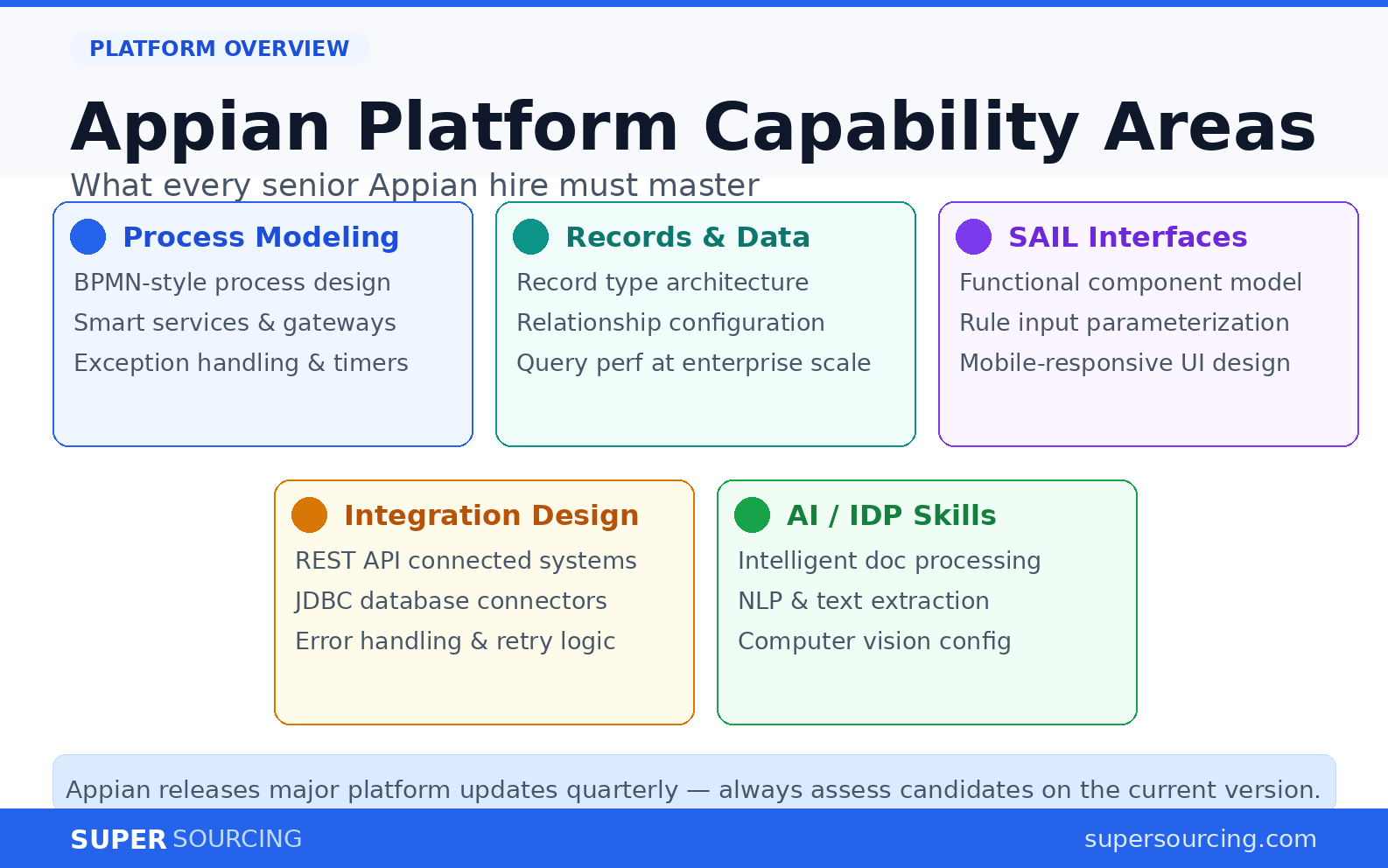
Appian’s platform has several major capability areas that require specific expertise.
Process modeling using Appian’s process designer — BPMN-adjacent but Appian-specific. Process model design covers node configuration (smart services, activity nodes, gateways), process variable management, exception handling design, and the correct use of Appian’s subprocess and event node patterns for complex enterprise workflows.
Records — Appian’s data layer for surfacing and managing structured data in process applications. Record type design, record list and summary view configuration, relationship configuration between record types, and the performance implications of record queries at enterprise data volumes are all design decisions that require depth to get right.
Interfaces — Appian’s UI layer for building forms, dashboards, and process-driven user experiences. Interface design in Appian uses a functional component model — SAIL (Sailpoint Application Interface Language — actually Appian’s own interface language). Developers who do not understand component reuse, rule input design for parameterization, and the rendering performance implications of complex interface hierarchies will build Appian UIs that are slow to load and hard to modify.
Connected systems and integrations — how Appian connects to external data sources, REST APIs, JDBC databases, and robotic process automation robots. Integration design in Appian requires understanding connected system configuration, HTTP connected systems for REST APIs, expression rules for data transformation, and the RPA integration model for attended and unattended robot invocation.
AI and intelligent document processing — Appian has increasingly integrated AI capabilities: intelligent document processing using Appian’s AI skill for document extraction, computer vision models for image classification, and natural language processing for text extraction from unstructured documents. Appian developers who understand these AI capabilities and can configure AI skills within process workflows represent a growing and valuable specialization.
The Appian Talent Market in India: What You Are Competing For
Appian developer demand in India has grown significantly in the last three years as US government contractors, financial services firms, and healthcare organizations have expanded their Appian programs and moved delivery to India-based teams.
The platform’s community is smaller than Salesforce or SAP — which means experienced Appian developers are a genuinely scarce pool. Certified Appian developers (Appian Certified Associate Developer, Appian Certified Senior Developer, and Appian Certified Lead Developer) with 4+ years of real implementation experience are actively competed for by the major SIs running government and financial services Appian programs.
| Level | Experience | Annual CTC (INR) |
| Appian Associate Developer | 1–3 years | ₹6L – ₹12L |
| Appian Mid-Level Developer | 3–6 years | ₹12L – ₹22L |
| Appian Senior Developer | 6–9 years | ₹22L – ₹38L |
| Appian Lead Developer / Architect | 9–13 years | ₹36L – ₹60L |
| Appian Practice Lead / Principal | 13+ years | ₹55L – ₹80L |
Contract and staff augmentation rates are customized to your Appian version, application complexity, domain context (government vs BFSI vs healthcare), and seniority level. Supersourcing sends a custom quote within 24 hours of receiving the JD.
What to Actually Assess in an Appian Developer Interview
Process model design quality — not just the ability to drag nodes onto a canvas. Ask the candidate to design a multi-step approval workflow with exception handling — a procurement approval process where a request above a certain threshold requires a second level of approval, where any approver can reject with comments triggering a rework loop, and where the process automatically escalates if no action is taken within 24 hours. How they approach the process model — node selection, exception handling, timer events, variable management — reveals whether they understand Appian process architecture or just its surface.
Records architecture for data-intensive applications. For applications managing significant data volumes, Records are a critical design element. Ask about the candidate’s approach to record type design — how they handle many-to-many relationships between record types, how they use record filters for role-based data visibility, and how they optimize record list queries for performance at scale. Developers who have only built small-data Appian applications will struggle with the record architecture design requirements of large enterprise programs.
Interface design and component reuse strategy. Appian interfaces can become maintenance nightmares if not designed with reuse in mind. Ask the candidate to explain how they structure their interface hierarchy for a multi-step process form — how they design shared rule inputs for parameterized components, how they manage interface-level constants for configurable values, and how they approach responsive design for mobile-accessible process applications.
Integration design — REST APIs, JDBC, and RPA robots. Real enterprise Appian applications integrate with multiple external systems. Ask the candidate to walk through an integration they have designed — how they configured the connected system, how they designed the integration rule for data transformation, how they handled error states when the external system was unavailable, and how they tested integration reliability before go-live.
Government and regulated industry domain awareness for the relevant buyer profile. Many Appian buyers are government agencies or financial services firms with specific process governance requirements — ITAR compliance for defense contractors, FedRAMP authorization for US government cloud deployments, SOC 2 compliance for financial services. Appian developers working in these environments need at least awareness of these compliance frameworks and their implications for application design.
Appian version currency. Appian releases significant platform updates frequently. Ask candidates which Appian version they have most recently worked on and what capability changes they are aware of from recent releases. Developers who are more than 2 major versions behind the current release may have gaps in their knowledge of current platform patterns — particularly the ongoing evolution of Appian AI skills and the Appian intelligent document processing capabilities.
Where Appian Is Being Used — and What That Means for Hiring
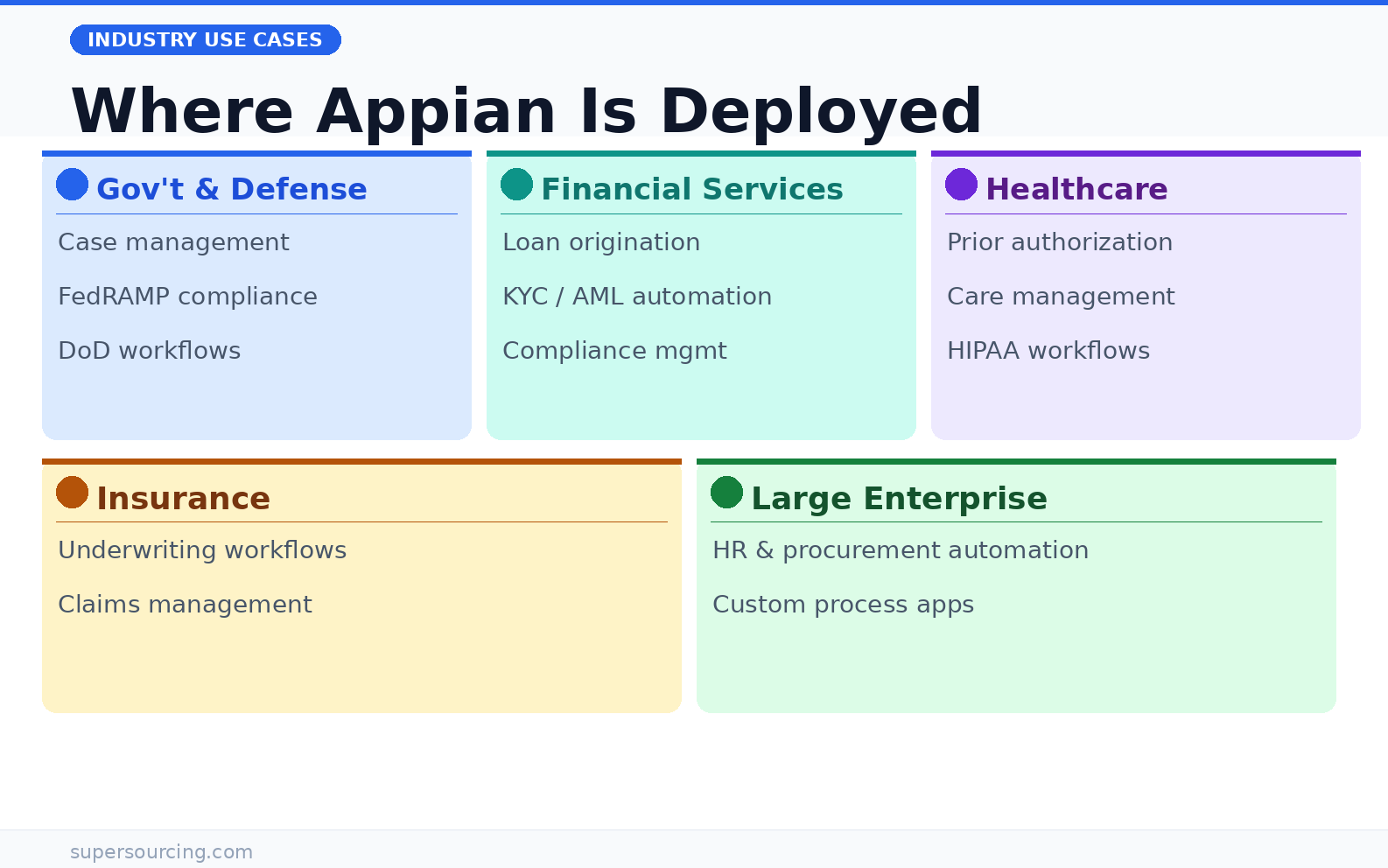
US Government and Defense Contractors. Appian has a strong position in the US federal government — used by the US Army, DoD components, and multiple civilian agencies for case management, compliance tracking, and operational workflow automation. India-based delivery teams supporting US government Appian programs often require security clearance awareness, FedRAMP cloud deployment understanding, and experience with government-specific process governance requirements.
Financial Services — Compliance and Loan Operations. Banks and financial services firms use Appian for loan origination workflows, compliance case management, KYC and AML process automation, and regulatory reporting workflows. Appian developers for BFSI buyers need awareness of the compliance context — how audit trails are designed, how process evidence is captured for regulatory examination, and how Appian’s security model is configured for financial data.
Healthcare — Prior Authorization and Care Management. Healthcare payers and providers use Appian for prior authorization workflows, care management coordination, and clinical operations case management. Healthcare Appian developers need awareness of HIPAA requirements for PHI handling within process applications and the clinical workflow context that determines how processes are designed.
Insurance — Underwriting and Claims. Insurance companies use Appian as an alternative to or alongside Guidewire for underwriting workflow orchestration and claims management support processes. Developers need insurance domain awareness — underwriting decision processes, claims adjuster workflows, and regulatory filing requirements.
 The 3 Most Common Appian Hiring Mistakes
 The 3 Most Common Appian Hiring Mistakes
Hiring based on low-code platform experience rather than Appian-specific depth. Appian’s interface language (SAIL), its process modeling patterns, its Records data layer, and its connected system integration model are all Appian-specific. A developer with ServiceNow, Mendix, or OutSystems experience has adjacent skills — they are not Appian developers. Appian-specific assessment is mandatory.
Not assessing process design discipline alongside development skills. Appian’s value is realized in the quality of the business process models it executes. A developer who can build technically functional Appian applications but designs process models that are brittle, unmaintainable, or incorrect for the business process creates long-term maintenance problems. Process design judgment must be assessed alongside technical implementation skills.
Underestimating the domain knowledge requirement for regulated industry programs. Appian developers working on US government, financial services, or healthcare programs need awareness of the compliance and regulatory frameworks governing those industries. A technically strong Appian developer without this context will make design decisions that create compliance gaps — and those gaps are expensive to find and fix.
How Supersourcing Sources and Vets Appian Developers
Our senior process architecture team assesses every Appian developer shortlist. We evaluate process model design quality, Records architecture, SAIL interface design and component reuse strategy, integration design for connected systems and RPA, AI skill configuration for intelligent document processing, and domain knowledge alignment for government, BFSI, or healthcare buyers.
We maintain a continuously vetted bench of Appian developers across all certification levels — Associate, Senior, and Lead — and across the domain contexts where Appian is most commonly deployed. Shortlist in 48 hours. 14-day free replacement on every engagement.
Optional independent technical interviews through Barraiser or interview.io — arranged by us, zero coordination effort on your side.
FAQ
1. What Appian certifications should I require?
Appian Certified Associate Developer for mid-level roles. Appian Certified Senior Developer for senior implementation leads. Appian Certified Lead Developer for architects and practice leads. Certifications validate training completion and basic platform knowledge — they are a filter, not a substitute for real implementation scenario assessment.
2. Can Appian developers also handle Appian RPA?
Appian acquired Novayre (now Appian RPA) and has integrated robotic process automation into the platform. Appian RPA configuration is a separate skill from core Appian process development — not all Appian developers have RPA experience. If RPA automation is part of your program, specify it explicitly in the JD and we will assess for it.
3. What is the difference between Appian and Camunda for hiring?
Appian is a full low-code platform — it provides process engine, data layer, UI builder, and integration tools in one integrated platform. Camunda is a process engine and orchestration tool that requires development teams to build the application layer around it. Appian suits buyers who want a complete application platform. Camunda suits developer-led teams who want a process engine integrated into their own application architecture.
4. Can someone outside Supersourcing technically interview the Appian candidate?
Yes. We arrange Barraiser, interview.io, or a direct technical round with your own Appian lead. We handle scheduling — zero coordination effort on your side.
5. What is your replacement policy?
Free replacement within 14 days. No charge, no questions.
6. Do I need a legal entity in India?
No. We act as Employer of Record — payroll, PF, ESIC, TDS, all statutory compliance handled by us.
7. What is the realistic hiring timeline for a senior Appian developer in India without Supersourcing?
8–12 weeks through a standard job posting for a developer with 5+ years Appian experience and domain alignment. Through Supersourcing: 48-hour shortlist, hire within 7 days.
Talk to Us About Your Appian Requirement
If you are building an Appian team in India — government program, BFSI compliance workflow, healthcare care management, or insurance operations — I am usually the one on those calls.
Email: mayank@supersourcing.com Or book a meeting directly at supersourcing.com
Tell us your Appian version, application domain, certification requirements, and program phase. Shortlist in 48 hours from there.
No retainer until you hire. Replacement clause on every engagement.
Mayank Pratap Singh · Co-founder, Supersourcing Google AI Accelerator · LinkedIn Top 20 Startups India · 5,000+ Engineers Placed · 1,000+ Companies · 17 Fortune 500s
