

The $2.1M Mistake That Started This Guide
A $2.1M Sitecore modernization failure is not an edge case; it’s a recurring pattern in enterprise digital transformation projects. In 2026, migrating from legacy Sitecore XP to XM Cloud with headless architecture requires far more than certification-level knowledge; it demands real production experience with JSS, composable DXP, and SaaS-based integrations.
Hiring Sitecore Developers from India has become a strategic decision for global enterprises aiming to balance cost efficiency with deep technical capability. While India offers a large pool of Sitecore-certified developers, many lack hands-on experience with XM Cloud, headless delivery, and CDP integrations creating a critical gap between perceived and actual expertise.
The urgency is driven by market growth. According to Fortune Business Insights, the global digital experience platform (DXP) market is projected to reach $41.7 billion by 2030, with strong adoption accelerating through 2026 as enterprises shift to composable architectures: Digital Experience Platform Market Report
As enterprises invest heavily in modern DXP ecosystems, the real challenge is not access to developers but identifying those who can deliver production-ready Sitecore XM Cloud implementations without costly rework.
TL;DR 8 Answers Before You Read Further
| Question | Answer |
| What does a Senior Sitecore Developer cost from India? | $42–68/hr fully loaded. Section 6 has the full stack by level. |
| The fastest I can close 10 Sitecore developers? | 30–45 days with a pre-vetted bench. 70+ days sourcing cold at that volume. |
| Which Indian city has the deepest Sitecore talent? | Pune for XP legacy. Bangalore for XM Cloud and JSS headless. Mumbai for BFSI Sitecore programs specifically. |
| What certification actually matters in 2026? | Sitecore XM Cloud Developer certification active and version-current. XP 9 certs signal legacy-only experience. |
| What are Indian enterprises actually building on Sitecore right now? | BFSI portals, multi-brand manufacturing sites, hospitality digital platforms, and XM Cloud + Content Hub + CDP combinations. Section 5 covers this in full. |
| XM Cloud how many India developers actually know it in production? | Fewer than 800 developers in India have delivered production XM Cloud projects as of May 2026. Most "Sitecore developers" in India are XP 9.x or earlier. |
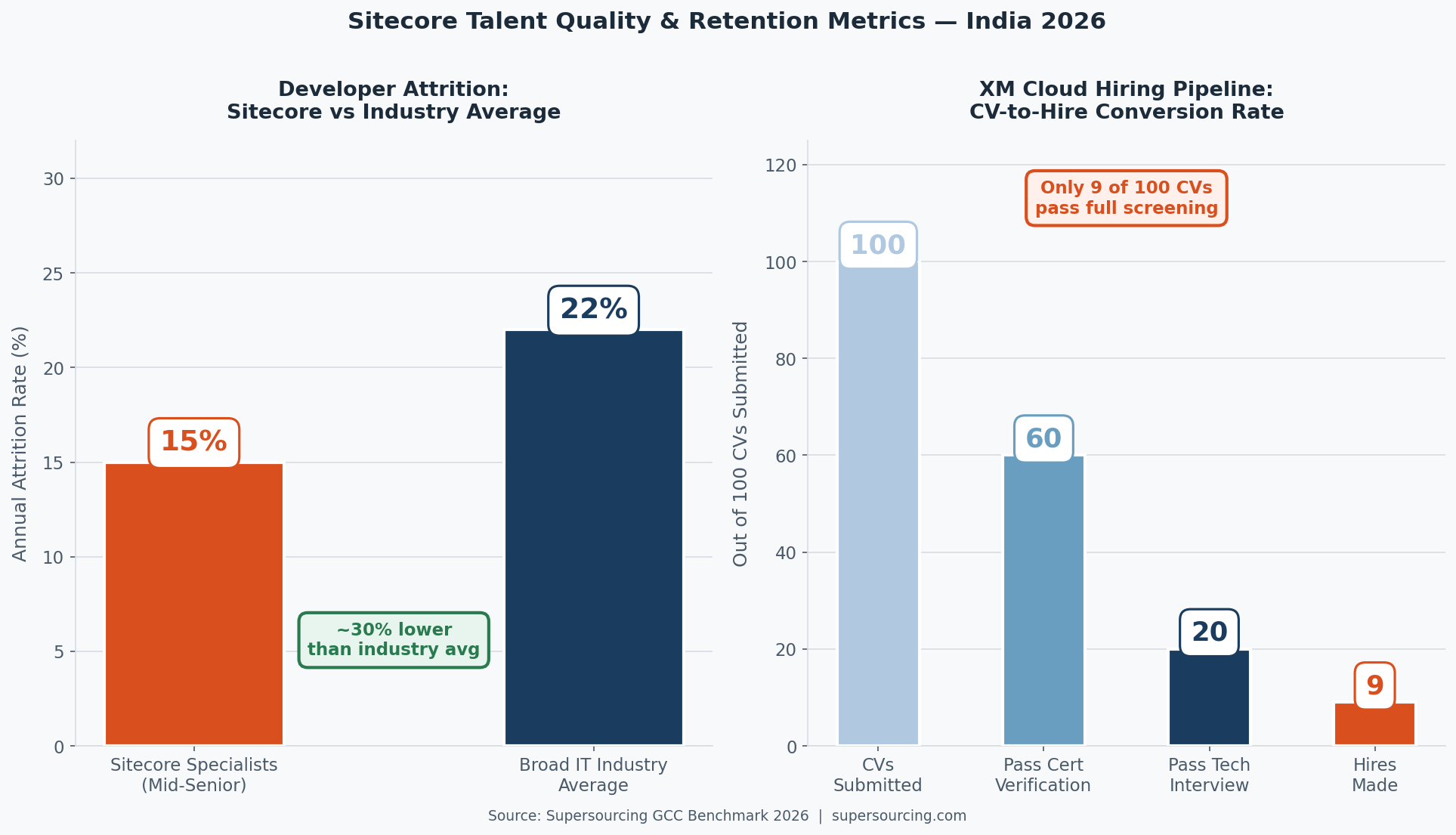
| What's typical attrition for Sitecore specialists in India? | 13–17% for mid-senior Sitecore developers. Below the 22% IT industry average the community is tight and options are fewer than full-stack generalists. |
| What's the single biggest hiring mistake for Sitecore programs? | Hiring for "Sitecore experience" without specifying XM Cloud vs XP version. The two are architecturally different platforms. Section 9 explains how to verify. |
Are You Actually Ready for This?
Sitecore engagements fail for buyer-readiness reasons more often than talent reasons. Score yourself before you evaluate a single vendor.
Score each: 0 (not in place), 2 (partially), 4 (done).
| # | Criterion | Score |
| 1 | Named Sitecore platform owner. One person. Not a digital committee. | 0/2/4 |
| 2 | Sitecore version decided XP on-premise, XM, or XM Cloud SaaS | 0/2/4 |
| 3 | Headless vs traditional delivery decided JSS/Next.js or MVC rendering | 0/2/4 |
| 4 | Content Hub strategy defined standalone or integrated with XM Cloud | 0/2/4 |
| 5 | CDP and personalisation strategy confirmed Sitecore CDP, third-party, or none | 0/2/4 |
| 6 | Multisite architecture documented how many sites, languages, regions | 0/2/4 |
| 7 | Interview panel with hands-on Sitecore experience available within 5 business days | 0/2/4 |
| 8 | Legal SLA under 15 days for MSA review | 0/2/4 |
| 9 | Dev/QA/Prod environment provisioned or roadmapped | 0/2/4 |
| 10 | CI/CD pipeline approach decided Sitecore CLI, containers, or traditional | 0/2/4 |
| 11 | KPIs defined: deployment frequency, page performance scores, personalisation lift | 0/2/4 |
| 12 | CISO signed off on Sitecore XM Cloud SaaS data residency requirements | 0/2/4 |
| 13 | Escalation path defined: vendor PM → your Digital Director → your CTO | 0/2/4 |
| 14 | IP ownership for custom Sitecore components and templates in MSA | 0/2/4 |
| 15 | Finance can process USD-denominated invoices within 30 days | 0/2/4 |
What your score means:
| Score | Tier | Reality Check |
| 48–60 | Scaler | You’re ready. This guide is a checklist. |
| 34–46 | Builder | 3–4 gaps. They’ll cost you the first 60 days. Fix before signing. |
| 20–32 | Explorer | Significant internal work needed. Don’t sign an MSA yet. |
| 0–18 | Pre-Stage | 90 days of internal work before a productive Sitecore offshore engagement. Start there. |
From the deal floor: A US-based insurance company with 5,000 employees, Sitecore XP 9.3 scored 22 on this checklist. Their Digital Director signed a 7-person SOW anyway. By month two the team discovered the client hadn’t decided between staying on XP or migrating to XM Cloud. The first six weeks of development were on a delivery model that was abandoned at the architecture review. Sunk cost: $140K in sprint work discarded. Readiness criterion 2 version decided would have surfaced in the kickoff call.
The Sitecore Talent Market in India 2026
Sitecore crossed $500M+ ARR in FY2024. The platform has 25 years of enterprise deployment history. India’s Sitecore talent pool reflects that history large at the legacy XP layer, thin at the modern XM Cloud and composable DXP layer.
The certified pool breakdown:
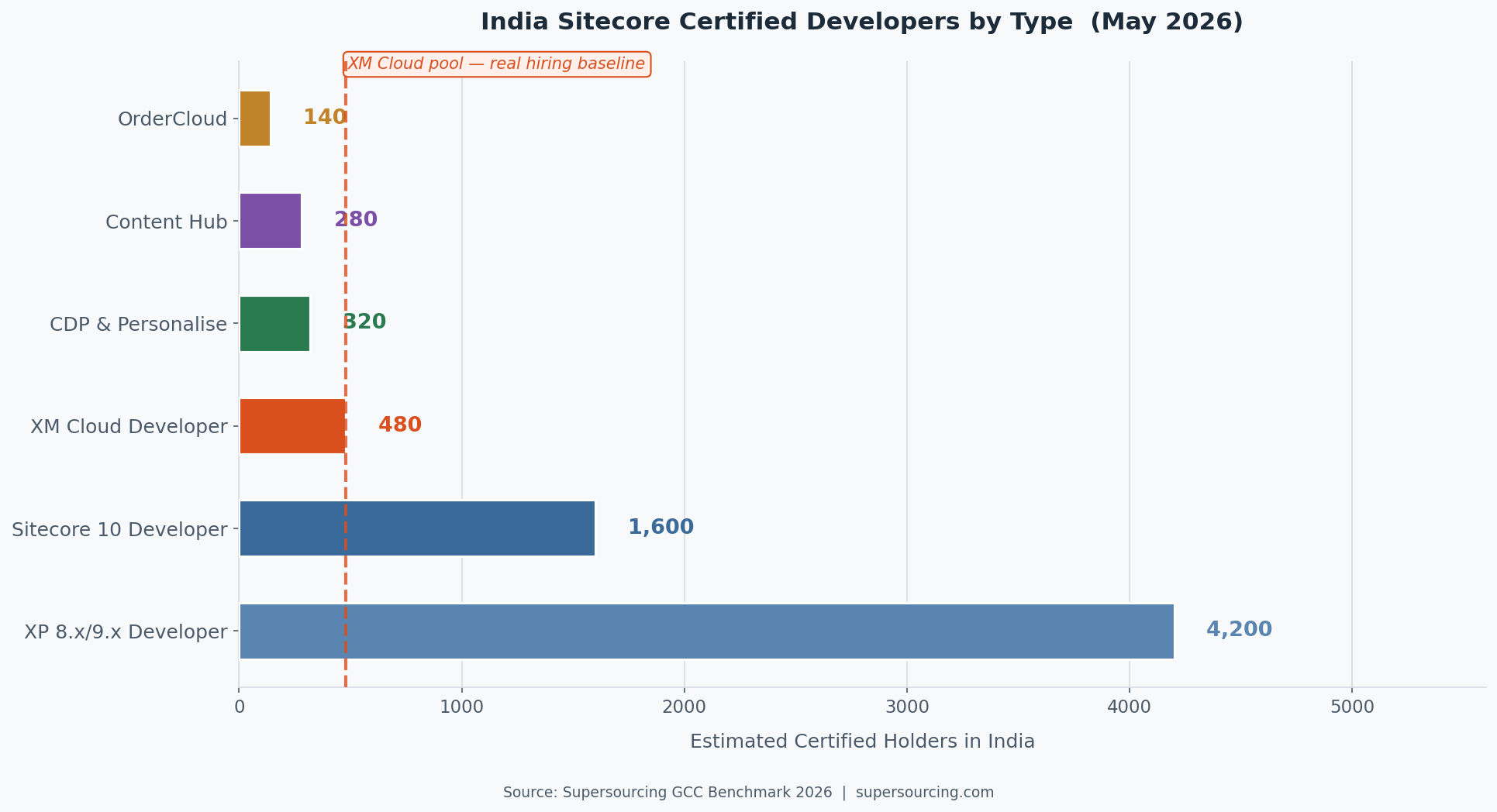
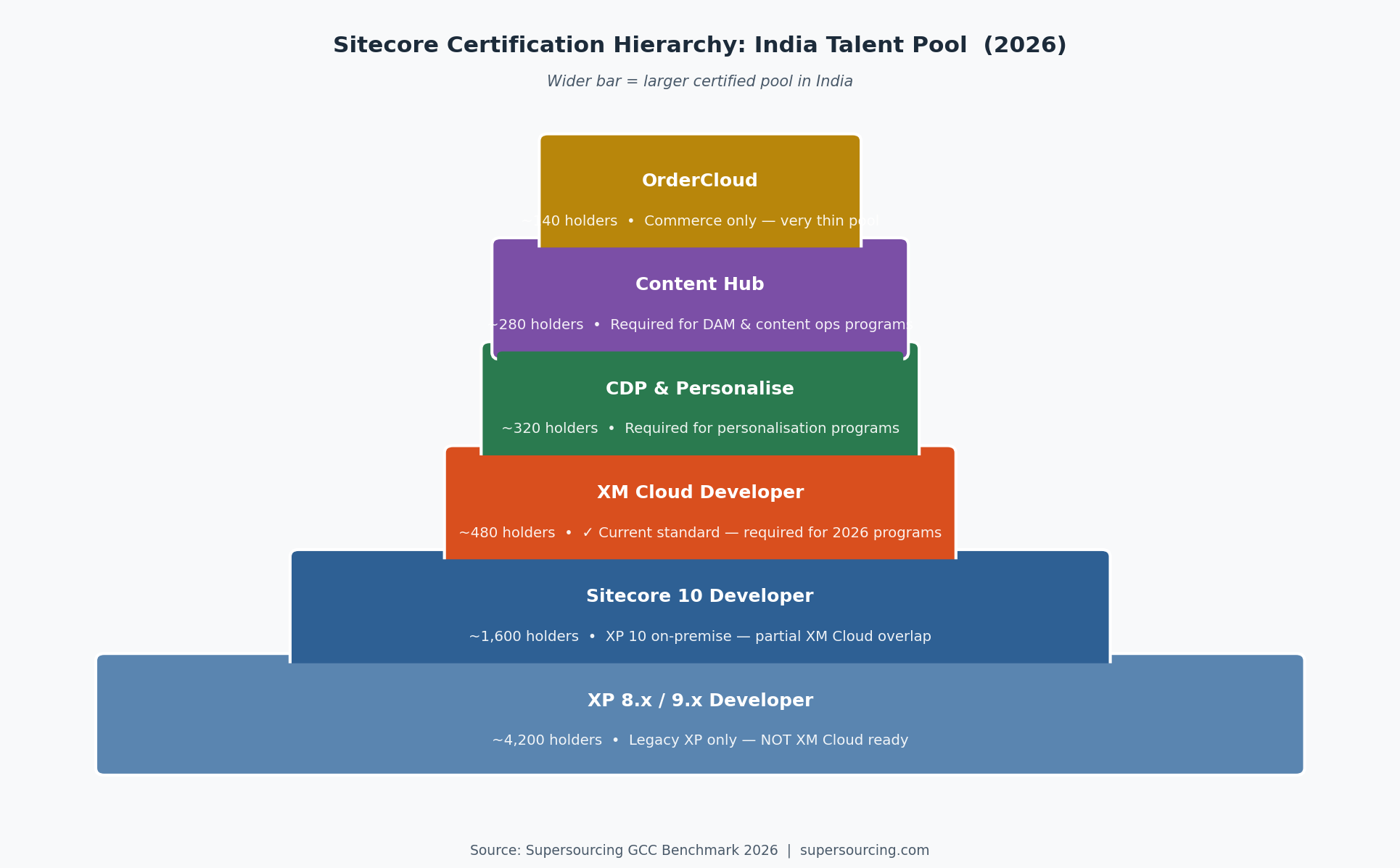
As of May 2026, approximately 6,500 Sitecore-certified professionals are based in India.
| Certification | Estimated India Holders | Relevance for Enterprise Programs |
| Sitecore XP 8.x / 9.x Developer | ~4,200 | Legacy XP programs only. Not XM Cloud-ready without retraining. |
| Sitecore 10 Developer | ~1,600 | Current for XP 10 on-premise. Partial relevance for XM Cloud. |
| Sitecore XM Cloud Developer | ~480 | The current standard. Required for any XM Cloud program. |
| Sitecore CDP and Personalise | ~320 | Required for personalisation and customer data programs. |
| Sitecore Content Hub | ~280 | Required for DAM and content operations programs. |
| Sitecore OrderCloud | ~140 | Commerce programs only. Thin pool. |
The critical number is 480 not 6,500. For XM Cloud programs, you are drawing from 480 verified practitioners. This is the number that determines your hiring timeline, rate expectations, and how hard you need to push vendors to verify what they’re actually giving you.
Where the talent lives:
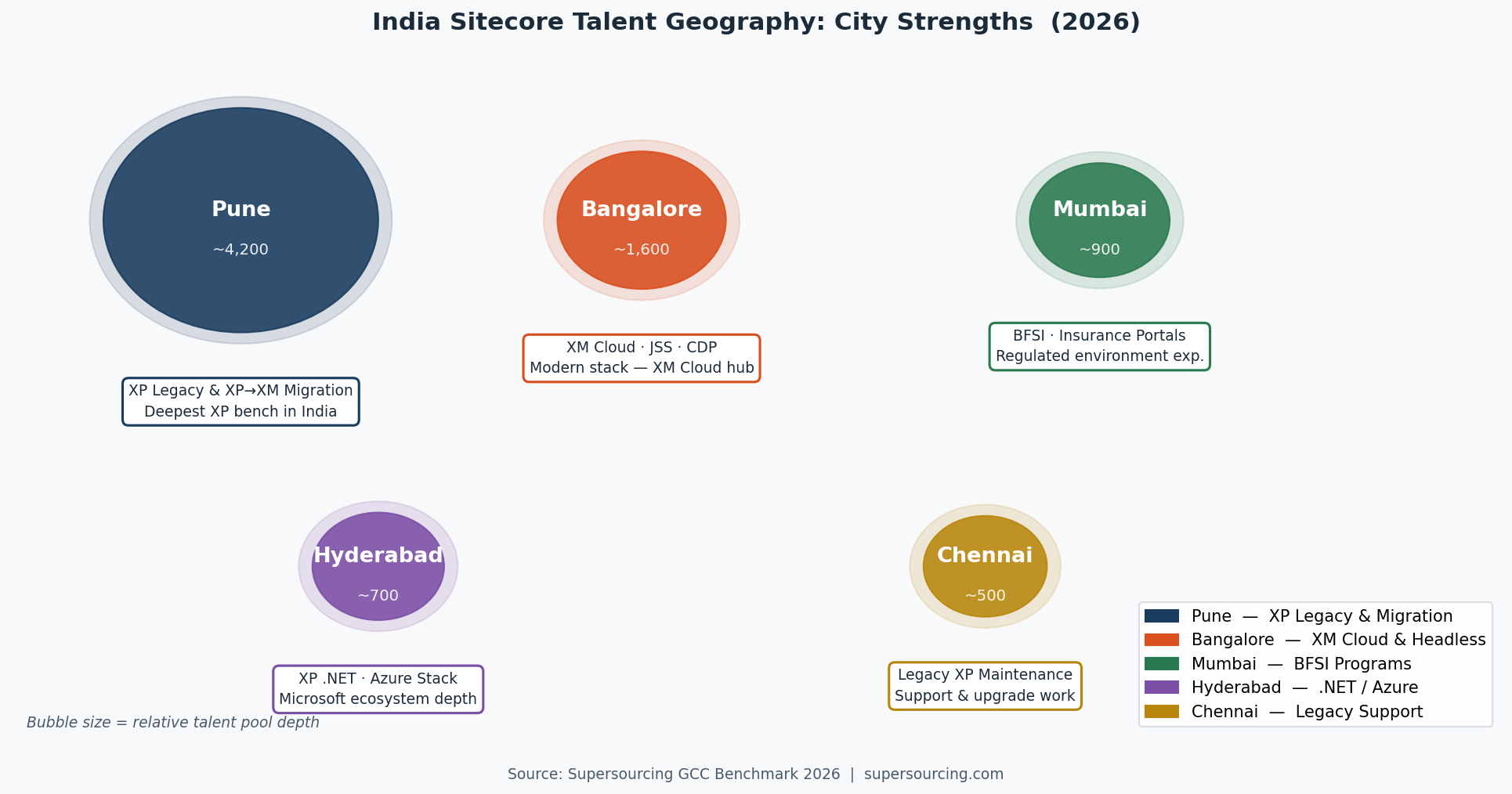
| City | Dominant Sitecore Use Cases | Why |
| Pune | Sitecore XP 9/10, MVC rendering, legacy enterprise CMS, XP-to-XM migration | Largest Sitecore SI partner base in India. Cognizant, Wipro, and specialist Sitecore partners have CoEs here. Deepest XP bench in the country. |
| Bangalore | XM Cloud, JSS/Next.js headless, Sitecore CDP, composable DXP architecture | Cloud-native digital engineering talent. Stronger on the modern stack. Where XM Cloud-ready architects concentrate. |
| Mumbai | BFSI Sitecore implementations, insurance portals, wealth management platforms | Proximity to India’s financial services industry. HSBC, AXA, Zurich Kotak, and domestic BFSI enterprises run Sitecore programs from here. |
| Hyderabad | Sitecore XP .NET implementations, portal development, Microsoft stack integration | Microsoft India HQ effect. Strong .NET depth supporting Sitecore XP on Azure. |
| Chennai | Legacy Sitecore XP maintenance, version upgrade programs | TCS/Cognizant delivery centers. Strong in support and upgrade work. Less in greenfield XM Cloud. |
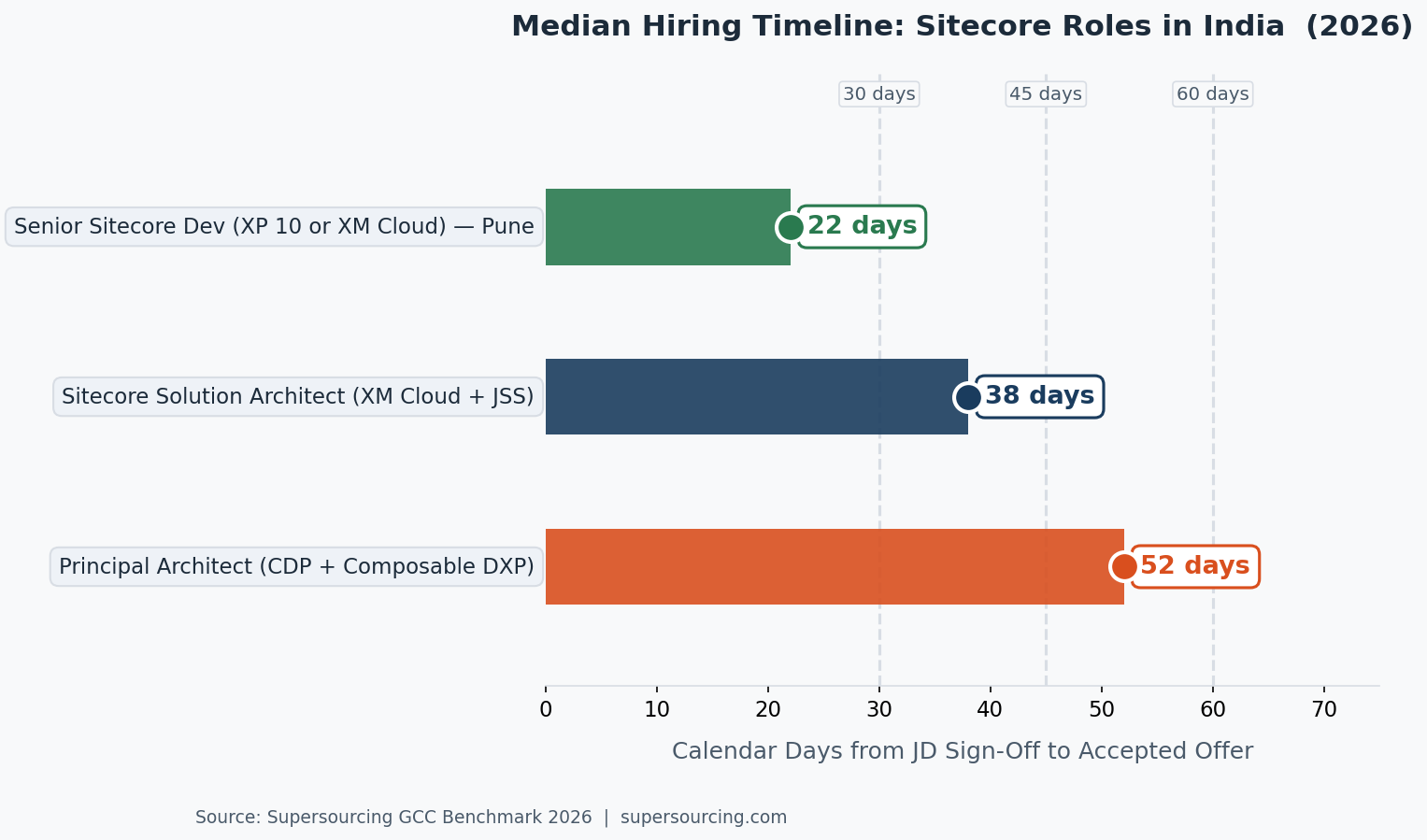
Supersourcing Index: Across 94 Sitecore placements in the Supersourcing GCC Benchmark 2026, median time-to-fill for a Senior Sitecore Developer (XP 10 or XM Cloud) in Pune was 22 calendar days. For a Sitecore Solution Architect with XM Cloud and JSS production experience: 38 days. For a Principal Architect with CDP integration and composable DXP architecture depth: 52 days.
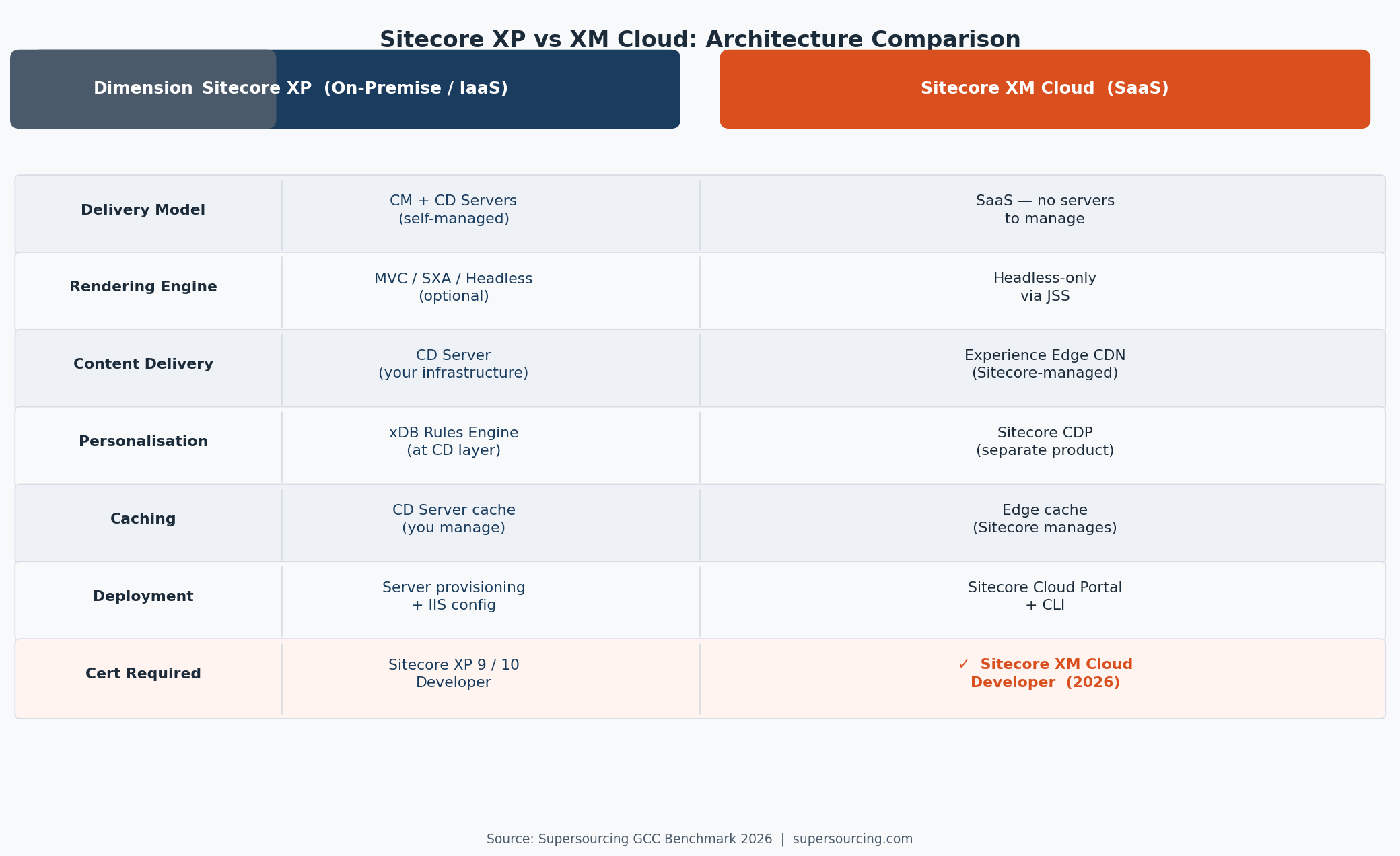
The version currency problem explained simply: Sitecore has released 12 major versions since 2010. XP and XM Cloud are not upgrades of each other; they are different delivery architectures. XP runs on your server infrastructure with a .NET MVC rendering engine. XM Cloud is SaaS-delivered, uses a headless JSS rendering model, and delivers content via Sitecore Experience Edge.
A developer who has spent 5 years on XP 9 needs 3–4 months of structured retraining to become productive on XM Cloud. Most vendors won’t tell you this.
Red flag: Any vendor claiming “20+ Sitecore developers on bench ready for XM Cloud” without producing XM Cloud cert IDs or named XM Cloud project references within 24 hours is presenting XP developers at XM Cloud rates. Ask for version-specific project history before the first CV reaches you.
What India Enterprises Are Actually Building on Sitecore Right Now
This section matters. Understanding what Indian enterprises are deploying on Sitecore tells you two things: where the real production experience lives in India, and what use cases your India-based team will genuinely understand because they’ve built them for domestic clients.
BFSI The Largest India Sitecore Vertical
India’s banking and financial services sector has the deepest Sitecore user base in the country. Banks including HSBC, Bank of Baroda, and Saxo Bank run Sitecore for customer-facing digital banking portals, product marketing pages, and multi-language regional sites.
Insurance companies including Birla Sun Life, AXA, XL Insurance Reinsurance, Generali, and Zurich Kotak use Sitecore for policy product pages, customer onboarding journeys, and agent portals.
What they’re building right now: personalised customer journeys for loan, insurance, and investment product pages. Multi-language deployments across India’s regional markets. Integration with CRM systems Salesforce and Microsoft Dynamics for unified customer profiles. And increasingly, XM Cloud migrations from XP-based legacy implementations that were built 5–7 years ago and are now at end-of-life.
What this means for your hiring: Sitecore developers from Mumbai and Pune who have worked on BFSI programs understand compliance-sensitive content governance, multi-language content architecture, and CRM integration patterns. They have worked in regulated environments. That is directly transferable to US and UK financial services Sitecore programs.
Manufacturing and Automotive Multi-Brand, Multi-Region
Maruti Suzuki, Volvo, TVS, Honeywell, Ford, Bajaj, Husqvarna, KTM, Triumph, Honda, and ArcelorMittal all have India-delivered Sitecore implementations. The use case is consistent: managing multiple brand websites, dealer portals, and product configurators from a centralised platform across regions and languages.
What they’re building right now: dealer portal modernisations, B2B partner platforms, and product catalogue sites with headless delivery for mobile-first markets. The shift from traditional XP MVC rendering to JSS headless is happening across this vertical as Indian enterprises modernise for mobile traffic India’s mobile web traffic is now over 75% of total digital sessions.
What this means for your hiring Developers who have built multi-site, multi-language Sitecore implementations for Indian manufacturing enterprises understand the complexity of brand governance, regional content variation, and workflow approvals at scale. These are the exact patterns global manufacturing enterprises Volvo globally, Ford globally need on their own programs.
Hospitality Experience-Led, Personalisation-Driven
Oberoi Hotels & Resorts, Accor Hotels, and Trident Hotels are active Sitecore users in India. L’Oréal and P&G use Sitecore for brand and product experience platforms. The common thread: high-traffic, experience-led digital properties where personalisation and content performance directly drive revenue.
What they’re building right now: Sitecore XM Cloud migrations for faster page performance, Content Hub implementations for centralised DAM and brand asset management, and Sitecore CDP integrations for guest personalisation.
The Sitecore AI Roadmap specifically AI-assisted page optimisation, conversational search, and AI-powered variant creation is being piloted in hospitality and retail first because the ROI on personalisation is most measurable in these verticals.
What this means for your hiring: Sitecore developers from this background have hands-on experience with Sitecore CDP event streaming, personalisation rules, and content performance optimisation. They understand that Sitecore is not a CMS, it’s a revenue tool. That mindset matters on enterprise programs where the VP Digital is measured on conversion, not deployment dates.
Consulting and Professional Services
McKinsey, BCG, Accenture, VFS Global, and CBRE are Sitecore users in India. These are knowledge-worker organisations using Sitecore for thought leadership platforms, client portals, and regional office sites. The use case is less about personalisation and more about content operations at scale workflow governance, multi-author environments, content approval chains across geographies.
What they’re building right now: Content Hub implementations for centralised content operations, Sitecore XM Cloud for headless delivery on corporate websites, and multisite governance for regional offices.
The Sitecore AI Roadmap What Enterprises Are Hiring For Starting Now
Sitecore’s published AI roadmap (powered by Stream) signals exactly where enterprise hiring needs are heading. The features moving from roadmap to production in 2026 include:
- Generative Q&A and Content Exploration AI-assisted content discovery across large content libraries
- AI-Assisted Page Optimisation automated personalisation recommendations
- Visual Search and Conversational Search next-generation site search replacing keyword models
- Variant Assistant and AI-Powered A/B Testing automated experiment creation and analysis
- Agentic Workflows in XM Cloud AI agents for content creation and approval workflows
- Brand Kit APIs and Brand Assistant centralised brand governance with AI enforcement
What this means for your hiring now: The Sitecore developer you hire in Q3 2026 needs to be capable of implementing these AI features by Q1 2027. That means they need to understand Sitecore’s composable architecture, the XM Cloud API layer, and Sitecore’s integration patterns with Azure OpenAI and Microsoft AI services.
A developer whose experience stops at XP 9 and Experience Editor will not be able to implement any of this. Version currency is not a preference. It is a delivery requirement.
What You’re Really Paying
Rate Table by Level
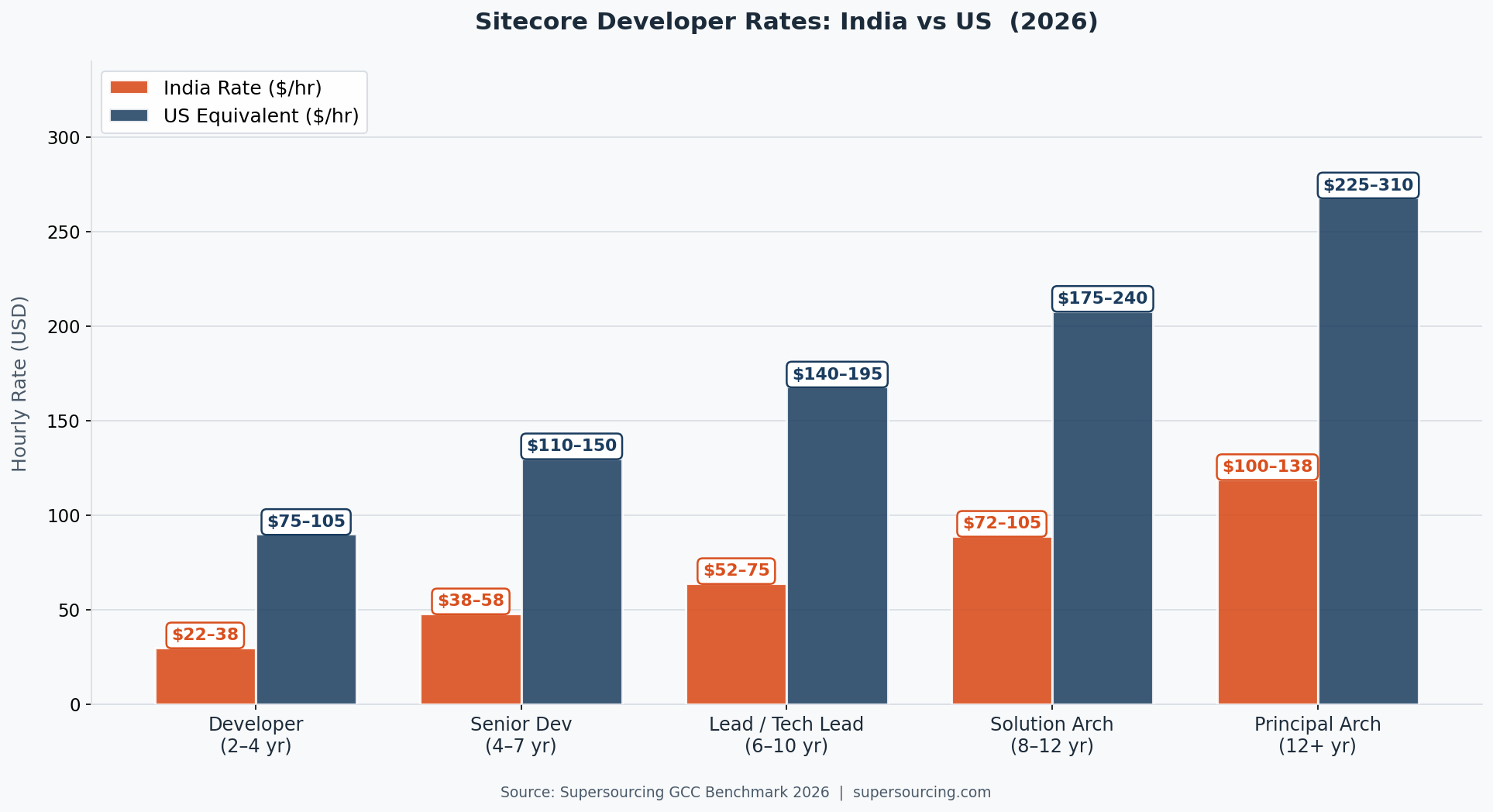
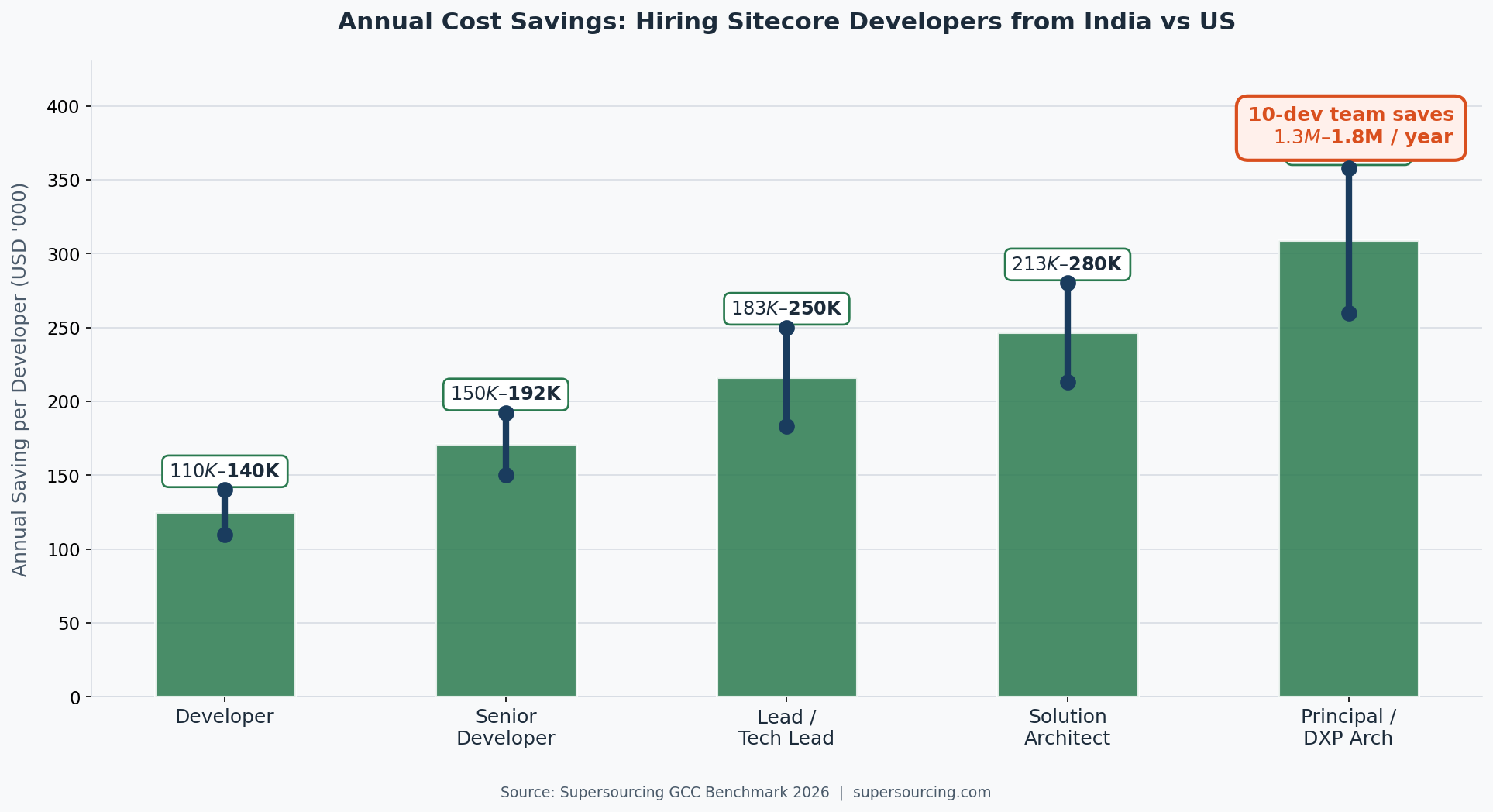
| Level | Experience | India Rate ($/hr) | US Equivalent ($/hr) | Annual Saving ($) |
| Sitecore Developer | 2–4 yr | $22–38 | $75–105 | $110K–$140K |
| Senior Sitecore Developer | 4–7 yr | $38–58 | $110–150 | $150K–$192K |
| Lead Developer / Tech Lead | 6–10 yr | $52–75 | $140–195 | $183K–$250K |
| Sitecore Solution Architect | 8–12 yr | $72–105 | $175–240 | $213K–$280K |
| Principal / DXP Architect | 12+ yr | $100–138 | $225–310 | $260K–$358K |
The 4 Cost Layers
- Layer 1 Gross CTC: A Senior Sitecore Developer with 5 years and version-current certification earns ₹22–36 LPA. At ₹96.4/$1 that’s $23K–$37K annually $11–18/hr at the gross level.
- Layer 2 Employer Burden: Provident Fund: 12% of basic salary. ESIC: 3.25% of gross wages. Gratuity: 8.33–20% of eligible salary. Labour Welfare Fund: state-specific. Performance bonus: 8.33% statutory minimum. Total employer burden: 22–28% on top of gross CTC. A ₹30 LPA engineer costs the vendor ₹37–38 LPA all-in.
- Layer 3 Vendor Margin: For Sitecore specialist staffing, vendor margin runs 20–26%. Sitecore is a thin-pool, specialist stack. Vendors charge higher margin than commodity stacks because sourcing cost is higher and attrition replacement is harder. Vendors who quote Sitecore at generic .NET developer rates are either buying from a very shallow bench or delivering XP-experienced developers at XM Cloud prices.
- Layer 4 What Hits Your Invoice: Your invoice rate for a Senior Sitecore Developer: $38–58/hr. At 2,000 hours/year, a 10-developer team at a blended $50/hr costs $1.0M annually. The US equivalent team: $2.5–3.0M. Annual saving on a 10-person Sitecore team: $1.5–2.0M.
The XM Cloud premium: XM Cloud-experienced developers command 18–25% premium over XP-experienced developers at the same level. The Senior Developer rate moves from $38–50 for XP to $48–68 for confirmed XM Cloud production experience. The pool is thinner. The sourcing cost is higher. This is not negotiable.
The JSS + full-stack premium: Sitecore developers who can work across both Sitecore backend (.NET/C#) and JSS frontend (Next.js/React) command an additional 10–15% over pure backend Sitecore developers. In a headless XM Cloud world, this full-stack capability is not a bonus. It is the baseline for a productive senior developer.
The Content Hub + CDP premium: Developers with hands-on Sitecore Content Hub configuration or Sitecore CDP implementation experience command a further 12–18% premium because both products have thin practitioner pools in India. Enterprises building the full composable Sitecore stack XM Cloud + Content Hub + CDP + Personalise need to budget for these premiums or accept longer sourcing timelines.
Blended team math: A 10-developer Sitecore XM Cloud team 1 architect, 2 leads, 5 seniors, 2 mid-level at market rates runs approximately $950K–$1.15M annually fully loaded. The US equivalent: $2.4–2.9M. Annual saving: $1.3–1.8M.
The Certification Hierarchy What Actually Matters in 2026
Sitecore XP 8.x / 9.x Developer Certification
The legacy developer certification. Valid for XP-based programs. Irrelevant for XM Cloud programs the rendering model, deployment architecture, and content delivery are fundamentally different. The largest pool in India holds this. Most “Sitecore certified” candidates hold this. It is not current for modern enterprise programs.
Sitecore 10 Developer Certification
Version-current for XP 10 on-premise deployments. Tests container-based deployment, Headless Services, and the SXA framework. More current than XP 9. Still not sufficient for XM Cloud XP 10 and XM Cloud share concepts but diverge significantly on delivery architecture. Relevant for enterprises maintaining XP 10 on-premise installations.
Sitecore XM Cloud Developer Certification
The current certification for Sitecore’s SaaS platform. Tests XM Cloud architecture, Pages editor, JSS component development, Experience Edge delivery, and composable DXP patterns. Approximately 480 holders in India. Required for any XM Cloud program. This is the filter to apply for Senior and above.
Sitecore CDP and Personalise Certification
Tests Sitecore’s customer data platform event streaming, audience segmentation, personalisation conditions, and experiment configuration. Approximately 320 holders in India. Required for CDP integration roles. If your program involves personalisation beyond basic XM Cloud rules, require this specifically.
Sitecore Content Hub Certification
Tests Content Hub DAM configuration, content lifecycle workflows, and integration with XM Cloud. Approximately 280 holders in India. Required for any Content Hub implementation role. DAM programs without a certified Content Hub architect typically produce governance debt that becomes expensive to remediate.
Sitecore OrderCloud Certification
Commerce-specific. Approximately 140 holders in India. If your program doesn’t include B2C or B2B commerce, this is irrelevant. If it does, the thin pool means expect 45–60 day sourcing timelines and premium rates.
How to verify exact steps: Go to learning.sitecore.com/certification. Search the candidate’s name or badge URL. Confirm: certification name and version specificity, active status, and issue date currency. Check that the version on the certificate matches the platform version your program runs on. A Sitecore 9 Developer certificate does not verify XM Cloud experience. They look similar on a CV. They are not.
The version timeline trap: Sitecore XM Cloud was generally available from late 2022. Any candidate claiming “XM Cloud production experience” on a project that ended before Q3 2022 is misrepresenting their timeline. Ask for project start and end dates alongside the cert.
The JD That Attracts the Right Candidates
Most enterprise JDs for Sitecore roles are written by procurement teams who copied a template from a previous CMS hire. They attract XP-only developers for XM Cloud programs, filter out full-stack JSS candidates by over-indexing on .NET, and add 4–6 weeks to sourcing timelines by being too generic.
JD 1: Senior Sitecore XM Cloud Developer (4–7 years, Staff Augmentation)
Senior Sitecore XM Cloud Developer Remote from India Engagement: Staff Augmentation | Duration: 12 months, renewable Rate: ₹22–36 LPA CTC equivalent | Billing: $42–68/hr (vendor-facing)
What you’ll own: Build and maintain JSS-based components on Sitecore XM Cloud. You’ll work in a headless delivery architecture using Next.js, contribute to the component library, implement personalisation rules via Sitecore CDP, and support content author workflows in the Pages editor. This is a delivery role where you’ll be measured on deployment quality, component reusability, and page performance scores.
What we require:
- Sitecore XM Cloud Developer certification (active will be verified at learning.sitecore.com before interview)
- 4–7 years in Sitecore development, minimum 1 completed production XM Cloud project
- Hands-on JSS experience: Next.js components, Experience Edge delivery, GraphQL endpoint consumption
- Sitecore Pages editor understanding content author workflows, component placement, variant management
- .NET/C# background for any custom middleware or integration layer work
- Git-based workflow PR-based code review, Sitecore CLI for serialisation
What disqualifies you:
- XP 9 or XP 10 only experience with no XM Cloud production exposure
- JSS experience limited to Sitecore training labs
- No understanding of Experience Edge vs CD server delivery model
- “Sitecore developer” background entirely in Experience Editor the Pages editor is a different authoring paradigm
Interview process: Technical screen (30 min) → Component build task in a live XM Cloud environment (90 min) → Architecture discussion with Digital Platform Lead (45 min)
JD 2: Sitecore Solution Architect XM Cloud + Content Hub + CDP (10+ years)
Sitecore Solution Architect India GCC or BOT Engagement Engagement: GCC Build or BOT | Duration: 24+ months CTC: ₹65–95 LPA | Billing: $85–120/hr (vendor-facing)
What you’ll own: End-to-end Sitecore composable DXP architecture for an enterprise program covering XM Cloud, Content Hub, and Sitecore CDP. You will own the multisite architecture, content type design, JSS component strategy, CDP audience model, and Content Hub taxonomy. You will be the technical authority for a team of 8–20 Sitecore developers.
What we require:
- Sitecore XM Cloud Developer certification (active) + Sitecore CDP and Personalise certification preferred
- 10+ years in Sitecore, minimum 2 completed enterprise XM Cloud programs as architect of record
- Can describe composable DXP architecture how XM Cloud, Content Hub, CDP, and Personalise connect at the API and data layer
- Multisite governance design: how you’ve structured sites, languages, and content sharing across a 5+ site XM Cloud implementation
- Integration architecture: Sitecore Connect, middleware patterns, CRM/CDP data flow
- Awareness of Sitecore AI Roadmap features what’s available now vs future, and how to architect for AI-assisted authoring and personalisation
Interview process: Architecture whiteboard (60 min) → Live XM Cloud + Content Hub integration scenario (45 min) → Reference call with prior Digital Director or VP Digital
What most enterprise JDs get wrong for Sitecore:
They ask for “Sitecore CMS experience” which returns XP 8 developers from 2016. They list “Experience Editor proficiency” as a requirement when XM Cloud uses Pages, not Experience Editor. They require 10+ years of Sitecore experience when XM Cloud has only been in production since 2022; nobody has 10 years of XM Cloud experience. And they don’t mention JSS, Next.js, or headless delivery which signals to the best XM Cloud developers that the client doesn’t know what they’re hiring for.
How to Verify Experience Not Just Credentials
The 3 verification steps before you interview:
Step 1: learning.sitecore.com/certification
Before the CV reaches your interview panel, verify the certification name, version, and status. Sitecore 9 Developer and XM Cloud Developer look similar on a CV summary. They are not the same platform. This takes 90 seconds. Do it before scheduling any interview.
Step 2: GitHub and portfolio audit
Ask for a GitHub profile or portfolio before the interview. A real XM Cloud developer in 2026 has: JSS component repositories with Next.js, Sitecore CLI serialisation scripts, Experience Edge GraphQL query examples, or Content Hub connector configurations.
A candidate who claims “2 years of XM Cloud experience” with no public code should be asked directly for a portfolio or case study. Absence of any shareable work for a claimed XM Cloud specialist is a flag.
Step 3: Project reference with version specificity
Ask for the specific Sitecore version on each project listed on the CV. Ask for the client name, industry, and number of sites managed. Cross-check the project timeline against XM Cloud’s availability any XM Cloud claim on a project ending before Q3 2022 is impossible.
Any candidate who cannot name the specific Sitecore version they worked on for each project does not have the depth they’re representing.
The 5 interview questions that expose fake seniority:
Q1: XM Cloud vs XP Architecture “Explain the architectural difference between Sitecore XP’s CD/CM server model and XM Cloud’s Experience Edge delivery. How does that change your approach to caching and personalisation?”
Real answer: XP uses dedicated Content Delivery servers that you manage; XM Cloud eliminates CD servers entirely and delivers via Experience Edge CDN. Caching is handled at the Edge layer, not at the CD server. Personalisation in XP uses xDB and rules engine at the CD layer; in XM Cloud, real-time personalisation routes through Sitecore CDP because there is no CD server to run rules on. They describe the architecture change with specifics.
Tutorial candidate says: “XM Cloud is the newer cloud version of Sitecore.” Cannot describe the CD server elimination or explain how personalisation works differently.
Q2: JSS Component Architecture “Walk me through how you’d structure a JSS component library for a 5-site multisite XM Cloud implementation component reuse strategy, variant handling, and how content authors interact with components in Pages.”
Real answer describes: shared component library structure, how site-specific variants are handled via Sitecore’s variant model in Pages, the difference between datasource items and rendering parameters, and how content authors create pages in Pages editor vs Experience Editor. They describe real decisions about component granularity and reuse.
Tutorial candidate describes JSS components generically. Cannot explain the Pages editor authoring model or the difference between datasource-driven and hardcoded components.
Q3: Content Hub + XM Cloud Integration “How does the Content Hub connector work with XM Cloud how do assets flow between the two systems and what does a content author’s workflow look like when both products are in play?”
Real answer: Sitecore Connect is used as the integration middleware. Assets published in Content Hub are made available via the DAM connector in XM Cloud’s media library. Content authors select approved assets directly in XM Cloud Pages from the Content Hub repository. They describe the content lifecycle created in Content Hub, approve, sync to XM Cloud and can name the specific connector and configuration steps.
Tutorial candidate describes the two products separately. Cannot explain the integration mechanism or the authoring workflow.
Q4: CDP Personalisation Implementation “Describe how you’ve implemented a personalisation condition in Sitecore CDP from event stream setup through to a live component variant being served to a specific audience segment.”
Real answer walks through: event stream configuration in CDP to capture page views and interactions, audience segment definition based on behavioral conditions, the connection between CDP audiences and XM Cloud personalisation conditions, and how the component variant is assigned to the audience in Pages. They can name the specific CDP event types and describe the latency between event capture and segment qualification.
Tutorial candidate describes personalisation conceptually. Cannot describe the CDP event stream configuration or explain how CDP audiences connect to XM Cloud personalisation conditions.
Q5: Sitecore AI Roadmap Awareness “Sitecore’s AI roadmap includes agentic workflows, generative Q&A, and AI-assisted page optimisation. How would you architect an XM Cloud implementation today to be ready for these features when they reach production?”
Real answer: architect for composable clean separation of content types, well-structured GraphQL schemas, Content Hub as the single source of truth for assets, and CDP for the data layer. Avoid hard-coded content assumptions. Use Sitecore’s published API layer rather than custom extensions that will conflict with AI feature rollouts. Reference specific roadmap features by name and explain which architectural decisions today enable or constrain them.
Tutorial candidates cannot name specific AI roadmap features. Describes AI generally without connecting it to architectural decisions.
8 CV red flags exact language to watch for:
- “Sitecore XM Cloud experience” on a project ending before Q3 2022 the platform wasn’t available
- “Experience Editor proficiency” listed as primary skill XM Cloud uses Pages, not Experience Editor
- “Sitecore architect” with only a Sitecore 9 Developer certification developer cert, not architect credential
- “JSS experience” without Next.js or React specified JSS without a frontend framework is not production JSS
- “Sitecore CDP experience” without being able to name the event streaming model or segment conditions
- “Content Hub DAM experience” with no workflow or connector knowledge DAM without workflow is file storage
- “XM Cloud migration experience” with no named production client or go-live date
- “Headless Sitecore” experience from before 2020 headless Sitecore at enterprise scale is a post-2020 story
How to Source What’s Working, What Isn’t
What’s working in 2026:
Sitecore Partner Network in India.
Sitecore maintains a partner directory of certified implementation partners. Indian Sitecore partners particularly those in Pune and Bangalore keep active bench rosters. A direct inquiry to 3–4 Sitecore-certified partners about available contractors yields a curated shortlist faster than any job board. Partners have direct lines to the developer community and a reputation incentive not to misrepresent version experience.
Sitecore Community Slack and MVP program.
Sitecore’s MVP program recognises the most active community contributors. India has approximately 25–30 active Sitecore MVPs. These are uniformly architect-level practitioners with deep platform knowledge and verifiable public contributions. Ask vendors specifically if any of their benches are Sitecore MVPs or active community contributors. A real one is worth naming.
3 ready-to-use LinkedIn boolean search strings:
- String 1 (XM Cloud Senior Developer): “Sitecore” AND “XM Cloud” AND “JSS” AND (“Senior” OR “Lead”) AND (“Pune” OR “Bangalore” OR “Mumbai”)
- String 2 (Solution Architect): “Sitecore” AND “XM Cloud” AND (“Solution Architect” OR “DXP Architect”) AND “India”
- String 3 (Full Composable Stack): “Sitecore” AND (“Content Hub” OR “CDP”) AND “XM Cloud” AND “India”
BFSI-experienced Sitecore developers via Mumbai network.
The Mumbai Sitecore developer community is smaller but more experienced in regulated, compliance-sensitive implementations. Developers who have worked on BFSI Sitecore programs, insurance portals, banking product pages have dealt with content approval workflows, multi-language governance, and integration with legacy systems. For global BFSI Sitecore programs, this experience is directly transferable and rarely found on generic job boards.
Supersourcing pre-vetted bench. For Senior XM Cloud Developers, Supersourcing’s median fill time from JD sign-off to accepted offer is 22 calendar days with pre-vetted bench. Cert IDs verified at learning.sitecore.com before any CV is submitted.
What isn’t working:
- Generic “Sitecore developer” postings on Naukri. Returns XP 8 and XP 9 developers overwhelmingly. The platform’s job board algorithm doesn’t differentiate by version. Every applicant looks like a Sitecore developer. Most are not current.
- Asking vendors for “Sitecore CVs” without version specification. Without specifying XM Cloud and JSS in your brief, vendors send XP-experienced developers at XM Cloud rates. This is not dishonesty, it is how their internal search works. The XP pool is what they have. Specify the version, the delivery model, and the cert level required.
- Assuming .NET experience equals Sitecore experience. India has a deep .NET/C# developer pool. Sitecore is built on .NET. The overlap is real but limited. A .NET developer with basic Sitecore exposure is not a Senior Sitecore Developer. The platform-specific knowledge content tree structure, rendering engine, JSS architecture, and CDP integration is the differentiator. .NET depth is necessary but not sufficient.
- Interviews without a live XM Cloud environment task. Verbal Sitecore interviews in 2026 do not filter effectively. Coached candidates can describe JSS architecture from documentation. The reliable filter is a 60–90 minute task in a live XM Cloud sandbox to build a JSS component, configure a personalisation condition, or implement a Content Hub asset picker. Candidates who can’t do it live haven’t done it in production.
Supersourcing Index: Pipeline-to-offer conversion rate for Sitecore XM Cloud roles in the Supersourcing GCC Benchmark 2026: 9%. Of every 100 CVs submitted by vendors for XM Cloud roles, 9 result in hires that pass the technical bar set in Section 9. The primary reason for rejection: XP experience presented as XM Cloud-ready. The version verification step alone 90 seconds at learning.sitecore.com eliminates 40% of submitted CVs before a single interview is scheduled.
The Contract Stack for Sitecore Engagements
Four clauses are non-negotiable. Without all four you are exposed.
Clause 1: Individual Resource Approval with Cert ID and Version Specification
Every developer who touches your Sitecore environment must be individually approved in writing before starting. The SOW schedule must list: developer name, Sitecore certification name and version, cert ID, and approved environment access scope. The cert version must match your program’s platform version. A Sitecore 9 Developer cert listed in the SOW schedule for an XM Cloud program is a contractual misrepresentation. Specify the platform version in the approval clause.
Clause 2: Substitution Notice 14 Days, Client Approval Required
Any personnel change requires 14 days written notice and client approval before the substitution occurs. The replacement must hold equivalent or superior Sitecore certification at the same version level. Without this clause, a vendor can replace your approved XM Cloud Senior Developer with an XP 9 developer the week after SOW signing and you have no contractual remedy.
Clause 3: IP Assignment Deed Per Developer
Executed within 5 business days of each developer’s start date. Must cover: JSS component code, custom Sitecore templates and content types, serialised Sitecore items via Sitecore CLI, Content Hub taxonomy configurations, CDP audience definitions and personalisation rules. Standard MSA IP clauses referencing “software code” are insufficient for Sitecore serialised item definitions, content type schemas, and CDP configurations are IP that those clauses don’t clearly cover.
Clause 4: Environment Access Termination 24 Hours
All vendor developer accounts in your Sitecore Cloud Portal must be deactivated within 24 hours of engagement end. XM Cloud user accounts, Content Hub user accounts, and CDP user accounts must all be revoked; they are separate systems with separate access controls. Sitecore CLI authentication tokens must be invalidated. This requires a named offboarding action list in the contract, not a best-efforts process.
Sitecore-specific IP considerations:
Serialised item definitions. Sitecore CLI serialises content types, templates, and configuration as YAML files committed to Git. These files are IP. They must be in your repository, not the vendor’s. Specify in the MSA that all Sitecore CLI serialisation commits go to your Git repository.
Content Hub taxonomy. A Content Hub taxonomy built for your program asset categories, metadata schemas, content lifecycle states is valuable IP. It is not obviously “software code.” Your IP Deed must explicitly include “Content Hub taxonomy structures and configuration” in the IP assignment scope.
CDP audience definitions. Audience segments built in Sitecore CDP represent business intelligence about your customer behaviour patterns. They must be owned by you. Specify CDP audience and condition definitions as IP in the Deed.
Running a Sitecore Team at Scale
Governance model for a 10–20 developer Sitecore program:
- Environment governance.
XM Cloud provides separate Environments within a single Organisation. Production, pre-production, and development should be separate XM Cloud Environments, not separate folders in the same environment. Developers should have access to development environments only. Promotion to pre-production and production should be gated by your internal platform owner, not vendor-controlled.
- Sitecore CLI and serialisation discipline.
Sitecore CLI serialises content types, templates, and configuration as YAML. On a 10+ developer team, all serialised items must be version-controlled in Git with PR-based review. A team developing Sitecore items without CLI serialisation creates configuration debt that is impossible to audit and costly to remediate. Make CLI serialisation mandatory from day one.
- JSS component library governance.
On a multisite XM Cloud program, JSS components should be built for reuse first. Establish a component library review process; no new component is created without a check against the existing library. On a 15-developer team without this governance, component sprawl creates 3x the codebase maintenance overhead within 12 months.
- Content Hub workflow ownership.
If Content Hub is in scope, the workflow configuration content lifecycle states, approval chains, publishing triggers must be owned by your internal content operations lead. Vendor developers configure it. Your team owns it. A Content Hub workflow built entirely by a vendor team and never transferred to your operations team becomes a black box at engagement end.
Early warning signals that a Sitecore developer is disengaging:
- Declining JSS commit frequency in Git
- Reduced PR review participation
- Missing sprint demos without prior notice
- LinkedIn profile updates Sitecore skills refreshed, new connections from competing digital agencies
- Support ticket quality drop shallower analysis, slower resolution on content author queries
Retention levers specific to Sitecore developers in India:
Platform currency keeps them. Sitecore developers who are working on XM Cloud, Content Hub, and CDP stay longer than those maintaining XP installations. The platform is evolving AI features, agentic workflows, and composable architecture. Developers who are building on the roadmap are not looking for the door.
Certification sponsorship is effective and cheap. The XM Cloud Developer exam costs approximately $200. Sponsoring it signals investment. Developers mid-certification for CDP or Content Hub certifications do not leave mid-cycle.
Community participation. India’s Sitecore MVP and community program is small enough that participation is meaningful. Supporting developers to write community blog posts, submit talks to Sitecore events, or contribute to open-source Sitecore projects gives them a professional identity that isn’t purely tied to your engagement. That identity retention is real.
When Things Go Wrong
Pattern 1: The XM Cloud Retrofit
A US-based insurance company hired 7 Sitecore developers through an IT staffing vendor for an XM Cloud customer portal program. Six months in, the technical review revealed: the team had built the entire solution using XP-style MVC rendering patterns instead of JSS headless components. The content was not delivered via Experience Edge. The personalisation was not connected to CDP.
The architecture was valid for Sitecore XP. It was architecturally wrong for XM Cloud; the rendering model is fundamentally different. The developers had XP experience. They had been presented as XM Cloud-ready. Nobody verified.
The retrofit required 11 weeks of rework. A certified XM Cloud architect was brought in at $185/hr to redesign the component library. Total additional cost: $220K. The readiness criterion version decided, headless delivery decided and the verification step in Section 9 would have caught this before day one.
Pattern 2: The Content Hub Orphan
A European retail enterprise deployed Sitecore Content Hub as their central DAM for a 12-market rollout. The vendor team configured the entire taxonomy, workflow, and metadata schema over 8 months. The client team was not trained on the configuration layer only on the authoring interface.
When the engagement ended, the client had a Content Hub instance nobody on their team could modify. Adding a new asset category required raising a vendor ticket at $180/hr for a task that takes 15 minutes in the admin interface. Three markets’ content governance was blocked waiting for vendor support within the first month post-handover.
The fix: a 3-week Content Hub administration training program and full documentation of the taxonomy and workflow configuration. Cost: $42K. Entirely preventable with a knowledge transfer clause in the SOW and a requirement that all Content Hub configuration changes be documented and reviewed by the client’s content operations throughout the engagement.
Pattern 3: The Cert Mismatch
A UK-based financial services company was presented with a “Sitecore XM Cloud Solution Architect” at £95/hr. The CV listed XM Cloud, JSS, CDP, and Content Hub. The certification on the CV: “Sitecore Certified Developer.”
The verification at learning.sitecore.com took 90 seconds. The certification was Sitecore 9 Developer not XM Cloud, not any current version. The candidate had rebranded their XP 9 cert as “Sitecore Certified Developer” without specifying the version.
The client’s procurement team had not run the verification. They discovered it at the technical interview when the candidate could not explain the difference between Experience Edge and a CD server. Three weeks of sourcing time lost. The substitution clause they didn’t have meant the vendor billed for the gap period.
The 90-second cert check in Section 9 eliminates this entirely.
When India Is the Wrong Call for Sitecore
Three scenarios where India-based Sitecore hiring creates more risk than it solves.
Scenario 1: Highly bespoke composable DXP with niche third-party integrations.
Sitecore XM Cloud + Content Hub + CDP + Salesforce Commerce Cloud + Azure Purview + custom middleware the overlap of all of these in a single architect profile in India is thin. You can find XM Cloud architects. Finding someone who has delivered the full composable stack with Salesforce Commerce and Purview governance in a GDPR-regulated European context narrows the India pool to under 30 active practitioners. For this profile, consider a US or European lead architect for the integration design with India-based developers for component and content type execution.
Scenario 2: Programs requiring significant content author co-location.
Sitecore programs with heavy content operations requirements daily content author training, live personalisation strategy sessions, campaign launch support work best with some onsite presence. India-based developers can build and maintain the platform. They cannot easily sit alongside content authors in a New York or London office for campaign week. If your program requires that kind of embedded support more than 20% of the time, factor in the travel costs or plan for a hybrid model.
Scenario 3: XP legacy maintenance with no modernisation roadmap.
If your program is purely maintaining a Sitecore XP 8.2 installation with no migration roadmap, no new feature development, and no intent to move to XM Cloud the economic case for India-based staffing is thinner. The pool of XP 8 developers in India who are actively available is shrinking as developers upgrade to XM Cloud or move to other platforms. Support and maintenance of legacy XP is also a low-complexity engagement that most enterprise staffing models are not built for. A Sitecore-specialist managed support partner is a better fit than offshore staff augmentation for this scenario.
The Supersourcing Vendor Scorecard™ Sitecore Edition
Score your vendor before you sign. Maximum 100 points. Minimum threshold to proceed: 60.
Category 1: Bench Depth (0–20 pts)
| Criterion | 0 | 10 | 20 |
| Can produce XM Cloud cert IDs for claimed bench within 24 hours | Cannot | Some | All claimed XM Cloud bench |
| JSS + Next.js capable developers on bench | None | 1–2 | 3+ verified |
| CDP or Content Hub certified practitioners available | None | 1 | 2+ verified |
Category 2: Vetting Process (0–20 pts)
| Criterion | 0 | 10 | 20 |
| Version-specific technical assessment | Generic CMS test | Sitecore-specific written | Live XM Cloud environment task |
| Hands-on JSS component build assessment | No | Optional | Mandatory for senior+ |
| Reference check with version specificity | None | CV-based | Named client + version confirmed |
Category 3: Contract Readiness (0–20 pts)
| Criterion | 0 | 10 | 20 |
| IP Assignment Deed covering serialised items and CDP configs | Not available | Available on request | Standard in all SOWs |
| Environment access termination clause (XM Cloud + Content Hub + CDP) | Not present | Present, vague | Present, all 3 systems named |
| Sitecore cert ID + version in SOW schedule | Never | On request | Standard |
Category 4: Delivery Track Record (0–20 pts)
| Criterion | 0 | 10 | 20 |
| Named XM Cloud production clients they can reference | None | Logo only | Named contact available |
| Completed JSS headless deliveries verifiable | None claimed | Claimed, unverified | Verified with go-live date |
| Attrition rate on Sitecore programs | Unknown / >22% | 15–22% | <15% |
Category 5: Commercial Structure (0–20 pts)
| Criterion | 0 | 10 | 20 |
| Rate card transparency CTC visible on request | Refused | Partial | Full CTC visible |
| Substitution clause with version equivalence requirement | Not present | Available | Standard in all MSAs |
| SLA on replacement if developer rolls off | None | Best effort | Contractual SLA ≤14 days |
Score interpretation:
- 80–100: Shortlist. Proceed to SOW negotiation.
- 60–79: Proceed with conditions. Close the gap categories before signing.
- 40–59: Red flag. Negotiate hard on Categories 2 and 3 or walk.
- Below 40: Walk.
15 Questions Buyers Actually Ask
Q: What’s the difference between Sitecore XP and Sitecore XM Cloud?
XP is Sitecore’s traditional on-premise or IaaS platform. You manage your own Content Management and Content Delivery servers, xDB analytics database, and infrastructure stack. XM Cloud is SaaS-delivered Sitecore manages the infrastructure, and content is delivered via Experience Edge CDN. The rendering model is different: XP supports both MVC and headless; XM Cloud is headless-only via JSS. For new enterprise programs in 2026, XM Cloud is the strategic platform. XP is in extended support mode.
Q: Can I hire developers with XP experience for an XM Cloud program?
With retraining, yes for mid-level execution roles. A Senior XP developer with strong .NET and Sitecore fundamentals can transition to XM Cloud productivity in 3–4 months with structured upskilling. For Architect and Lead roles on XM Cloud programs, require XM Cloud production experience. You cannot train your way to becoming an architect. The platform decisions on an XM Cloud program need to be made by someone who has made them before in production.
Q: Should I require JSS experience or is .NET Sitecore background sufficient?
For XM Cloud programs: JSS is required. XM Cloud delivers content exclusively via JSS headless rendering. A pure .NET/C# Sitecore developers without Next.js/React experience cannot build the rendering layer. For XP 10 programs with Headless Services enabled: JSS experience is strongly preferred. For XP programs on traditional MVC rendering with no headless roadmap: .NET/C# background is sufficient. Match the requirement to your actual delivery model.
Q: What’s the realistic timeline to hire a Sitecore XM Cloud Solution Architect in India?
38 days from JD sign-off to accepted offer, per the Supersourcing GCC Benchmark 2026. The pool of architects with XM Cloud + JSS + CDP production experience in India numbers under 150 active practitioners. Expect competition from other enterprise programs for the same profiles. If you need one in under 21 days, you’re paying a premium and accepting higher risk on experience verification.
Q: Can one vendor handle Sitecore and Salesforce on the same program?
Sitecore and Salesforce appear on the same program regularly, Salesforce CRM feeding CDP personalisation, Salesforce Commerce integrated via middleware. A vendor who claims depth on both should provide separate cert IDs and named project references for each stack. Bundling the rate card creates an incentive to staff the weaker stack with lighter talent. Separate SOW schedules with separate approved resource lists give you clean accountability.
Q: What happens to my Sitecore CLI serialisation files when the engagement ends?
Whatever your MSA says. If your MSA doesn’t specify repository ownership for serialised Sitecore items, the vendor’s team may have been committing to their own repository rather than yours throughout the engagement. Your IP Deed (Section 11) must specify that all Sitecore CLI serialisation commits go to your Git repository from day one. This is a day-one onboarding configuration decision, not an end-of-engagement negotiation.
Q: How does the Sitecore AI Roadmap affect who I should hire now?
The Sitecore AI roadmap (powered by Stream) is bringing generative Q&A, AI-assisted page optimisation, agentic content workflows, and conversational search into production in 2026. These features sit on top of XM Cloud and Content Hub via API integrations with Azure OpenAI. The developers you hire today need to be capable of implementing these integrations when they reach production. That means: XM Cloud API fluency, understanding of Sitecore’s composable architecture, and awareness of Azure AI services. An XP 9 developer cannot implement any of this.
Q: Is Sitecore Content Hub the same as the Sitecore Media Library?
No and confusing them is a common buyer mistake. The Media Library is XM Cloud’s native asset storage simple file management within the CMS. Content Hub is a separate product: a full Digital Asset Management (DAM) platform with content lifecycle workflows, metadata schemas, brand approval processes, and publishing pipelines. Content Hub integrates with XM Cloud via connector but requires separate licensing, separate implementation, and separately certified practitioners. If your program needs DAM, Content Hub governance, or centralised asset operations you need Content Hub, not just the Media Library.
Q: What’s the minimum team size where India Sitecore hiring makes sense?
4–5 developers for staff augmentation. Below that, the onboarding overhead, timezone coordination, and vendor management cost approaches the rate saving. For a 2–3 developer program, a Sitecore-specialist boutique agency or senior freelance contractor is a better model than enterprise staffing.
Q: How do I verify a vendor’s claimed Sitecore Sitecore partner status is current?
Go to sitecore.com/partners and search the vendor name. Sitecore partner status is tiered Select, Gold, and Platinum. Tier reflects verified delivery capacity and certified headcount. A vendor claiming “Sitecore partner” without being findable in the partner directory is either lapsed or misrepresenting. Ask for the tier and verify it. Gold and Platinum partners are required to maintain certified headcount which means their developer certifications are at least partially verified by Sitecore directly.
Q: Can I use a BOT model for a Sitecore GCC?
Yes and it works particularly well for large Sitecore programs with a 3+ year horizon. The BOT model for a Sitecore GCC transfers not just headcount but institutional platform knowledge: JSS component libraries, Content Hub taxonomy, CDP audience models, serialised item configurations. The transfer clause must specify that all Sitecore platform assets, repositories, configuration exports, Content Hub workflows, CDP configurations transfer to your India entity at transition. Guide 2 in this series covers BOT transfer clause specifics.
Q: What’s typical Sitecore developer attrition in India and how do I manage it?
13–17% annually for mid-senior Sitecore developers lower than the 22% IT industry average. Sitecore is a specialist platform with a smaller community. Developers who build Sitecore expertise have fewer lateral options than full-stack generalists, which moderates attrition. The highest attrition risk is developers on legacy XP maintenance programs who want to move to XM Cloud work. Managing it: ensure your program gives developers exposure to the modern Sitecore stack. A developer doing XP support work for 12 months straight will leave for a program with XM Cloud delivery.
Q: Is Supersourcing the right partner for a 3-developer Sitecore program?
Not our ideal engagement. Our model is built for 8+ developer programs with enterprise governance requirements, verified bench depth, and SOW-level accountability. For 3 developers on a defined Sitecore scope, a Sitecore-specialist SI partner or boutique agency with Sitecore practice depth is a better fit. We’d rather tell you that than win a deal we’ll underserve.
Q: How does BFSI Sitecore experience in India translate to global programs?
Directly. Indian BFSI enterprises, banks, insurance companies, financial services portals have been running complex Sitecore implementations for years. HSBC, Saxo Bank, AXA, Zurich Kotak, Generali, and BOBCAPS all have India-delivered Sitecore programs. Developers from these programs understand compliance-sensitive content governance, multi-language content architecture, CRM integration, and the approval workflows that regulated industries require. These patterns are exactly what global BFSI Sitecore programs need. When sourcing for a financial services Sitecore program, specifically ask vendors for developers with BFSI Sitecore delivery experience. It narrows the pool but dramatically improves fit.
Q: What’s the hardest Sitecore profile to fill from India in 2026?
A Sitecore Principal Architect with XM Cloud production delivery, Content Hub governance design, CDP implementation, and composable DXP integration architecture all on a single profile. The combination of all four product lines at architect depth narrows the India pool to under 50 active practitioners. Median fill time: 52 days. Expect top-of-range rates, competition from other enterprise programs, and a bench fee to hold a verified profile while legal reviews the MSA.
Closing
Sitecore hiring from India works. The talent is real, the BFSI and enterprise delivery track record is deep, and the savings versus US and UK hiring are substantial $150K to $358K per developer per year depending on level and specialisation.
The failure mode is not India. The failure mode is hiring for “Sitecore experience” when you need XM Cloud experience. It is interviewing without a hands-on XM Cloud environment task. It is signing an MSA without a cert version requirement in the resource approval clause. None of these checks are complicated. All of them matter.
India’s Sitecore community is building real things for real enterprises HSBC, Aditya Birla Capital, Maruti Suzuki, Oberoi Hotels, Adani. The production experience is here. The verification process in this guide is how you find it.
If you want Supersourcing to verify a specific Sitecore role, bring us a JD and we’ll tell you what the talent pool looks like, what the realistic rate is, and how long it’ll take to source someone who passes every layer.
Book a 30-minute Sitecore Talent Discovery Call → No deck. Just the numbers and the bench.
