

Sitecore’s product architecture changed fundamentally and most enterprise hiring pipelines haven’t caught up. Teams evaluating candidates against outdated job descriptions are either overpaying for skills they don’t need or under-screening for the ones that will define project success. If your organization is planning to hire Sitecore developer India talent for an XM Cloud migration, a composable DXP build, or a multi-site enterprise rollout, this guide gives you the evaluation framework, salary benchmarks, and skill mapping you need before posting a single job description.
Hire Sitecore developer India is where enterprises can gain both cost efficiency and access to scalable talent but only when hiring aligns with modern skills like headless architecture, API-driven development, and cloud-native deployment, not legacy Sitecore XP expertise.
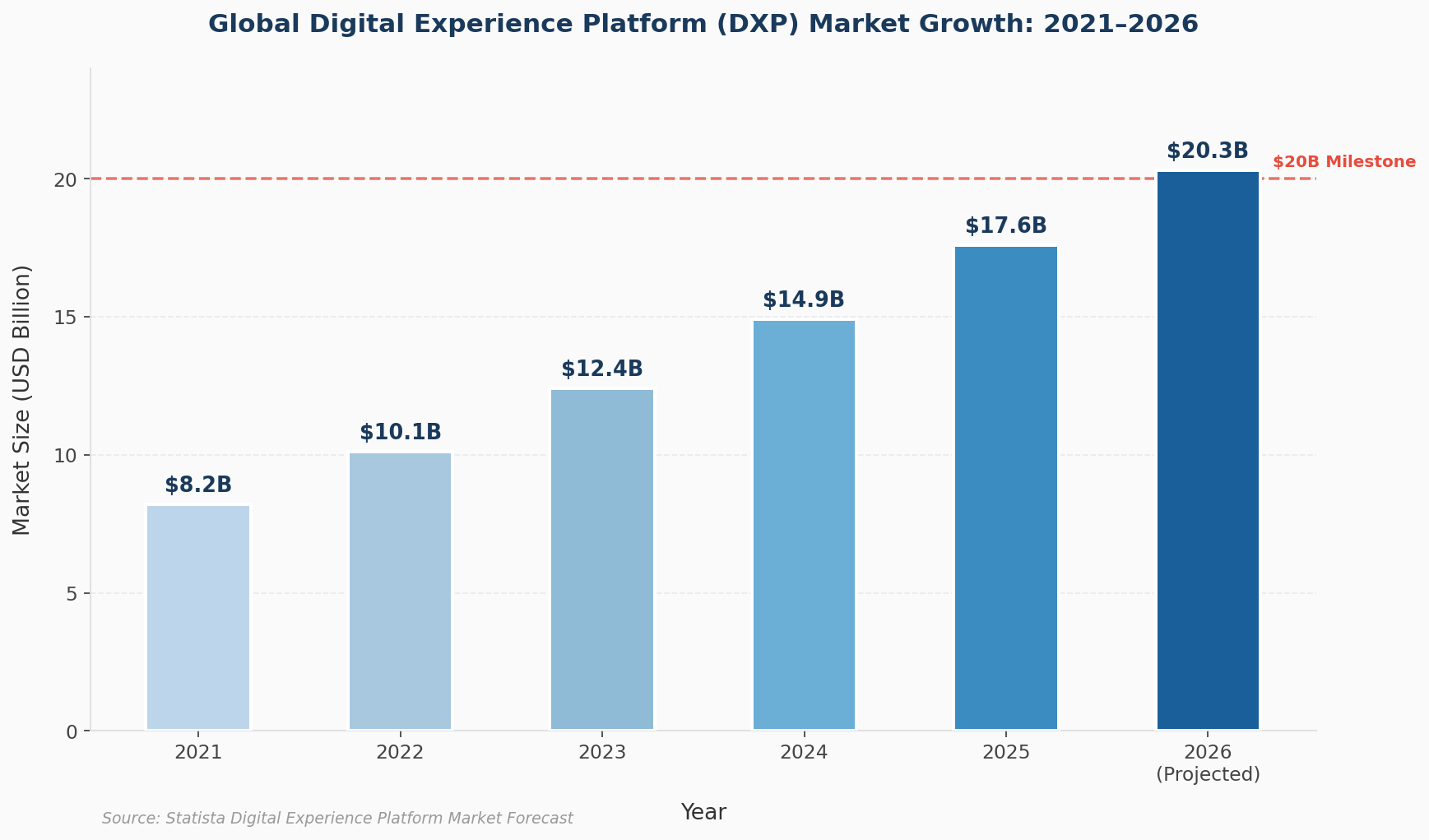
The shift is backed by market trends. According to Statista digital experience platform market forecast, the global digital experience platform (DXP) market is projected to exceed $20 billion by 2026, driven by demand for composable and cloud-based content ecosystems.
The takeaway: successful Sitecore hiring today depends on aligning with its new architecture, not legacy assumptions about the platform.
What Does It Mean to Hire a Sitecore Developer?
To hire Sitecore developer talent means sourcing a .NET or full-stack engineer with platform-specific expertise in Sitecore’s content management, personalization, and delivery architecture including configuration, custom component development, integration with third-party systems, and increasingly, headless front-end delivery via Sitecore JSS.
Why Hiring Sitecore Talent Is Harder Than It Looks
The challenge isn’t availability it’s platform fragmentation. Sitecore currently has three materially different product lines in active enterprise use: Sitecore XP (the legacy monolith), Sitecore XM (the CMS-only variant of XP), and Sitecore XM Cloud (the SaaS-native, composable successor). A developer who is expert in XP 9.3 may have zero working knowledge of XM Cloud’s edge delivery model, GraphQL content APIs, or Pages editor.
Enterprise teams consistently underestimate the skill gap by 2–3x when transitioning from XP to XM Cloud. Screening candidates on Sitecore Experience Manager experience without specifying which generation is the single most common hiring error in this ecosystem.
Beyond the platform version, the composable DXP model has introduced adjacent skill requirements. Sitecore XM Cloud developers now need proficiency in Next.js, Vercel or edge hosting, Sitecore CDP integration, and headless rendering architecture none of which apply to classic MVC-based Sitecore XP builds.
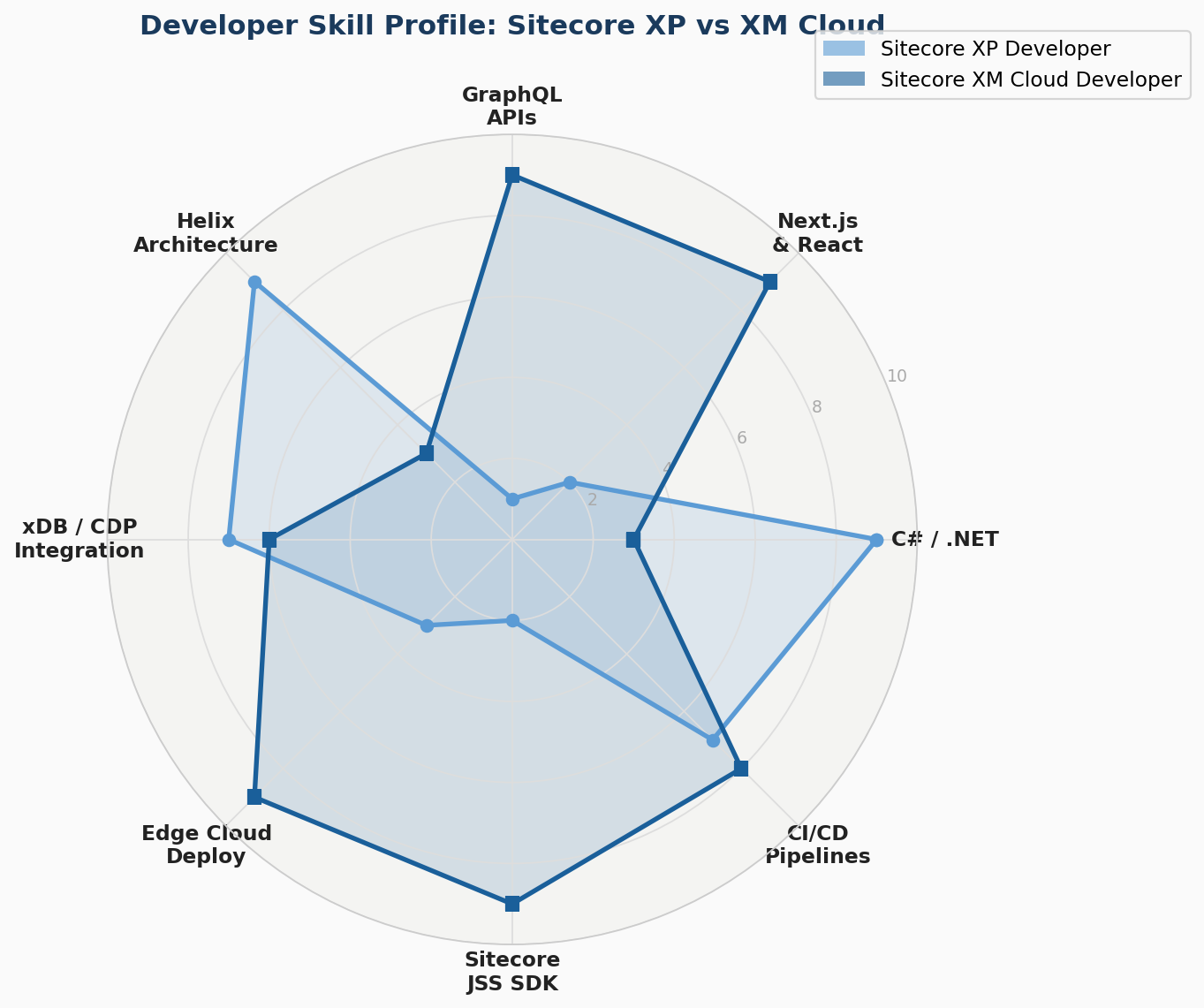
Sitecore XP vs XM Cloud: Why the Skill Sets Are Fundamentally Different
Understanding this distinction is not optional; it determines your entire hiring brief.
Sitecore XP (and XM On-Premise)
XP is a .NET-heavy, server-rendered platform. Core skills for this stack include:
- C# and ASP.NET MVC controllers, renderings, pipelines
- Sitecore Helix architecture (modular solution design)
- xDB (Experience Database) configuration and xConnect API
- Sitecore Forms, EXM (Email Experience Manager), and personalization rules
- Solr or Azure Search integration
- On-premise or PaaS (Azure App Service) deployment and CI/CD pipelines
Sitecore XM Cloud (SaaS / Composable)
XM Cloud is decoupled by design. The required skill profile shifts significantly:
- Next.js and React component development with Sitecore JSS SDK
- GraphQL queries against the Sitecore Edge delivery layer
- Experience Editor / Pages in the cloud-hosted authoring environment
- Sitecore CDP and Personalize for behavioral targeting
- Vercel, Netlify, or cloud-native edge deployment
- Sitecore CLI, XM Cloud Deploy tooling, and source control integration
When you hire Sitecore developer India for an XM Cloud project, a candidate without Next.js and GraphQL experience is not a match regardless of their XP tenure.
Sitecore XM Cloud Developer Skills: Minimum Bar for Enterprise Projects
- 2+ years hands-on with Sitecore JSS in a headless architecture
- Live XM Cloud project delivery (not just sandbox/training)
- Familiarity with Sitecore Serialization (Sitecore CLI or Unicorn equivalent)
- Component library development in Next.js with TypeScript
- Understanding of multi-site, multi-language content modeling in XM Cloud
What Hiring Sitecore Developers in India Actually Costs
Sitecore developer salary India varies significantly by experience tier, platform specialization, and engagement model. Here are current market benchmarks as of 2026:
| Experience Level | XP / XM On-Premise (Annual CTC) | XM Cloud / Headless (Annual CTC) |
| 3–5 years | ₹12–18 lakhs | ₹16–24 lakhs |
| 5–8 years | ₹20–32 lakhs | ₹28–42 lakhs |
| 8+ years / Architect | ₹38–55 lakhs | ₹45–70 lakhs |
XM Cloud and headless CMS developer India profiles command a 20–35% premium over equivalent XP experience, reflecting the scarcity of production-grade Nextjs + Sitecore delivery experience in the market.
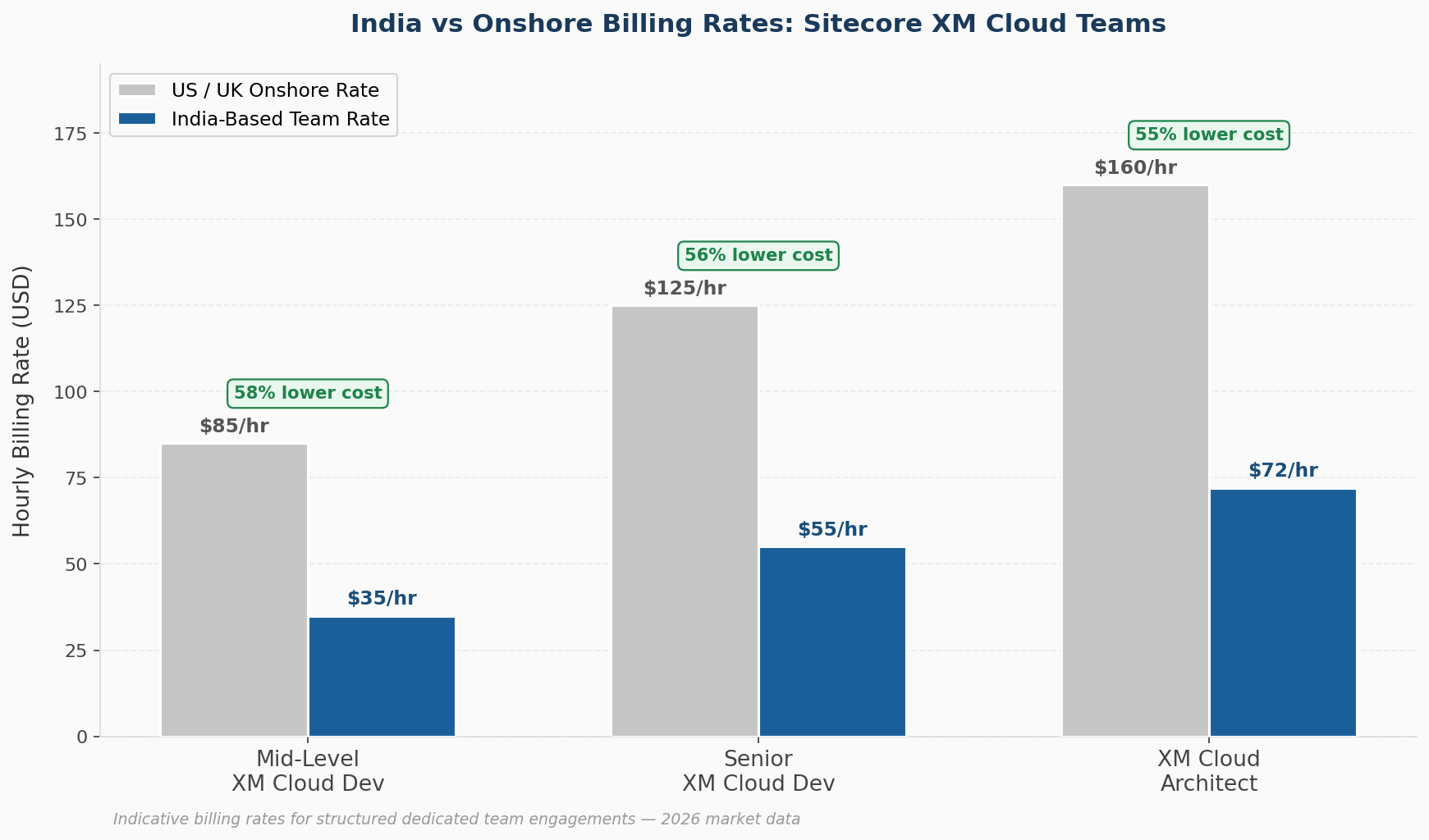
For contract or dedicated team engagements, billing rates range from $25–45/hour for mid-level to $55–80/hour for senior XM Cloud architects roughly 40–60% below equivalent UK or US onshore rates with comparable output quality on structured delivery teams.
How to Structure the Hiring and Evaluation Process
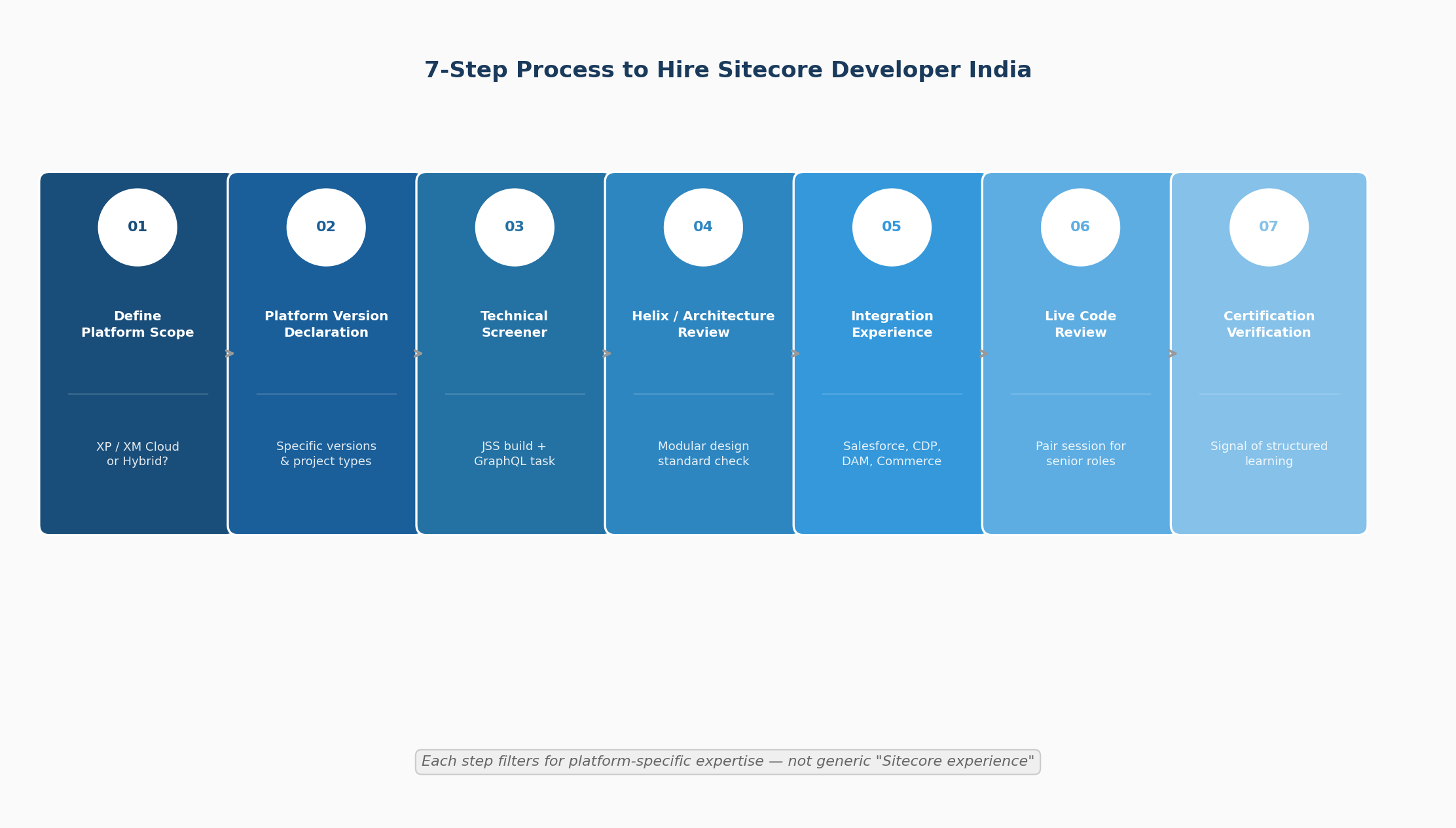
Teams that hire Sitecore developer India candidates effectively don’t rely on resumes alone. Here is a process that consistently surfaces genuine platform expertise:
- Define the platform scope first. XP maintenance, XM Cloud greenfield, or hybrid migration each requires a different profile. Write separate job descriptions for each.
- Require a platform version declaration in the application not just “Sitecore experience.” Ask for specific versions and project types.
- Use a technical screener built around the target stack. For XM Cloud: include a JSS component build question, a GraphQL schema interpretation task, and a content modeling exercise.
- Assess Helix/Helixbase knowledge for XP-track candidates it is the architectural standard, and deviations from it create long-term maintenance debt.
- Evaluate integration experience separately. Sitecore implementations rarely exist in isolation; Salesforce CRM, CDP, commerce engines, and DAM integrations are common. A developer who has only worked within Sitecore’s native feature set will struggle.
- Run a live code review or pair session before final hire decisions, particularly for senior or architect-level roles.
- Check Sitecore certification status not as a filter but as a signal of structured learning. The Sitecore 10 Developer Certification and XM Cloud-specific credentials are relevant markers.
 Real-World Application: What Structured Hiring Delivers
 Real-World Application: What Structured Hiring Delivers
Case 1: A UK-based retail group needed to migrate three brand websites from Sitecore XP 9.0 to XM Cloud within a 9-month window. By rebuilding their screening criteria around XM Cloud and Next.js-specific competencies, they assembled a 6-person India-based delivery team in under 6 weeks half the time of their prior hiring cycle and delivered the migration 3 weeks ahead of schedule.
Case 2: A North American financial services firm attempted to staff an XM Cloud project using its existing Sitecore XP contractor pool. Nine months in, the project required a complete architecture reset due to server-side rendering assumptions baked into the early codebase. Restructuring with XM Cloud-native developers added ₹1.2 crore in remediation cost. Skill-level specificity at hiring would have prevented it.
What Most Teams Get Wrong When They Hire Sitecore Developer India
The most consistent failure is treating Sitecore as a single skill. It is not. Posting a job for a “Sitecore Developer” in 2026 without specifying platform generation is equivalent to posting for a “cloud engineer” without specifying AWS, Azure, or GCP.
Three other patterns that consistently cause problems:
- Over-indexing on certification over delivery history. Certified developers with no live XM Cloud deployments are a risk on enterprise timelines. Practical project evidence beats badges.
- Ignoring front-end depth for XM Cloud projects. The Sitecore composable DXP model means your “Sitecore developer” will spend 40–60% of their time in Next.js and React. Front-end skill gaps become delivery blockers fast.
- Hiring individuals when you need a team. XM Cloud projects require parallel workstreams front-end, back-end, DevOps, content architecture. Solo developers, however strong, create bottlenecks at integration points.
FAQ: Hiring Sitecore Developers in India
What skills should a Sitecore XM Cloud developer have?
A qualified Sitecore XM Cloud developer should have hands-on experience with Sitecore JSS, Next.js or React, GraphQL content APIs, Sitecore Pages/Experience Editor in the cloud environment, and Sitecore CLI for serialization and deployment. Production delivery experience on at least one XM Cloud project is a baseline requirement for senior roles.
How much does a Sitecore developer cost in India?
Sitecore developer salary India benchmarks range from ₹12–18 lakhs annually for mid-level XP profiles to ₹45–70 lakhs for senior XM Cloud architects. Contract billing rates for dedicated teams typically range from $25–80/hour depending on seniority and platform specialization.
What is the difference between Sitecore XP and XM Cloud for hiring purposes?
Sitecore XP vs XM Cloud represents a fundamental technology shift from .NET MVC server-rendered architecture to a SaaS-native, API-first, headless delivery model. Developers skilled in one are not automatically qualified for the other. XM Cloud requires additional competencies in Next.js, GraphQL, and edge delivery that XP experience does not cover.
How to evaluate a Sitecore developer for enterprise projects?
Require platform-version-specific project history, run a technical screener targeting your actual stack, assess integration experience with systems like Salesforce or Sitecore CDP, and conduct a live coding or architecture review session before committing to a hire.
How long does it take to hire a qualified Sitecore developer in India?
For standard XP profiles, 3–5 weeks is typical. For XM Cloud-specific talent, expect 6–10 weeks given the smaller candidate pool unless working through a partner network with pre-vetted talent pipelines. Rushed hiring on XM Cloud projects is a leading cause of early-stage rework.
Is it better to hire a dedicated Sitecore development team India or individual contractors?
For enterprise implementations, a dedicated Sitecore development team India consistently outperforms individual contractor models. Parallel workstreams, internal knowledge transfer, and delivery accountability are structurally easier to manage with a structured team than with independently sourced contractors.
What are the most common mistakes when hiring a Sitecore developer for enterprise?
Not specifying platform generation, over-relying on certification without delivery evidence, ignoring front-end depth for XM Cloud work, and hiring single developers for team-scale projects. Each of these mistakes adds 2–4 months of remediation time on average.
Build the Right Team Before the Wrong One Costs You a Quarter
If your enterprise is in the process of evaluating vendors or building an in-house team to hire Sitecore developer India talent for an XM Cloud migration or multi-site deployment, the platform-specific skills gap is the risk that derails most projects at the 3–4 month mark, not budget, not timelines. Most teams discover this too late, after a quarter of delivery has already been lost to rework, re-scoping, or replacing developers who were hired against the wrong brief.
Getting the hiring brief right before sourcing begins is where engagements succeed or stall. The difference between a 6-week ramp and a 6-month delay almost always traces back to decisions made in the first two weeks of the hiring process platform version, skill weighting, team structure, and integration depth. These are not details. They are the foundation.
At Supersourcing, we have structured Sitecore delivery teams across XP, XM, and XM Cloud engagements for enterprise clients in retail, financial services, and healthcare. If you want to pressure-test your current hiring approach, validate your skill requirements before committing to a vendor, or simply get a second opinion on a brief that doesn’t feel right, we are straightforward to reach. Visit us or write directly to mayank@engineerbabu.com to start a no-commitment scoping conversation. No sales process, no pitch deck, just a direct conversation about what your project actually needs.
