

Every eighteen months, a new JavaScript runtime, meta-framework or edge database gets declared the successor to MERN. Almost none of them changed what a CTO actually does in Q1: approve headcount, and fill it fast enough that the roadmap survives. That gap between what trends on developer Twitter and what can be staffed in three weeks is the entire reason MERN is still the default in 2026.
The stack’s persistence is not sentiment; it is liquidity. Teams that choose to hire MERN stack full stack developers are usually buying a shortlist that arrives in days, not a technology they find intellectually exciting. Node.js and React remain the two most widely used web technologies in the world, which means a hiring manager writing a MERN job description is fishing in the largest talent pool in software and a manager writing a Rust one is not.
The forward-looking number that matters: the U.S. The Bureau of Labor Statistics projects employment of software developers, QA analysts and testers to grow 15% between 2024 and 2034 much faster than the average occupation with roughly 129,200 openings every year across the decade. Demand is not the constraint. Supply, speed and vetting quality are.
Contrast that with the buying experience most teams report. A role opens, three months pass, four candidates ghost the offer, two of the people who join turn out to be React developers who have never designed a Mongo schema under load, and the sprint that was supposed to ship in April ships in August with a data model that will need rewriting.
This guide is written against that failure mode. It covers the technical case for MERN in 2026 honestly including three scenarios where the answer is don’t use MongoDB and then covers the part nobody publishes: what the hire costs, how long it takes, how to test for genuine full stack ability, what the contract should say, and how to tell in week six whether it is working.
TL;DR
This guide is for engineering leaders, founders and hiring managers who have decided to build or extend a JavaScript product team and want to know whether MERN is still the right call in 2026 and what it costs to hire MERN full stack developers today. It covers the technology decision, the hiring process, the contract, and the first ninety days of delivery.
The single most useful number here: a well-run process produces an interview-ready shortlist in 7–10 working days, while the market average for a mid-level full stack role runs 6–10 weeks from job description to signed offer. That delta is where budgets and roadmaps quietly break. The cost bands attached to it, in both rupees and dollars, are in the Cost & Timeline Reality Check.
By the end you will be able to write a MERN role definition that filters correctly, run a three-stage technical screen that catches the "React developer in a full stack costume" pattern, choose between in-house, freelance and staff-augmented hiring on evidence rather than instinct, and name the five delivery metrics that tell you a hire is working before the first invoice cycle closes. One of the clearest MERN stack benefits is that all of this is measurable within a single sprint.
What Is the MERN Stack?
The MERN stack is a full stack JavaScript architecture built from four components: MongoDB as the document database, Express.js as the server framework, React as the front-end library, and Node.js as the runtime. One language, JavaScript, spans the browser, the API layer and the data-access code, so a single engineer can own a feature end to end.
Three clarifications, because these get conflated in job descriptions constantly:
- It is not a framework. MERN is a convention, not a package you install. There is no MERN CLI, no MERN release notes and no opinionated project structure which is why two MERN codebases at two companies can look nothing alike.
- It is not “React plus any backend.” A React front end talking to a Django or Spring Boot API is not MERN, and the hiring profile is completely different. The single-language advantage disappears the moment the backend is in another language.
- It is not interchangeable with MEAN. Swapping Angular for React changes the developer market, the learning curve, the rendering model and the salary band. Treated as a footnote in most comparison posts, it is the most consequential decision in the stack.
Why MERN Still Matters in 2026: The Business Case
Stack decisions get argued on technical merit and settled on operational reality. These are the outcomes that move when a team commits to MERN rather than a polyglot alternative:
- Compressed time-to-first-release. Teams that share one language across client and server cut handoff overhead materially. In the engagements we have run, a two-person MERN pod ships a functioning authenticated CRUD product with a deployment pipeline in 4–7 weeks; the same scope split across a separate front-end and back-end team with an API contract negotiation in the middle typically runs 8–12 weeks.
- Lower total headcount at the same scope. One competent full stack engineer covering React and Express replaces the 1.5–2 specialists most orgs default to. At Indian mid-level rates, that is ₹12–20 lakhs per year of avoided cost per role and one fewer coordination surface.
- A shallower AI-assistance gradient. JavaScript and React have the deepest public training corpus of any stack, so AI coding assistants produce materially more usable output here than in niche ecosystems. That widens the productive range of a mid-level engineer and makes senior review time the bottleneck rather than typing speed.
- Replaceability as risk management. The commercial argument for MERN is not that it is the best-engineered stack; it is that a departing engineer can be replaced in weeks instead of a quarter. For a Series A company with eighteen months of runway, that is a survival property. When clients ask us to hire MERN stack developers rather than commit to a more exotic pairing, this is almost always the stated reason.
The honest counterweight: none of these benefits apply to a workload that needs strong transactional guarantees, complex joins or heavy analytical querying. That case is handled directly in the “Where MERN Actually Wins” section skipping it is how teams end up migrating off MongoDB in year two.
The Core Problem Most Buyers Face
Almost nobody fails at buying MERN because they chose the wrong database. Teams that set out to hire MERN stack full stack developers fail because they bought a job title instead of a capability, and discovered the difference at the worst possible moment.
Four failure patterns show up repeatedly across the engagements we have run:
- The full stack label is unverified. Roughly a third of self-identified full stack candidates in the volume market are front-end engineers who have consumed APIs but never designed one. They pass a React interview comfortably and then cannot explain why an unindexed query on a 2-million-document collection took the site down.
- Data modelling effort gets underestimated by 3–4x. Teams budget days for schema design and spend weeks. MongoDB’s flexibility means bad decisions are cheap to make and expensive to reverse: embed a growing array, hit the 16 MB document ceiling in month eight, and now you are writing a migration against live traffic.
- The hiring calendar is planned from the offer date, not the join date. The sequence that actually applies is sourcing → screening → interviews → offer → notice period → onboarding → productive output. Indian notice periods run 30–90 days. A “we hired in three weeks” story routinely means the first useful commit landed four months after the requisition opened.
- Attrition is priced at zero. A mid-level engineer leaving in month five costs the salary paid, the recruiting fee, the ramp-up time of the replacement, and the context that walked out the door conservatively 1.5 — 2x the annual cost of the role. Most hiring plans model none of it.
The pattern underneath all four: MERN is easy to start and unforgiving to staff badly. The stack lets a mediocre engineer produce working software quickly, which delays the moment you find out. The walkthrough below is structured to move that moment forward into the screening stage, where it is cheap.
Where MERN Actually Wins in 2026 (and Where It Doesn’t)
Stack fit is decided by the shape of the data and the shape of the read/write pattern, not by the industry. These are the MERN stack use cases that hold up under production load, and the three that reliably don’t.
Strong fit pick MERN with confidence:
- Content and catalogue products with variable schemas. Marketplaces, listings platforms, CMS-backed products, learning platforms. Every item has different attributes, and the document model absorbs that without thirty nullable columns.
- Real-time collaborative and social features. Node’s event loop plus WebSockets handles many concurrent, low-computation connections efficiently, chat, notifications, live dashboards, and presence indicators.
- Event, telemetry and log-shaped writes. High-volume append-heavy workloads where each record is self-contained and reads are mostly by key or time range.
- MVPs and products with unsettled requirements. When the schema will change eleven times before product-market fit, migration-free iteration is worth more than referential rigour.
- Internal tools and admin portals. Speed of construction dominates; the data volume rarely justifies anything heavier.
Poor fit choose differently, or split the workload:
- Money movement and ledgering. Anything requiring multi-entity ACID transactions as the normal path, not the exception. MongoDB supports multi-document transactions, but building a core ledger on them means fighting the tool’s grain. Use PostgreSQL for the ledger; keep Node and React for the application layer.
- CPU-bound workloads. Video transcoding, large-scale numerical computation, ML training. Node’s single-threaded model is the wrong shape; offload to Python or Go workers.
The hybrid answer most mature teams land on: React and Node stay; the database is chosen per service. Roughly half the “we outgrew MERN” stories are really “we used MongoDB for a relational problem.” Keeping the language monoculture while allowing polyglot persistence preserves the hiring advantage without paying for the modelling mismatch.
How to Hire MERN Stack Full Stack Developers: The Full Walkthrough
Six phases, in order. Each one has a gate to a specific thing that must be true before spending money on the next phase. Teams that skip a gate almost always pay for it two phases later.
Phase 1 Defining requirements before you write a job description
Most job descriptions written to hire MERN stack full stack developers are unusable because they list the four technologies and nothing about the work. That produces high applicant volume and low signal, which is the worst combination. Fix it before sourcing starts.
Define the role against these five axes:
- Scope of ownership. Feature-level (implements to spec), service-level (owns an API and its data model), or product-level (makes architectural calls). This single choice moves the salary band by 60–100%.
- Where the load is. Front-end-heavy (60/40 React), backend-heavy (60/40 Node/Mongo), or genuinely balanced. Balanced roles are the hardest to fill and the most expensive per unit of output only specify one when the work genuinely requires it.
- Non-negotiable adjacencies. TypeScript, Next.js, AWS or GCP deployment, Docker, CI/CD ownership, GraphQL. In 2026, TypeScript should be treated as a baseline for any codebase expected to live past eighteen months, not as a bonus skill.
- Compliance and domain constraints. HIPAA, PCI-DSS, SOC 2, GDPR, RBI data-localisation rules. These change the vetting bar and the rate band, not just the paperwork.
- Time zone overlap required. Four hours of overlap is a different market and a different price than “async-first.”
The MERN stack developer skills matrix mid-level baseline for 2026:
| Layer | Must have | Strong signal | Not required |
| React | Hooks, component composition, state management, controlled re-render debugging | Server Components, Suspense boundaries, bundle-size discipline, Core Web Vitals awareness | Redux specifically |
| Node / Express | Middleware chains, auth flows (JWT/OAuth 2.0), error handling, async patterns beyond await | Rate limiting, queue workers, structured logging, graceful shutdown | Writing a framework from scratch |
| MongoDB | Schema design for access patterns, indexing, Mongoose modelling, explain() reading | Aggregation pipelines, replica-set behaviour, migration strategy | DBA-level sharding operations |
| Delivery | Git workflow, code review, testing basics, reading a CI failure | Docker, IaC exposure, on-call participation | Kubernetes administration |
If the role skews the front-end after this exercise, stop and hire ReactJS developers instead; a specialist at 100% relevance beats a generalist at 60%, and costs less.
Budget bands to set before sourcing (2026, verify against current benchmarks):
- India, mid-level (3–5 yrs): ₹12–22 lakhs/year full-time; $18–28/hour through a staffing partner
- India, senior (6–9 yrs): ₹25–45 lakhs/year; $30–45/hour
- US/Western Europe, mid-level: $95,000–135,000/year
- US/Western Europe, senior: $140,000–185,000/year
Phase 1 gate: a one-page role definition that a technical interviewer who has never met you could screen against. If two engineers on your team read it and disagree about whether a given candidate qualifies, it is not done.
Phase 2 Sourcing and vetting: catching the mislabelled full stack developer
Volume is not the problem in this market; discrimination is. Screening for MongoDB Express React Node hiring is not about finding someone who can list the four technologies, it is to find someone who has made a data-modelling decision they later had to live with.
The three-stage funnel that works:
- Stage 1 Async technical screen (45 minutes, no live pressure). A small take-home or a code-reading exercise. Best version: hand them a working repo with a deliberately bad schema and an N+1 query, and ask them to write a one-page review. This tests judgement rather than recall, and it is very hard to fake with an AI assistant because the answer depends on the specific code.
- Stage 2 Live pair-programming round (60 minutes). Extend an existing Express endpoint against a real Mongo collection. Watch how they read unfamiliar code, whether they check indexes before optimising, and whether they ask about access patterns before designing.
- Stage 3 System design and scope conversation (45 minutes). For anything above feature-level: “design the data model for X, then tell me what breaks at 100x volume.” The answer you want includes the word access pattern.
Red flags with high predictive value from actual screening cycles:
- The “it depends on requirements” deflection on every design question, with no attempt to state an assumption and commit. Real practitioners assume, then qualify.
- Cannot describe a single production incident they were involved in. Anyone with three years of genuine backend exposure has a 2 a.m. story. No story usually means no production ownership.
- Embed everything. Asked to model a user with orders, they nest orders inside the user document without asking about growth or read patterns. This one predicts the year-two rewrite more reliably than any other signal.
- React fluency with zero deployment vocabulary. They cannot describe what happens between git push and the code being live. Front-end engineer, mislabelled.
- Résumé stack inflation. Nine technologies listed, three years of experience. Ask which one they would defend in a code review; watch the list shrink.
The screening friction nobody warns you about: in the volume Indian market, AI-assisted take-homes have made asynchronous coding tests substantially less predictive since 2024. Two adjustments restore signals make the take-home a review rather than a build, and add a ten-minute live walkthrough where the candidate explains their own submitted code. Candidates who did not write it cannot narrate it.
For backend-weighted roles it is usually more efficient to hire Nodejs developers against a deep server-side bar and pair them with a front-end specialist, rather than searching for a unicorn who is genuinely strong at both. Our own funnel surfaces roughly the top 2% of vetted candidates and produces an interview-ready shortlist in 7–10 working days. The compression comes from having already run stages 1 and 2 before you see a resume.
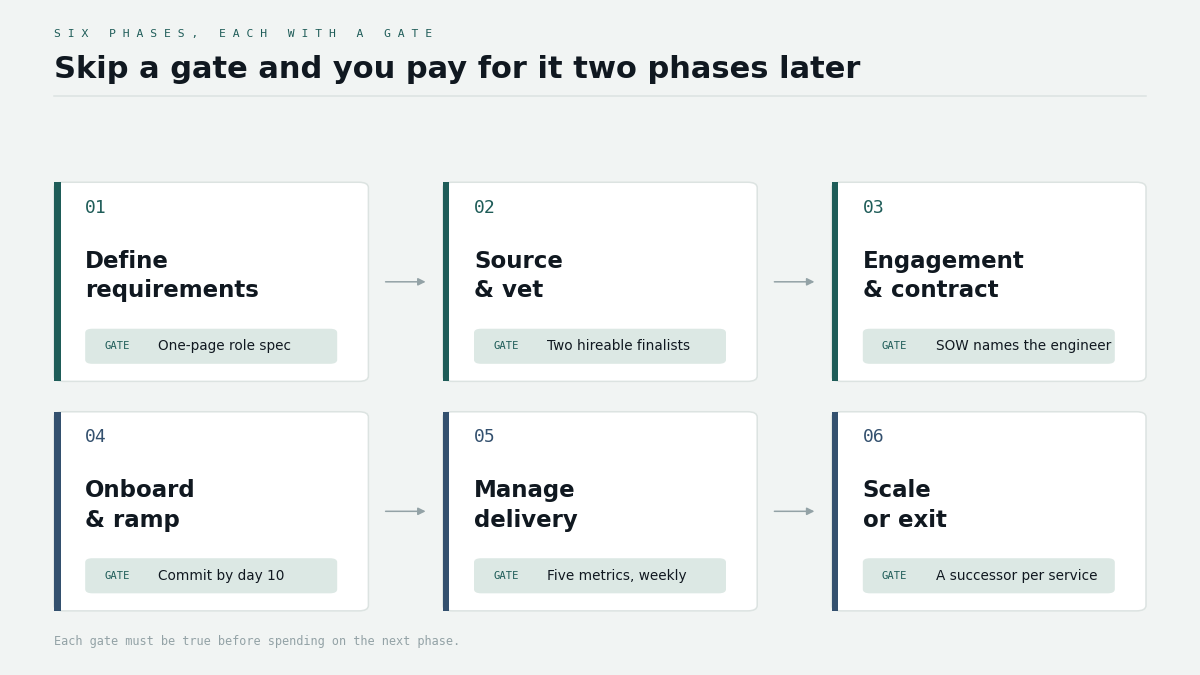
Phase 2 gate: at least two candidates you would hire, not one. A single-candidate shortlist is a negotiation position you have already lost.
Phase 3 Engagement models and contract terms
The engagement model determines cost predictability, control and exit cost. Pick it against how stable your scope is, not against which is cheapest per hour.
| Model | Cost profile | Control | Best when | Real risk |
| In-house full-time | Highest total (salary + benefits + overhead + hiring cost) | Full | Core product IP, 2+ year horizon | 8–14 week fill time; attrition resets it |
| Staff augmentation | ₹/$ per person per month, predictable | High you manage them directly | Known scope, existing engineering leadership | Bad partner = bench-quality engineers |
| Dedicated team / pod | Per-pod monthly, includes coordination | Medium-high you set priorities | Scaling a roadmap without building a hiring function | Weak account management turns it into a black box |
| Project / fixed-bid | Fixed, tied to a defined SOW | Low vendor controls execution | Genuinely fixed, well-specified scope | Every change is a change order |
| Freelance / marketplace | Lowest hourly, highest variance | Low | Short bounded tasks, prototypes | Shared bandwidth; no continuity or accountability |
Contract terms worth negotiating specifically these are the ones that matter in disputes:
- IP assignment on creation, not on payment. Default marketplace terms often vest IP only after final invoice clearance. Fix the clause.
- Named-resource commitment with no shared bandwidth. Written explicitly: this engineer is allocated to you, not split across three accounts. Silent bench-sharing is the most common quality failure in staff augmentation.
- Replacement window with a stated SLA. A replacement guarantee within 7–10 days of a fit issue being raised is a meaningfully different promise from “we’ll work with you on it.”
- Notice period symmetry. If you owe 60 days and they owe 15, you are carrying all the transition risk.
- Repository, credential and knowledge-transfer terms at exit. Documentation obligations written into the SOW, not requested after the relationship sours.
- Data handling and localisation. Where code and customer data physically sit, especially under GDPR or RBI localisation rules.
Teams comparing partners will find the differences concentrated in these clauses rather than in the rate card a useful lens when evaluating IT staffing services proposals side by side.
Phase 3 gate: a signed SOW that names the individual, the replacement SLA and the IP assignment trigger. Rate is the least interesting number on the page.
Phase 4 Onboarding and ramp-up: the first two weeks decide the engagement
Ramp-up is the most under-managed phase in technical hiring and the one with the highest leverage. A structured first fortnight moves the first meaningful production commit from week five to week two. The mechanism is unglamorous: remove every blocker before the engineer arrives, then give them something real to ship immediately.
Day-zero checklist complete before the start date, not on it:
- Repository access, cloud console access (read-only first), CI/CD visibility, staging environment credentials
- Local environment runnable from a documented script; if setup takes a senior engineer more than two hours, fix the script rather than the onboarding doc
- Seeded local or staging database with realistic volume not an empty collection
- Named onboarding buddy with explicitly protected calendar time for the first ten working days
- One pre-selected starter ticket: real, small, shippable, touching both React and an Express endpoint
Week-by-week ramp expectations:
| Period | Expected output | Warning sign |
| Days 1–3 | Environment running; first PR opened (docs, small fix) | Still blocked on access on day 3 |
| Days 4–10 | Starter ticket merged to production; participating in code review | No merged PR by day 10 |
| Weeks 3–4 | Owns a small feature end to end; asks domain questions, not setup questions | Questions are still about tooling |
| Weeks 5–8 | Delivering at roughly 70–80% of steady-state velocity | Velocity flat since week 3 |
| Week 12 | Steady state; can be the reviewer rather than the reviewed | Still requires rework on most PRs |
The onboarding friction we see most often in distributed MERN teams: the environment-setup gap. The existing team has accumulated undocumented local configuration over two years, and the new engineer loses four to six days to it. Every hour spent scripting a one-command setup returns roughly a day per subsequent hire and it is the single cheapest intervention available to a dedicated team planning to add three or more engineers.
Communication cadence to establish in week one:
- Daily async written standup blockers first, in writing, in a channel
- Two fixed overlap hours if time zones differ by more than four
- Weekly 30-minute one-to-one for the first six weeks, then fortnightly
- A single named escalation contact on both sides
Phase 4 gate: a production commit from the new engineer within ten working days.
Phase 5 Managing delivery: five metrics that tell the truth
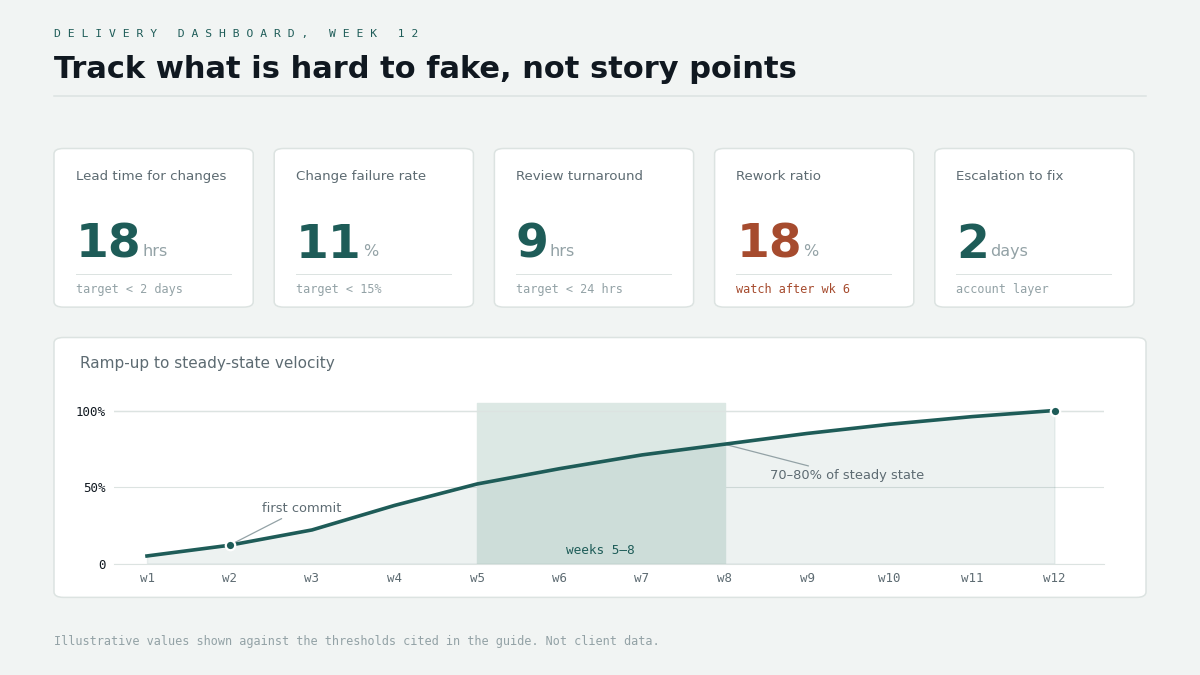
Story points are gameable and velocity charts flatter everyone. Track outcomes that are hard to fake instead. Four of these five come straight from DORA research and apply cleanly to a MERN pod.
The five-metric delivery dashboard:
- Lead time for changes committed to production. A healthy MERN pod on a modern pipeline runs hours to two days. Weeks means the release process is the problem, not the people.
- Change failure rate percentage of deployments causing an incident or rollback. Above roughly 15% and the testing gate is decorative.
- Code review turnaround median time a PR waits for first review. Anything beyond 24 hours quietly halves effective throughput regardless of headcount.
- Rework ratio percentage of merged work revisited within 30 days. The clearest early signal of a vetting miss, usually visible by week six.
- Escalation-to-resolution time: how long a raised concern takes to change something. This measures the account management layer, not the engineer.
Reporting cadence that scales without becoming theatre:
- Weekly: written delivery note shipped, in progress, blocked, decisions needed
- Fortnightly: sprint review with a working demo, not slides
- Monthly: metric review against the five above plus commercial reconciliation
- Quarterly: capability review what the pod can now own that it could not last quarter
Red flag: a partner that reports activity (hours logged, tickets touched) rather than outcomes. Dedicated account managers exist to convert the second into the first for you; if you are assembling the picture yourself from Jira, you are paying for IT staffing and doing the management.
Phase 6 Scaling up or exiting cleanly
Both directions need to be designed before you need them. The exit plan is what makes the scale-up decision reversible, which is what makes it affordable.
Scaling checklist before adding headcount:
- Confirm the constraint is capacity, not clarity. Adding engineers to an unclear roadmap slows delivery.
- Add in pairs where possible; a lone new engineer in an established pod ramps slower than two who can debug together.
- Cap growth at roughly 50% pod size per quarter beyond that, review capacity becomes the bottleneck.
- Promote a technical lead from inside the pod before it exceeds five engineers.
- Re-run the environment-setup script as a hiring readiness test, not an afterthought.
Replacement and offboarding:
- Raise fit concerns in writing by week six, with specific examples tied to the five metrics. Vague dissatisfaction at month four is a much weaker position, contractually and practically.
- A replacement guarantee with a 7–10 day SLA only functions if the concern was documented; keep the paper trail from week two.
- Require a written handover: architecture notes, open decisions, known issues, credential inventory. Two days of the departing engineer’s time saves two weeks of the successor’s.
- Revoke access on the last working day, not the last calendar day of the month.
Phase 6 gate: you can name, today, who would take over each service if its owner resigned tomorrow. If you cannot, the risk is concentration, not staffing.
Case Studies
Three engagements where the constraint was hiring speed and vetting quality rather than the technology itself. Metrics first.
100+ engineers hired for Paytm across a sustained scale-up. Fintech hiring at that volume usually breaks on offer-stage drop-off candidates accept, then renege during a 60-day notice period. The work here was funnel discipline: pre-vetted pipelines maintained ahead of requisition, and offer-stage engagement managed rather than assumed. Across our contract placements, candidate drop-off stays under 1% and the joining rate sits at 98%, which is what makes volume hiring plannable rather than hopeful.
Swiggy’s engineering scale-up during a high-growth phase. The requirement was React and Node-heavy product engineers at a cadence the internal talent team could not sustain alongside its existing load. Running sourcing and first-round technical screening externally kept the internal team on closing and culture assessment the part that cannot be outsourced. The measurable outcome was a shortlist cycle compressed to days rather than weeks, sustained across multiple parallel roles.
OkCredit’s core engineering hiring under startup constraints. A lean team with no dedicated recruiting function needed senior JavaScript engineers who could own services independently from week one. Screening was weighted toward production-ownership evidence, incident history, on-call experience, schema decisions defended in review rather than algorithm puzzles. Supersourcing has delivered 527+ IT projects and engagements of this type across fintech, healthtech and e-commerce, and the pattern is consistent: for teams under ten engineers, vetting depth matters more than pipeline volume.
MERN vs MEAN vs the Alternatives: A Decision Framework
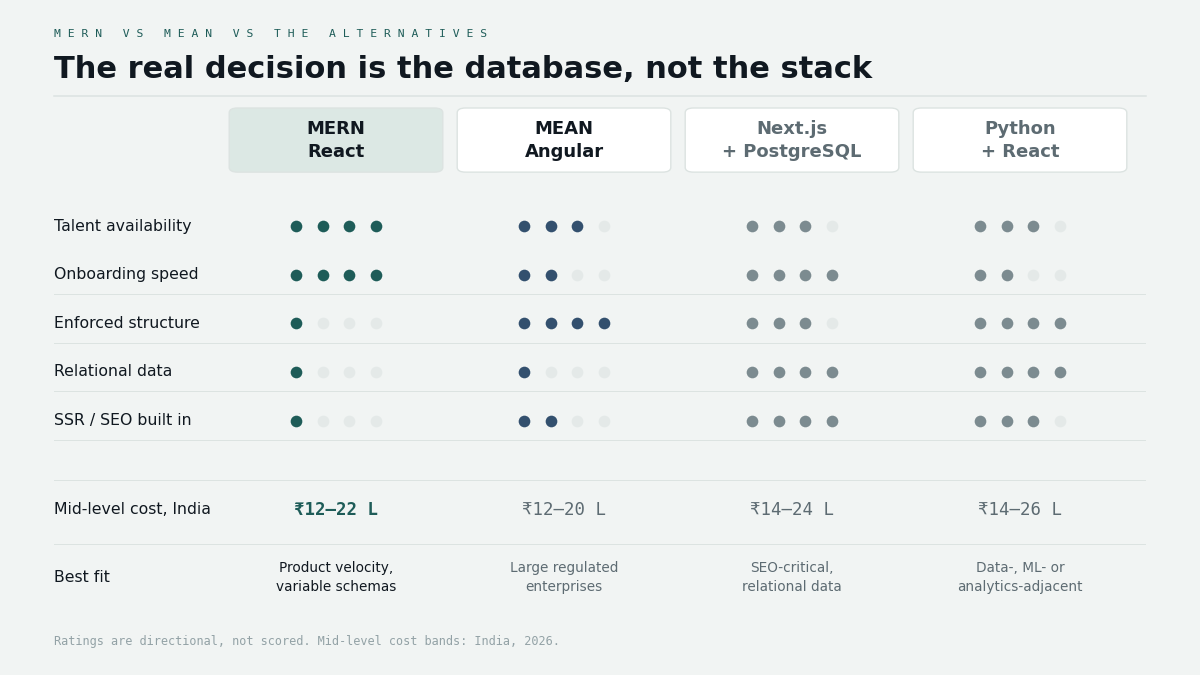
The MERN vs MEAN question is usually asked as a technology comparison and should be answered as a hiring and rendering comparison. Angular is a batteries-included framework with strong conventions; React is a library that demands architectural decisions from you. That difference propagates into everything, including who you can hire.
| Dimension | MERN (React) | MEAN (Angular) | Next.js + PostgreSQL | Python (Django/FastAPI) + React |
| Talent availability | Largest pool globally | Solid but narrower; enterprise-concentrated | Growing fast; overlaps MERN heavily | Deep, but full stack overlap is thinner |
| Onboarding speed for new hires | Fast most JS devs know React | Slower Angular’s conventions take weeks | Fast if the team knows React | Two-language context switch |
| Enforced structure | Low you design it | High the framework decides | Medium-high | High on the backend |
| Relational data handling | Weak by default | Weak by default | Strong | Strong |
| SSR / SEO out of the box | Requires Next.js | Requires Angular Universal | Native | Native templating |
| Typical mid-level cost (India) | ₹12–22 L | ₹12–20 L | ₹14–24 L | ₹14–26 L |
| Best fit | Product velocity, variable schemas, real-time | Large regulated enterprises, big teams needing uniformity | Content-heavy or SEO-critical products with relational data | Data-, ML- or analytics-adjacent products |
Apply this in four questions, in order:
- Is the data relational at its core? Yes → keep React, replace MongoDB with PostgreSQL. This resolves more architecture debates than anything else on the list.
- Does organic search drive acquisition? Yes → Next.js is not optional. Client-rendered React remains a measurable SEO handicap.
- Will the team exceed roughly twenty engineers on one codebase? Yes → Angular’s enforced structure has real value, and it is worth pricing what it costs to hire MEAN stack developers before defaulting to React.
- Is anyone on the team already senior in one of these? Yes → weight that heavily. An existing senior who has operated the stack in production outperforms a theoretically better stack nobody has run.
The framing that saves the most money: MERN and “Next.js plus a relational database” are no longer opposing choices. Next.js is React with server rendering; the real decision is the database. Teams that frame it as a database decision rather than a stack decision make it correctly about twice as often.
What Most Teams Get Wrong
The dominant mistake is treating MERN as a technology decision that happens to have hiring consequences. It is a hiring decision that happens to have technology consequences. Teams that internalise the inversion stop asking “is MERN still good in 2026” and start asking the operational version: “can I staff, vet and replace this stack in my market, at my budget, within my roadmap window” which is the question that actually determines whether the project ships.
Five patterns, in rough order of how much they cost:
- Optimising the rate card instead of the vetting bar. A $22/hour engineer who needs 40% senior review time is more expensive than a $34/hour engineer who reviews others. The cheap hire shows up as a discount on the invoice and a tax on your senior engineers’ calendars, where nobody measures it.
- Buying “full stack” without defining the ratio. A genuinely balanced full stack engineer is rare and priced accordingly. Most teams need 70/30 in one direction and would be better served by a specialist plus a generalist than by two mislabelled generalists.
- Choosing MongoDB by default because it is the M in MERN. The acronym is a convention from 2015, not a recommendation for your data. Half the “we outgrew MERN” postmortems are relational data forced into documents.
- Treating the first ninety days as the engineer’s problem. Ramp-up is an operational responsibility of the hiring team. Environment setup, a real starter ticket and a named buddy are the difference between week-two output and week-six output and the cost of that gap is roughly a month of salary per hire.
- Confusing time-to-offer with time-to-productivity. A 10-day shortlist followed by a 60-day notice period and a 5-week ramp is not a 10-day hire. Plan backwards from the sprint that needs the output.
The contrarian read: MERN’s technical ceiling has been the wrong thing to argue about for at least three years. Its actual competitive advantage in 2026 is that it is the most replaceable stack in production software. Replaceability is not a compliment about elegance, it is a risk property, and for any team where a single resignation could stall the roadmap, it is worth more than any benchmark.
Cost & Timeline Reality Check
Budgets for MERN stack hiring fail on the numbers nobody publishes, so every figure below is a range observed in the market as of 2026 re-benchmark it before it goes into a board deck. Where a figure varies too much to state usefully, the driver is described instead.
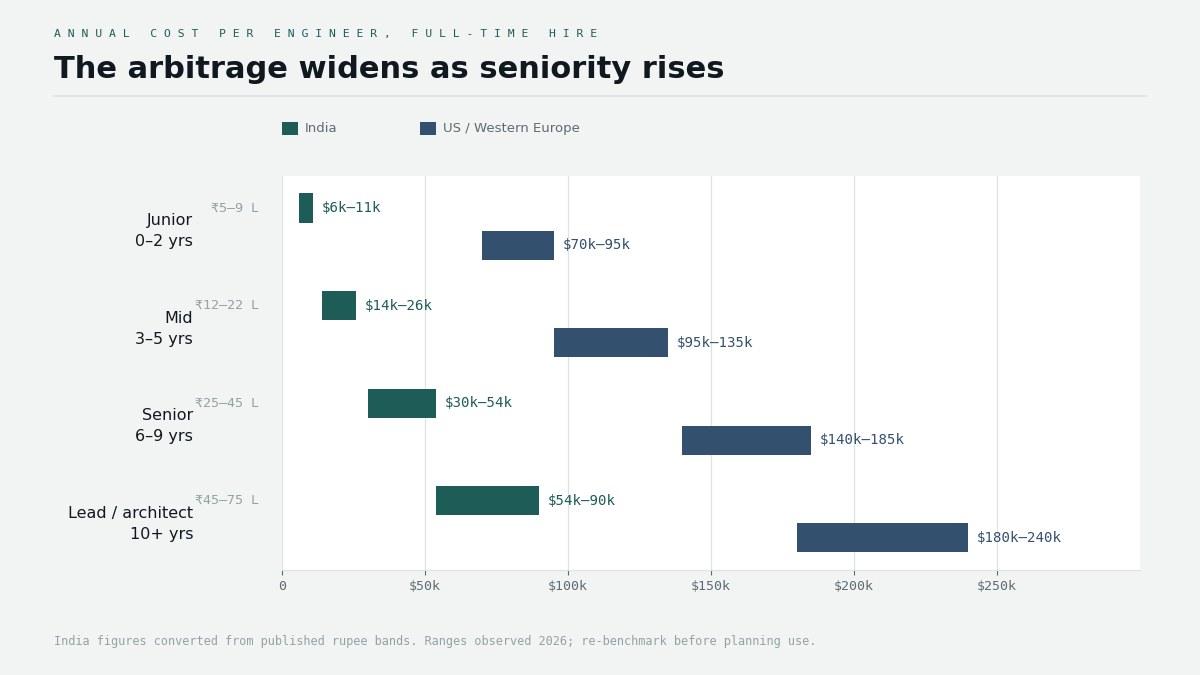
MERN stack developer cost annual salary, full-time hire:
| Level | India (₹/year) | India ($/year equiv.) | US / W. Europe ($/year) |
| Junior (0–2 yrs) | ₹5–9 L | $6k–11k | $70k–95k |
| Mid (3–5 yrs) | ₹12–22 L | $14k–26k | $95k–135k |
| Senior (6–9 yrs) | ₹25–45 L | $30k–54k | $140k–185k |
| Lead / architect (10+ yrs) | ₹45–75 L | $54k–90k | $180k–240k |
Billing rates through a staffing or dedicated-team partner (India-based talent):
| Level | Hourly | Monthly (full-time equivalent) |
| Mid-level | $18–28 | $3,000–4,600 |
| Senior | $30–45 | $5,000–7,500 |
| Tech lead | $45–65 | $7,500–10,500 |
Add-ons that materially change the total: dedicated QA (typically 0.5 FTE per 3 engineers), DevOps (0.25–0.5 FTE per pod), and design. A “two developers” budget that omits these is short by roughly 25–35%.
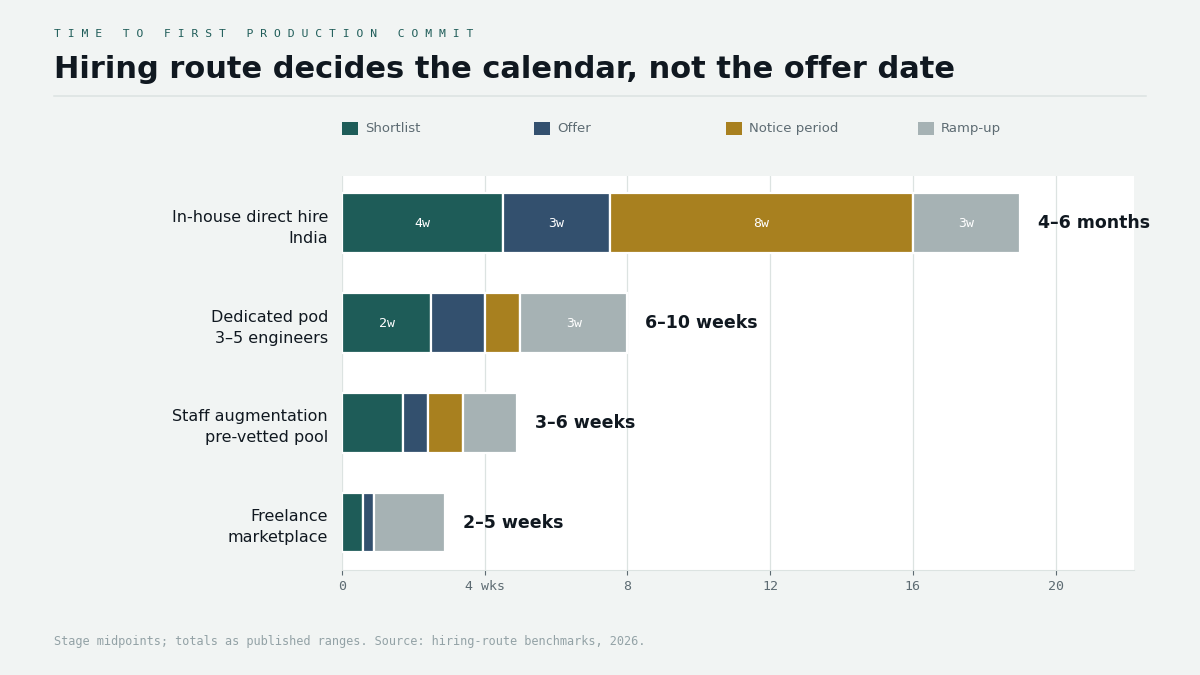
Timeline by scenario job description to first production commit:
| Scenario | Shortlist | Interview to offer | Notice period | Ramp | Total to first commit |
| In-house direct hire, India | 3–6 weeks | 2–4 weeks | 30–90 days | 2–4 weeks | 4–6 months |
| Staff augmentation, pre-vetted pool | 7–10 working days | 3–7 days | 0–2 weeks | 1–2 weeks | 3–6 weeks |
| Freelance / marketplace | 2–7 days | 1–3 days | 0 | 1–3 weeks | 2–5 weeks (highest variance) |
| Dedicated pod (3–5 engineers) | 2–3 weeks | 1–2 weeks | 0–2 weeks | 2–4 weeks | 6–10 weeks |
What drives cost up:
- Genuine full stack balance rather than a 70/30 skew (+15–25%)
- Compliance domains HIPAA, PCI-DSS, RBI localisation (+10–20%)
- Four or more hours of forced time-zone overlap (+10–15%)
- Niche adjacencies stacked onto the role: Kubernetes, ML integration, blockchain (+20–40%)
- Sub-four-week start requirement (+10–15%, or a quality compromise)
What drives cost down:
- Tier-2 Indian cities Indore, Coimbatore, Jaipur where cost arbitrage runs 20–30% below Bengaluru for comparable mid-level talent
- Committing to a six-month-plus engagement instead of month-to-month
- Accepting a 70/30 skew and pairing complementary engineers
- Async-first working with two overlap hours instead of five
The number most teams miss entirely: the fully loaded cost of a wrong hire discovered at month five runs 1.5 — 2x the annual cost of the role once you count salary paid, recruiting cost, ramp time, the replacement’s ramp, and lost roadmap time.
A partner-side replacement guarantee inside 7–10 days exists to cap exactly that exposure which is why the clause matters more than the rate.
Your Next Step If You’re Mid-Decision
Most teams reading this are at one of two decision points. If the open question is still should we build this on MERN, run the four-question framework above the answer usually turns on whether your core data is relational, and that question is answerable in an afternoon with your own schema in front of you.
If the stack is settled and the constraint is people, the useful next step is a calibrated role definition and a look at what the market will actually deliver against it. That means a defined skills matrix, a real cost band for your seniority mix, and a timeline that counts notice periods honestly rather than optimistically.
If it helps to pressure-test that against a pool of engineers already vetted to hire MERN stack full stack developers against, Supersourcing’s team can put an interview-ready shortlist in front of you in 7–10 working days, with the replacement terms and named-resource commitments described in Phase 3 written into the engagement rather than promised verbally.
One next step: book a consultation with your role scope and timeline, and ask for the shortlist calibration before you ask for the rate card. The teams that get this right almost always start there.
FAQ
Is the MERN stack still worth using in 2026?
For product-velocity work with variable schemas, yes. The technical arguments against it have narrowed to the database, not the stack: React and Node remain the two most-used web technologies in the world. Keep React and Node; choose the database on the data’s shape. If your core entities are relational, use PostgreSQL and keep the JavaScript monoculture everywhere else.
How much does it cost to hire MERN stack developers in India?
Mid-level full-time salaries run ₹12–22 lakhs per year and senior ₹25–45 lakhs. Through a staffing partner, expect $18–28 per hour for mid-level and $30–45 for senior, billed as a monthly full-time equivalent. Compliance requirements, forced time-zone overlap and niche adjacencies each add 10–25%.
How long does it take to hire MERN stack full stack developers?
Through a pre-vetted pool, 7–10 working days to an interview-ready shortlist and 3–6 weeks to first production commit. A direct in-house hire in India realistically takes 4–6 months end to end, because the 30–90 day notice period sits between the offer and the start date. Plan backwards from the sprint that needs the output.
What is the real difference between MERN and MEAN?
React versus Angular, and everything that follows from it. React gives you a larger talent pool, faster onboarding and architectural freedom you must exercise deliberately. Angular gives you enforced structure that pays off past roughly twenty engineers on one codebase and in regulated enterprise environments where uniformity beats flexibility.
How do I test whether a candidate is genuinely full stack?
Give them a working repository with a deliberately bad schema and an N+1 query, and ask for a written review. Judgement is hard to fake and hard to outsource to an AI assistant, because the answer depends on that specific code. Follow with a live walkthrough of their own submission candidates who did not write it cannot narrate it.
When should I not use MongoDB in a MERN application?
Three cases: money movement requiring multi-entity transactions as the normal path, reporting-heavy products whose value is analytical querying across related entities, and anything where a compliance auditor will ask for referential guarantees. In all three, keep Node and React and put the ledger or the warehouse in PostgreSQL.
What happens if the developer we hire isn’t a fit?
With a direct hire, you absorb the full cost typically 1.5 — 2x annual salary once ramp and re-hiring are counted. With a staffing engagement, a documented replacement SLA transfers that risk; ours is 7–10 days. The condition is documentation: raise concerns in writing by week six, tied to specific delivery metrics, not at month four in general terms.
Can I start with one MERN developer and scale later?
Yes, and it is usually the right sequence provided the first hire is senior enough to set the architecture the next three will inherit. A junior first hire optimises for this month’s budget and creates a codebase that slows every subsequent engineer. If the budget only supports one person, buy seniority and reduce scope.
