

As of March 31, 2026, standard support for Informatica PowerCenter 10.5 is gone. Extended support buys most enterprises one more year of paid fixes before the platform enters sustaining mode, where even critical patches stop. That is not a distant deadline on a roadmap slide, it is a clock that has already started, and the engineers who can carry your pipelines across it are not the same engineers who built them.
That distinction is where most data integration leads lose six months. The instinct is to redeploy the existing PowerCenter team onto the cloud platform and assume the skills transfer. They partially do. But the operating model underneath Informatica’s cloud stack is different enough that treating migration as a lift-and-shift staffing exercise is the single most expensive assumption an enterprise can make this year. The decision to hire IICS developer India talent rather than retrain on the fly is increasingly the difference between a clean cutover and a stalled program.
Hire IICS developer India is where many organizations are redirecting their hiring strategy but success depends on understanding that cloud-native integration demands a different skill set than traditional ETL development.
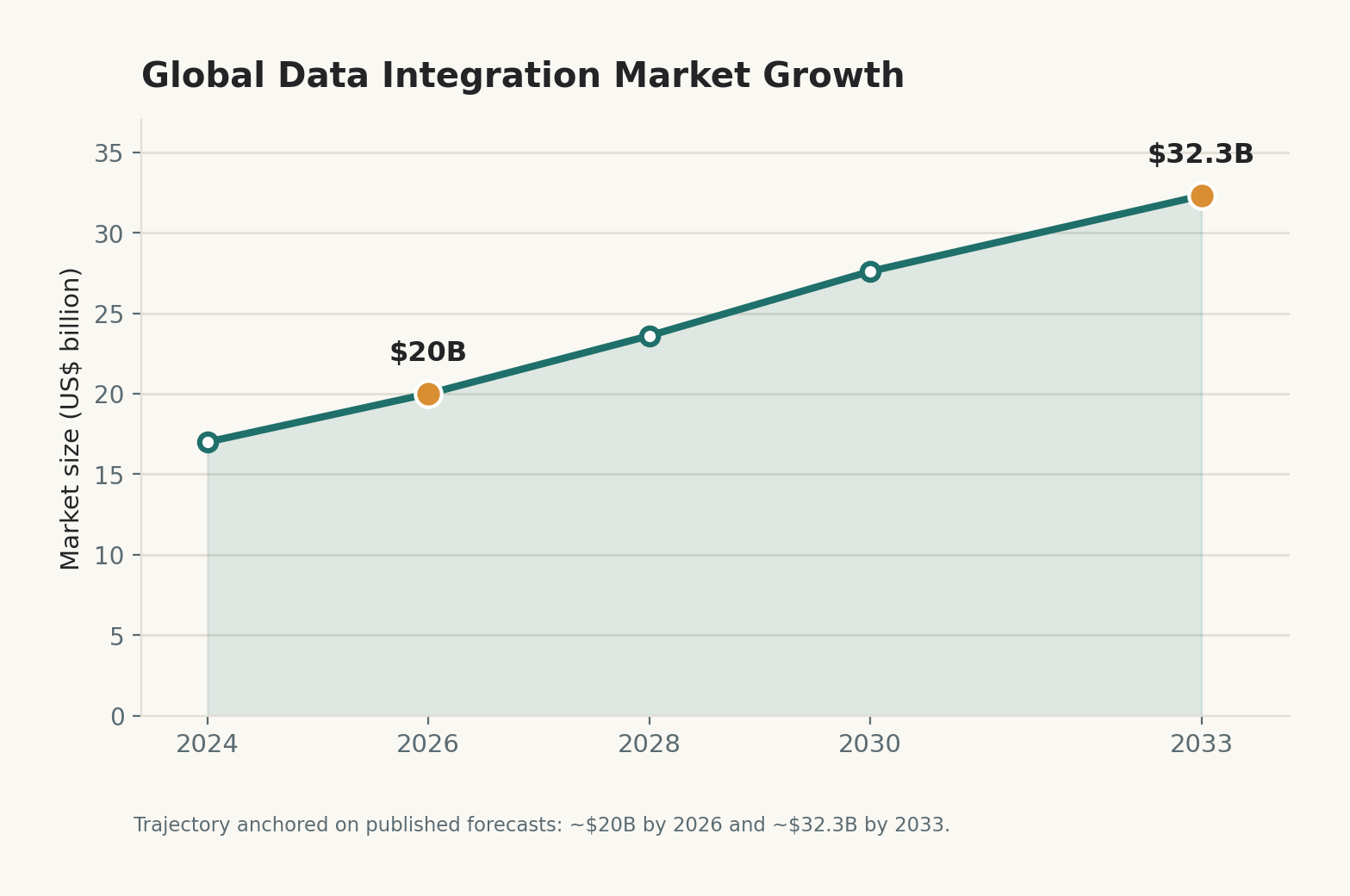
The urgency is reflected in market growth. According to Statista data integration market forecast, the global data integration software market is projected to exceed $20 billion by 2026, driven by cloud adoption and real-time data processing needs.
The takeaway: IICS hiring is not a continuation of legacy staffing; it is a shift to a new integration paradigm that requires specialized expertise from day one.
That acquisition reshaped the hiring math overnight. The vendor that owns IICS now also owns MuleSoft, which means the “which integration skill set do I recruit for” question is no longer a comparison between two companies, it is a portfolio decision inside one. Read the next section before you post a single job description, because the title you advertise is probably wrong.
What Is an IICS Developer?
An IICS developer is a data integration engineer who designs, builds, and operates pipelines on Informatica Intelligent Cloud Services, the cloud-native suite within Informatica’s IDMC platform. They construct ETL and ELT mappings, configure connectors and Secure Agents, and manage cloud data and application integration workloads, replacing the on-premise work historically done in PowerCenter.
The Core Problem: A Sunset Deadline Meets a Thin Talent Pool
The challenge is not that cloud data integration is hard to learn. It is that the migration window and the hiring window are colliding at the same moment, and the second one is tighter than leaders expect.
Here is the squeeze in plain numbers. The PowerCenter standard-support cutoff was March 31, 2026. Most large migrations run 12 to 18 months end to end once you account for assessment, re-platforming reusable mappings, parallel runs, and decommissioning. If you are starting your sourcing in mid-2026, you are already inside the window where every quarter of delay compounds into either extended-support fees or unsupported production risk.
Meanwhile, the supply side is constrained. PowerCenter has been a workhorse for two decades, so the installed base of PowerCenter engineers in India is deep. The pool of engineers with two or more years of production IICS delivery not certification, delivery is a fraction of that. Every enterprise running the same migration is fishing in the same small pond at the same time, which is exactly the dynamic that drives both salaries and counter-offers up.
The result is a measurable skills gap. Teams routinely underestimate IICS IT staffing needs by three to four times because they scope for “the same people, new tool” and discover mid-program that they need cloud architecture, consumption-cost governance, and connector expertise their PowerCenter team never had to develop. To hire IICS developer India talent effectively, you have to scope for the gap, not the title.
There is a second-order effect worth naming. Because the deadline is industry-wide, the demand spike is synchronized. Every bank, retailer, manufacturer, and services firm running PowerCenter is recruiting from the same pool in the same eighteen-month window. That synchronization is what turns a normal hiring market into a seller’s market: notice-period buyouts become routine, counter-offers escalate, and the candidate you shortlisted in March may be gone by May. Treating the hire as an HR formality that runs in parallel to the “real” technical work is how programs lose their best people before onboarding even starts.
The Strategic Hiring Playbook: Roles, Skills, Cost, and Sourcing
This is the section worth slowing down for. Getting the hire right depends on understanding what the role actually contains, how it differs from the legacy skill set, what it costs, and how to source it without overpaying for the wrong profile.
IICS Developer Roles and Responsibilities
A production-grade cloud data integration developer India hires far more than mapping logic. The day-to-day spans several distinct competencies that rarely live in one PowerCenter resume:
- Cloud Data Integration (CDI): Building mapping tasks, mapplets, and parameterized templates that handle batch and incremental loads into cloud warehouses like Snowflake, BigQuery, Redshift, and Databricks.
- Cloud Application Integration (CAI): Designing real-time, event-driven, and API-led processes flows the piece that overlaps conceptually with MuleSoft and trips up batch-only engineers.
- Secure Agent and runtime management: Configuring and maintaining the Secure Agent that bridges cloud orchestration with on-premise and hybrid data sources.
- Connector fluency: Working across Informatica’s library of prebuilt connectors, and knowing where custom connectivity or REST/API integration is required when a native connector falls short.
- Consumption-cost governance: Designing pipelines that are economical under IPU (Informatica Processing Units) consumption pricing, a discipline that simply did not exist under PowerCenter’s perpetual-license model.
- Data governance and lineage: Increasingly working alongside IDMC’s data quality, cataloging, and CLAIRE AI–driven metadata features rather than treating governance as a separate team’s problem.
A candidate who can speak fluently to all six is senior. One who covers three or four with depth is your typical mid-level target. Anyone presenting only mapping-task experience is, functionally, a PowerCenter developer with an IICS certificate useful, but not the architect your migration needs.
IICS vs PowerCenter: Why the Skill Gap Actually Matters
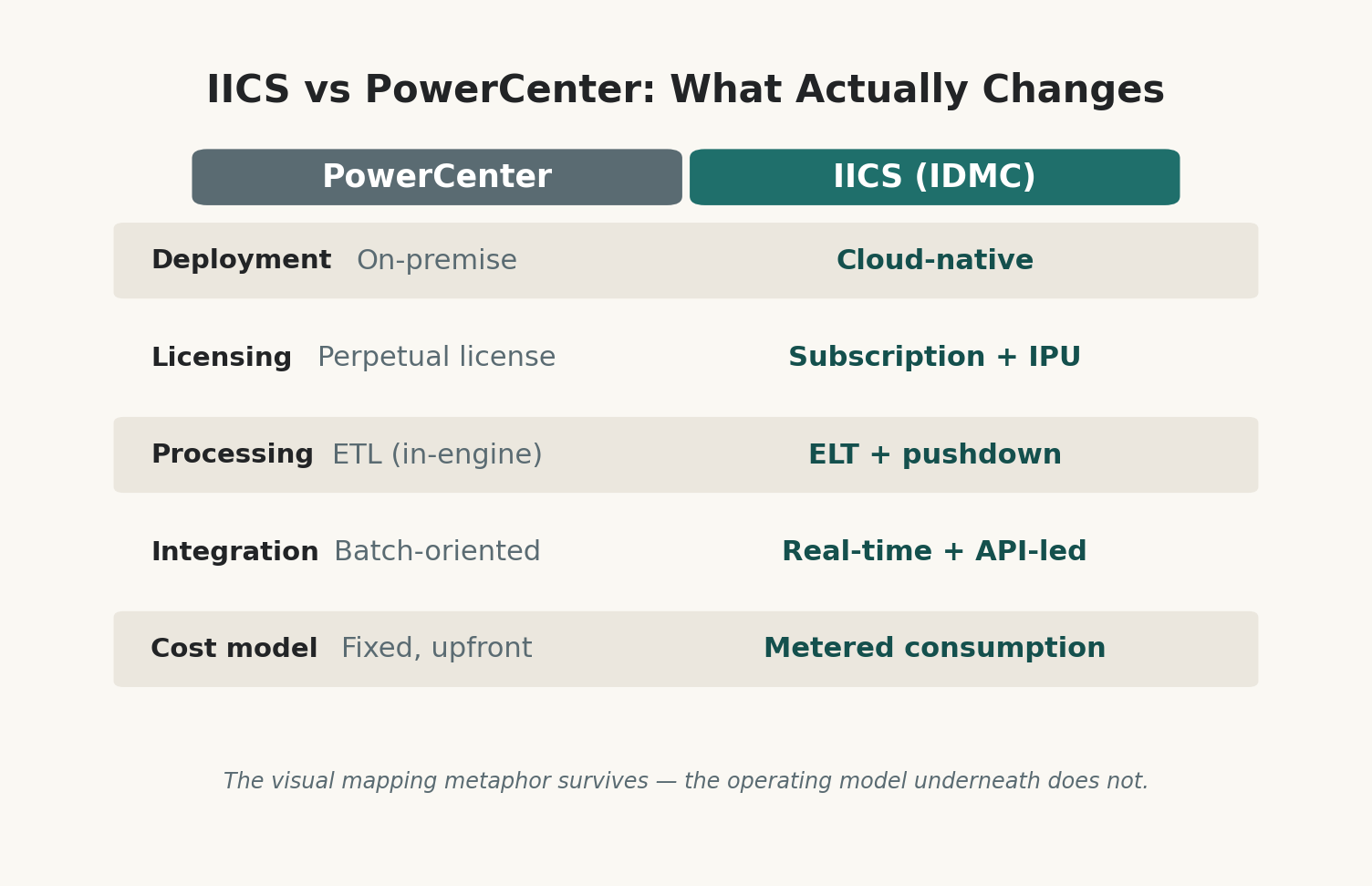
The temptation to treat IICS vs PowerCenter as a syntax change is the costliest misconception in this whole transition. The visual mapping metaphor survives, which lulls teams into complacency. What changes underneath is the part that breaks programs.
PowerCenter is an on-premise, perpetually licensed, infrastructure-owned platform. You sized hardware, you tuned sessions, and cost was fixed and upfront. IICS is cloud-native, subscription-based, and metered. The engineer who never had to think about per-job consumption now has to architect for it, because an inefficient mapping that was merely slow on-premise becomes a recurring monthly bill in the cloud.
Three differences carry the most hiring weight:
- ELT over ETL. IICS pushes transformation down into the cloud warehouse far more aggressively than PowerCenter did. Engineers must think in pushdown optimization, not just in-engine transformation.
- Real-time and API-led patterns. CAI introduces event-driven integration that batch-trained PowerCenter staff have rarely built in production.
- Cost-as-architecture. Under IPU pricing, design decisions have direct financial consequences. This is a governance skill, and it is the single most common gap in otherwise-strong candidates.
This is precisely why the choice to hire IICS developer India specialists versus retraining a PowerCenter team on the job pays back. The migration is the worst possible time to learn cloud cost discipline on production workloads.
How to Source: A Step-by-Step Hiring Process
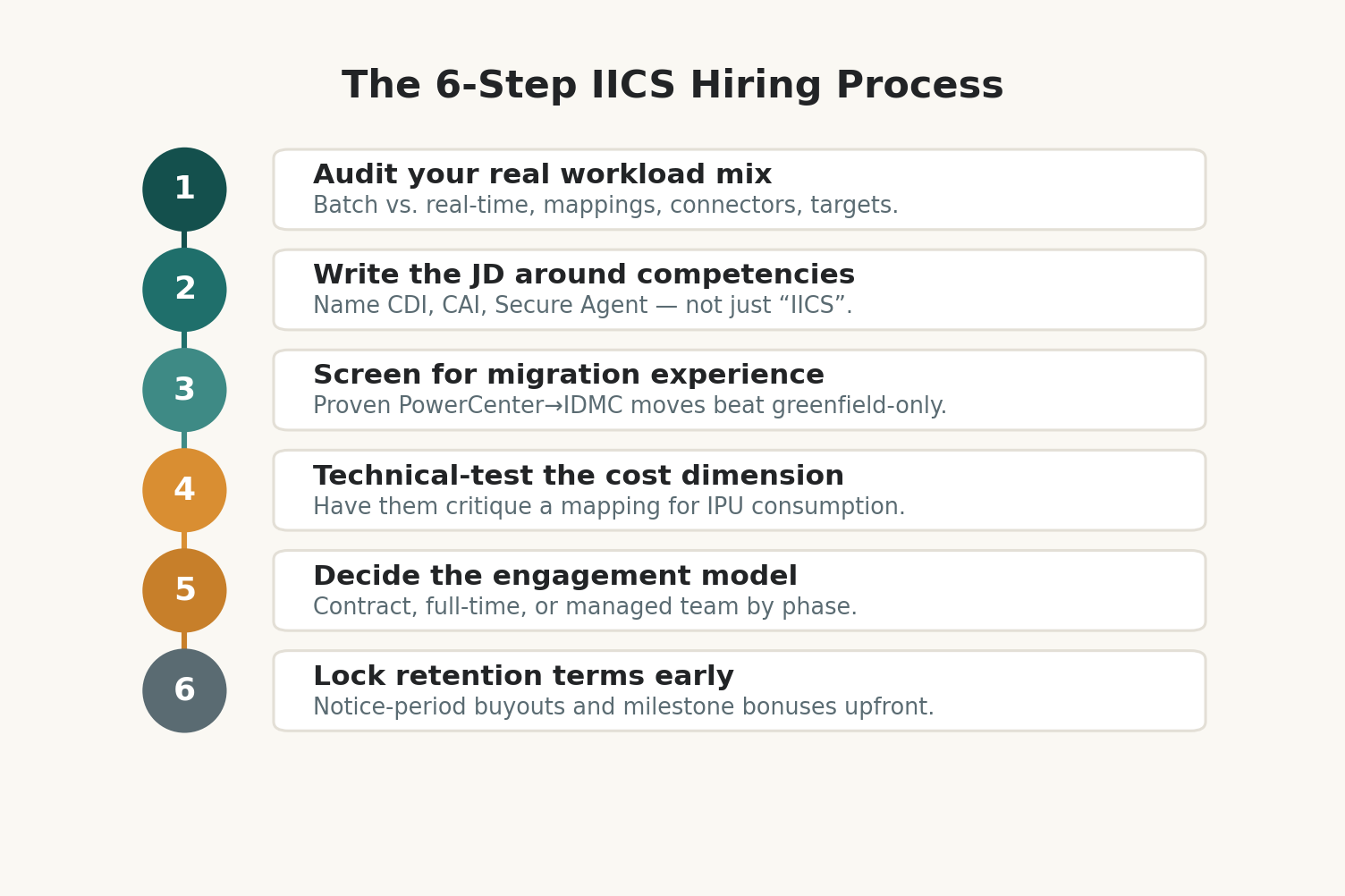
Use this sequence to run a tight, snippet-worthy sourcing process:
- Audit your real workload mix first. Quantify batch vs. real-time, number of mappings, connector types, and target platforms before writing a JD. Your workload tells you whether you need a CDI specialist, a CAI specialist, or both.
- Write the JD around competencies, not the tool name. Specify CDI, CAI, Secure Agent, target warehouse, and consumption-cost awareness explicitly. “IICS developer” alone attracts certificate-holders, not architects.
- Screen for migration experience, not just IICS experience. A candidate who has personally moved PowerCenter mappings to IDMC is worth a meaningful premium over one who only ever built greenfield cloud pipelines.
- Technical-test the cost dimension. Ask candidates to critique an inefficient mapping for IPU consumption. The answer separates genuine practitioners from the certified-but-untested.
- Decide the engagement model deliberately. Match contract, full-time, or managed-team sourcing to your migration timeline (covered in the framework below).
- Lock retention terms early. In a counter-offer market, build notice-period buyouts and milestone bonuses into the offer rather than scrambling after acceptance.
How to Evaluate an IICS Developer Before You Commit
Interviewing for this role is easy, because the surface signals certification, a tidy resume of mapping work, and fluent vocabulary are abundant and cheap. The signals that predict migration success are harder to elicit, and worth designing your process around.
Start with a portfolio walk-through rather than a quiz. Ask the candidate to narrate a real pipeline they built end to end: the source systems, the transformation logic, the target, and crucially, the decisions they reversed along the way. Engineers who can only describe the happy path have usually not owned production. Engineers who can tell you what broke, what they over-built, and what they would do differently.
Then probe the cloud-cost dimension directly. Hand them a deliberately inefficient mapping one that pulls full datasets where incremental loads would do, or transforms in-engine where pushdown would be cheaper and ask them to critique it for IPU consumption. A genuine practitioner spots the waste in under a minute. A certificate-holder describes what the mapping does without ever questioning whether it should be built that way at all.
Finally, test for migration judgment specifically. Pose a scenario: a PowerCenter mapping with a custom transformation that has no clean IICS equivalent. The strong answer weighs re-engineering against re-platforming, considers parallel-run validation, and flags the risk to downstream consumers. The weak answer reaches immediately for a like-for-like rebuild. That gap in instinct is exactly what separates a successful cloud data integration developer India hire from an expensive learning experience on your production systems.
How Much Does It Cost to Hire an IICS Developer in India?
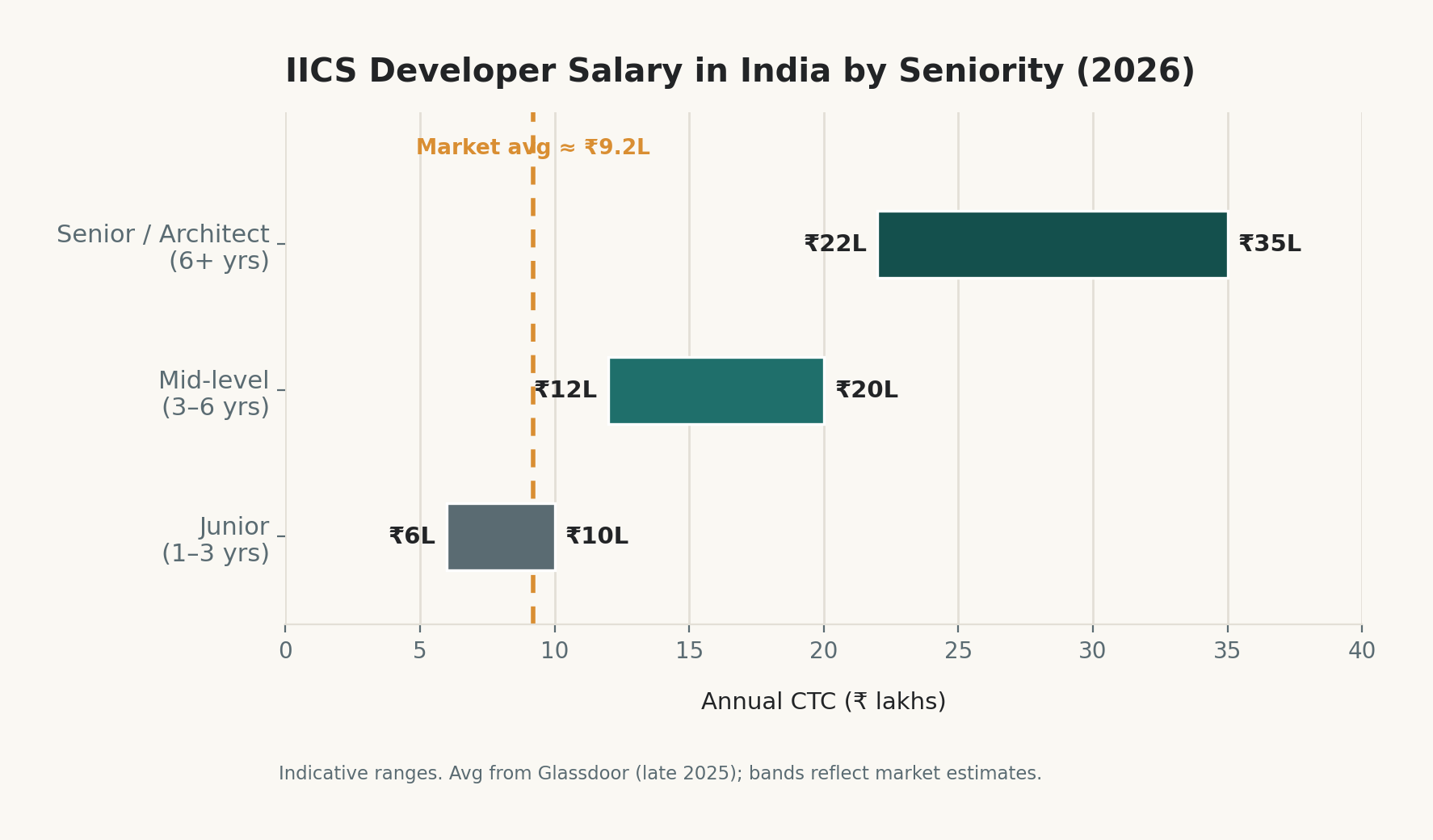
The Informatica IICS developer salary in India spans a wide band, and the spread itself tells you something about the market’s immaturity. Public salary data from Glassdoor (as of late 2025) puts the average annual pay for an IICS developer in India near ₹9.2 lakhs, with a typical range roughly ₹7.6 to ₹13.2 lakhs and top reported earners above ₹16 lakhs
In practice, what enterprises actually pay clusters by seniority:
- Junior (1–3 years, mapping-task focused): ₹6–10 lakhs.
- Mid-level (3–6 years, CDI + some CAI): ₹12–20 lakhs.
- Senior / architect (6+ years, full-stack IICS + migration lead): ₹22–35 lakhs, with migration-proven architects commanding the top of that range or beyond.
Contract and offshore data engineering rates run differently, billed by the day or month and carrying a premium for migration-window availability. The premium is real, but so is the cost of an extended-support contract on a platform you are trying to leave. When you model the Informatica cloud developer recruitment budget, weigh the salary against the monthly cost of not completing migration on time. The latter is almost always larger.
Compliance, Architecture, and the Hidden Considerations
Two factors quietly raise the bar on who you hire. First, data governance: with IDMC consolidating catalog, quality, lineage, and CLAIRE AI metadata in one place, your developers increasingly need to build governance-aware pipelines rather than handle the problem downstream. Second, data residency and security: regulated industries running hybrid architectures need engineers who understand Secure Agent placement, network boundaries, and where data physically processes. Neither shows up in a certification, and both surface during audits if you skipped them at the hiring stage.
There is also the matter of the platform’s trajectory under new ownership. With Informatica now inside Salesforce, the roadmap is steering toward agentic AI and tighter coupling with the Agentforce, MuleSoft, and Tableau ecosystem. Hiring engineers who are merely competent at today’s mapping tasks is short-sighted if your platform is going to lean harder into AI-assisted integration and cross-product data flows over the next two to three years. The more durable hire is curious about that direction and comfortable learning toward it, not someone whose ceiling is the feature set as it exists this quarter.
Where IICS Talent Concentrates in India
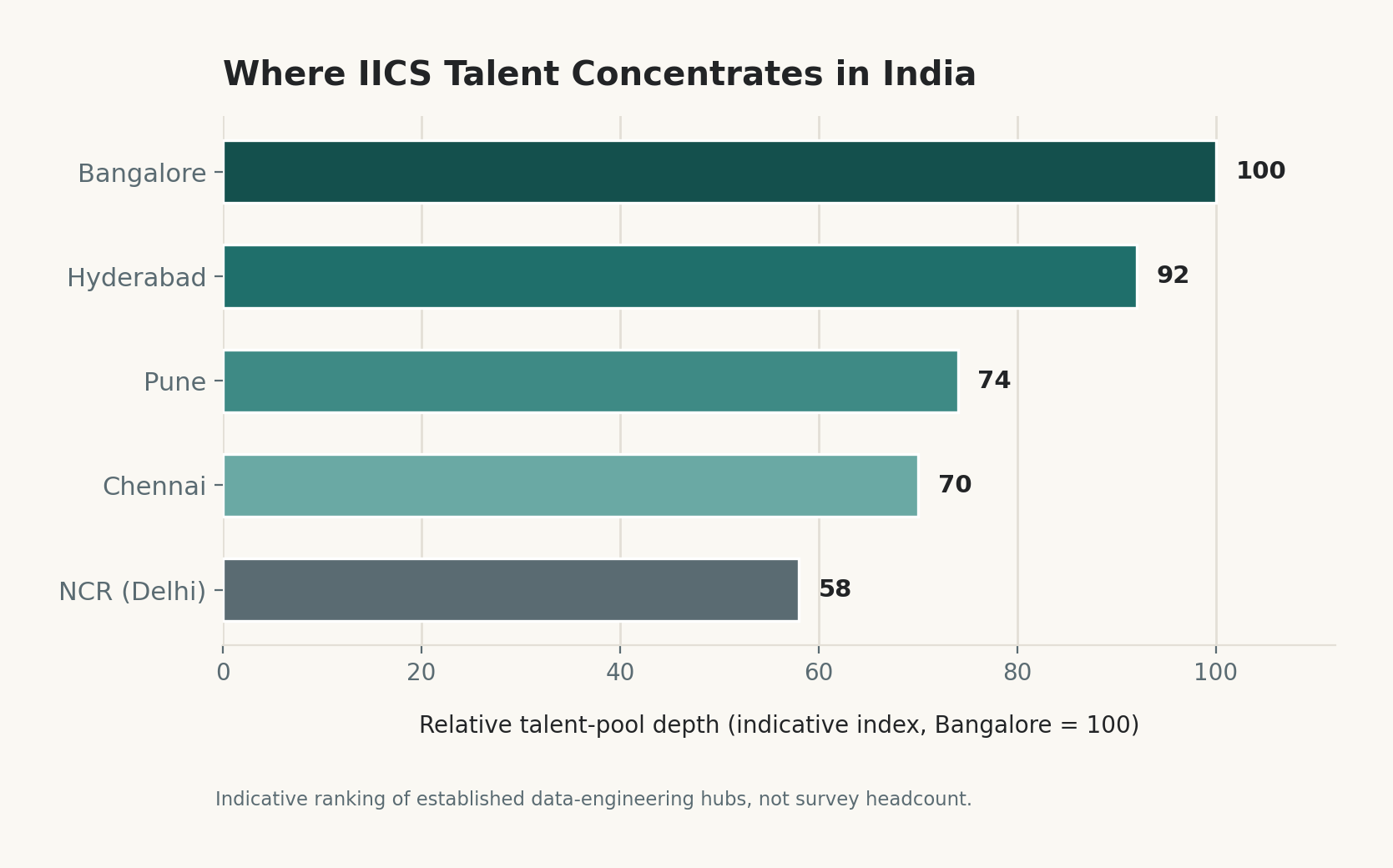
Sourcing efficiently means knowing where the supply actually sits, and through which channels it moves. The geography of Informatica cloud developer recruitment in India is not evenly distributed, and posting to a generic national job board is the slowest path to a shortlist.
The deepest pools sit in the established data-engineering hubs. Bangalore and Hyderabad carry the largest concentrations, driven by global capability centers (GCCs) and the analytics arms of major enterprises. Pune and Chennai follow closely, both with mature data-integration talent bases built over the PowerCenter era and now retooling toward the cloud. The National Capital Region rounds out the top tier. The practical implication: if you are open to hybrid or remote engagement, you can fish across all five markets at once; if you require on-site presence, your salary band needs to reflect the specific city’s competition.
Channel choice matters as much as geography. Three routes consistently outperform generic listings:
- Referrals from existing data engineers. Practitioners know who the real migration-proven architects are, and warm introductions cut both screening time and counter-offer risk.
- Specialist staffing and offshore data engineering partners. For time-boxed migration surges, a partner who pre-vets IICS skill depth removes the screening burden entirely at the cost of a margin you should weigh against your internal recruiting capacity.
- GCC and competitor talent. The strongest production IICS experience often sits inside enterprises already mid-migration. Reaching that talent requires active outreach and a compelling counter to a stable role, not a passive listing.
A note on titles: many strong candidates are not searching for “IICS developer” by name. They list “data integration engineer,” “ETL developer,” or “cloud data engineer” and mention IICS or IDMC inside the body of their profile. If you screen only on the exact title, you will miss a meaningful share of the pool, a frequent, avoidable error when enterprises rush to hire IICS developer India talent under deadline pressure.
Real-World Application
Case one: a financial services migration. A mid-size Indian lender approached its PowerCenter migration as a retraining exercise, redeploying its existing ETL team. Six months in, consumption costs ran roughly 40% over forecast because pipelines had been ported without pushdown optimization. Bringing in two migration-proven IICS architects to re-engineer the highest-volume mappings cut monthly IPU spend back to budget within a quarter and recovered the timeline.
Case two a retail data platform. A retailer scoping a real-time inventory integration assumed its batch-trained team could deliver CAI workflows. The gap surfaced only in user acceptance testing. A targeted hire with production Cloud Application Integration experience delivered the event-driven flows in roughly eight weeks of work the original team had estimated, then missed, twice. The lesson in both cases is the same, and it is worth stating plainly: scope the hire to the actual workload in front of you, not to the name of the tool on the box.
A Decision Framework: Which Engagement Model and Which Skill Set
Two decisions trip up most leads: how to engage talent, and which integration skill set to recruit now that Salesforce owns both IICS and MuleSoft.
On the engagement model, match the choice to your migration phase rather than defaulting to full-time hiring:
| Model | Best for | Trade-off |
| Full-time hire | Long-term platform ownership post-migration | Slowest to onboard; hardest to source mid-crunch |
| Contract / staff augmentation | Time-boxed migration surge capacity | Higher day rate; knowledge can walk out at contract end |
| Managed offshore team | Scaling delivery fast with cost control | Requires strong governance and clear acceptance criteria |
On the skill-set question the heart of IICS vs MuleSoft hiring the portfolio overlap is now a feature, not a confusion. Recruit IICS talent for data-centric integration: bulk movement, warehouse loading, ELT, and batch-plus-incremental pipelines. Recruit MuleSoft talent for application-centric, API-led connectivity between operational systems. The mistake is hiring one to do the other’s job. A MuleSoft engineer will not optimize a Snowflake ELT pipeline, and an IICS developer is not your API gateway architect. Where you genuinely need both, hire both or hire a senior who can credibly bridge CDI and CAI, which is the rarest and most valuable profile in the market.
In most enterprise migrations the dominant near-term need is data-centric, which is why the urgent decision for this cycle is usually whether to hire IICS developer India specialists first and layer application-integration talent in later. Sequencing the two hires data movement now, API-led connectivity as real-time use cases mature keeps your budget proportional to the workload in front of you rather than the architecture you might want eventually.
What Most Teams Get Wrong
The pattern repeats across nearly every stalled migration we see: leaders hire for the certification and discover, too late, that they needed the judgment.
An IICS certificate proves someone can build a mapping. It says nothing about whether they can architect for consumption cost, design real-time flows, or make the dozen small decisions during a migration that determine whether the cutover is clean or a year of firefighting. The market is flooded with newly certified candidates because everyone saw the PowerCenter sunset coming. Certification supply is high; production-judgment supply is not.
The second mistake is sequencing. Teams start sourcing after committing to a migration timeline, which inverts the leverage. The talent market should inform the timeline, not the other way around. If migration-proven architects in your region carry a three-month lead time, that lead time is part of your project plan and pretending otherwise is how a 12-month program quietly becomes an 18-month one.
The third, more subtle error: optimizing for the lowest salary on the offer instead of the lowest total cost of the migration. A cheaper hire who lets IPU consumption drift, or who needs the cutover redone, costs multiples of the salary you saved. Where you decide to hire IICS developer India talent, price the role against the program, not against a job board average.
Frequently Asked Questions
Is IICS the same as Informatica Cloud?
Effectively, yes. Informatica Intelligent Cloud Services (IICS) is the cloud-native integration suite within Informatica’s broader IDMC (Intelligent Data Management Cloud) platform. People use “Informatica Cloud,” “IICS,” and “IDMC” loosely and often interchangeably, though strictly IDMC is the wider platform and IICS refers to the integration services inside it.
How much do IICS developers earn in India?
Public data places the average near ₹9.2 lakhs annually, but real offers vary sharply by skill depth. Mid-level engineers with solid CDI and some CAI experience typically land ₹12–20 lakhs, while migration-proven senior architects command ₹22–35 lakhs or more. The wide spread reflects how much production experience not certification drives value in the current market.
What skills should an IICS developer have?
At minimum: Cloud Data Integration mapping design, Secure Agent configuration, and connector fluency. Stronger candidates add Cloud Application Integration for real-time and API-led patterns, pushdown/ELT optimization, IPU consumption-cost awareness, and governance familiarity with IDMC’s catalog and CLAIRE AI features. The cost-architecture skill is the most commonly missing.
Is IICS replacing PowerCenter?
Yes, in practical terms. With PowerCenter 10.5 standard support ended as of March 31, 2026, and Informatica steering customers toward IDMC, IICS is the designated cloud successor. The difference between IICS and PowerCenter developers is real, though cloud-native architecture, ELT, real-time integration, and consumption-cost design separate the two skill sets.
IICS vs MuleSoft: which talent do you actually need?
Since Salesforce now owns both, treat it as a workload question. Choose IICS engineers for data-centric integration: bulk movement, warehouse loading, and batch or incremental ELT. Choose MuleSoft engineers for application-centric, API-led connectivity between operational systems. Hiring one for the other’s role is a common and avoidable mistake.
Should I hire a contract or full-time for a migration?
It depends on your phase. Contract and staff-augmentation models give you surge capacity for a time-boxed migration without long-term headcount commitment, while full-time hires make sense for the steady-state platform ownership you will need after cutover. Many enterprises blend both contractors for the migration peak, a smaller full-time core to operate the platform afterward. If you want to pressure-test that split for your specific workload, that is a sensible point to bring in outside help.
Before You Post the Job Description
If you are scoping a PowerCenter-to-cloud migration and weighing whether to hire IICS developer India talent directly, retrain internally, or blend the two, the decision deserves more rigor than a job-board salary average. The cost of getting it wrong is measured in extended-support fees and slipped quarters, not in recruiting spend.
The practical sequence is straightforward, even if the execution is not. Audit your real workload mix before you write the job description. Decide the engagement model against your migration phase, not your org chart. Screen for migration judgment and consumption-cost awareness rather than certifications. And treat your regional talent lead time as a line item in the project plan, because in a synchronized demand market it behaves like one. Leaders who run that sequence deliberately tend to cut over on schedule; the ones who improvise it tend to discover the skill gap during user acceptance testing, which is the most expensive place to find it.
It also helps to remember that the window narrows the longer it stays open. With standard PowerCenter support already behind you and the broader platform steering toward agentic, AI-assisted integration under new ownership, the engineers who can both finish the migration and operate what comes after it are the scarce resource, not the certificates. Hiring for that durability now is cheaper than re-hiring it in a year.
At Supersourcing, we have run this sourcing-and-scoping process across enterprise migrations, and the pattern holds: the teams that map workload to profile before they recruit move faster and spend less than the ones that start from a salary benchmark. If you want a second set of eyes on your IICS staffing plan engagement model, skill mix, realistic timelines, and where your real gaps sit, that is a conversation worth having before you commit to a hire or a vendor. You can start one at supersourcing.com or reach me directly at mayank@engineerbabu.com for a no-pressure working session.
