

The $3.1M Integration Program That Created a Spaghetti Architecture
A US-based healthcare network 12 hospitals, Epic EHR, Salesforce Health Cloud, Workday HR, and 34 ancillary clinical applications approved a MuleSoft Anypoint Platform integration program. The brief: replace point-to-point integrations with a unified API-led integration architecture. API-led connectivity, reusable APIs across system, process, and experience layers. Sixteen months. Eleven India-based MuleSoft engineers. $3.1M.
The vendor’s pitch was credible. Anypoint Platform experience. API-led connectivity implementations. Healthcare HL7 and FHIR integration. The CVs listed MuleSoft certifications and enterprise integration projects.
What arrived: nine MuleSoft developers who understood Anypoint Studio and could build flows. They built flows prolifically. By month six, 87 Mule flows had been created across 23 integration projects. Zero of them followed the API-led connectivity model. System APIs, Process APIs, and Experience APIs had not been implemented as a layered architecture; every integration was a direct point-to-point flow from source to target, implemented in MuleSoft instead of legacy middleware. The architecture was spaghetti, built in Anypoint instead of the previous middleware. More modern spaghetti. Still spaghetti.
This is the hidden risk enterprises face when evaluating integration talent. Hiring MuleSoft & integration platform engineers is not just about finding developers who can build flowsit’s about identifying engineers who understand API-led connectivity, system design, and long-term reuse.
The urgency is driven by how central APIs have become to enterprise IT. According to Postman’s State of the API Report, 89% of organizations say APIs are critical to their business strategy, reinforcing why integration architecture must be treated as a core capability, not an afterthought.
For enterprise buyers, the real challenge is not hiring fasterit’s hiring engineers who can prevent costly rework by building integration systems correctly from day one.
TL;DR 8 Answers Before You Read Further
| Question | Answer |
| What does a Senior MuleSoft Developer cost from India? | $45–70/hr fully loaded. A MuleSoft Integration Architect runs $88–125/hr. Section 5 has the full rate stack. |
| What's the single most important thing to verify? | API-led connectivity understanding. Can the candidate describe the three API layers (System, Process, Experience) and when to use each? MuleSoft without API-led is expensive middleware, not architecture. |
| Which Indian city has the deepest MuleSoft talent? | Bangalore leads for MuleSoft Anypoint and cloud-native integration. Pune and Hyderabad for enterprise integration patterns and SAP/Salesforce connectivity. |
| What certification actually matters? | MuleSoft Certified Developer Level 1 and Level 2 for developers. MuleSoft Certified Platform Architect for architect roles. The Platform Architect certification is what separates API-led practitioners from flow builders. |
| How many MuleSoft Platform Architects are in India? | Approximately 1,200 MuleSoft Certified Platform Architects in India. The total MuleSoft certified pool is approximately 18,000. The Platform Architect certification is the meaningful filter. |
| What's the most commonly misrepresented credential? | MuleSoft Developer Level 1 presented as architect-level capability. Level 1 tests basic flow building. The Platform Architect certification tests API-led connectivity design, runtime fabric, and enterprise integration patterns. |
| What's typical attrition for MuleSoft specialists? | 15–19% annually. MuleSoft skills are portable to adjacent integration platforms (Azure Integration Services, AWS). Top MuleSoft architects have options. |
| What's the single biggest hiring mistake? | Hiring MuleSoft developers without an API-led connectivity architect. A team of 10 MuleSoft developers with no Platform Architect produces flow spaghetti at enterprise scale. The architect role is not optional. |
Are You Actually Ready for This?
Integration programs fail at a high rate not because of bad developers, but because of undefined architecture and unclear ownership. Score yourself before engaging any vendor.
Score each: 0 (not in place), 2 (partially), 4 (done).
| # | Criterion | Score |
| 1 | Named integration platform owner with architecture authority | 0/2/4 |
| 2 | API-led connectivity vs ESB vs event-driven architecture decision made | 0/2/4 |
| 3 | System inventory complete which source and target systems are in scope | 0/2/4 |
| 4 | API governance model defined API versioning, deprecation policy, developer portal | 0/2/4 |
| 5 | Non-functional requirements defined latency SLA, throughput, availability requirements | 0/2/4 |
| 6 | Security architecture confirmed OAuth, mTLS, API key management approach | 0/2/4 |
| 7 | Interview panel with integration architecture experience available within 5 business days | 0/2/4 |
| 8 | Legal SLA under 15 days for MSA review | 0/2/4 |
| 9 | MuleSoft Anypoint Platform environment provisioned for offshore team | 0/2/4 |
| 10 | CI/CD pipeline approach decided Anypoint CLI, Maven, GitHub Actions | 0/2/4 |
| 11 | KPIs defined: API availability, integration error rate, mean time to recover | 0/2/4 |
| 12 | CISO signed off on offshore access to integration middleware and API credentials | 0/2/4 |
| 13 | Escalation path: vendor PM → your Integration Architecture Lead → your CTO | 0/2/4 |
| 14 | IP ownership for custom connectors, API specifications, and flow logic in MSA | 0/2/4 |
| 15 | Finance can process USD-denominated invoices within 30 days | 0/2/4 |
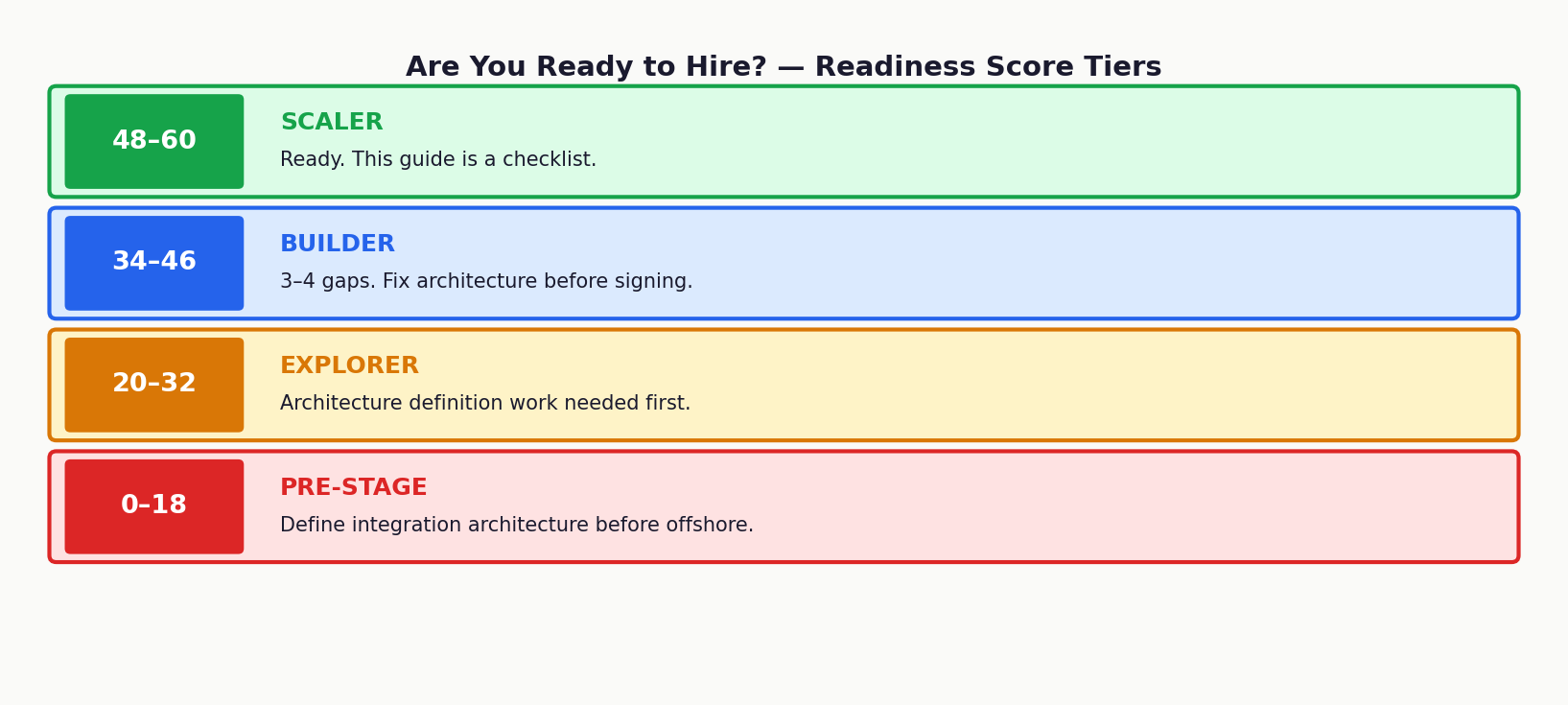
What your score means:
| Score | Tier | Reality Check |
| 48–60 | Scaler | Ready. This guide is a checklist. |
| 34–46 | Builder | 3–4 gaps. Integration programs without defined architecture produce expensive technical debt. Fix before signing. |
| 20–32 | Explorer | Architecture definition work needed before offshore delivery starts. |
| 0–18 | Pre-Stage | Define your integration architecture first. An offshore team without architectural direction will produce point-to-point flows. |
From the deal floor: A UK financial services company scored 12 on this checklist. The API governance model (criterion 4) and non-functional requirements (criterion 5) had never been defined. The offshore MuleSoft team built 40 integration flows with no error handling standards, no retry logic consistency, and no API versioning. When the first API needed to be updated, it broke 14 downstream consumers. Remediation: 8 weeks of API versioning retrofit. £180K. Both issues were directly predictable from the checklist score.
The Integration Platform Talent Market in India 2026
Every enterprise has integration work. Every cloud migration creates integration requirements. Every SaaS platform adoption requires connecting the new application to existing systems. Integration is the invisible plumbing of enterprise technology. It doesn’t get the attention of ERP or CRM programs, but it is required for every one of them.
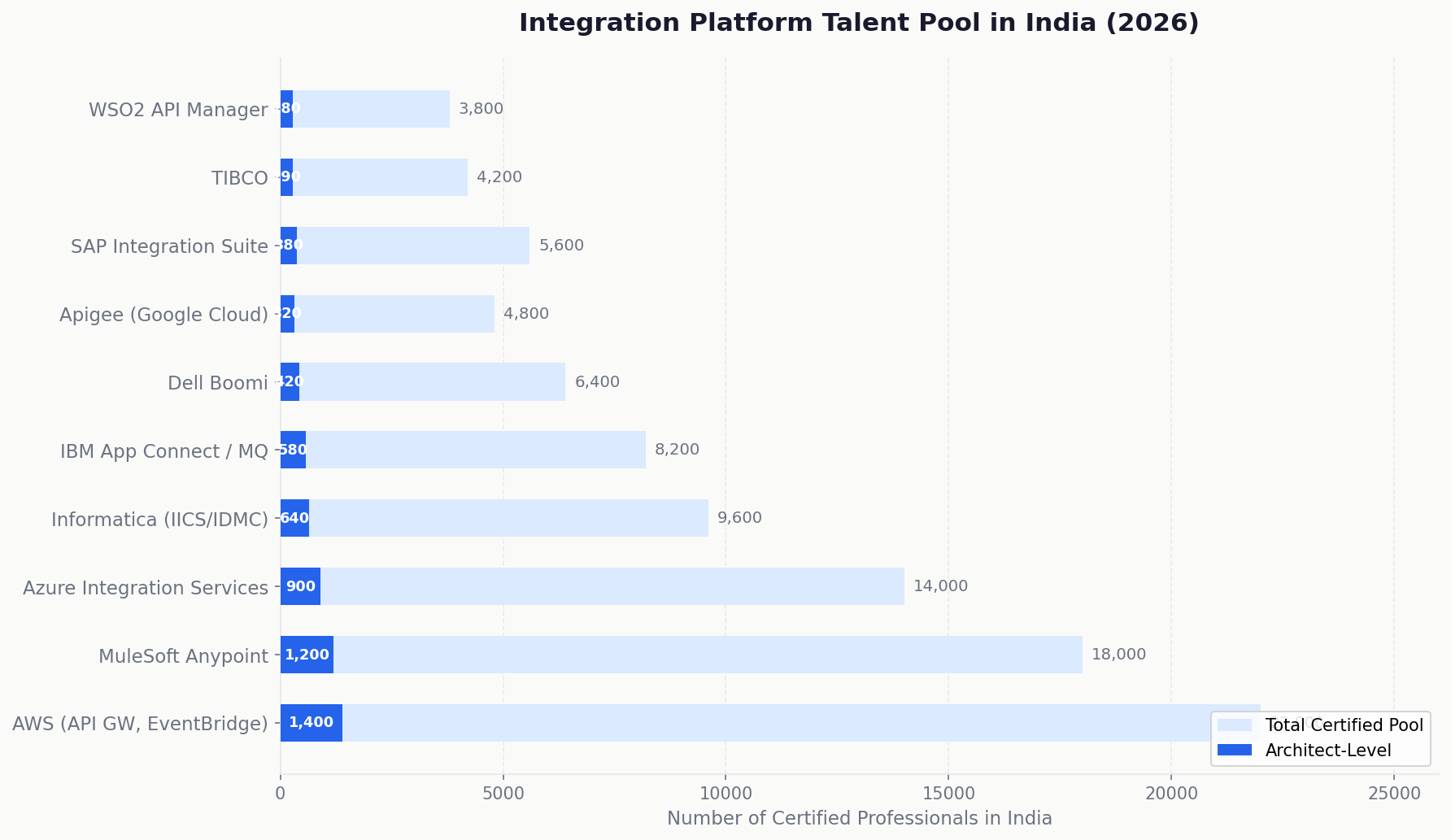
India’s integration platform talent pool reflects this ubiquity, large overall, fragmented by platform, and with a significant gap between flow builders and integration architects.
The platform-specific pool:
| Platform | Estimated India Certified Pool | Architect-Level |
| MuleSoft Anypoint Platform | ~18,000 | ~1,200 |
| Azure Integration Services (Logic Apps, API Management, Service Bus) | ~14,000 | ~900 |
| AWS (API Gateway, EventBridge, Step Functions, SQS/SNS) | ~22,000 | ~1,400 |
| Dell Boomi (now Boomi) | ~6,400 | ~420 |
| IBM App Connect / MQ | ~8,200 | ~580 |
| WSO2 API Manager | ~3,800 | ~280 |
| Informatica (IICS, IDMC) | ~9,600 | ~640 |
| SAP Integration Suite | ~5,600 | ~380 |
| Tibco | ~4,200 | ~290 |
| Apigee (Google Cloud) | ~4,800 | ~320 |
The architecture pattern gap:
This is the central challenge in integration hiring in India. India has deep integration experience and every large IT services firm has been doing enterprise integration for 25+ years. IBM MQ, TIBCO, webMethods, BizTalk, and Oracle SOA Suite have all had large India delivery practices.
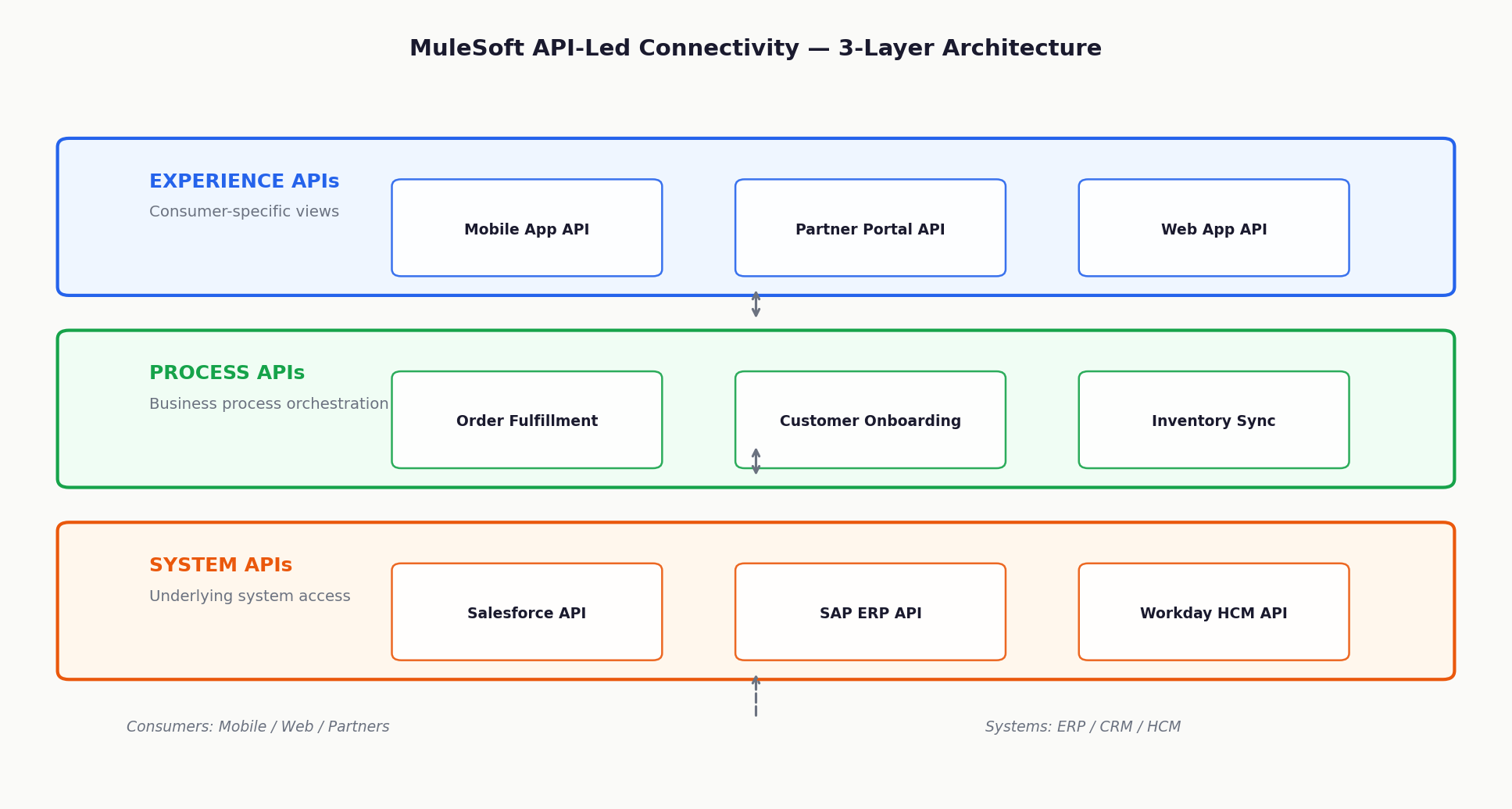
The gap is architectural pattern knowledge. API-led connectivity (MuleSoft’s three-layer model), event-driven architecture (EDA), and composable integration patterns are modern architectural approaches that many experienced integration developers have not formally implemented. They know how to build flows. They don’t know when to build a System API vs a Process API, when to use synchronous vs asynchronous patterns, or how to design for API reuse and governance at enterprise scale.
A MuleSoft developer who has been building flows for 5 years but has never worked under an API-led connectivity architect is a very different profile from a MuleSoft developer who has designed and implemented a layered API architecture for a Fortune 500 enterprise. Both call themselves “MuleSoft developers.”
Where the talent lives:
| City | Dominant Integration Specialisations | Why |
| Bangalore | MuleSoft Anypoint, Azure Integration Services, AWS event-driven, Apigee | Cloud-native integration engineering. Modern API-led and EDA patterns. |
| Pune | MuleSoft for SAP/Salesforce integration, Boomi, IBM App Connect | Large SI delivery centers with enterprise integration practices. Salesforce and SAP connectivity depth. |
| Hyderabad | Azure Integration Services, SAP Integration Suite, Microsoft Power Automate | Microsoft ecosystem. SAP integration from Hyderabad SAP technical base. |
| Gurgaon | BFSI integration, IBM MQ, financial services middleware | BFSI GCC concentration. Legacy financial services middleware. |
| Chennai | IBM MQ, TIBCO, legacy enterprise middleware, Informatica | TCS/Cognizant legacy. Strong in older integration platforms and data integration. |
| Mumbai | Temenos/SWIFT integration, financial services API, insurance integration | BFSI proximity. Financial services-specific integration patterns. |
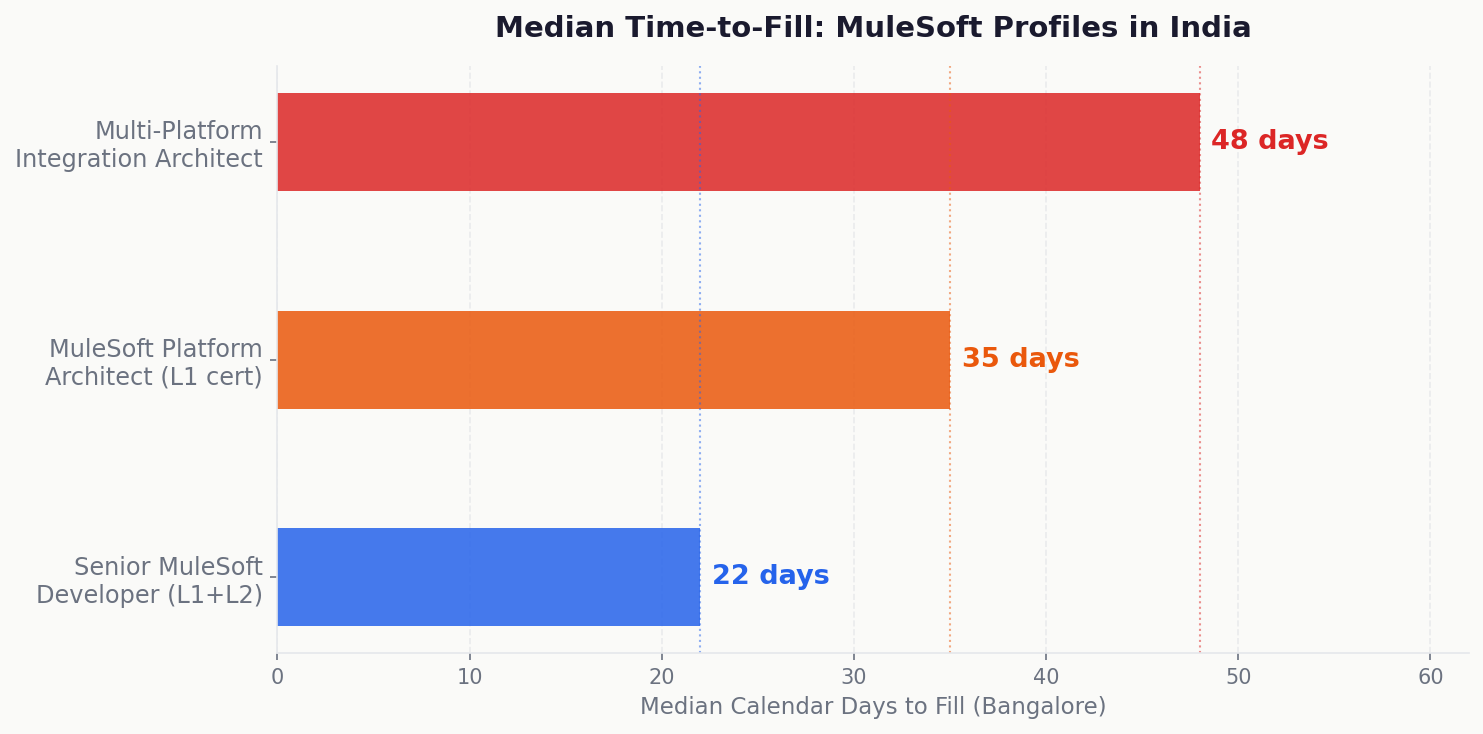
Supersourcing Index: Across 102 integration platform placements in the Supersourcing GCC Benchmark 2026, median time-to-fill for a Senior MuleSoft Developer (Level 1 and Level 2 certified, API-led experience) in Bangalore was 22 calendar days. For a MuleSoft Platform Architect (Platform Architect certified, enterprise API-led implementation) 35 days. For a multi-platform Integration Architect (MuleSoft + Azure or AWS, enterprise architecture depth): 48 days.
Red flag: Any vendor presenting MuleSoft Developer Level 1 certified engineers for integration architect roles. Level 1 tests basic flow building. Platform Architect certification tests the architectural depth that enterprise programs require. The certification names are specific and verifiable. Verify before scheduling.
What You’re Really Paying
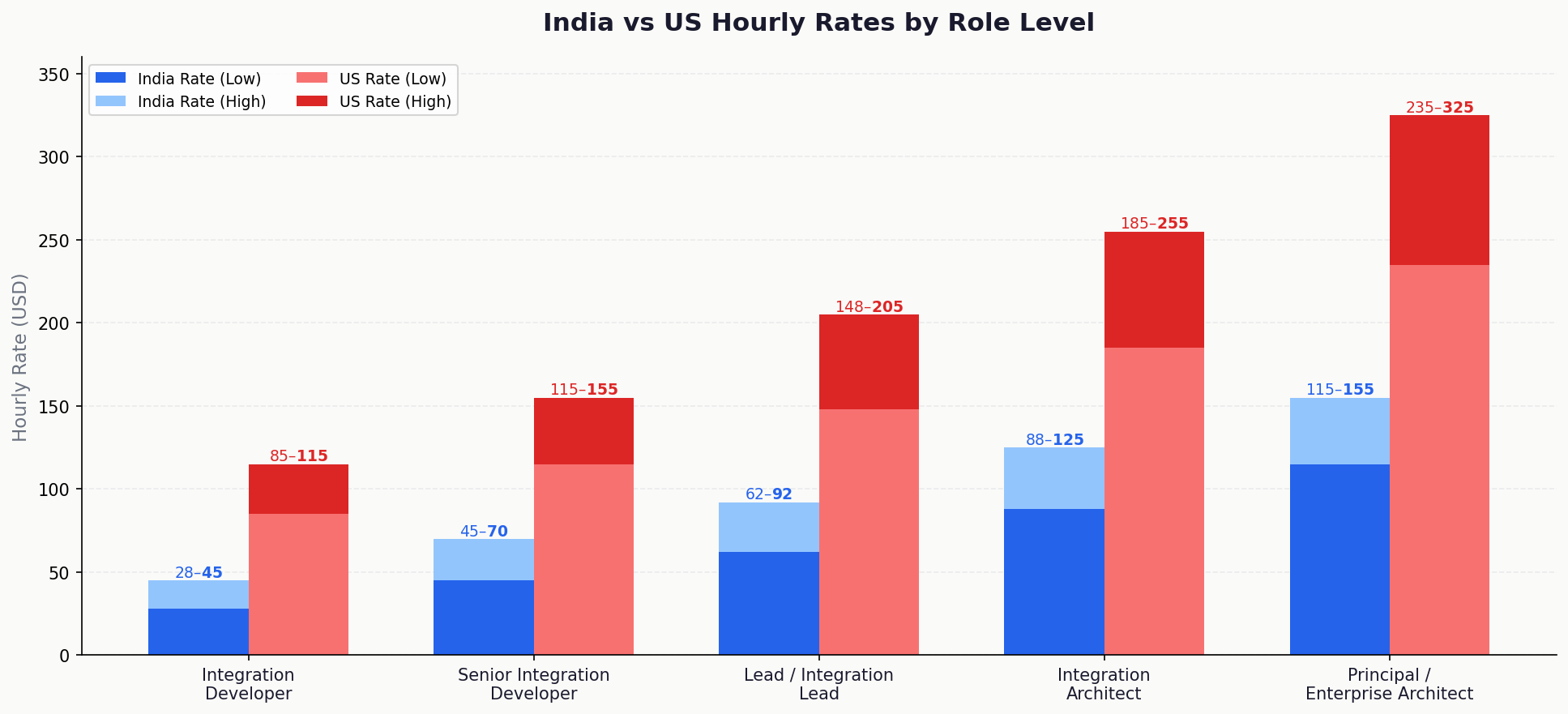
Rate Table by Level
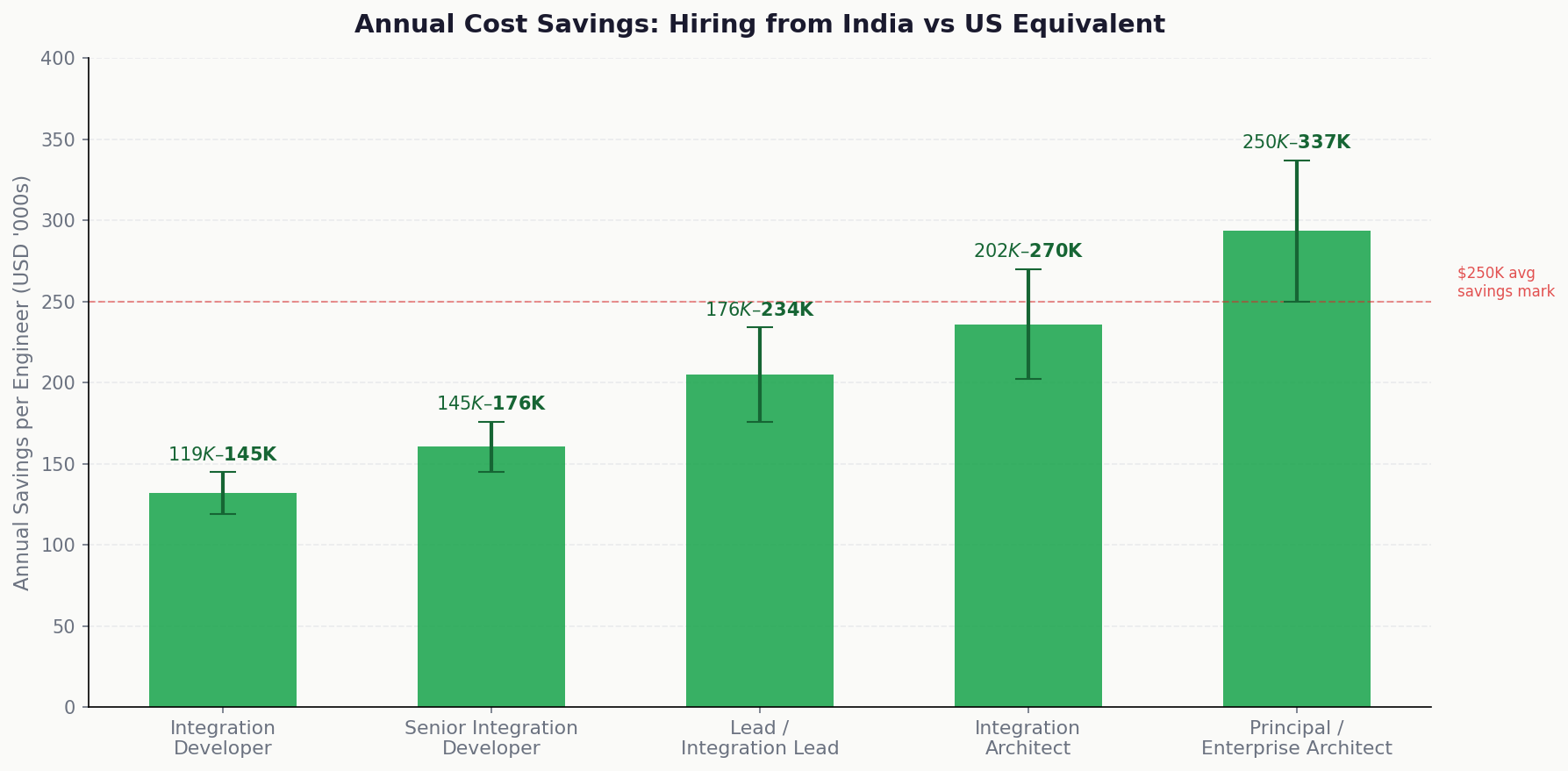
| Level | Experience | India Rate ($/hr) | US Equivalent ($/hr) | Annual Saving ($) |
| Integration Developer | 2–4 yr | $28–45 | $85–115 | $119K–$145K |
| Senior Integration Developer | 4–7 yr | $45–70 | $115–155 | $145K–$176K |
| Lead Developer / Integration Lead | 6–10 yr | $62–92 | $148–205 | $176K–$234K |
| Integration Architect (MuleSoft Platform Architect) | 8–12 yr | $88–125 | $185–255 | $202K–$270K |
| Principal / Enterprise Integration Architect | 12+ yr | $115–155 | $235–325 | $250K–$337K |
The 4 Cost Layers
- Layer 1 Gross CTC A Senior MuleSoft Developer with 5 years and Level 1+2 certification earns ₹28–42 LPA. At ₹96.4/$1, that’s $29K–$44K annually.
- Layer 2 Employer Burden PF, ESIC, Gratuity, bonus: 22–28% on top of gross CTC.
- Layer 3 Vendor Margin For integration specialists: 19–24%.
- Layer 4 What Hits Your Invoice Senior MuleSoft Developer: $45–70/hr. A 10-developer integration team at blended $60/hr costs $1.2M annually. US equivalent: $2.8–3.2M. Annual saving: $1.6–2.0M.
The Platform Architect premium: MuleSoft Platform Architects command 40–55% premium over Developer Level 1+2 developers at the same experience level. The Platform Architect certification test is significantly more demanding; it tests enterprise architecture patterns, Runtime Fabric, API governance, and end-to-end integration design. The premium reflects genuine scarcity and genuine capability difference.
The multi-platform premium: Integration architects who can design across MuleSoft + Azure Integration Services, or MuleSoft + AWS event-driven, command 20–30% premium over single-platform specialists. Enterprise programs increasingly require multi-cloud integration competency; a MuleSoft-only architect for a program that also has Azure Logic Apps and AWS EventBridge is a gap.
The healthcare/FHIR premium: Integration architects with HL7 v2, FHIR R4, and healthcare interoperability experience command 15–20% premium. Healthcare integration has specific standards, vocabulary, and regulatory context (HIPAA, 21st Century Cures Act) that generic integration architects don’t have.
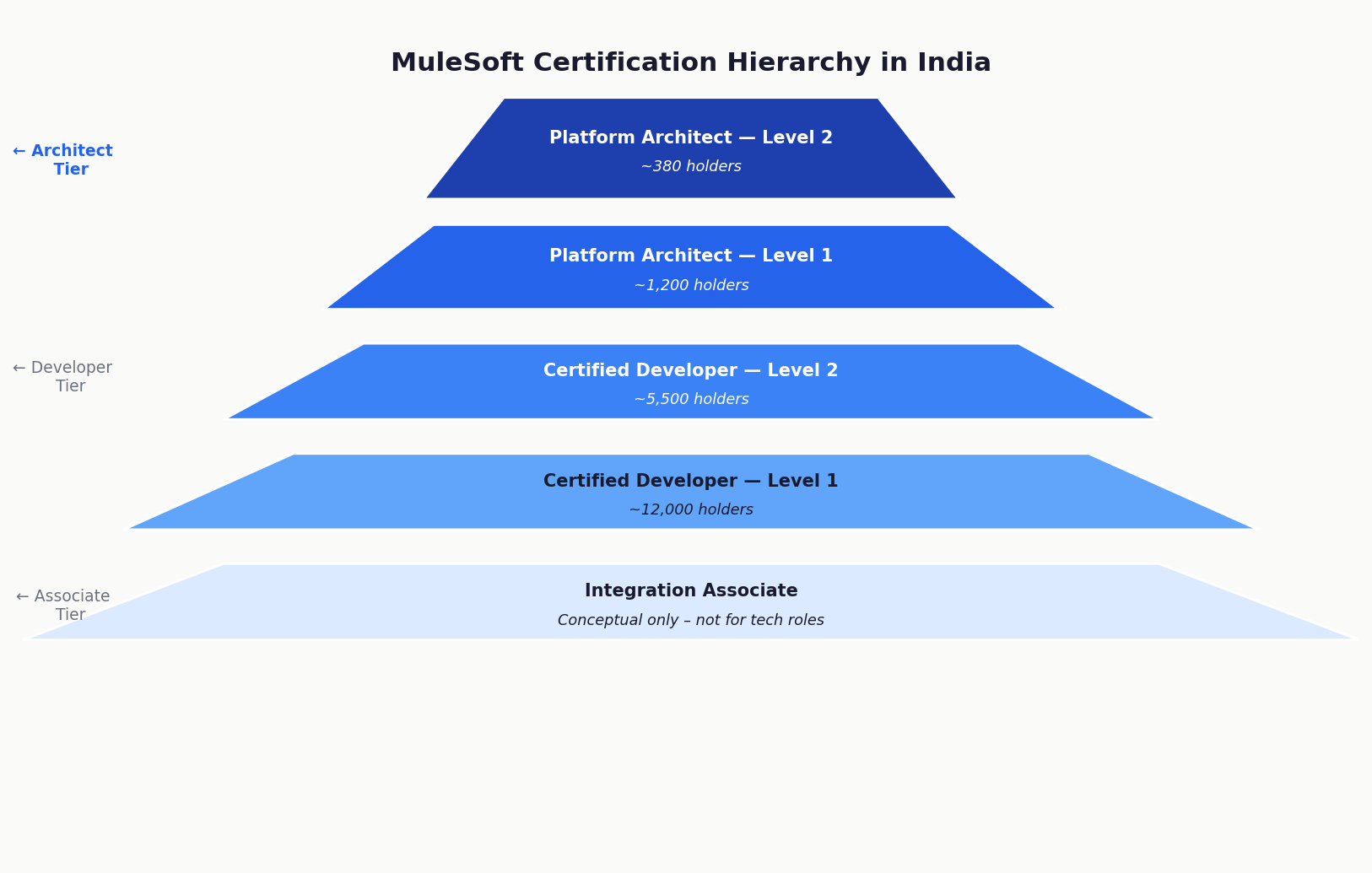
The Certification Hierarchy What Actually Matters
MuleSoft Certified Developer Level 1
Tests basic Anypoint Studio usage, fundamental flow construction, core connectors, and basic DataWeave transformations. The minimum baseline for any MuleSoft developer. Widely held in India approximately 12,000 holders. Not a differentiator. Required baseline, not a senior credential.
MuleSoft Certified Developer Level 2
Tests advanced DataWeave transformations, error handling strategies, API testing with MUnit, custom connectors, and more complex flow patterns. The meaningful developer certification. Approximately 5,500 holders in India. Required for senior developer roles.
MuleSoft Certified Integration Associate
Tests integration concepts and Anypoint Platform fundamentals without the implementation depth of Developer Level 1. A conceptual credential for non-developers. Not relevant for technical roles.
MuleSoft Certified Platform Architect Level 1
The architect certification. Tests API-led connectivity design (System, Process, Experience API layers), Runtime Fabric architecture, API governance with API Manager, security architecture (OAuth 2.0, mTLS, JWT), deployment topologies, and enterprise integration design patterns. Approximately 1,200 holders in India. This is the credential that separates API-led architects from flow builders.
MuleSoft Certified Platform Architect Level 2
The advanced architect certification. Tests complex multi-cloud deployment architectures, advanced Runtime Fabric, and enterprise-scale API management. Approximately 380 holders in India.
How to verify: MuleSoft certifications are verified through Salesforce’s Trailhead (MuleSoft is a Salesforce company) at trailhead.salesforce.com/credentials/verification. Enter the candidate’s name. Every active MuleSoft credential appears with the certification name and active status. Level 1 Developer and Platform Architect Level 1 look different on the credential to verify the specific name before scheduling architect interviews.
The DataWeave depth signal: DataWeave is MuleSoft’s data transformation language. Advanced DataWeave knowledge of complex transformations, custom functions, pattern matching, and performance optimization is a strong signal of genuine MuleSoft experience.
Basic DataWeave (simple field mappings) is learnable in days. Advanced DataWeave (complex nested transformations, recursive functions, streaming transformations for large payloads) requires real implementation experience. One DataWeave question in the technical screen filters effectively for genuine depth.
The JD That Attracts the Right Candidates
JD 1: Senior MuleSoft Developer (4–7 years)
Senior MuleSoft Developer Remote from India Engagement: Staff Augmentation | Duration: 12 months, renewable Rate: ₹28–42 LPA CTC equivalent | Billing: $45–70/hr (vendor-facing)
What you’ll own: Build and maintain MuleSoft Anypoint Platform integrations across our Salesforce, SAP, and Workday systems. You’ll work within our API-led connectivity architecture implementing System and Process APIs under the direction of our Platform Architect. Measured on integration reliability (error rate), deployment frequency, and DataWeave transformation accuracy.
What we require:
- MuleSoft Certified Developer Level 1 and Level 2 (verified at trailhead.salesforce.com before interview)
- 4–7 years integration development, minimum 2 years on MuleSoft Anypoint Platform in production
- API-led connectivity understanding can describe the difference between a System API and a Process API with a specific example from their experience
- Advanced DataWeave: complex nested transformations, custom functions, error handling in DataWeave expressions
- Error handling and retry logic can describe their approach to transient vs permanent errors, retry configuration, and dead letter queue handling
- Anypoint CI/CD experience Maven, Anypoint CLI, or GitHub Actions for MuleSoft deployment
What disqualifies you:
- MuleSoft experience limited to Anypoint Studio flow building without DataWeave depth
- “API-led connectivity experience” that cannot describe the three API layers
- Integration experience limited to point-to-point flows without layered architecture awareness
- MuleSoft Developer Level 1 only for a senior role
Interview process: Technical screen (30 min) → Live DataWeave transformation task (60 min) → API-led architecture design discussion (45 min)
JD 2: MuleSoft Platform Architect (10+ years)
MuleSoft Platform Architect India GCC or BOT Engagement: GCC Build or BOT | Duration: 24+ months CTC: ₹75–110 LPA | Billing: $92–125/hr (vendor-facing)
What you’ll own: End-to-end API-led integration architecture for our enterprise MuleSoft program across 40+ source and target systems. You will own the API layer design (System, Process, Experience API taxonomy), Runtime Fabric deployment topology, API Manager governance configuration, security architecture (OAuth 2.0, mTLS, API key management), and the integration standards for a team of 8–15 MuleSoft developers.
What we require:
- MuleSoft Certified Platform Architect Level 1 (verified at trailhead.salesforce.com before interview); Level 2 preferred
- 10+ years integration experience, minimum 3 enterprise MuleSoft programs as architect of record
- API-led connectivity implementation at scale can describe their API taxonomy decisions for a 30+ system enterprise program
- Runtime Fabric architecture CloudHub vs Runtime Fabric deployment decisions, worker sizing, high availability configuration
- API governance API Manager policy design, API versioning strategy, developer portal governance
- Security architecture OAuth 2.0 implementation, mTLS for backend system connectivity, PII data handling in transit
- Multi-system integration depth Salesforce, SAP, Workday, or similar enterprise systems in the integration scope
Interview process: Architecture scenario presentation (60 min) → Live Runtime Fabric topology design (45 min) → API governance design discussion (30 min) → Reference call with prior VP Engineering or Enterprise Architect
What most enterprise JDs get wrong for MuleSoft:
They say “MuleSoft experience required” without specifying the certification level which returns the full 18,000-person India MuleSoft pool. They don’t mention API-led connectivity specifically which means flow builders apply for architecture roles.
They list “DataWeave knowledge” as a preference rather than a requirement DataWeave is not optional for a senior MuleSoft developer. And they don’t distinguish CloudHub from Runtime Fabric, two different deployment models that require different architectural knowledge. Specify the deployment model in the JD.
How to Verify Experience Not Just Credentials
The 3 verification steps before any MuleSoft interview:
Step 1: trailhead.salesforce.com credential verification
Go to trailhead.salesforce.com/credentials/verification and search by the candidate’s name. Confirm: Developer Level 1 and Level 2 both present and Active for senior developer roles; Platform Architect Level 1 present and Active for architect roles. A Developer Level 1 only credential for a senior role or a Platform Architect role is a mismatched credential.
Step 2: API-led connectivity understanding screen
Before scheduling a technical interview, ask in writing: “Describe the three API layers in MuleSoft API-led connectivity and give an example of a System API, Process API, and Experience API from a program you’ve delivered.” This question takes 5 minutes to answer. Real API-led practitioners answer immediately with specific examples from their work. Flow builders describe the concept generically or confuse the layers. This question alone filters 40% of mismatched senior developer submissions.
Step 3: Production program specificity
Ask for the number of source/target systems in the largest MuleSoft program they’ve worked on, the deployment model (CloudHub vs Runtime Fabric), and whether it was a greenfield implementation or migration from legacy middleware. Real production architects name specific numbers “42 source systems, CloudHub 2.0, migration from IBM MQ and custom ETL.” Candidates without production scale experience describe programs generically.
The 5 interview questions that expose fake seniority:
Q1: API-Led Connectivity Layer Design “For a retail enterprise connecting Salesforce CRM, SAP ERP, and 15 store management systems, walk me through your API taxonomy which APIs go in each layer, and how you determine the boundary between a System API and a Process API.”
Real answer: System APIs provide access to underlying systems one System API per system (Salesforce System API, SAP System API, Store Management System API). They abstract the system’s native API behind a consistent contract. Process APIs orchestrate business processes using an “Order Fulfillment Process API” that calls the Salesforce, SAP, and Store System APIs to execute an order.
Experience APIs are consumer-specific “Mobile App Experience API” that aggregates data from multiple Process APIs for the mobile app’s specific data requirements. The candidate explains the boundary decisions: why order fulfillment logic goes in a Process API rather than being embedded in each System API, and why the mobile app gets a dedicated Experience API rather than calling Process APIs directly.
Flow builder describes the layers conceptually without specific taxonomy decisions. Cannot explain the boundary between System and Process APIs with a concrete example.
Q2: DataWeave Transformation “Write a DataWeave 2.0 expression that transforms a list of orders with nested line items, calculates the total for each order, and outputs only orders where the total exceeds $1,000, sorted by total descending.”
Real answer: write the DataWeave expression correctly using map to iterate over orders, reduce or sum to calculate line item totals, filter to apply the threshold, and orderBy for sorting. They handle edge cases, empty line item arrays, null values in unit price or quantity. They use DW 2.0 syntax (no payload.? optional chaining confusion).
A developer without strong DataWeave depth produces incorrect output, uses DataWeave 1.0 syntax, or needs significant prompting to construct the expression. This question is impossible to answer from documentation alone; it requires hands-on DataWeave experience.
Q3: Error Handling Architecture “Describe your error handling architecture for an enterprise MuleSoft integration with a 99.9% SLA how do you differentiate transient from permanent errors, how do you implement retry logic, and what happens to messages that can’t be processed after maximum retries?”
Real answer: describes the error classification approach (transient errors network timeouts, 429 rate limits, 503 temporary unavailability vs permanent errors 400 bad request, 404 not found, business validation failures), retry configuration for transient errors (exponential backoff, maximum retry count, retry intervals), and the dead letter queue approach for permanently failed messages publishing to an error queue with full message context for manual review and reprocessing. They describe specific MuleSoft error handling components Try scope, On Error Continue vs On Error Propagate, and the Until Successful scope for retry logic.
Developers without production integration experience describe error handling conceptually. Cannot describe the difference between On Error Continue and On Error Propagate, or explain when each is appropriate.
Q4: Runtime Fabric Architecture “Walk me through a Runtime Fabric deployment architecture for a global enterprise with data sovereignty requirements in the EU and US. How do you structure worker pools, handle high availability, and ensure EU data doesn’t transit US infrastructure.”
Real answer: describes the Runtime Fabric architecture self-managed Kubernetes-based runtime deployed in the enterprise’s own cloud (AWS, Azure, or GCP), separate Runtime Fabric installations per region (EU Runtime Fabric on EU-region Kubernetes, US Runtime Fabric on US-region Kubernetes), API Manager policies routing EU-origin requests only to EU Runtime Fabric workers, worker pool sizing based on expected throughput, and high availability configuration (minimum 3 worker nodes per pool, health checks, automated restart). They distinguish CloudHub 2.0 (MuleSoft-managed) from Runtime Fabric (customer-managed) and explain when each is appropriate.
A developer without Runtime Fabric experience describes CloudHub. Cannot describe the Kubernetes architecture, worker pool configuration, or data residency routing approach.
Q5: API Security Architecture “Describe your OAuth 2.0 implementation for a MuleSoft Experience API consumed by a mobile application, the grant type selection, token lifecycle, and how you handle the resource server validation in the Mule runtime.”
Real answer: describes the authorization code with PKCE grant type for mobile (more secure than implicit flow for public clients), the token endpoint configuration in API Manager, the OAuth 2.0 policy applied to the Experience API in API Manager (validation of token scope, token introspection vs JWT validation), access token lifetime (short 15–60 minutes) and refresh token lifecycle, and the Mule runtime validation approach using API Manager’s OAuth 2.0 policy rather than implementing validation in the Mule flow. They describe token revocation handling and the edge case of token expiry during a long-running operation.
A developer without security implementation experience describes OAuth 2.0 conceptually. Cannot describe PKCE for mobile clients, the API Manager OAuth 2.0 policy configuration, or JWT vs introspection validation tradeoffs.
8 CV red flags:
- “MuleSoft architect” with Developer Level 1 certification only Level 1 is developer entry-level, not architect
- “API-led connectivity experience” that cannot name the three API layer types when asked
- “MuleSoft experience” with no DataWeave examples in portfolio or discussion DataWeave is central to MuleSoft; absence suggests limited depth
- “Enterprise integration experience” on projects with fewer than 10 source/target systems “enterprise” integration starts at meaningful scale
- “CloudHub deployment” listed as primary experience for a Runtime Fabric architect role different deployment models requiring different knowledge
- “RAML/OAS API design experience” without being able to describe versioning strategy or backward compatibility approach API design without governance awareness is partial
- MuleSoft experience limited to Salesforce-to-Salesforce integrations single-vendor integrations don’t build multi-system architectural depth
- “Integration architect” who has only worked as a developer in architect-supervised programs delivery experience is not architectural design experience
How to Source What’s Working, What Isn’t
What’s working in 2026:
MuleSoft Partner network.
MuleSoft (Salesforce) maintains a partner ecosystem with tiered partners. MuleSoft partners in India are required to maintain certified headcount. An inquiry to 3–4 MuleSoft Gold or Platinum partners about available Platform Architect benches yields verified candidates faster than general job postings.
MuleSoft Community and MuleSoft Meetup India.
MuleSoft has active community groups in Bangalore, Pune, and Hyderabad. Community contributors, blog post authors on the MuleSoft Community portal, meetup speakers, MuleSoft Ambassador program members are identifiable senior practitioners. India has approximately 15–20 MuleSoft Ambassadors platform-level practitioners recognized by MuleSoft directly.
3 ready-to-use LinkedIn boolean search strings:
- String 1 (MuleSoft Platform Architect): “MuleSoft” AND (“Platform Architect” OR “Anypoint”) AND (“API-led” OR “Runtime Fabric”) AND (“India” OR “Bangalore” OR “Pune”)
- String 2 (Senior MuleSoft with DataWeave): “MuleSoft” AND “DataWeave” AND (“Senior” OR “Lead”) AND (“Bangalore” OR “Hyderabad” OR “Pune”)
- String 3 (Multi-platform Integration Architect): (“MuleSoft” OR “Azure Integration”) AND (“Boomi” OR “AWS”) AND (“Architect” OR “Lead”) AND “India”
Salesforce/MuleSoft Trailhead community search.
MuleSoft certifications on Trailhead are public-facing practitioners who have earned Platform Architect certification often list it prominently on LinkedIn with the Trailhead badge. Searching for “MuleSoft Certified Platform Architect” on LinkedIn with India location filter yields a manageable list of verifiably certified architects.
Supersourcing pre-vetted bench. For Senior MuleSoft Developers (Level 1 + Level 2 certified, API-led experience), median fill time 22 calendar days. For Platform Architects, 35 days with certification verified at trailhead.salesforce.com before any CV submission.
What isn’t working:
“MuleSoft developer” postings on Naukri.
Returns the full 18,000-person India MuleSoft pool. Without Platform Architect certification and API-led connectivity experience as explicit requirements, the posting returns flow builders for architect roles and Developer Level 1 holders for Level 2 requirements.
Assuming Salesforce integration experience equals MuleSoft architecture experience.
India has a very large Salesforce developer pool. MuleSoft is a Salesforce company. Many Salesforce developers have basic MuleSoft exposure Salesforce-to-Salesforce integrations using MuleSoft. This is not MuleSoft enterprise integration architecture. Salesforce integration experience and enterprise MuleSoft architecture are different depth levels.
Single-platform architects for multi-platform programs.
Most enterprise integration programs involve multiple integration platforms MuleSoft for API-led connectivity plus Azure Service Bus for event-driven messaging plus Informatica for data integration. A MuleSoft-only architect for this program scope is a partial solution. Increasingly, enterprise integration architects need cross-platform fluency. Hire for the full scope, not the most visible platform.
The Contract Stack for Integration Engagements
Clause 1: Individual Resource Approval with Certification Level Specification
SOW schedule must list: name, MuleSoft certification level (Developer Level 1, Level 2, Platform Architect Level 1, Level 2), verified at trailhead.salesforce.com, and API-led connectivity experience declaration. A Developer Level 1 substituted for a Platform Architect role is a contractual misrepresentation.
Clause 2: IP Assignment API Specifications, Flow Logic, and Custom Connectors
Must cover: RAML and OpenAPI specifications for all APIs designed in the engagement, MuleSoft flow XML and DataWeave transformation code, custom connector definitions, API Manager policy configurations, and integration architecture documentation (API taxonomy, sequence diagrams, error handling specifications). API specifications are IP they define the contracts that downstream consumers depend on.
Clause 3: API Governance Documentation as Delivery Requirement
Require API documentation as a delivery gate, not a project closeout activity. Every API delivered must include: RAML/OAS specification in the API portal, error catalogue documentation, SLA definition, and version history. APIs without documentation are not deliverable. This is rarely specified contractually it should be.
Clause 4: Integration Pattern Standard Compliance
Require compliance with the agreed integration architecture pattern as a delivery standard. If API-led connectivity is the agreed architecture, point-to-point flows that bypass the API layer are non-compliant deliverables. This clause enables the client to reject deliverables that don’t follow the agreed pattern preventing the spaghetti architecture failure described in Section 1.
Clause 5: Access Revocation Anypoint Platform and Backend System Credentials
All vendor developer access to Anypoint Platform environments (production, UAT, development) must be revoked within 24 hours of engagement end. API Manager access must be reviewed and revoked. Any client system credentials stored in Anypoint Platform secure properties must be rotated at engagement end. Integration middleware has access to every connected system credential hygiene at engagement end is critical.
Running an Integration Team at Scale
API architecture review as a delivery gate.
Before any API is built, the API design RAML/OAS specification, layer assignment (System/Process/Experience), and error handling approach must be reviewed by the Platform Architect and approved. No development against an unreviewed API specification. This prevents the spaghetti architecture failure by catching architectural deviations before they are implemented.
DataWeave code review.
DataWeave transformations are deceptively easy to write incorrect technically correct outputs for tested inputs, incorrect for edge cases. Require code review for all DataWeave transformations before deployment to UAT, with specific review criteria: null handling, empty array handling, large payload streaming approach, and character encoding for international data.
Integration testing protocol.
Every integration must have an integration test, not unit tests of individual components, but end-to-end tests validating the full source-to-target data flow. Require automated integration tests in MUnit that cover the happy path, error scenarios, and retry logic before UAT promotion.
API versioning governance.
Establish a versioning policy before the first API is deployed semantic versioning (v1, v2, v3 for breaking changes; v1.1 for non-breaking additions), deprecation policy (minimum 6-month notice before removing a version), and consumer notification process for API changes. API versioning decisions made retroactively on a 40-API portfolio are extremely expensive.
Early warning signals:
- API designs skipping the formal review process
- DataWeave transformations without null handling
- Point-to-point flows appearing in sprint reviews
- Error handling inconsistency across flows in the same project
- LinkedIn activity MuleSoft skills updated, Salesforce/Boomi connections increasing
Retention levers: Platform evolution exposure Runtime Fabric, MuleSoft Flex Gateway, MuleSoft Composer, and the continued Salesforce/MuleSoft product integration give MuleSoft engineers a growing platform to work with. Engineers who are working with current platform features stay engaged.
Certification progression Platform Architect Level 2 certification sponsorship. Architecture ownership engineers who own the API taxonomy for a major enterprise program have a career narrative that is valuable and difficult to leave mid-program.
When Things Go Wrong
Pattern 1: The API-Led Architecture Bypass
Described in Section 1. Flow-building developers without architectural direction produce point-to-point integrations implemented in MuleSoft instead of legacy middleware. The platform changed. The architecture didn’t. The API-led connectivity architecture question (Q1 in Section 8) catches this capability gap before the first flow is built. The integration pattern standard compliance clause in the contract prevents non-compliant deliverables from passing acceptance.
Pattern 2: The DataWeave Performance Crisis
A UK retailer’s MuleSoft integration team built a product catalogue synchronising 2 million product records from SAP to Salesforce, nightly. The DataWeave transformation worked correctly in testing with 1,000 records. In production with 2 million records: 9-hour runtime, memory exhaustion, integration failure.
The team had written non-streaming DataWeave loading the entire 2 million record payload into memory before transformation. Streaming DataWeave which processes records incrementally would have handled 2 million records in 45 minutes.
The fix: DataWeave transformation rewrite with streaming support. 3 weeks. £65K. The DataWeave performance question (Q2 in Section 8 if we asked about large payload handling specifically) and a code review standard requiring streaming review for any transformation processing more than 100K records would have caught this before production.
Pattern 3: The Version Proliferation
A US financial services company hired a MuleSoft team that delivered 35 APIs over 18 months without a versioning policy. Multiple dedicated teams integrated directly against v1 of each API. In month 19, three APIs needed breaking changes for a new business requirement.
No versioning policy meant no deprecation process. No consumer registry meant no way to identify who was using v1. No notification process meant no time to prepare consumers for the change. The breaking changes caused 14 downstream integration failures simultaneously.
Remediation: consumer registry reconstruction (6 weeks), v2 API deployment with parallel running period (8 weeks), consumer migration support (10 weeks). Total: £240K. The API governance documentation clause and versioning policy would have established the process before the first API was deployed.
When India Is the Wrong Call
Scenario 1: Legacy middleware requiring specialist platform knowledge.
IBM MQ depth at mainframe integration level, TIBCO EMS for ultra-high-throughput financial messaging, or Sterling B2B Integrator for complex EDI these legacy platforms have thin India pools at specialist level. The experience concentrates in delivery centers of specific SI firms (IBM GBS, Accenture) rather than being broadly available. For legacy middleware specialist work, verify the specific platform depth before assuming the general India integration pool covers it.
Scenario 2: Real-time event streaming at financial services scale.
Kafka at financial services scale millions of events per second, sub-millisecond latency, regulatory audit trail for every event requires a specialist profile that is thin globally and thin in India specifically. The overlap of Kafka expertise, financial services domain knowledge, and regulatory audit requirements is a narrow intersection. For ultra-high-throughput event streaming programs, verify Kafka production scale experience with specific throughput numbers before assuming the India integration pool covers this profile.
Scenario 3: Sub-5 developer programs with niche platform combinations.
A 3-developer program requiring Boomi + TIBCO + SAP Integration Suite simultaneously is too niche for standard IT staffing and too small for enterprise program governance. For niche multi-platform small programs, an independent integration architect contractor with multi-platform credentials is a better fit than enterprise staff augmentation.
The Supersourcing Vendor Scorecard Integration Edition
Score your vendor before you sign. Maximum 100 points. Minimum threshold: 65.
Category 1: Bench Depth and Certification Accuracy (0–20 pts)
| Criterion | 0 | 10 | 20 |
| Can produce certification levels (Developer L1/L2 vs Platform Architect) within 24 hours | Cannot | Some | All bench, all levels |
| Platform Architect certified practitioners on bench (not Developer L1 only) | None | 1 | 2+ verified Platform Architects |
| API-led connectivity experience distinguished from flow building proactively | Conflates them | Distinguishes when asked | Proactively verifies with API taxonomy examples |
Category 2: Vetting Process (0–20 pts)
| Criterion | 0 | 10 | 20 |
| API-led connectivity layer design question in technical screen | Not asked | Asked conceptually | Specific taxonomy example required |
| DataWeave transformation task in assessment | No DataWeave | Basic transformation | Complex transformation with edge cases |
| Runtime Fabric vs CloudHub distinction verified for architect roles | Not verified | Asked verbally | Architecture topology task required |
Category 3: Contract Readiness (0–20 pts)
| Criterion | 0 | 10 | 20 |
| IP Assignment covering RAML/OAS specs and DataWeave code | Not available | Available on request | Standard, items named |
| Integration pattern compliance clause | Not present | Best effort | Contractual non-compliant deliverable rejection |
| API governance documentation as delivery gate | Not present | End-of-project | Per-API delivery gate |
Category 4: Integration Delivery Track Record (0–20 pts)
| Criterion | 0 | 10 | 20 |
| Named API-led connectivity enterprise programs | None | Logo only | Named contact + API count + systems confirmed |
| Platform Architect-led programs (not developer-only) | None | Claimed | Verified with architecture reference |
| Attrition on MuleSoft programs | Unknown / >22% | 15–22% | <15% |
Category 5: Commercial Structure (0–20 pts)
| Criterion | 0 | 10 | 20 |
| Rate card by certification level (Developer L1 vs L2 vs Platform Architect) | Single rate | Developer/architect | Full level matrix |
| Substitution clause with certification level equivalence | Not present | Available | Standard, Platform Architect equivalence |
| SLA on replacement with cert verification | None | Best effort | Contractual 14-day SLA |
Score interpretation: 85–100 shortlist; 65–84 proceed with conditions; 45–64 red flag; below 45 walk.
15 Questions Buyers Actually Ask
Q: What is API-led connectivity and why does it matter?
API-led connectivity is MuleSoft’s recommended integration architecture a three-layer model where System APIs provide access to underlying systems (Salesforce, SAP, databases), Process APIs orchestrate business processes by combining multiple System APIs, and Experience APIs provide consumer-specific views for different channels (mobile, web, partner). The model creates integration reuse, a Process API built once can be consumed by multiple Experience APIs. Without API-led connectivity, MuleSoft integrations become point-to-point flows functionally equivalent to legacy middleware but built in a modern tool. The architecture pattern is more valuable than the platform. Require it explicitly.
Q: What is the difference between MuleSoft CloudHub and Runtime Fabric?
CloudHub is MuleSoft’s fully managed integration platform-as-a-service MuleSoft manages the infrastructure, scaling, and availability. It runs on MuleSoft’s cloud infrastructure. Runtime Fabric is a self-managed runtime that runs on the enterprise’s own Kubernetes infrastructure (on AWS, Azure, GCP, or on-premise). Runtime Fabric gives enterprises full control over the runtime environment, data residency, and network connectivity. CloudHub is faster to start and requires no infrastructure management. Runtime Fabric is required for data sovereignty requirements, specific network topology requirements, or enterprises that need runtime control. For architect roles, require demonstrated experience with the deployment model your program uses.
Q: How do I verify a MuleSoft certification?
Go to trailhead.salesforce.com/credentials/verification and search by candidate name. Every active MuleSoft credential appears with the specific certification name. Verify: Developer Level 1 and Level 2 are both present for senior developer roles, Platform Architect Level 1 is present for architect roles, and all credentials are Active status. Developer Level 1 and Platform Architect look completely different on the credential; the name clearly states the level.
Q: What is DataWeave and how important is it for MuleSoft hiring?
DataWeave is MuleSoft’s data transformation and query language, the primary tool for transforming data between the formats of different systems in a MuleSoft integration. Every non-trivial MuleSoft integration requires DataWeave. Basic DataWeave (simple field mappings) is learnable quickly. Advanced DataWeave complex nested transformations, custom functions, streaming transformations for large payloads, pattern matching, and error handling requires production implementation experience. For senior developer roles, DataWeave proficiency at advanced level should be tested live in the interview. A MuleSoft developer who cannot write advanced DataWeave cannot implement complex real-world integrations.
Q: What is the realistic timeline to build a 12-person India MuleSoft team?
For a mixed team 1 Platform Architect, 2 leads, 8 senior developers, 1 DevOps with certification verification: 40–55 days from JD sign-off to full team onboarded. The Platform Architect profile (approximately 1,200 in India) has a 35-day median fill. Senior Developer profiles (Level 1 + Level 2, API-led experience) have a 22-day median fill. Parallel sourcing of all profiles with the Platform Architect search starting first minimises total team assembly time.
Q: Should I require RAML or OpenAPI for API specification?
For MuleSoft programs: RAML (RESTful API Modeling Language) was MuleSoft’s native API specification language and is still widely used in the MuleSoft ecosystem. OpenAPI (OAS 3.0) is the industry standard and has broader tooling support. MuleSoft’s Anypoint Design Center supports both. For greenfield programs, OAS 3.0 is a defensible choice for broader tooling compatibility. For existing MuleSoft programs with a RAML-based API catalogue, continue with RAML for consistency. Require specification-first API design regardless of which format API development without a specification produces undocumented APIs that cannot be governed.
Q: Can MuleSoft replace all integration patterns in my enterprise?
MuleSoft is strong for API-led connectivity, request-response integration, and orchestration patterns. It is less optimal for ultra-high-throughput event streaming (Kafka is better for millions of events per second), complex ETL with large data volumes (Informatica or Talend are better for bulk data transformation), and batch processing at scale. Most enterprise environments use MuleSoft alongside Kafka for event streaming and Informatica for data integration. A “MuleSoft for everything” approach is a vendor selection mistake. Design the integration architecture with the right tool for each pattern, then staff for the full architecture.
Q: Is there an India premium for healthcare FHIR integration experience on MuleSoft?
Yes, approximately 15–20% premium for architects with HL7 v2, FHIR R4, and SMART on FHIR experience on MuleSoft. Healthcare interoperability has specific standards, vocabulary and regulatory context (HIPAA, 21st Century Cures Act information blocking requirements) that generic integration architects don’t have. India has meaningful FHIR-capable MuleSoft talent concentrated in Bangalore where US healthcare companies have GCCs and Hyderabad where health-tech product companies operate. Sourcing timeline for FHIR MuleSoft architects: add 10–15 days to the standard architect sourcing timeline.
Q: What’s the most commonly overlooked governance requirement in MuleSoft programs?
API consumer registry. Every API should have a documented list of consumers which applications call it, at what frequency, and under what SLA agreement. Most MuleSoft programs track APIs but not consumers. When a breaking change is needed, the consumer registry determines the notification list and migration support scope. Without it, breaking change management is a crisis. Require a consumer registry as a maintained artefact from the first API deployment.
Q: What’s the hardest MuleSoft profile to hire in India?
A MuleSoft Platform Architect Level 2 with Runtime Fabric production experience on a multi-cloud program (AWS + Azure), FHIR healthcare integration depth, and API governance at scale (50+ APIs in production). The combination of Level 2 certification, Runtime Fabric at multi-cloud scale, and healthcare domain specificity narrows the India pool to under 80 active practitioners. Median fill time: 48+ days. Top-of-range Platform Architect rates.
Q: Is Supersourcing the right partner for a 4-developer MuleSoft program?
Not our ideal engagement. Our model is built for 10+ developer programs. For 4 developers on a defined integration scope, a MuleSoft partner firm with a staffing offering is a better fit. We’d rather tell you that than win a deal we’ll underserve.
Closing
MuleSoft and integration platform hiring from India works. The certified talent is real, the enterprise delivery track record is deep, and the savings versus US hiring are substantial $145K to $337K per engineer per year.
The failure mode is not India. It is hiring “MuleSoft experience” when you need “MuleSoft Platform Architect Level 1 with API-led connectivity enterprise delivery.” It is not verifying Developer vs Platform Architect certification before scheduling an architect interview. It is signing a SOW without an integration pattern compliance clause that prevents flow spaghetti from passing acceptance.
The API-led connectivity question in Section 8 takes 5 minutes to ask in writing before scheduling. It eliminates 40% of mismatched architect submissions before any interview time is spent. Use it.
Book a 30-minute Integration Platform Talent Discovery Call → No deck. Just the numbers and the bench.
