

Seventy-two percent of enterprises plan to deploy generative AI applications in production within the next 18 months yet fewer than one in five hiring managers can accurately describe what a Gen AI engineer job description should include. That gap is expensive. Misaligned job posts attract the wrong candidates, extend hiring timelines by 3–4 months, and often result in a mis-hire that costs 1.5× annual salary to unwind.
Generative AI adoption is accelerating but most hiring managers still struggle to define the role responsible for building these systems. As companies move from experimentation to production, the lack of clarity around responsibilities is leading to misaligned hiring and costly delays.
Gen AI Engineer Job Description is often misunderstood or oversimplified, resulting in job posts that attract the wrong candidates and fail to identify real production-level expertise in LLMs, orchestration, and deployment.
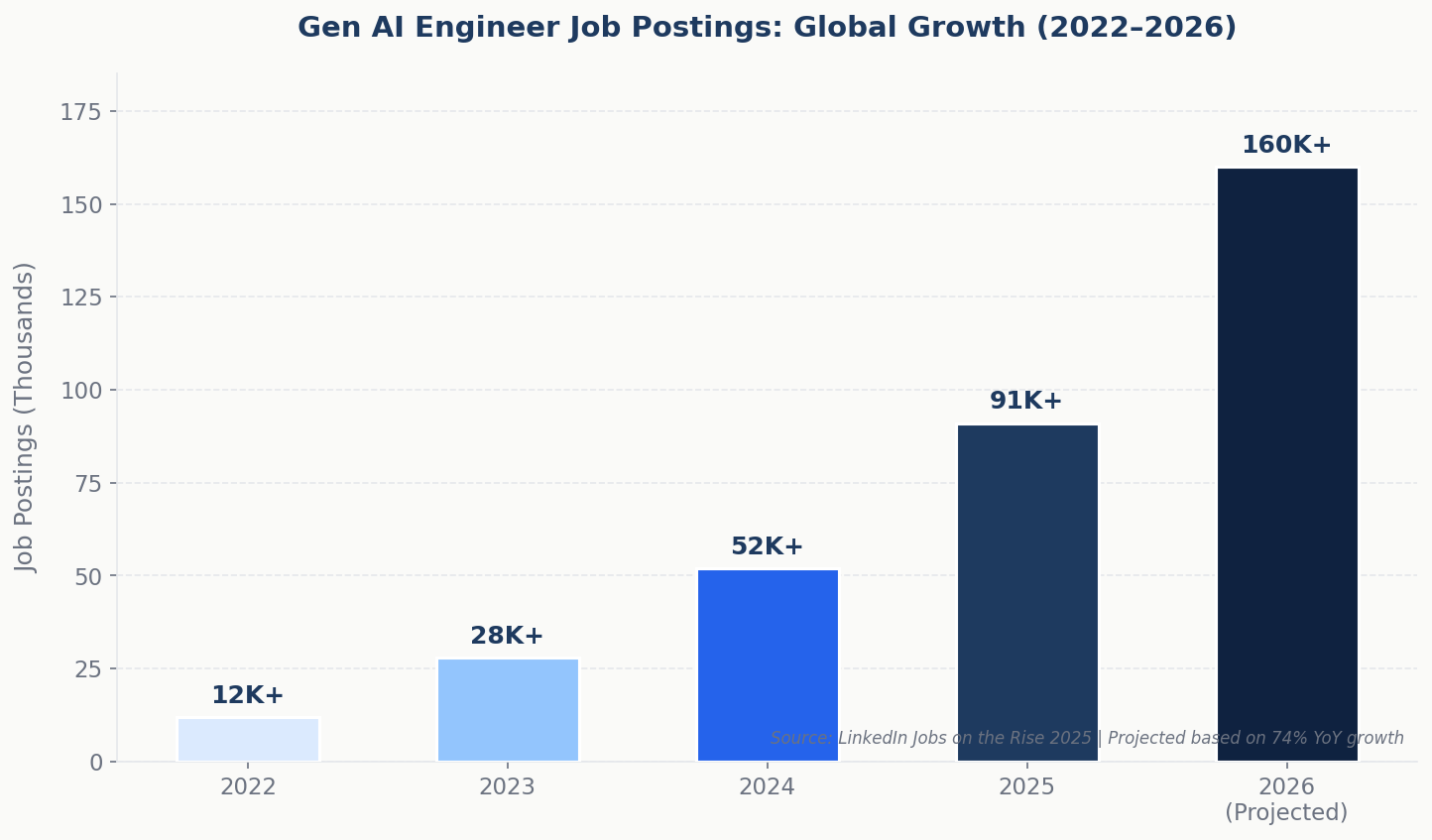
This gap is becoming more critical in 2026. According to McKinsey, generative AI could contribute up to $4.4 trillion annually to the global economy, driving rapid enterprise adoption and increasing demand for skilled engineers.
Despite this surge, most organizations still lack a clear, practical definition of what a Gen AI engineer actually does.
TL;DR: What You Need to Know in 60 Seconds
A Gen AI engineer is not a data scientist. Not a backend developer. Not a prompt writer. This role sits at the intersection of software engineering and AI building production systems that run on large language models.
Most hiring managers write the wrong job description. That mistake costs 3–4 months and up to 1.5× annual salary in mis-hire fallout. The fix starts with understanding exactly what this role builds, owns, and measures.
This guide breaks down the Gen AI engineer job description layer by layer responsibilities, must-have skills for 2026, common hiring mistakes, and a ready-to-use sample JD. If you're hiring for this role in the next 90 days, every section here is directly actionable.
What Is a Gen AI Engineer?
What is a Gen AI engineer? A Gen AI engineer is a software professional who designs, builds, and deploys applications powered by foundation models including large language models (LLMs), image generation models, and multimodal systems. Unlike a traditional ML engineer who trains models from scratch, a Gen AI engineer works primarily at the application and integration layer, using pre-trained models as infrastructure.
Why Most Hiring Managers Get This Role Wrong
The most common mistake is writing a Gen AI engineer job description that mirrors a data scientist or backend developer posting. These are different disciplines with different toolchains, different success metrics, and different failure modes.
A data scientist builds predictive models and runs experiments. A backend engineer builds APIs and databases. A generative AI developer does neither of those things as their primary job. Their core output is AI-powered products: chat interfaces, document automation systems, intelligent agents, semantic search tools that route user inputs through models and return structured, useful outputs.
Teams that confuse these roles typically underestimate the scope of what Gen AI engineering involves by a factor of 3–4×. They hire a Python developer with basic API experience, then wonder why their AI product performs inconsistently at scale.
Gen AI Engineer Roles Responsibilities: A Full Breakdown
Understanding Gen AI engineer roles responsibilities means separating the role into three layers: foundation, application, and evaluation.
1. Foundation Layer: Working With Models and Data
This layer involves selecting the right foundation model for the use case GPT-4o, Claude, Gemini, Mistral, or open-source alternatives and determining whether to use the model out of the box or apply fine-tuning language models for domain-specific performance. Most production systems today rely on retrieval-augmented generation (RAG) rather than fine-tuning, because RAG is faster to deploy, cheaper to maintain, and easier to update.
2. Application Layer: Building the AI Pipeline
A Gen AI engineer builds what is commonly called the AI integration layer, the system that sits between a user’s request and the model’s response. This includes:
- Prompt engineering designing instructions that produce reliable, safe, and accurate model outputs
- Vector databases storing and retrieving semantically indexed documents for RAG systems (tools: Pinecone, Weaviate, pgvector)
- Orchestration managing multi-step model calls using frameworks like LangChain, LlamaIndex, or custom pipelines
- API integration connecting the AI layer to existing enterprise systems, databases, and front-end interfaces
- Agentic AI systems building autonomous agents that can plan, call tools, and execute multi-step tasks without human input at each step
- Inference optimization reducing latency and compute costs so the application is viable at production scale
3. Evaluation Layer: Measuring What Actually Works
This is where most teams underinvest. A skilled Gen AI engineer designs evaluation frameworks both automated and human-in-the-loop to measure model evaluation and safety, output quality, hallucination rate, latency, and cost per query. Without this layer, AI applications degrade silently in production.
AI Engineer Skills 2026: What the Role Demands Today
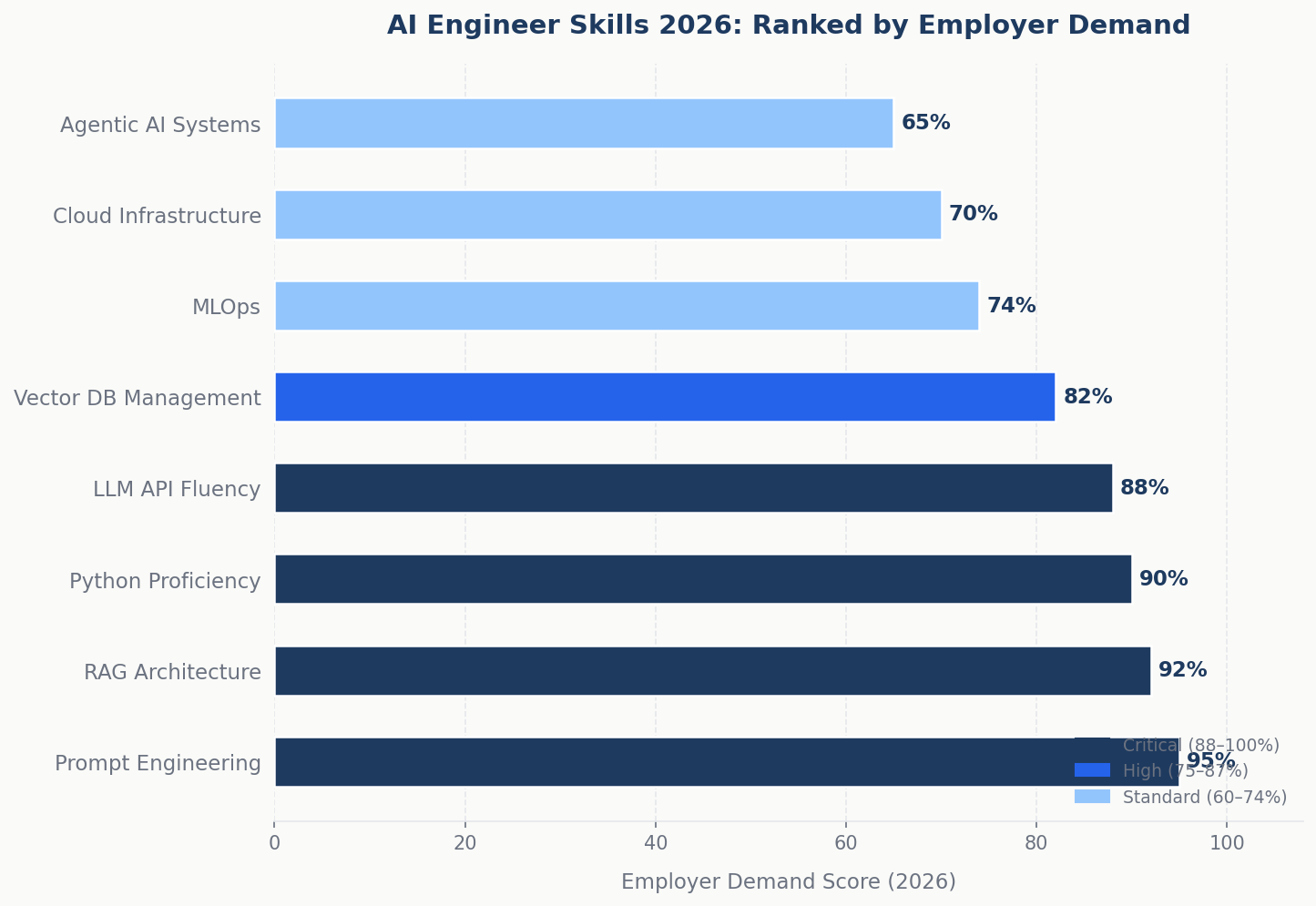
AI engineer skills 2026 have shifted significantly from even two years ago. A qualified candidate should demonstrate:
- Python core language for model interaction, data handling, and pipeline scripting
- LLM API fluency hands-on experience with OpenAI, Anthropic, Google Vertex, or Azure OpenAI APIs
- RAG architecture ability to design and debug retrieval-augmented generation pipelines end-to-end
- Prompt engineering systematic approach to designing, versioning, and testing prompts
- MLOps familiarity with deployment, monitoring, and versioning of AI models in production
- Vector database management experience with at least one vector store and embedding strategy
- Cloud infrastructure AWS, GCP, or Azure for deploying and scaling AI workloads
- AI product development understanding how to translate a business problem into an AI system specification
Strong candidates will also have exposure to LLM application engineering patterns guardrails, output parsing, fallback logic, and context window management. This is where production systems either hold or break.
Real-World Applications: What Gen AI Engineers Build
To make the role concrete, consider two representative engagements.
Enterprise Document Intelligence: A financial services firm needed to extract structured data from thousands of unstructured contract PDFs. A Gen AI engineer built a RAG-based pipeline combining OCR, semantic chunking, a vector store, and a GPT-4o extraction layer. Turnaround time on contract review dropped from 4 hours to 11 minutes per document, with a 94% accuracy rate on structured field extraction.
Internal Knowledge Assistant: A healthcare operator deployed an internal AI assistant to surface answers from clinical SOPs, HR policies, and compliance documents. The Gen AI engineer designed the retrieval architecture, built confidence scoring into the output layer, and set up a human-review queue for low-confidence responses. Staff query resolution time fell 60%, and escalation to senior staff dropped 35% within 90 days.
Gen AI Engineer vs. Related Roles: A Decision Framework
Before writing a Gen AI engineer job description, confirm you’re hiring for the right role.
| Role | Builds | Core Skill | When to Hire |
| Gen AI Engineer | AI-powered apps, agents, pipelines | LLM integration + prompt engineering | You need AI features in a product |
| ML Engineer | Trained models, recommendation systems | Model training, MLOps | You need custom predictive models |
| Data Scientist | Analyses, experiments, forecasts | Statistics, Python, SQL | You need insights from data |
| Backend Engineer | APIs, databases, infrastructure | System design, scalability | You need core product infrastructure |
| Data Engineer | Data pipelines, warehouses, ETL | Spark, Airflow, dbt | You need reliable data infrastructure |
What Most Teams Get Wrong When Hiring for This Role
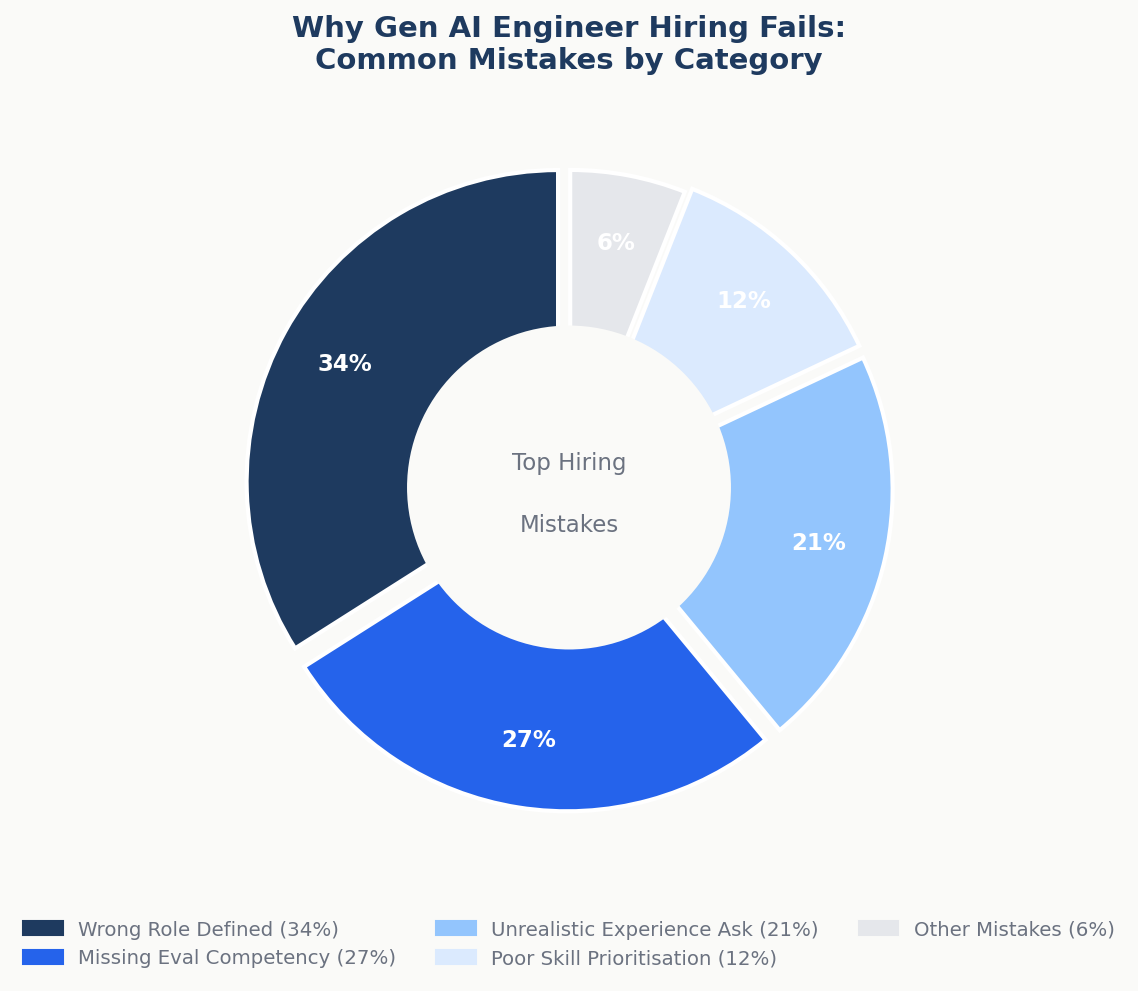
The single biggest error is treating Gen AI engineering as a prompt-writing job. It is not. Writing good prompts is one skill among a dozen. Teams that post “Prompt Engineer” when they need a Gen AI engineer attract candidates who have experimented with ChatGPT but cannot build a scalable AI pipeline architecture that survives real-world edge cases.
The second most common mistake is skipping the evaluation competency entirely. Job posts routinely omit any mention of model testing, output scoring, or safety benchmarking. Engineers hired under those specs often deliver systems that work in demos but hallucinate in production and no one on the team knows how to measure or fix it.
A third pattern: hiring managers list five years of “AI experience” as a requirement. The Gen AI engineer job description category barely existed three years ago. Setting arbitrary experience thresholds eliminates the most capable candidates in the market, those who learned on the job as the field evolved.
Frequently Asked Questions
What is the difference between a Gen AI engineer and a data scientist?
A data scientist analyzes data to extract insights and build predictive models. A Gen AI engineer builds applications that use pre-trained foundation models LLMs, image models, and multimodal systems to perform tasks. The overlap is minimal. Data scientists work primarily in notebooks and dashboards; Gen AI engineers work in production codebases and API integrations.
What programming languages does a Gen AI engineer need?
Python is the primary language for AI product development and LLM integration. JavaScript or TypeScript is often needed for front-end or full-stack AI applications. SQL is useful for working with structured data in hybrid RAG pipelines. Rust or Go expertise is a differentiator for inference optimization work but not a baseline requirement.
Do I need a Gen AI engineer or an ML engineer?
If you are building on top of existing models deploying a chatbot, automating document processing, building a semantic search system you need a Gen AI engineer. If you need to train or fine-tune models on proprietary data at scale, or build custom recommendation systems, you need an ML engineer. Many modern AI products require only the former.
What tools does a Gen AI engineer use?
Core tools include LangChain or LlamaIndex for orchestration, Pinecone or Weaviate for vector databases, OpenAI or Anthropic APIs for model access, and standard MLOps tooling for deployment. Evaluation frameworks like RAGAS, TruLens, or custom harnesses are part of a mature Gen AI engineer’s toolkit.
How long does it take to hire a Gen AI engineer?
At current market demand, expect 8–14 weeks from job posting to offer acceptance for a qualified Gen AI engineer. Roles with vague or misaligned Gen AI engineer job description language take 4–6 weeks longer. Partnering with a specialist hiring team can compress this to 4–6 weeks by reducing mis-filtered candidates early in the funnel.
What should I look for in a Gen AI engineer’s portfolio?
Look for evidence of end-to-end builds: not just prompts or API calls, but deployed systems that include a retrieval layer, an evaluation framework, and some form of production monitoring. Candidates who can walk through a RAG architecture they designed including why they made specific tools and chunking choices demonstrate real competency beyond surface-level familiarity.
What is a realistic Gen AI engineer salary range in India in 2026?
Depending on experience and specialization, Gen AI engineer compensation in India currently ranges from ₹18–28 lakhs per annum for mid-level roles to ₹35–60 lakhs for senior engineers with strong deployment track records. Engineers with expertise in agentic AI systems or inference optimization command a 20–30% premium above those ranges.
Sample Gen AI Engineer Job Description
Role: Gen AI Engineer Location: [Remote / Hybrid / On-site your city] Employment Type: Full-time
About the Role
We are building AI-powered products that automate complex, document-heavy workflows for enterprise clients. We need a Gen AI engineer who can own the full stack of that build from retrieval-augmented generation pipeline design through production deployment, monitoring, and iteration.
What You Will Do
- Design and build end-to-end Gen AI application pipelines using LLMs and RAG architecture
- Implement and optimize vector database retrieval strategies for production workloads
- Develop robust prompt engineering frameworks with versioning and evaluation harnesses
- Build and maintain agentic AI systems capable of multi-step task execution
- Instrument AI applications with evaluation layers to track output quality, latency, and hallucination rate
- Collaborate with product and domain teams to translate business requirements into AI system specifications
What You Bring
- 3+ years of software engineering experience; 1+ year working with LLM APIs in production
- Proficiency in Python and at least one orchestration framework (LangChain, LlamaIndex, or equivalent)
- Hands-on experience with at least one vector store (Pinecone, Weaviate, pgvector, Chroma)
- Understanding of model evaluation, output scoring, and safety benchmarking
- Familiarity with cloud deployment environments (AWS, GCP, or Azure)
- Strong debugging instinct for non-deterministic systems
Bonus Points
- Experience with fine-tuning or PEFT methods for domain adaptation
- Exposure to inference optimization (quantization, batching, caching strategies)
- Prior work in regulated industries (healthcare, legal, finance) where AI output reliability is non-negotiable
 Ready to Hire Right the First Time?
 Ready to Hire Right the First Time?
If you are defining a Gen AI engineer job description for the first time or refining one that has not been converting qualified candidates, the specificity of your requirements is the leverage point. Vague posts produce vague applicants. And in a market where qualified Gen AI engineers receive 4–6 competing offers simultaneously, a poorly scoped role does not get a second look.
The cost of getting this wrong is not abstract. Mis-hires in this space set AI product timelines back by 3–6 months on average. Rebuilding a pipeline that a wrong hire left behind costs more than the hire itself. The leverage point is always upstream in how the role is defined before the search begins.
At Supersourcing, our team has helped over 40 technology and enterprise companies structure Gen AI engineering roles, define realistic skill benchmarks, and run technical screening that separates production-ready engineers from AI enthusiasts. We have seen every variation of this hiring problem and the fix is almost always the same: sharper requirements, better-calibrated evaluation, and a sourcing process built for a niche that generic platforms do not serve well.
If you want to pressure-test your job description or hiring criteria before committing to a search, we are happy to do that in a single conversation. No lengthy process, no obligation. Reach out directly at mayank@engineerbabu.com to start that conversation. If you prefer, you can also use the contact form and someone from our team will respond within one business day.
The right Gen AI engineer does not just fill a role they become the technical foundation your AI product roadmap runs on. That hire deserves a well-built process behind it.
