

A US company will pay $160,000 to $200,000 in total compensation for a senior Technical Program Manager in San Francisco, then watch three roadmaps slip anyway because that one person can’t be in two time zones at once. The same skill set sits in Bengaluru and Pune at roughly a third of the loaded cost and most teams still get the hire wrong.
The reason is rarely the talent. India produces an enormous, mature pool of program leaders. The reason is that US companies import a US hiring playbook, screen for the wrong signals, and then structure the role so it can’t succeed. They treat the position as a cheaper coordinator instead of an accountable owner, and the program suffers for it.
When you hire TPM India teams correctly, you are not buying a status-update machine eight hours offset from headquarters. You are buying decision velocity inside your delivery or someone who can unblock engineers at 9 PM Pacific because it’s 9:30 AM for them, and who holds the line on scope when a VP changes their mind on a Friday.
This is the gap this guide closes. It covers what the role actually is, what it costs with current numbers, how it differs from a Product Manager and an Engineering Manager, and the specific, repeatable mistakes that turn a high-leverage offshore hire into an expensive disappointment.
India’s Global Capability Centers grew from $40.4 billion in export revenue in FY19 to $64.6 billion in FY24, and the number of global leadership roles based in India is projected to rise from roughly 6,500 to more than 30,000 by 2030. That single shift leadership, not headcount is the context every US hiring manager is missing.
The companies winning here aren’t the ones paying the least. They’re the ones who understood what they were buying before they bought it.
What Is a Technical Program Manager?
A Technical Program Manager is an accountable cross-functional owner who drives complex, multi-team technical programs to completion by managing scope, dependencies, risk, and delivery cadence without owning the product vision or directly managing the engineers. The role exists where coordination becomes a full-time engineering problem in its own right.
That definition matters because it draws a hard boundary. A TPM is measured on whether the program ships, not on lines of code or on the product roadmap. They turn ambiguity into a sequenced plan and keep it on track.
The Core Problem: You’re Not Hiring a Coordinator, You’re Hiring Throughput
Most US teams reach for an offshore program hire when delivery is already late. That timing is the first trap. They write a job description for a “coordinator” , someone to take notes, chase status, and run standups and then they’re confused when the program keeps slipping.
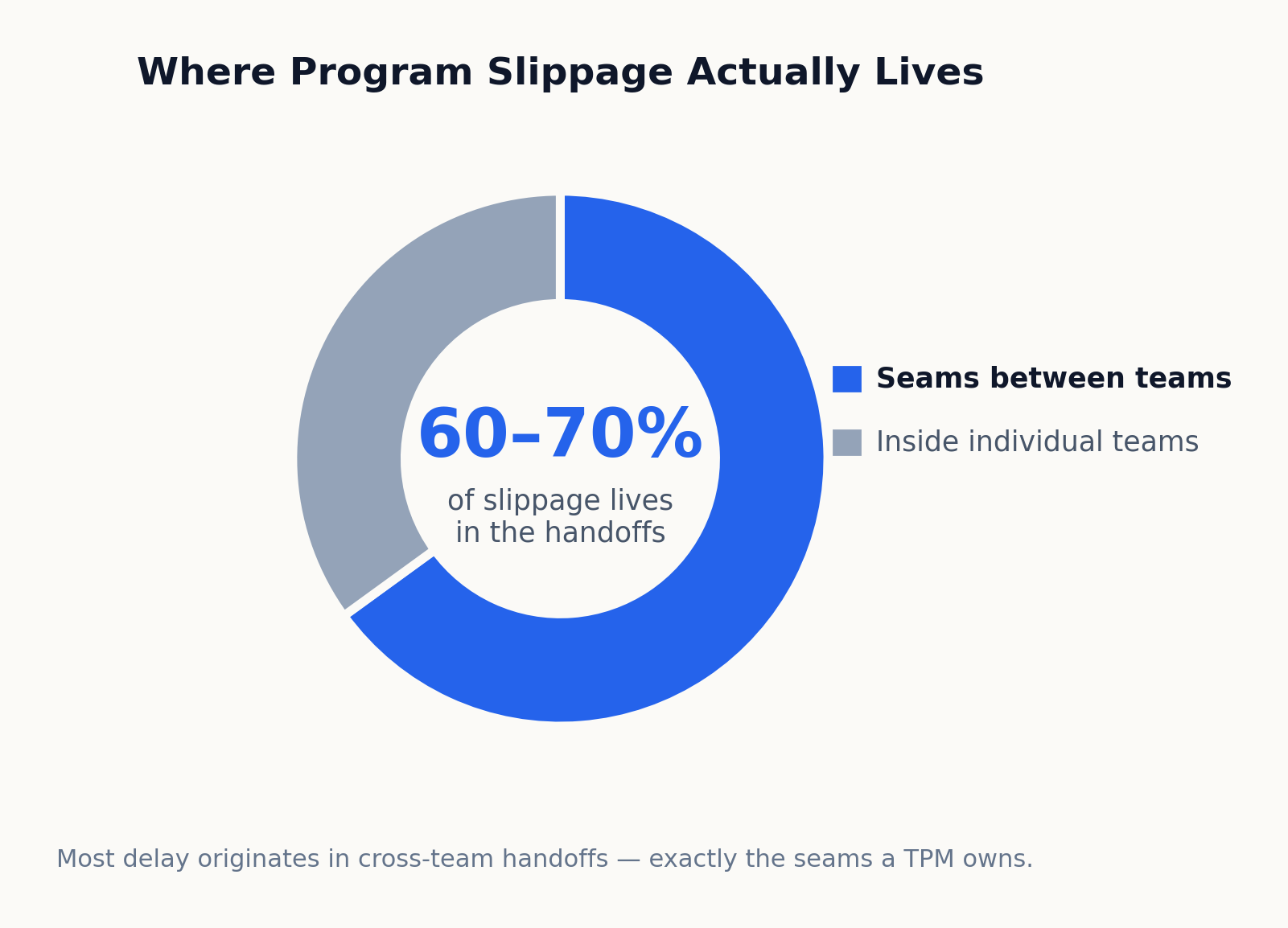
The real challenge is throughput across teams that don’t naturally talk to each other. In a typical mid-sized engineering org, a single feature can touch four to six teams, two to three external vendors, and a compliance review. Nobody owns the seams between them. That’s where 60–70% of slippage lives not inside any one team, but in the handoffs.
A genuine Technical Program Manager role is built to own those seams. The difference between a coordinator and a TPM is the difference between reporting a blocker and removing it. One updates a spreadsheet; the other gets two staff engineers and a vendor on a call and forces a decision.
The cost of getting this wrong is concrete. Industry hiring data suggests 58% of capability centers in India take more than 45 days to fill a critical role, and the wrong fit on a program lead doesn’t surface for two to three months by which point a quarter’s roadmap is already compromised. A mis-hire here isn’t a salary you wasted; it’s a quarter you lost and a team you demoralized.
The teams that win treat this as a senior, high-leverage hire from day one. The teams that struggle treat it as offshore overhead and get exactly the outcome they paid for.
How to Hire a TPM in India: The Full Playbook
This is the part competitors gloss over. Hiring well across a 9.5–12.5 hour offset is a system, not a job post. Below is the end-to-end approach, with the reasoning behind each decision.
What Does a Technical Program Manager Actually Do, Day to Day?
Before you screen anyone, get specific about the mandate. A strong TPM spends their week on five things: maintaining the technical roadmap and its critical path; running dependency management across dedicated teams; surfacing and mitigating risk management items before they become fires; owning the escalation path when a decision stalls; and protecting delivery cadence so engineering keeps a predictable rhythm.
Notice what’s not on that list: writing specs, setting product priorities, and managing people. When you blur those in, you’ve created a job no single person can do well and you’ll filter out the candidates who actually understand the discipline.
Step-by-Step: How to Hire a TPM in India the Right Way
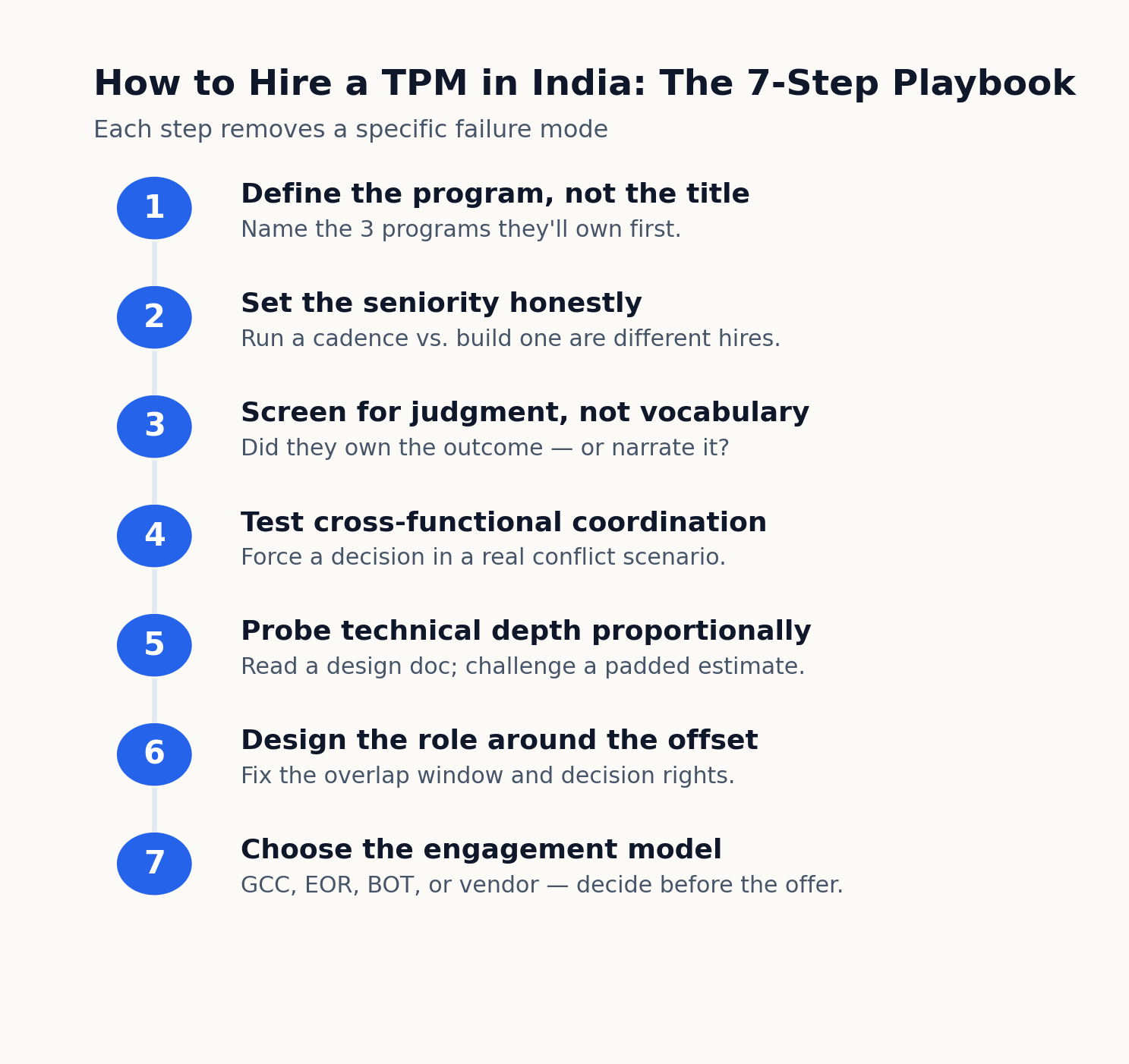
Use this sequence. Each step exists to remove a specific failure mode.
- Define the program, not the title. Write down the three programs this person will own in their first six months, with the teams and dependencies involved. If you can’t name them, you’re not ready to hire. You need a coordinator or a contractor, not a TPM.
- Set the seniority honestly. Decide whether you need someone to run an established cadence or build one from zero. These are different hires at different price points. Building from zero requires a senior operator; the market will not give you that cheaply.
- Screen for judgment, not vocabulary. Anyone can recite Agile ceremonies. Ask candidates to walk you through a program that went sideways and exactly what they did. Listen for whether they owned the outcome or narrated it.
- Test cross-functional coordination directly. Give a realistic scenario: two teams disagree on an API contract, the deadline is fixed, and one team lead outranks the other. A real TPM drives to a decision and a documented owner; a weak one schedules another meeting.
- Probe technical depth proportionally. They don’t need to ship code, but they must read a system design doc, understand why a dependency is hard, and call BS on a padded estimate. Have an engineer in the loop on at least one interview.
- Design the role around the offset. Define which four hours of time zone overlap with headquarters are non-negotiable, what they’re empowered to decide solo, and what must wait for a US sync. Ambiguity here is what kills offshore programs.
- Decide your engagement model before the offer. GCC, employer-of-record, build-operate-transfer, or vendor each changes cost, control, and retention. Choosing this after you’ve found the person is backwards.
That numbered sequence is the whole game. Most failures trace back to skipping step 1 or step 6.
Engagement Models and Their Cost Implications
When you hire TPM offshore India talent, the structure you choose shapes everything downstream: how much you pay, how much control you keep, and whether the person stays.
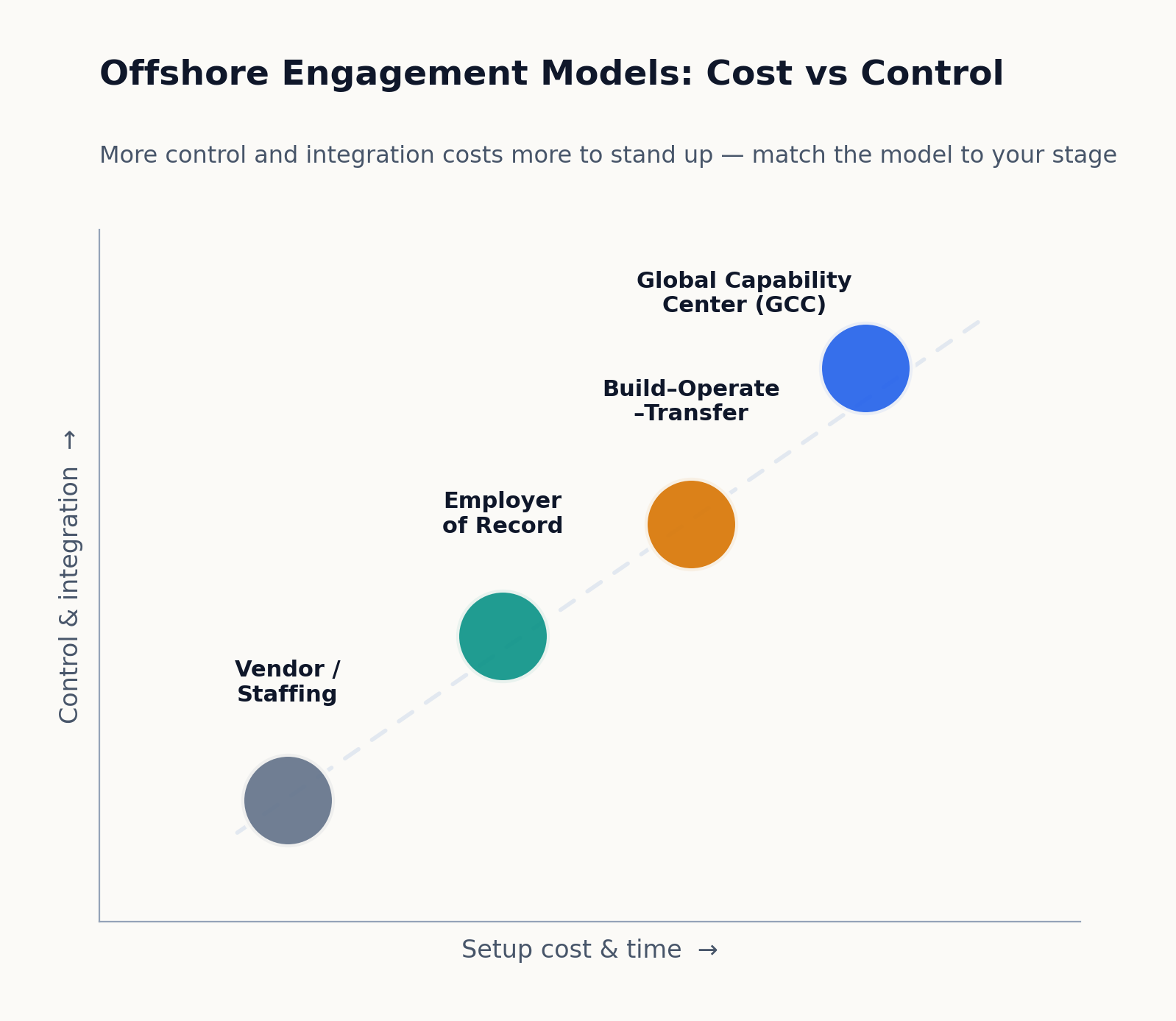
A global capability center (GCC) gives you the most control and the deepest integration. The TPM is genuinely your employee, inside your culture and systems. India now hosts more than 1,800 GCCs employing close to 2 million professionals, and they pay a documented 12–20% premium over traditional IT services firms precisely to win this caliber of talent. The trade-off is setup cost and time.
An employer-of-record (EOR) model lets you hire one person fast without a legal entity, at a per-head premium. A build-operate-transfer arrangement is the middle path for teams that intend to scale. A pure vendor or staffing model is fastest and cheapest up front, but you sacrifice the integration that makes a TPM effective and integration is the entire value of the role.
There’s no universally correct answer. There is a correct answer for your stage: one TPM to prove the model points toward EOR; a planned team of eight points toward a GCC.
Compliance and Integration Considerations
Two things quietly sink offshore programs. The first is access to a TPM who can’t see your tickets, dashboards, code reviews, and incident channels is flying blind, and security teams often default to over-restricting offshore staff. Decide the access model before day one.
The second is RACI ownership. If your TPM is “Responsible” for delivery but a US director holds every “Accountable” slot, you’ve built a bottleneck across a 12-hour offset. Push real decision authority down, or you’ve hired an expensive messenger.
Technical Program Manager Salary India: What the Numbers Actually Say
Here is where US teams either find their edge or talk themselves out of it. The Technical Program Manager salary India picture in 2026 is well-documented, and the arbitrage is real but it is not “cheap,” and treating it as cheap is itself a mistake.
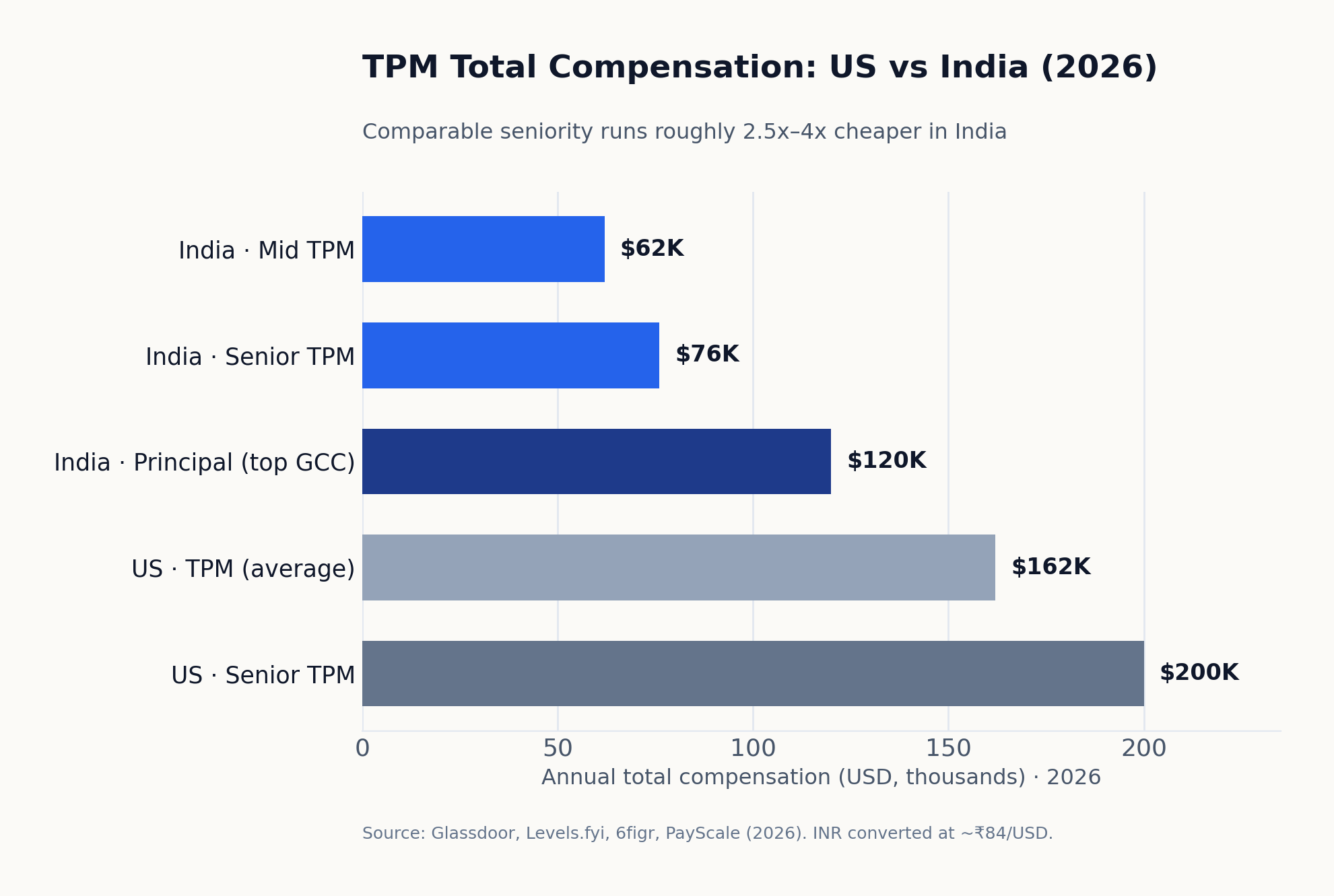
A mid-level TPM in India averages roughly ₹35–55 lakh in total compensation, with the broad market average landing near ₹52 lakh based on a sample of over 1,000 profiles. A Senior Technical Program Manager averages around ₹63 lakh, and top-tier GCC employers like Amazon push principal-level total compensation past ₹1 crore. In US-dollar terms, that’s roughly $42,000 to $76,000 for mid-to-senior, climbing past $120,000 at the very top.
Compare that to the US, where a Technical Program Manager averages around $162,000 and a senior TPM clears $200,000 in total compensation. Even at India’s senior end, you are typically looking at a 2.5x to 4x difference in loaded cost for comparable capability.
The mistake isn’t paying these numbers it’s anchoring to the bottom of the range. The ₹15–20 lakh “TPM” is usually a coordinator with a relabeled title, and you will feel the difference within a quarter. Pay for the senior operator. The arbitrage is still enormous, and the downside of underpaying is a lost roadmap.
TPM vs PM vs Engineering Manager: Who Actually Does What
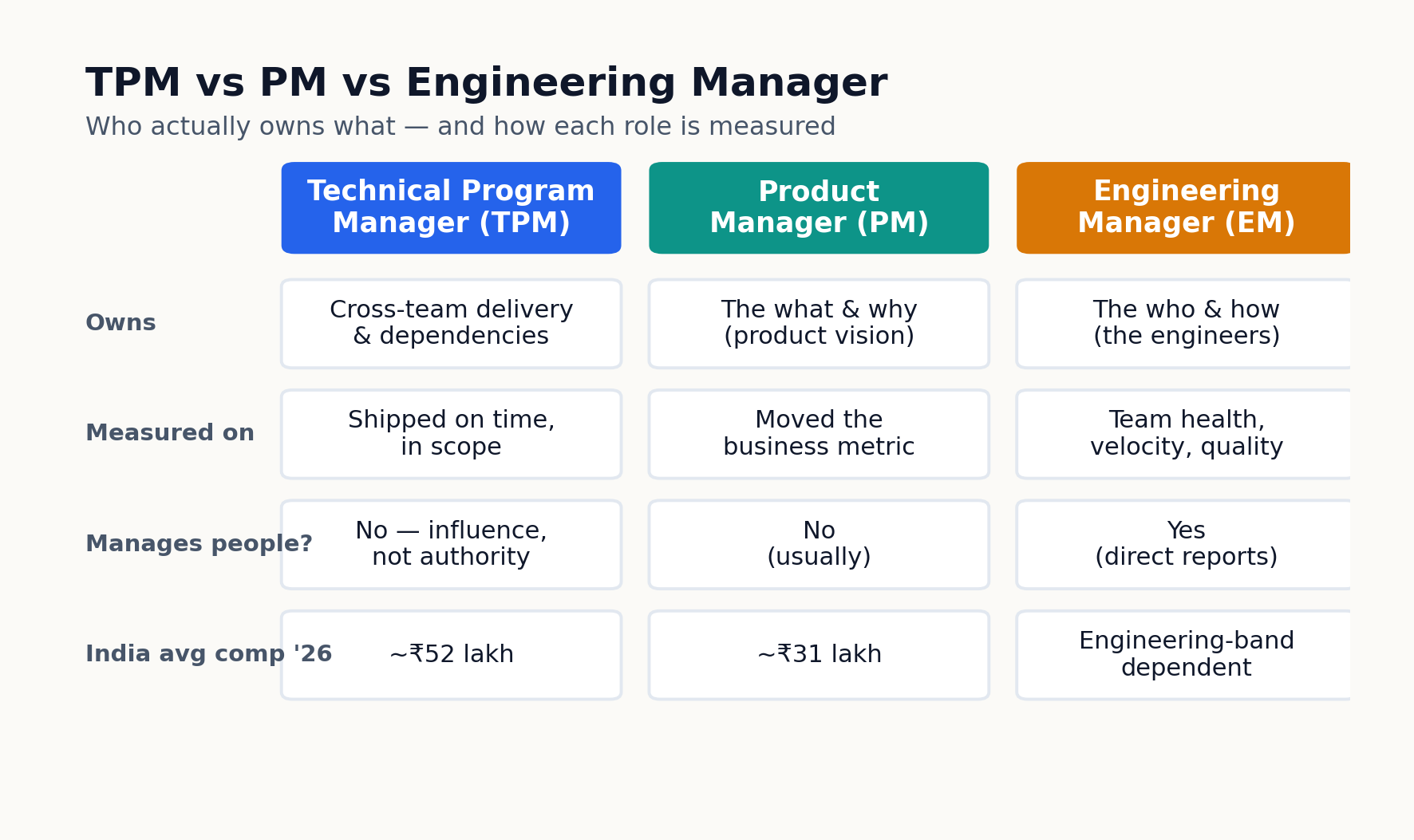
This is the confusion that produces more bad hires than any salary miscalculation. US teams routinely scope a TPM job description, interview against a PM rubric, and then expect Engineering Manager outcomes. The roles overlap at the edges and are fundamentally different at the core.
| Dimension | Technical Program Manager (TPM) | Product Manager (PM) | Engineering Manager (EM) |
| Owns | Cross-team delivery & dependencies | The what and why (product vision) | The who and how (the engineers) |
| Measured on | Did the program ship on time, in scope | Did the product move the business metric | Team health, velocity, code quality |
| Manage people? | No (influence, not authority) | No (usually) | Yes (direct reports) |
| Primary failure mode | Slipped, tangled multi-team programs | Building the wrong thing | Burned-out or stalled team |
| India avg total comp (2026) | ~₹52 lakh | ~₹31 lakh (Program Manager) | Varies; engineering-band dependent |
The table makes the TPM vs PM difference concrete: a PM decides what to build and why; a TPM makes sure the cross-functional machine delivering it doesn’t seize up. An EM owns the people and the technical quality of one team. When one team’s work is the whole program, you may not need a TPM. The moment delivery spans four teams and two vendors, the TPM becomes the highest-leverage role on the program.
Case Studies: What This Looks Like in Practice
A US fintech scaling its platform team. A Series-C payments company kept missing quarterly platform milestones because three feature teams, a compliance reviewer, and a third-party processor were never sequenced. They chose to hire TPM India capability through a GCC model at roughly ₹58 lakh total comp a senior operator, not a coordinator. Within two quarters, on-time milestone delivery moved from under 50% to over 85%, and the US engineering director got back roughly a day a week previously lost to cross-team firefighting.
A mid-market SaaS company that hired wrong first. A B2B SaaS firm initially hired a ₹18 lakh “TPM” through an IT staffing vendor and treated the role as offshore status reporting. Three months in, programs were still slipping and the role was clearly mis-scoped. They re-hired at a senior band with real decision authority and a defined four-hour overlap window. The second hire cost more than double and recovered a roadmap that the first arrangement had quietly put a full quarter behind.
The pattern across both: outcome tracked seniority and mandate, not headcount or hourly rate.
What Most Teams Get Wrong
After enough of these engagements, the mistakes rhyme. They are rarely about talent and almost always about how US companies frame the role. These are the TPM hiring mistakes US companies make, in rough order of how much damage they cause.
They hire a coordinator and call it a TPM. The single most common and most expensive error. A coordinator reports problems; a TPM removes them. If the job description is built around meeting notes and status decks, you’ve pre-decided to fail and you’ll blame “offshore” for a scoping mistake you made in the US.
They withhold decision authority. Teams hire a capable senior operator and then route every real decision through a US director eight to twelve hours away. You’ve now installed a bottleneck and demoralized the exact person you paid a premium for. If you don’t trust someone to decide, don’t hire them at this level.
They anchor to the cheapest salary. The bottom of the Technical Program Manager salary India range buys you a relabeled coordinator. The gap between a ₹18 lakh hire and a ₹55 lakh hire is not 3x the cost , it’s the difference between a program that ships and one that doesn’t. The arbitrage versus US comp is so large that underpaying to save a few lakh is irrational.
They ignore the offset instead of designing for it. Time zone overlap is a feature, not a bug; a well-structured TPM in India unblocks your engineers while the US sleeps. But that only works if you’ve defined the overlap window, the async decision rights, and the escalation path. Teams that “wing it” on the offset get the worst of both worlds.
They skip the technical screen. A TPM who can’t read a design doc or challenge a padded estimate will be steamrolled by senior engineers within weeks. “Technical” is in the title for a reason. Put an engineer in the loop.
They treat retention as someone else’s problem. GCCs pay a 12–20% premium for a reason this talent has options. Hire well, then under-invest in growth and integration, and you’ll be re-hiring in eighteen months, eating the productivity hit twice.
The throughline: the talent in India is not the constraint. The framing imported from US headquarters usually is.
Frequently Asked Questions
What is the difference between a TPM and a PM?
A Product Manager owns what gets built and why the product vision, priorities, and business outcome. A Technical Program Manager owns how it ships sequencing the work across multiple teams, managing dependencies and risk, and protecting the delivery timeline. A PM can succeed while a program slips; a TPM is measured precisely on whether that program lands on time and in scope.
How much does it cost to hire a TPM in India?
In 2026, expect roughly ₹35–55 lakh in total compensation for a mid-level TPM and around ₹63 lakh for a senior one, with top GCC employers exceeding ₹1 crore at principal level. That’s broadly $42,000–$76,000 versus a US average near $162,000 a 2.5x to 4x advantage. The cost mistake to avoid is anchoring to the ₹15–20 lakh band, which typically buys a coordinator, not a program owner.
Do TPMs need to know how to code?
Not to ship production code, but yes to read it. A TPM must understand system design documents, grasp why a dependency is technically hard, and credibly challenge an inflated estimate. Without that depth, senior engineers will route around them and the program loses its honest broker. Screen for the ability to reason about architecture, not to write algorithms.
What does a Technical Program Manager actually do?
Day to day, a TPM maintains the technical roadmap and its critical path, runs dependency management across teams and vendors, surfaces and mitigates risks before they escalate, owns the decision-and-escalation path, and protects engineering’s delivery cadence. In short, they own the seams between teams, the place where most program slippage actually originates.
Is hiring an offshore TPM in India worth it?
For programs spanning multiple teams, almost always provided you hire at the right seniority and grant real decision authority. The cost advantage is large, the talent pool is deep and increasingly senior, and the time-zone offset becomes an asset when structured deliberately. It stops being worth it the moment you treat the role as cheap offshore overhead rather than an accountable owner.
How long does it take to hire a TPM in India?
Plan for 45–75 days from open requisition to start date for a senior hire, and longer if you’re standing up a new engagement model at the same time. Industry data shows most capability centers already take more than 45 days to fill critical roles, so compressing the technical and judgment screens to “go faster” is usually a false economy that surfaces as a mis-hire later.
How do you evaluate offshore TPM candidates effectively?
Test judgment over vocabulary. Use a realistic cross-functional conflict scenario and watch whether the candidate drives to a documented decision and owner, or schedules another meeting. Put an engineer in at least one round to confirm technical depth, and probe a real program that went wrong to see whether they owned the recovery. If this is a make-or-break hire, it’s worth pressure-testing your evaluation rubric before you start interviewing.
Before You Hire: Pressure-Test the Plan
The decision to hire TPM India capability is rarely the hard part getting the role scoped, leveled, and structured correctly is. The companies that succeed define the programs first, pay for a real operator, and design the role around the time-zone offset instead of apologizing for it. Everything in this guide points back to that single discipline: clarity before commitment.
Run your own plan through the same filters before you open a requisition. Are the first three programs named, with their teams and dependencies written down? Is the seniority band honest about whether you need someone to run a cadence or build one? Have you decided the decision rights, the overlap window, and the escalation path? And is your engagement model GCC, EOR, or vendor matched to your stage rather than chosen after you’ve already found a candidate? If any of those answers is fuzzy, that’s the cheapest possible thing to fix now, before a single rupee or dollar gets spent.
Most of the offshore TPM hiring failures we see trace back to one of those gaps, not to the talent itself. The market is deep and increasingly senior; the constraint is almost always the framing imported from US headquarters.
If you want to pressure-test your scope, seniority band, and engagement model before you commit, that’s the kind of conversation Supersourcing has run across multiple US engineering organizations and it’s worth having while the role is still a draft, not a signed offer. The aim isn’t to sell you a headcount; it’s to make sure the role you’re about to open is the one that actually moves your roadmap. If it’s useful, you can send the three programs you’d hand this person to mayank@engineerbabu.com or start at supersourcing.com, and use them as the basis for a candid read on whether you’re ready to hire well.
Bring those three programs. If they’re clear, you’re ready. If they’re not, you’ve just found the highest-leverage thing to fix first.
