

Roughly seven out of ten enterprise software projects that miss their deadlines trace the slip back to one root cause: requirements that were never properly defined. Not bad code. Not weak project management. Vague, contradictory, or incomplete specifications that nobody owned. That single gap is the reason the role you are about to fill matters more than your next hire of three developers combined.
The decision to hire System Analyst India teams make is rarely the problem. The problem is who gets hired, and against what bar. Most hiring managers treat the position as a documentation clerk who writes things down after the real decisions are made. The strongest analysts do the opposite: they shape the decisions, expose the assumptions, and prevent the expensive rework that surfaces in month four.
This guide is built for technology leaders, founders, and delivery heads who are evaluating candidates right now and want a defensible framework rather than a generic job description. We will cover what the role genuinely owns, the System Analyst salary India market is actually paying in 2026, the skills that separate a strong analyst from an order-taker, and the specific interview red flags that predict failure before the offer letter goes out.
There is also a persistent point of confusion worth settling early. The titles “system analyst” and “business analyst” are used interchangeably across Indian job portals, which leads teams to recruit for the wrong skill set entirely. By the end, you will know which one your project needs and why the difference costs you months if you get it wrong.
The U.S. The Bureau of Labor Statistics projects roughly 34,200 openings for computer systems analysts every year through the decade, driven largely by replacement demand as professionals move into adjacent roles, a structural scarcity that keeps experienced analysts hard to retain.
What Is a System Analyst?
A system analyst is a technical professional who bridges business requirements and technical implementation by analyzing existing systems, defining functional specifications, and designing how software should behave to meet organizational goals. They translate what stakeholders need into precise, build-ready documentation that engineering teams execute against.
That definition sounds simple, but it hides the part that makes the role valuable: an analyst is accountable for correctness of intent. When a feature ships and the business says “this isn’t what we asked for,” the analyst either prevented that conversation or caused it.
The Real Problem Most Teams Are Solving For
Companies do not hire analysts because they have spare budgets. They hire them because something already broke, usually one of three things, and each has a measurable cost.
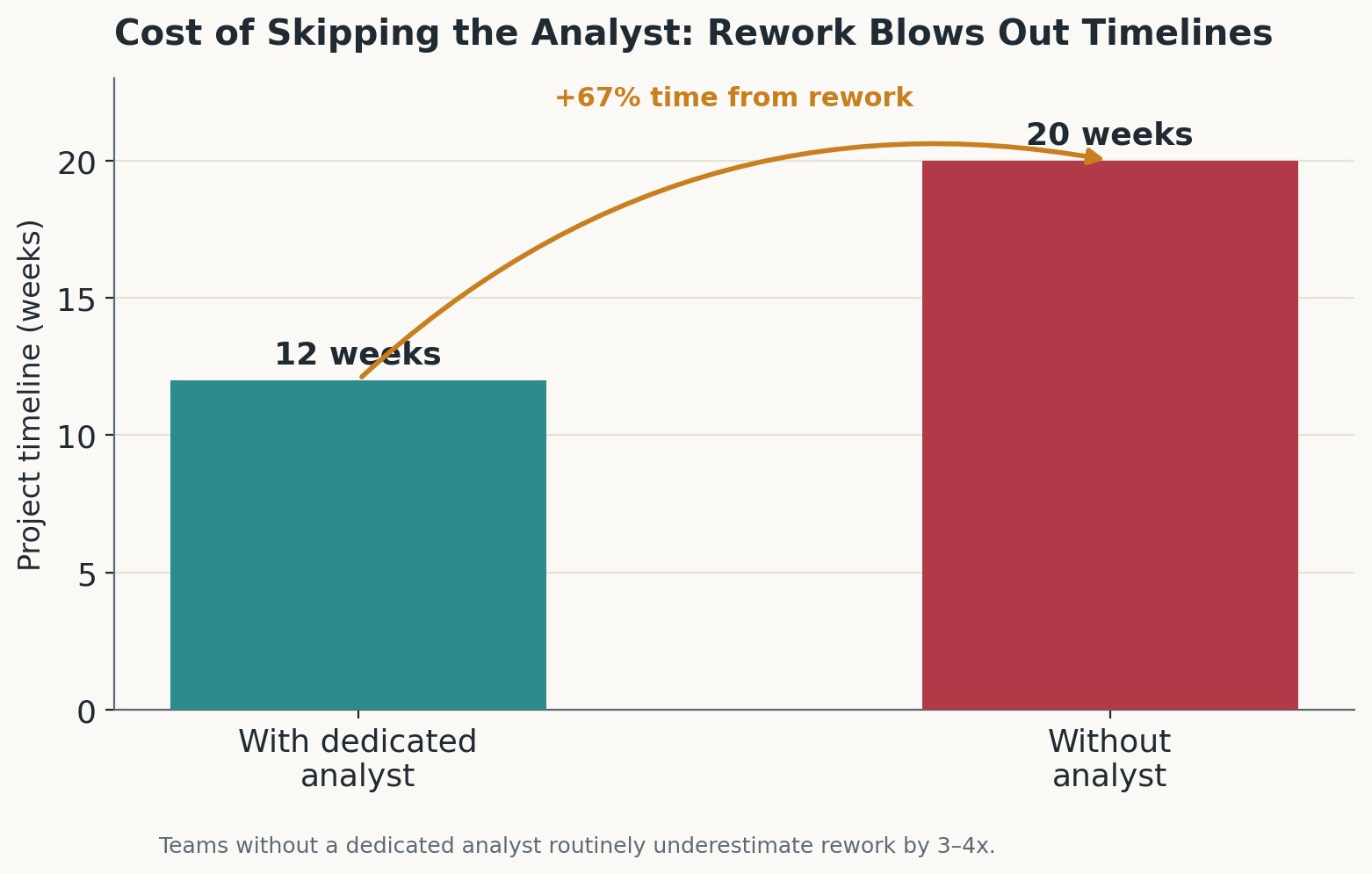
The first is rework. When requirements gathering is done informally a few Slack threads, a couple of calls, a half-finished doc engineering builds against assumptions. Industry post-mortems routinely show teams underestimating rework by 3–4x on projects without a dedicated analyst, turning a 12-week build into a 20-week one.
The second is integration risk. Most Indian mid-market and enterprise environments are not greenfield. They run legacy system integration alongside newer cloud services, and a feature that looks trivial in isolation touches four systems nobody documented. A data analyst who maps those dependencies before the sprint starts saves weeks of discovery-by-failure.
The third is stakeholder misalignment. Finance wants one thing, operations wants another, and the CTO assumed they agreed. Without strong stakeholder management, those conflicts surface during user acceptance testing (UAT) , the most expensive possible moment to discover them, often 8–10 weeks after the work was committed.
When you decide to hire System Analyst India candidates, you are buying down all three of these risks at once. The cost of the role is small relative to the cost of the failures it prevents which is exactly why under-screening is so damaging.
How to Hire System Analyst India Teams Can Actually Rely On
This is the section to slow down on. Hiring well is not about reading résumés faster; it is about testing for the few capabilities that predict on-the-job performance and ignoring the proxies that don’t.
The Core Skills Checklist for Hiring Managers
Before you screen a single candidate, agree internally on what “good” looks like. The teams that hire System Analyst India-based talent successfully start here, not with a job post. A practical system analyst skills checklist for hiring managers separates capabilities into three tiers.
Foundational technical skills come first: fluency in the software development life cycle (SDLC), comfort reading and writing SQL for data modeling questions, and the ability to produce clear functional specifications that an engineer can build from without a follow-up meeting. An analyst who cannot write an unambiguous spec is not yet an analyst.
Analytical skills are the second tier structured gap analysis, process mapping, and the discipline to ask “why” three layers deep before proposing a solution. The best signal here is whether a candidate interrogates your problem or simply accepts your framing.
The third tier is communication, and it is the one most teams under-weight. Strong technical documentation is table stakes; the differentiator is whether the analyst can sit between a defensive engineering lead and an impatient business sponsor and keep both moving toward the same system design.
A Defensible Hiring Process, Step by Step
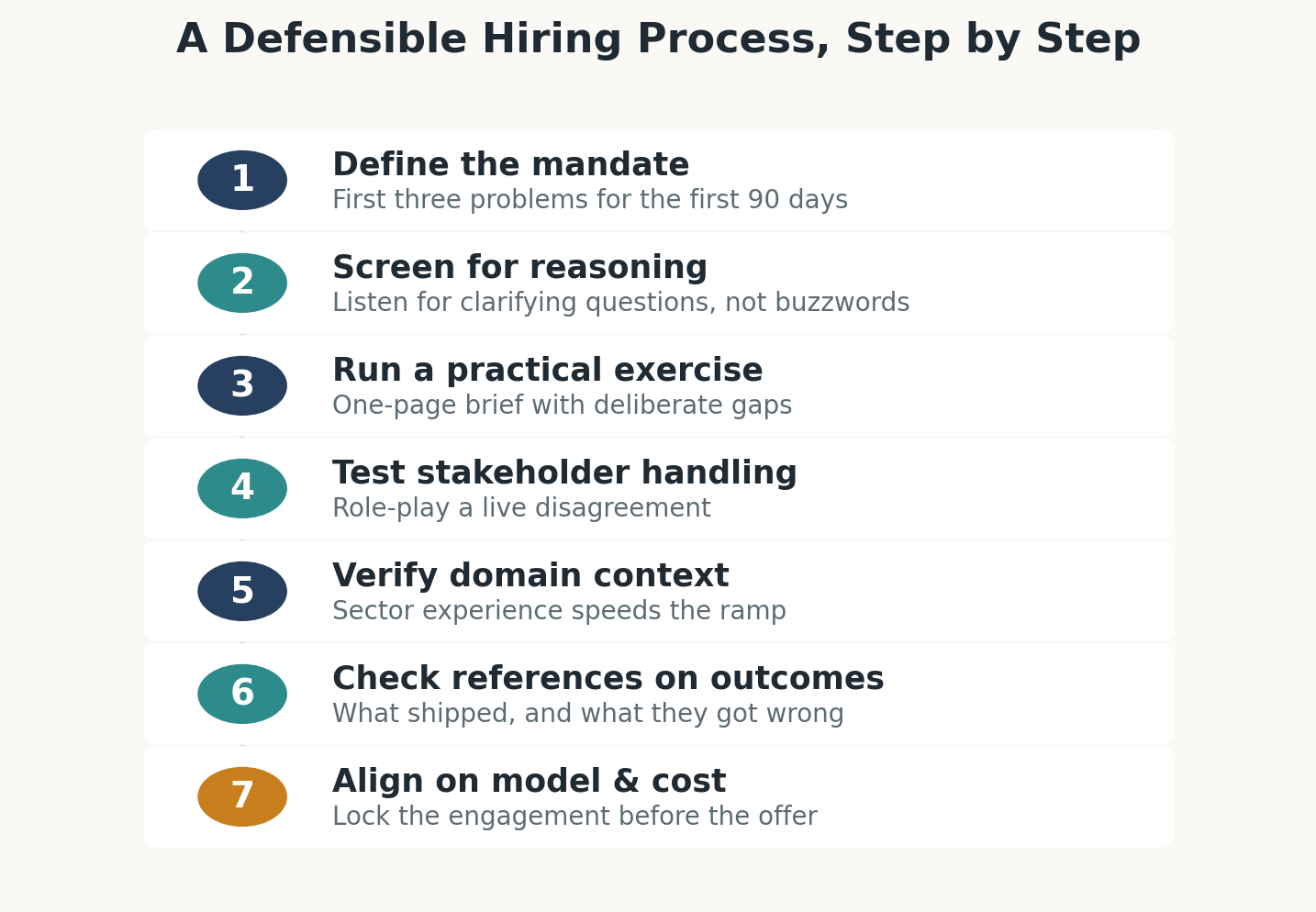
A repeatable process beats gut feel. The following sequence has held up across enterprise and product hiring alike:
- Define the mandate before the job post. Write down the first three problems the analyst will own in their first 90 days. If you cannot, you are not ready to hire.
- Screen for reasoning, not vocabulary. On the first call, describe a messy real scenario and listen for clarifying questions. Buzzword fluency is cheap; structured curiosity is not.
- Run a practical exercise. Give a one-page brief with deliberate gaps and ask the candidate to produce a short requirements summary. This single test predicts performance better than any résumé line.
- Test stakeholder handling live. Role-play a disagreement between two stakeholders and watch whether the candidate mediates or picks a side.
- Verify domain context. An analyst who has done enterprise software implementation in your sector fintech, healthcare, logistics ramps far faster on compliance and integration constraints.
- Check references on outcomes, not attendance. Ask what shipped because of them, and what they got wrong.
- Align on engagement model and cost before the offer, so salary expectations don’t collapse the deal at the last step.
Engagement Models and Cost Implications
There are three common ways to hire BA SA India organizations, and each carries a different cost and risk profile. A full-time hire suits long product roadmaps where institutional knowledge compounds. A contract analyst fits a defined transformation project with a clear end date. A staff-augmentation or agency model works when you need vetted capacity quickly and want someone else to own the screening risk.
The wrong model is expensive in subtle ways: a full-time hire for a four-month project leaves you paying for idle capacity, while a contractor on an open-ended platform leaves you re-onboarding every renewal. Match the model to the system design lifecycle, not to whichever option is fastest to approve.
Compliance, Integration, and Tooling Considerations
The technical environment an analyst walks into shapes how hard the role is, and screening should reflect that. In regulated sectors banking, insurance, healthcare the analyst is partly responsible for ensuring that data flows respect compliance constraints like data residency, audit trails, and consent handling. An analyst who has never worked under those constraints will produce specifications that pass internal review and then fail an external audit.
Integration complexity is the other multiplier. A feature spec that ignores how three upstream systems already exchange data is not a spec; it is a wish. Strong analysts insist on seeing the existing architecture before committing to a solution, and they document the legacy system integration points explicitly so engineering does not discover them mid-sprint.
Tooling is the easiest part to learn but worth confirming. Comfort with requirements platforms such as Jira and Confluence, diagramming tools for process mapping, and a working command of SQL for ad-hoc data modeling questions are reasonable expectations for a mid-level analyst. Treat tool familiarity as a hygiene check, not a hiring criterion; the judgment behind the diagrams is what you are paying for.
How AI Is Reshaping the Analyst Role
The role is being reshaped, not replaced, by AI-assisted workflows. Analysts now use large-language-model tooling to draft first-pass functional specifications, summarize stakeholder interviews, and surface inconsistencies across requirement sets far faster than manual review allowed. Reported productivity gains of 2–4x on documentation-heavy tasks are now common enough that they show up in compensation data.
What this means for hiring is a shift in what you screen for. The mechanical parts of the job drafting, formatting, first-pass technical documentation are increasingly automated. The judgment-heavy parts of knowing which requirement is wrong, mediating a stakeholder conflict, deciding what not to build are exactly the parts AI cannot do. When you hire a system analyst in 2026, you are paying a premium for the half of the job that does not automate, so weigh your interview accordingly.
System Analyst Salary India: What 2026 Numbers Look Like
Pay for the role spans a wide band because the title covers everyone from a junior documentation specialist to a senior architect-adjacent analyst. Treating it as one number is the most common budgeting mistake.
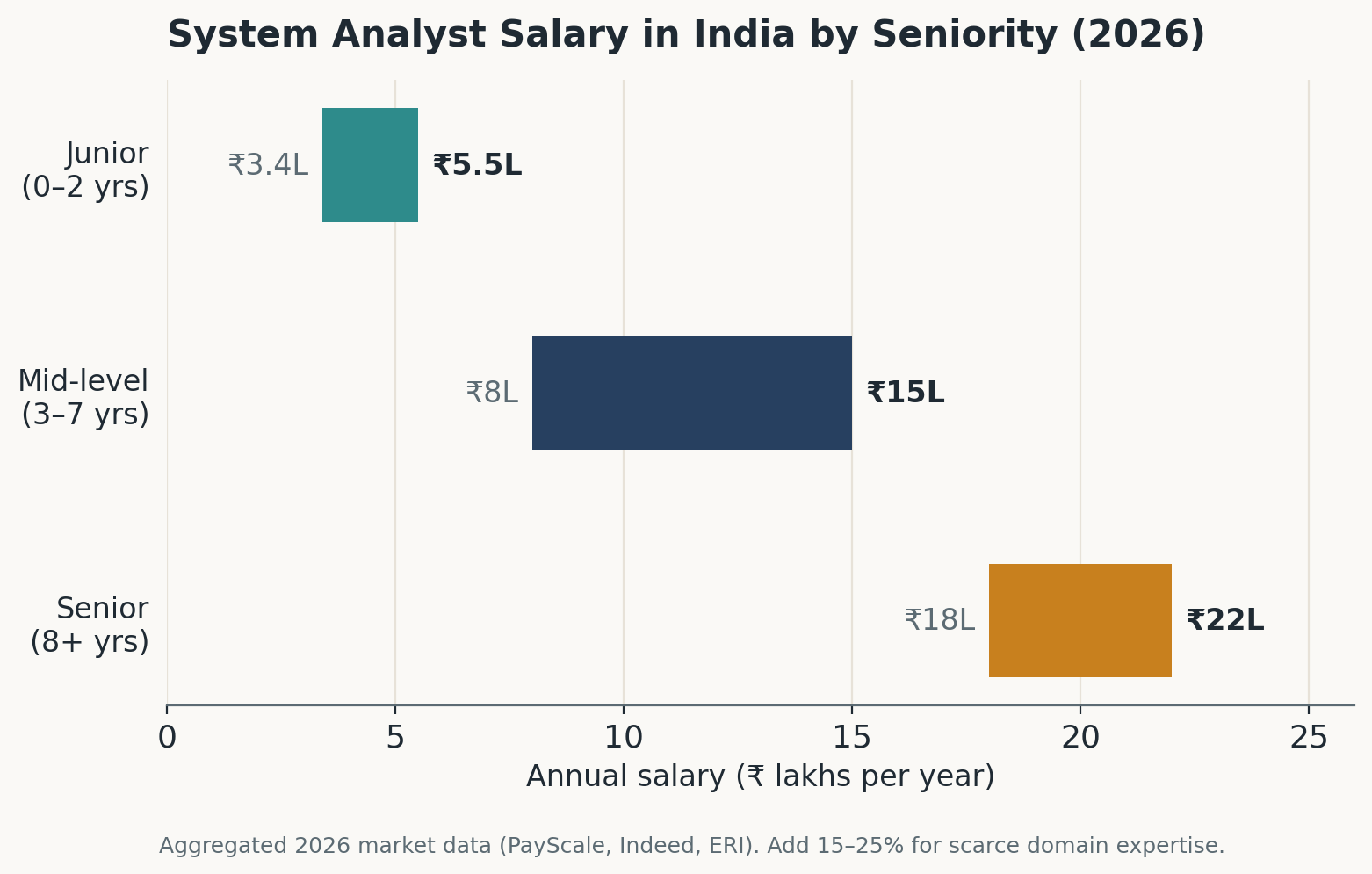
Aggregated 2026 market data places the broad average around ₹6.5–10 lakhs per year, with PayScale reporting an average near ₹6.4 lakhs and Indeed reporting closer to ₹9.8 lakhs depending on how the role is scoped. Entry-level analysts with under two years of experience typically land in the ₹3.4–5.5 lakhs range. Mid-level analysts with four to eight years generally command ₹8–15 lakhs, and senior analysts in metro hubs or specialized domains can reach ₹18–22 lakhs and beyond.
The System Analyst salary India premium is increasingly tied to two factors: domain depth and AI-tool fluency. Analysts who can orchestrate AI-assisted documentation and analysis workflows are being repriced upward, and that premium shows up at the top of the distribution rather than the median.
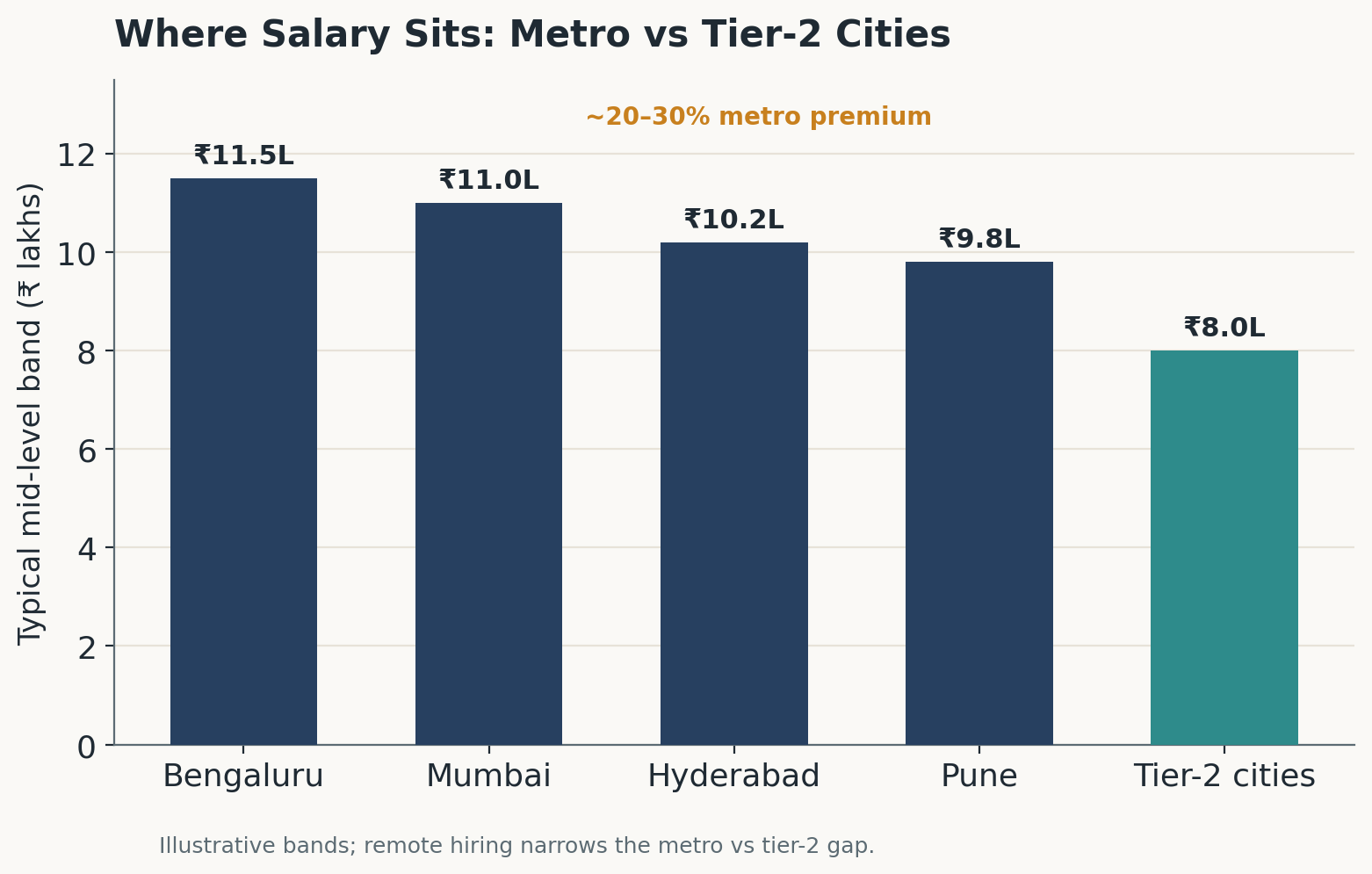
Location still matters, but less than it did. Bengaluru, Pune, and Hyderabad carry the highest bands, yet remote hiring in India has compressed the gap, letting companies access tier-1 talent at tier-2 cost structures when they hire outside the metros.
How Much Does a System Analyst Cost in India by Seniority?
Budgeting accurately means refusing to plan against a single average. A junior analyst handling requirements gathering under supervision is a genuinely different hire from a senior analyst who owns architecture-adjacent decisions, and paying junior rates for senior work or the reverse is where teams waste money.
For a clean planning baseline, treat the bands as follows. Junior analysts (0–2 years) sit at ₹3.4–5.5 lakhs and need oversight on functional specifications. Mid-level analysts (3–7 years) at ₹8–15 lakhs can own a workstream end to end. Senior analysts (8+ years) at ₹18–22 lakhs operate as a peer to engineering leadership and are the ones worth competing for. Add a 15–25% premium for scarce domain expertise such as payments, healthcare interoperability, or core banking.
The city still moves the number. A Bengaluru or Mumbai analyst typically commands 20–30% more than an equivalent profile in a tier-2 city, which is precisely why remote and hybrid hiring has become the lever smart teams pull to widen the talent pool without inflating the band. The trade is real but manageable: you gain access and cost efficiency, and you pay for it with more deliberate onboarding and documentation discipline. For most companies that hire System Analyst India profiles today, a remote-first or hybrid model is the default rather than the exception.
Case Studies: What Good Looks Like in Practice
A mid-market logistics firm running a legacy ERP migration brought in a senior analyst three weeks before development. By mapping undocumented dependencies across their billing and dispatch systems, the analyst cut the discovered-defect rate during UAT by an estimated 60% and kept the migration inside its 16-week window, a project that comparable peers routinely overrun by a full quarter.
In a second case, a fintech product team had churned through two developers blaming “unclear requirements.” Rather than hiring a third engineer, they hired one analyst to own requirements gathering and functional specifications. Sprint predictability improved within two cycles, and the rework rate on shipped features dropped sharply because the build matched intent the first time.
A third example is more cautionary. A retail company hired for the title rather than the skill, bringing on a “system analyst” who turned out to be a documentation generalist with no integration experience. Three months in, an undocumented dependency between their inventory and payments systems surfaced during UAT, the spec had never accounted for it, and the launch slipped a full quarter. The lesson is blunt: the cost of mis-screening dwarfs the cost of the role, which is the entire argument for taking the interview seriously.
Business Analyst vs System Analyst India: Settling the Confusion
This is the distinction that derails the most hiring decisions, so it deserves a direct framework. The two roles overlap, but they optimize for different things and Indian job listings blur them constantly.
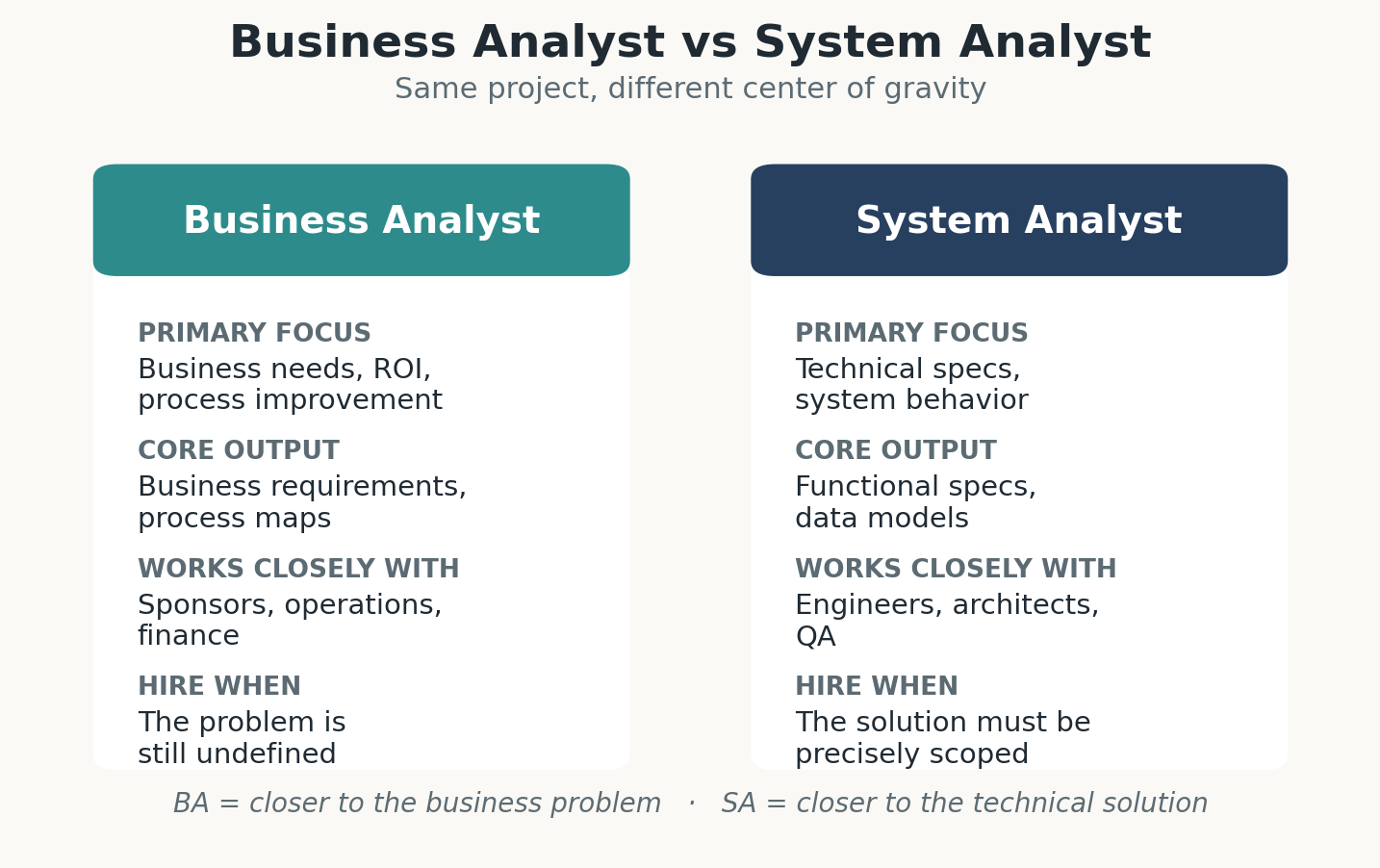
A business analyst leans toward the why and what: business cases, process improvement, ROI, and stakeholder priorities. A system analyst leans toward the what and how: turning those priorities into technical specifications, data flows, and system design that engineers implement. The clearest business analyst vs system analyst India distinction is proximity to the build, the BA is closer to the business problem, the SA is closer to the technical solution.
| Dimension | Business Analyst | System Analyst |
| Primary focus | Business needs, ROI, process | Technical specs, system behavior |
| Core output | Business requirements, process maps | Functional specs, data models |
| Closest collaborators | Sponsors, operations, finance | Engineers, architects, QA |
| Best hired when | Problem is undefined | Solution must be precisely scoped |
If your problem is “we don’t know what to build,” start with a BA. If your problem is “we know what we want but builds keep missing the mark,” you need a system analyst. Many dedicated teams that hire BA SA India professionals for hybrid scope succeed only when one person genuinely holds both skill sets which is rarer and more expensive than the title inflation on portals suggests.
What Most Teams Get Wrong
The single most common mistake is hiring for documentation output instead of judgment. Teams read a portfolio of tidy specs and assume competence, when the spec is the easy part. The hard part is knowing which requirements are wrong, missing, or politically contested before they reach a developer. A beautiful document built on a flawed premise is worse than no document, because it manufactures false confidence.
The second mistake is treating the analyst as a junior role to be slotted under a project manager. The strongest analysts function as a peer to engineering leadership. When you bury the role organizationally, you strip it of the authority to push back on a sponsor and an analyst who cannot say “that requirement is contradictory” to a stakeholder is decorative.
The third pattern, and the most relevant to screening, is ignoring interview red flags because a candidate interviews smoothly. Watch for these specifically. A candidate who never asks clarifying questions during your scenario exercise will not ask them on the job. One who blames “the business” or “the developers” for every past failure will repeat that blame loop with you. One who cannot describe a single requirement they got wrong is either inexperienced or unreflective. And one who talks exclusively in frameworks without a concrete example of applying them has learned the vocabulary but not the work.
These red flags matter more than any certification. When you hire a system analyst against a smooth interview alone, you are selecting for presentation, not for the judgment that prevents six-figure rework.
The Interview Red Flags Worth Failing a Candidate Over
It is worth being explicit about the disqualifiers, because hiring managers routinely talk themselves out of acting on them. Treat the following as hard signals, not soft concerns.
The candidate who accepts a flawed brief without challenge is the most dangerous, because the entire value of the role is catching the flaw. In your practical exercise, the brief should contain a deliberate contradiction; an analyst who delivers a tidy spec without flagging it has just shown you how they will perform on a real one.
The candidate who cannot quantify their impact is the second flag. “I documented requirements for a large platform” tells you nothing. “Rework dropped because we caught three contradictory requirements before the sprint” tells you they understand what the job is for. Vague ownership usually means peripheral involvement.
The candidate who treats stakeholders as obstacles is the third. Listen for how they describe past sponsors and engineers. An analyst who frames every prior conflict as other people being unreasonable will recreate that dynamic with stakeholder management on your project. The job requires standing between two camps without belonging to either.
Finally, be wary of credential-heavy, evidence-light candidates. Certifications in SDLC methodology or analysis frameworks are fine, but a candidate who recites frameworks without a single concrete story of applying one under pressure has studied the role rather than done it. The exercise and the scenario questions exist precisely to separate the two.
Frequently Asked Questions
What does a system analyst actually do?
A system analyst studies an organization’s existing processes and systems, gathers and clarifies requirements from stakeholders, and translates them into precise functional specifications and system designs that engineers build against. In practice, the role’s real value is preventing rework by exposing flawed or missing requirements before development starts, rather than simply documenting decisions after they are made.
Is a system analyst the same as a business analyst?
No, though the titles are used interchangeably across Indian job portals. A business analyst focuses on business needs, ROI, and process improvement; a system analyst focuses on translating those needs into technical specifications, data models, and system behavior. The simplest test is proximity to the build. If you need someone closer to engineering and precise scoping, you need a system analyst.
How much does it cost to hire a system analyst in India?
In 2026, the broad average sits around ₹6.5 — 10 lakhs per year. Entry-level analysts land near ₹3.4–5.5 lakhs, mid-level professionals command ₹8–15 lakhs, and senior analysts in metro hubs or specialized domains can reach ₹18–22 lakhs. Domain depth and AI-tool fluency are the two factors pushing compensation toward the upper end of that range.
What qualifications should a system analyst have?
Look for a relevant degree in computer science, IT, or a related field, but weight demonstrated capability over credentials. The non-negotiables are SDLC fluency, the ability to write unambiguous functional specifications, structured analytical thinking for gap analysis, and strong stakeholder communication. Domain experience in your sector such as fintech or healthcare meaningfully reduces ramp time.
How long does it take to hire a system analyst in India?
A well-run process typically takes 4–6 weeks from defining the mandate to a signed offer, assuming a practical screening exercise rather than résumé-only filtering. Compressing it below three weeks usually means skipping the live problem-solving test, which is the step most predictive of on-the-job performance. Staff-augmentation models can shorten time-to-start considerably.
Should I hire a system analyst or a business analyst first?
It depends on where your uncertainty lives. If you cannot yet articulate what to build or why, start with a business analyst. If you know what you want but development keeps missing the mark, a system analyst is the higher-leverage hire. If your scope genuinely needs both and the budget is tight, a consultation can help you sequence the hires correctly before you commit.
Before You Make the Hire
The teams that hire System Analyst India markets reward are not the ones with the biggest budgets, they are the ones with the sharpest screening bar. A clear mandate, a practical exercise built around a deliberately flawed brief, and a willingness to act on red flags will outperform a longer candidate pipeline every time.
If you are evaluating how to hire a system analyst your team will actually rely on and you want to pressure-test your role definition, salary band, and screening rubric before committing to a vendor or a full-time offer it pays to stress-test the plan against patterns that have already played out across dozens of engagements. Supersourcing has run this exact process across enterprise migrations, product builds, and transformation programs, and the failure modes are remarkably consistent.
The cheapest hour you will spend on this hire is the one you spend getting the mandate and the screening exercise right. If you would like a second read on your shortlist criteria or your interview rubric before you sign, [Supersourcing] is happy to look at it with no obligation, just a sharper bar going in.
