

For every ten open Generative AI roles inside India’s global capability centers, there is roughly one qualified engineer actually available to take them. That single ratio explains more about GCC tech hiring India 2026 than any headcount target on a leadership slide. The demand exists. The funded requisitions exist. The talent, in the specific configuration enterprises need, frequently does not.
This is the uncomfortable subplot underneath an otherwise triumphant year. India now hosts 2,117 GCCs employing 2.36 million professionals and generating close to $98.4 billion in revenue, according to the Nasscom-Zinnov GCC landscape data released in mid-2026. Centers are no longer back-office cost plays 96% of those set up after FY21 launched with product or portfolio mandates from day one. The ambition has scaled. The hiring engine has not kept the same pace, and the gap shows up most sharply in five specific roles.
ManpowerGroup’s 2026 Talent Shortage Survey of 39,000 employers across 41 countries found that, for the first time, AI skills have become the single hardest capability for employers to find worldwide surpassing traditional engineering and IT.
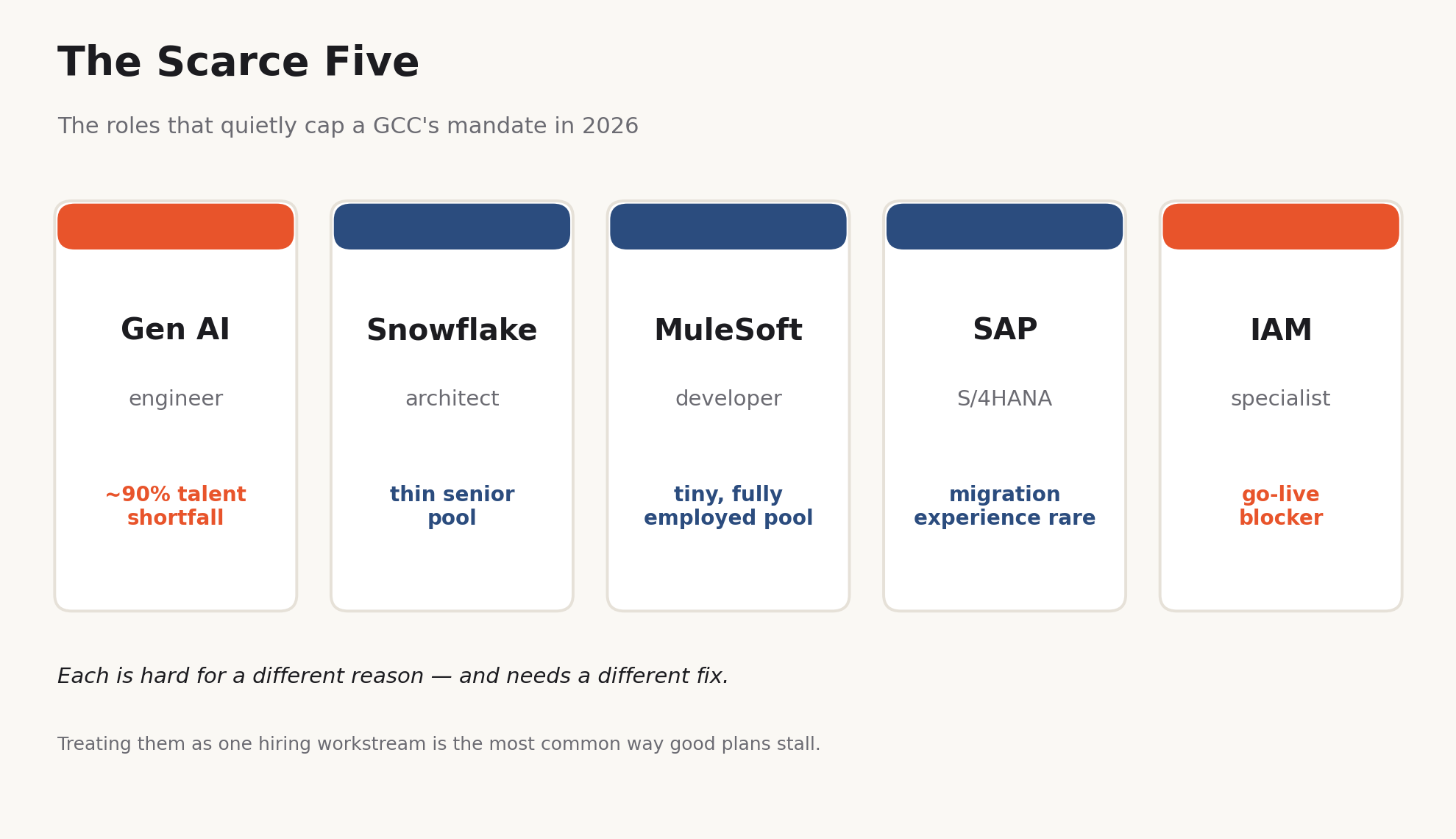
The roles that stall are not the ones most teams worry about. Bulk engineering hiring has largely normalized. What breaks budgets and timelines is the narrow band of specialists Generative AI builders, Snowflake architects, MuleSoft integration leads, SAP S/4HANA consultants, and identity and access management specialists where supply is thin, the talent is already employed, and the skill premium resets monthly. The rest of this analysis breaks down why each of these is hard, what it actually costs, and where teams keep misreading the market.
What GCC Tech Hiring in India Means in 2026
GCC tech hiring India 2026 is the process by which multinational enterprises staff their India-based global capability centers with engineering, data, and security talent increasingly for product ownership and AI mandates rather than support functions, against acute shortages in specialized roles. It is now a skill-priced market, not a title-priced one, where two engineers with identical designations can command very different compensation depending on demonstrable production experience.
That definitional shift matters because it changes who you are competing against and how fast you must move. The center is no longer staffing a delivery annex; it is assembling a team that owns a global function. The screening bar, the compensation bands, and the time-to-fill all rise accordingly. Approached this way, GCC tech hiring India 2026 is less a volume exercise and more a precision one; a handful of roles carry disproportionate weight, and getting them wrong is what quietly caps a center’s mandate.
GCC Talent Challenges India: The Real Shape of the Gap
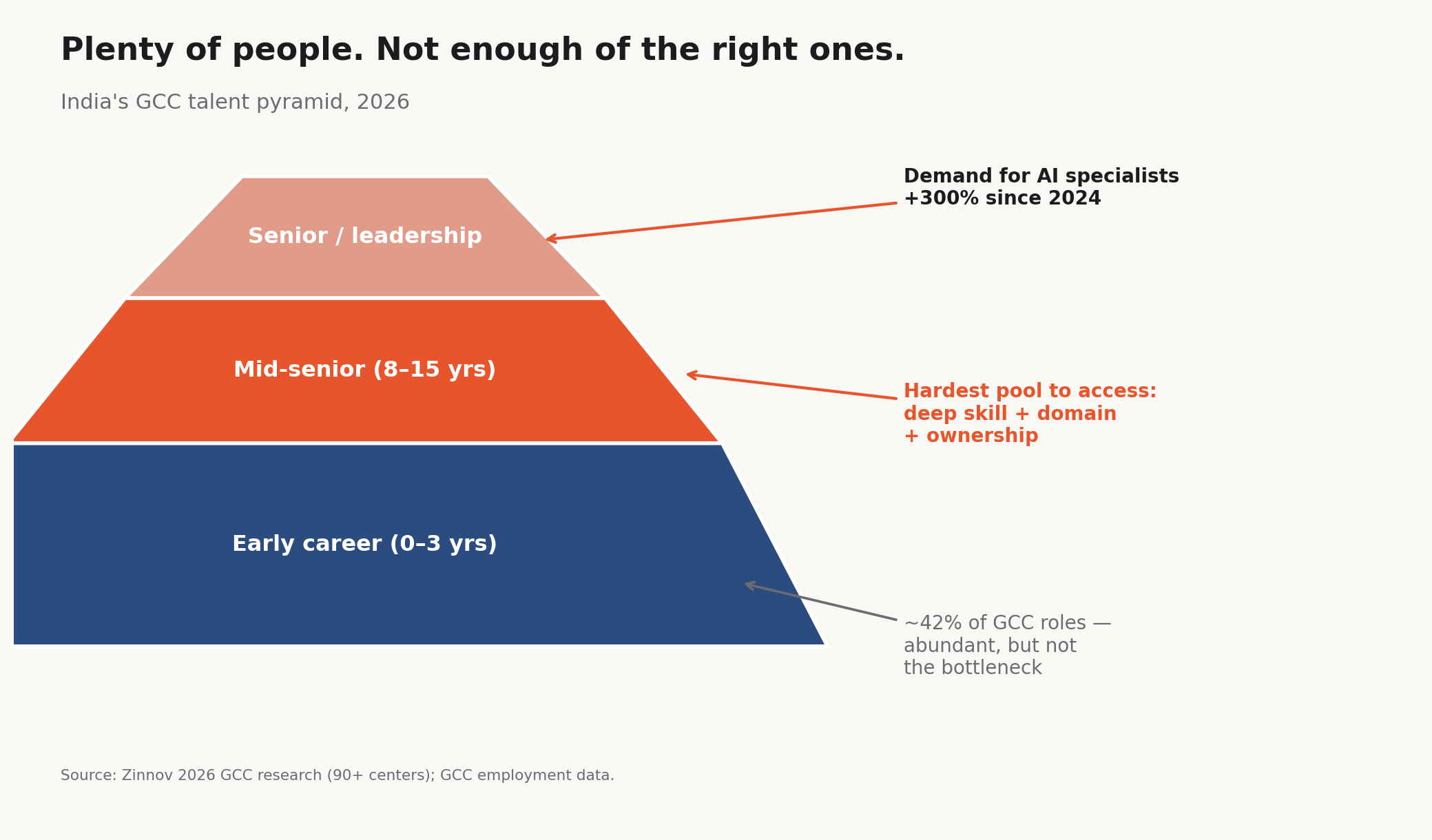
The headline numbers obscure where the pain actually concentrates. India produces enormous volumes of engineering graduates and a deep pool of early-career talent; roughly 42% of GCC positions are filled by professionals with zero to three years of experience. Entry-level supply is not the problem, and any honest read of GCC tech hiring India 2026 has to start by setting that abundance aside.
The structural weak point sits in the mid-senior band: the eight-to-fifteen-year cohort that combines deep technical skill with delivery ownership and domain fluency. Zinnov’s 2026 research across more than 90 GCCs places this cohort as the hardest talent pool to access in the Indian market, and the data behind the surge is that demand for AI specialists has climbed more than 300% since 2024 while supply has barely moved.
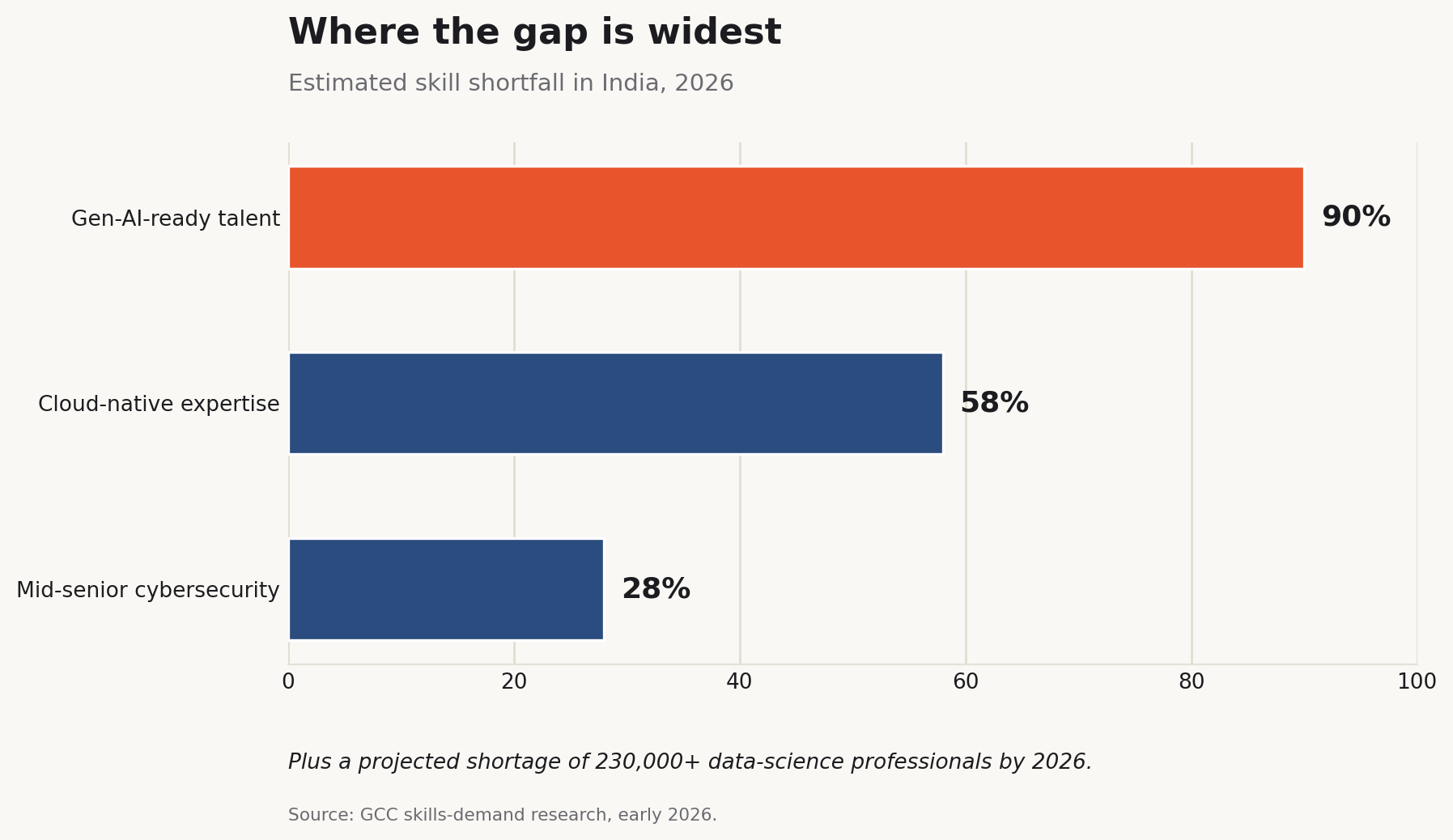
Quantify the shortage and it stops sounding like recruiter hyperbole. India reports a roughly 90% shortfall in Generative-AI-ready talent, a 55–60% deficit in cloud-native expertise, and a 25–30% shortage of mid-to-senior cybersecurity specialists, per skills-demand research published in early 2026. These are not rounding errors on a hiring plan. They are the difference between a center that owns a global product in 18 months and one that quietly reverts to a support role because it could never staff the senior chairs.
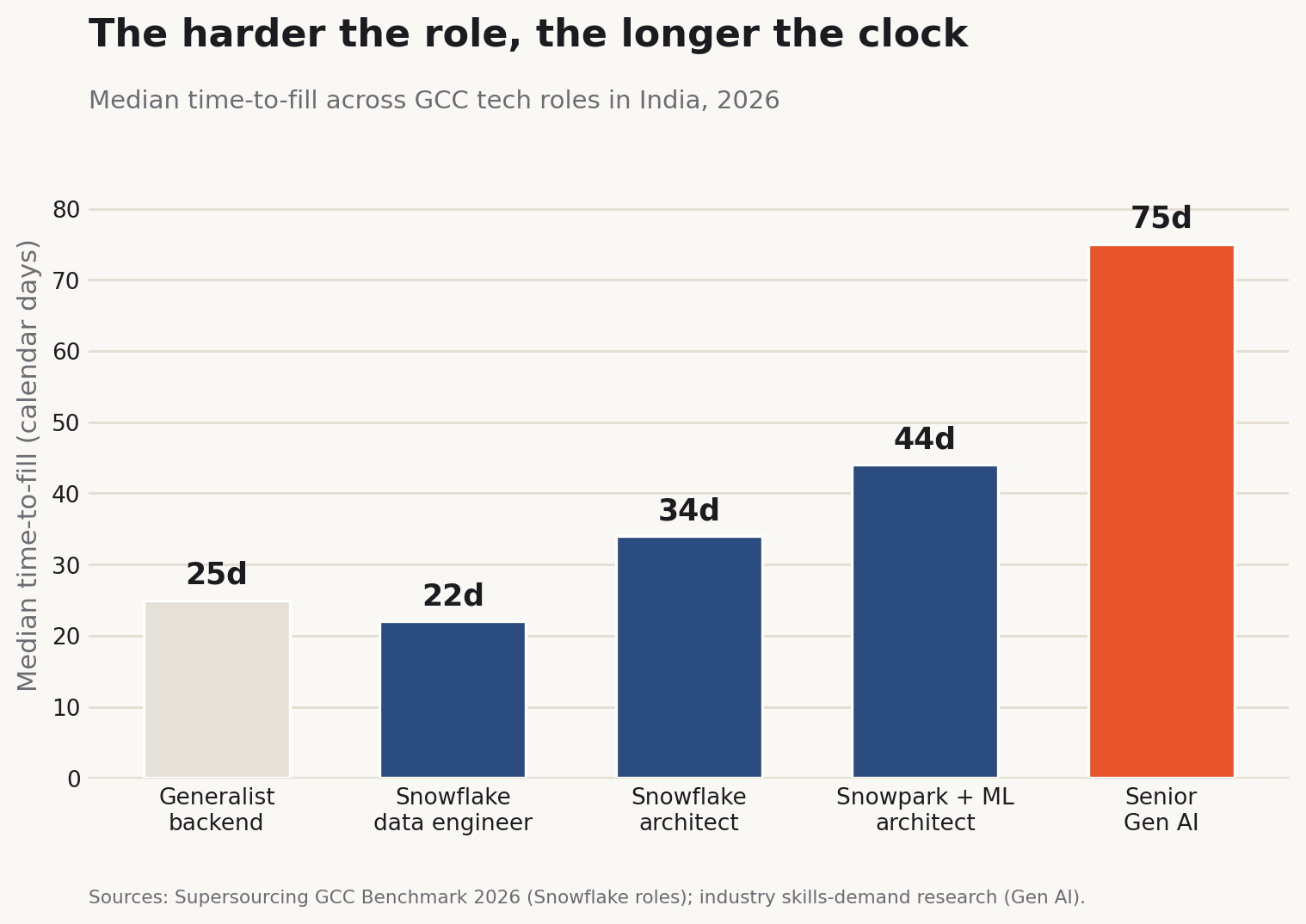
There is a second-order effect most plans underestimate by a wide margin. When a center sets a target of, say, 200 engineers and assumes a uniform fill rate, it typically misjudges the niche-role timeline by three to four times. A generalist backend hire might close in three to four weeks. A production Generative AI engineer or a governance-grade Snowflake architect can take two to three months on a well-resourced search and that is before factoring in offer competition and counteroffers.
The competitive backdrop makes this worse, not better. Bengaluru still concentrates roughly 35–39% of all GCC activity with close to 900 operational units, and Hyderabad and Pune are not far behind. Every month brings fresh entrants chasing the same narrow pool the engineers a center needs are already employed, already comfortable, and not checking job boards. That density of competition is precisely why GCC tech hiring India 2026 has become a sourcing problem first and a screening problem second: the candidates exist, but reaching and converting them is the binding constraint.
The cost of getting these wrong compounds quietly. A senior backend engineer at a GCC in Hyderabad earns ₹35–50 lakh, against ₹18–24 lakh for the same title at a mid-size IT services firm in the same city. When a center over-pays for the wrong profile of someone who studied a stack rather than shipped on it, it absorbs both the salary delta and the replacement cost when the mismatch surfaces three months in. For the scarce five roles, a mis-hire at ₹40 lakh-plus is not a minor budgeting error; it is a quarter of lost delivery capacity.
Hardest Tech Roles to Hire India: A Role-by-Role Breakdown
This is where the abstract talent gap becomes concrete. Each of the five roles below is hard for a different reason and the remedy differs accordingly. Understanding the specific failure mode is what separates a center that fills these chairs from one that leaves them open for two quarters. Read together, they are the roles that define GCC tech hiring India 2026 far more than any aggregate headcount figure does.
Why Are Gen AI Roles So Hard to Fill in India?
Generative AI is the role that defines the GCC talent challenges India is wrestling with this year. Demand has surged roughly 300% versus 2024, and India is projected to need on the order of a million skilled AI professionals by the end of 2026 against a skill deficit estimated near 53%.
The harder truth is behavioral, not numerical. Roughly 70% of qualified senior Generative AI engineers are not actively looking; they are employed, well-compensated, and not scrolling job boards. So even where talent technically exists, it is not in the market, which is the single fact that warps GCC tech hiring India 2026 budgets most. For senior briefs such as RAG architects and LLM fine-tuning engineers, realistic timelines run 60 to 90 days on a properly resourced search, and the single biggest screening filter has become the distinction between “experience with AI” and demonstrable production AI models shipped, evaluated, and maintained at scale rather than prototyped in a notebook.
Generative AI engineers now command 30–60% pay premiums over adjacent engineering talent, and signing bonuses for senior AI hires have become routine rather than exceptional.
What centers are actually hiring within this space reveals how far the field has matured. The brief is rarely “a data scientist” anymore. It is an LLM fine-tuning engineer who can adapt a base model to a domain corpus, a RAG architect who can design retrieval pipelines that hold up under enterprise data volumes, or a GenAI product owner, a role that did not exist eighteen months ago. Nearly half of all GCCs set up since FY21 were built with AI as a core focus from inception, and more than 1,200 centers now embed AI and machine-learning capabilities, supported by a national base of roughly 250,000 AI professionals. That sounds like abundance until you filter for production seniority, at which point the pool collapses to the narrow cohort everyone is fighting over.
How Long Does It Take to Hire a Snowflake Architect in India?
Snowflake demand sits inside a broader data-engineering crunch India is projected to face a shortage of more than 230,000 data-science professionals in 2026, and the modern data stack has moved well beyond the ETL developer of five years ago. What centers need now is production fluency: debt for transformation, real-time streaming with Kafka or Flink, and warehouse-grade governance.
Real placement data sharpens the picture, and it is the kind of evidence GCC tech hiring India 2026 plans too rarely build on. Across 78 Snowflake data engineer placements in the Supersourcing GCC Benchmark 2026, the median time-to-fill for a senior Snowflake data engineer with SnowPro Core, dbt, and production-deployment experience in Bangalore was 22 calendar days. A Snowflake architect with SnowPro Advanced certification and RBAC and governance-design experience ran for 34 days. A Snowflake-plus-Snowpark architect delivering production ML workloads stretched to 44 days. Snowpark production experience alone carries a 20–28% premium because the pool is thinner than for SQL-only engineers.
MuleSoft and SAP: The Integration and ERP Squeeze
MuleSoft integration developers are scarce for a structural reason; the skill only matters at enterprises with complex, API-led integration estates, so the talent pool is small and almost entirely employed inside large captives or service firms. A certified MuleSoft architect fluent in Anypoint, API Manager, and RAML is rarely on the open market; these hires move through referral and targeted outreach, not applications.
SAP S/4HANA consultants face an adjacent problem. The migration wave toward S/4HANA created a demand spike that outran the supply of consultants who have actually run a production migration rather than studied one. Functional-plus-technical hybrids: someone who understands both the finance module and the underlying data model are the genuine bottleneck, and they command a premium precisely because they are the people who keep a transformation from stalling.
Both roles share a trait that makes them resistant to volume sourcing: the work is invisible on a resume. A MuleSoft developer’s value is in the integration estates they have stabilized, and an SAP consultant’s value is in the migrations they have shepherded to go-live without a finance close breaking. Neither shows up cleanly in a keyword search, which is why job-board volume produces almost no qualified signal for these two roles and why GCC tech hiring India 2026 increasingly routes them through specialist networks rather than open applications.
IAM: The Security Role Nobody Plans For Early Enough
IAM security specialists identity and access management are the quiet crisis. They fall inside the 25–30% mid-to-senior cybersecurity shortfall, and the work is unforgiving: a misconfigured identity layer is how breaches happen. GCCs in regulated sectors like BFSI need specialists who understand zero-trust architecture and the relevant compliance regime, not generalist security engineers. Because IAM is rarely staffed until a center is already operational, it routinely becomes the role that holds up a go-live.
The compliance dimension is what narrows this pool further. An IAM specialist supporting a banking GCC needs to reason about RBI-aligned controls and data-residency obligations under India’s DPDP framework not as theory, but as constraints they have implemented before. That combination of identity engineering and regulatory fluency is rare enough that most centers discover the gap only when a security review flags it, by which point the timeline pressure is acute. Planning the IAM hire alongside the cloud and platform roles rather than after is one of the cheapest fixes available in GCC tech hiring India 2026, and one of the least practiced.
A Practical Hiring Sequence for Niche GCC Roles
For leaders building a center this year, the order of operations matters as much as the roles themselves. A workable sequence:
- Anchor leadership and the first 40 hires in a Tier-1 hub where the capability genuinely sits, before opening any satellite location.
- Identify your single hardest-to-fill role and run a manual discovery sprint across technical communities to benchmark realistic timelines and candidate quality.
- Map each niche role to a specific premium and timeline rather than assuming a uniform fill rate across the org.
- Build a pre-vetted pipeline for the scarce five (Gen AI, Snowflake, MuleSoft, SAP, IAM) months before the requisition opens, since 70% of the senior talent is passive.
- Separate “production” from “exposure” in every senior screen demand named, masked references to real deployments.
- Use a blended model contract specialists alongside permanent hires for time-bound work like a migration sprint or a Gen AI proof-of-concept.
The Economics: Why Skill Now Prices the Market, Not Title
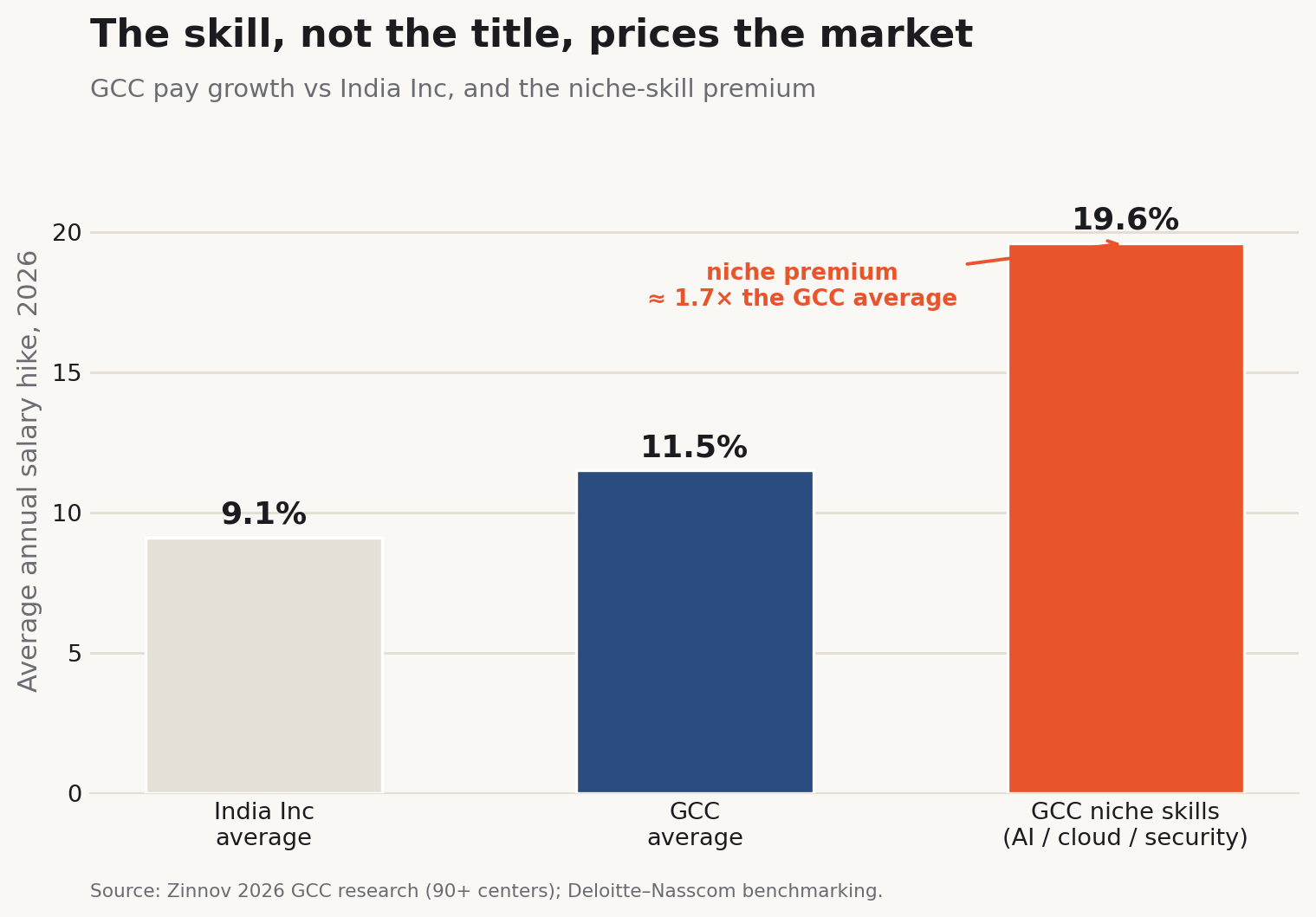
A structural shift sits underneath every one of these roles. The old model of paying by role and seniority is being replaced by a skill-priced market, where two people with identical titles can earn materially different totals depending on what they can actually do. Zinnov’s 2026 research across more than 90 centers puts average GCC salary hikes at 11.5%, comfortably above the roughly 9.1% projected for India Inc at large but the average hides the real story. Hikes for niche skills in AI, cloud, and security are running at roughly 1.7 times the rate for adjacent roles.
The Deloitte–Nasscom compensation benchmarking work makes the same point from a different angle: engineers with production experience in ML infrastructure, cloud-native architecture, zero-trust security, and platform engineering command 20–40% more than generalists at the same experience level, and that premium has widened since 2024. For a center budgeting GCC tech hiring India 2026, the practical implication is that a single “senior engineer” band in a compensation model is now a liability; it will either over-pay the commoditized roles or under-bid the scarce five and lose every offer that matters.
This is also why Tier-2 economics are tempting but partial. Cities like Coimbatore, Kochi, and Ahmedabad offer 40–60% lower operational costs and attrition that runs meaningfully below the 16–18% seen in Bengaluru and Hyderabad. For mid-level engineering, QA, and analytics, that arbitrage is real. For the scarce five, the senior pool simply is not deep enough outside Tier-1 hubs yet which is why the workable pattern is to anchor the hardest roles where the capability sits and use Tier-2 as a scale layer underneath.
Case Studies: How These Roles Actually Get Filled
A semiconductor and consumer-electronics enterprise scaling its India innovation hub needed R&D engineers and specialists faster than its in-house team could source them. By sourcing against a pre-vetted specialist pool rather than open job boards, the center accelerated product-development capacity without diluting the seniority bar the outcome that matters when a hub is meant to own innovation rather than support it.
On the data side, the placement benchmark tells its own story. The 22-day median for a senior Snowflake engineer versus 44 days for a Snowpark-plus-ML architect is not a quirk; it is a direct read on pool depth. The lesson for hiring leaders is to treat each sub-specialization as its own market with its own clock, rather than budgeting a single “Snowflake hire” timeline and being surprised when the architect search runs twice as long. That granularity is what separates GCC tech hiring India 2026 plans that hold from those that slip a quarter.
GCC Staffing India: A Decision Framework for the Scarce Five
Not every hard role should be solved the same way. The table below maps each role to its dominant constraint and the approach that tends to work useful when a center is triaging where to spend scarce recruiting energy first. Treating these five as a single GCC tech hiring India 2026 workstream, rather than five distinct markets, is the most common way good plans stall.
| Role | Primary constraint | Realistic time-to-fill | Best-fit approach |
| Generative AI engineer | 90% talent shortage; 70% passive | 60–90 days (senior) | Pipeline early; pay production premium |
| Snowflake architect | Thin senior/Snowpark pool | 34–44 days | Reference-verify production deployments |
| MuleSoft developer | Tiny, fully-employed pool | Referral-driven; weeks–months | Targeted outreach, not job posts |
| SAP S/4HANA consultant | Migration-experience scarcity | Variable; premium hybrids | Prioritize functional + technical hybrids |
| IAM specialist | 25–30% cyber shortfall | Often the go-live blocker | Staff before operations begin |
What Most Teams Get Wrong About GCC Recruitment Strategy India
The most expensive mistake in GCC recruitment strategy India leaders make is assuming the old playbook still works. It does not, and nowhere is that clearer than in GCC tech hiring India 2026. LinkedIn cold outreach now converts at roughly 8–12% for senior roles, premium recruiter seats run past $8,000 a year each, and the best candidates’ inboxes are saturated. Job boards generate volume and almost no signal for niche roles 200 applications might yield five worth a phone screen. Referral programs work for the first wave and then dry up. You cannot build a 500-person center on referrals.
The second error is screening for the title instead of the work. In a skill-priced market, two “senior data engineers” are not interchangeable, and the resume designation tells you almost nothing about whether someone has run a production Snowflake governance model or merely completed a course. The teams that win are ruthless about verifying production experience to the point of asking a vendor to name the masked production deployments behind every claimed senior engineer within 24 hours. Any partner that cannot is presenting tutorial-grade experience at production rates.
The third, and most strategic, miscalculation is the build-versus-buy reflex. Many global CEOs assume they can hire mid-level and develop senior capability in-house. For the scarce five, that is a two-year bet most timelines cannot absorb, which is why centers increasingly buy senior capability first and build the bench underneath it, rather than the reverse.
A fourth pattern is subtler and shows up only after a center is operational: under-investing in the offer-to-join window. In a market where 70% of the senior pool is passive and counteroffers are routine, the gap between a signed offer and a joined engineer is where the scarce five quietly leak away. Centers that treat the offer as the finish line lose candidates they spent two months sourcing; the ones that hit their targets treat retention as starting at the offer stage with clear decision-making authority, a competitive structure, and genuine ownership of a global function, communicated before the candidate has a chance to entertain a counter. For the hardest roles, the difference between a 70% and a 95% join rate is not sourcing skill. It is everything that happens after “yes.”
Frequently Asked Questions
What roles are hardest to hire for in Indian GCCs?
The five consistently hardest are Generative AI engineers, Snowflake architects, MuleSoft integration developers, SAP S/4HANA consultants, and IAM security specialists. Each is scarce for a different reason: passive talent for Gen AI, a thin senior pool for Snowflake, a small fully-employed pool for MuleSoft, migration-experience scarcity for SAP, and a broad mid-senior cybersecurity shortfall for IAM. The common thread across GCC tech hiring India 2026 is that supply has not kept pace with mandate-driven demand.
Why is there a Gen AI talent shortage in India?
Demand for Generative AI skills has surged more than 300% since 2024, while the supply of engineers with genuine production experience has barely moved. India reports roughly a 90% shortfall in Gen-AI-ready talent, and around 70% of qualified senior engineers are not actively job-seeking. The result is long timelines, steep premiums, and a sharp screening filter between AI exposure and shipped, maintained production systems.
How much do niche GCC engineers cost in 2026?
GCCs pay roughly 12–20% above traditional IT services firms for comparable roles, and the gap widens sharply for scarce skills. Generative AI engineers command 30–60% premiums over adjacent talent, and niche AI, cloud, and security roles are seeing 15–25% increases at competitive employers versus 6–8% for commoditized roles. Zinnov’s 2026 research puts average GCC hikes near 11.5%, with niche-skill hikes running about 1.7x that rate which is why GCC tech hiring India 2026 budgets need skill-level granularity, not a single seniority band.
How long does GCC hiring take in India?
For generalist roles, three to four weeks is realistic. For the scarce five, expect far longer: senior Snowflake architects run 34–44 days, and senior Generative AI roles run 60–90 days on a well-resourced search. The most common GCC tech hiring India 2026 planning error is applying a single uniform time-to-fill across the org rather than budgeting each niche sub-specialization as its own market with its own clock.
Should GCCs build or buy specialized tech talent?
For commoditized and early-career roles, building internally is sound. For the scarce five, buying senior capability first is usually the better bet developing eight-to-fifteen-year specialists in-house is a roughly two-year investment most global mandates cannot absorb. The pragmatic pattern is to buy the senior chairs, then build the mid-level bench underneath them once the capability is anchored.
Are Tier-2 cities a fix for GCC talent shortages?
Partly. Tier-2 hubs like Coimbatore, Kochi, and Ahmedabad offer 40–60% lower operational costs and meaningfully lower attrition, and their share of GCC activity is growing faster than the metros. But they work best as a scale play for mid-level engineering, QA, and analytics, not as a founding location for the scarce five, where proximity to senior leadership and pool depth still favor Tier-1 hubs. In GCC tech hiring India 2026, Tier-2 is a cost lever, not a cure for scarcity.
Closing: Pressure-Test Your Hardest Roles Before You Commit
The centers hitting their 2026 targets are not the ones with the biggest budgets, they are the ones that mapped each scarce role to a realistic timeline and a verified pipeline before the first requisition opened. The pattern is consistent: the plans that hold treat the five hardest roles as five separate markets, each with its own clock, its own premium, and its own sourcing motion, rather than rolling them into a single headcount line that looks neat on a slide and falls apart in month two.
That discipline is what turns a funded mandate into a working center. A budget tells you what you can spend; it does not tell you whether a production Generative AI engineer is reachable in your timeline, whether the Snowflake architect you need exists in your target city, or whether your IAM hire will clear a compliance review before go-live. Those are empirical questions, and they are far cheaper to answer before a requisition opens than after a quarter has slipped.
If you are scoping GCC tech hiring India 2026 and want to pressure-test your assumptions on the hardest-to-fill roles Gen AI, Snowflake, MuleSoft, SAP, or IAM against real placement timelines and current premiums before committing to a vendor or a headcount plan, that benchmark exercise is worth running first. It is a short conversation that tends to save a quarter of misjudged hiring, and it usually surfaces one or two roles that need to start sourcing months earlier than the plan assumed.
The benchmark data referenced throughout this analysis lives at supersourcing.com, and questions on specific roles or city-level timelines can go directly to mayank@engineerbabu.com. Either way, the more useful first step is rarely “post the requisition” ; it is mapping which of your scarce five will be the one that holds up everything else.
