

India’s technology sector isn’t just growing, it’s entering what many analysts are calling its most defining decade yet. The industry is on track to touch the $300 billion mark by FY2026, with a clear path toward $500 billion by 2030, and that kind of momentum is reshaping hiring across the board.
If you’re on the hunt for the best tech hiring companies in India right now, you’ve landed in the right place, because this guide breaks down exactly who’s shaping the country’s tech employment landscape and why.
This piece is written for software engineers, IT professionals, and fresh graduates who are trying to figure out where to build their careers next. The employer you choose shapes far more than your paycheck. It influences how fast you grow, what skills you pick up, and how sustainable your work life actually feels.
India continues to be recognized worldwide for its depth of tech talent, and according to Taggd’s India Decoding Jobs 2026 report, the country is expected to have nearly 9.5 million tech professionals by FY 2026, making this one of the most competitive and opportunity-rich job markets globally.
This guide focuses purely on direct employers, not staffing agencies, spanning IT services giants, global product companies, semiconductor firms, and Global Capability Centers driving hiring across Bengaluru, Hyderabad, Pune, Chennai, and beyond.
Note: Sections on the role of recruitment agencies and the tech hiring process are included for context, but the main focus is on direct employers.
Types of Companies Included in This Guide
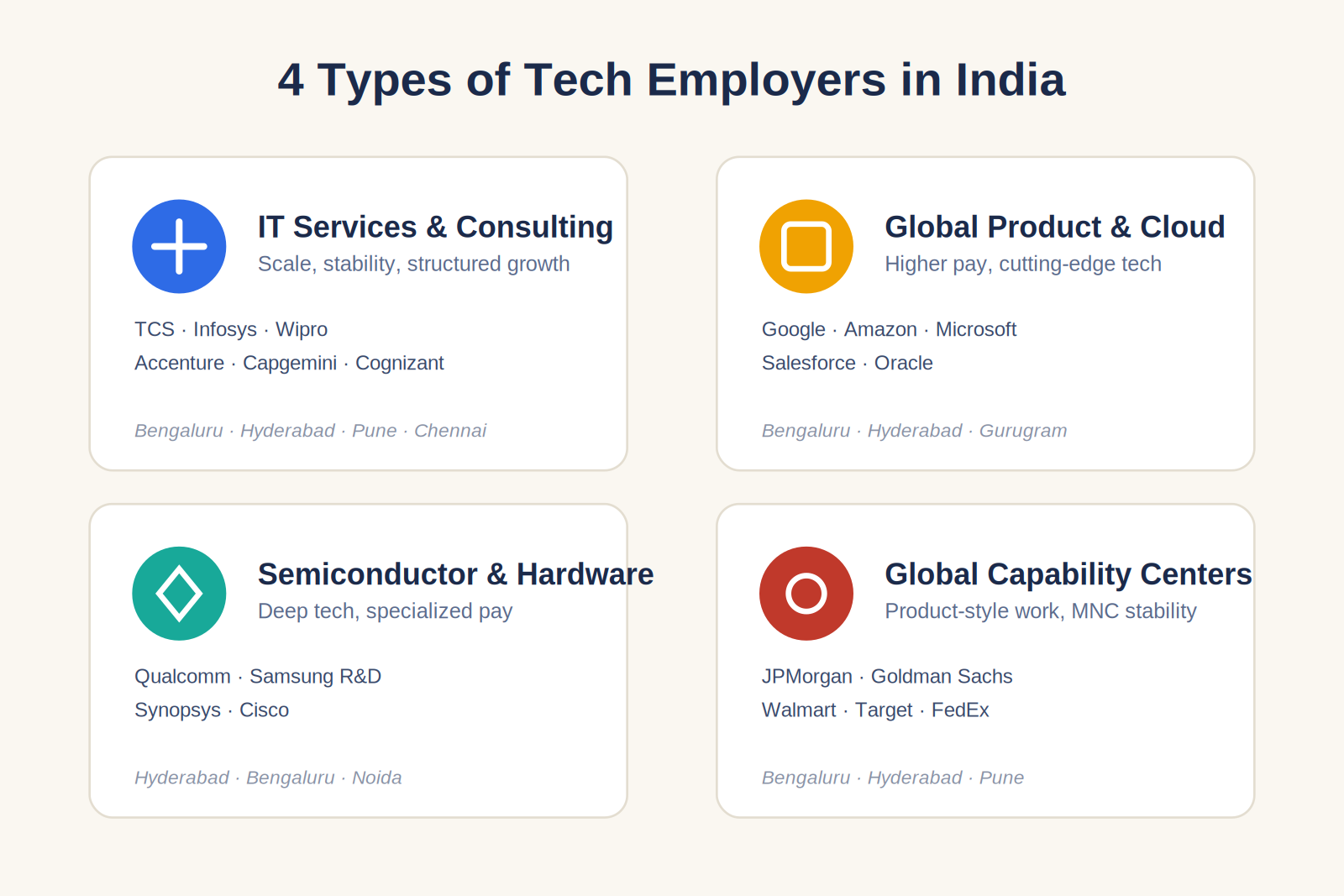
India’s tech hiring landscape includes a diverse mix of employers, offering opportunities for professionals at all levels. These include:
- Indian IT services firms: TCS, Infosys, Wipro, HCLTech, Tech Mahindra
- Global product companies: Google, Amazon, Microsoft, Salesforce, Oracle
- Semiconductor and hardware firms: Qualcomm, Samsung, Synopsys, Cisco
- Global Capability Centers (GCCs): JPMorgan Chase, Goldman Sachs, Walmart Global Tech, Target, FedEx
These companies represent the breadth of opportunities available, from large-scale IT services to cutting-edge product development and innovation hubs.
Global tech giants have significant operations in cities like Bangalore, Hyderabad, and Pune, while leading domestic product companies and startups such as Flipkart, Swiggy, Zoho, and Oracle are also major tech employers.
How to Find the Best Tech Hiring Companies in India
Before diving into specific companies, it’s worth acknowledging that the “best” employer depends entirely on your priorities. Some job seekers optimize for maximum compensation, others want predictable 9-to-6 schedules, and many are looking for cutting-edge work on technologies that will define the future.
Job seekers can explore opportunities in:
- Software Engineering: Designing, developing, and maintaining software applications and systems.
- Data Analytics: Analyzing and interpreting complex data to help organizations make informed decisions.
- Cloud Computing: Building and managing scalable cloud-based solutions and infrastructure.
- AI: Developing artificial intelligence systems and applications.
- Machine Learning: Creating algorithms and models that enable systems to learn and improve from data.
- Cybersecurity: Protecting systems, networks, and data from digital threats and attacks.
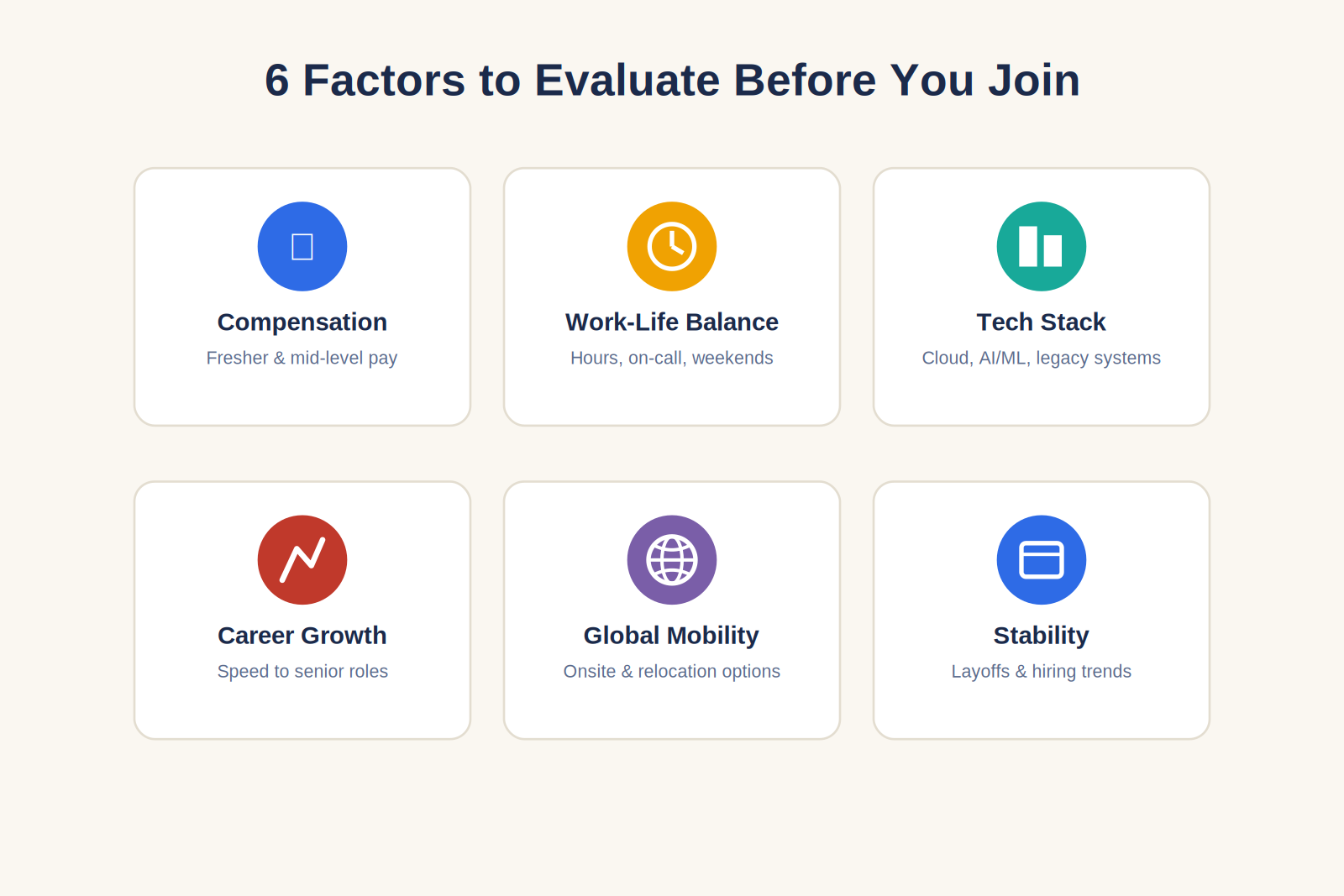
Here are the concrete factors worth evaluating when comparing tech hiring companies in India:
- Fresher and mid-level compensation: Pay bands still vary sharply between IT services firms and top product companies, and mid-level professionals with several years of experience see even wider gaps depending on the company type and role.
- Work-life balance: Look at typical hours per week, weekend work expectations, and on-call rotations. This varies dramatically by team, not just by company.
- Tech stack: Are they working on cloud computing, AI/ML, embedded systems, or legacy enterprise software? Your skill growth depends heavily on this.
- Career progression speed: How quickly can you move from an entry-level engineering role to a senior one? What’s the typical timeline to reach a technical lead or architect position?
- On-site and global mobility options: Does the company offer opportunities to work from the US, UK, or other global offices?
- Office locations: Major tech hubs include Bengaluru, Hyderabad, Pune, Gurugram, Chennai, and Mumbai. Your preferred city matters more than people realize.
- Stability: Look into a company’s recent hiring patterns and whether it has gone through layoffs or freezes in the last couple of years, since this tells you a lot about how secure a role there might be.
One critical note: verify current reality via LinkedIn, Glassdoor, and r/developersIndia threads before signing any offer. Team-level variance in work-life balance is huge; the same company can have one team doing comfortable 40-hour weeks while another regularly pulls 60+ hours.
Labeling an entire company as having ‘wrong’ work conditions is often an oversimplification, as experiences can vary greatly depending on the team, manager, or internal culture.
Top IT Services & Consulting Tech Hiring Companies in India
Large Indian and global IT services companies remain the biggest employers of tech talent in the country, hiring tens of thousands of professionals every year through campus recruitment and lateral hiring. While compensation is generally lower than product companies, these organizations offer scale, stability, and structured career paths, giving employees clear opportunities to grow and pick up new skills. That said, retaining top tech talent remains a challenge given how competitive India’s tech sector has become.
The hiring landscape through 2026 has been a mixed picture.
Several large IT services firms have trimmed overall headcount even as they continue investing in fresh graduate hiring, a sign that the industry is shifting toward leaner, more skill-focused workforce planning rather than the bulk hiring models of the past.
Tata Consultancy Services (TCS)
TCS is India’s largest IT services company, headquartered in Mumbai, with a workforce of roughly 584,500 professionals as of the March 2026 quarter. The company operates major tech hubs in Bengaluru, Hyderabad, Chennai, Pune, and Kolkata, serving clients across the globe.
Core services include:
- Application development and maintenance
- Business process services
- Cloud migration and consulting
- Digital transformation projects across banking, retail, telecom, and government sectors
Even though its overall headcount dipped through FY26, TCS has continued to be one of India’s biggest campus recruiters, rolling out around 25,000 campus offers with plans to bring its annual fresher intake closer to 40,000. Leadership has said future hiring volumes will depend on demand, with a growing emphasis on AI and consulting-ready skills rather than sheer numbers.
What TCS is known for:
- Strong job security and predictable work schedules on many projects
- Slower salary growth compared to product companies
- Extensive training programs for freshers, alongside a growing push to upskill employees in AI capabilities
- Work-life balance varies significantly by client account and project manager
Common roles include System Engineer, IT Analyst, and Developer, with skills in demand including Java, .NET, testing frameworks, cloud basics, and increasingly, AI-adjacent tooling.
Infosys
Infosys, headquartered in Bengaluru, is known for its iconic Mysuru training campus and early adoption of global delivery models. Infosys offers information technology and consulting services, including software development and maintenance, making it one of the leaders in the IT sector.
The company continues to be recognized as a certified Top Employer, reflecting its ongoing investment in talent development.
Infosys works across sectors including retail, healthcare, manufacturing, and finance, with a strong focus on digital transformation, cloud services, and AI initiatives.
The company hired over 20,000 freshers through FY26 and has said it plans a similar intake for the year ahead, even as its overall headcount has seen some quarterly fluctuation tied to project volumes and utilisation.
Key details:
- Fresher hiring remains a priority even as total headcount adjusts with demand cycles
- Structured training and clear hierarchies
- Attrition has eased in recent quarters, pointing to a more stable overall workforce environment
- Major India locations: Bengaluru, Hyderabad, Pune, Chennai, Mysuru, and NCR
Typical roles include System Engineer, Specialist Programmer, and Digital Specialist Engineer, with opportunities to work on enterprise software, cloud, and AI-linked initiatives.
Accenture
Accenture is a global professional services and technology consulting firm with a substantial India workforce spread across Bengaluru, Hyderabad, Chennai, Pune, Mumbai, and Gurugram.
Focus areas include:
- Enterprise software implementations (SAP, Oracle)
- Cloud services (AWS, Azure, GCP)
- Cybersecurity
- Digital transformation for Fortune 500 clients
Accenture India continues to be seen as paying somewhat better than traditional Indian IT firms for comparable roles, especially in niche cloud and consulting tracks.
Work-life balance still has nuances here: some consulting and client-facing projects can get intense with late-night calls across time zones, while internal or back-office teams tend to have steadier schedules.
Common roles include Application Development Analyst, Software Engineer, and Cloud Consultant, with data engineering and DevOps skills particularly valued.
Capgemini
Capgemini is a French-headquartered consulting and IT services firm with a growing India base in Bengaluru, Hyderabad, Pune, Mumbai, Chennai, and NCR.
The company serves telecom, automotive, manufacturing, and financial clients through projects in SAP, Salesforce, cloud, and testing.
Key features:
- Fresher salaries generally sit in line with other large IT services firms, though niche roles in SAP, Salesforce, and cybersecurity tend to command a premium
- Capgemini continues to invest heavily in learning platforms and partner-led courses, making it an attractive option for professionals who want to keep upskilling
- Work-life balance still gets mixed reviews, with some teams enjoying steady schedules while others get demanding around go-live phases
Common job titles include Software Associate, SAP Consultant, and QA Engineer.
Cognizant
Cognizant is a major multinational IT and digital services provider with a strong India presence in Chennai, Hyderabad, Bengaluru, Pune, and Kolkata.
The company offers services including application modernization, QA and testing, data engineering, and automation across BFSI, healthcare, and retail sectors.
Important considerations:
- Candidates should check the latest reviews and news before joining, since the company has gone through periods of restructuring in the past and stability can vary by business unit
- Fresher compensation is broadly comparable to Infosys and TCS bands
- Higher packages are available for digital and specialized roles
- Good opportunities exist for lateral, mid-level hires
Common roles include Programmer Analyst, Software Engineer, and Senior Developer, with key stacks including Java, .NET, cloud platforms, and API integration.
EngineerBabu and Supersourcing Group
EngineerBabu, part of the Supersourcing Group, stands out as a modern and innovative company specializing in fixed-price app development and tech hiring solutions. Recognized for its forward-thinking approach, EngineerBabu has earned a spot among LinkedIn’s Top 20 companies in India, reflecting its strong employer brand and commitment to excellence.
Additionally, EngineerBabu is proud to be a part of the prestigious Google AI Accelerator batch, underscoring its focus on leveraging cutting-edge technologies to deliver superior services.
Trusted by numerous Global Capability Centers (GCCs) and leading hiring managers across the tech sector, EngineerBabu and Supersourcing provide reliable, scalable, and efficient solutions tailored to meet the evolving needs of businesses and job seekers alike.
Their integrated platform combines streamlined hiring processes with expert app development, enabling organizations to accelerate growth while accessing top talent.
This positions EngineerBabu and Supersourcing as key players in India’s tech ecosystem, driving innovation and connecting professionals with the best job opportunities in the industry.
Transition: Now that we’ve covered the leading IT services and consulting employers, let’s shift focus to the global product and cloud companies that are shaping India’s tech landscape with high compensation and cutting-edge projects.
Top Global Product & Cloud Companies Hiring Tech Talent in India
This section covers big name global tech product and cloud companies, the FAANG/MAMAA tier and similar organizations, with a significant engineering presence in India. These employers generally offer higher compensation than IT services firms but expect stronger problem solving skills and may come with more demanding workloads.
Amazon India (AWS & Consumer Tech)
Amazon is a global tech and e-commerce leader with major India development centers in Bengaluru, Hyderabad, Chennai, and Delhi-NCR. The company has continued to expand its India investments across both AWS cloud services and its consumer business, making it one of the more active hirers in the country.
Amazon hires SDE-1/2 engineers, data engineers, and applied scientists in India, with compensation for entry-level SDE roles varying widely depending on team, level, and location. The company is known for its intense, high ownership culture. Many teams work long hours with on-call rotations and periodic weekend pushes, though some internal tools and platform teams tend to have relatively better work-life balance.
Skills required:
- Strong fundamentals in data structures and algorithms
- System design, for more experienced roles
- Java, C++, or Python expertise
- Solid grasp of cloud fundamentals
Amazon India remains one of the most active high paying recruiters on campuses like IITs, NITs, and top private colleges, and continues to be a top choice for engineers looking to build strong system design interviews skills early in their careers.
Alphabet / Google India
Google is a premier global tech employer with offices in Bengaluru, Hyderabad, Gurugram, and Mumbai. India teams work on Search, Ads, Android, Maps, YouTube, and Google Cloud features that serve users worldwide.
Google hires software engineers, site reliability engineers, product managers, and data scientists in India. Entry-level software engineering compensation here tends to be among the highest in the country for fresh graduates, based on publicly available reports.
What to expect:
- A highly competitive hiring process with multiple rounds of algorithm and system design interviews
- Strong brand value and rich learning opportunities
- Work-life balance that’s often better than some other big tech firms, though it still depends heavily on the team
- Tech stacks built around C++, Java, Go, and Python
- Excellent office infrastructure and strong internal mobility options
Microsoft India
Microsoft maintains engineering centers in Hyderabad, home to its large campus, as well as Bengaluru and Noida. India teams contribute to Azure, Office 365, Windows, LinkedIn, and developer tools, along with newer AI focused initiatives.
Microsoft India offers compensation for SDE roles that stays competitive with other big tech players, typically strong for early career engineers, with generous stock components kicking in at higher levels.
The company is generally seen as more balanced than some other US tech giants when it comes to work-life balance, though this still varies across product groups and managers. Key skills include C#, C++, TypeScript, Azure, and distributed systems. Microsoft actively hires experienced engineers coming from startups and service companies alike.
Oracle India
Oracle is an enterprise database and cloud company with large development teams in Bengaluru, Hyderabad, and the Mumbai Metropolitan Region.
Focus areas include databases, Oracle Cloud Infrastructure (OCI), ERP and CRM systems, and industry specific SaaS products.
Oracle India hires software engineers, database developers, and cloud engineers, usually offering solid mid-tier product company compensation along with stable work and relatively predictable schedules.
The company tends to attract engineers who are genuinely interested in backend and infrastructure heavy work.
Key skills:
- Java
- PL/SQL
- Database internals
- Microservices architecture
Work-life balance is generally moderate here, with crunch cycles around big releases but noticeably fewer weeknight calls compared to client heavy IT services firms.
Salesforce India
Salesforce is a leading CRM and cloud applications provider with development hubs in Hyderabad, Bengaluru, and Delhi-NCR.
The company’s flagship products include Salesforce CRM, Slack, Tableau, and MuleSoft.
Salesforce is known globally for its strong culture and employee friendly policies, and its India offices are often rated highly for work-life balance and benefits.
Compensation is competitive among cloud product companies, making it a strong pick for developers who want decent pay paired with a relatively humane workload, an important factor when thinking through long-term career growth in tech.
Typical roles include Software Engineer, Technical Support Engineer, and Platform Developer, with skills in Apex, Java developers, Lightning components, and data analytics being the most valuable.
Top Semiconductor, Hardware & EDA Employers for Tech Talent
India has become a critical hub for semiconductor design, embedded systems, and electronic design automation (EDA) R&D.
These companies offer strong pay for specialized skills and are especially relevant for engineers from ECE, EEE, and CS backgrounds interested in chip design, verification, and low-level systems.
Qualcomm India
Qualcomm is a global leader in mobile and wireless chipsets, with major India centers in Hyderabad, Bengaluru, and Chennai. Focus areas include 5G modems, Snapdragon SoCs, RF, automotive, and IoT silicon development.
Qualcomm India is known in engineering communities for high compensation in VLSI and embedded roles often significantly above IT services salaries even for freshers from top campuses.
Workload can be intense around tape-out and critical project milestones, but many teams offer intellectually challenging, cutting-edge work.
Typical roles and skills:
- Design Engineer, Verification Engineer, Embedded Software Engineer
- Verilog/SystemVerilog, C/C++, DSP, scripting languages
Samsung R&D Institute India
Samsung’s R&D presence in India (primarily Bengaluru and Noida) focuses on smartphones, consumer electronics, 5G, and software platforms.
The company hires both software and hardware engineers, often offering healthy compensation for embedded, Android, and modem-related roles.
Work-life balance varies some mobile and firmware teams face high pressure near flagship launches, while others have steadier cycles.
Required skills include C/C++, Android internals, modem stacks, and algorithm development. Samsung is a strong option for those wanting brand value plus hands-on work on devices shipped to users around the world.
Cisco India
Cisco is a networking and security giant with large engineering offices in Bengaluru and other Indian cities. Work includes routers, switches, SD-WAN, cybersecurity, and collaboration products (Webex).
Cisco is known for relatively good work-life balance for many teams along with solid salaries and benefits, making it popular among experienced engineers.
The company often hires laterals from services companies and smaller startups who want more stability and structured benefits.
Common roles include Software Engineer (L2/L3 protocols), Network Engineer, and Security Engineer, with skills in C/C++, networking protocols, and Linux being essential.
Synopsys India
Synopsys is a leading EDA and semiconductor IP company with R&D centers in Bengaluru, Hyderabad, and Noida. The company develops tools for chip design, verification, physical design, and formal verification.
Synopsys India is respected for deep technical work in VLSI and EDA, with strong compensation within the semiconductor industry segment. Workload can be moderate to high during major tool releases, but employees often value the highly specialized expertise they gain.
Roles and skills:
- Design Engineer, Application Engineer, and CAD Engineer
- HDL, scripting (Python/Tcl), and algorithm design
Transition: With a strong foundation in hardware and semiconductor innovation, let’s now explore the Global Capability Centers (GCCs) and captive tech centers that offer product-style work with multinational stability.
Best Global Capability Centers (GCCs) & Captive Tech Centers in India
Global Capability Centers are in-house tech and innovation centers of global companies, banks, retailers, and Fortune 500 brands operating from India. These centers often combine product-style work with MNC stability, serving as a major channel for high-quality tech jobs across Bengaluru, Hyderabad, Pune, Chennai, and Gurugram.
FinTech & Banking GCCs (e.g., JPMorgan Chase, Goldman Sachs, Morgan Stanley)
Leading banking GCCs maintain large tech centers in Bengaluru, Hyderabad, and Mumbai. These organizations work on trading platforms, risk systems, payments infrastructure, data platforms, and cybersecurity for their global businesses.
What to expect:
- Compensation usually strong for software engineers and data engineers, often rivaling product company salaries
- Bonuses linked to business performance
- Can be demanding during market hours and release cycles
- Excellent exposure to complex, high-scale financial systems
Key skills include Java, Python, distributed systems, data engineering, and low-latency architectures. These GCCs maintain strong campus and lateral hiring from Tier-1/2 colleges and experienced talent pools.
Retail & Consumer GCCs (e.g., Walmart Global Tech, Target, Lowe’s)
US and global retailers like Walmart and Target run India tech hubs primarily in Bengaluru and Chennai to build e-commerce, supply chain, and data platforms. These centers hire software engineers, data scientists, and product managers to work on large-scale retail and logistics problems.
Key characteristics:
- Modern tech stacks (Java, React, microservices, big data)
- Compensation typically higher than IT services but slightly below top-tier big tech
- Relatively balanced work-life balance in numerous teams
- Good long-term stability and strong internal mobility
- Exposure to global stakeholders and data science initiatives
Logistics, Travel & Other Global Brands (e.g., FedEx, Kenvue, Inspire Brands)
Many global logistics, travel, and consumer brands run or expand GCCs in India. Companies like FedEx, Kenvue, and Inspire Brands employ Indian engineers on supply chain optimization, customer platforms, and analytics.
Compensation and work-life balance vary widely by company but are often competitive due to the need to attract senior engineering talent.
These roles usually involve collaboration with global product and operations teams, offering strong international exposure. Aspiring candidates can track these GCC opportunities through targeted job platforms focused on GCCs.
Transition: Now that you know the top direct employers, let’s provide context on how tech recruitment agencies fit into the hiring ecosystem and what the typical hiring process looks like in India.
Role of Tech Hiring Companies in India
Recruitment agencies are a crucial part of the tech hiring ecosystem in India, acting as a vital link between job seekers and tech companies.
Definition: Tech recruitment agencies specialize in helping organizations find, evaluate, and hire technology professionals.
The best tech recruitment agencies specialize in understanding the unique demands of the tech sector, from software development to data analytics and cloud computing.
By leveraging their deep industry knowledge and extensive networks, these agencies streamline the hiring process for both employers and candidates.
How Recruitment Agencies Help Employers
- Provide access to a curated pool of top talent, saving time and resources in sourcing and evaluating candidates.
- Identify professionals with the right skills and experience, ensuring a strong fit for roles in high-demand areas like cloud computing and data analytics.
- Offer strategic insights and market intelligence to help companies stay competitive in attracting talent.
How Recruitment Agencies Help Job Seekers
Connect candidates with job opportunities that match their expertise and career goals.
Offer guidance on resume building, interview preparation, and navigating the hiring process.
Provide support and feedback throughout the recruitment journey.
In a competitive tech sector like India’s, where demand for skilled talent is high, recruitment agencies play a pivotal role in building a capable and diverse workforce. By leveraging their expertise, both companies and candidates can achieve better outcomeswhether it’s finding the right job or hiring the right talent to drive innovation and growth.
Understanding How Tech Hiring Companies in India Work
The tech hiring process in India is a multi-stage journey designed to identify and secure top talent for a rapidly evolving industry.
Typical Stages in the Tech Hiring Process
Job Posting and Sourcing
- Companies and recruitment agencies post job openings on portals, company websites, and social media.
- Agencies use their networks and industry insights to connect tech companies with professionals skilled in areas like data science, machine learning, and software development.
- Companies and recruitment agencies post job openings on portals, company websites, and social media.
- Agencies use their networks and industry insights to connect tech companies with professionals skilled in areas like data science, machine learning, and software development.
Screening and Assessment
- Resumes are evaluated, and initial assessments are conducted.
- Increasingly, tech companies leverage data science and machine learning tools to automate candidate matching and streamline the hiring process.
- Resumes are evaluated, and initial assessments are conducted.
- Increasingly, tech companies leverage data science and machine learning tools to automate candidate matching and streamline the hiring process.
Technical Evaluation
- Candidates undergo technical assessments, coding challenges, and multiple rounds of interviews to evaluate both technical and soft skills.
- Candidates undergo technical assessments, coding challenges, and multiple rounds of interviews to evaluate both technical and soft skills.
Final Interviews and Offer
- Shortlisted candidates meet with hiring managers and leadership for final interviews.
- Offers are extended to successful candidates, often with negotiation on compensation and benefits.
- Shortlisted candidates meet with hiring managers and leadership for final interviews.
- Offers are extended to successful candidates, often with negotiation on compensation and benefits.
For job seekers, understanding each stage of how tech hiring companies in India work is essential for effective preparation and success.
For tech companies, insights into the hiring process enable them to refine their recruitment strategies, attract top talent, and maintain a competitive edge in India’s dynamic tech sector.
Job Seeker Support: Resources and Guidance
Navigating the tech job market in India can be challenging, but a wealth of resources and support is available to help job seekers succeed.
- Recruitment agencies are a valuable ally, offering expert advice on the hiring process, resume optimization, and interview strategies tailored to the tech sector.
Their industry insights can help candidates stand out and secure roles with leading tech companies.
- Educational institutions and online platforms provide courses and certifications in high-demand technologies such as data analytics, cloud computing, and machine learning.
These programs enable job seekers to upskill and stay current with the latest industry trends, making them more attractive to employers.
- Professional networking events, tech meetups, and job fairs offer opportunities to connect with top companies, industry leaders, and peers. By leveraging these resources, job seekers can expand their networks, gain valuable insights, and access a broader range of job opportunities.
Proactive engagement with these platforms and communities can significantly enhance a candidate’s skills, visibility, and overall career prospects in the tech sector.
Work-Life Balance vs. Pay: What Engineers Actually Experience
Here’s the reality that communities like r/developersIndia discuss frequently: work-life balance and compensation differ not just by company but dramatically by team, manager, and project type. A company’s overall reputation is just a starting point.
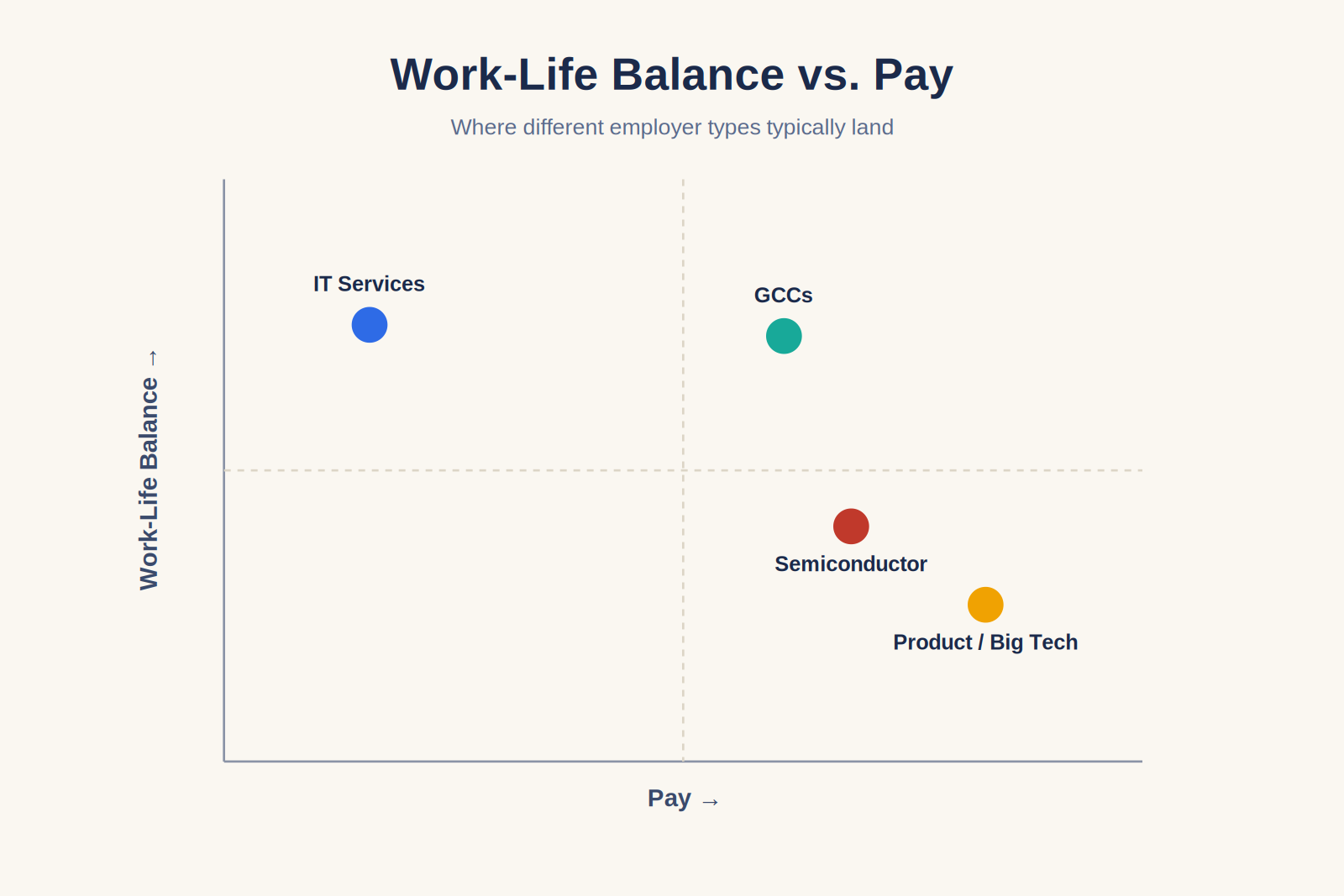
Big Tech vs. IT Services:FAANG and similar product companies offer 3-5x higher compensation than IT services firms but often demand longer hours, on-call rotations, and high performance expectations.
IT services companies like TCS and Infosys provide more stability and predictable schedules but with significantly lower pay and slower career progression.
Product vs. Service:
Product companies let you work on a single product with deep ownership, while services firms expose you to multiple clients and technologies, sometimes creating a “jack of all trades” skillset that can be valuable or limiting depending on your goals.
Semiconductor & Hardware:
Companies like Qualcomm, Samsung, and Cisco pay well within their niche but may have crunch periods around tape-outs and product launches.
The trade-off is access to genuinely cutting-edge engineering work that’s hard to find elsewhere.
GCC vs. Traditional MNC:
GCCs often offer the best of both worlds product-style work with MNC stability but growth paths may be limited compared to a company’s home office, and India teams sometimes get less strategic projects.
Key insight:
Ask specific questions during interviews about on-call rotations, weekend work expectations, and team culture instead of relying solely on company-wide reputations.
How the “Best Tech Hiring Companies” Were Selected
This list considers multiple factors similar to frameworks used by LinkedIn and industry analysts: career advancement opportunities, skills growth potential, company stability, external opportunity creation, diversity initiatives, and employee reviews.
Selection criteria included:
- Substantial India engineering presence (typically 500+ employees)
- Active hiring as of 2026-2027
- Combination of compensation competitiveness and work culture
- Brand recognition and career value
- Publicly available data from salary reports, job postings, and review platforms
Important clarification: IT Staffing firms, tech recruitment agencies, and best tech recruitment agencies are not included here. This article focuses exclusively on actual tech employers, product firms, IT services companies, semiconductor organizations, and GCCs where you would be an employee of that organization.
Conditions can change quickly due to layoffs, hiring freezes, and market shifts. Cross-check the latest information on LinkedIn, Glassdoor, and industry news before making career decisions.
Conclusion: Picking the Tech Hiring Companies in India
There is no single “best” companyIT services firms, big tech product organizations, semiconductor companies, and GCCs each offer different trade-offs in pay, work-life balance, learning opportunities, and stability.
What matters is alignment between a company’s strengths and your personal priorities.
Your next steps:
- Shortlist 5-10 companies from this guide based on your priorities (compensation vs. work-life balance vs. tech stack vs. global exposure)
- Research specific teams through LinkedIn connections and review platforms
- Update your LinkedIn profile and practice DSA and system design for product roles
- Build projects that demonstrate your capabilities in cloud, data, or your target domain
- Network with current employees to get team-level insights before interviews
