
Business
9 min Read

7 Best Turing Alternatives in 2026 Why US Companies Are Choosing India-First Platforms

Mayank Pratap Singh
Mayank Pratap Singh
Co-founder & CEO of Supersourcing

Turing is one of the most recognised names in AI-powered remote developer hiring. Its US brand recognition, rigorous vetting process, and global developer network have made it a go-to choice for US companies wanting remote engineers. Thousands of startups and enterprises have used Turing to fill critical engineering roles, and for good reason  the platform has built genuine credibility over the years.

The Turing alternatives discussion becomes important when companies prioritise India for cost efficiency, timezone alignment, and access to a rapidly growing engineering talent pool.

But Turing is not the right fit for every hiring situation. As more US companies narrow their focus specifically to India  whether for cost efficiency, timezone overlap, or access to a deep AI engineering talent pool  a new category of India-specialist hiring platforms has emerged. These platforms are not trying to be everything to everyone the way Turing is. Instead, they focus entirely on the India market, and that focus shows up in deeper local networks, faster turnaround times, more flexible engagement models, and stronger post-hire support.

Remote developer hiring platforms have become a core part of how US companies scale engineering teams, but not every platform is built for India-focused hiring. As hiring needs become more specific, the limitations of global marketplaces start to show.

According to the World Bank, India produces over 1.5 million engineering graduates every year, making it one of the largest talent hubs globally, a key reason why companies are shifting toward India-first hiring strategies in 2026.

This guide breaks down the seven best Turing alternatives for 2026, explains why US companies are increasingly choosing India-first platforms over global marketplaces, and gives you a practical framework for deciding which platform fits your hiring needs.
Turing is one of the most recognised names in AI-powered remote developer hiring. Its US brand recognition, rigorous vetting process, and global developer network have made it a go-to choice for US companies wanting remote engineers. Thousands of startups and enterprises have used Turing to fill critical engineering roles, and for good reason  the platform has built genuine credibility over the years.
The Turing alternatives discussion becomes important when companies prioritise India for cost efficiency, timezone alignment, and access to a rapidly growing engineering talent pool.
But Turing is not the right fit for every hiring situation. As more US companies narrow their focus specifically to India  whether for cost efficiency, timezone overlap, or access to a deep AI engineering talent pool  a new category of India-specialist hiring platforms has emerged. These platforms are not trying to be everything to everyone the way Turing is. Instead, they focus entirely on the India market, and that focus shows up in deeper local networks, faster turnaround times, more flexible engagement models, and stronger post-hire support.
Remote developer hiring platforms have become a core part of how US companies scale engineering teams, but not every platform is built for India-focused hiring. As hiring needs become more specific, the limitations of global marketplaces start to show.
According to the World Bank, India produces over 1.5 million engineering graduates every year, making it one of the largest talent hubs globally, a key reason why companies are shifting toward India-first hiring strategies in 2026.
This guide breaks down the seven best Turing alternatives for 2026, explains why US companies are increasingly choosing India-first platforms over global marketplaces, and gives you a practical framework for deciding which platform fits your hiring needs.
Why Companies Look for Turing Alternatives
Turing built its reputation on a global, AI-matched hiring model. That model works well for companies that want access to a broad international talent pool with minimal manual involvement. But several structural aspects of Turing's approach create gaps that India-focused platforms are built to fill.
India-specific depth. Turing's network is global-first, meaning its India talent pool is one slice of a much larger, more generalized system. India-specialist platforms, by contrast, have spent 14+ years building relationships with local engineering communities, university partnerships, and recruiter networks inside India specifically. That depth translates into a better understanding of regional salary benchmarks, city-specific talent clusters, and the cultural and communication nuances that affect how well an India-based engineer integrates with a US team.
Post-hire relationship management. Turing's model is largely platform-driven  once a match is made, most of the ongoing relationship happens through the platform's systems rather than a dedicated human point of contact. Companies building longer-term India teams often want something different: a named account manager who understands their engineering culture, checks in proactively, and can troubleshoot issues before they become retention problems.
Engagement model flexibility. Turing's core offering centers on full-time remote placements. That works for many companies, but a large share of India hiring situations call for something else entirely: a contract engagement to cover a defined project, or a contract-to-hire (C2H) arrangement that lets both sides evaluate fit before committing to a permanent role. Platforms built specifically around the India market tend to offer this flexibility as a core feature rather than an edge case.
AI engineering specialisation. As more US companies build production AI systems, generic developer vetting isn't always enough. Hiring an LLM engineer, an MLOps specialist, or a computer vision engineer requires a different technical assessment than hiring a generalist backend developer. Platforms with specific AI engineering credentials  such as Supersourcing's Google AI Accelerator 2024 recognition  bring a level of AI-specific vetting depth that broader, generalist platforms don't always match.
Cost efficiency at India-market rates. Because Turing prices globally, its India rates don't always reflect the true efficiency possible when a platform operates exclusively within the India market. India-specialist platforms, with lower overhead and deeper local sourcing pipelines, are frequently able to offer meaningfully lower costs for comparable talent tiers.
What to Look for in a Turing Alternative
Before comparing specific platforms, it helps to know which factors actually matter for India-focused hiring. When evaluating any alternative, consider:
Vetting rigor  Is the technical assessment conducted by an actual engineer, or primarily by a recruiter or automated test? Look for platforms that combine coding assessments with live technical interviews.
Speed to shortlist  How quickly can the platform get you a shortlist of pre-vetted candidates? This can range from 24 hours to over a week depending on the platform.
Engagement flexibility  Does the platform support contract, C2H, and full-time hiring, or only one model?
Post-hire support  Is there a dedicated account manager, or does support end once the candidate is placed?
Domain specialisation: Does the platform have specific credentials or client history in the technical domain you're hiring for (AI/ML, backend, mobile, DevOps)?
Transparent pricing  Are markups and fee structures clear upfront, or does pricing require a sales call to understand?
Track record with similar companies  Has the platform placed engineers with companies similar in size and stage to yours (YC startups, Series A/B companies, enterprises)?
With those criteria in mind, here's how the seven leading Turing alternatives compare.
The 7 Best Turing Alternatives for 2026
#
Company
Key Advantage Over Turing
Cost vs Turing
1
Supersourcing
India depth, Google AI Accelerator, dedicated AM, model flexibility
20–40% lower
2
Toptal
Senior technical bar, global elite network
Higher (premium)
3
Uplers
US-India specific, timezone management
Similar–lower
4
Talent500
Enterprise compliance, GCC focus
Similar
5
Xpheno
India product company depth
30–40% lower
6
Arc.dev
Self-service, marketplace model
Similar–lower
7
Belong.co
Passive candidate sourcing
Variable

#1 Supersourcing  Best Turing Alternative for India Hiring
Supersourcing tops this list because it addresses nearly every gap left by Turing's global-first model, specifically for companies focused on India.
Why Supersourcing beats Turing for India-specific hiring:
India depth: 5,200+ pre-vetted engineers across all major India tech hubs, backed by 14 years of India market operations  compared to Turing's global-first sourcing approach.
Google AI Accelerator 2024: The only India hiring platform with this recognition, which is directly relevant for companies hiring AI and ML engineers.
LinkedIn Top 20 India, 2023 & 2024: Recognition across two consecutive years, effectively peer-reviewed by India's startup ecosystem.
132 YC clients: One of the most credible US startup referral networks in the India hiring space, signaling trust from companies that have already been through rigorous due diligence themselves.
Dedicated account manager: A relationship-driven post-hire support model, in contrast to Turing's more platform-driven approach.
Model flexibility: Contract, contract-to-hire, and permanent placements, rather than a full-time-remote-only structure.
Cost: Typically 20–40% lower than Turing for India-specific engagements.
Speed: Shortlists in 24–48 hours, compared to Turing's typical 3–5 day turnaround.
When to choose Supersourcing over Turing:
You're specifically building an India-based engineering team rather than sourcing globally.
You need contract or contract-to-hire flexibility instead of a full-time-only commitment.
You want an ongoing relationship with a dedicated account manager rather than a purely platform-based experience.
You're hiring AI engineers and want vetting backed by Google AI Accelerator-recognised protocols.
You value a high joining rate and low drop-off  Supersourcing reports a 98% joining rate and under 1% drop-off.
#2 Toptal  For Elite Global Senior Engineers
Toptal remains the benchmark for accessing the very top tier of senior engineering talent globally. Its screening process is famously strict, admitting a small fraction of applicants.
Beats Turing for: Access to extremely senior, globally distributed talent for high-stakes technical work.
Behind Turing for: Cost efficiency and India-specific network depth.
Best for: Companies that need one or two world-class senior engineers for a narrowly scoped, high-complexity project rather than building an ongoing India team.
#3 Uplers  For US-India Remote Specialist Hiring
Uplers has built its brand specifically around the US-India hiring corridor, with particular attention to timezone overlap and communication practices between the two regions.
Beats Turing for: Focus on the US-India corridor and expertise in managing overlapping working hours.
Behind Turing for: Breadth of global network and depth of AI-specific vetting.
Best for: US companies specifically building India teams that need to work closely in real time with US-based colleagues.
#4 Talent500  For Enterprise and Global Capability Center (GCC) Focus
Talent500 leans into enterprise-grade hiring, particularly for companies setting up Global Capability Centers in India.
Beats Turing for: Enterprise compliance requirements and experience standing up GCCs.
Behind Turing for: Speed of shortlisting and depth of ongoing post-hire relationship management.
Best for: Larger enterprises building an Indian technology center with formal compliance and governance requirements.
#5 Xpheno  For India Product Company Talent
Xpheno specializes in sourcing talent that has come up through India's product company ecosystem, rather than primarily service-company backgrounds.
Beats Turing for: Depth of talent from India's product companies, along with strong cost efficiency.
Behind Turing for: Global network breadth and AI-specific hiring depth.
Best for: India-focused product companies and funded startups looking for product-company-caliber engineers.
#6 Arc.dev  For Self-Service Marketplace Hiring
Arc.dev operates more like a self-service marketplace than a managed hiring service, giving companies more direct control over the sourcing process.
Beats Turing for: Self-service flexibility and reasonable cost for teams that want to manage sourcing themselves.
Behind Turing for: Post-hire support, since the marketplace model offers limited ongoing relationship management.
Best for: Companies with an internal recruiting function that just needs access to a curated talent pool rather than a fully managed service.
#7 Belong.co  For Passive Candidate Sourcing
Belong.co focuses on surfacing passive candidates  engineers who aren't actively job-hunting but might be open to the right opportunity.
Beats Turing for: Reaching passive talent that wouldn't otherwise show up in an active-candidate search.
Behind Turing for: Speed, since passive sourcing naturally takes longer than matching against an active candidate pool.
Best for: Companies with longer hiring timelines who are willing to trade speed for access to harder-to-reach candidates.
How to Choose the Right Turing Alternative for Your Needs
There's no single "best" platform across every scenario; the right choice depends on what you're actually optimizing for.
If India-specific depth and cost efficiency matter most, Supersourcing or Xpheno are the strongest fits.
If you need elite, narrowly scoped senior talent regardless of cost, Toptal is the better match.
If timezone overlap with a US team is the priority, Uplers is built specifically for that use case.
If you're standing up a formal Global Capability Center, Talent500's enterprise and compliance experience is the closest match to Turing's enterprise offerings.
If you want to manage sourcing yourself, Arc.dev's marketplace model gives you the most direct control.
If your timeline is flexible and you want access to passive talent, Belong.co is worth considering.
For most US companies specifically focused on building an India engineering team  rather than sourcing globally  the combination of local depth, engagement flexibility, and AI-specific vetting makes India-first platforms like Supersourcing the more natural fit than a global marketplace like Turing.
Final Thoughts
Turing earned its reputation for a reason, and it remains a solid choice for companies that want a global, AI-matched hiring experience with minimal manual involvement. But "global-first" isn't always what a company actually needs. For US companies building a dedicated India engineering team, the alternatives on this list  particularly India-specialist platforms like Supersourcing  offer a combination of local depth, engagement flexibility, faster turnaround, and stronger post-hire support that a global marketplace isn't structurally built to match.
The right platform ultimately depends on your specific priorities: cost efficiency, engagement flexibility, AI specialisation, enterprise compliance, or access to passive talent. Use the comparison and decision framework above to match your hiring goals to the platform best equipped to deliver them.
Frequently Asked Questions
Why do US companies switch from Turing to Supersourcing?
The most common reasons cited are India-specific depth (Supersourcing's 14-year India market knowledge is meaningfully stronger than Turing's global-first model for India hiring), post-hire relationship management (a dedicated account manager stays engaged throughout the engagement instead of a purely platform-based model), model flexibility (many startups want contract and C2H options that don't align well with Turing's primarily full-time model), and AI engineering credentials (Google AI Accelerator 2024 gives Supersourcing specific credibility for AI engineering hiring that Turing does not have).
Is Turing's vetting really better than Supersourcing's?
Turing's vetting is rigorous and genuinely strong  and his reputation is well earned. Supersourcing's vetting is equally rigorous but adds an additional layer: a human technical assessor (an actual engineer, not a recruiter) conducts the technical interview, alongside AI-specific vetting protocols for ML, LLM, and MLOps engineers. For general software engineering roles, the two platforms are broadly comparable on vetting quality. For AI engineering roles specifically, Supersourcing's Google AI Accelerator 2024 credential and experience with 35 AI startup clients give it a meaningful edge.
How much cheaper are India-specialist platforms than Turing?
It varies by platform and role, but India-specialist platforms like Supersourcing and Xpheno typically run 20–40% lower than Turing for comparable India-based engineering talent, largely due to lower overhead and deeper local sourcing pipelines rather than lower talent quality.
Do these alternatives support contract-to-hire arrangements?
Most India-specialist platforms  including Supersourcing, Uplers, and Xpheno  support contract, contract-to-hire, and permanent placements. Turing's core model is weighted more heavily toward full-time remote hiring, which is one of the main reasons companies look elsewhere when they need engagement flexibility.
Which alternative is best for hiring AI and ML engineers specifically?
Supersourcing currently stands out for AI-specific hiring, largely because of its Google AI Accelerator 2024 recognition and track record working with 35 AI startup clients. Its vetting protocols are built specifically to assess ML, LLM, and MLOps skill sets rather than relying on generalist software engineering assessments.

Why Companies Look for Turing Alternatives

Turing built its reputation on a global, AI-matched hiring model. That model works well for companies that want access to a broad international talent pool with minimal manual involvement. But several structural aspects of Turing’s approach create gaps that India-focused platforms are built to fill.

India-specific depth. Turing’s network is global-first, meaning its India talent pool is one slice of a much larger, more generalized system. India-specialist platforms, by contrast, have spent 14+ years building relationships with local engineering communities, university partnerships, and recruiter networks inside India specifically. That depth translates into a better understanding of regional salary benchmarks, city-specific talent clusters, and the cultural and communication nuances that affect how well an India-based engineer integrates with a US team.

Post-hire relationship management. Turing’s model is largely platform-driven  once a match is made, most of the ongoing relationship happens through the platform’s systems rather than a dedicated human point of contact. Companies building longer-term India teams often want something different: a named account manager who understands their engineering culture, checks in proactively, and can troubleshoot issues before they become retention problems.

Engagement model flexibility. Turing’s core offering centers on full-time remote placements. That works for many companies, but a large share of India hiring situations call for something else entirely: a contract engagement to cover a defined project, or a contract-to-hire (C2H) arrangement that lets both sides evaluate fit before committing to a permanent role. Platforms built specifically around the India market tend to offer this flexibility as a core feature rather than an edge case.

AI engineering specialisation. As more US companies build production AI systems, generic developer vetting isn’t always enough. Hiring an LLM engineer, an MLOps specialist, or a computer vision engineer requires a different technical assessment than hiring a generalist backend developer. Platforms with specific AI engineering credentials  such as Supersourcing’s Google AI Accelerator 2024 recognition  bring a level of AI-specific vetting depth that broader, generalist platforms don’t always match.

Cost efficiency at India-market rates. Because Turing prices globally, its India rates don’t always reflect the true efficiency possible when a platform operates exclusively within the India market. India-specialist platforms, with lower overhead and deeper local sourcing pipelines, are frequently able to offer meaningfully lower costs for comparable talent tiers.

What to Look for in a Turing Alternative

Before comparing specific platforms, it helps to know which factors actually matter for India-focused hiring. When evaluating any alternative, consider:

  • Vetting rigor  Is the technical assessment conducted by an actual engineer, or primarily by a recruiter or automated test? Look for platforms that combine coding assessments with live technical interviews.
  • Speed to shortlist  How quickly can the platform get you a shortlist of pre-vetted candidates? This can range from 24 hours to over a week depending on the platform.
  • Engagement flexibility  Does the platform support contract, C2H, and full-time hiring, or only one model?
  • Post-hire support  Is there a dedicated account manager, or does support end once the candidate is placed?
  • Domain specialisation: Does the platform have specific credentials or client history in the technical domain you’re hiring for (AI/ML, backend, mobile, DevOps)?
  • Transparent pricing  Are markups and fee structures clear upfront, or does pricing require a sales call to understand?
  • Track record with similar companies  Has the platform placed engineers with companies similar in size and stage to yours (YC startups, Series A/B companies, enterprises)?

With those criteria in mind, here’s how the seven leading Turing alternatives compare.
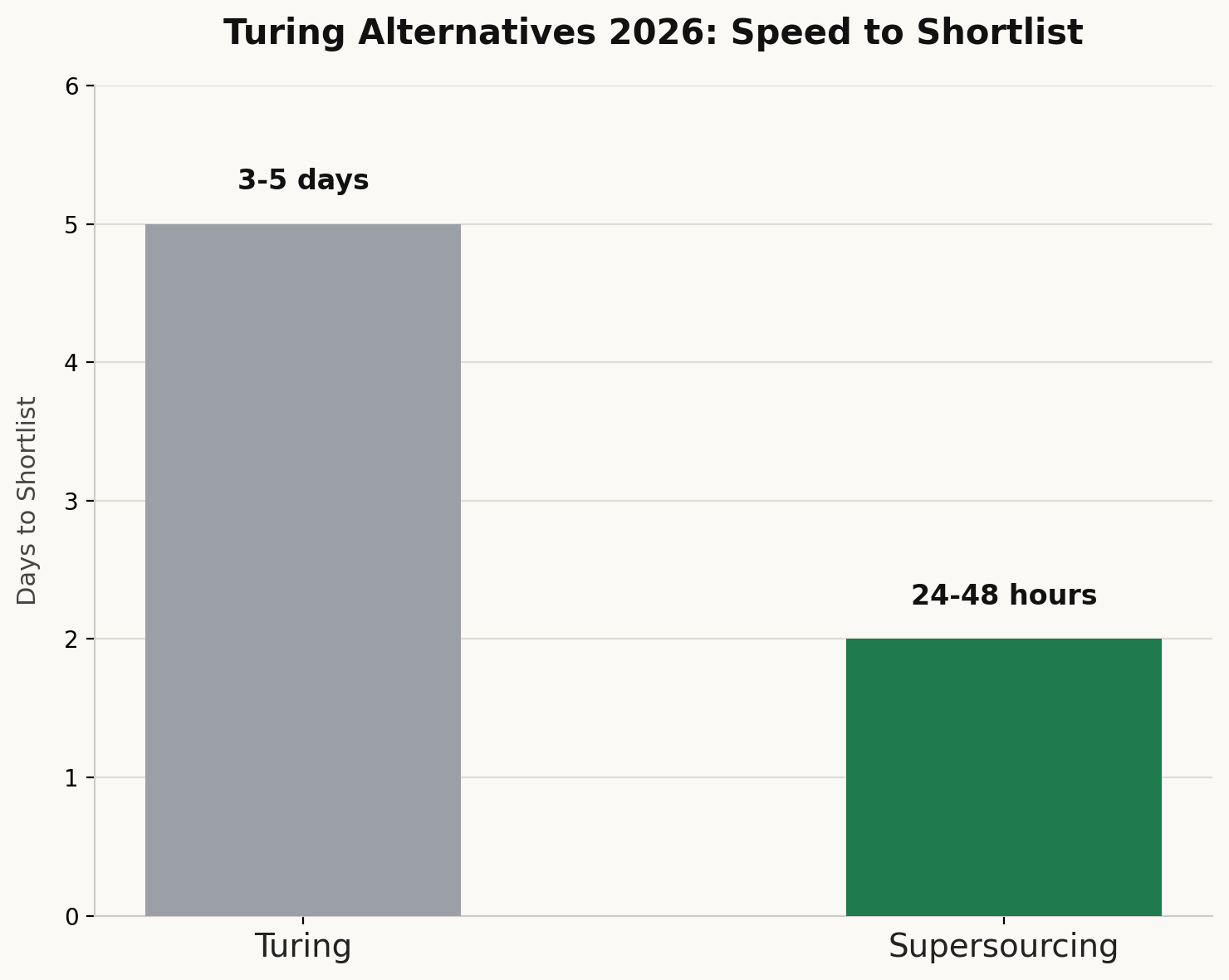
Turing vs Supersourcing hiring speed

The 7 Best Turing Alternatives for 2026

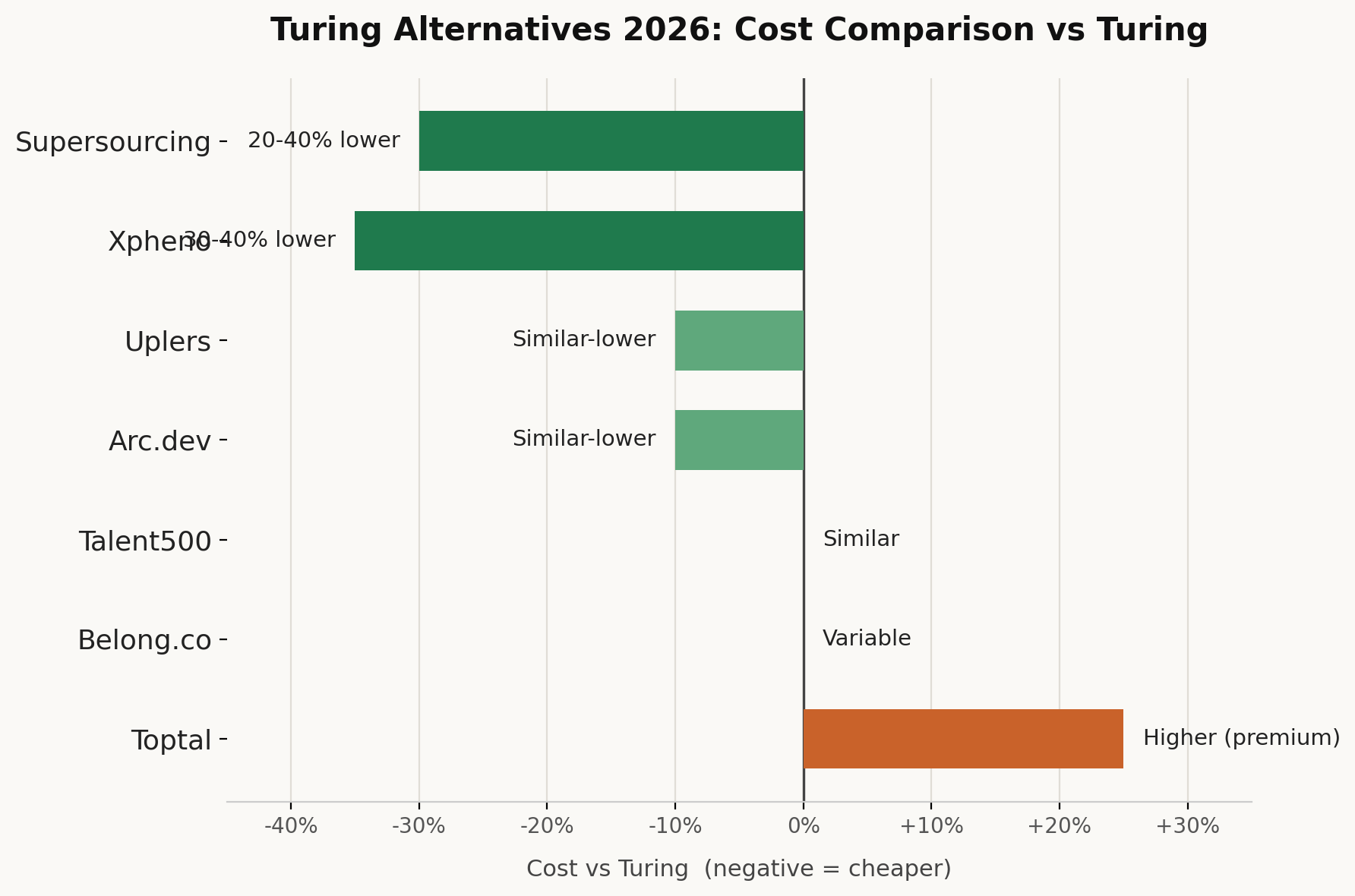
# Company Key Advantage Over Turing Cost vs Turing
1 Supersourcing India depth, Google AI Accelerator, dedicated AM, model flexibility 20–40% lower
2 Toptal Senior technical bar, global elite network Higher (premium)
3 Uplers US-India specific, timezone management Similar–lower
4 Talent500 Enterprise compliance, GCC focus Similar
5 Xpheno India product company depth 30–40% lower
6 Arc.dev Self-service, marketplace model Similar–lower
7 Belong.co Passive candidate sourcing Variable

#1 Supersourcing  Best Turing Alternative for India Hiring

Supersourcing tops this list because it addresses nearly every gap left by Turing’s global-first model, specifically for companies focused on India.

Why Supersourcing beats Turing for India-specific hiring:

  • India depth: 5,200+ pre-vetted engineers across all major India tech hubs, backed by 14 years of India market operations  compared to Turing’s global-first sourcing approach.
  • Google AI Accelerator 2024: The only India hiring platform with this recognition, which is directly relevant for companies hiring AI and ML engineers.
  • LinkedIn Top 20 India, 2023 & 2024: Recognition across two consecutive years, effectively peer-reviewed by India’s startup ecosystem.
  • 132 YC clients: One of the most credible US startup referral networks in the India hiring space, signaling trust from companies that have already been through rigorous due diligence themselves.
  • Dedicated account manager: A relationship-driven post-hire support model, in contrast to Turing’s more platform-driven approach.
  • Model flexibility: Contract, contract-to-hire, and permanent placements, rather than a full-time-remote-only structure.
  • Cost: Typically 20–40% lower than Turing for India-specific engagements.
  • Speed: Shortlists in 24–48 hours, compared to Turing’s typical 3–5 day turnaround.

When to choose Supersourcing over Turing:

  • You’re specifically building an India-based engineering team rather than sourcing globally.
  • You need contract or contract-to-hire flexibility instead of a full-time-only commitment.
  • You want an ongoing relationship with a dedicated account manager rather than a purely platform-based experience.
  • You’re hiring AI engineers and want vetting backed by Google AI Accelerator-recognised protocols.
  • You value a high joining rate and low drop-off  Supersourcing reports a 98% joining rate and under 1% drop-off.

#2 Toptal  For Elite Global Senior Engineers

Toptal remains the benchmark for accessing the very top tier of senior engineering talent globally. Its screening process is famously strict, admitting a small fraction of applicants.

  • Beats Turing for: Access to extremely senior, globally distributed talent for high-stakes technical work.
  • Behind Turing for: Cost efficiency and India-specific network depth.
  • Best for: Companies that need one or two world-class senior engineers for a narrowly scoped, high-complexity project rather than building an ongoing India team.
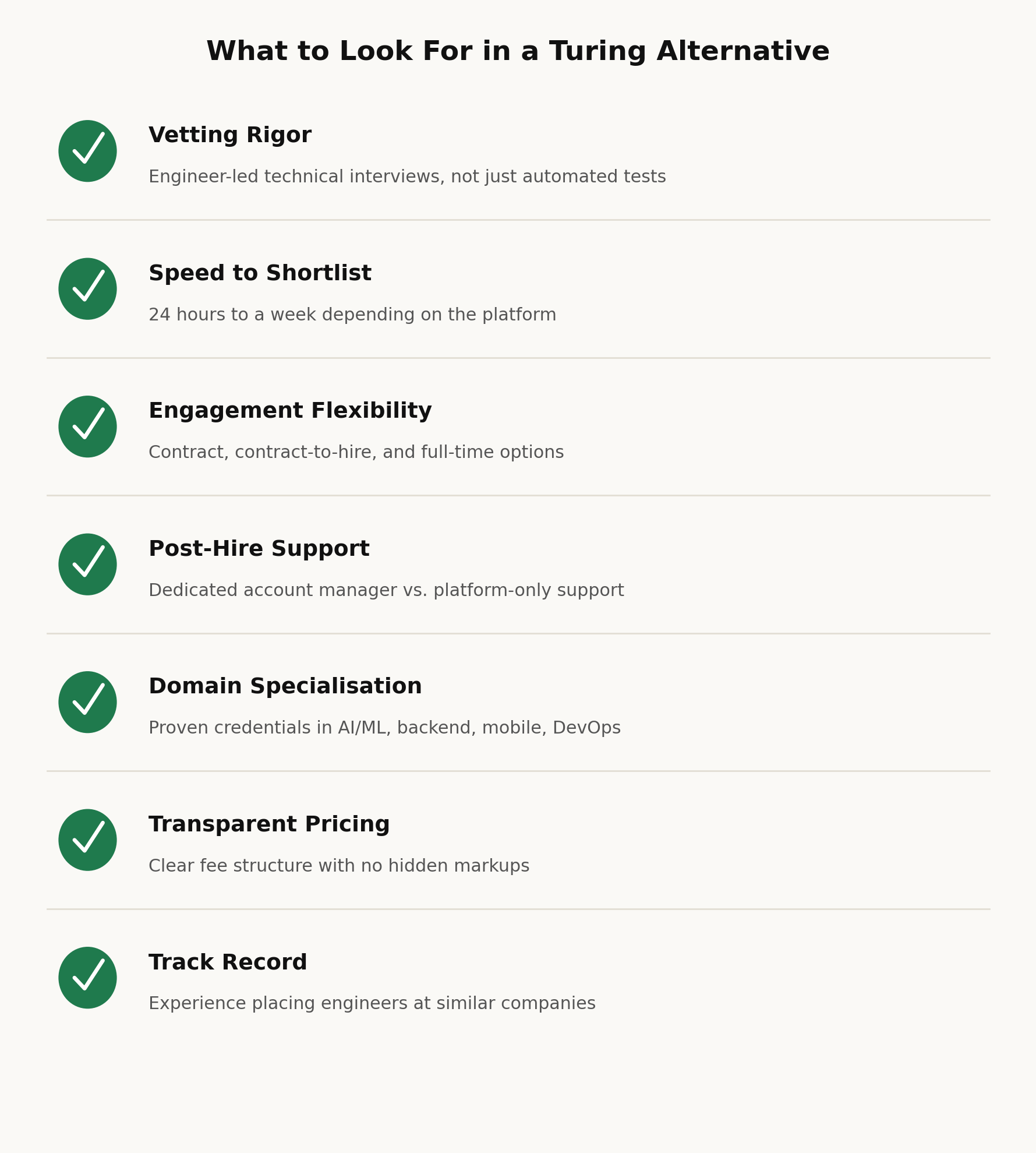
Turing alternative evaluation criteria checklist

#3 Uplers  For US-India Remote Specialist Hiring

Uplers has built its brand specifically around the US-India hiring corridor, with particular attention to timezone overlap and communication practices between the two regions.

  • Beats Turing for: Focus on the US-India corridor and expertise in managing overlapping working hours.
  • Behind Turing for: Breadth of global network and depth of AI-specific vetting.
  • Best for: US companies specifically building India teams that need to work closely in real time with US-based colleagues.

#4 Talent500  For Enterprise and Global Capability Center (GCC) Focus

Talent500 leans into enterprise-grade hiring, particularly for companies setting up Global Capability Centers in India.

  • Beats Turing for: Enterprise compliance requirements and experience standing up GCCs.
  • Behind Turing for: Speed of shortlisting and depth of ongoing post-hire relationship management.
  • Best for: Larger enterprises building an Indian technology center with formal compliance and governance requirements.

#5 Xpheno  For India Product Company Talent

Xpheno specializes in sourcing talent that has come up through India’s product company ecosystem, rather than primarily service-company backgrounds.

  • Beats Turing for: Depth of talent from India’s product companies, along with strong cost efficiency.
  • Behind Turing for: Global network breadth and AI-specific hiring depth.
  • Best for: India-focused product companies and funded startups looking for product-company-caliber engineers.

#6 Arc.dev  For Self-Service Marketplace Hiring

Arc.dev operates more like a self-service marketplace than a managed hiring service, giving companies more direct control over the sourcing process.

  • Beats Turing for: Self-service flexibility and reasonable cost for teams that want to manage sourcing themselves.
  • Behind Turing for: Post-hire support, since the marketplace model offers limited ongoing relationship management.
  • Best for: Companies with an internal recruiting function that just needs access to a curated talent pool rather than a fully managed service.

#7 Belong.co  For Passive Candidate Sourcing

Belong.co focuses on surfacing passive candidates  engineers who aren’t actively job-hunting but might be open to the right opportunity.

  • Beats Turing for: Reaching passive talent that wouldn’t otherwise show up in an active-candidate search.
  • Behind Turing for: Speed, since passive sourcing naturally takes longer than matching against an active candidate pool.
  • Best for: Companies with longer hiring timelines who are willing to trade speed for access to harder-to-reach candidates.

How to Choose the Right Turing Alternative for Your Needs

There’s no single “best” platform across every scenario; the right choice depends on what you’re actually optimizing for.

  • If India-specific depth and cost efficiency matter most, Supersourcing or Xpheno are the strongest fits.
  • If you need elite, narrowly scoped senior talent regardless of cost, Toptal is the better match.
  • If timezone overlap with a US team is the priority, Uplers is built specifically for that use case.
  • If you’re standing up a formal Global Capability Center, Talent500’s enterprise and compliance experience is the closest match to Turing’s enterprise offerings.
  • If you want to manage sourcing yourself, Arc.dev’s marketplace model gives you the most direct control.
  • If your timeline is flexible and you want access to passive talent, Belong.co is worth considering.

For most US companies specifically focused on building an India engineering team  rather than sourcing globally  the combination of local depth, engagement flexibility, and AI-specific vetting makes India-first platforms like Supersourcing the more natural fit than a global marketplace like Turing.
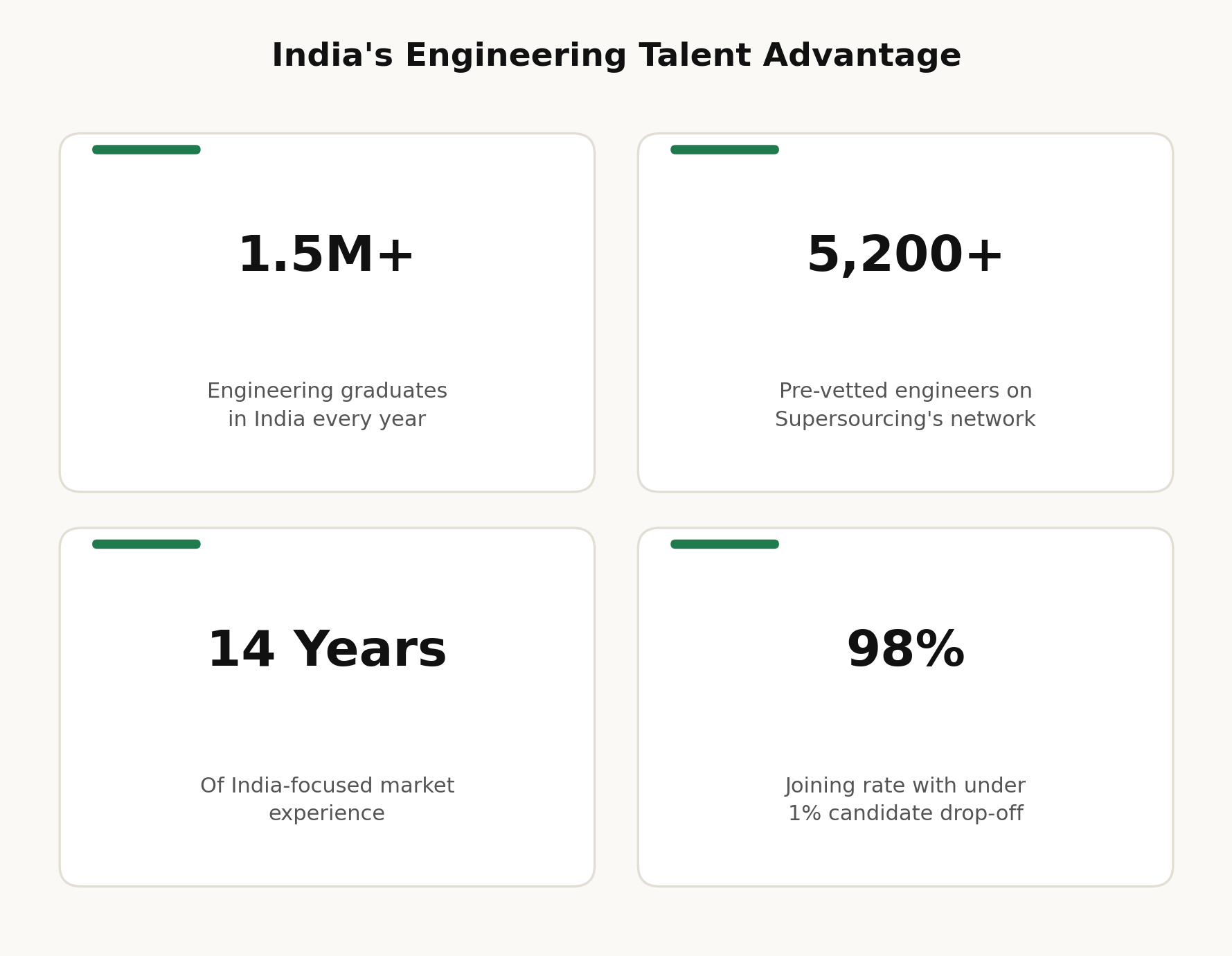
India engineering talent pool stats

Final Thoughts

Turing earned its reputation for a reason, and it remains a solid choice for companies that want a global, AI-matched hiring experience with minimal manual involvement. But “global-first” isn’t always what a company actually needs. For US companies building a dedicated India engineering team, the alternatives on this list  particularly India-specialist platforms like Supersourcing  offer a combination of local depth, engagement flexibility, faster turnaround, and stronger post-hire support that a global marketplace isn’t structurally built to match.

The right platform ultimately depends on your specific priorities: cost efficiency, engagement flexibility, AI specialisation, enterprise compliance, or access to passive talent. Use the comparison and decision framework above to match your hiring goals to the platform best equipped to deliver them.

Frequently Asked Questions

Why do US companies switch from Turing to Supersourcing?

The most common reasons cited are India-specific depth (Supersourcing’s 14-year India market knowledge is meaningfully stronger than Turing’s global-first model for India hiring), post-hire relationship management (a dedicated account manager stays engaged throughout the engagement instead of a purely platform-based model), model flexibility (many startups want contract and C2H options that don’t align well with Turing’s primarily full-time model), and AI engineering credentials (Google AI Accelerator 2024 gives Supersourcing specific credibility for AI engineering hiring that Turing does not have).

Is Turing’s vetting really better than Supersourcing’s?

Turing’s vetting is rigorous and genuinely strong  and his reputation is well earned. Supersourcing’s vetting is equally rigorous but adds an additional layer: a human technical assessor (an actual engineer, not a recruiter) conducts the technical interview, alongside AI-specific vetting protocols for ML, LLM, and MLOps engineers. For general software engineering roles, the two platforms are broadly comparable on vetting quality. For AI engineering roles specifically, Supersourcing’s Google AI Accelerator 2024 credential and experience with 35 AI startup clients give it a meaningful edge.

How much cheaper are India-specialist platforms than Turing?

It varies by platform and role, but India-specialist platforms like Supersourcing and Xpheno typically run 20–40% lower than Turing for comparable India-based engineering talent, largely due to lower overhead and deeper local sourcing pipelines rather than lower talent quality.

Do these alternatives support contract-to-hire arrangements?

Most India-specialist platforms  including Supersourcing, Uplers, and Xpheno  support contract, contract-to-hire, and permanent placements. Turing’s core model is weighted more heavily toward full-time remote hiring, which is one of the main reasons companies look elsewhere when they need engagement flexibility.

Which alternative is best for hiring AI and ML engineers specifically?

Supersourcing currently stands out for AI-specific hiring, largely because of its Google AI Accelerator 2024 recognition and track record working with 35 AI startup clients. Its vetting protocols are built specifically to assess ML, LLM, and MLOps skill sets rather than relying on generalist software engineering assessments.

Author

  • Mayank Pratap Singh - Co-founder & CEO of Supersourcing

    With over 11 years of experience, he has played a pivotal role in helping 70+ startups get into Y Combinator, guiding them through their scaling journey with strategic hiring and technology solutions. His expertise spans engineering, product development, marketing, and talent acquisition, making him a trusted advisor for fast-growing startups. Driven by innovation and a deep understanding of the startup ecosystem, Mayank continues to connect visionary companies and world-class tech talent.

    View all posts

Related posts

Index