

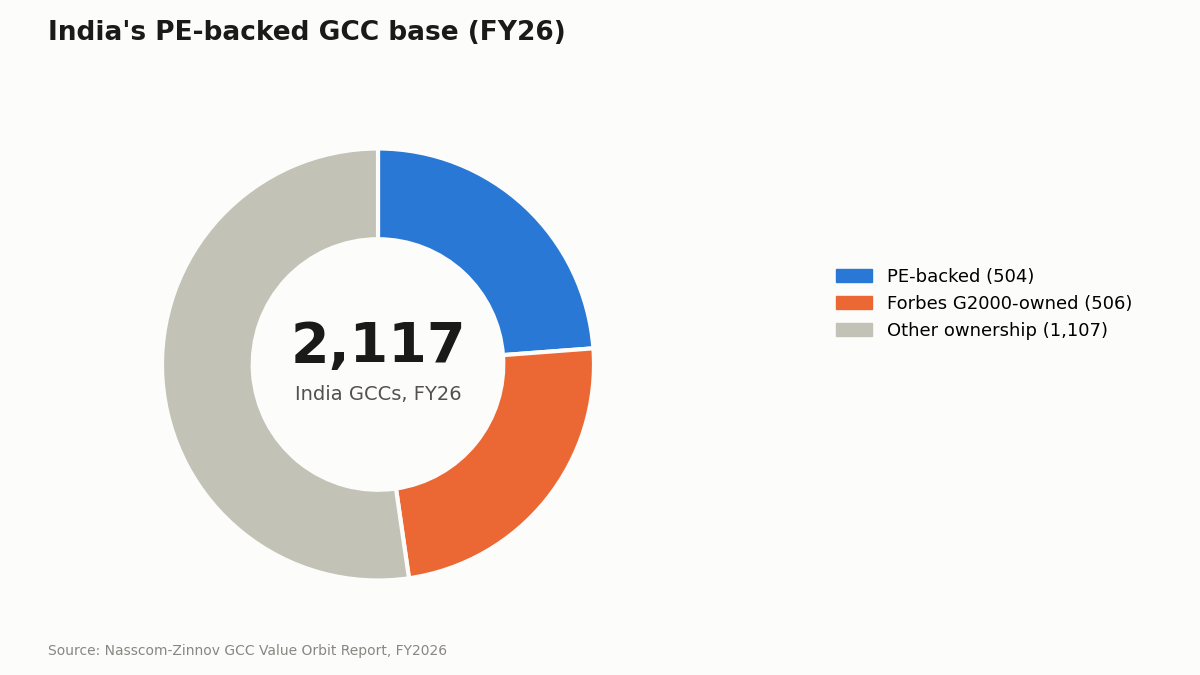
Of India’s 2,117 Global Capability Centers as of FY26, 504 are already private-equity-backed and a further 506 belong to Forbes Global 2000 companies meaning a meaningful share of the ecosystem was already bought, carved out, or recapitalized rather than built from a blank sheet.
Add to that a global M&A market that KPMG’s 2026 dealmaker survey is calling “the year of the carve-out,” with 71% of private equity respondents actively pursuing or open to portfolio separation, and it’s clear that acquiring or divesting an existing offshore center is no longer a fringe scenario it’s a mainstream path into or out of India.
Yet almost every piece of GCC content in existence is written for someone starting from zero: how to incorporate, how to hire the first 50 people, how to pick a city. None of it tells a corporate development lead, a PE operating partner, or a CFO what to actually check when the center already exists, has 300 people on payroll, a five-year office lease, and a delivery roadmap nobody outside the target company has ever seen.
This guide is that missing piece, drawing on more than a decade of hands-on GCC hiring and setup work at Supersourcing across fintech, healthtech, and enterprise SaaS. It walks through GCC M&A due diligence end to end from the first decision to explore a deal, through legal, HR, and technology diligence, to Day 1 governance and the retention plan that determines whether the asset you bought is still intact 12 months later.
TL;DR
This guide is for corporate development teams, PE operating partners, and CFOs evaluating whether to acquire, carve out, or wind down a Global Capability Center in India whether you're the buyer, the seller, or the team being transferred. It covers the full GCC M&A due diligence lifecycle: defining deal scope, running legal and HR diligence on a people-heavy asset, structuring the transition services period, and managing delivery once ownership changes hands.
The single number to hold onto: in the FY26 Nasscom-Zinnov landscape data, 504 of India's GCCs are already PE-backed. This asset class has a real, active secondary market, and the deals that go wrong almost always fail on the same handful of predictable points, not on surprises.
By the end, you'll be able to run a GCC carve-out or acquisition process yourself, build a diligence checklist, size the deal, negotiate the transition period, and stand up a retention plan without treating the workforce as an afterthought to the legal paperwork.
What Is GCC M&A Due Diligence?
GCC M&A due diligence is the structured evaluation of an existing Global Capability Center’s legal, financial, technological, and workforce health before a buyer acquires it, a parent carves it out, or an investor takes a stake distinct from greenfield setup diligence because the target is an operating, people-dependent delivery organization, not a shell.
It is not:
- GCC setup planning evaluating whether and where to build a new captive center from scratch.
- Vendor or outsourcing due diligence assessing a third-party IT services provider you’ll contract with, rather than a legal entity and workforce you’ll own or absorb.
- Standard IT/software company M&A diligence while it borrows from that playbook, a GCC’s core asset is its people and delivery relationships, not IP or a product roadmap, which changes what actually matters in the review.
Why It Matters: The Business Case
Getting GCC M&A due diligence right or wrong shows up directly in cost, delivery continuity, and downside risk:
- Retention economics. A center that loses 20-30% of its senior bench in the first two quarters after a deal closes effectively forces the buyer to re-run the hiring process it thought it was avoiding by acquiring an existing team.
- Valuation accuracy. Centers get priced differently depending on delivery maturity; a center still running as a cost-plus execution arm is worth less per head than one already operating as what Zinnov’s own maturity framework calls a “Portfolio Hub,” and buyers who skip this distinction routinely overpay or underpay.
- Deal timeline risk. KPMG’s 2026 survey found 52% of dealmakers cite operational separation as a material hurdle in carve-outs, and 40% flag IT and data separation specifically both are workforce- and systems-heavy problems, not pure legal ones.
- Regulatory exposure. Indian labor law (Provident Fund, ESI, gratuity, the new labor codes), STPI/SEZ registration status, and transfer pricing arrangements with the parent entity can each independently delay or kill a deal if surfaced late.
- Continuity of service to the parent business. Unlike acquiring a product company, a GCC’s “customers” are internal business units of the seller if delivery stalls during transition, the damage is felt immediately inside the acquirer’s or seller’s own operations, not in a separate market.
- Deal financing structure. Since India’s regulatory framework for acquisition financing was broadened in early 2026, more buyers now have a domestic bank financing route available for GCC deals but only if the target’s financials and compliance history are clean enough to satisfy bank covenants, which makes early diligence quality a direct driver of financing options, not just a risk-management exercise.
- Market timing. With 71% of PE respondents in KPMG’s 2026 survey actively pursuing portfolio separation, sellers currently have more competing buyer interest than they did even two years ago which means diligence timelines that used to stretch informally now get compressed by competitive pressure, rewarding buyers who arrive with a structured process already built.
The Core Problem Most Buyers Face
Most corp dedicated development teams doing their first GCC acquisition India deal run a diligence process built for a product or manufacturing target and bolt on an HR checklist as an afterthought. That approach consistently misses three things:
- Bench composition is treated as a spreadsheet line, not a risk category. Headcount totals hide the real question of how many of the 300 people are actually irreplaceable in the next 90 days, and how many are commoditized roles you could backfill through any staffing channel.
- Timelines get modeled on the legal close date, not the operational one. Teams routinely underestimate the gap between signing and stable delivery by 3-4x, because the transition services agreement (TSA) period commonly 6 to 18 months for a mid-market carve-out gets treated as a formality rather than the riskiest phase of the entire deal.
- Culture and reporting-line diligence gets skipped entirely. A center that reports into a matrixed global function will behave very differently under a new, more centralized ownership structure, and that mismatch is what actually drives the attrition spike, not compensation.
THE WALKTHROUGH: From First Decision to Stable Delivery
Phase 1 Defining Scope, Structure, and Budget
Before any diligence starts, both sides need to agree on what is actually being transacted.
Decide the deal shape first. In India, three structures dominate:
- A full entity acquisition buyer acquires the legal entity that houses the GCC (share sale). Cleanest for continuity, but the buyer inherits all historical liabilities.
- Slump sale / business transfer the GCC’s operations, assets, and employees are transferred as a going concern for a lump-sum consideration, commonly used for carve-outs and internal restructurings because it is exempt from GST liability under the CGST Act and treated as a single capital asset for tax purposes.
- Build-Operate-Transfer (BOT) exit where a GCC setup services partner has been running the center on the parent’s behalf, and ownership formally transfers to the client at a pre-agreed point, typically 18-36 months in.
Budget bands to plan against:
- Legal, tax, and transaction advisory fees for a mid-market GCC deal (200-800 FTEs) typically run into the low-to-mid single-digit percentage of deal value, front-loaded into the first 60 days.
- Retention/stay bonuses for critical roles are commonly budgeted as a separate line and treat this as non-negotiable spend, not a contingency.
- Real estate: assume the office lease will need either assignment (with landlord consent) or a fresh lease, and price in the gap either way.
Requirements checklist for this phase:
- Deal structure decided (share sale / slump sale / BOT exit)
- Target headcount band and org chart requested
- Preliminary valuation range set against comparable deal data
- Advisory team assembled: M&A counsel, tax, HR/labor law, IT security
- Confidentiality agreement and clean-room protocol in place before data room access
Who needs to be in the room from day one: most first-time buyers assemble legal and finance first and bring in HR/workforce advisory only once diligence is already underway. Reverse that order.
A GCC’s core asset is its people, so a workforce advisor reviewing org design and attrition patterns should sit in the same early scoping conversations as counsel not be handed a data room three weeks after everyone else has already formed a view on valuation.
The same logic applies to IT/security review: bring in a technical reviewer before the letter of intent, not after, since systems debt discovered post-signing has no negotiating leverage behind it.
The 3-day rule: once a target agrees to data-room access, insist on a specific first-look window of three business days to review the headcount file, org chart, and attrition report before committing further advisory spend.
If a seller can’t produce clean versions of these three documents inside that window, treat it as an early signal about how well the center’s operations are actually tracked, independent of anything else in the deal.
Phase 2 Sourcing & Vetting the Target
This phase is where a GCC deal diverges most from a typical acquisition, because “vetting the target” means vetting a workforce, not just a balance sheet.
What good screening looks like:
- Headcount reconciliation cross-check payroll records, org charts, and actual badge/access data. Mismatches here (ghost headcount, unfilled-but-budgeted roles) are one of the most common surprises in a data room.
- Skills and delivery-maturity mapping is the center still running as an execution arm for the parent, or has it already progressed to owning product decisions and global mandates? This single distinction changes both valuation and post-close integration complexity.
- Attrition and tenure analysis: a center with 25%+ annual attrition concentrated in year-2 and year-3 talent has a structurally different retention problem than one with low attrition but an aging senior bench approaching key-man risk.
- Compensation benchmarking confirms the center is paying market rate, not a legacy rate the parent negotiated years ago that will trigger a retention crisis the moment employees compare notes post-announcement.
Red flags:
- The “single point of failure” pattern: one or two senior leads hold undocumented institutional knowledge (vendor relationships, system access, client contacts) with no succession plan.
- The bench inflation flag: contractor or bench headcount reported as billable capacity when it’s actually idle.
- The silence flag: a target that won’t allow any structured employee conversations before signing this alone should slow the process down, since it usually means the seller knows morale is fragile.
Technical due diligence belongs here too; this is where reviewing the center’s cloud footprint and platform ownership matters: if the target’s infrastructure team is thin, it’s worth mapping what it would take to backfill through hiring cloud engineers channels versus retaining the existing team intact.
A workforce due diligence checklist most buyers skip entirely:
- Manager-to-report ratios across the org, not just at the top layer a flat structure under one or two overloaded leads is a retention risk that won’t show up in a headcount summary
- Notice-period terms by seniority band, since a mass exit is bounded (or not) by how fast people are legally able to leave
- History of internal transfers or secondments to the parent’s other geographies, which can quietly reduce the “sticky” headcount you think you’re buying
- ESOP or long-term-incentive terms tied to the parent entity these frequently lapse or need re-papering at close, and employees will notice before your HR team finishes drafting the new terms
- Client-facing role mapping which employees have direct relationships with the parent’s internal business units, since those relationships are part of what you’re actually acquiring
Cultural due diligence deserves its own line item, not a mention in passing. A center built to run inside a heavily matrixed global reporting structure will often struggle under a buyer that runs a flatter, more centralized model and vice versa.
Ask specifically how decisions currently get made day to day (escalation paths, sign-off layers, how much autonomy a team lead actually has) rather than relying on the org chart, which rarely reflects how authority actually flows in a mature captive center.
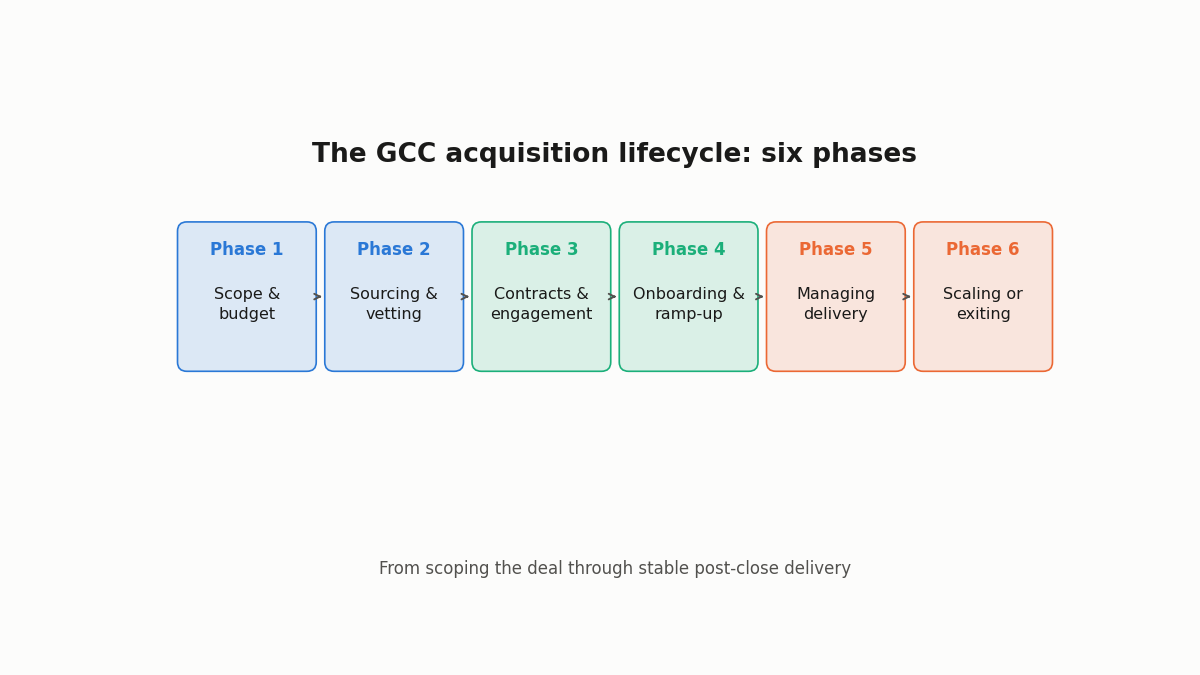
Phase 3 Engagement Models & Contracts
Once the target passes initial screening, the deal’s legal skeleton gets built.
Choose the transaction vehicle deliberately:
| Structure | Best for | Key risk to check |
| Share purchase | Buyer wants full continuity, existing contracts, and licenses to survive untouched | Inherits historical liabilities, tax exposure, and pending disputes |
| Slump sale / business transfer | Carve-outs where only part of a larger entity is being separated | Requires clean “perimeter definition” deciding precisely what assets, contracts, and people are in vs. out |
| Asset purchase | Buyer wants to cherry-pick specific assets/contracts | Employee transfer is not automatic; each contract may need individual assignment or novation |
Contract and IP checklist:
- NDA and IP assignment terms confirmed for every employee, not just leadership
- Vendor contracts reviewed for assignability many MSAs require counterparty consent to transfer
- Non-compete and non-solicit clauses checked against Indian enforceability limits
- Data processing and cross-border data-transfer terms reviewed against the parent’s compliance posture
- Real estate lease assignment or fresh lease negotiated in parallel with legal close, not after
A negotiation point that surfaces almost every time: the seller wants a shorter TSA to reduce its own overhead cost of supporting a business it no longer owns; the buyer wants a longer TSA to de-risk the systems and knowledge handoff.
The workable middle ground in most mid-market carve-outs is a tiered TSA core IT services and payroll systems supported for 12-18 months, lower-priority services cut off at 90 days, with defined exit ramps for each service line rather than one blanket end date.
Regulatory and compliance checklist specific to Indian GCCs:
- STPI or SEZ registration status confirmed, along with any conditions attached to continued benefits post-transfer
- GST registration and historical filing compliance reviewed, since the entity’s tax history transfers with it in a share sale
- Transfer pricing arrangements with the parent documented and reviewed a captive center’s intercompany pricing model often needs to be re-papered entirely once it’s no longer 100% owned by the same parent
- Provident Fund, ESI, and gratuity liability schedules reconciled against actual payroll records, not just policy documents
- Pending labor disputes, tribunal matters, or union/works-council engagement history disclosed in full
- Cross-border data transfer terms checked against both Indian data protection requirements and the buyer’s home-jurisdiction obligations, particularly for BFSI or healthcare-serving centers
Since February 2026, the RBI’s revised framework permits Indian commercial banks to fund acquisitions of target-company shares directly, including refinancing of a target’s existing borrowings where that forms part of the acquisition structure, a meaningful shift from the earlier position that pushed most leveraged GCC deals toward offshore lenders.
Confirm early which financing route your deal will use, since it affects both timeline and the covenants a buyer will need to satisfy at close.
Phase 4 Onboarding & Ramp-Up
The first two weeks after legal close set the tone for the entire retention outcome.
Day-1 essentials:
- All-hands communication from new leadership within 24 hours of close silence is what drives resignations, not the change itself
- System access transitioned or bridged (email, HRMS, code repositories, ticketing) with zero-gap continuity
- Payroll continuity confirmed in writing to employees before the first post-close pay cycle
- Manager-level 1:1s scheduled with every direct report in the first 10 working days
Communication cadence for the first 90 days:
- Weekly leadership office hours (open, not just top-down updates)
- Bi-weekly written status to the acquiring organization’s stakeholders on retention metrics, not just delivery metrics
- A named, single point of contact for HR questions benefits, notice period terms, equity/ESOP treatment because ambiguity here is what triggers exits, more than the underlying answer itself
This is also where IT consulting services support is often brought in for a defined window, specifically to stabilize systems handoff without pulling the acquired team’s attention away from client delivery during the most fragile stretch of the transition.
Phase 5 Managing Delivery Through Transition
Reporting structure that actually works:
- A joint steering committee (buyer + seller + center leadership) meeting weekly for the first quarter, then monthly once delivery metrics stabilize
- KPIs split into two tracks that get reported separately, not blended: delivery continuity (SLA adherence, ticket volume, release cadence) and workforce health (attrition, engagement pulse scores, open-role backlog)
- An account management structure that mirrors what the parent used to run internally don’t strip out a dedicated account manager model the moment ownership changes, since that’s often exactly when people need the most continuity
A detail only visible from having run these transitions: the delivery dip that shows up in weeks 6-10, not week 1. Week 1 looks fine because the original team is still intact and motivated by novelty.
The real test is whether the center is still delivering at the same SLA once the first wave of “is this still a good place to work” conversations has happened privately among the team which is usually around week 6. Track delivery metrics weekly through week 12 specifically because of this lag, not just at 30/60/90-day checkpoints.
If the acquired center’s infrastructure or platform team needs reinforcement during this window, this is typically where a buyer will bring in DevOps engineers capacity to backstop the transition without destabilizing the existing team’s workload.
Phase 6 Scaling or Exiting
If scaling post-acquisition:
- Rebuilding the hiring pipeline under the new employer brand before the old one fades, a center that was hired under the parent’s name will see applicant flow drop if the new identity isn’t actively marketed within the first two quarters.
- Set a replacement policy explicitly know your standard for how fast a departing critical hire gets backfilled (a 7-10 working day replacement guarantee model, where a staffing partner is on the hook to have a qualified fit in the seat within that window, sets a very different retention risk profile than an open-ended search).
- Re-baseline the delivery-maturity roadmap within the first two quarters rather than inheriting the parent’s old one by default a center bought specifically because it had room to grow into a Portfolio Hub role needs an explicit plan for what that growth looks like, not an assumption that momentum alone will get it there.
- Revisit compensation bands at the 6-month mark, not annually. Post-acquisition compensation reviews that wait for the standard cycle are consistently too slow relative to how fast employees recalibrate their expectations once ownership changes.
If exiting or winding down, the sequencing matters as much as the checklist itself. Employee-facing communication should happen before, not alongside, vendor and landlord notices employees who learn about a closure secondhand, through a vendor conversation or an office-access change, lose trust in every subsequent communication from leadership, which then complicates severance negotiations that would otherwise be straightforward.
If exiting or winding down:
- Employee transfer or severance plan finalized and communicated before, not after, public announcement
- Vendor and lease exit terms confirmed (notice periods, early-termination penalties)
- Statutory closure compliance: gratuity settlement, PF/ESI closure filings, final STPI/SEZ de-registration if applicable
- Data destruction or transfer certification completed and documented for audit purposes
Case Studies: What the Underlying Problem Actually Looks Like
These examples draw on Supersourcing’s delivered engagements not GCC acquisitions themselves, but the same operational mechanics that show up inside a carve-out or acquisition diligence process.
Workforce planning at scale mirrors a carve-out sizing problem. When Paytm needed to scale past 100 engineering hires quickly, the core question wasn’t “can we find candidates” it was mapping which roles were genuinely scarce versus commoditized, the exact exercise a buyer has to run on a target’s org chart during Phase 2 diligence. The same bench-classification logic that supports a fast internal scale-up is what a due diligence team needs to apply to a target company’s headcount.
Engineering hiring quality under time pressure resembles retention-critical backfill. OkCredit’s engineering hiring process depended on a 98% candidate joining rate and sub-1% drop-off on contract roles, the same reliability standard a buyer needs from whatever backfill channel it uses to replace departures during a post-acquisition transition, when every open seat compounds delivery risk.
Recruitment automation parallels the systems-handoff problem in a carve-out. Somnoware’s recruitment process automation work illustrates the kind of system-dependency mapping who owns which tool, what breaks if access lapses that shows up identically in Phase 3/4 of a GCC transition, just applied to HR systems instead of hiring pipelines.
These are analogous operational patterns from adjacent engagements, not GCC acquisitions themselves but the underlying mechanics (bench classification, reliable backfill, systems dependency mapping) transfer directly to M&A diligence work.
Comparison Framework: How to Acquire a GCC Capability
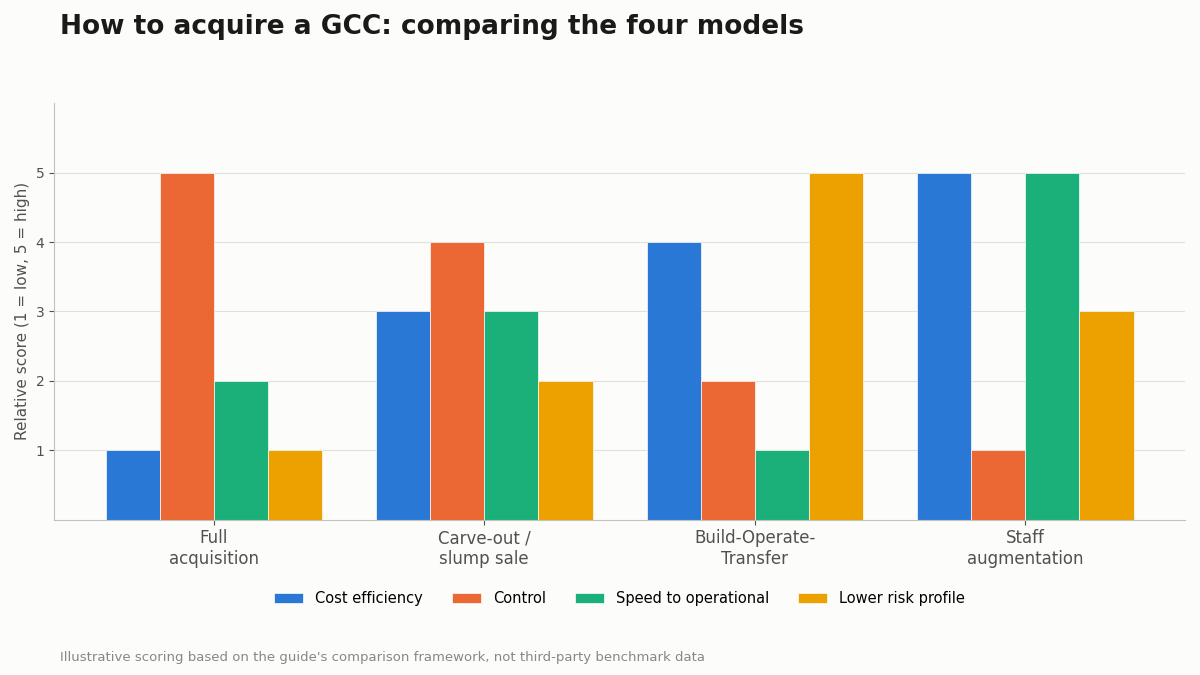
| Model | Cost | Control | Speed to operational | Risk profile |
| Full acquisition (share sale) | Highest upfront | Full, immediate | Fast legally, slow operationally (TSA-bound) | Inherits all historical liability |
| Carve-out / slump sale | Deal-size dependent, often lower than a full entity | High, but perimeter must be cleanly defined | Moderate bounded by TSA exit ramps | Separation execution risk (IT, contracts, people) |
| Build-Operate-Transfer | Spread over the build period | Low initially, full at transfer | Slowest to full ownership, but de-risked | Lowest center is proven before transfer |
| Staff augmentation / vendor partnership | Lowest capital outlay | Lowest no ownership | Fastest | No asset ownership; exposed to vendor dependency |
Use this to frame the real trade-off: acquiring or carving out an existing center buys you speed and an existing delivery track record, at the cost of inheriting someone else’s technical debt, culture, and attrition risk. A BOT model defers that risk but delays full control.
How to apply this framework in practice: score the target against each column on a simple 1-5 scale before you get deep into legal diligence, and be honest about which column matters most to your specific mandate.
A PE operating partner buying for a fast multiple expansion will weight speed and control heavily and tolerate more separation risk; a strategic acquirer folding the center into an existing global operating model will weight risk profile far more heavily than speed, since a botched integration damages the parent’s broader delivery reputation, not just this one deal.
What Most Teams Get Wrong
- Treating the TSA period as an administrative formality. It is the highest-risk phase of the entire deal, not a bridge to get past quickly. Under-resourcing TSA governance is the single most common execution mistake in GCC carve-outs.
- Pricing the deal purely on headcount, not delivery maturity. Two 300-person centers can be worth meaningfully different amounts depending on whether they’re still cost-plus execution arms or already own product and strategic decision-making for the parent buyers who price on headcount alone systematically overpay for the former and underpay for the latter.
- Announcing the deal before the retention plan exists. Employees find out about ownership changes faster than corp-dev teams expect, and a vacuum of information not the change itself is what triggers the first resignation wave.
- Assuming Indian labor law works like the buyer’s home jurisdiction. Notice periods, gratuity thresholds, and the treatment of fixed-term versus permanent employees under India’s revised labor codes catch first-time buyers consistently, and a diligence checklist copied from a US or European deal will miss all of it.
- Skipping employee conversations to preserve confidentiality. Confidentiality is real, but a target that won’t allow any structured, NDA-bound conversations with key personnel before signing is usually signaling that morale won’t survive scrutiny.
- Confusing a GCC acquisition with a vendor RFP. Buyers who’ve previously only run outsourcing vendor selections tend to bring that muscle memory to a GCC deal comparing rate cards and SLAs when the actual question is org design, reporting lines, and retention economics. The two evaluations use almost none of the same criteria, and treating them as similar leads to diligence questions that miss what actually determines deal success.
- Under-scoping the technology and data separation workstream. IT and data separation was flagged by 40% of dealmakers in KPMG’s 2026 survey as a material carve-out hurdle, yet it’s routinely staffed as a two-person IT liaison role rather than a dedicated workstream with its own budget, timeline, and named owner reporting into the same steering committee that tracks retention and delivery.
Red flag worth calling out on its own: a target that presents a single, polished attrition number for “the center” without a breakdown by tenure band, function, or manager.
Aggregate attrition figures hide exactly the risk a buyer needs to see a center can show a flattering 12% blended number while quietly losing 40% of its most senior architects. Always ask for the cut by seniority and function before accepting a headline figure.
Cost & Timeline Reality Check
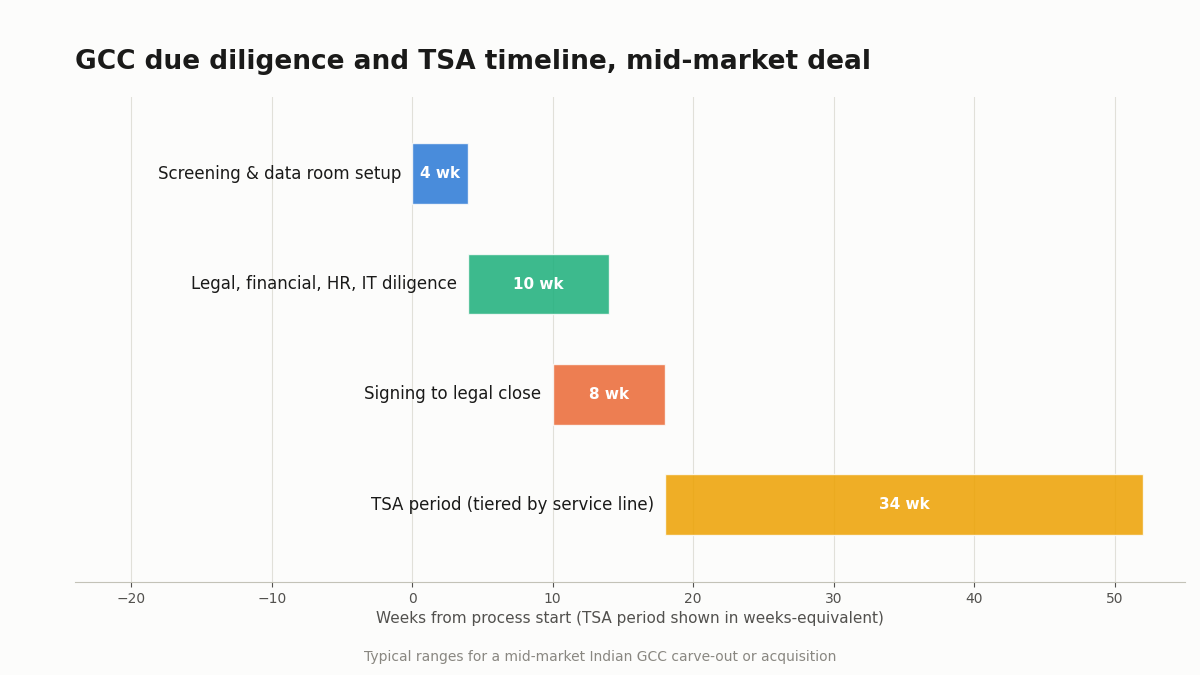
Typical diligence and close timeline for a mid-market Indian GCC deal:
- Preliminary screening and data room setup: 2-4 weeks
- Full legal, financial, HR, and technology diligence: 6-10 weeks, run in parallel workstreams
- Signing to legal close: 4-8 weeks, depending on regulatory approvals and consents needed for contract assignment
- TSA period post-close: commonly 6-18 months, tiered by service line rather than a single end date
What drives cost and timeline up:
- Fragmented vendor contracts requiring individual consent for assignment
- Multiple legal entities or shared-services arrangements with the parent that complicate perimeter definition
- Low data hygiene in HR and payroll systems, forcing manual headcount reconciliation
- A target with SEZ or STPI registration requiring formal de-registration or transfer approval
What drives cost and timeline down:
- A single, clean legal entity already ring-fenced from the parent’s other operations
- Existing delivery maturity (the center already operates with defined SLAs and its own account governance)
- A pre-negotiated, tiered TSA structure agreed before signing rather than drafted from scratch post-close
Rough cost-tier reference by center size (advisory, retention, and transition spend as a share of overall deal complexity not deal value, which varies too widely by sector to generalize):
| Center size | Diligence complexity | Typical TSA length | Retention budget priority |
| Under 150 FTEs | Lower fewer vendor contracts, simpler org | 6-9 months | Concentrated on 3-5 named critical roles |
| 150-500 FTEs | Moderate multiple system dependencies, layered management | 9-15 months | Tiered across leadership, senior ICs, and delivery leads |
| 500+ FTEs | Higher likely multiple business units, shared services with the parent | 12-18+ months | Portfolio-wide retention program, often with phased bonus vesting |
Treat this as a planning reference, not a pricing quote; actual figures depend on sector (BFSI and healthcare centers carry heavier compliance overhead than e-commerce or SaaS-serving centers), the parent’s own systems complexity, and how cleanly the center was already ring-fenced before the deal process started.
Where to Go From Here
If you’re mid-diligence on a specific center, the highest-leverage next step isn’t reading further; it’s getting a second set of eyes on the workforce data specifically, since that’s the diligence category most teams under-resource relative to legal and financial review. If that’s where you are right now, talk to our team about a workforce and delivery-maturity assessment before you finalize valuation.
Frequently Asked Questions
What is a GCC carve-out?
A GCC carve-out is the separation of a captive center’s operations, assets, contracts, and employees from its parent company, sold or spun off as a standalone or acquired business most commonly structured in India as a slump sale to preserve going-concern tax treatment.
How long does GCC due diligence take?
For a mid-market center, full legal, financial, HR, and technology diligence typically runs 6-10 weeks once the data room is open, run in parallel workstreams rather than sequentially, with legal close following 4-8 weeks after signing.
What are the biggest risks when acquiring a GCC?
The two recurring risks are workforce attrition during the transition period and operational separation of IT systems and vendor contracts KPMG’s 2026 survey found both cited by dealmakers as leading hurdles in carve-out execution specifically.
How is a GCC valued?
Valuation should weight delivery maturity (execution arm versus strategic hub), not just headcount a center already owning product or business decisions for its parent commands a different multiple than one performing pure execution work, alongside standard financial and contract-based valuation inputs.
What happens to employees when a GCC is acquired?
Under a slump sale or business transfer, employees typically transfer as part of the going-concern sale with continuity of service recognized; under an asset purchase, employee transfer is not automatic and each employment relationship may need individual re-offer or novation.
Can a GCC be sold as a slump sale?
Yes, slump sale is the most common structure for Indian GCC carve-outs, transferring the business as a going concern for a lump-sum consideration, and it carries favorable GST and capital-gains treatment compared to itemized asset transfers.
What licenses or registrations does an Indian GCC need checked in diligence?
Confirm current STPI or SEZ registration status, GST registration, PF/ESI compliance history, and any sector-specific approvals (RBI, data-localization requirements for BFSI or healthcare clients) lapses here can delay or block a deal.
How do you retain talent during a GCC ownership change?
Communicate within 24 hours of close, guarantee payroll and benefits continuity in writing, budget retention bonuses for critical roles as a non-negotiable line item, and track delivery and attrition metrics weekly through at least week 12 this is also the point at which most teams benefit from bringing in outside GCC services India expertise to run the retention and backfill plan in parallel with internal integration work.
What’s the difference between acquiring a GCC and outsourcing to a vendor?
Acquiring or carving out a GCC means owning the legal entity, employees, and infrastructure directly, with full control over hiring, compensation, and delivery decisions; outsourcing to a vendor means contracting for a service level without owning the underlying team, trading control for lower upfront capital commitment and less integration risk.
What does winding down or exiting a GCC in India actually cost?
Beyond severance and gratuity settlements, factor in vendor and lease early-termination penalties, statutory closure filings for PF/ESI and STPI/SEZ de-registration, and data destruction or transfer certification the timeline for a clean closure typically runs several months longer than teams initially budget for, primarily due to statutory filing sequencing rather than the operational shutdown itself.
