

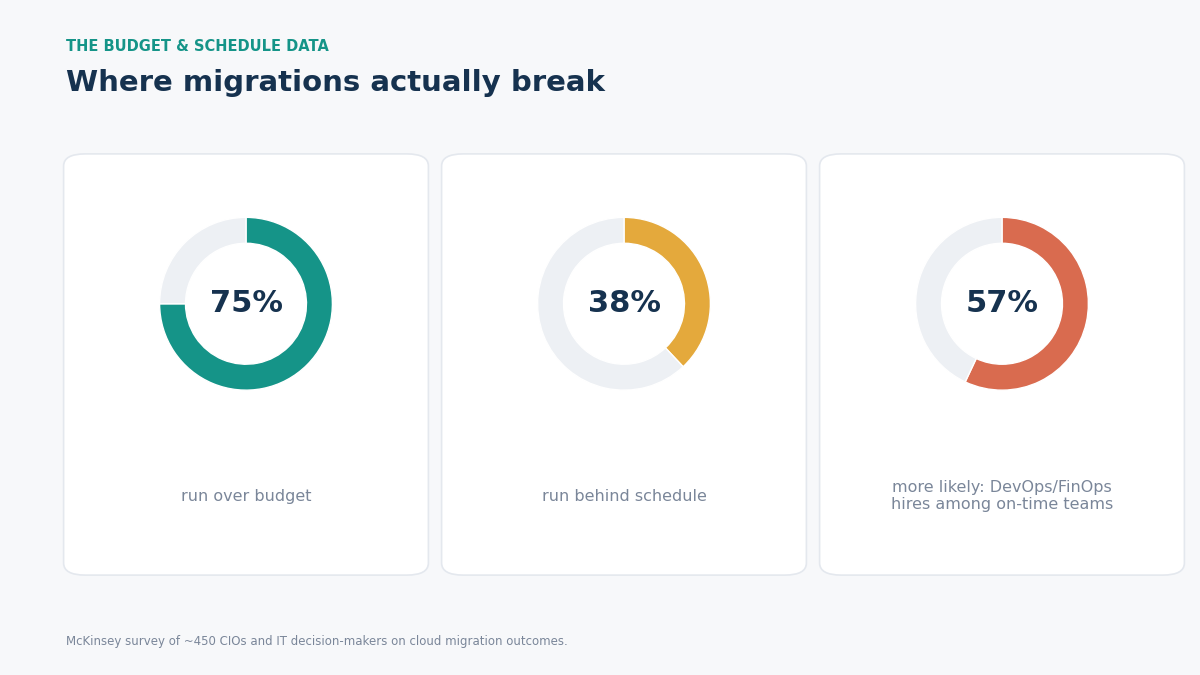
Leaders who had to hire cloud engineers for migration programs of every size and found that 75% of those migrations ran over budget and 38% ran behind schedule and the organizations that didn’t were 57% more likely to have hired staff with advanced DevOps and FinOps skills before the project started. Read that carefully: the single strongest differentiator wasn’t the cloud provider, the tooling, or the consulting partner. It was who was on the team.
Gartner’s July 2026 forecast puts worldwide IT spending at $6.37 trillion in 2026, up 14.2% year over year, with data center systems and infrastructure-as-a-service (IaaS) as the two fastest-growing segments. Every company reading this is competing for the same migration-capable engineers that the spending surge is absorbing.
Yet most companies staff migrations backwards. They hire the same profile a generalist “cloud engineer” for every phase, even though the discovery phase needs an architect who can read a 15-year-old dependency graph, the cutover phase needs an SRE who has personally survived a 2 a.m. rollback, and the optimization phase needs a FinOps-minded engineer who treats the AWS bill as a bug tracker.
This guide fixes that. It breaks the cloud migration process into its real phases, names the specific engineering skills each phase consumes, and then walks through the full lifecycle of building that team scoping, vetting, contracting, onboarding, managing, and eventually winding down. The numbers in it (timelines, cost bands, team ratios) come from real staffing engagements across fintech, healthtech, and enterprise SaaS, not from vendor brochures.
If you’re about to build a migration team, the next 20 minutes of reading will save you a quarter of misfires.
TL;DR
This guide is for CTOs, engineering leaders, and IT decision-makers planning a cloud migration and trying to figure out who to hire, when, and at what cost. It covers the full journey: migration phases, the roles each phase needs, vetting, contracts, onboarding, and offboarding.
One number frames everything here. Teams that hire cloud engineers for migration work before discovery starts, rather than after workloads stall, avoid the budget overruns that hit 75% of migration projects and a properly-run staffing cycle takes only 7-10 working days per role, not the 8-12 weeks most companies budget for.
By the end, you'll be able to size your migration team phase by phase, tell a lift and shift vs re-architecture decision apart on paper, benchmark cost bands in ₹ and $, and know exactly which contract clauses protect you when a hire doesn't work out. Understanding the cloud migration process at this level is what separates on-time projects from the other 38%.
What Does It Mean to Hire Cloud Engineers for Migration?
Hiring cloud engineers for migration means staffing time-bound specialists cloud architects, DevOps engineers, data engineers, and SREs whose specific job is moving workloads from legacy or on-premise infrastructure to cloud platforms like AWS, Azure, or GCP, across discovery, replatforming, cutover, and optimization phases. (46 words snippet-ready.)
What it is not:
- Not general cloud hiring. A migration engineer is hired against a project lifecycle with an end state; a platform engineer is hired against a product roadmap with no end state. Different vetting, different contracts.
- Not a managed-services contract. You’re hiring named engineers who join your standups and your Slack not buying a black-box outcome from a systems integrator.
- Not just “AWS-certified people.” Certifications test provider knowledge. Migrations test dependency archaeology, downtime negotiation, and rollback discipline none of which appear on a certification exam.
Why Migration Staffing Decisions Matter More Than Tooling
Migration tooling has largely commoditized every hyperscaler ship’s free assessment, replication, and cutover tools. What hasn’t commoditized is judgment. That’s why staffing is where the economic outcomes are actually decided.
The concrete outcomes this one decision affects:
- Budget adherence. McKinsey’s survey pegs projected wasted migration spend at roughly $100 billion industry-wide, driven mostly by orchestration and skills gaps, not technology failures. A single mis-scoped re-architecture wave can consume 20-30% of a migration budget.
- Timeline. In staffing engagements we’ve run, a migration blocked on a missing skill (most often a senior DevOps engineer or a database migration specialist) slips 3-6 weeks per missing role while internal recruiting catches up. A specialist staffing pipeline fills the same role in 7-10 working days.
- Run-rate cost after migration. Engineers without FinOps instincts routinely leave 25-40% of post-migration cloud spend on the table oversized instances, unattached volumes, cross-AZ data transfer nobody mapped. The hiring decision you make in month one shows up in your cloud bill in month nine.
- Risk exposure. The most expensive migration failures, data loss during replication, extended downtime during cutover, compliance gaps in regulated data are all skill failures with technical symptoms.
- Opportunity cost of your own team. Every senior engineer you pull off product work to run migration waves costs you roadmap velocity. Ring-fencing migration work with dedicated hires is often cheaper than the invisible product delay.
The 3-question test: if you can’t name (1) which migration phase you’re staffing for, (2) which of the 6 Rs each workload group will follow, and (3) who owns rollback authority at cutover you’re not ready to write the job description yet. The rest of this guide gets you there.
Migration Project Risks: Where Budgets and Timelines Actually Break
Most teams build their risk register out of technology line items. The real migration project risk register looks different: it is dominated by people and sequencing failures, with “provider outage” or “data corruption” appearing only as their downstream symptoms. The field data is unambiguous on this inversion. Below are the failure patterns that recur across real engagements, with the magnitude most teams underestimate.
The five risks that actually materialize:
- Dependency blindness (underestimated 3-4x). Teams assume they know what talks to what. Then discovery finds the payroll system calling a database via a hardcoded IP that also serves the warehouse app. Every undiscovered dependency found after wave planning costs roughly 5-10x more to handle than one found during discovery because it forces re-sequencing of waves already in flight.
- The mid-project skills cliff. Phase 1-2 skills (assessment, architecture) are different from Phase 3-4 skills (pipeline automation, cutover execution). Dedicated teams staffed once, at the start, hit a wall around week 8-12 when the work changes shape and the people don’t. Symptom: velocity halves while headcount stays flat.
- Cutover fatigue. Cutovers happen in maintenance windows nights and weekends. A team running 6+ consecutive weekend cutovers with no rotation makes its worst decisions in windows 5 and 6. Most post-mortems that read “human error during cutover” are actually rota-design errors.
- Cost model drift. The business case was built on a list-price computer. Nobody modeled egress costs, cross-region replication, or the 3-6 month period of double running paying for on-premise and cloud simultaneously. Double-run costs alone typically add 15-25% to year-one spend, and they’re the single most common source of the “75% over budget” statistic.
- The rollback that was never rehearsed. Every plan has a rollback section. In practice, fewer than one in five teams we’ve staffed against had ever executed a rollback drill before the first production cutover. An unrehearsed rollback is a hope, not a plan.
Red flag: if your migration plan’s staffing section says “existing team + 2 cloud engineers,” with no phase breakdown, you are looking at pattern #2 before it happens.
The common thread: every one of these is prevented or contained by having the right specialist in the room at the right phase. Which is exactly what the next two sections map out.
The Cloud Migration Process: Phases and the Skills Each One Needs
The core mental model of this guide is a sequencing one. Treat the cloud migration process as a series of distinct skill profiles, not one long project with one team and the staffing plan almost writes itself. Here is the lifecycle, phase by phase, with the engineering skills each phase actually consumes.
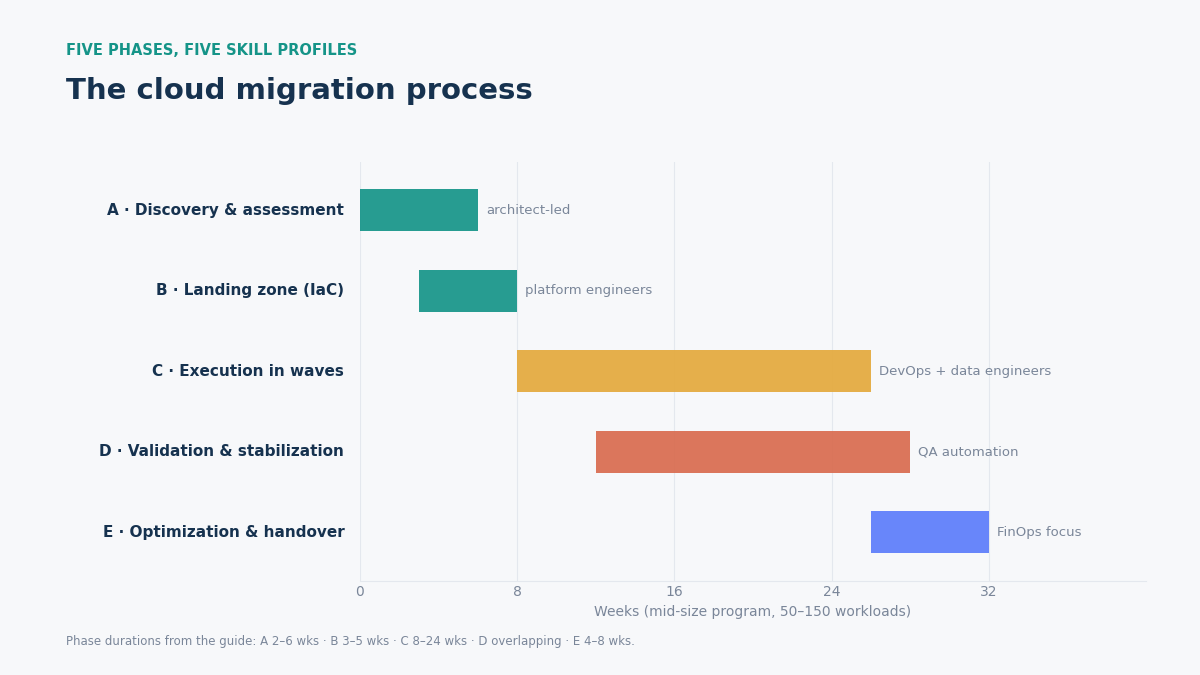
Phase A Discovery & Assessment (2-6 weeks)
The job: inventory every application, map dependencies, classify workloads by criticality and data sensitivity, and assign each to one of the 6 Rs rehost, replatform, refactor, repurchase, retire, retain.
Skills this phase consumes:
- Application portfolio analysis reading legacy architectures, often undocumented, and producing a dependency map that survives contact with reality.
- Discovery tooling fluency AWS Application Discovery Service, Azure Migrate, or agentless scanners, plus the judgment to distrust their output where agents can’t reach.
- TCO modeling building the cost case including egress, licensing changes, and double-run periods.
- Stakeholder archaeology interviewing the one person who remembers why the 2011 batch job exists.
Who does this: a senior cloud architect (8+ years, has led 3+ migrations) plus a business analyst or engineering manager from your side. Headcount: 2-3. Hiring a big execution team during discovery is the classic way to burn a budget on idle engineers.
Phase B Landing Zone & Foundation (3-5 weeks, can overlap Phase A)
The job: build the destination before anything moves account/subscription structure, networking, identity and access management, security baselines, logging, and guardrails. Done right, this is entirely infrastructure as code.
- Terraform or CloudFormation/Bicep modules for the account structure, VPC/VNet design, and IAM policy sets.
- Security and compliance baselines mapped to your regulatory context (SOC 2, HIPAA, PCI-DSS, RBI guidelines for Indian fintech).
- Centralized logging, monitoring, and cost-allocation tagging standards tags defined now are what make FinOps possible later.
- A well-architected review against the target provider’s framework before the first workload lands.
Who does this: 1-2 platform/cloud engineers with deep IaC experience and, in regulated industries, fractional access to a cloud security engineer. This is the phase where certification depth genuinely matters.
Phase C Migration Execution in Waves (8-24 weeks, scale-dependent)
The job: move workloads in planned waves typically starting with low-risk, low-dependency applications and ending with the crown jewels. Each wave is a mini-project: replicate, test, cut over, validate, decommission source.
Skills this phase consumes:
- Pipeline and automation engineering CI/CD rework, container builds where replatforming to Kubernetes, automated environment provisioning. This is where you hire DevOps engineers, and where under-hiring hurts most: a single strong automation engineer replaces roughly 2-3 engineers doing manual migration steps.
- Data migration specialism replication tooling (DMS, native log shipping), schema conversion, and the discipline to verify row counts and checksums instead of trusting dashboards.
- Cutover execution runbook authorship, downtime-window negotiation with the business, rollback rehearsal, and calm at 2 a.m.
- Application remediation fixing the hardcoded IPs, connection strings, and file-path assumptions that every legacy app hides.
Who does this: the largest team of the project. Typical composition for a mid-size enterprise migration (50-150 workloads): 1 architect (continuing), 2-4 DevOps/cloud engineers, 1-2 data engineers, 1 QA engineer, 0.5-1 project/delivery manager. Headcount: 5-9.
Phase D Validation & Stabilization (2-4 weeks per major wave, overlapping)
The job: prove each migrated workload meets its performance, cost, and reliability targets before the old environment is switched off and hold the line against “we’ll fix it post-migration” debt.
- Performance baselining: compare pre/post latency and throughput against the numbers captured in discovery (if nobody captured them, that’s a Phase A failure surfacing here).
- Failover and disaster recovery testing in the new environment DR configs are the most commonly forgotten migration artifact.
- Regression and integration testing at wave boundaries; this is where teams hire QA engineers with automation backgrounds rather than relying on developer spot checks.
- Decommissioning discipline: source environments actually turned off on schedule, because every week of unnecessary double running is pure budget leak.
Phase E Optimization & Handover (4-8 weeks, then ongoing)
The job: turn a completed migration into a good one. Right-size instances against observed utilization, buy commitments (reserved instances / savings plans) once usage stabilizes, tune storage tiers, and hand the environment to the permanent platform team with documentation that isn’t archaeology.
Skills: FinOps and cloud cost optimization, observability tuning, and knowledge-transfer discipline. This phase is where the McKinsey “outperformer” pattern teams 57% more likely to have advanced DevOps engineers/FinOps skills pays out in hard currency: 25-40% run-rate reductions against the unoptimized post-cutover bill are the normal range, not the exceptional one.
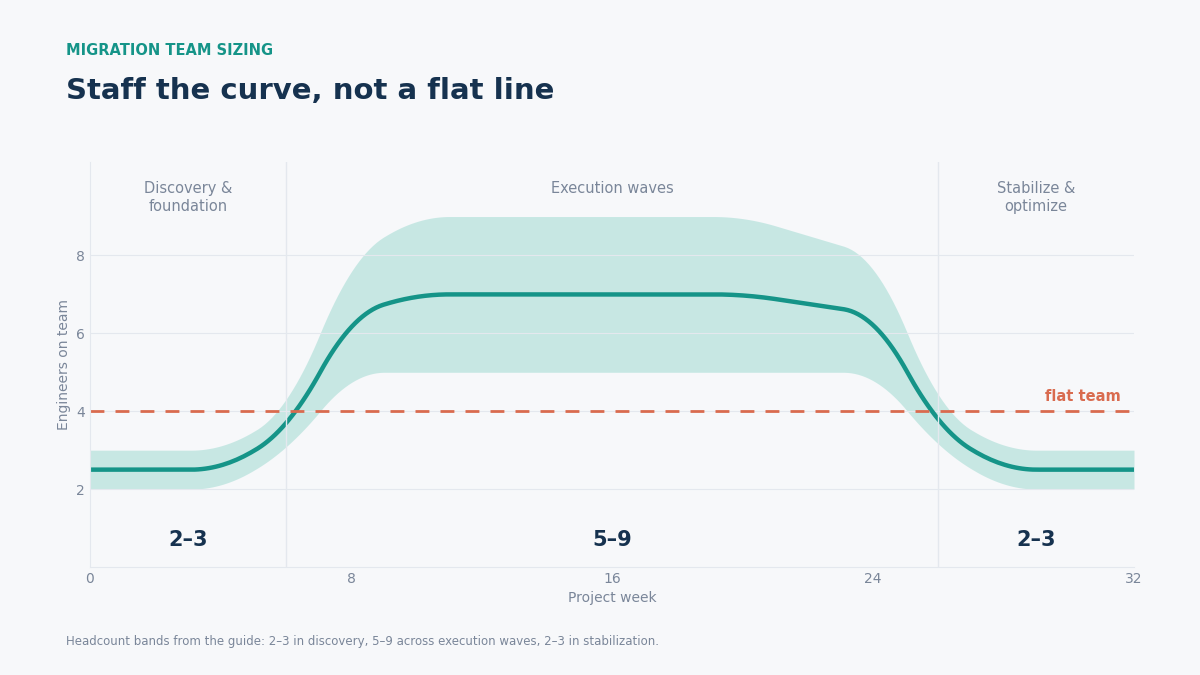
The one-line takeaway: Phases A/B are architect-heavy, Phase C is automation-heavy, Phases D/E are QA- and FinOps-heavy. Staff the curve, not a flat line.
Migration Team Roles: The Org Chart That Actually Works
Job boards flatten everything into one title “Cloud Engineer.” Real migration team roles are far more differentiated, which is precisely how the flattening leads companies to interview Kubernetes specialists for what is actually a database replication problem. Here is the role taxonomy, what each one owns, and when in the lifecycle you need them.
| Role | Owns | Needed in phases | Typical count | Seniority floor |
| Cloud/Migration Architect | Target architecture, 6R decisions, wave sequencing | A-E (full arc) | 1 | 8+ yrs, 3+ migrations led |
| Platform Engineer (IaC) | Landing zone, networking, IAM, guardrails | B, C | 1-2 | 5+ yrs, Terraform/Bicep in prod |
| DevOps Engineer | CI/CD rework, automation, container platforms | C, D | 2-4 | 4+ yrs |
| Data/Database Engineer | Replication, schema conversion, data validation | C, D | 1-2 | 5+ yrs on your specific DB engines |
| Cloud Security Engineer | Compliance baselines, IAM review, audit evidence | B, D | 0.5-1 (fractional OK) | 5+ yrs in your regulatory context |
| QA/Test Automation Engineer | Wave-boundary regression, performance baselines | C, D | 1-2 | 3+ yrs automation |
| SRE (cutover lead) | Runbooks, rollback drills, cutover command | C, D | 1 (can be a senior DevOps hire) | Has run production cutovers |
| FinOps-minded Engineer | Tagging, right-sizing, commitment purchases | B (tags), E | 0.5-1 | Comfortable in billing consoles |
| Delivery/Project Manager | Wave plan, stakeholder comms, downtime negotiation | A-E | 0.5-1 | Has shipped infra projects |
Three structural notes that save real money:
- Fractional beats full-time for security and FinOps. These roles have intense but bursty involvement. Paying full-time rates for them across a 6-month migration is the most common quiet overspend.
- The architect must not also be the delivery manager. When one person owns both the technical decisions and the timeline, timeline pressure silently corrupts technical decisions. Every seriously delayed project we’ve been brought into had this dual-hat pattern.
- Ratio rule of thumb: for every 25-40 workloads in a wave-based migration, plan one dedicated execution engineer (DevOps/data). Below that ratio, waves stretch; above it, engineers idle between waves.
The Hiring Walkthrough: From Requirements to Offboarding
This is the full lifecycle of building the team above written so that someone who has never staffed a migration can execute it end to end. Budget 3-5 weeks from “we need people” to “first hires productive” if you follow it; budget 10-14 weeks if you improvise.
Phase 1 Defining Requirements (week 1)
Do not start with job descriptions. Start with the wave plan draft from your discovery work (even a rough one), because the wave plan tells you when each skill is needed which determines contract lengths and start dates, which determines cost.
The requirements checklist, in order:
- Map roles to phases using the table above. Output: a staffing curve e.g., “2 people in weeks 1-6, 7 people in weeks 7-24, 3 people in weeks 25-32.”
- Fix the tech-stack non-negotiables. Target provider (AWS/Azure/GCP), IaC tool, database engines, container platform. “Multi-cloud experience preferred” in a JD is noise; “has migrated SQL Server to Azure SQL Managed Instance” is signal.
- Set budget bands per role before talking to anyone. For India-based talent, current market bands run roughly ₹18-35 LPA for mid-level DevOps/cloud engineers, ₹35-60 LPA for senior engineers and data specialists, and ₹60 LPA-1 Cr+ for migration architects; on contract, ₹1.2-2.5 lakh/month mid-level and ₹2.5-5 lakh/month senior. US-market equivalents: $110k-160k, $150k-210k, and $190k-260k+ respectively, or $70-140/hour on contract. (These are labeled ranges, not quotes your regulated-industry premium or niche stack can push +15-25%.)
- Decide the timezone overlap requirement. Cutovers need real-time coordination; 3-4 hours of daily overlap with the team that owns the source systems is the workable floor.
- Write the JD from the phase, not the title. “DevOps engineer to automate wave-based workload migration to AWS, including CI/CD rebuild and rollback tooling, 6-month engagement with extension option” will out-filter a generic JD by an order of magnitude.
The one-page rule: if your requirements can’t fit on one page roles, phases, stacks, bands, dates you haven’t finished deciding, and every vendor conversation you have will be a negotiation against your own ambiguity.
Phase 2 Sourcing & Vetting (week 1-2)
You have three sourcing channels: internal recruiting (8-12 weeks to productive hire for these profiles, realistically), freelance marketplaces (fast but unvetted for migration-specific judgment), and specialist staffing partners.
The market context matters here: with India’s public cloud spend forecast to grow 28.1% to $17.5 billion in 2026 and IaaS growing 40% migration-capable engineers are being absorbed faster than generalist pipelines can surface them. Speed of vetted access, not access itself, is what you’re actually buying.
AI-driven sourcing platforms that pre-vet against the top 2% of a talent pool can compress the JD-to-interview-ready-shortlist cycle to 7-10 working days; this is the model Supersourcing runs, and the mechanism is pre-vetting depth, not recruiter heroics. When you hire cloud engineers through a pre-vetted pipeline, the interviews you run are confirmation, not filtration.
What good migration-specific vetting looks like use this whether you outsource sourcing or not:
- Scenario, not trivia. “Walk me through a cutover that went wrong and what you did in the window” beats any number of “explain VPC peering” questions. Listen for rollback specifics and downtime-communication behavior.
- A dependency-mapping exercise. Give a small fictional app inventory with two hidden dependencies. Strong candidates ask about batch jobs, DNS, and service accounts unprompted. Weak ones start drawing target architecture immediately.
- IaC code review, not whiteboard architecture. Have them review 50 lines of flawed Terraform. Real reviewers find the state-management and secrets problems in minutes.
- One reference call focused on a specific migration. Ask the reference what wave the candidate personally ran and what broke. Vague answers mean adjacent involvement, not ownership.
Red flags that predict mid-project pain:
- Every past project is described with “we” and none with “I owned.”
- Certification-heavy CV with no decommissioning stories people who’ve finished migrations talk about turning things off.
- Can’t name a migration decision they’d reverse in hindsight.
- Available immediately with no notice period and no explainable gap in a market this tight, investigate.
Phase 3 Engagement Models & Contracts (week 2)
Three models cover almost every migration staffing scenario:
| Model | Best for | Cost profile | Control | Exit friction |
| Dedicated engineers (contract, via staffing partner) | The execution bulge (Phase C) defined duration, full integration into your team | Monthly rate per engineer; India contract bands above | High your standups, your tools | Low, if replacement clause exists |
| Staff augmentation into an existing squad | Filling 1-2 skill gaps (e.g., a data migration specialist) | Same bands, shorter minimums | High | Low |
| Project-based / outcome contract | Well-bounded chunks (e.g., “migrate these 30 workloads”) | Fixed or milestone-priced; 20-35% premium for risk transfer | Lower you manage outcomes, not people | Contractual, higher |
For most enterprise migrations the answer is a blend: dedicated engineers for the long execution arc via IT staffing services, augmentation for the specialist gaps, and project-based only for genuinely severable chunks like a standalone data-warehouse move.
Contract clauses that matter more in migrations than in normal staffing:
- Replacement guarantee with a defined clock. If a hire isn’t a fit, a 7-10 day replacement window (which credible partners contractually offer) is the difference between a hiccup and a slipped wave.
- NDA and IP assignment covering infrastructure code. Your Terraform modules and runbooks are IP. Contracts should assign them explicitly “work product” language written for application code that sometimes misses infra artifacts.
- No shared bandwidth. Written commitment that engineers are dedicated, not split across clients. Migration cutovers cannot share an engineer’s weekend with another client’s incident.
- Extension and ramp-down options. Migrations end in a taper, not a cliff. Contract for the right to step from 7 engineers to 3 with 2-3 weeks’ notice instead of paying full-team rates through Phase E.
- Access-revocation and offboarding terms. Named-account access, key rotation on exit, and evidence of revocation auditors will ask.
Phase 4 Onboarding & Ramp-Up (weeks 2-4)
Migration hires are throughput hires; every idle day is a paid day. The difference between a 3-day ramp and a 3-week ramp is entirely in your preparation:
- Day 0 (before start): accounts, VPN, repo access, and cloud-console roles provisioned; discovery documents and the current wave plan shared under NDA. The single most common onboarding failure is a senior contractor spending week one waiting for IAM approvals.
- Day 1-2: architecture walkthrough by your architect; access verified hands-on (have them run one read-only task in the real environment, not a sandbox tour).
- Day 3-5: first real contribution, deliberately small one runbook review, one Terraform module fix, one replication test. Small, real, shipped.
- Week 2: owning a wave task end to end with review. If a senior migration hire isn’t independently productive by day 10, escalate to your staffing partner now this is exactly what the replacement clause is for, and waiting until week 6 wastes the clause.
Communication cadence to set on day one: a daily 15-minute wave standup, a weekly stakeholder summary (migrated count, blocked count, next window), and a named escalation path for cutover nights. Ambiguity about who calls the rollback is not a process gap, it’s a future outage.
Phase 5 Managing Delivery (ongoing)
Manage a migration team on leading indicators, not migrated-workload counts (which lag by weeks and hide trouble):
- Wave velocity trend workloads validated per wave, plotted across waves. Flat or falling velocity with stable headcount is the earliest signal of the skills-cliff problem from the risks section.
- Rollback drill currency date of last rehearsed rollback per critical workload class. Older than 30 days before its cutover = red.
- Double-run burn count of source systems still running past their planned decommission date, priced per week. Make this number visible to the business; it converts “we’ll decommission later” into an invoice.
- Defect escape rate at wave boundaries issues found in production post-cutover vs. found in validation. Rising escape rate means Phase D is being squeezed, usually by timeline pressure.
- Cost-per-workload actuals vs. model updated per wave, so the business case is corrected in month 2, not discovered dead in month 8.
On the vendor side, insist on a dedicated account manager with authority to swap or add engineers, not a ticket queue. Review the engagement monthly against the staffing curve you built in Phase 1: the plan said headcount would change; make it actually change.
Phase 6 Scaling, Tapering, or Exiting (final weeks)
The end of a migration is a staffing event most teams never plan:
- Scale down on the curve, not the cliff. Step from the Phase C bulge to a 2-3 person stabilization crew as validation completes, using the ramp-down clause you negotiated.
- Convert selectively. Typically 1-2 contract engineers have become load-bearing. Contract-to-hire conversion terms should already be in the agreement; negotiate them in week 1, not week 30, when you have no leverage.
- Enforce knowledge transfer as a deliverable. Runbooks, IaC repositories with README depth, an architecture decision record, and a recorded handover walkthrough contractually due before final invoices, because documentation written after people leave is fiction.
- Offboard with evidence. Access revoked, keys rotated, NDA survival terms confirmed in writing. Keep the file; your next SOC 2 audit will want it.
- Retain a call-back option. A 3-6 month window to re-engage specific named engineers at agreed rates covers the inevitable post-migration surprise cheaply.
Lift and Shift vs Re-Architecture: The Decision That Sizes Your Team
One decision sizes your team more than any other. The lift and shift vs re-architecture call matters because the two approaches consume almost entirely different skill profiles, budgets, and calendars. Most real programs mix both across the portfolio; the framework below is applied per workload group, not once for the whole company.
Ashika Gupta [11:33 AM]
| Dimension | Lift & Shift (Rehost) | Replatform (middle path) | Re-Architecture (Refactor) |
| What moves | VM as-is to cloud VM | Same app, managed services swapped in (e.g., self-hosted DB → managed DB) | App rebuilt cloud-native (containers, serverless, managed everything) |
| Timeline per workload | Days-weeks | Weeks | Months-quarters |
| Team profile | Infra-heavy: platform engineers, replication specialists | Balanced infra + app | Dev-heavy: application engineers + architects, plus infra |
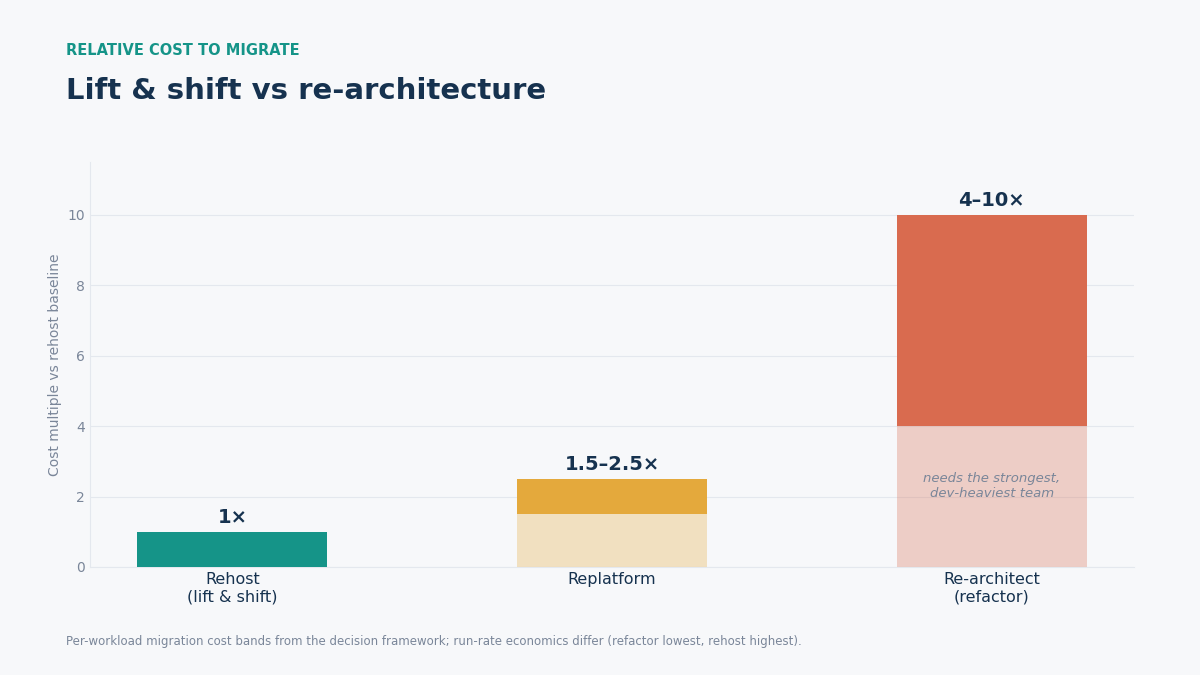
| Relative cost to migrate | 1x baseline | 1.5-2.5x | 4-10x |
| Post-migration run cost | Highest (cloud tax on legacy shape) | Moderate | Lowest, if executed well |
| Risk profile | Low per-move risk; risk deferred to run-rate | Moderate | High project risk; needs strongest team |
| When it wins | Data center exit deadlines, stable legacy apps, retiring-soon systems | Databases and middleware with clear managed equivalents | High-change, high-scale, differentiating applications |
The 20/60/20 pattern: in most enterprise portfolios we’ve staffed against, roughly 20% of workloads justify re-architecture, ~60% land on rehost/replatform, and ~20% should be retired or repurchased instead of migrated at all. Teams that skip the “retire” analysis routinely pay to migrate applications nobody logs into.
Decision test per workload group answer these four in order:
- Is it differentiating? If the app is not a competitive differentiator, do not refactor it. Buy it (repurchase) or rehost it.
- Is there a deadline? Hard exit dates (lease expiry, license cliff) push toward rehost now, optimize later a legitimate strategy when priced honestly, including the higher interim run cost.
- Does it change often? High-change applications compound re-architecture benefits; frozen ones never repay the refactor.
- Can you staff it? Re-architecture without senior cloud-native engineers on the team isn’t a strategy; it’s a stalled rehost with extra steps. If the skills aren’t securable within your window, the honest answer is replatform.
Staffing implication in one line: every workload you move from the rehost column to the refactor column adds application-engineering headcount and months re-run your staffing curve every time the 6R classification shifts.
Case Studies: What Migration-Adjacent Staffing Looks Like at Scale
Three patterns from Supersourcing’s delivery history, chosen because each maps to a stage of the playbook above. Metric first, story second.
Paytm 100+ engineers, compressed hiring cycles. When Paytm needed to scale engineering capacity by more than 100 engineers, the constraint wasn’t candidate volume, it was vetted-candidate velocity. Pre-vetted pipelines and dedicated account management compressed the JD-to-joining cycle to a fraction of internal-recruiting norms, with the 98% joining rate holding at scale. The migration-relevant lesson: at 5+ parallel roles, the bottleneck is always vetting throughput, not sourcing.
OkCredit specialist engineering hires under growth pressure. OkCredit’s fintech stack required engineers vetted for both stack depth and regulated-data context the same dual filter a BFSI cloud migration demands. Structured technical vetting ahead of client interviews meant OkCredit teams interviewed shortlists, not pipelines, cutting engineering-leadership hours spent per hire by a large multiple.
Anonymized enterprise SaaS mid-migration skills cliff, resolved in 9 working days. A SaaS client mid-way through an Azure migration hit the classic Phase C wall: architecture staff in place, automation capacity missing, wave velocity down ~50%. Two senior DevOps engineers and one data migration specialist were shortlisted, interviewed, and onboarded within 9 working days under a dedicated-engineer contract with a replacement guarantee. Wave velocity recovered within the following two waves the pattern this entire guide is built to help you avoid needing.
What Most Teams Get Wrong
The quotable version, grounded in recurring engagement patterns rather than caution-for-caution’s-sake:
They staff for the average, not the curve. Migration workload is a bulge, not a line. Hiring a flat team means paying for idle architects in month five and starving for automation engineers in month three. The staffing curve is 2-3 people, then 5-9, then 2-3 is the plan; a fixed headcount is the anti-plan.
They vet for the destination, not the journey. Interviews test cloud-provider knowledge of the destination. Migrations are won by journey skills: dependency archaeology, cutover discipline, rollback rehearsal, decommissioning follow-through. A candidate who can’t tell you what they’ve turned off has never finished a migration.
They treat the double-run period as a rounding error. Paying for both environments for 3-6 months adds 15-25% to year-one cost, and it’s the most predictable “surprise” in the industry. Budget it explicitly, assign an engineer-owner to decommissioning dates, and publish the weekly burn.
They confuse a systems integrator engagement with a team. An SI sells outcomes through people you don’t manage; staffing gives you named engineers inside your own delivery process. Both are legitimate but teams that think they bought the second while contracting the first discover it at the worst possible moment: mid-cutover, when the person they need is on another client’s escalation.
They let the migration team leave with the knowledge. If runbooks, IaC repos, and decision records aren’t contractual deliverables due before final payment, the migration’s knowledge walks out the door with the last contractor and the first post-migration incident becomes an expensive re-discovery project.
They optimize hiring cost instead of hiring latency. Saving ₹3-4 lakh a year on a cheaper engineer while a wave slips six weeks is a trade every delayed program has made. At typical enterprise migration burn rates, a week of program delay costs more than the annual salary delta between a mediocre hire and a strong one.
Cost & Timeline Reality Check
The section with the most competing content skips. All figures are labeled market ranges from staffing engagements and public salary data treat them as planning bands, not quotes.
Talent cost bands (2026 market):
| Role | India full-time (LPA) | India contract (₹/month) | US-market full-time | Contract hourly (offshore/onshore) |
| Mid DevOps/Cloud Engineer | ₹18-35 | ₹1.2-2.5 lakh | $110k-160k | $25-45 / $70-100 |
| Senior DevOps / Data Migration Engineer | ₹35-60 | ₹2.5-5 lakh | $150k-210k | $40-65 / $95-140 |
| Migration Architect | ₹60 LPA-1 Cr+ | ₹5-9 lakh | $190k-260k+ | $60-90 / $120-180 |
| QA Automation Engineer | ₹12-28 | ₹1-2 lakh | $95k-140k | $20-35 / $60-90 |
| Cloud Security Engineer (fractional) | ₹1.5-3 lakh (part-time) | $50-80 / $110-160 |
What moves costs up: regulated-industry context (+15-25%), niche stacks (mainframe-to-cloud, SAP), compressed timelines requiring parallel waves, and onshore/timezone constraints.
What moves costs down: offshore or hybrid teams (typical cost arbitrage of 40-60% vs. US onshore at equivalent vetting standards), longer contract commitments, and fractional use of security/FinOps specialists.
Timeline bands by scenario:
- Small (10-30 workloads, mostly rehost): 3-5 months end to end; team of 3-5; staffing lead time 2-3 weeks via specialist pipelines.
- Mid-size (50-150 workloads, mixed 6Rs): 6-12 months; team peaking at 6-9; expect 2-3 distinct staffing events as the phase mix shifts.
- Enterprise (300+ workloads, regulated): 12-24+ months, run as a program of parallel wave streams; 12-20+ engineers at peak; staffing becomes a continuous function with monthly curve reviews.
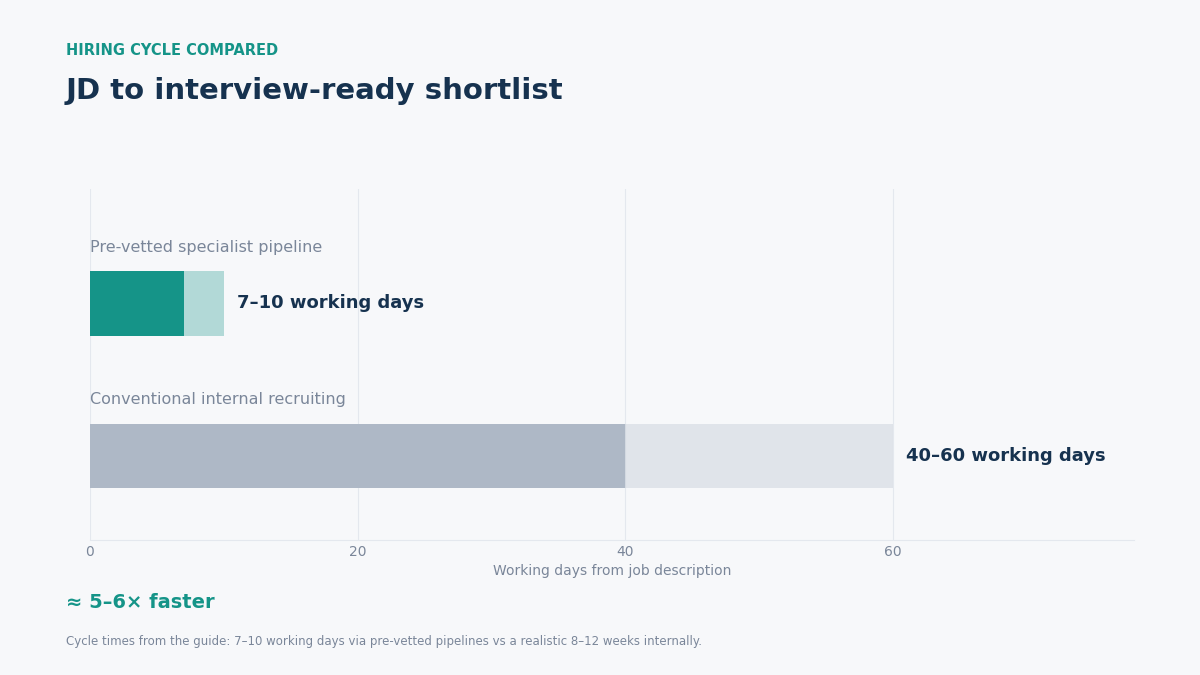
- Hiring cycle itself: when you hire cloud engineers for migration roles through pre-vetted pipelines, expect 7-10 working days from JD to interview-ready shortlist, vs. a realistic 8-12 weeks through conventional internal recruiting for the same seniority.
Total program math (mid-size example): a 9-month, 100-workload migration with a peak team of 8 blended offshore/hybrid engineers typically lands in the ₹2.5-5 crore / $300k-600k range for talent, before cloud consumption and double-run costs. The same program staffed fully onshore in the US commonly runs 2-2.5x that. These are the numbers to pressure-test your business case against before Phase A, not after.
Next Step: Pressure-Test Your Staffing Curve
If you’re mid-decision, don’t start with a vendor pitch, start with your own wave plan. Sketch the staffing curve from the Walkthrough (Phase 1), price it against the cost bands above, and identify the two or three roles where your internal pipeline can’t hit your dates.
Then get a second set of eyes on it. Supersourcing’s delivery team will review a migration staffing plan against 527+ delivered IT projects’ worth of pattern data and tell you specifically where the plan is thin, what the realistic cost band is, and whether the 7-10 day shortlist cycle covers your gaps: book a consultation.
One conversation before Phase A costs an hour. The same conversation in week 12, mid-skills-cliff, costs a slipped wave.
FAQ
What does a cloud migration engineer do?
A cloud migration engineer moves workloads from legacy or on-premise infrastructure to cloud platforms: mapping dependencies, building target environments in infrastructure as code, automating replication and cutover, validating performance, and decommissioning source systems. The role shifts phase by phase assessment early, automation in the middle, optimization at the end which is why one job title hides several distinct skill profiles.
How many engineers do I need for a cloud migration?
Plan roughly one dedicated execution engineer per 25-40 workloads per wave, plus one architect and fractional security, QA, and FinOps coverage. A 100-workload mid-size migration typically peaks at 6-9 people. The honest answer is a curve: 2-3 people during discovery, the full team during execution waves, and 2-3 during stabilization.
How long does a cloud migration take?
Small rehost-heavy migrations (10-30 workloads) run 3-5 months; mid-size mixed programs run 6-12 months; regulated enterprise programs run 12-24+ months. The biggest schedule variables are the share of workloads being re-architected rather than rehosted, and how quickly specialist skills gaps get filled when the work changes shape mid-project.
What is the difference between lift and shift and re-architecture?
Lift and shift (rehost) moves an application to cloud infrastructure largely unchanged fast and low-risk per move, but it carries legacy inefficiency into your cloud bill. Re-architecture rebuilds the application cloud-native 4-10x the migration cost and a dev-heavy team, repaid through lower run costs and agility, but only for applications that change often and differentiate the business.
Should migration engineers be contractors or full-time hires?
Mostly contractors, structurally: a migration is a bulge of work with an end date, and dedicated contract engineers with replacement guarantees match that shape. Hire or convert full-time only for the 1-2 roles that persist after cutover, typically a platform engineer and a FinOps-minded operator. Negotiate contract-to-hire terms at signing, when you still have leverage.
How much does it cost to hire cloud engineers in India?
Current bands run ₹18-35 LPA for mid-level cloud/DevOps engineers, ₹35-60 LPA for senior migration specialists, and ₹60 LPA-1 crore+ for architects; contract equivalents run ₹1.2-5 lakh/month depending on seniority. Regulated-industry experience and niche stacks add 15-25%. Offshore or hybrid teams typically deliver 40-60% cost arbitrage against US onshore rates at equivalent vetting standards.
What are the biggest risks in a cloud migration project?
The recurring five: undiscovered dependencies (typically underestimated 3-4x), the mid-project skills cliff when work shifts from architecture to automation, cutover fatigue from unrotated maintenance-window work, unbudgeted double-run costs (15-25% of year-one spend), and rollback plans that were written but never rehearsed. All five are staffing and process risks wearing technical costumes.
How do I get a migration team in place quickly without compromising vetting?
Use a pipeline that pre-vets before you engage rather than screening after the fastest safe way to hire cloud engineers for migration deadlines. Specialist staffing partners running AI-assisted vetting against a deep bench can deliver an interview-ready shortlist in 7-10 working days with joining rates near 98% and contract terms like dedicated bandwidth and 7-10 day replacement guarantees carry the vetting standard through the whole engagement. If your migration has a fixed window, this is usually the deciding factor; a short scoping conversation against your wave plan will tell you what the staffing curve should look like.
