

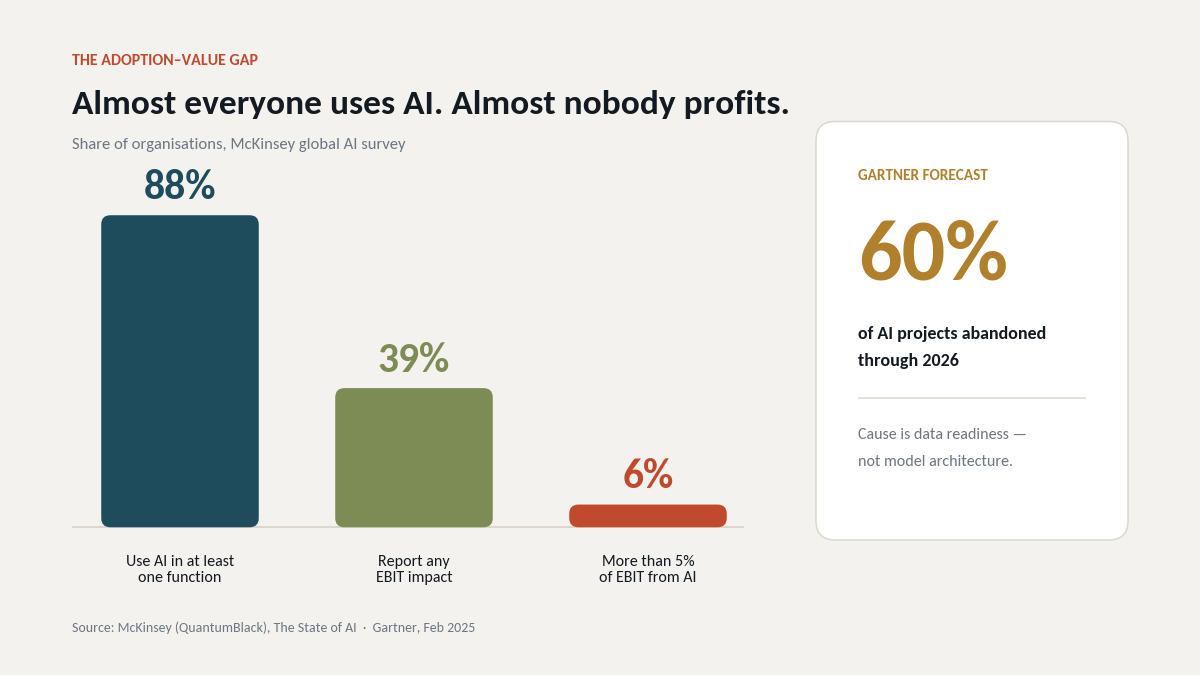
Gartner’s forecast is the number worth starting with, because it reframes the whole hiring question:
Through 2026, organisations will abandon 60% of AI projects because they aren’t supported by AI-ready data.
Read that carefully. The projected cause of failure is not model architecture. It is not a GPU budget. It is the state of the data and the discipline of the people handling it. Which means the decision that most determines whether your ML project ships is made months before any model is trained at the point where you decide who to bring in and what you screen them for.
Most teams get this backwards. They write a job description that reads like a Coursera syllabus Python, TensorFlow, deep learning, NLP interview against it, hire a strong modeller, and then spend the next four months watching that person negotiate with a data warehouse nobody has documented. Six months in, there’s a notebook with 0.91 AUC and nothing in production.
The gap is not talent supply. India’s AI talent pool is growing fast: Deloitte and Nasscom project demand rising from 600,000–650,000 professionals to over 1.25 million by 2027. There are plenty of people who can build a model. The scarcity is in people who can decide whether a model is the right answer at all, get to a defensible baseline in two weeks, and hand something to engineering that survives contact with real traffic.
This guide is the vetting playbook for that. It covers what the role actually is, where it ends and machine learning engineering begins, the exact skills checklist to screen against, the interview loop that catches the failure modes, real cost bands, contract terms specific to model IP, and what “on track” looks like at day 14, day 30 and day 90.
TL;DR
This is a complete, practitioner-level guide to how you hire data scientists for ML projects from deciding whether you need one at all, through screening and contracts, to onboarding and measuring delivery. It's written for founders, CTOs, product leaders and hiring managers who are technical or semi-technical, and who have an ML initiative approved but no proven playbook for staffing it.
Here's the number that should change how you screen. McKinsey's latest global survey finds 88% of organisations now use AI in at least one function, but only about 6% see more than 5% of EBIT attributable to it. The bottleneck almost never turns out to be modelling ability. Its problem framing, data readiness and the handoff to production are three things that a standard data scientist skills for ML checklist doesn't test for at all.
By the end you'll have a defensible role definition, a scorecard you can run even without in-house ML expertise, salary and contract bands in ₹ and $, a set of contract clauses covering training data and model artefacts, and a 14-day onboarding sequence with checkpoints. You'll know within two weeks of a hire starting whether the engagement is working instead of finding out in month five.
What Is a Data Scientist on an ML Project?
A data scientist on an ML project is the person who converts an ambiguous business problem into a measurable prediction task, establishes whether the available data can support it, builds and validates the model, and proves the result holds outside the training set. They own the question, the evidence and the model, not the serving infrastructure.
That definition matters because three adjacent roles get conflated with it:
- Not an ML engineer. An ML engineer owns deployment, serving, latency, retraining pipelines and inference cost. The data scientist decides what to predict; the ML engineer makes it run at scale, reliably, under a latency budget.
- Not a data engineer. A data engineer owns ingestion, warehousing, schema, orchestration and data quality contracts. A data scientist consumes that layer. If the layer doesn’t exist, a data scientist will build a fragile version of it and lose two months doing it.
- Not a BI or analytics professional. Analysts explain what happened. Data scientists estimate what will happen, and attach a confidence interval to it. Both are valuable; they fail differently and interview differently.
There is a fourth clarification worth making. A data scientist is also not an AI product manager. Deciding which use case is worth the investment, sequencing it against the roadmap, and holding the business case is a distinct job and on projects under about eight people, it usually lands on the founder or product lead, not on the person building the model.
Why the Right Data Science Hire Decides Whether the Project Ships
The business case for getting this hire right is not abstract. It shows up in four measurable places:
- Time for the first defensible answer. A strong hire will tell you within 10–15 working days whether your data can support the prediction you want. A weak one will spend a quarter building toward an answer that was never available in the data because they were never trained to check first.
- Sunk cost avoided. A mid-to-senior ML data scientist in India costs roughly ₹18–45 lakh/year fully loaded, or ₹2.5–5 lakh/month on a contract basis. A six-month dead-end therefore burns ₹15–27 lakh in salary alone, before counting cloud spend, engineering time and the opportunity cost of the roadmap slot.
- Rework in engineering. Notebooks handed over without tests, pinned dependencies or a documented feature definition typically cost an engineering team 3–6 weeks to reimplement. That rework is invisible in the data science budget and lands entirely on the platform team.
- Model risk exposure. In lending, insurance, hiring and healthcare, a model that can’t be explained is a model that can’t be defended to a regulator. Under India’s DPDP Act 2023 and GDPR, training-data provenance and purpose limitation are audit questions, not engineering preferences.
The compounding effect is what most cost models miss. McKinsey’s survey data shows the gap between adopting AI and getting bottom-line value is enormous. 88% of organisations use AI somewhere, but only around 39% report any enterprise-level EBIT impact. The organisations that close that gap aren’t the ones with better models. They’re the ones whose first hire insisted on defining the success metric in business terms before opening a notebook.
The single question that predicts hire quality: ask a candidate what business metric their last model moved, and by how much. Strong candidates answer in one sentence with a number and a caveat. Weak candidates answer with a model architecture.
The Core Problem: Everyone Hires for Modelling, Almost Nobody Hires for Everything Around It
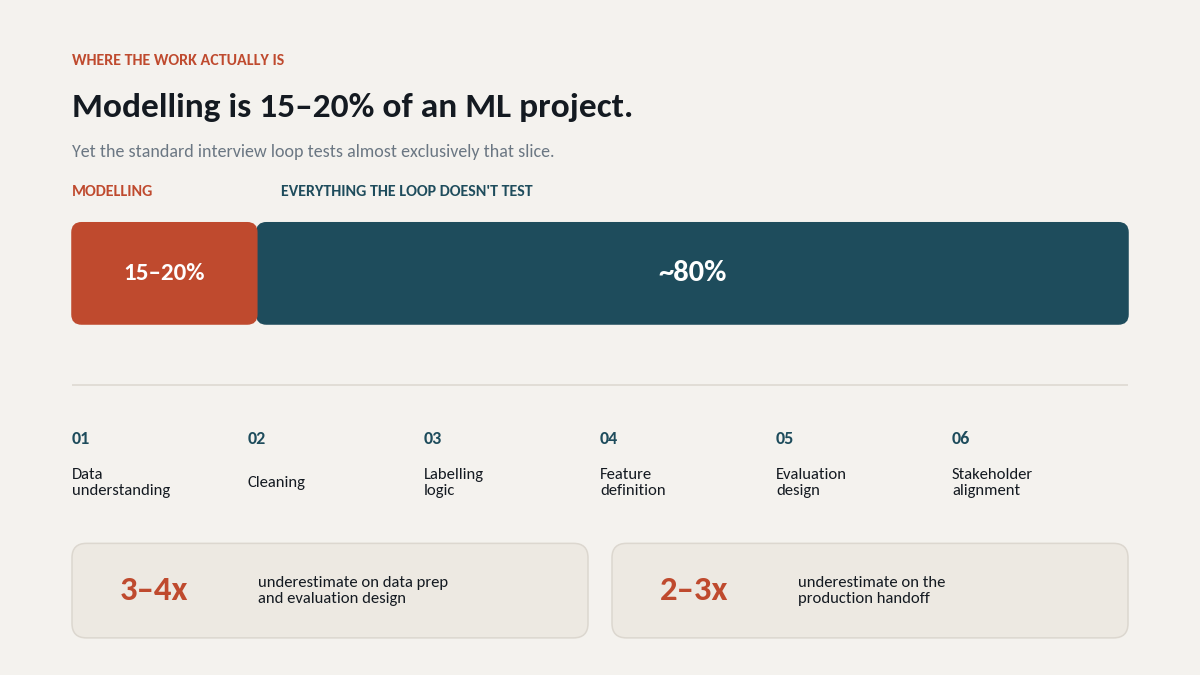
Modelling is roughly 15–20% of the work on a typical applied ML project. Data understanding, cleaning, labelling logic, feature definition, evaluation design and stakeholder alignment are the other 80%. Yet the standard interview loop takes a take-home on a clean dataset, an algorithms round, a stats quiz tests almost exclusively the 15%.
Here is what that mismatch produces, in the order it usually happens:
- Weeks 1–4: access limbo. The new hire can’t get production data. Nobody scoped who owns the warehouse credentials, the PII masking policy or the sandbox environment. In our engagements, this is the single most common ramp-up blocker, and it is entirely preventable with a pre-start access checklist.
- Weeks 4–8: the leakage honeymoon. Early results look extraordinary. A field in the training set encodes the outcome: a status flag updated after the event, a timestamp, a downstream ID. Nobody catches it because nobody was hired to be paranoid about it.
- Weeks 8–16: the moving target. The business stakeholder, seeing early numbers, expands scope. The prediction task quietly changes three times. No decision log exists, so no one notices that the evaluation set no longer matches the deployment population.
- Weeks 16–24: the handoff wall. The model works in a notebook. Nobody can serve it under 200ms, nobody knows how features will be computed at inference time, and the feature transformations exist only inside a .ipynb file with hard-coded paths.
- Month 6+: quiet abandonment. The project doesn’t get cancelled in a meeting. It gets deprioritised, and the data scientist gets reassigned to dashboards.
The underestimate pattern: most first-time buyers underestimate the data-preparation and evaluation-design phase by 3–4x, and the production-handoff phase by 2–3x. If your plan says “model in six weeks,” the honest version of that plan is four to five months to a production system unless your data layer is already mature, in which case eight to ten weeks is achievable.
None of this is fixed by hiring someone smarter. It’s fixed by changing what you screen for.
How to Hire Data Scientists for ML Projects: The Full Walkthrough
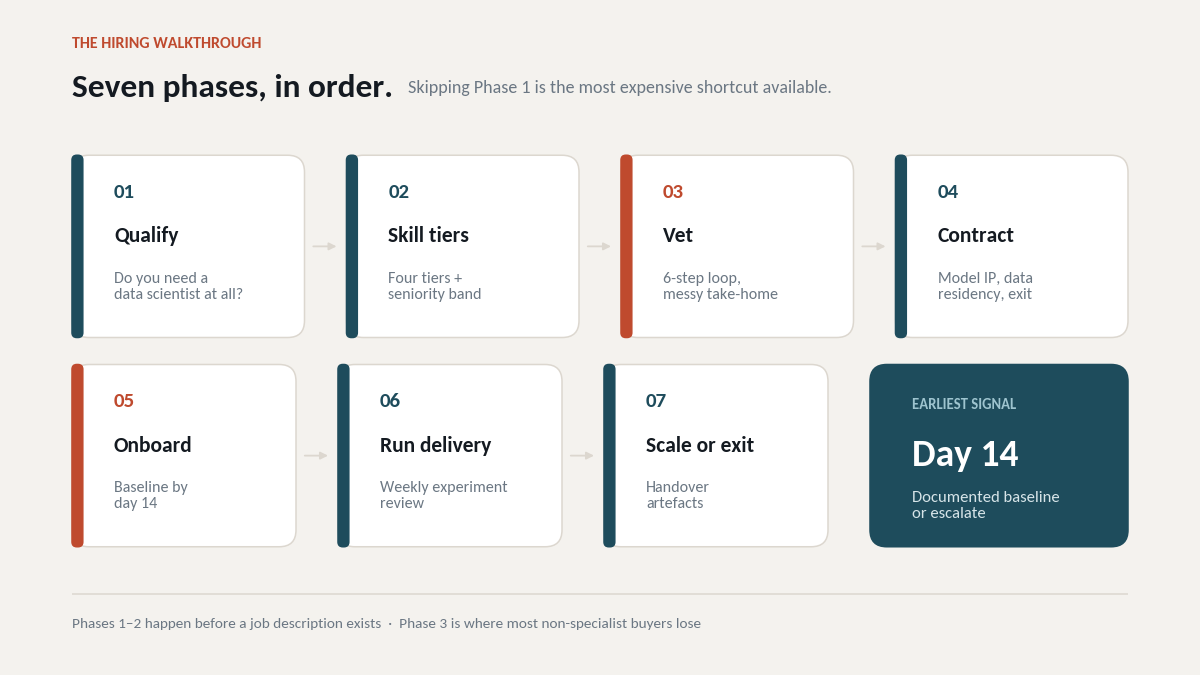
Six phases, in order. Skipping Phase 1 is the most expensive shortcut available to you.
Phase 1 Decide whether you need a data scientist at all
The machine learning hiring process should start with a disqualification test, not a job description. Teams that successfully hire data scientists for ML projects almost always run this filter before they write a word of the JD:
- Is there a decision that changes based on the prediction? If no one will act differently, you need a dashboard, not a model.
- Do you have labelled outcomes? For supervised problems, you need historical examples of the thing you want to predict, ideally 1,000+ positive cases for tabular classification, and far more for anything with high dimensionality.
- Is the outcome observable within a useful window? Predicting 18-month churn when you have 11 months of data is not a modelling problem. It’s a data collection problem.
- Would an off-the-shelf API solve 80% of it? OCR, transcription, translation, standard sentiment, generic document extraction these are solved products. Buying beats building unless your data is genuinely unusual.
- Is your data in one queryable place? If the answer involves joining four systems by hand, your first hire should be a data engineer.
The honest branch: if you fail items 2, 3 or 5, hire data infrastructure capability first. Bringing in a modeller ahead of a usable data layer is the ordering mistake that produces the 60% abandonment rate Gartner is forecasting.
If you pass, define the following before sourcing this becomes the brief:
- The prediction target, in one sentence, with its unit and time horizon
- The business metric the prediction should move, and the current baseline value
- The decision threshold what action is taken at what predicted probability
- The deployment surface batch job, API, embedded in an existing service
- The latency and volume budget 50ms real-time, or nightly batch of 2M rows
- The hard constraints explainability requirements, data residency, PII handling
Phase 2 Build the skills checklist and the seniority band
Now translate that brief into a role spec. The skills that matter are project-dependent, so screen in tiers rather than against a flat list. When teams hire data scientists for ML projects using a generic JD, they end up optimising for the wrong tier entirely.
Tier 1 non-negotiable for every ML project:
- SQL beyond SELECT * window functions, CTEs, understanding of join fan-out
- Python with pandas, NumPy, scikit-learn; ability to write a function, not just a cell
- Applied statistics: sampling bias, hypothesis testing, confidence intervals, base rates
- Evaluation design: train/validation/test discipline, temporal validation for anything time-dependent, and active data leakage detection
- Baseline discipline always establishing a naive or rules-based benchmark before modelling
- Metric selection under class imbalance (AUC-PR over accuracy, precision/recall trade-off framed in business cost)
Tier 2 choose based on your problem type:
| Problem type | What to screen for |
| Tabular prediction (churn, risk, pricing) | Gradient boosting (XGBoost/LightGBM), calibration, feature importance interpretation |
| Forecasting | Backtesting, seasonality decomposition, hierarchical reconciliation |
| NLP / LLM applications | Embeddings, RAG architecture, fine-tuning vs prompting trade-offs, eval harness design |
| Computer vision | Augmentation strategy, annotation quality control, transfer learning |
| Recommendations / ranking | Ranking metrics (NDCG, MAP), cold-start handling, offline-online metric gaps |
| Measuring intervention impact | Causal inference, uplift modelling, A/B test design and power calculation |
Tier 3 production-adjacent hygiene (skip this and you pay for it later):
- Git fluency, and code that runs outside the author’s laptop
- Experiment tracking (MLflow, Weights & Biases) as a habit, not a tool they’ve heard of
- Awareness of feature stores and the training/serving skew problem
- Basic containerisation literacy enough to hand off cleanly to whoever will hire Python developers or ML engineers to productionise the work
Tier 4 the ones that actually separate candidates:
- Can state a business metric and a model metric in the same sentence
- Has killed a project, and can explain the evidence that killed it
- Writes decisions down model cards, assumption logs, evaluation memos
- Asks about label provenance unprompted
Seniority bands, practically defined:
- Junior (0–2 yrs): executes a well-specified modelling task. Needs a defined problem and a reviewed evaluation plan. Not a first hire.
- Mid (2–5 yrs): owns a defined prediction task end-to-end, including evaluation design. Appropriate first hire only if a technical lead reviews their work.
- Senior (5–8 yrs): frames the problem, challenges the business assumption, designs the evaluation, and negotiates scope with stakeholders. This is the correct first hire for most projects.
- Staff/Principal (8+ yrs): sets ML strategy across multiple projects, builds the team. Overkill for a single initiative and hard to retain one.
If your project needs a specialist rather than a generalist production serving, retraining automation, inference optimization the correct move is to hire machine learning engineers alongside or instead. See the role comparison below before you commit to a title.
Phase 3 Sourcing and vetting
Vetting a data scientist is where most non-specialist buyers lose. You cannot assess modelling judgement by reading a resume, and a standard four-round loop tests the wrong 15%. The loop below is the one we run when clients ask us to hire data scientists for ML projects on their behalf, and it holds up even without an in-house ML panel.
- Screen (30 min). One project, in depth. Ask: what was the business metric, what was your baseline, how did you split the data, and what nearly went wrong? You are listening for specificity and self-correction, not vocabulary.
- Data exercise (2–3 hours, take-home). Give them a deliberately messy extract from your own domain of inconsistent nulls, duplicate keys, a date column in two formats, and one planted leakage field. Score the write-up, not the score.
- Problem-framing case (60 min, live). Present a real business problem with no obvious target variable. Watch them define the prediction task, question the data, and say what they’d refuse to promise.
- Past-project deep dive (60 min). Have them walk through their own code or architecture. Ask why three times on any decision. Shallow depth surfaces within ten minutes.
- Stakeholder round (30 min). A non-technical business owner asks them to explain their last model and its limitations. If your commercial lead doesn’t understand the answer, neither will your board.
- References focused on outcomes. Not “were they good to work with.” Ask: did their work reach production, who maintained it afterwards, and what broke.
Red flags pattern-matched from real screening loops:
- A portfolio composed entirely of Titanic, MNIST, Iris or Kaggle-competition notebooks. It means they have never met raw organisational data.
- Reports accuracy on an imbalanced dataset without volunteering the base rate.
- Cannot describe how any of their models reached an actual user.
- Never mentions a baseline. Strong candidates bring it up in the first three minutes.
- Describes the business objective only in model terms (“we improved F1 to 0.84”).
- Talks fluently about architectures but hesitates on GROUP BY semantics.
- Has never killed or rejected a project. Everyone senior has.
Green flags the four that correlate most strongly with delivery:
- Asks how labels were generated, and whether the labelling process changed over time.
- Asks about the latency budget and retraining cadence before discussing algorithms.
- Proposes a temporal split unprompted when the problem is time-dependent.
- Explicitly states what the model will not be able to do.
The 3-day rule we apply on ML roles: if a shortlisted candidate hasn’t been given a decision within three working days of the final round, assume they’re gone. In our own delivery data across 527+ IT projects, ML and data roles have the shortest offer-acceptance windows of any engineering category and offer-shopping is the norm, not the exception. Compressing the loop is a quality lever, not just a speed one.
For teams without the internal bandwidth to run this loop, structured IT staffing services exist precisely to front-load steps 1–4 so your team only spends time on final-round candidates. The relevant metric to ask any partner for is not shortlist volume, it’s shortlist-to-offer conversion.
Phase 4 Engagement models and contracts
The engagement model should follow the project’s certainty, not your headcount policy.
| Model | Best for | Typical cost signal | Control | Main risk |
| Full-time in-house | Ongoing ML as a core product capability | ₹18–45 LPA (India), $110k–190k (US) | Highest | 60–90 day hiring cycle; wrong hire is expensive to unwind |
| Dedicated hire via partner | Defined 6–18 month initiative, needs continuity | ₹2.5–5 L/month | High | Depends entirely on partner vetting depth |
| Staff augmentation | Adding capacity to an existing ML team | ₹1.8–4 L/month | Medium-high | Weak if you have no internal technical review |
| Project-based / outcome | Well-specified, bounded deliverable | Fixed-fee, scoped | Medium | Scope-change disputes; IP ambiguity |
| Freelance / fractional | Feasibility spikes, second opinions, audits | $40–120/hr | Low | Availability, continuity, no production ownership |
Contract clauses specific to ML the ones generic MSAs miss:
- IP assignment must name model artefacts explicitly trained weights, feature definitions, prompt templates, evaluation datasets and notebooks. “Deliverables” alone has been argued both ways.
- Training data usage restrictions. State whether your data may be used to train anything outside your project, and prohibit retention after termination.
- Data residency and processing location. For DPDP Act 2023 and GDPR exposure, specify the geography where processing occurs and who the sub-processors are.
- Third-party model and API terms. If the work uses commercial LLM APIs, confirm who holds the account, who pays inference costs, and whether the provider’s terms permit your use case.
- Reproducibility as an acceptance criterion. Deliverables include the environment specification and a runnable pipeline, not a notebook that only executes on the author’s machine.
- Replacement terms with a defined window. Ours is a 7–10 day replacement guarantee; whatever the number, get it in writing with the clock starting from your notice, not from the partner’s acknowledgement.
- Notice period and transition obligations minimum two weeks of documented handover, with named artefacts.
The negotiation point most buyers concede by accident: partners often propose that model IP transfers on final payment. On a multi-month engagement, that means you hold nothing if you terminate at month four. Push for IP vesting progressively, at each accepted milestone.
Phase 5 Onboarding and the first 14 days
Ramp-up is where good hires are wasted. The objective of week one is not a model. It is access, context and a baseline.
Pre-start checklist complete before day one:
- Warehouse/lakehouse read access provisioned, with the PII masking policy documented
- A sandbox compute environment with a stated budget ceiling
- Repository access, and a named code reviewer
- One-page data dictionary for the three most relevant tables, however imperfect
- Named business stakeholder with a recurring 30-minute slot
- The Phase 1 brief, written down and shared
Days 1–3 orientation and access verification. They should independently reproduce one existing business number (last month’s churn rate, last quarter’s conversion) from raw tables. If they can’t, you’ve found a data problem before it becomes a model problem.
Days 4–7 data audit and baseline. Deliverable: a short memo covering row counts, null patterns, label distribution, suspected leakage fields, and a naive baseline metric. This memo is the highest-value artefact of the entire first month.
Days 8–14 first evaluated model. Not a good model. A measured one, with a documented split strategy and a comparison against the baseline.
The 14-day baseline rule: if there is no documented baseline and evaluation plan by day 14, escalate immediately. In every stalled ML engagement we’ve reviewed, this artefact was either missing or produced retroactively. It is the earliest reliable signal available.
Phase 6 Managing delivery
ML delivery does not fit a standard sprint report, because progress is not linear and a negative result can be the correct output of a two-week experiment.
Cadence that works:
- Weekly, 30 min experiment review. What was tested, what the metric did, what’s next. Negative results are reported as results, not as delays.
- Bi-weekly, 45 min stakeholder alignment. Business metric movement, assumption changes, scope drift check.
- Monthly model review. Evaluation on a fresh holdout, drift check, error analysis on the worst-performing segment.
- Ad hoc decision log entries. Every changed assumption gets one line and a date.
KPIs that actually indicate health:
- Time to first baseline (target: ≤ 14 days)
- Experiment velocity measured hypotheses per fortnight, not lines of code
- Offline-to-online metric gap a large gap means the evaluation design is wrong
- Model documentation currency is the model card current as of the last change
- Production readiness score reproducible pipeline, pinned dependencies, tests on feature transforms
What to stop measuring: model accuracy as a standalone KPI. It rises when you overfit and falls when you fix leakage. Track the business metric and the offline-online gap instead.
Phase 7 Scaling or exiting
Two decisions, both with clear triggers.
Add headcount when any of these is true:
- The data scientist is spending more than 30% of their time on pipeline maintenance → add a data engineer
- A model is validated offline and blocked on serving → add an ML engineer
- Two or more models are live and need monitoring and retraining → add MLOps capability
- Annotation volume exceeds a few hours a week → add an annotation vendor or workflow, not a scientist
For organisations reaching three or more concurrent ML initiatives, the economics start favouring a permanent offshore team over rolling contracts which is the point at which a global capability center becomes a sensible structure rather than an overbuild.
Offboarding the handover artefacts to demand, non-negotiably:
- Runnable end-to-end pipeline with pinned dependencies and an environment spec
- Feature definitions documented in text, not only in code
- Evaluation datasets with their generation logic
- Model card: intended use, known failure modes, performance by segment, retraining trigger
- Decision log covering every scope and assumption change
- A recorded 60-minute walkthrough with the receiving engineer
Replacement reality check: even with a partner-backed replacement guarantee, a mid-engagement change costs 2–4 weeks of context rebuilding. That is an argument for vetting depth up front, not for tolerating a bad fit.
Data Scientist vs ML Engineer: Settling the Overlap
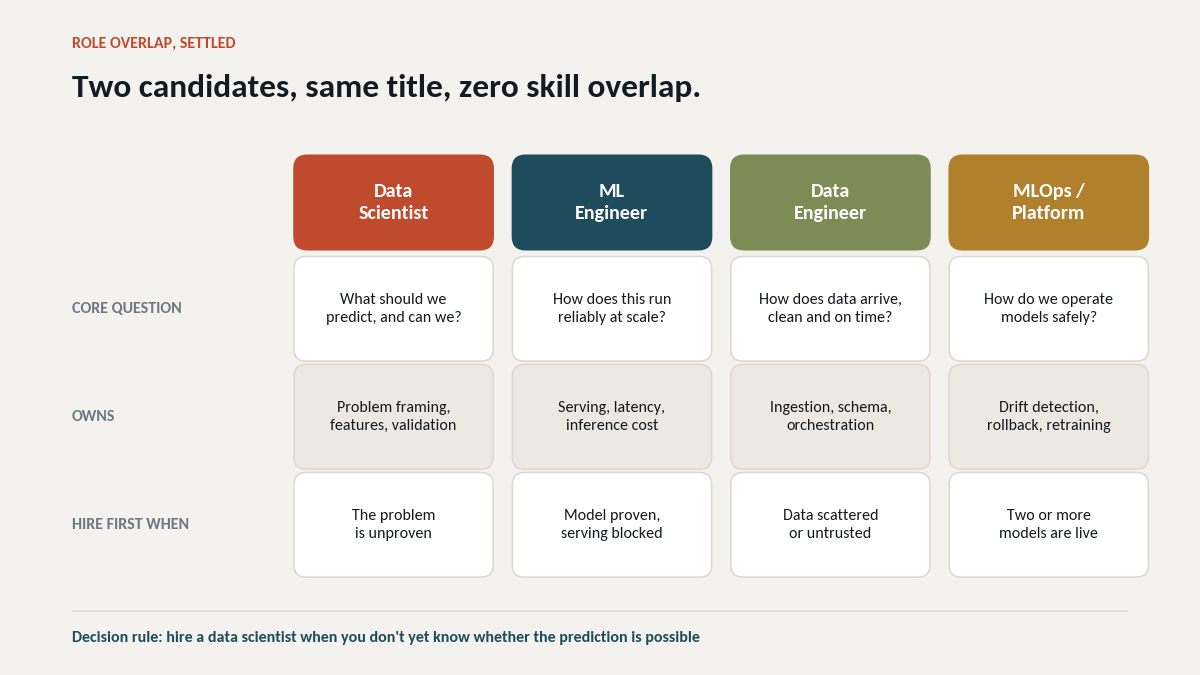
The data scientist vs ML engineer confusion costs more money than any other role-definition error in ML hiring, because both titles are used loosely by candidates and job boards alike. Two candidates with identical titles can have zero skill overlap.
| Dimension | Data Scientist | ML Engineer | Data Engineer | MLOps / Platform |
| Core question | What should we predict, and can we? | How does this run reliably at scale? | How does data arrive, clean and on time? | How do we operate models safely? |
| Primary output | Validated model + evaluation evidence | Deployed service under SLA | Pipelines, tables, quality contracts | CI/CD, monitoring, registries |
| Owns | Problem framing, features, validation | Serving, latency, inference cost | Ingestion, schema, orchestration | Drift detection, rollback, retraining |
| Typical stack | Python, SQL, scikit-learn, PyTorch, statsmodels | Python/Go, FastAPI, Docker, Kubernetes, ONNX | SQL, Spark, dbt, Airflow, Kafka | Terraform, MLflow, Kubeflow, Prometheus |
| Fails by | Building an accurate model nobody can use | Shipping a model that solves the wrong problem | Optimising pipelines for data nobody consumes | Over-engineering for one model |
| Hire first when | The problem is unproven | The model is proven, serving is blocked | Data is scattered or untrusted | Two or more models are already live |
The decision rule: hire a data scientist when you don’t yet know whether the prediction is possible. Hire an ML engineer when you know it is, and it isn’t reaching users. Getting this order wrong is what produces a well-paid modeller writing Airflow DAGs for a quarter.
The hybrid reality: roughly one in five senior candidates genuinely spans both and they can frame a problem and ship a containerised service. They exist, they cost 20–35% above the band, and on a first ML project they are usually worth it, because they remove the handoff entirely.
Screen for it explicitly rather than hoping for it: ask for one example of something they built and then operated in production for at least six months. It is the highest-leverage question available to anyone about to hire data scientists for ML projects on a compressed timeline.
ML Project Team Structure by Stage
A sensible ML project team structure grows in a fixed order. Adding roles out of sequence is how teams end up with five people and no deployed model.
Stage 1 Feasibility (weeks 0–6). Team of 1–2.
- 1 senior data scientist (or 1 mid + fractional senior review)
- Part-time access to a data engineer or analytics engineer
- Named business stakeholder, 30 min/week
- Exit criterion: documented baseline, feasibility verdict, and a go/no-go recommendation in writing
Stage 2 Build (weeks 6–16). Team of 2–4.
- 1 senior data scientist (owner)
- 1 data engineer (0.5–1.0 FTE)
- 1 ML engineer joining from about week 10, not week 1
- Exit criterion: model beating baseline on a temporally held-out set, plus a production readiness review
Stage 3 Deploy and operate (weeks 16–28). Team of 3–5.
- 1 ML engineer (lead through this stage)
- 1 data scientist (0.5 FTE, error analysis and iteration)
- MLOps capability, often shared across projects rather than dedicated
- Exit criterion: live model with monitoring, rollback path, and a defined retraining trigger
Stage 4 Scale (month 7+). Team of 5–10.
- Dedicated MLOps, multiple data scientists, an AI product manager holding the portfolio
- Exit criterion: second and third use cases shipping without a proportional headcount increase
The ratio worth remembering: in mature teams, data scientists to ML/data engineers converges to roughly 1:1.5. Teams that stay at 3:1 in favour of scientists accumulate models that never ship.
Case Studies
Three engagements from Supersourcing’s delivery history that map directly onto the phases above. Metrics first.
Paytm 100+ engineers, sustained hiring velocity. A hiring programme spanning 100+ engineering hires, run against a 7–10 working day cycle from job description to interview-ready shortlist. The relevant lesson for ML hiring: at that volume, the constraint was never sourcing reach; it was the depth of technical screening applied before the client’s panel spent time. Front-loading the technical filter is what held a 98% candidate joining rate at scale.
Swiggy engineering scale-up under product pressure. Rapid-growth hiring across engineering functions in a high-velocity consumer environment, where the cost of a slow loop is measured in shipped features. The applicable pattern: compressed decision windows plus dedicated account management, with no shared bandwidth across accounts, kept candidate drop-off on contract roles under 1% the same discipline that protects ML offers from being lost to counter-offers.
Somnoware recruitment automation for a healthtech data product. A healthtech engagement where the hiring requirement itself was data- and compliance-adjacent, requiring candidates screened for both technical depth and regulated-data handling. The transferable lesson: when the role touches sensitive data, compliance literacy has to be a screening criterion in its own right, not a checkbox at offer stage exactly the argument for making DPDP and GDPR awareness a Tier 1 requirement on any healthcare or fintech ML project.
The Decision Framework: Which Hiring Route Fits Your Project
There is no universally correct route to hire data scientists for ML projects; the right structure is a function of your problem certainty and your data. Score your project on five factors, then read across. Each factor is 1–3 points.
- Problem certainty 1: exploratory · 2: defined but unvalidated · 3: proven, needs scaling
- Data maturity 1: scattered · 2: warehoused but undocumented · 3: governed with quality contracts
- Internal ML expertise 1: none · 2: one technical reviewer · 3: existing ML team
- Duration 1: under 3 months · 2: 3–12 months · 3: ongoing capability
- Sensitivity 1: public/low-risk data · 2: internal business data · 3: regulated PII or PHI
| Total score | Recommended route | Why |
| 5–7 | Fractional senior data scientist or a scoped feasibility engagement | You don’t yet know what to hire for. Buy an answer, not a headcount. |
| 8–11 | Dedicated hire through a vetted partner | Continuity matters, but a 60–90 day in-house search is too slow for the window. |
| 12–15 | Staff augmentation into your existing team, or direct in-house hire | You have the review capability to make either work. Optimise for retention. |
| 12–15 with score 3 on duration | Offshore team or GCC structure | Rolling contracts stop being economical past three concurrent initiatives. |
Override rule: if internal ML expertise scores 1, do not choose freelance. Without an internal reviewer, unsupervised freelance work on an unvalidated problem is the highest-variance option available, and you have no way to detect a bad result until it’s expensive.
What Most Teams Get Wrong
Five patterns, in descending order of cost. This is the section worth screenshotting.
- They hire for the model, not for the data. The job description lists frameworks. The project fails on label quality and pipeline reliability. Gartner’s projection that 60% of AI projects will be abandoned through 2026 for want of AI-ready data is, read correctly, a hiring critique: teams staffed for the last 20% of the work.
- They test candidates on clean data. A take-home built on a tidy CSV measures scikit-learn familiarity. It cannot distinguish someone who will notice that your created_at column changed timezone semantics in 2023. Give messy data, and plant one leakage field.
- They treat “senior” as a year’s count. The distinguishing behaviour of a senior applied data scientist is refusal to say a prediction isn’t supported by the data, in writing, to a stakeholder who wants a different answer. Screen for it directly: “tell me about a time you told the business no.”
- They defer the production conversation. Deployment surface, latency budget and retraining cadence get discussed after a model exists. By then the feature engineering has assumed information that won’t be available at inference time. Every one of those constraints belongs in the Phase 1 brief.
- They optimise the offer instead of the loop. Competing on compensation for ML talent against funded AI-native companies is a losing position for most buyers. Competing on decision speed, problem quality and access to real data is a winning one. Strong applied data scientists consistently choose interesting, well-scoped problems over marginal salary differences and a three-day decision window signals a well-run organisation more credibly than any recruiter pitch.
The contrarian summary: when you hire data scientists for ML projects, the best predictor of success is not the calibre of the modeller. It is whether the problem was framed and the data verified before anyone was hired at all. Sequence beats seniority.
Cost and Timeline Reality Check
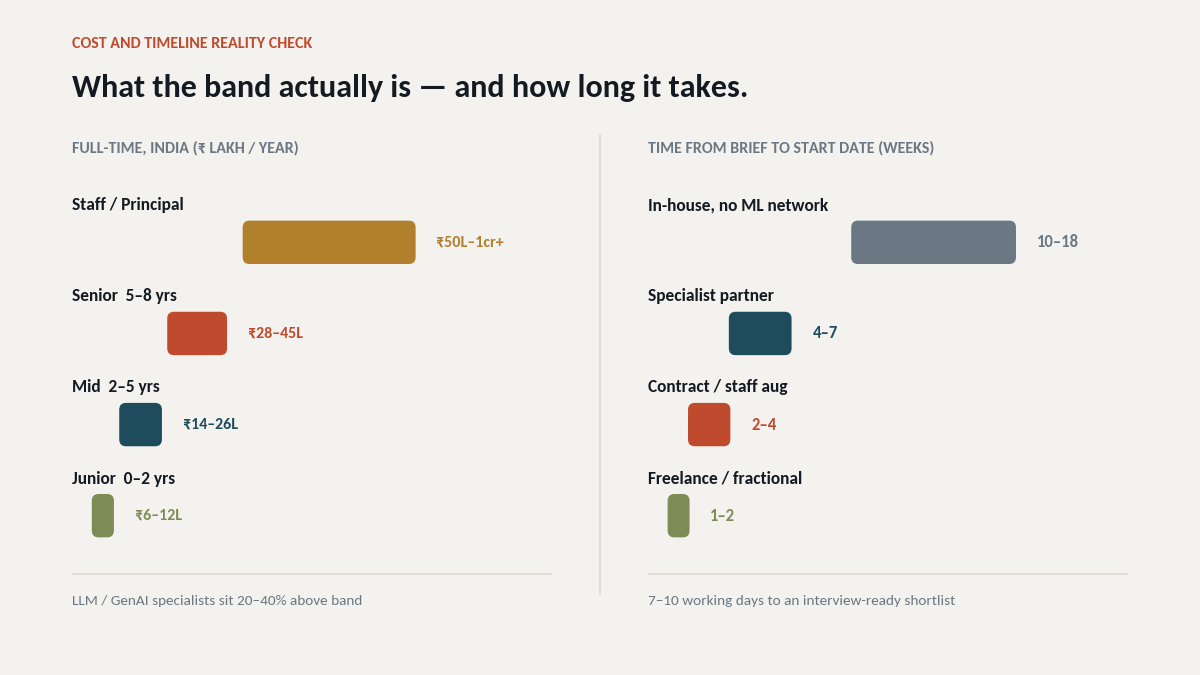
Budgeting to hire data scientists for ML projects fails most often on timeline, not on rate. The ranges below reflect Indian and US market bands as of 2026 and should be treated as planning bands, not quotes.
Actual pricing moves with domain (fintech and healthtech carry a premium), specialisation (LLM and causal inference specialists sit at the top of the band), and location tier.
Compensation and contract bands India
| Level | Full-time (annual) | Contract (monthly) | What you get |
| Junior (0–2 yrs) | ₹6–12 lakh | ₹0.8–1.5 lakh | Executes specified tasks under review |
| Mid (2–5 yrs) | ₹14–26 lakh | ₹1.8–3 lakh | Owns a defined prediction task |
| Senior (5–8 yrs) | ₹28–45 lakh | ₹2.5–5 lakh | Frames problems, designs evaluation |
| Staff/Principal (8+ yrs) | ₹50 lakh–1 crore+ | ₹5–9 lakh | Sets ML direction, builds team |
| LLM/GenAI specialist | 20–40% above band | 20–40% above band | Scarcity premium, moves fastest |
Comparative offshore rates: India typically lands at $25–60/hour for mid-to-senior applied data science, against $80–150/hour in Eastern Europe and $110–200/hour in the US for equivalent experience. That cost arbitrage is real, but it only converts into savings if the vetting is equivalent to a cheap hire that fails, vetting costs more than the differential saved.
What drives cost up:
- Regulated domains requiring compliance literacy (+15–30%)
- Genuine LLM production experience, as opposed to prompt experimentation (+20–40%)
- Hybrid scientist/engineer profiles (+20–35%)
- Urgency under two weeks, which narrows the pool to immediately available candidates
- Requiring on-site presence in Tier 1 cities
What drives cost down:
- A documented data layer, which reduces the seniority you need
- Willingness to hire remote across Tier 2 cities
- Contract-to-hire structures that reduce the buyer’s commitment risk
- A clearly scoped brief ambiguity is priced in by every vendor
Timelines by route
| Route | JD to shortlist | Shortlist to offer accepted | Total to start |
| In-house recruiting, no ML network | 4–8 weeks | 3–6 weeks | 10–18 weeks |
| Specialist staffing partner | 7–10 working days | 1–3 weeks | 4–7 weeks |
| Contract / staff augmentation | 5–10 working days | 3–10 days | 2–4 weeks |
| Freelance / fractional | 2–7 days | Days | 1–2 weeks |
Project timelines by data maturity this is the number to give your board:
- Governed data layer already in place: 8–12 weeks from hire to a deployed first model
- Warehoused but undocumented data: 16–24 weeks
- Data scattered across systems: 24–36 weeks, and hire data engineering first
- Feasibility spike only (go/no-go verdict): 4–6 weeks, one senior data scientist
Add 2–4 weeks to any of these if the model requires an explainability review for compliance sign-off.
The ML Project Hiring Checklist
A condensed ML project hiring checklist to run against before you make an offer. If more than three items are unchecked, pause the loop.
Before sourcing
- Prediction target defined in one sentence, with horizon and unit
- Business metric and its current baseline value documented
- Deployment surface, latency budget and volume stated
- Labelled historical outcomes confirmed to exist, and counted
- Data location and access owner identified by name
- Decided whether a data engineer should precede this hire
During vetting
- Take-home used real, messy data with a planted leakage field
- Candidate proposed a baseline unprompted
- Candidate asked about label provenance
- Candidate stated at least one limitation of their own past model
- Non-technical stakeholder understood their explanation
- References confirmed the work reached production
Before signing
- IP assignment names model artefacts, weights, features and evaluation sets
- Training-data usage and retention restrictions written in
- Data residency and sub-processors specified
- Reproducibility included as an acceptance criterion
- Replacement window defined, with the clock starting on your notice
- IP vesting tied to milestones, not final payment
Before day one
- Data access provisioned and tested
- Sandbox environment with a budget ceiling
- Named code reviewer and named business stakeholder
- Phase 1 brief shared in writing
- Day 14 baseline expectation communicated explicitly
Your Next Step Depends on Where You Are Right Now
Three situations, three different next moves.
If you can’t yet answer Phase 1’s five questions, don’t hire anyone this month. Write the brief first: prediction target, business metric, deployment surface, latency budget, hard constraints. That document will save you more money than any sourcing decision.
If the brief exists and the data layer is ready, run the Phase 3 loop as written messy take-home, framing case, stakeholder round, outcome-focused references and hold yourself to the three-day decision rule.
If you need a shortlist that’s already been through that filter, that is the specific problem Supersourcing exists to solve. AI-powered sourcing surfaces the top 2% of vetted candidates, ML and data roles are screened by practitioners rather than keyword matched, and the typical cycle is 7–10 working days from brief to interview-ready shortlist with a replacement window in the same range if a hire isn’t a fit. If you’d rather see the shortlist than debate the theory, bring your brief to a 30-minute scoping call: supersourcing.com/contact-us. Come with your prediction target and your data situation; you’ll leave knowing which role to hire first and what band it sits in.
If you’d prefer to run it yourself, take the checklist above and start with the pre-sourcing block. Either way, the sequence is the same and the sequence is what decides whether the model ships.
FAQ
What does a data scientist actually do on an ML project?
They convert a business problem into a measurable prediction task, verify the data can support it, engineer features, design the evaluation, and validate that results hold outside the training set. They own the question and the evidence. Serving the model in production, under a latency budget, is ML engineering work a related but distinct skill set.
Do I hire a data scientist or a data engineer first?
If your data is spread across systems, undocumented, or untrusted, hire the data engineer first. A data scientist without a usable data layer will spend 60–70% of their time building a fragile version of one, at a higher hourly cost. If your data is already warehoused and queryable, the data scientist goes first.
How do I test a data scientist if I’m not technical?
Use three non-technical filters. Ask what business metric their last model moved and by how much you’re listening for a number and a caveat. Ask them to explain a past model to your commercial lead; if that lead doesn’t follow it, the model won’t get adopted. And run a take-home on your own messy data, scoring their written reasoning rather than their accuracy figure.
How long does it take to hire an ML data scientist?
Timelines to hire data scientists for ML projects vary by route more than by seniority. Through in-house recruiting without an existing ML network, expect 10–18 weeks to a start date. Through a specialist partner, 7–10 working days to an interview-ready shortlist and 4–7 weeks to start. Contract and staff-augmentation routes compress that to 2–4 weeks, because availability rather than notice period governs the timeline.
How many data scientists does one ML project need?
One senior data scientist for the feasibility stage. Two to four people once you’re building the scientist plus data engineering support, with an ML engineer joining around week 10. Deployment shifts the centre of gravity to engineering. Very few single-model projects benefit from more than one data scientist at a time.
What are the biggest red flags when interviewing data scientists?
A portfolio made entirely of public competition datasets, accuracy quoted without a base rate, no mention of a baseline, inability to describe how any model reached a real user, and no example of a project they killed. Individually these are yellow flags. Two or more together reliably predict a stalled engagement.
Should I hire a freelance data scientist or a dedicated one?
Both routes work, but for different risk profiles. Freelance suits bounded, low-risk work: a feasibility spike, a second opinion, an audit of an existing model. For anything intended to reach production, dedicated engagement wins on continuity, IP clarity and accountability. The hard rule: if you have no internal technical reviewer, don’t use freelance for an unvalidated problem.
What should a new data scientist deliver in their first 30 days?
By day 3, an independently reproduced existing business number. By day 7, a data audit memo covering nulls, label distribution, suspected leakage and a naive baseline. By day 14, a first evaluated model measured against that baseline. By day 30, a go/no-go recommendation with evidence. If the day 14 artefact is missing, escalate it is the earliest reliable warning signal.
Is it cheaper to build an offshore ML team than to hire locally?
Usually yes on rate, at roughly $25–60/hour in India against $110–200/hour in the US for comparable experience, but the saving only holds if vetting depth is equivalent. If you’re weighing a permanent offshore ML function against rolling contracts, a short scoping conversation is worth more than another spreadsheet. That comparison depends on your project count and data-sensitivity profile more than on rate cards.
