

The teams that fail to ship AI products rarely fail because of the model. They fail because the person who was supposed to build the training pipeline, clean the data, write the inference API, and monitor model drift turned out to be a very skilled data analyst with a PyTorch certificate. I see this pattern in 30–40% of the engagements we rescue.
A company dedicated Python developers for AI and ML projects got resumes with TensorFlow on them, onboarded two engineers — and six months later: clean notebooks, beautiful EDA, zero production endpoints. The models exist. They just don’t run anywhere.
This isn’t just anecdotal — it’s structural. According to 2026 Global Talent Shortage Report (AI hiring data), 72% of employers globally are struggling to hire skilled talent, with AI and machine learning roles among the hardest to fill due to a shortage of engineers who can actually deploy and scale systems in production.
The gap between a Python developer and a production ML engineer is wider than most job descriptions acknowledge. This guide is about how to hire for the latter — and how to structure a dedicated team that can actually ship.
When the Supersourcing team built Open Money’s banking and settlement platform — handling real-time transaction flows across multiple payment rails — the first engineering hire we made wasn’t a senior Python developer. It was a Python ML engineer who could simultaneously design the fraud detection pipeline and own the deployment infrastructure. That one decision saved 4 months of rework.
What “Dedicated” Actually Means — and Why It Matters for AI Projects
A dedicated Python developers for AI and ML projects is an engineer allocated exclusively to your team, working under your technical direction, integrated into your sprint cycles, and accountable to your product goals — not split across three other clients, not billing by the hour with a gap between calls.
For ML work specifically, dedication isn’t just a commercial arrangement. It’s a technical necessity. Training runs, data pipeline debugging, model evaluation, and experiment iteration all require sustained context. A developer who knows your dataset, your edge cases, your latency requirements, and your infrastructure will move 3x faster than someone picked up for a sprint and rotated out.
The dedicated model also scales with your roadmap. Most AI products evolve from “build a classifier” to “build an LLM-powered feature” to “we need a full vector search layer.” A dedicated engineer accumulates that context. A project-based hire disappears right before things get complicated.
 The Real Problem Most Teams Don’t See Coming
 The Real Problem Most Teams Don’t See Coming
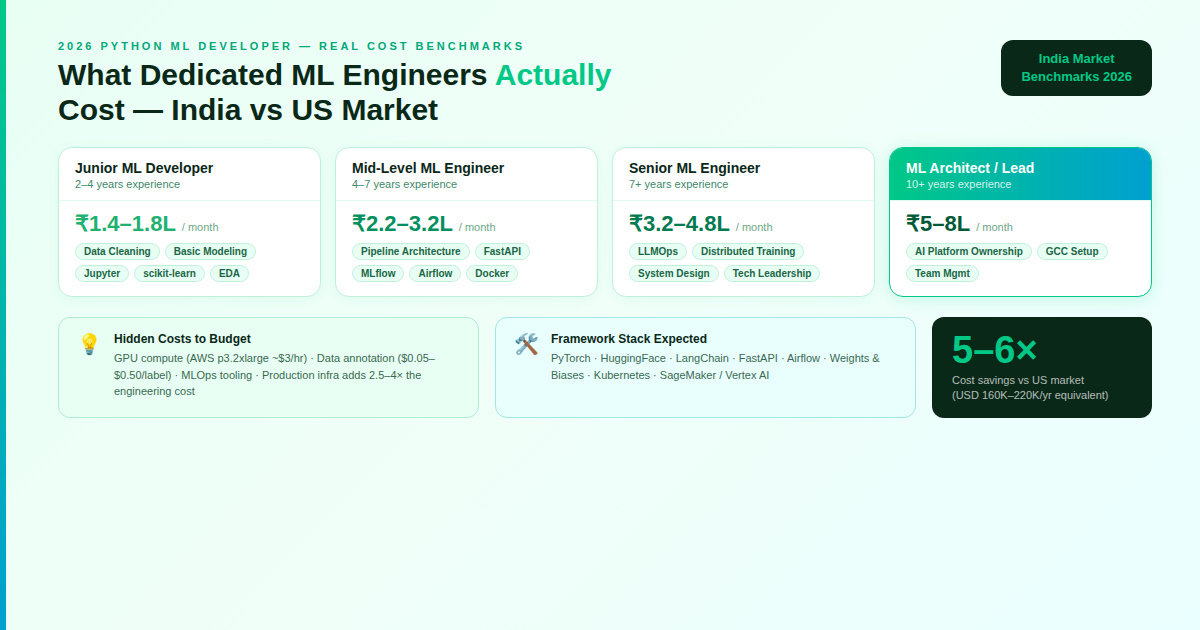
Most CTOs underestimate the production gap by 3–4x. Here’s what it looks like: You hire a Python developer who can build a working recommendation model in scikit-learn. The model performs well in a Jupyter notebook. Getting it to run reliably at 500 requests/second with p99 latency under 80ms — that’s a different skill set entirely.
“The research-to-production gap in ML is a specialization gap, not a difficulty gap. The skills for training a model and deploying a model overlap but don’t align.”
What you actually need for a production ML system includes: feature engineering pipelines that don’t break when the data schema changes; model versioning and rollback capability; A/B testing infrastructure for model experiments; monitoring for data drift and concept drift; and an inference layer that handles cold starts, caching, and graceful degradation.
None of that is in the standard “Python developer + ML” job description. And none of that gets built if you hire based on algorithmic interview scores and Kaggle competition rankings.
The other gap: infrastructure fluency. Your Python ML developer needs to own their cloud footprint — GPU instances, spot instance management, S3 bucket structures, containerized training jobs on ECS or Kubernetes. This isn’t DevOps. It’s ML platform engineering, and in teams under 15 people, the same person usually covers both.
What to Actually Look For in a Python ML Developer
The resume signals that matter: a public GitHub with at least one deployed ML project (not a tutorial repo); experience with MLflow, Weights & Biases, or DVC for experiment tracking; and evidence of having touched production — logs, metrics, incident writeups, or a mention of latency optimization.
The framework stack I’d expect from any senior Python ML engineer in 2026:
- PyTorch or TensorFlow for deep learning — strong preference for PyTorch in research-adjacent work
- HuggingFace Transformers and PEFT for LLM fine-tuning and inference
- scikit-learn and XGBoost / LightGBM for traditional ML and feature importance analysis
- FastAPI or BentoML for model serving with proper async handling
- Airflow, Prefect, or Luigi for pipeline orchestration
- LangChain or LlamaIndex for RAG architectures and LLM application development
- Pandas and Polars for data manipulation — Polars for anything over 10M rows
- Docker, Kubernetes basics, and at least one cloud ML service (SageMaker, Vertex AI, or Azure ML)
The assessment I run when evaluating candidates: give them a messy CSV with class imbalance, missing values, and a few obvious outliers. Ask them to build a classification pipeline and present it as if it’s going to production next week. The output reveals: do they handle data leakage? Do they think about model monitoring from the start? Do they use cross-validation correctly? Do they ask clarifying questions about the business metric?
The last question matters most. An ML engineer who doesn’t ask “what are we optimizing for?” before writing code is going to optimize for the wrong thing. It cost 3 months of rework on a fintech fraud detection model — optimized for accuracy on a heavily imbalanced dataset, completely useless in production.
Hiring Models: Staff Augmentation vs Dedicated Team vs Project-Based
 Hiring Models: Staff Augmentation vs Dedicated Team vs Project-Based
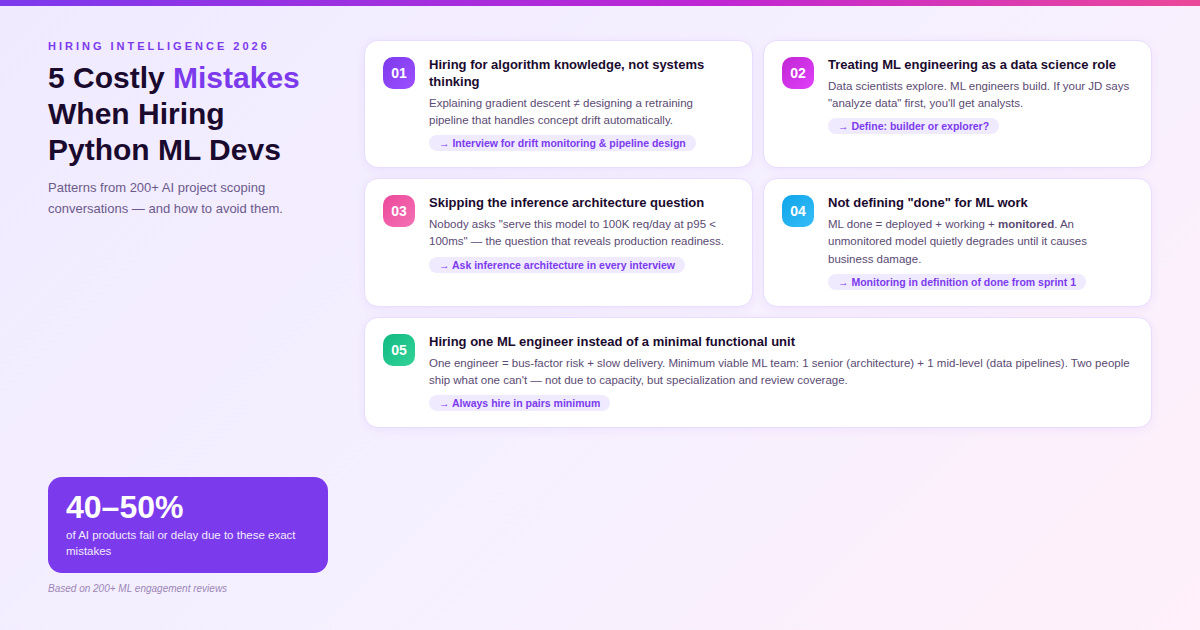
The right structure depends on three variables: how defined your roadmap is, how much technical context you need to transfer, and how long the AI investment runs. Here’s how the models actually compare:
| Model | Control | Speed to Start | Cost | Delivery Risk | Best For |
| Staff Augmentation | High | Medium (4–8 wks) | Medium | Low | Adding to existing team |
| Dedicated Team | High | Fast (1–2 wks) | Medium-Low | Low | New AI product / GCC model |
| Project-Based | Low | Fast | Variable | High (scope creep) | Fixed deliverable, clear specs |
| Full-Time Hire | Highest | Slow (8–16 wks) | High (+ overhead) | Medium | 18+ month continuous ML work |
| Freelancer | Medium | Fast | Low-Medium | Very High | Prototypes, never production |
My honest recommendation for 80% of the companies I talk to: start with a dedicated team of 2–3 engineers rather than augmenting your existing team with generalists. The dedicated model forces clarity on ownership, which is the most common failure mode in AI product development — nobody owns the pipeline end to end.
Supersourcing has set up dedicated ML teams for companies building everything from GCC (Global Capability Centres) to standalone AI SaaS products. The pattern that works: one senior ML engineer who owns architecture, one mid-level engineer who owns data infrastructure, and a part-time data scientist for domain-specific modeling decisions. Scales predictably.
Real Cost Breakdown — No Fluff
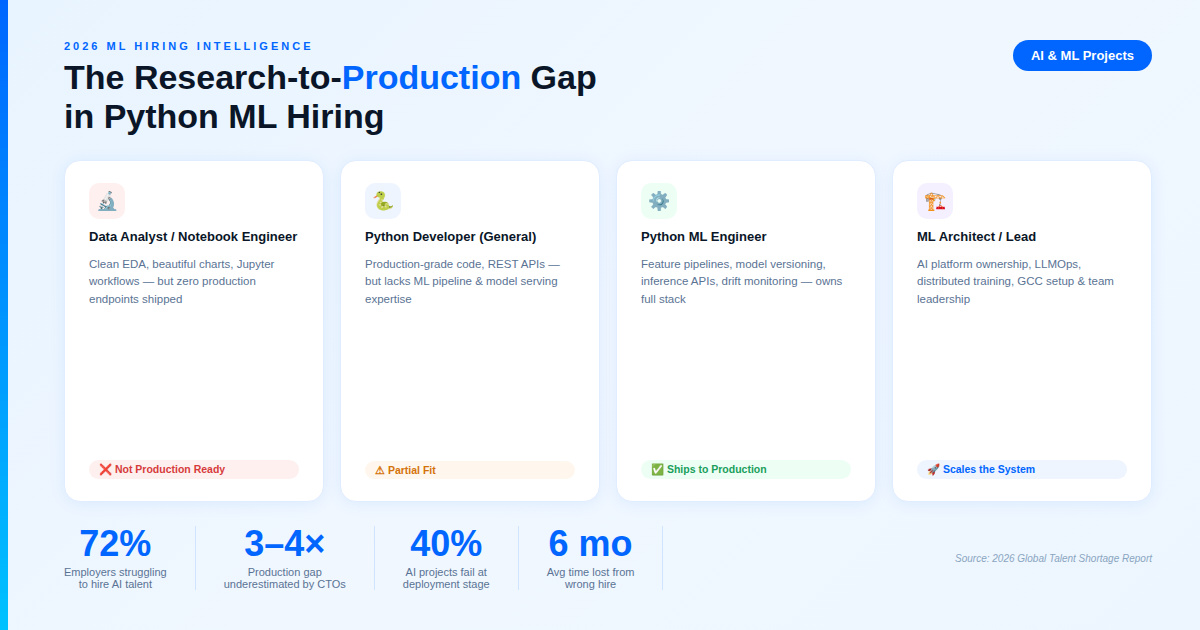
Here’s what dedicated Python ML developers actually cost in 2026, benchmarked from our current hiring pipeline. These are not aspirational ranges — they’re what we’re seeing cleared in placed contracts.
| Tier | Experience | Monthly (INR) | Typical Skills |
| Junior Python ML Developer | 2–4 years | ₹1.4–1.8L / mo | Data cleaning, basic modeling, Jupyter workflows |
| Mid-Level ML Engineer | 4–7 years | ₹2.2–3.2L / mo | Pipeline architecture, model deployment, API integration |
| Senior ML Engineer | 7+ years | ₹3.2–4.8L / mo | System design, LLM ops, distributed training, tech leadership |
| ML Architect / Lead | 10+ years | ₹5–8L / mo | Full AI platform ownership, GCC setup, team management |
For comparison: a senior Python ML engineer in the US costs USD 160,000–220,000 per year all-in. The equivalent Supersourcing dedicated placement runs USD 28,000–40,000 per year. The 5–6x cost difference is real — but only if you hire with the same quality bar, which is the entire point of the vetting layer.
Hidden costs to budget for: GPU compute (AWS p3.2xlarge runs ~USD 3/hr; a training run on 50GB of data typically costs USD 40–150), data annotation if you’re building custom models (budget USD 0.05–0.50 per label depending on complexity), and MLOps tooling — Weights & Biases Teams plan is USD 150/user/month, Databricks starts at USD 0.40/DBU.
The full cost of a production ML feature — from data collection through model serving — typically runs 2.5–4x the cost of the engineering labor alone, once you account for cloud infrastructure, tooling, and computation. Teams that miss this in their initial budget planning are the ones that run out of runway before the first model ships.
What Most People Get Wrong When Hiring Python ML Developers
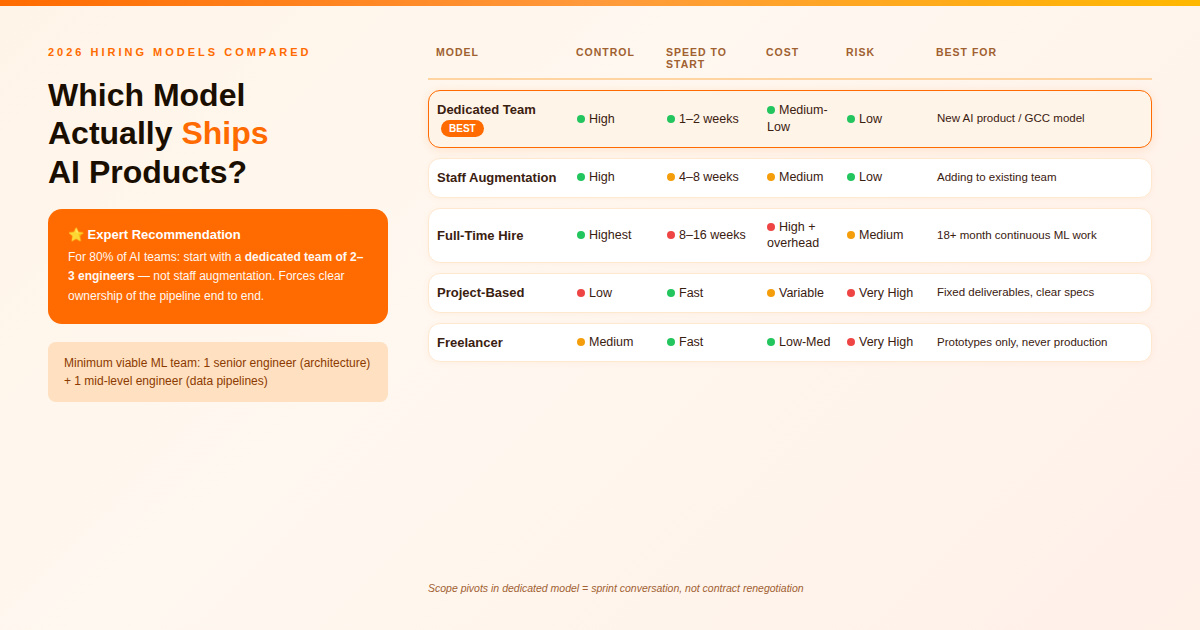
After reviewing 200+ ML project scoping conversations, here are the specific mistakes that show up in 40–50% of failed or delayed AI products:
01 — Hiring for algorithm knowledge instead of systems thinking
The ability to explain gradient descent in an interview correlates poorly with the ability to design a retraining pipeline that handles concept drift automatically. Interview for the latter. Most don’t.
02 — Treating ML engineering as a data science role
Data scientists explore. ML engineers build. The same person can do both, but the default skill profile is different. If your job description says “analyze data” before it says “build APIs,” you’ll get analysts. Decide which you need first.
03 — Skipping the inference architecture conversation
Most hiring conversations focus on training. Almost no one asks “how would you serve this model to 100,000 requests per day with p95 < 100ms?” That’s the question that reveals whether someone can take ML from notebook to production.
04 — Not defining “done” for ML work
In software, “done” means deployed and working. In ML, there’s a third condition: monitored. A model that’s deployed but unmonitored will quietly degrade until it’s causing business damage. Build monitoring into the definition of done before the first sprint starts.
05 — Hiring one ML engineer instead of building a minimal functional unit
One engineer can do everything slowly and with bus-factor risk. The minimum viable ML team for a production product is: one senior engineer for architecture + one mid-level engineer for data pipelines. That’s it. Two people can ship what one can’t — not because of capacity, but because of review coverage and specialization.
What We’ve Learned After 200+ AI and ML Engagements
 What We’ve Learned After 200+ AI and ML Engagements
When Brillio came to Supersourcing for enterprise digital transformation via SAP and DevOps — a project that involved building data pipelines for large-scale ERP migration — the initial instinct was to IT staffing Python generalists. We pushed back. The specific need was Python engineers who understood ETL at scale and could build validation frameworks for financial data integrity. That specificity changed the hiring bar and reduced the delivery timeline by 6 weeks.
For Pennywise’s digital transformation, we placed a mid-level Python ML engineer whose core skill was anomaly detection in transaction data. The difference between a general Python engineer and a specialist who’d built fraud detection pipelines before: they asked 4 questions in the first kickoff call that the client’s team hadn’t thought to ask. Every one of those 4 questions would have surfaced as a production bug.
The pattern across all of these: the developers who shipped fastest weren’t necessarily the most senior. They were the ones who communicated ambiguity clearly. “I need a decision on how we handle missing timestamps in the event log before I can finish this pipeline” is a better signal than silence followed by a week of wasted work.
Hire for communication velocity alongside technical depth. A Python ML developer who surfaces blockers early is worth more than one who works in silence and delivers surprises.
One pattern that surprises clients: the best ML engineers I’ve placed are often uncomfortable with uncertainty in requirements. They push for clarity aggressively. Some clients interpret that as being difficult. It’s actually the opposite — it’s a sign the engineer knows how expensive late-stage scope changes are in ML projects.
Frequently Asked Questions
 Frequently Asked Questions
1. How long does it take to hire a dedicated Python developer for an AI project?
Through Supersourcing’s AI-powered hiring platform, we typically surface 3–5 vetted profiles within 72 hours. Full onboarding — including codebase orientation, toolchain access, and first sprint — takes 7–10 working days. Compare that to 6–10 weeks for a traditional recruitment process, which is what most in-house hiring actually takes once you factor in screening, interviews, and notice periods.
2. What’s the difference between a Python developer and a Python ML engineer?
A Python developer writes clean, production-grade code. A Python ML engineer does that AND understands statistical modeling, data pipeline design, model evaluation, feature engineering, and deployment patterns like MLflow, BentoML, or Triton. For AI projects, you almost always need the latter. Most resumes blur this line — insist on a take-home assessment that tests both.
3. What hourly rates should I expect for dedicated Python ML developers in India?
Depending on experience tier: junior (2–4 years) runs ₹1,200–1,800/hr, mid-level (4–7 years) ₹2,200–3,200/hr, senior/ML specialist (7+ years) ₹3,500–5,500/hr. Monthly retainers for a dedicated senior ML engineer typically land between ₹1.8–3.2 lakhs. These are Supersourcing’s current market benchmarks — not aspirational numbers.
4. Should I hire a full-time employee or use a dedicated developer model?
If your AI roadmap covers 18+ months of continuous ML work, a full-time hire makes economic sense. Below that — or when your needs shift between ML research, productionization, and data engineering — a dedicated developer model wins on cost, speed, and flexibility. Most early-stage AI teams I see are better off with 2 dedicated engineers and a part-time data scientist than 3 full-time employees who aren’t fully utilized.
5. How do I evaluate a Python ML developer before hiring?
Ask for a GitHub profile and look for evidence of real shipped work — not tutorials. Give a take-home: “You have a CSV of 100k rows with missing values and class imbalance. Build a classification pipeline and explain your preprocessing choices.” The answer reveals how they think, not just whether they can code. Also test their systems instincts: “How would you serve this model to handle 10,000 concurrent inference requests?” That’s where most “ML engineers” fall apart.
6. What Python frameworks do your AI/ML developers typically use?
Our ML teams are comfortable across the standard stack: PyTorch and TensorFlow for training, HuggingFace Transformers for NLP and LLMs, scikit-learn and XGBoost for traditional ML, FastAPI for model serving, Airflow and Prefect for pipeline orchestration, and MLflow or Weights & Biases for experiment tracking. For LLM-specific work: LangChain, LlamaIndex, and direct OpenAI/Anthropic API integration.
7. Can a dedicated Python ML developer work in my timezone and join our standups?
Yes — we structure dedicated teams for genuine overlap, not just “available by email.” For US-based clients, we source engineers willing to work IST 2pm–11pm, which covers US mornings comfortably. For UK and Europe, IST 1:30pm–8:30pm overlaps cleanly. This is a hiring constraint we enforce, not a nice-to-have.
8. What if the ML project requirements change significantly mid-engagement?
This is the most underrated advantage of a dedicated model over a project-based contract. With a dedicated developer, scope shifts are sprint planning conversations, not contract renegotiations. We’ve had clients start with “build a recommendation engine” and pivot to “we actually need an LLM-based search layer” — and the team adapted in two sprints. That kind of flexibility is structurally impossible in fixed-scope project delivery.
Let’s Talk Before You Commit to a Vendor
If you’re evaluating dedicated Python developers for an AI or ML project and want to talk through the architecture and hiring structure before you decide — I’m usually the one on those calls myself.
No sales team. No account manager. A direct 30-minute conversation about what your stack needs, what kind of engineers make sense, and what the realistic timeline looks like. I’ve had this conversation a few hundred times. It’s free.
Mayank Pratap is Co-founder of Supersourcing, an AI-powered hiring and IT staffing platform. He has 14 years of experience building technology products and personally leads product and architecture conversations for every client engagement. Supersourcing is a vendor partner with Wipro, Virtusa, and Impetus, and has worked with companies including Open Money, Brillio, Pennywise, and Kargo.tech.
