

ManpowerGroup surveyed 39,000 employers across 41 countries and found something that hadn’t happened before: AI skills had overtaken traditional engineering as the single hardest capability to hire for, globally. Seventy-two percent of employers reported difficulty filling roles. That statistic sits behind almost every confused job posting you’ve probably seen recently, the ones that borrow half their bullet points from a 2021 data science template and the other half from a 2026 LinkedIn thread about AI agents.
Here’s the uncomfortable truth: most companies posting for “AI developers” are actually describing machine learning engineers, and vice versa. The two roles overlap heavily, but they solve different problems, cost different amounts, and if you hire the wrong one, quietly stall your product roadmap for a quarter while nobody notices why.
This guide exists to fix that confusion permanently. Not with a two-paragraph definition and a stock comparison table, but with the full picture: what each role actually does day to day, what it costs to hire ai and ml developers in 2026, how to vet them properly, and what the hiring process looks like from the first job description to the first sprint.
If you’re a technical founder, a CTO scaling a product team, or an HR lead who’s been handed a mandate to “get some AI people in,” this is the guide you read once and stop guessing.
The confusion isn’t accidental. Five years ago, “AI” mostly meant machine learning, and machine learning meant training a model from scratch. That’s no longer true. Any team can now call an API and get a world-class foundation model in minutes which means the scarce skill has shifted from “can you build a model” to “can you wire one into a real product that survives production traffic, cost constraints, and edge cases.”
That shift is exactly why the AI-developer role exists as a distinct discipline now, separate from the ML-engineer role that still owns the harder, deeper work of training and optimizing models. Neither role has disappeared; they’ve just diverged.
TL;DR
This guide is for founders, CTOs, and hiring managers trying to figure out whether they need an AI developer, a machine learning engineer, or both and how to actually hire one without wasting a quarter on the wrong candidate. It covers the skill differences, the full hiring lifecycle, real cost bands, and the mistakes that show up most often once a hire is already on the team.
The single biggest number to remember: demand for AI-enabled skills grew 109% year over year on major freelance platforms in 2026, while trust in AI-generated output among professional developers actually declined; only 29% of developers say they trust AI tool accuracy, down from 40% a year earlier. That gap between demand and trust is exactly why vetting matters more than the job title on the resume.
By the end of this guide, you'll be able to write an accurate job description, size a realistic budget, run a vetting process that actually filters for skill instead of buzzwords, and structure the engagement whether that's a dedicated hire, staff augmentation, or a small GCC pod so it survives past the first 90 days.
What Is an AI Developer vs an ML Developer?
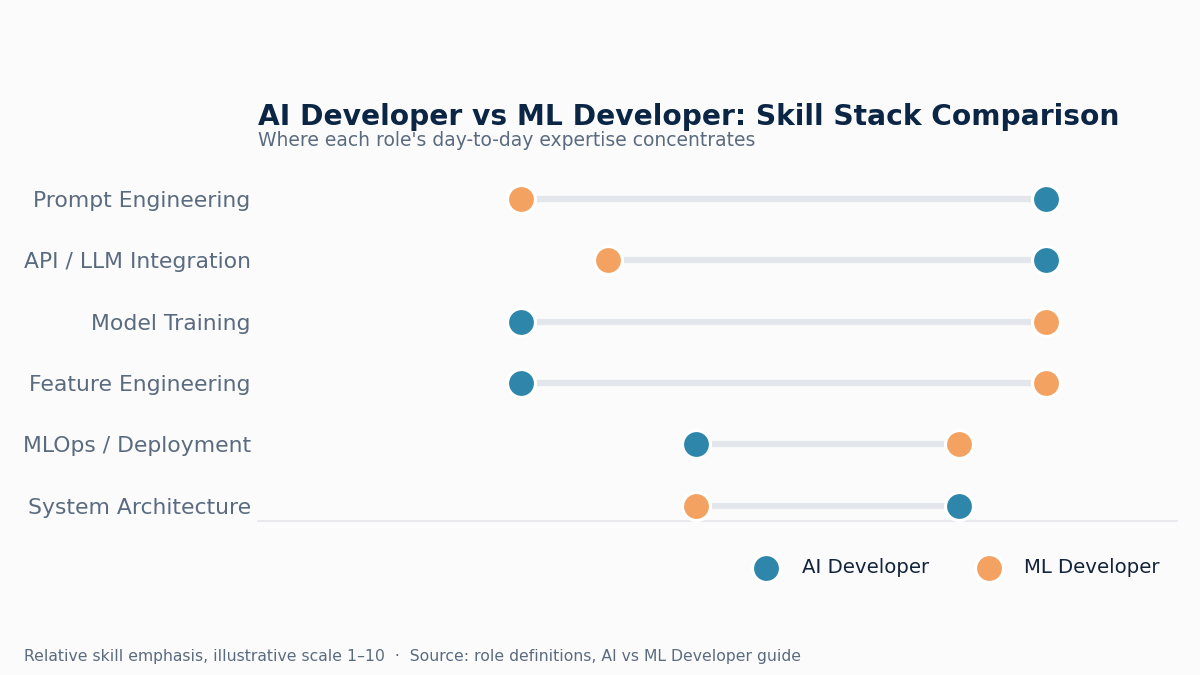
An AI developer is a software engineer who builds functional, end-to-end applications by integrating existing AI capabilities, foundation models, LLM APIs, computer vision services into real products. An ML developer (machine learning engineer) designs, trains, and deploys models from raw data, working close to the math: feature engineering, model architecture, and production-grade training pipelines. AI developers build with models that already exist; ML developers build the models themselves.
What they are not:
- Not interchangeable job titles for the same work. An AI developer wiring a chatbot into a support system and an ML engineer training a fraud-detection model are solving structurally different problems, even if both projects get labeled “AI” internally.
- Not a seniority ladder. One role isn’t a “junior” version of the other; a company can need a senior AI developer and a junior ML engineer simultaneously, depending on the project.
- Not always separate people. In small teams, one person often does both; at scale, companies split the roles because the skill depth required in each direction has grown too far apart to cover well part-time.
Why the Distinction Actually Matters
Getting this wrong isn’t a semantic problem; it shows up on the P&L.
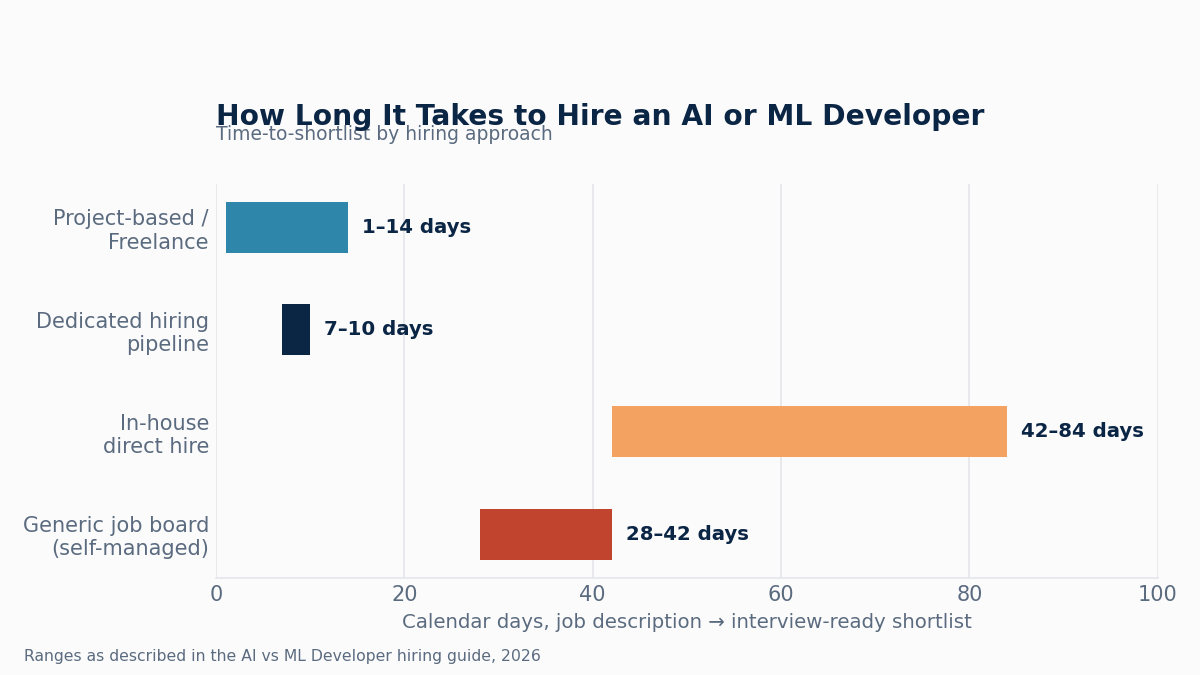
- Time-to-fill inflation. Roles that combine AI and ML requirements in one posting take measurably longer to fill because they attract candidates who are strong in only one half of the job. A precisely scoped role narrows the vetting pool to people who can actually do the work, which is most of what compresses a 7–10 working day shortlist timeline down from the 4–6 week average many teams experience with vague postings.
- Cost accuracy. Median compensation between the two roles differs by roughly 13–14% in current US postings, and the gap widens further once you factor in specialization (LLM-application engineering vs. production model engineering). Budgeting for “an AI person” without specifying which one leads to either overpaying for the wrong skill set or underpaying and losing the hire mid-process.
- Delivery risk. An AI developer asked to train a custom model from scratch, or an ML engineer asked to architect a production RAG pipeline, will both eventually produce something just slower, and with more rework, than someone whose actual specialization matches the task.
- Retention. Developers who are hired against a job description that doesn’t match their real day-to-day work disengage faster. Mismatched scope is one of the more common and most avoidable drivers of early attrition on technical teams.
- Skills-gap exposure at the organizational level. Gartner’s 2026 talent acquisition research projects that by 2030, half of enterprises will face irreversible skill shortages in critical roles, driven partly by uncompetitive pay and skills erosion tied to how fast AI capability requirements are moving. Companies that keep hiring against blended, imprecise AI/ML job descriptions are compounding that exposure every quarter, because each mis-scoped hire makes the next one harder to benchmark accurately.
- Vendor and platform risk. An AI developer’s job increasingly includes decisions about which model provider to depend on, what happens during an outage, and how token costs scale with usage. An ML engineer’s job includes decisions about data lineage, bias, and retraining cadence. Hiring the wrong profile for these decisions means nobody on the team is actually accountable for the risk that matters most for that project.
The Core Problem Most Buyers Face
Most hiring teams underestimate how much the AI/ML title landscape has fragmented in the last 24 months. What used to be a single “machine learning engineer” role has split into at least four distinct hiring profiles: classic ML engineers, AI/LLM application engineers, MLOps specialists, and generative AI developers and job boards, recruiters, and even candidates themselves don’t consistently use the same vocabulary for any of them.
The result, seen repeatedly across technical hiring:
- Scope creep in the JD. A single posting tries to cover model training, API integration, prompt engineering, and infrastructure, a combination almost no individual genuinely covers well, and a giveaway that the hiring manager hasn’t scoped the actual first-90-days work.
- 3–4x underestimation of vetting time. Teams budget one technical round for AI/ML hires, the same as a general backend hire, and then discover mid-project that a candidate who talked fluently about “training models” had never actually shipped one to production.
- Skills-gap blind spots. Stack Overflow’s 2025 Developer Survey found that 84% of developers are now using or planning to use AI tools in their workflow but trust in AI-generated output has fallen sharply, with under a third of professional developers saying they trust the accuracy of what these tools produce. That gap matters directly for hiring: a candidate who is fluent with AI coding assistants is not automatically someone who understands the systems those assistants are helping build.
- Compliance and IP blind spots, especially for regulated industries (fintech, healthcare) where model training data and output provenance carry real legal exposure that generic staffing processes don’t screen for.
Red flag in the hiring process itself: if your job description could be posted for either an AI developer or an ML engineer without changing a single line, the requisition hasn’t been scoped yet it’s been titled. That single tell predicts a longer, noisier hiring cycle almost every time, because the candidates who apply will self-select based on the title, not the actual work, and a meaningful share of them won’t be a fit once the first technical round starts probing specifics.
There’s also a talent-supply dimension buyers underestimate. Demand for roles requiring AI capability is growing far faster than the overall labor market in some verticals, demand for AI-skilled roles has grown by multiples of 3-4x within just a few years which means the “wait a bit longer, the right candidate will show up” instinct is getting more expensive every quarter, not less.
The Walkthrough: From Deciding You Need One to Managing the Hire
This is the full lifecycle scope to steady-state delivery. Skip a phase here and it tends to resurface later as a support ticket, a missed deadline, or an early resignation.
Phase 1 Defining Requirements
Before writing a single line of a job description, answer three questions in order: what problem are we solving, what does “done” look like in 90 days, and which of the four profiles below actually matches that work.
Role-to-project match:
| If your first project is… | You likely need… |
| Integrating an LLM API into an existing product (chatbot, search, summarization) | AI developer / Generative AI developer |
| Training a custom model on proprietary data (fraud detection, recommendation, forecasting) | ML developer / ML engineer |
| Deploying and monitoring models already built by data science | MLOps engineer |
| Building agentic workflows, RAG pipelines, or multi-step AI systems | AI engineer with LLM-orchestration experience |
Budget bands to plan against (India-based hiring, 2026, monthly, dedicated model):
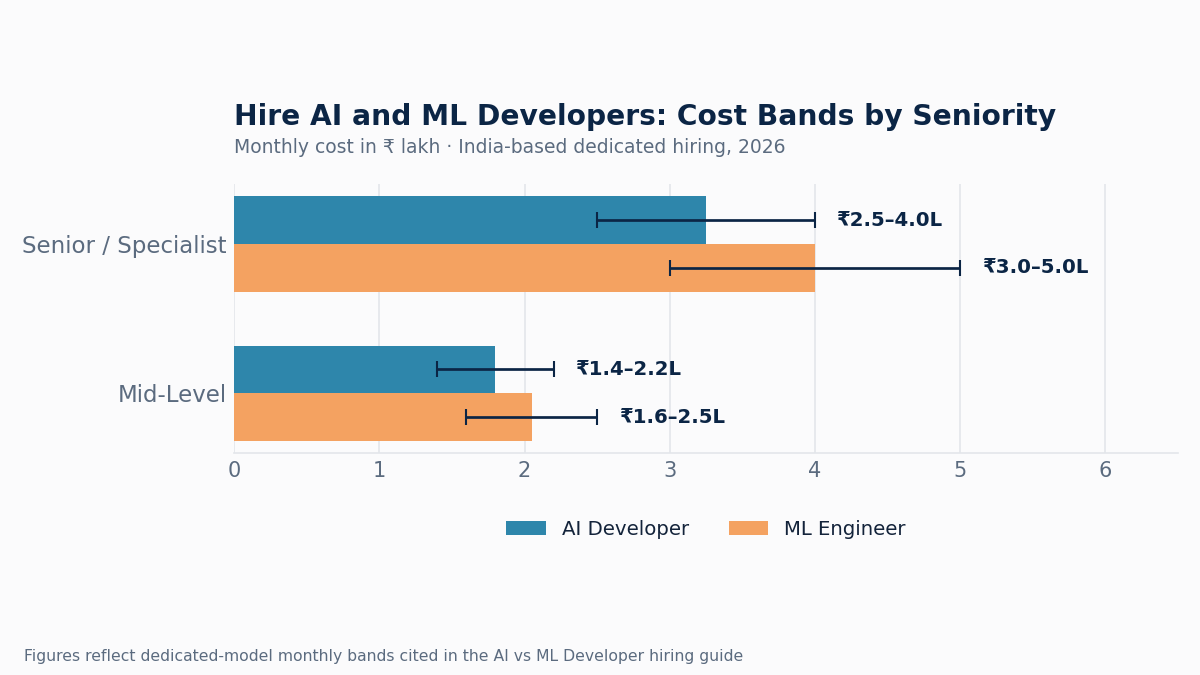
- Mid-level AI developer (API integration, RAG, LangChain): ₹1.4–2.2 lakh/month (~$1,700–$2,650)
- Senior AI/Generative AI developer: ₹2.5–4 lakh/month (~$3,000–$4,800)
- Mid-level ML engineer: ₹1.6–2.5 lakh/month (~$1,900–$3,000)
- Senior ML engineer (production training pipelines, MLOps): ₹3–5 lakh/month (~$3,600–$6,000)
US-based full-time hires run considerably higher: current postings put median base salary around $145,000 for AI Engineer roles and $165,000 for ML Engineer roles, a gap that reflects ML engineering’s deeper specialization requirement, not seniority.
The tech-stack question that scopes everything else: before writing the JD, decide which stack layer the hire actually owns. An AI developer’s stack typically centers on LangChain or similar orchestration frameworks, vector databases, prompt engineering, and API-layer integration with providers like OpenAI, Anthropic, or open-weight models.
An ML engineer’s stack centers on PyTorch or TensorFlow, feature stores, training infrastructure, and MLOps tooling for deployment and monitoring. If your JD lists both stacks as “required,” that’s the scope-creep red flag from the section above, showing up again at the requirements stage.
Requirements checklist before you post the role:
- Named the specific project this hire ships in the first 90 days
- Chosen one of the four profiles above not a blend
- Set a budget band based on real market data, not a round number
- Decided engagement model (dedicated / staff aug / project-based see Phase 3)
- Identified who technically vets the candidate internally
- Confirmed which stack layer (orchestration/integration vs. training/infrastructure) the role actually owns
The 3-day rule: if you can’t write the first three concrete tasks this hire will do in their first week, the requirements aren’t ready to post yet. This single discipline eliminates most of the downstream vetting confusion described in Phase 2.
Phase 2 Sourcing & Vetting
Sourcing volume is not the bottleneck in 2026 screening accuracy is. With AI-assisted resume writing now near-universal, a resume alone tells you almost nothing about real capability.
What good technical vetting looks like:
- A live, unaided coding or system-design round not a take-home that can be AI-generated, and not a pure whiteboard-algorithms round that has nothing to do with the actual job.
- For AI developers: a task involving real API integration, prompt design under constraints, and at least one question about failure handling when a model call times out or hallucinates.
- For ML engineers: a task involving feature engineering or model evaluation on a real (anonymized) dataset not a leetcode-style abstraction.
- A portfolio walkthrough where the candidate explains a project they shipped, including what broke and how they fixed it. Candidates who can only describe the happy path are a signal worth noting.
Red flags that show up repeatedly in poor vetting processes:
- Candidate can describe model architectures fluently but can’t explain a specific production incident they debugged
- Heavy reliance on buzzwords (“agentic,” “multimodal”) with no concrete project tied to them
- No comfort discussing cost or latency trade-offs a strong signal the candidate hasn’t shipped to production under real constraints
- Can’t explain why a model underperformed on a past project, only that it did
A specific pattern worth knowing: candidates who interview well on LLM orchestration frameworks (LangChain, LlamaIndex) but freeze when asked how they’d handle a provider outage or a sudden 10x cost spike from token usage this is one of the more common gaps between “can build a demo” and “can run this in production,” and it rarely shows up unless you ask directly.
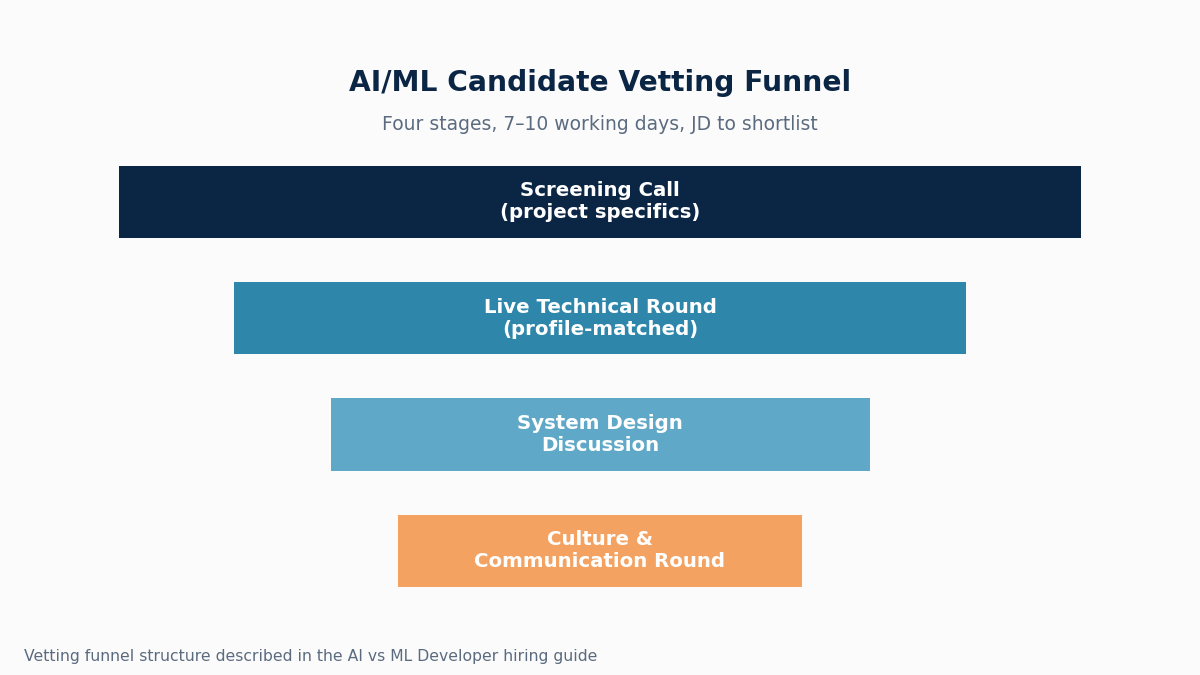
Structuring the vetting funnel itself matters as much as the individual round design. A funnel that works consistently for AI/ML roles typically runs: (1) a screening call focused on project specifics, not resume claims, (2) a live technical round matched to the exact profile from Phase 1, (3) a system-design or architecture discussion where the candidate has to justify trade-offs out loud, and (4) a culture/communication round because AI/ML hires who can’t clearly explain a model’s limitations to a non-technical stakeholder create downstream friction that shows up months later, usually in a product or leadership meeting rather than in the engineering team itself.
On timeline: a properly resourced vetting funnel, run against a pre-qualified pipeline, typically compresses to a 7–10 working day window between job description and an interview-ready shortlist. Running the same funnel from a cold job-board posting building the pipeline from zero routinely takes 4–6 weeks, simply because most of that time is spent filtering volume rather than assessing quality.
Phase 3 Engagement Models & Contracts
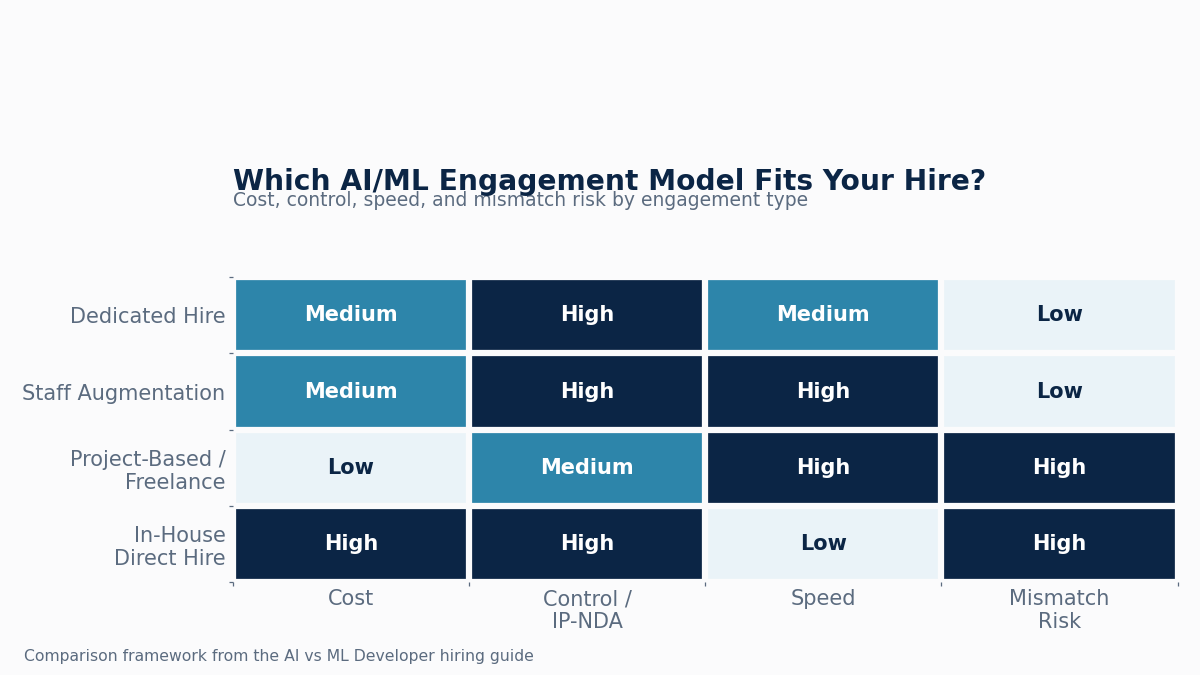
| Model | Best for | Control | Speed | Typical Contract Terms |
| Dedicated hire | Long-term, core product work | High | Medium (7–10 days to shortlist) | Monthly retainer, NDA + IP assignment, no shared bandwidth |
| Staff augmentation | Filling a skills gap on an existing team | Medium-High | Fast | Hourly/monthly, embedded in your existing sprint cycle |
| Project-based | Well-scoped, time-bound builds (e.g., a RAG proof-of-concept) | Medium | Fast to start, fixed scope | Fixed fee or milestone-based, deliverable-tied IP transfer |
| In-house direct hire | Core strategic AI capability, long horizon | Full | Slowest (6–12 weeks typical) | Standard employment contract, equity possible |
Non-negotiables regardless of model:
- NDA and IP assignment executed before technical access is granted, not after
- Clear data-handling terms if the developer will touch production or customer data
- A replacement clause a defined window (commonly 7–10 days) to swap a hire that isn’t working out, without re-starting the sourcing process from zero
- Data residency and model-provider terms, especially for regulated industries where training data is stored, which model providers are approved for use, and who owns fine-tuned model weights if the engagement ends
Companies increasingly formalize this through a Global Capability Center (GCC) structure rather than one-off contracts, particularly once AI/ML headcount crosses roughly 8-10 people. India’s GCC ecosystem has grown to over 2,100 centers generating close to $98 billion in revenue and employing 2.36 million professionals as of FY2026, and it is now recognized as the world’s largest AI hiring market by volume a scale that exists specifically because dedicated, NDA-backed, India-based technical hiring has matured enough to support long-term, IP-sensitive AI/ML work at that volume.
Phase 4 Onboarding & Ramp-Up
The first two weeks determine whether a hire ships in week 4 or week 10.
Week 1 checklist:
- Repo, environment, and API/model access provisioned before day one (not “we’ll get to it”)
- A small, real, scoped task assigned by day 2 not a generic onboarding doc read-through
- Introduction to the actual data or model artifacts they’ll work with, including known quirks and past failure modes
- Communication cadence set explicitly: standup time, async channel, escalation path
Week 2 checklist:
- First code or model artifact reviewed by a senior engineer, with specific feedback
- Access audit confirm the developer has exactly the access needed, no more, no less
- First 1:1 to surface friction points before they compound
Tooling that should be provisioned before day one, not requested on day one: model API keys and rate-limit tiers, vector database or feature store access, monitoring/observability dashboards for cost and latency, and for ML engineers specifically access to the actual training data with documentation of known quality issues. Teams that make a new hire request each of these individually over their first two weeks lose several productive days to access-request latency alone, which is a fully avoidable drag on ramp-up.
A dedicated-hire model with an experienced IT staffing partner typically has most of this provisioning templated already, since the same access pattern repeats across engagements one of the quieter reasons a 98% candidate joining rate and under 1% candidate drop-off are achievable at scale: the onboarding friction that causes early disengagement has largely been engineered out before the developer’s first day.
Phase 5 Managing Delivery
For AI/ML roles specifically, standard sprint velocity metrics undersell what’s happening, because model work doesn’t move linearly.
Reporting cadence that actually works:
- Weekly technical sync focused on blockers, not just status
- Bi-weekly demo of working output a model, an integration, a measurable output not a slide deck
- Monthly review against the original 90-day success definition from Phase 1
KPIs that matter more than “story points completed”:
- Model/feature accuracy against a defined baseline (for ML work)
- Latency and cost-per-request in production (for AI/LLM integration work)
- Number of production incidents traced to the AI/ML component, and mean time to resolution
Account management structure for dedicated hires: a named point of contact who isn’t the developer themselves should own escalation this matters more for AI/ML roles than generic engineering roles, because the failure modes (a model silently degrading, a provider changing pricing or deprecating an endpoint) are often invisible until someone is specifically watching for them.
Teams that skip a dedicated account manager tend to discover these issues weeks later, usually through a cost spike or a user complaint rather than proactive monitoring.
Phase 6 Scaling or Exiting
- Adding headcount: Scale the same profile (AI developer → more AI developers) before diversifying into adjacent roles (MLOps, data engineering) a common overcorrection is hiring a specialist too early, before there’s enough throughput to justify the role.
- Offboarding: Confirm IP and model artifacts are fully transferred and documented before an engagement ends; this is where undocumented “tribal knowledge” about model quirks gets lost most often.
- Replacement policy: A defined 7–10 day replacement window if a hire isn’t delivering, rather than absorbing a full re-hire cycle, meaningfully changes the cost of a bad match.
Case Studies
The following patterns are drawn from engagements across Supersourcing’s placement history spanning fintech, healthtech, and enterprise SaaS clients over 527 IT projects delivered to date.
Conversational AI scale-up (Yellow.ai, enterprise conversational AI platform). As demand for LLM-powered customer engagement accelerated, the engineering hiring bottleneck wasn’t sourcing volume; it was finding engineers who could work across both classic NLP pipelines and newer LLM-orchestration patterns without a learning-curve tax on live projects. Precisely scoping roles by which half of that skill set a project actually needed, rather than posting broad “AI engineer” requisitions, is the pattern that shortens time-to-productive-output most reliably across engagements like this.
Fintech engineering scale-up (OkCredit, digital ledger platform for merchants). Rapid user growth pushed the need for backend and ML-adjacent hiring (fraud detection, credit scoring signals) well ahead of typical hiring cycles. Structured technical vetting of live scenario-based rounds instead of resume screening alone is consistently what keeps candidate joining rates high and early attrition low in fast-scaling fintech engineering teams, in line with the 98% candidate joining rate and under 1% candidate drop-off figures typical of well-run dedicated hiring processes.
Healthtech recruitment automation (Somnoware, sleep-health diagnostics platform). Automating parts of the clinical workflow with AI required engineers comfortable with both regulated data handling and production ML deployment, a narrower intersection of skills than a generic “ML engineer” posting would surface. Engagements in regulated verticals like this benefit disproportionately from NDA-backed, IP-protected dedicated hiring models, since the compliance stakes of a mismatched or under-vetted hire are higher than in a typical consumer app context.
Comparison / Decision Framework
Use this to decide which engagement model and role profile fits your situation:
| Factor | Dedicated AI/ML Hire | Freelance/Marketplace | In-House Direct Hire | Staff Augmentation |
| Cost | Medium | Low upfront, variable long-term | High (salary + benefits + overhead) | Medium |
| Control over IP/NDA | High (contractually enforced) | Low-Medium (varies by platform) | High | High |
| Speed to start | 7–10 working days | Days | 6–12 weeks | Days to 2 weeks |
| Risk of mismatch | Low (replacement guarantee typical) | Medium-High | High (harder/slower to reverse) | Low |
| Best for | Long-term core AI/ML capability | Short, well-scoped experiments | Strategic, multi-year AI investment | Filling a specific skills gap fast |
The simple decision rule: if the work is exploratory and short (a proof-of-concept, a hackathon-style build), use freelance or project-based. If the work is core to your product and ongoing, use a dedicated hire or staff augmentation. Reserve in-house direct hiring for roles you expect to anchor your AI strategy for multiple years. The hiring cycle is long enough that it only pays off at that time horizon.
What Most Teams Get Wrong
They hire for the title, not the task. The single most repeated pattern: a hiring manager posts “AI Engineer” because it’s the trending title, when the actual first project is a classic ML training task, or vice versa. The fix is to write the first 90-day deliverable before the job title.
They treat vetting like a generic engineering hire. AI/ML roles need a technical round that specifically probes production judgment (cost, latency, failure modes, data quality) not just algorithmic fluency. A candidate can pass a generic coding round and still have never shipped a model or integration that survived contact with real users.
They underestimate the AI-assistance confound. With AI coding tools now used or planned by 84% of developers, distinguishing a candidate’s genuine skill from AI-assisted output during a take-home assignment has gotten measurably harder. Live, unaided technical rounds have become more important, not less, for exactly this reason.
They skip the replacement clause. Teams that don’t negotiate a defined replacement window upfront end up absorbing the full cost of a bad hire re-sourcing, re-vetting, re-onboarding instead of a fast swap.
They over-index on one geography for cost, and under-index on it for compliance. Offshore and GCC-based hiring can meaningfully reduce cost, but only if the vetting, NDA, and IP-assignment process is as rigorous as a direct hire, cost savings and compliance rigor aren’t a trade-off if the process is built correctly from the start.
They assume the cheapest AI-tool-fluent candidate is the fastest path to shipping. A candidate who’s fast with AI coding assistants can look highly productive in a demo and still produce code that takes longer to debug than it would have taken to write manually a pattern documented directly in the data: developers report spending more time debugging AI-generated code than expected in the majority of cases where they used it heavily. Speed in the interview room and speed in production aren’t the same signal.
They don’t revisit the role definition after the first project ships. A hire brought on as an AI developer for an integration project often gets asked, six months later, to “just train a quick model” for a new feature without anyone re-scoping the role, re-benchmarking the compensation, or acknowledging that the actual job has changed. This is a quieter version of the same mismatch problem from the hiring stage, just discovered later and harder to unwind.
Cost & Timeline Reality Check
What drives cost up:
- Regulated-industry data handling requirements (healthcare, fintech)
- Specialization in emerging sub-fields (agentic systems, multimodal models) where supply is thinnest
- Tight timelines requiring senior-only candidates
- US or Western Europe-based hiring vs. India/offshore hiring
What drives cost down without sacrificing quality:
- Precise role scoping (fewer false-start interviews)
- India-based dedicated hiring through an established vetting pipeline
- Staff augmentation for well-defined, bounded scopes rather than open-ended mandates
Typical timelines by scenario:
| Scenario | Typical Timeline |
| Dedicated hire via established staffing pipeline | 7–10 working days, JD to interview-ready shortlist |
| Generic job board posting, self-managed | 4–6 weeks to first viable shortlist |
| In-house direct hire (full-time, competitive market) | 6–12 weeks |
| Project-based / freelance engagement | Days to 2 weeks |
Cost tiers (monthly, dedicated model, India-based):
- Junior AI/ML developer: ₹80,000–1.4 lakh (~$950–$1,700)
- Mid-level: ₹1.4–2.5 lakh (~$1,700–$3,000)
- Senior/specialist: ₹2.5–5 lakh (~$3,000–$6,000)
Why India-based dedicated hiring has become the default for scaling AI/ML teams, not just a cost lever: the same NASSCOM-Zinnov data showing India’s GCC ecosystem crossing $98 billion in revenue also identifies India as the world’s number-one AI hiring market by volume. That scale means a deeper, more continuously vetted talent pool for AI/ML-specific roles than most single-country alternatives can offer, which is a quality argument as much as a cost one. Teams that treat offshore hiring purely as a cost-arbitrage decision, without weighing the depth of the available talent pool, tend to undervalue this dimension.
One more number worth planning around: demand for AI-enabled skills on major freelance and staffing platforms grew 109% year over year through 2026, with the fastest-growing sub-skills AI integration work and AI chatbot development sitting squarely in the AI-developer category rather than classic ML engineering. Budget cycles set a year in advance, based on last year’s rate cards, are increasingly out of date by the time a requisition actually opens.
Where to Go From Here
If you’ve read this far, you already know which of the four profiles your next hire needs to be and roughly what it should cost and how long it should take. The part that’s harder to self-serve is the vetting: telling a candidate who’s fluent in AI buzzwords apart from one who’s actually shipped production model or integration work.
That’s the specific gap Supersourcing’s AI-driven sourcing process is built to close, surfacing the top 2% of pre-vetted AI and ML talent against a 7–10 working day shortlist timeline, with NDA-backed IP protection and a replacement guarantee built into every dedicated engagement. If you’re mid-decision on your next AI or ML hire, the fastest next step is a scoping conversation, not another round of job board postings: talk to the team.
Frequently Asked Questions
What is the difference between an AI developer and an ML developer?
An AI developer integrates existing AI capabilities foundation models, APIs, pre-trained systems into functional applications. An ML developer builds and trains models from data. AI developers work one layer up the stack, on the product; ML developers work closer to the math and the training pipeline itself.
Can one developer do both AI and ML work?
In early-stage teams, yes many developers cover both, especially with modern tooling lowering the barrier to integration work. At scale, companies typically split the roles because the depth required in model training and in production system integration has diverged enough that covering both well, long-term, becomes difficult for one person.
How much do AI and ML developers cost to hire?
In India, dedicated mid-level hires typically run ₹1.4–2.5 lakh/month; senior specialists run ₹2.5–5 lakh/month. In the US, median base salaries currently sit around $145,000 for AI Engineer roles and $165,000 for ML Engineer roles, with meaningful premiums for LLM and agentic-systems specialization.
How long does it take to hire a qualified AI/ML developer?
Through an established dedicated-hiring pipeline, an interview-ready shortlist typically takes 7–10 working days. Self-managed job board postings commonly take 4–6 weeks to produce a comparable shortlist, largely due to screening volume and AI-assisted resume noise.
Is machine learning a subset of AI development?
Conceptually, yes machine learning is one approach within the broader field of artificial intelligence. As job titles, though, “AI developer” and “ML developer” describe different day-to-day work, not a hierarchy, so treating one as senior to the other is a common and costly misread.
Should a startup hire an AI engineer or an ML engineer first?
It depends entirely on the first project. If the immediate need is integrating an LLM into an existing product, start with an AI/Generative AI developer. If the need is training a custom model on proprietary data, start with an ML engineer. Hiring against the actual 90-day deliverable, not a general “AI headcount” mandate, avoids the most common early mis-hire.
What questions should I ask to vet an AI developer’s real skill level?
Ask about a specific production incident they debugged, how they’d handle a model API outage or cost spike, and have them walk through a real project including what broke. Fluency with framework names alone is not a reliable signal of production-readiness.
What’s the difference between staff augmentation and a dedicated AI team?
Staff augmentation embeds a developer into your existing team and sprint cycle to fill a specific skills gap, typically for a bounded scope. A dedicated hire is a longer-term, higher-control engagement often with NDA-backed IP protection and no shared bandwidth better suited to core, ongoing AI/ML capability.
Do I need a generative AI developer specifically, or is a general AI developer enough?
If your project centers on large language models, chatbots, content generation, RAG-based search, a developer with specific generative AI and prompt-engineering experience will ramp up faster than a general AI developer. For projects centered on computer vision or classic predictive systems, a general AI developer background is usually sufficient, and requiring “generative AI” specifically in the JD would unnecessarily narrow the pool.
What happens if the AI or ML developer I hire isn’t working out?
This is exactly what a replacement clause is for. A well-structured dedicated engagement includes a defined window commonly 7–10 days to swap the hire without restarting the full sourcing and vetting process. Confirm this term exists in the contract before the engagement starts, not after a problem surfaces; renegotiating it retroactively is far harder than agreeing to it upfront.
