

The average engineering team discovers a mis-hire in week 9. Everything in this guide on how to technically vet a developer exists to move that discovery back to week zero before the offer, before onboarding, before the damage. Because the contract says probation ends in week 12, the project deadline was week 8, and that gap between when you know and when you can act is where weak vetting concentrates its cost. All of it is preventable at the interview stage.
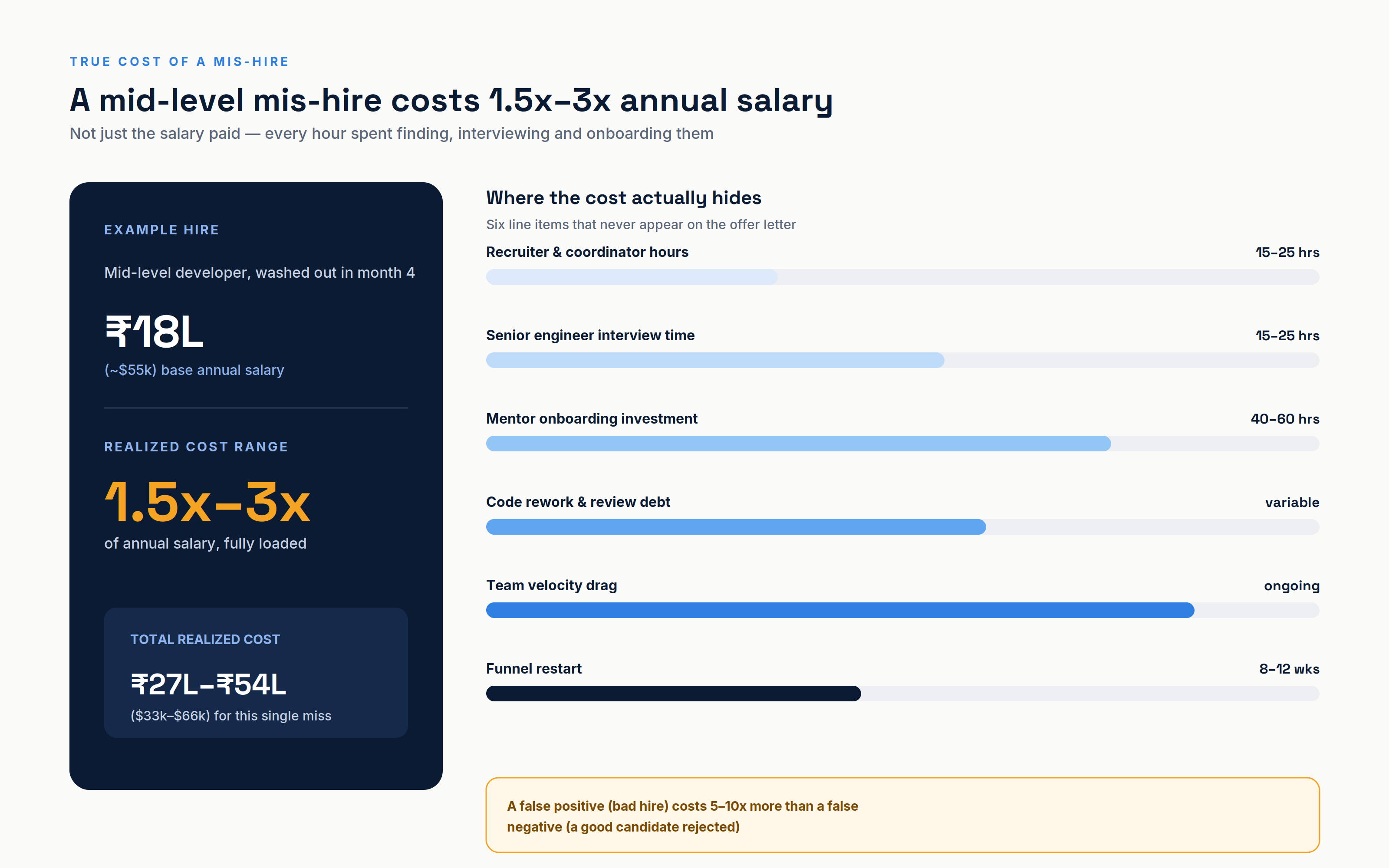
Here is the uncomfortable math. A mid-level developer hired at ₹18 lakhs (~$55k) who washes out in four months does not cost you four months of salary. They cost you the recruiter hours, the 15–25 engineering hours your senior staff spent interviewing, the 40–60 hours a mentor spent onboarding them, the code that now needs review or rewrite, and the 8–12 weeks it takes to restart the funnel. Teams that have run this calculation honestly land somewhere between 1.5x and 3x annual salary in total cost before counting the morale tax on the engineers who absorbed the workload.
McKinsey research on talent found that in highly complex roles and software engineering is the canonical example, high performers are up to 800% more productive than average performers.
That 8x spread is why rigorous developer vetting is not an HR formality. It is the single highest-leverage process an engineering organization owns. A vetting process that reliably separates the top quartile from the middle of the pack is worth more than almost any tooling or methodology investment you will make this year.
This guide is the full playbook: sourcing, resume screening, coding assessments, live coding and system design, culture and communication evaluation, reference checks, and the post-offer validation most guides never mention. It includes copy-ready scorecards, stage-by-stage time budgets, and the specific red flags that predict failure. Read it start to finish and you can run the entire process yourself with no prior hiring experience assumed.
What Is Technical Vetting?
Technical vetting is the structured, multi-stage evaluation of a developer’s coding ability, system design judgment, problem-solving process, and collaboration skills using calibrated assessments and scorecards rather than gut feel to predict on-the-job performance before an offer is extended.
To be precise about what it is not:
- It is not a single coding test. A standalone algorithm quiz measures test-taking, not engineering. Vetting is a funnel of complementary signals.
- It is not resume verification. Confirming someone worked at a company tells you nothing about how well they worked there.
- It is not culture-fit interviewing alone. “Would I enjoy working with this person?” is a real question, but answered without technical evidence it produces likable underperformers.
Why Rigorous Vetting Matters: The Business Case
A disciplined developer skills assessment process changes four business outcomes you can put on a dashboard. The numbers below reflect patterns Supersourcing has observed across 527+ delivered IT projects and a decade of enterprise hiring engagements.
- The cost of mis-hires drops sharply. The U.S. The Department of Labor’s widely cited estimate puts a bad hire at up to 30% of first-year earnings and that is the conservative floor. For engineering roles, once you add lost velocity and rework, total cost typically lands at 1.5x–3x annual salary. A vetting funnel with structured scoring at every stage cuts mis-hire rates from the industry-typical 15–25% down to low single digits.
- Time-to-productivity shrinks by 30–50%. Developers vetted against your actual stack and problem domain, not generic puzzle ramps in 2–4 weeks instead of 6–10, because the assessment already proved they can operate in your environment.
- Offer-to-joining conversion improves. A tight, respectful process signals a serious engineering culture. Funnels that run in 7–10 working days from job description to interview-ready shortlist routinely see joining rates above 95%; funnels that drag past 4–5 weeks lose 30–40% of accepted candidates to competing offers.
- Senior engineer time is protected. An uncalibrated process burns 20–30 senior-engineer hours per hire on interviews that produce weak signals. A calibrated funnel with an effective early screen cuts that to 8–12 hours because only the top 10–15% of applicants ever reach a human interviewer.
The compounding effect: each of these gains multiplies across every hire. A team making 20 engineering hires a year that improves mis-hire rate by just 10 percentage points recovers, conservatively, ₹1.5–3 crores ($180k–$360k) in avoided waste.
The Core Problem: Why Most Vetting Fails
Most teams do not fail at vetting because they lack effort. They fail because they systematically mismeasure and they underestimate the difficulty of measurement itself by 3–4x.
The four failure patterns that account for most bad hires:
- Optimizing for false negatives while ignoring false positives. Teams obsess over “did we reject anyone good?” and never audit “did we hire anyone weak?” But a false positive (a bad hire) costs 5–10x more than a false negative (a missed good candidate), because the good candidate you missed costs you a restart of the funnel, while the bad hire costs you salary, velocity, morale, and then a restart of the funnel.
- Unstructured interviews masquerading as rigor. Five rounds of “tell me about a challenging project” with five different interviewers, no shared rubric, and a debrief that amounts to thumbs up/down. Research on structured vs. unstructured interviews consistently shows unstructured formats are barely better than chance at predicting performance, yet they remain the default.
- Assessments that measure the wrong job. Testing a backend platform engineer on dynamic-programming puzzles they will never touch, while never once asking them to read, debug, or extend existing code which is 70–80% of the actual job.
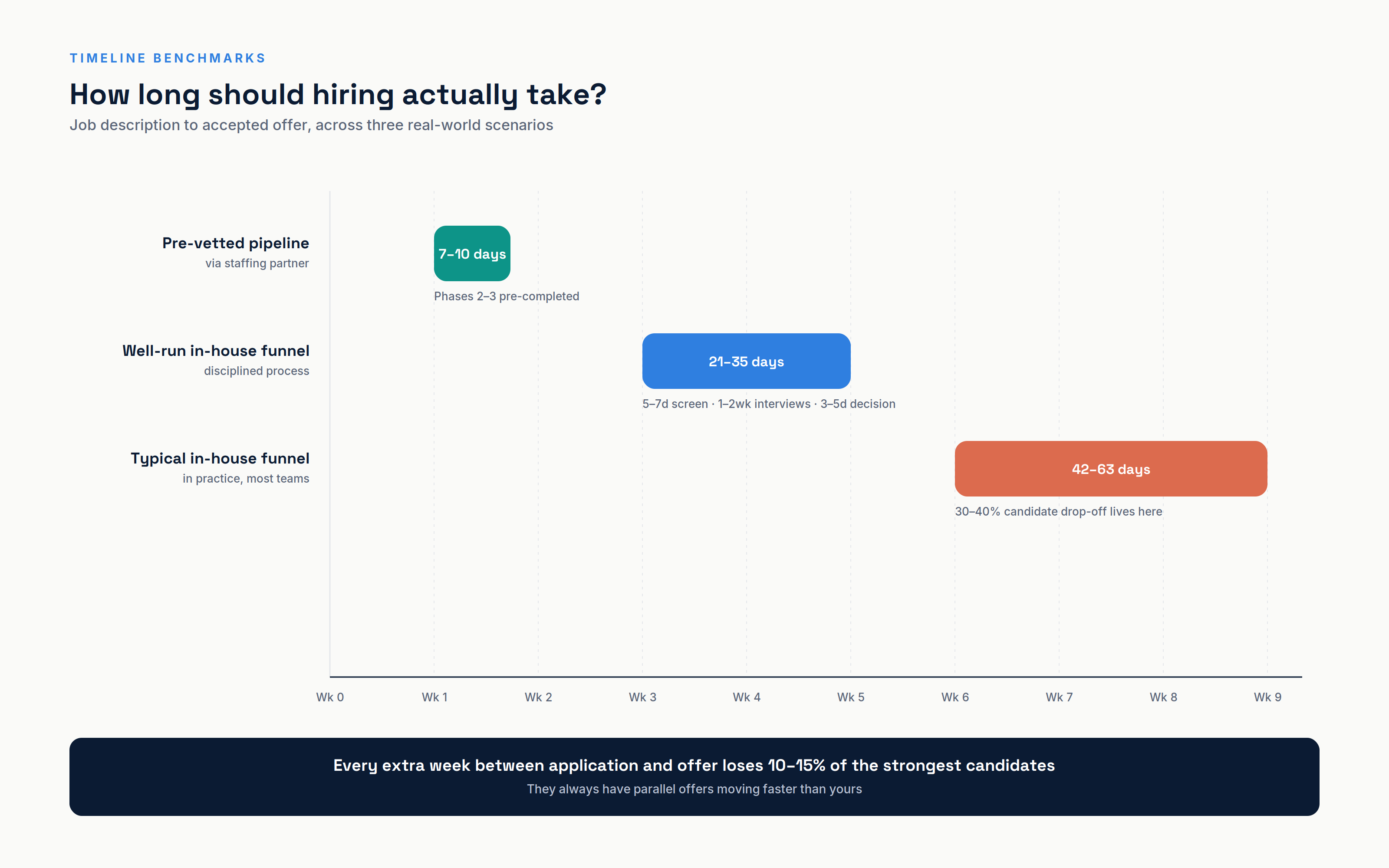
- Funnel decay from slowness. Every extra week between application and offer loses you 10–15% of the strongest candidates, because the strongest candidates always have parallel offers. Teams routinely plan a “two-week process” that takes six weeks in practice, a 3x slippage that quietly filters for candidates nobody else wanted.
Red flag for your own process: if your interviewers cannot state, before the interview starts, exactly which competencies they are scoring and on what scale, you are running an unstructured process regardless of how many rounds it has.
The rest of this guide is correct: a six-phase system for how to technically vet a developer, where every stage has a defined purpose, a time budget, a scorecard, and a drop-off checkpoint.
The A-to-Z Walkthrough: A Six-Phase Developer Vetting Process
This is the complete lifecycle from the moment you decide to hire, to the day you know the hire worked. Each phase has a purpose, a time budget, and a checkpoint where weak candidates exit the funnel, and each numbered block doubles as a developer vetting checklist you can lift into your own process document.
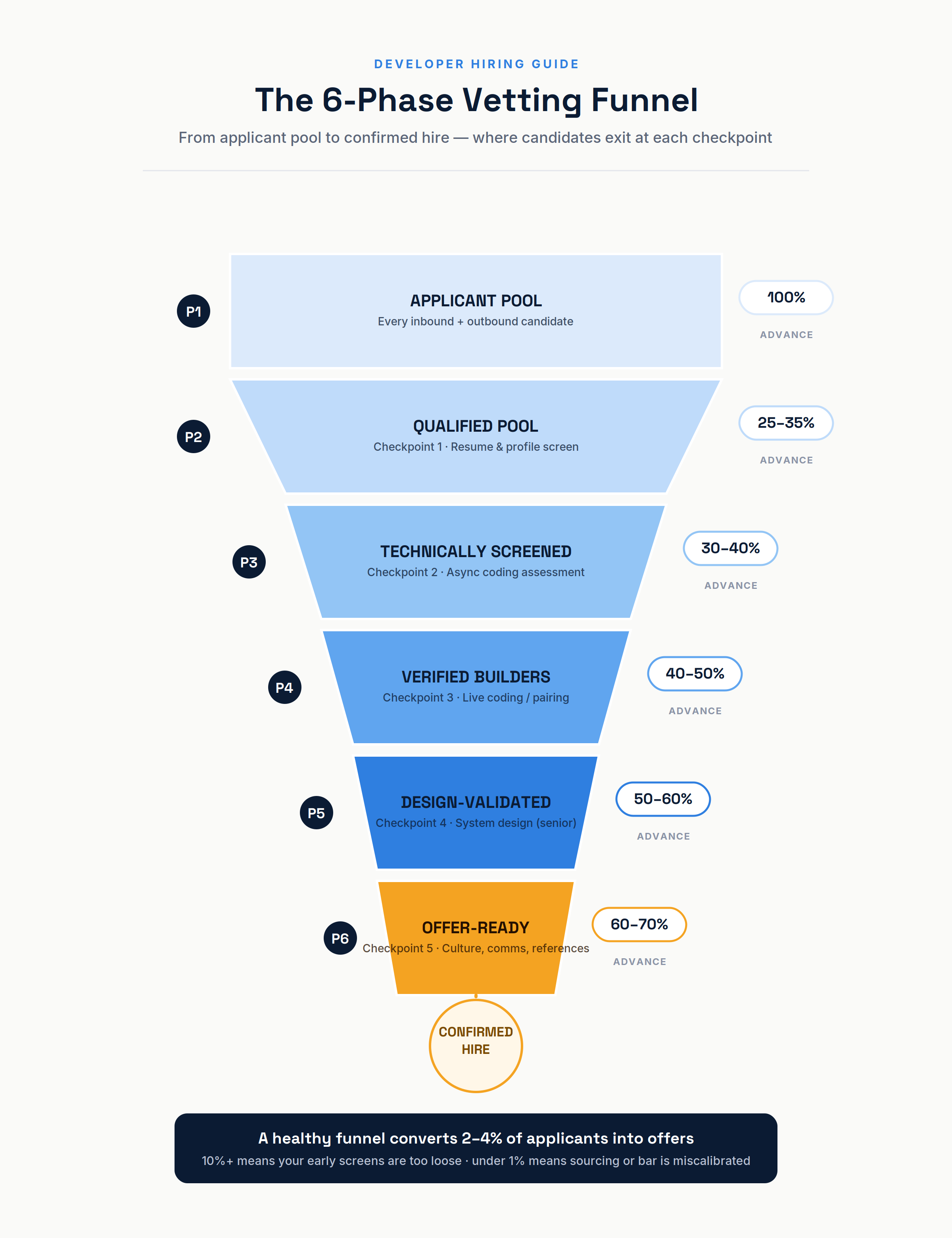
The funnel at a glance (infographic reference):
APPLICANT POOL (100%)
│
▼ Checkpoint 1: Resume & profile screen ──────► ~25–35% advance
QUALIFIED POOL
│
▼ Checkpoint 2: Async coding assessment ──────► ~30–40% advance
TECHNICALLY SCREENED
│
▼ Checkpoint 3: Live coding / pairing ────────► ~40–50% advance
VERIFIED BUILDERS
│
▼ Checkpoint 4: System design (senior roles) ─► ~50–60% advance
DESIGN-VALIDATED
│
▼ Checkpoint 5: Culture, communication, refs ─► ~60–70% advance
OFFER-READY (typically 2–4% of original pool)
│
▼ Checkpoint 6: Offer → joining → 90-day review
CONFIRMED HIRE
A healthy funnel converts roughly 2–4% of applicants into offers. If yours converts 10%+, your early screens are too loose; if it converts under 1%, your top-of-funnel sourcing is broken or your bar is miscalibrated.
Phase 1 Define the Role, the Bar, and the Scorecard (Days 1–2)
Everything downstream inherits the quality of this phase. Skipping it is why interviewers disagree in debriefs they were never evaluating the same job.
Build the role definition in this order:
- List the 5–7 tasks this developer will actually do in month one. Not the job-ad wish list the real backlog. “Extend a Node.js payments service, write integration tests, review 3–5 PRs a week, debug production incidents on-call.”
- Derive must-have vs. trainable skills. Must-haves are skills where ramp-up would take 3+ months (core language, architectural paradigm, domain depth). Everything else is a specific framework version, your CI tool is trainable in weeks and should not filter candidates.
- Calibrate seniority honestly. Junior = executes well-defined tickets with review. Mid = owns features end-to-end. Senior = owns systems, makes design trade-offs, multiplies others. Title inflation at this step causes 30–40% of “senior” mis-hires.
- Set the budget band before sourcing. Typical India bands: junior ₹6–12 LPA, mid ₹12–25 LPA, senior ₹25–45 LPA; US equivalents roughly $60k–90k / $90k–140k / $140k–200k+. Sourcing without a band wastes the whole funnel on candidates you cannot close.
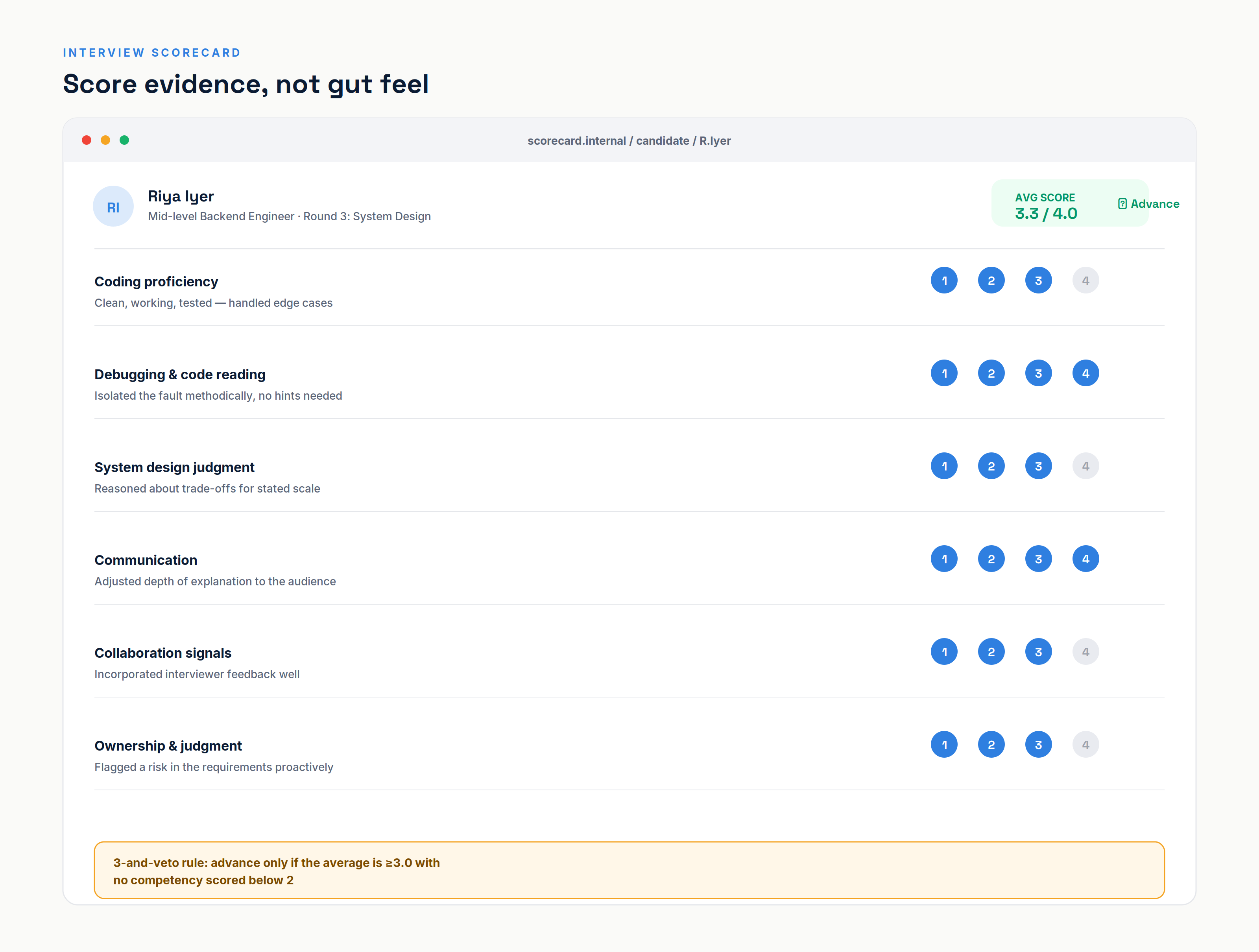
- Write the scorecard now, not after interviews. Define 5–6 competencies and a 1–4 scale for each.
Sample role scorecard (copy and adapt):
- Coding proficiency 1: cannot produce working code; 2: works with heavy hints; 3: clean, working, tested; 4: elegant, handles edge cases unprompted
- Debugging & code reading 1: lost in unfamiliar code; 2: navigates slowly; 3: isolates faults methodically; 4: forms and tests hypotheses like a senior on-call engineer
- System design judgment 1: no trade-off awareness; 2: textbook answers only; 3: reasons about trade-offs for stated scale; 4: probes requirements before designing
- Communication 1: cannot explain own code; 2: explains when prompted; 3: narrates thinking clearly; 4: adjusts depth to audience
- Collaboration signals 1: defensive under feedback; 2: accepts feedback passively; 3: incorporates feedback; 4: builds on feedback and disagrees constructively
- Ownership & judgment 1: waits for instruction; 2: executes tickets; 3: flags risks proactively; 4: reframes problems when the ticket is wrong
The 3-and-veto rule: advance a candidate only if they average ≥3.0 with no competency below 2, and any interviewer scoring a must-have competency at 1 triggers an automatic decline regardless of other scores.
Phase 2 Sourcing and Resume Screening (Days 2–5)
Technical interview process quality is capped by pipeline quality: you cannot interview your way to a great hire from a weak pool. Source from at least three channels in parallel inbound applications, outbound search (LinkedIn, GitHub activity, communities in your stack), and referrals because each channel over-indexes on a different candidate type. AI-assisted sourcing platforms can compress this dramatically; the strongest ones surface the top 2% of pre-vetted talent and deliver an interview-ready shortlist in 7–10 working days, versus the 3–5 weeks a cold pipeline usually takes.
What to look for when screening a developer resume a 6-point pass:
- Impact statements over duty statements. “Cut API p95 latency from 900ms to 180ms” beats “worked on API performance.” Candidates who think in outcomes tend to work in outcomes.
- Stack depth vs. stack sprawl. Fifteen technologies in three years usually means surface exposure. Look for 2–3 technologies with visible depth (versions, internals, scaling stories).
- Tenure pattern, read fairly. One short stint means nothing. Four consecutive sub-12-month stints without contract/consulting context is a pattern worth probing not auto-rejecting.
- Progression of scope. Did responsibilities grow bigger systems, more ambiguity, mentoring? Flat scope across five years at “senior” pricing is a calibration warning.
- Evidence trail. GitHub, technical writing, conference talks, open-source contributions. Absence proves nothing; presence is a free verified signal that spends 5 minutes reading their actual code before wasting an interview slot.
- Claims that can be interrogated. Vague resumes (“involved in microservices migration”) are not disqualifying, but flag every vague claim for the live rounds.
Red flags at this stage: keyword-stuffed skill lists with no supporting projects; “led” appearing on every bullet of a 2-year career; project descriptions that read like the company’s marketing page rather than the candidate’s contribution.
Time budget: 3–5 minutes per resume, 60–90 minutes per day of open req. If screening is consuming more, your job description is attracting the wrong pool to fix the top of the funnel, not the screener’s stamina.
Phase 3 The Technical Screen: Asynchronous Coding Assessment (Days 5–8)
The purpose of a coding test for hiring is ruthless economics: eliminate the 60–70% of the qualified pool who cannot code to your bar, before they consume senior-engineer hours. This stage should be asynchronous, automated where possible, and short.
Design rules for an assessment that produces real signal:
- Cap it at 60–90 minutes. Completion rates fall off a cliff beyond 90 minutes, and the candidates you lose first are the strongest ones they have other offers and self-respect.
- Test the job, not the textbook. For product engineering roles, a “fix this failing service / extend this small codebase” exercise predicts performance far better than LeetCode-hard puzzles. Reserve algorithmic assessments for roles where algorithms are genuinely the work.
- Include one code-reading task. Give them 80 lines of imperfect code and ask what is wrong and how they would improve it. Reading code is most of the job; almost nobody tests it.
- Use a platform with plagiarism and AI-assistance detection (HackerRank, Codility, CodeSignal, or an internal harness), but treat detection flags as prompts for live verification, not verdicts.
- Score against a rubric, not a percentage. Correctness (40%), code quality and structure (30%), edge-case handling (20%), clarity of any written explanation (10%).
The AI-era adjustment: assume every candidate can use AI assistants on take-home work, because in the job, they will. Either explicitly allow it and raise the bar accordingly (“we expect production-quality, tested code”), or keep this stage light and shift decisive weight to the live round. Pretending AI tools do not exist produces the worst outcome: you filter for candidates willing to lie about it.
Checkpoint: only candidates scoring in your top band (typically 30–40% of test-takers) advance. Send results-based rejections within 48 hours candidate experience at this stage directly affects your offer-acceptance rate later and your employer brand permanently.
Phase 4 Live Coding and the System Design Interview (Days 8–12)
This is where senior engineers finally enter the funnel and where the decision is substantially made. Run two distinct sessions for mid-level and above; juniors can skip system design.
Session A: Live coding / pair programming (60 minutes). The goal is watching someone work, not watching them perform.
- Use a realistic environment CoderPad, a shared IDE, or their own setup with screen share. Whiteboard coding tests memory and stage presence, neither of which ships software.
- Start from existing code. “Here is a small working IT service; add this feature / fix this bug” mirrors the job and immediately exposes code-reading ability.
- Let them use their real workflow docs, autocomplete, and (if your team uses them) AI assistants. Score judgment and verification behavior: do they blindly accept a suggestion, or test it?
- Interject one requirement change at minute 35. How they absorb changing requirements is one of the strongest predictors of on-the-job behavior you can capture in an hour.
- Score the process, not just completion: how they decompose the problem, when they test, what questions they ask, how they respond to a hint.
Session B: System design (60–75 minutes, mid-senior and above). Present an open-ended, scoped problem near your domain “design the notification system for an app with 5M DAU” and evaluate on four axes:
- Requirements probing: do they ask about scale, latency budgets, consistency needs before drawing boxes? Candidates who design first and ask later replicate that habit in production.
- Trade-off reasoning: every choice (SQL vs. NoSQL, sync vs. queue, cache strategy) should come with a stated cost. “We’d use Kafka” without a reason is pattern-matching, not design.
- Depth on demand: pick one component and drill three levels down. Seniors survive the drill; resume-driven candidates run out of floor by level two.
- Failure thinking: unprompted discussion of what breaks, degrades, and gets monitored is the clearest senior signal in the entire funnel.
Red flags in this phase: jumping to code before restating the problem; defensiveness when a hint is offered; buzzword architecture with no drill-down depth; inability to explain a decision they made 10 minutes earlier.
Phase 5 Culture, Communication, and Reference Checks (Days 12–15)
Technical excellence with broken collaboration still produces a failed hire just a slower, more expensive one. This phase evaluates the human system the code comes from.
Behavioral interview (45–60 minutes), structured around real incidents:
- “Walk me through a technical decision you got wrong. What happened next?” tests ownership; candidates who cannot produce a single real failure are the red flag.
- “Tell me about a strong disagreement with a colleague about an approach. How did it resolve?” tests conflict style; listen for whether the other party is described as a person or an obstacle.
- “Describe the most unclear requirement you ever received. What did you do before writing code?” tests behavior under ambiguity.
- “What did you teach your last team? What did they teach you?” tests mentoring instinct and learning posture simultaneously.
Use the STAR structure to keep answers anchored in real events, and score against the collaboration and ownership rows of the Phase 1 scorecard not against likability.
Questions to ask a developer’s references (15–20 minutes each, 2 references minimum):
- “In which situations did they do their best work and their worst?” (forces balance)
- “How did they respond to code review pushback?” (collaboration under friction)
- “If they rejoined your team tomorrow, what role would you put them in?” (calibrates seniority against a real manager’s judgment)
- “Would you hire them again and what would you plan around doing?” (the hesitation before the answer is the data)
Verification basics that get skipped surprisingly often: confirm employment dates and titles, verify degrees where the role requires them, and for contract or outsourced engagements, ensure NDA and IP-assignment terms are in place before day one not discovered missing in month three.
Phase 6 Offer, Onboarding, and 90-Day Validation (Day 15 onward)
Vetting does not end at “yes.” The last phase converts a good decision into a confirmed hire and catches the rare miss early enough to fix cheaply.
Closing the offer without losing the candidate:
- Move within 24–48 hours of the final round. Every silent day costs you 5–10% probability of acceptance on a strong candidate.
- Anchor the offer to the scorecard, not to negotiate theater candidates hired at the top of a band they cleared cleanly out-retained candidates squeezed at the bottom of it.
- Maintain weekly contact between acceptance and joining. Most drop-offs happen in this window; disciplined engagement is how mature programs hold joining rates near 98% and contract-role drop-off under 1%.
First-2-weeks onboarding checklist:
- Access provisioned before day one (repo, CI, staging, comms) every idle day one burns credibility
- A scoped, shippable first task in week one; first merged PR by day 7–10
- A named buddy plus a 30/60/90 plan tied to the same competencies you interviewed for
- Communication cadence set explicitly: standups, demo days, escalation path, and (for distributed teams) overlap hours in writing
The 90-day validation loop: review the new hire at day 30, 60, and 90 against the original scorecard. Two purposes: catch a mis-hire while a replacement guarantee window (typically 7–10 days for a backfill through a staffing partner, 30–90 days contractually) is still open, and just as important audit your funnel. If day-90 performance disagrees with interview scores, a specific stage of your process is producing noise, and now you know which one.
Case Studies: What Rigorous Vetting Looks Like at Scale
Paytm 100+ engineers without diluting the bar. Scaling hiring past a few dozen engineers is where most vetting processes quietly collapse into volume-driven shortcuts. Hiring 100+ engineers for Paytm required the opposite: a standardized scorecard applied across every panel, an async screen that removed 65%+ of the pool before human interviews, and a shortlist cadence of 7–10 working days per role. The result was volume hiring at a joining rate above 95% proof that speed and rigor are not a trade-off when the funnel is designed rather than improvised.
OkCredit cutting time-to-shortlist for core engineering roles. OkCredit’s engineering leaders were losing strong fintech candidates to faster-moving competitors during a multi-week internal pipeline. Restructuring the funnel around pre-vetted talent pools candidates who had already cleared coding and system design benchmarks compressed the job-description-to-interview window into days rather than weeks. The interview load on senior engineers dropped by roughly half because only design-validated candidates reached them.
Somnoware recruitment automation for a specialized healthtech stack. Niche domains punish generic vetting hardest: a healthtech software platform needs engineers who can be assessed against domain-adjacent problems, not abstract puzzles. Automating the sourcing and screening layers while customizing the technical assessment to Somnoware’s actual stack produced shortlists where the majority of interviewed candidates were offer-viable inverting the usual ratio, where interviewers reject the majority of the people they meet.
The common thread across all three: none of these outcomes came from interviewing harder. They came from filtering earlier, scoring consistently, and moving fast enough that the best candidates were still available when the offer went out. You can read more detailed breakdowns in our hiring case studies.
Take-Home Assignment vs Live Coding: A Decision Framework
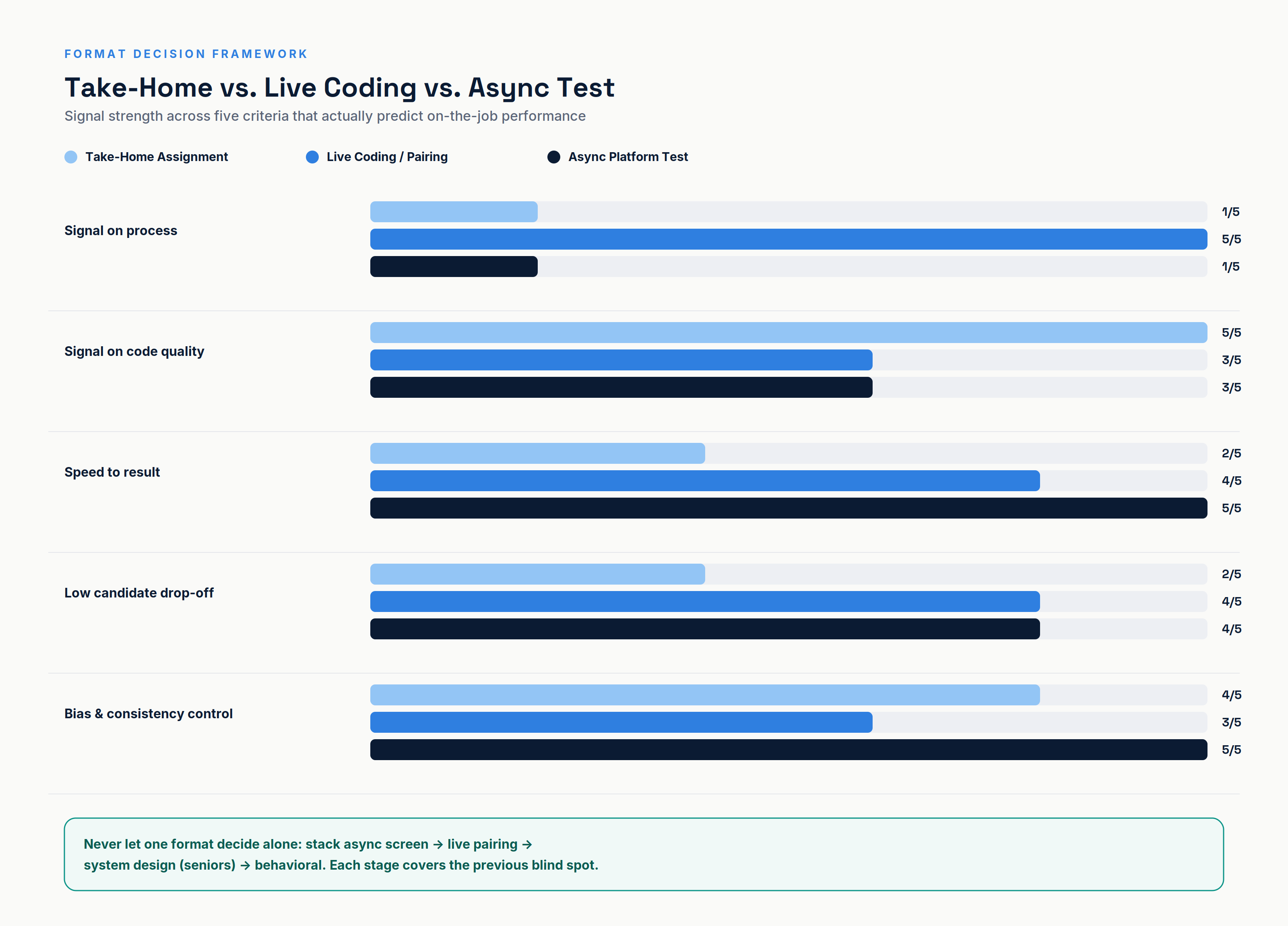
The take-home assignment vs live coding debate is usually argued as ideology. It is actually a context decision, and you can make it in five minutes with the table below.
| Criterion | Take-Home Assignment | Live Coding / Pairing | Async Platform Test |
| Best for | Senior candidates, product roles, writing-heavy codebases | All levels; strongest signal per hour | High-volume top-of-funnel filtering |
| Time cost to candidate | 2–4 hours (real-world: often 6+) | 60 minutes | 60–90 minutes |
| Time cost to your engineers | 30–45 min review per submission | 60–75 min per session | ~0 (automated scoring) |
| Signal quality | High for code quality; zero for process | Highest you see thinking live | Moderate correctness only |
| AI-assistance exposure | Total assume full AI use | Controlled and observable | Partial (detection tooling) |
| Drop-off risk | High 30–50% of senior candidates decline long take-homes | Low | Low if under 90 minutes |
| Bias/consistency | Good (work is comparable) | Depends on interviewer calibration | Best (identical conditions) |
How to choose three rules:
- Volume decides the first stage. Above ~30 applicants per role, an async platform test is the only economically sane first filter. Below that, skip straight to live formats.
- Seniority decides the take-home question. For senior candidates, either pay for take-home time, keep it under 3 honest hours, or replace it entirely with a live pairing session on real-ish code. Unpaid 8-hour projects selected for candidates with no other options.
- Never let any single format decide alone. The reliable pattern is a stack: async screen → live pairing → system design (for seniors) → behavioral. Each stage covers the blind spot of the previous one: the platform test cannot see process, pairing cannot see sustained code quality, and neither sees collaboration under real disagreement.
In-house funnel vs. pre-vetted pipeline is the second framework decision. Building the full funnel internally makes sense when you hire 15+ engineers a year and can staff calibration; below that volume, the fixed cost of building rubrics, training interviewers, and maintaining assessments usually exceeds the cost of plugging into an existing vetted pipeline via IT staffing or recruitment process outsourcing where the top-of-funnel screening, benchmarking, and replacement guarantees are already amortized across thousands of hires.
What Most Teams Get Wrong
These are pattern-level observations from a decade of Supersourcing engagements across 500+ engineering projects, the mistakes that repeat regardless of company size or funding stage.
- They interview for hiring, not for the job. The single most common failure. Teams test inverted binary trees and hire whoever performs best at interviews then act surprised when interview performance and job performance diverge. Fix: derive every assessment from the month-one backlog defined in Phase 1. If a task would never appear in a sprint, it should not appear in your funnel.
- They add rounds instead of adding structure. When a bad hire slips through, the reflex is a sixth round. But an unstructured sixth round adds noise, not signal and stretches the funnel past the point where strong candidates remain in it. Four calibrated rounds with shared rubrics outperform seven improvised ones, every time. If your process exceeds 4 rounds or 3 weeks, you are selecting for patience, not talent.
- They treat the debrief as a vote. “Thumbs up from everyone?” converts five structured interviews back into one unstructured feeling. Run debriefs as evidence reviews: each interviewer presents scores per competency with the specific observation behind each score, before anyone states a hire/no-hire position. Seniority speaks last, or it anchors the room.
- They never calibrate interviewers. Two interviewers watching the same candidate routinely score a full point apart on a 4-point scale. Teams that shadow new interviewers for 3–5 sessions and review score-vs-outcome data quarterly converge; teams that don’t are running a lottery with extra steps.
- They ignore the candidate’s evaluation of them. Your strongest candidates are vetting you back in every interaction response latency, interviewer preparedness, whether feedback is given. Teams with slow, opaque processes systematically lose the top of their own funnel and never see it happen, because declined offers and ghosted processes don’t show up in any dashboard they watch.
- They stop measuring at the offer. The funnel’s ground truth is 90-day performance, and almost nobody joins that data back to interview scores. Close this loop for two quarters and it will tell you with evidence which of your interview stages predicts nothing. Nearly every team that runs this exercise kills or rebuilds at least one round.
Cost & Timeline Reality Check
This is the section most guides on how to technically vet a developer omit, so here are the concrete ranges. Figures reflect typical India-based hiring with US equivalents; adjust ±20% for your market and stack rarity.
What the vetting process itself costs (per hire):
| Cost component | In-house funnel | Via staffing / RPO partner |
| Sourcing (ads, tools, outbound) | ₹30k–1L / $400–1,200 | Included in fee |
| Assessment platform | ₹1.5k–4k per candidate tested | Included |
| Engineering interview hours | 8–25 hrs × loaded senior cost ≈ ₹40k–1.5L | 4–8 hrs (final rounds only) |
| Recruiter/coordinator time | 15–25 hrs | Included |
| Agency/RPO fee | 8–15% of annual CTC (staffing) or per-seat RPO pricing | |
| Typical total | ₹1–3L / $1.5k–4k per hire | Fee-based, but 50–70% less internal time |
What a mis-hire costs (the number that justifies all of the above): salary paid (3–6 months), onboarding investment (40–80 mentor hours), rework and review of shipped code, team velocity drag, plus a full funnel restart totaling 1.5x–3x annual salary, i.e., ₹25L–₹75L ($30k–$90k+) for a single mid-to-senior miss.
Timeline benchmarks by scenario:
- Well-run in-house funnel: 3–5 weeks from JD to accepted offer (5–7 days screening, 1–2 weeks interviews, 3–5 days decision and offer).
- Typical in-house funnel in practice: 6–9 weeks and this is where the 30–40% candidate drop-off lives.
- Pre-vetted pipeline via a staffing partner: 7–10 working days from JD to interview-ready shortlist, offer within 2–3 weeks total, because Phases 2–3 are pre-completed.
- Niche stacks (Rust, embedded, ML infra, legacy mainframe): add 50–100% to any of the above plans for it rather than discovering it.
What drives cost and time up: title inflation (interviewing “seniors” your budget can’t close), more than 4 rounds, interviewer scheduling bottlenecks (block weekly interview slots in advance), and vague JDs that fill the funnel with mismatched applicants. What drives them down: a written scorecard, a sub-90-minute first screen, a 48-hour decision SLA after final rounds, and honest budget bands published to the sourcing team on day one.
Where to Go From Here
Everything above is the long version of how to technically vet a developer; here is the week-one version. If you have an open engineering req right now, do these three things, in order:
- Write the scorecard before the next interview five competencies, 1–4 scale, evidence-based descriptions. This single artifact upgrades every round you already have booked.
- Audit your funnel timing. If job-description-to-offer exceeds four weeks, identify the slowest stage and fix that one bottleneck it is almost always interviewer scheduling or a bloated take-home.
- Decide the build-vs-plug question honestly. Under ~15 hires a year, an in-house funnel rarely pays back its calibration cost.
And if the answer to #3 is “plug” or you simply want a benchmark of what a 7–10-day, pre-vetted shortlist would look like for your specific stack and budget and talk to the Supersourcing team. Bring the job description; a 30-minute conversation will tell you whether your role is a 2-week fill or a 2-month one, and exactly why. You can also explore how teams hire pre-vetted software developers or scale entire engineering functions through a Global Capability Center.
FAQ: How to Technically Vet a Developer
How do you vet a software developer before hiring?
Run a staged funnel: resume screen against a written competency list, a 60–90-minute asynchronous coding assessment, a live coding session on realistic code, a system design interview for mid-senior roles, a structured behavioral round, and two reference calls. Score every stage on a shared 1–4 rubric and advance only candidates averaging 3.0+ with no critical gaps.
What should a technical interview process include?
At minimum: one automated or asynchronous coding screen, one live coding or pair-programming session, and one structured behavioral interview plus a system design round for senior roles. Every round needs a defined competency list and rubric before the interview starts. Four calibrated rounds inside three weeks is the sweet spot; more rounds add noise and candidate drop-off, not signal.
How long should a coding test be?
60–90 minutes for an asynchronous screen. Completion rates and candidate quality both fall sharply beyond 90 minutes, because the strongest candidates, the ones with competing offers, quit long tests first. If you use a take-home project instead, cap it at 3 honest hours or compensate the candidate’s time.
Are take-home assignments better than live coding?
Neither is better universally, which is why the question matters less than the stack. Take-homes show sustained code quality but reveal nothing about process and assume full AI assistance; live coding shows real-time thinking, debugging, and collaboration but samples only an hour. The strongest funnels stack both: a short async screen for volume, then live pairing for depth.
What are red flags in a developer interview?
The reliable ones: coding before restating the problem, defensiveness when offered a hint, inability to explain a decision made minutes earlier, buzzword-heavy design answers that collapse under a three-level drill-down, no recallable example of a personal failure, and every past conflict narrated with the candidate as the only competent actor.
How many interview rounds should developer hiring have?
Three rounds for junior and mid-level roles (screen, live coding, behavioral); four for senior roles (add system design). Beyond four rounds, each additional stage measurably increases drop-off 10–15% of strong candidates per extra week while adding almost no predictive signal if the earlier rounds were structured.
What should a technical interview scorecard include?
Five to six competencies tied to the actual job coding proficiency, debugging and code reading, design judgment, communication, collaboration, ownership each on a defined 1–4 scale with written descriptions of what each level looks like. Interviewers score independently with evidence notes before any group debrief, and a hire requires a 3.0+ average with no must-have competency below 2.
How do you run this process without burning weeks of engineering time?
Either invest in building the funnel internally realistic if you hire 15+ engineers a year or plug into a pre-vetted pipeline where sourcing, screening, and benchmarking are already done, and your engineers only run final rounds. Mature vetted-talent programs deliver interview-ready shortlists in 7–10 working days with joining rates near 98%; if you’re weighing that trade-off for an active req, a short consultation call is usually enough to pressure-test which route fits your volume.
