

Hiring your first employee in another country usually starts with the same question: what is this actually going to cost?
You get on a call with an Employer of Record provider, see a number on a pricing page, and assume that’s the bill. Then the invoice arrives, and it’s higher sometimes a lot higher than what you budgeted for.
“The global Employer of Record market is estimated to reach $5.97 billion in 2026, highlighting the growing adoption of EOR services for international hiring and workforce management.”
This isn’t a pricing mistake on your end. It’s how EOR pricing models are built. Most providers quote one number publicly and let statutory contributions, currency conversion, onboarding charges, and “optional” add-ons do the rest of the work on the actual invoice.
This guide breaks down every major EOR pricing model in use today, what’s typically bundled into the fee versus billed separately, where hidden costs tend to hide, and how to compare providers on more than just the sticker price.
What Is an EOR, and Why Does Pricing Vary So Much?
An Employer of Record is a third-party entity that legally employs a worker on your behalf in a country where you don’t have a registered business presence.
The EOR handles local payroll, statutory contributions, tax filings, employment contracts, and compliance with local labor law, while you continue to manage the person’s day-to-day work.
Because employment law, tax rates, and mandatory benefits differ by country, and because EOR providers differ in how much of that complexity they absorb into one fee versus charge for separately,
EOR pricing swings widely. In practice, the EOR fee alone can range from roughly $200 to $1,000+ per employee per month, before you’ve added the employee’s salary or the country’s statutory employer contributions on top.
That range is exactly why understanding the pricing model matters more than chasing the lowest headline number.
The Main EOR Pricing Models
Most Employer of Record providers price their services using one of four structures. Each one shifts the risk and predictability differently between you and the provider.
1. Per-Employee (Flat Fee) Pricing
This is the most common EOR pricing model on the market. You pay a fixed monthly fee for each employee, regardless of that employee’s salary. A junior support hire and a senior engineer cost the same EOR fee, even though their salaries are very different.
How it typically works:
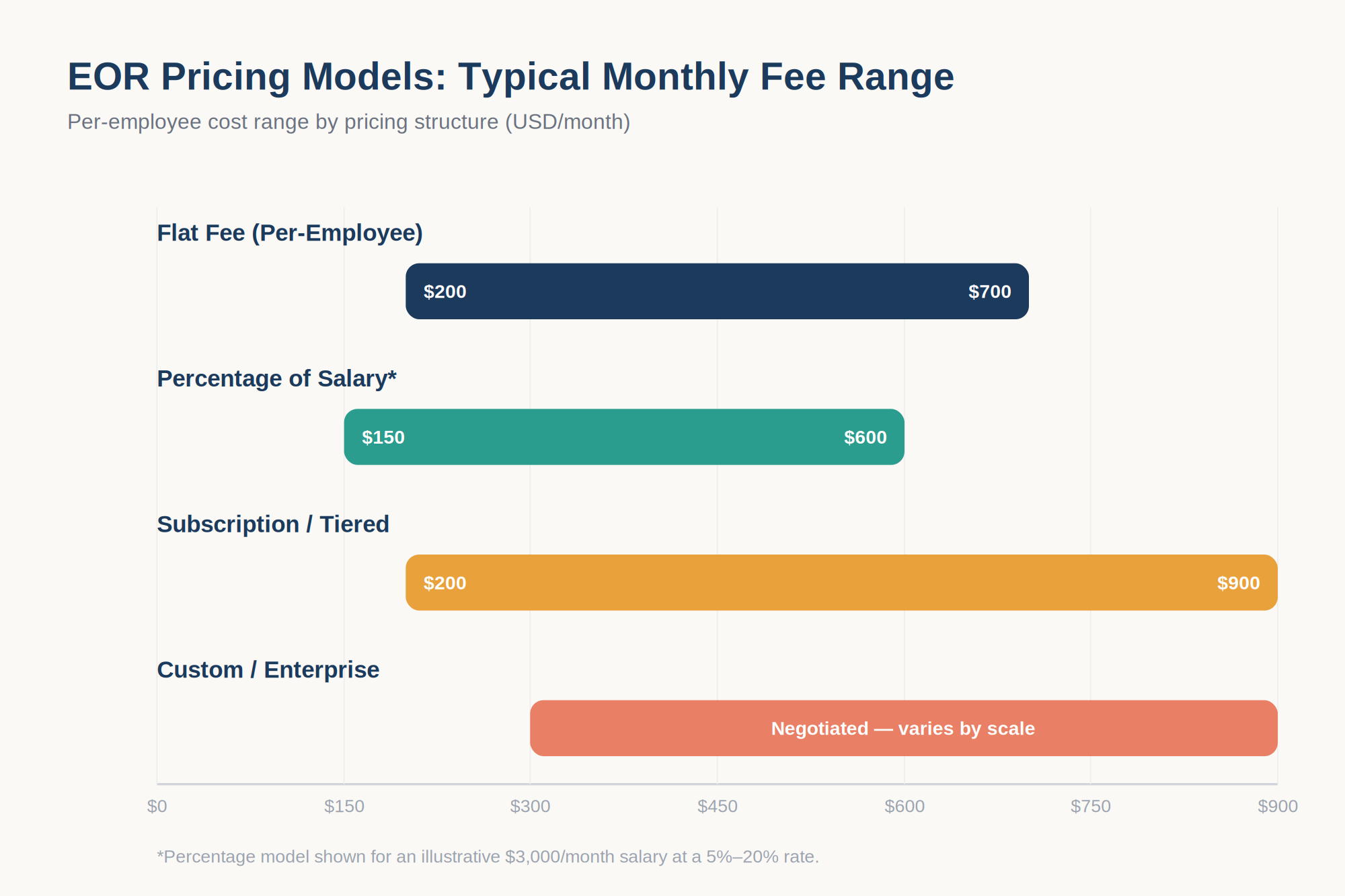
- A flat rate, usually somewhere between $200 and $700 per employee per month, depending on the provider and the country
- The fee usually covers payroll processing, statutory compliance, contract generation, and a baseline level of HR support
- Pricing is often tiered: a basic compliance-only package costs less than a package that includes benefits administration, equity support, or dedicated account management
Why businesses like it: it’s predictable. If you’re hiring five people across three countries, you can multiply the flat fee by headcount and get a fairly accurate monthly EOR cost, which makes budgeting for international hiring far simpler than a variable model.
Where it falls short: flat pricing doesn’t account for how much work a given employee actually generates. A straightforward remote hire in a low-compliance-burden country costs the provider far less to manage than a senior hire in a country with heavy statutory reporting requirements but you’re often charged the same flat rate either way.
2. Percentage-of-Salary Pricing
Instead of a flat fee, some EOR providers charge a percentage of the employee’s gross monthly salary, typically in the 5% to 20% range.
How it typically works:
- The provider takes an agreed percentage of gross salary as their fee
- As the employee’s salary increases (through a raise or a promotion), the EOR fee increases proportionally
- This model is more common with EOR providers who work heavily in performance-based or commission-driven industries, or with providers who want their revenue to scale with the value of the placement
Why businesses consider it: for lower-salary roles, percentage-based pricing can come out cheaper than a flat monthly fee. If you’re hiring an entry-level employee at $2,000 a month, 10% of salary is only $200, well under most flat-fee EOR rates.
Where it falls short: the model penalizes you for hiring senior or highly compensated talent. A $7,000-a-month engineer at a 12% rate costs $840 a month in EOR fees alone often more than what a comparable flat-fee provider would charge for the same role.
If your international team includes senior ICs, architects, or country leads, percentage-based EOR pricing can quietly become your most expensive line item.
3. Monthly Subscription / Tiered Plans
Some providers package their EOR service fees into subscription tiers Starter, Growth, Enterprise, or similarly named plans where each tier bundles a defined set of services at a fixed monthly rate per employee or per company.
How it typically works:
- Lower tiers cover core payroll and compliance
- Mid tiers add benefits administration, faster onboarding, and dedicated support
- Top tiers add things like immigration support, equity management, multi-country consolidated invoicing, and a named account manager
This model overlaps with per-employee pricing but is worth calling out separately because the tier you choose materially changes what counts as an “included” service versus an extra line item on your invoice.
A provider’s advertised starting price is almost always the lowest tier, stripped of the features most growing teams actually need.
4. Custom / Enterprise Pricing
Once a company crosses a certain headcount, often somewhere between 20 and 50 employees through a single provider, EOR providers typically move clients to custom, negotiated pricing rather than standard published rates.
How it typically works:
- Pricing is negotiated based on total headcount, contract length, number of countries, and the specific mix of services required
- Volume discounts kick in at defined thresholds, though the trigger point and discount depth vary significantly by provider
- Custom contracts often include service-level agreements (SLAs), dedicated support, and consolidated multi-country billing
Custom pricing generally produces the best per-employee rate at scale, but it also removes price transparency; you won’t know your real rate until you’ve gone through a sales negotiation, which makes early-stage comparison shopping harder.
What’s Usually Included in EOR Fees
Understanding what a “standard” EOR fee is supposed to cover helps you spot when a provider is under-delivering or when a competitor’s lower price comes with fewer inclusions. Most EOR service fees are built to cover:
- Drafting and issuing a locally compliant employment contract
- Monthly payroll processing and payslip generation
- Calculating and remitting statutory employer contributions (social security, pension, unemployment insurance, etc.)
- Income tax withholding and filing on the employee’s behalf
- A baseline level of ongoing compliance monitoring as local labor law changes
- Basic HR support and a point of contact for the client
Anything beyond this baseline benefits administration, equity or stock option management, visa and immigration support, background checks, or a dedicated account manager is frequently priced as an add-on, even at providers whose base fee looks competitive.
Common Hidden Costs in EOR Pricing
This is where most companies get caught off guard. The advertised EOR cost per employee is rarely the full monthly bill. Watch for these EOR hidden costs, since they can inflate the number on your pricing page by 20% to 30% or more:
- Onboarding and setup fees: A one-time charge per new employee for contract drafting, background checks, or system setup sometimes disclosed only at the contract stage.
- Foreign exchange (FX) markups: If the EOR pays your employee in local currency while invoicing you in USD or EUR, the currency conversion often carries a markup above the market rate. On a large international team, this adds up fast.
- Security deposits: Some providers require one to three months of an employee’s salary held as a refundable deposit to cover potential severance or unpaid invoices. This isn’t a “fee” in the traditional sense, but it does affect your upfront cash outlay.
- Termination and offboarding fees: Ending an employment contract, especially in countries with mandatory notice periods or severance requirements, can trigger a separate offboarding charge.
- Benefits administration surcharges: Health insurance, retirement contributions, or supplemental benefits are often quoted as “available” rather than included, with their own monthly per-employee add-on.
- Multi-country setup or consolidation fees: If you’re hiring across several countries through one provider, some EORs charge a setup fee per new country added to your account.
- Amendment fees: Changing an employee’s salary, title, or contract terms mid-year can trigger a per-amendment administrative charge at some providers.
The takeaway: before signing, ask for a sample invoice, not just a pricing page. A provider that can’t show you what a real monthly bill looks like line by line is one where hidden costs are more likely to surface later.
 Factors That Affect EOR Pricing
 Factors That Affect EOR Pricing
Several variables move the final number regardless of which pricing model a provider uses:
- Country of hire. Statutory employer contributions vary enormously from under 15% of salary in some markets to well over 30% in others. This single factor often has more impact on total employment cost than the EOR’s own fee.
- Employee salary level. Under percentage-based pricing, this directly drives the fee. Even under flat pricing, higher salaries sometimes push you into a higher service tier.
- Headcount and contract length. Volume discounts and multi-year commitments typically bring the per-employee rate down.
- Employment type. Full-time employees with statutory benefits generally cost more to administer than contractors, which shows up in pricing.
- Complexity of the role or contract. Fixed-term contracts, executive-level hires, or roles requiring visa sponsorship generally carry higher administrative costs.
- Level of support required. Self-serve platforms with minimal human support are cheaper than providers offering a dedicated account manager and hands-on HR guidance.
EOR Pricing Comparison: Which Model Fits Your Business?
| Pricing Model | How It’s Charged | Best For | Watch Out For |
| Per-employee (flat fee) | Fixed monthly rate per employee, regardless of salary | Predictable budgeting; teams with a mix of salary levels | Tier limitations; may overpay for low-salary roles |
| Percentage of salary | 5%–20% of gross monthly salary | Hiring lower-salary or entry-level roles | Costs scale sharply with senior or highly paid hires |
| Monthly subscription/tiered | Bundled service tiers at a set monthly rate | Companies that want clarity on exactly what’s included | Advertised price is usually the lowest, stripped-down tier |
| Custom/enterprise | Negotiated based on headcount, countries, and services | Larger teams (20+ employees) scaling across multiple countries | Limited price transparency before you’re deep in a sales process |
There isn’t a universally “cheapest” model the right fit depends on your team’s salary distribution, how many countries you’re hiring in, and how much support you need beyond core payroll and compliance.
Practical Tips for Choosing a Cost-Effective EOR Provider
- Ask for a fully itemized quote, not a headline rate.
Request the exact monthly cost for a specific role in a specific country, including statutory contributions, benefits, and any setup or FX charges not just the EOR’s own fee.
- Match the pricing model to your team’s salary mix
If you’re doing EOR tech hiring mostly senior or specialized roles, a flat per-employee fee is usually more cost-effective than a percentage-of-salary model. If you’re hiring mostly junior or entry-level roles, percentage-based pricing can work in your favor.
- Model the total cost of employment, not just the EOR fee.
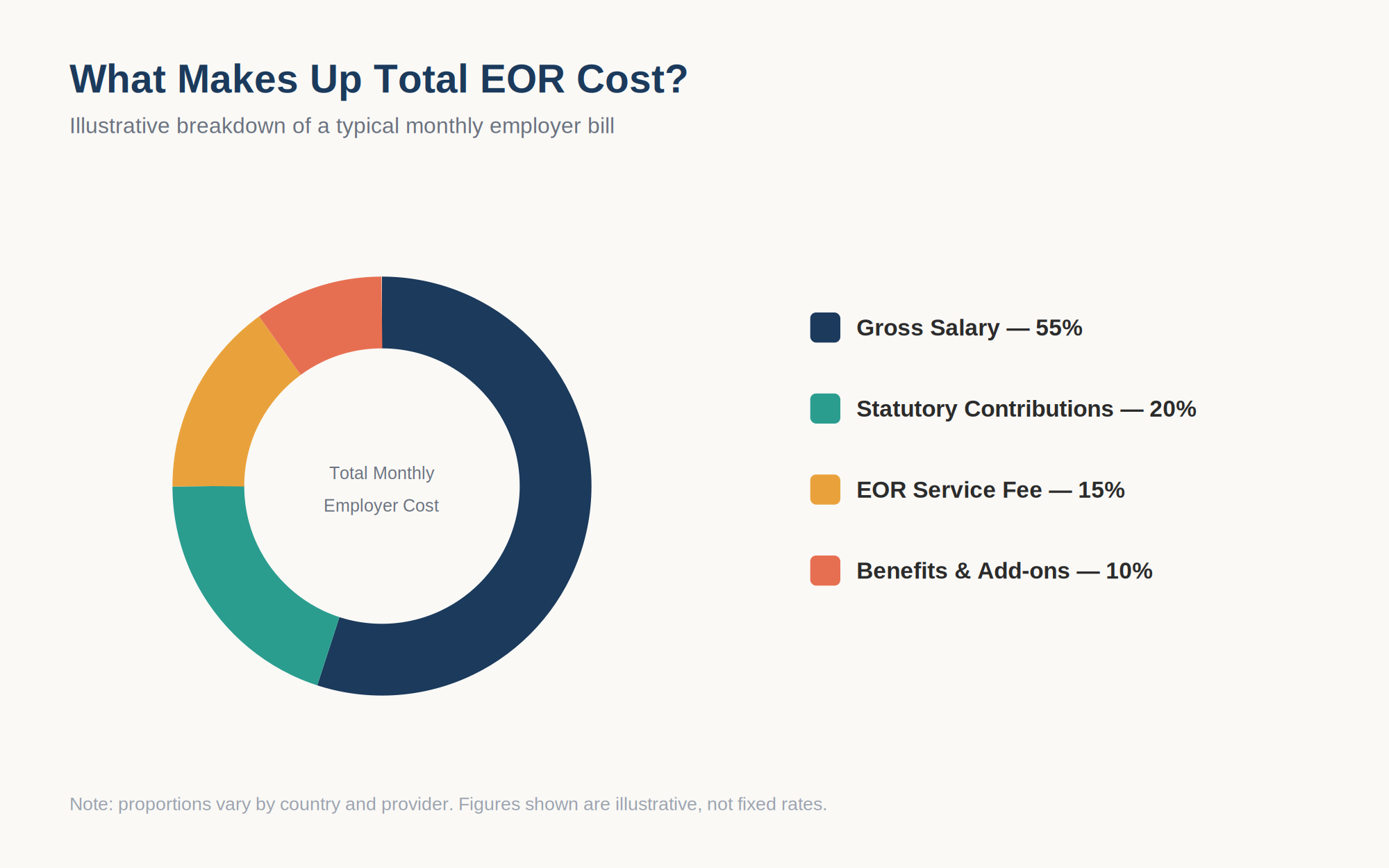
Total cost = EOR fee + gross salary + statutory employer contributions + benefits + any add-ons.
The EOR fee itself is often the smallest part of the total monthly cost.
- Clarify what triggers an extra charge.
Ask directly: does changing an employee’s salary cost extra? Does terminating a contract cost extra? Is there a deposit requirement? Get these answers in writing before signing.
- Check the volume discount threshold.
If you plan to scale past 10–20 employees with one provider, ask where the pricing steps down and whether that threshold is negotiable upfront rather than after you’ve already built out the team.
- Weigh support level against price.
A cheaper, self-serve platform can work well for straightforward hires, but if you’re navigating a country with complex labor law for the first time, the lower price may cost you more in compliance risk than it saves in fees.
- Get a sample invoice before signing.
This is the single fastest way to separate providers who are transparent about EOR pricing from providers who will let hidden costs surface later.
Conclusion
EOR pricing isn’t a single number you can compare across providers at a glance.
The pricing structure determines what you actually pay once statutory contributions, payroll, benefits, add-ons, and other fees are factored in. Per-employee, percentage-based, tiered, and custom EOR pricing models can all produce different total costs for the same hire.
The best value comes from looking beyond the headline EOR fee, calculating the full employment cost, and choosing a pricing model that fits your hiring plans.
For companies hiring in India, Supersourcing can simplify this process by managing EOR services, payroll processing, statutory compliance, contracts, salary disbursement, and employee exits through one platform.
Its EOR service is designed for companies that want to hire Indian employees without setting up their own local entity.
By combining transparent pricing with managed payroll and compliance support,
Supersourcing helps businesses reduce the administrative burden of international hiring while keeping their India-based workforce compliant and easier to manage.
Frequently Asked Questions
1. What is the average cost of an EOR per employee?
Most EOR providers charge between $200 and $700 per employee per month for their service fee, with premium or high-support providers going higher. This is separate from the employee’s salary and the country’s statutory employer contributions.
2. Is percentage-based EOR pricing cheaper than flat-fee pricing?
It depends on the employee’s salary. For lower-salary roles, percentage-based pricing (typically 5%–20% of gross salary) can be cheaper than a flat fee. For senior or highly compensated roles, flat-fee pricing is usually more cost-effective.
3. What’s usually not included in the base EOR fee?
Benefits administration, equity management, visa and immigration support, background checks, and dedicated account management are commonly billed separately, even when the base fee looks competitive.
4. What are the most common hidden costs with EOR providers?
Onboarding fees, FX markups on currency conversion, security deposits, termination or offboarding charges, and contract amendment fees are among the most frequently overlooked EOR hidden costs.
5. Does EOR pricing change based on the country of hire?
Yes. Statutory employer contributions differ significantly by country, and some providers also adjust their own service fee based on the compliance complexity of a given market.
6. When does it make sense to negotiate custom EOR pricing?
Once you’re hiring 20 or more employees through a single provider, or committing to a multi-year contract, custom or enterprise pricing generally brings the per-employee rate down significantly compared to standard published rates.
7. How can I avoid hidden EOR costs?
Ask for a fully itemized sample invoice before signing, get clarity on what triggers additional charges (salary changes, terminations, new countries), and confirm whether FX markups or security deposits apply.
