

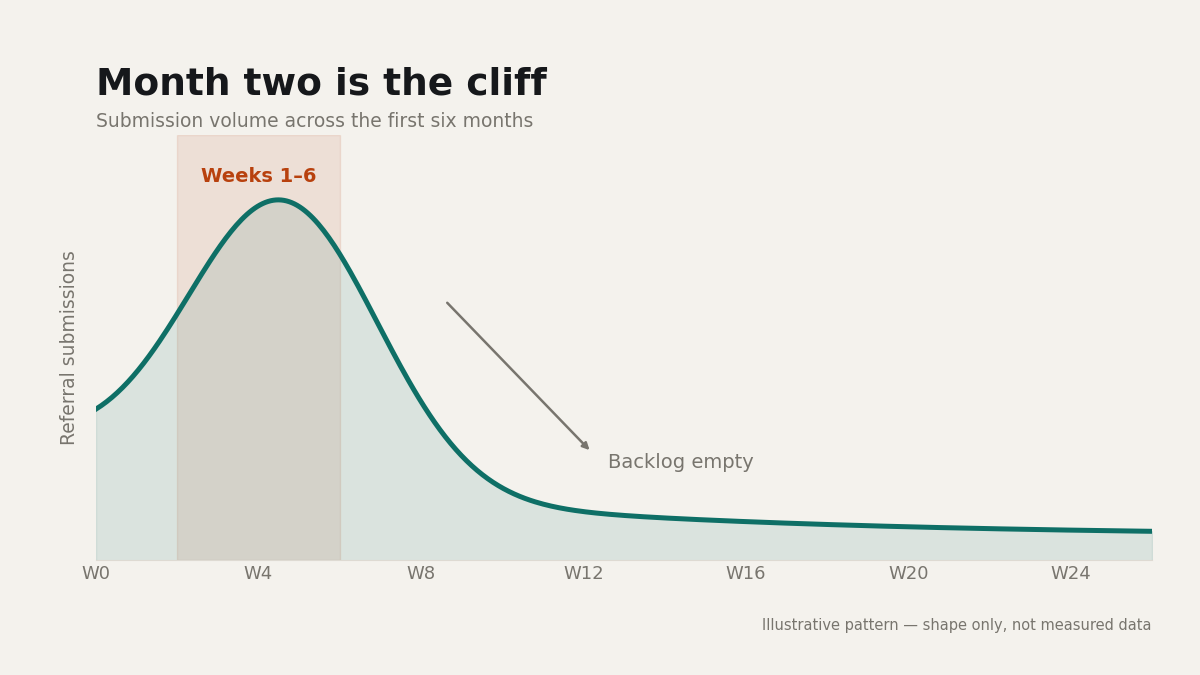
The shape of the failure is consistent enough to plan around. Submissions spike for four to six weeks while employees clear the obvious names out of their heads, then fall off sharply once that mental backlog is empty. The incentive didn’t change. What changed is that the program stopped being a live conversation and became a policy page nobody opens. By month three, most of the volume is coming from the same four or five people, and the channel is quietly written off as “we tried referrals.”
That write-off is expensive, because the channel converts better than anything else most companies own. And the pressure is going up, not down: Gartner expects that by 2030, half of enterprises will face irreversible skill shortages in critical job roles, driven partly by uncompetitive pay and skills erosion. Owned channels get more valuable as paid ones get more crowded.
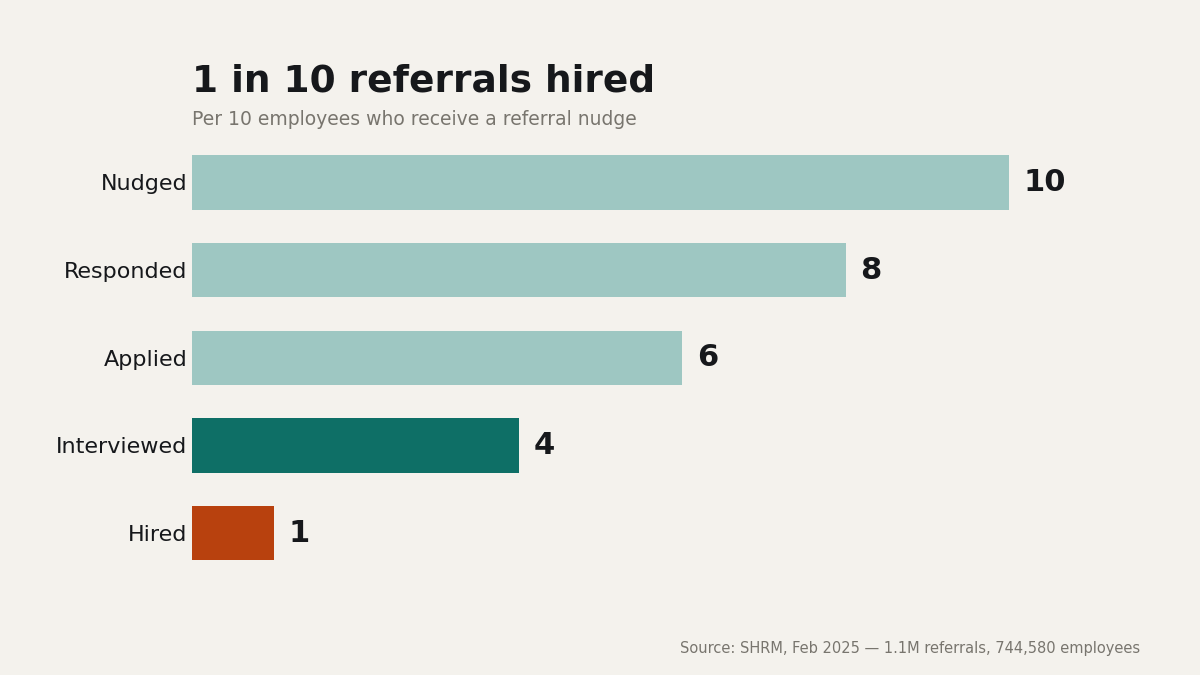
The number that should reframe your program design: analysis of 1.1 million referrals from 744,580 employees found that 1 in 10 referrals ends in a hire against the 50 to 60 applicants per hire that job boards typically require. The funnel is tight: of every 10 people who get a referral nudge, 8 respond, 6 apply, 4 interview, and 1 is hired.
So the question isn’t whether referrals work. The question is how to build an employee referral program that still produces qualified candidates in month nine after the launch email, after the Slack announcement, after the first three bonuses have been paid and the novelty is gone. That takes an operating model, not a bonus.
TL;DR
This guide covers how to build an employee referral program that keeps producing candidates after the launch buzz fades. It's written for talent acquisition leads, engineering managers and founders who already have a referral policy and are watching it die.
The single number worth holding onto: roughly 1 in 10 referrals converts to a hire, versus 50 to 60 applicants per hire from job boards. Most programs never see that rate because they lose people between "applied" and "interviewed," not at the top.
By the end you'll have a seven-step operating model, a referral bonus structure you can defend to finance, the four metrics that predict month-six volume, and a clear read on when referrals stop being the right channel and outbound sourcing has to take over.
What is an employee referral program?
An employee referral program is a structured hiring channel in which current employees submit candidates from their own networks for open roles, usually in exchange for a bonus paid after the referred candidate joins. A functioning program defines eligible roles, submission mechanics, recruiter response times, payout triggers, and the metrics used to judge whether it still works.
That last clause is where most policies stop short. A referral policy documents who gets paid. Working out how to build an employee referral program means managing a source of hire the way a recruiter owns a requisition: someone is accountable for its volume, its conversion and its decay.
Why referral programs fail after month two
Four failure modes explain almost every dead program we’ve been asked to revive, and only one of them is about money.
The backlog is finite. Every employee has a short list of people they’d vouch for without thinking. That list gets submitted in the first month. After that, referring requires actually scanning your network against a specific open role, a deliberate act that only happens if something prompts it. Programs that don’t re-prompt at the requisition level get exactly one wave.
Silence kills the second referral. A referrer takes real social risk: they told a friend this was worth their time. If three weeks pass with no update, the payoff for that risk is zero information. In most engagements we’ve run, days-to-first-response on referred candidates is the strongest single predictor of whether that employee refers again. Nobody tracks it.
The reward looks improbable. A bonus paid only after 90 days of survival, with clawback clauses and eligibility fine print, reads to employees as a lottery ticket. Effort and reward are separated by four months and several things the referrer can’t control.
Scope is too wide to be relevant. A careers page with 60 open roles across nine functions asks every employee to filter it themselves. Nobody in payments engineering is reading requisitions for customer support. Broad scope feels generous and performs like noise.
None of the four is fixed by a bigger check. All four are fixed by process, which is why how to build an employee referral program is an operations question rather than a compensation one and why the cost per hire advantage only materialises when the operations hold.
How to build an employee referral program: the seven-step operating model
Most published answers to how to build an employee referral program stop at the bonus table. The mechanics below are ordered deliberately instrument first, incentivise last, because a bonus bolted onto a broken funnel only makes the failure more expensive.
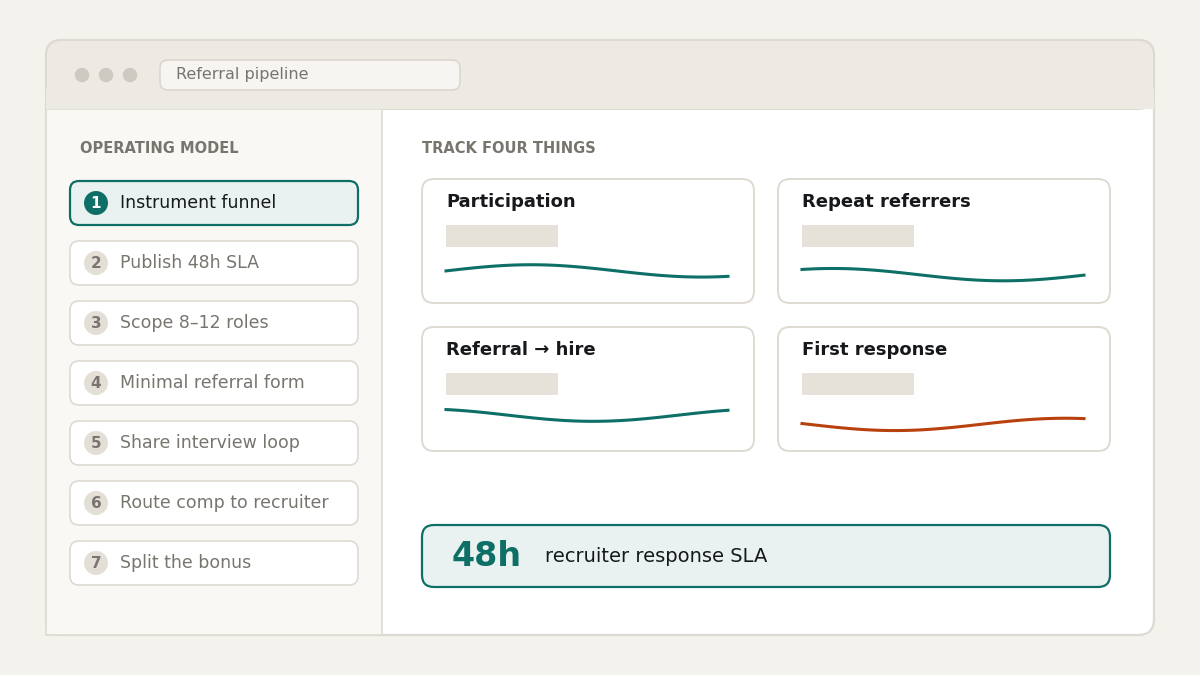
- Instrument the funnel before you design the reward. Track four things in your applicant tracking system (ATS): referral participation rate (share of employees submitting at least one candidate per quarter), repeat-referrer rate, referral-to-hire conversion rate, and days-to-first-response. Repeat-referrer rate is the leading indicator; it drops a full quarter before total volume does.
- Set a recruiter SLA and publish it. 48 hours to first human contact with the candidate, 48 hours to a status note back to the referrer. Publishing it converts an ambiguous favour into a transaction with known terms.
- Scope the program to 8–12 requisitions at a time. Pick the roles where time-to-fill is worst and network overlap is highest, usually senior backend, DevOps, data and specialist QA. Rotate the list monthly and announce the rotation at team level, not company level.
- Ask for the minimum viable referral. Name, LinkedIn URL, one line on why. The moment a form asks for a CV upload, submissions drop, because employees don’t have their friend’s CV and won’t ask for it. The recruiter’s job is to get the CV; the referrer’s job is to open the door.
- Arm the referrer with the interview loop. A one-page summary of stages, format, timeline and comp philosophy that they can forward directly. This is aimed squarely at the apply-to-interview step, where the SHRM funnel data shows the largest drop.
- Route comp conversations away from the referrer. Write this into the policy explicitly. When the referred candidate is an ex-colleague, the referrer often knows the band and the candidate will negotiate against it a friction point that surfaces late and sours both relationships.
- Design the incentive last, and split it. Covered in detail below.
Where referral programs have no network to draw on
One structural caveat worth naming: a new site has no referral channel for its first two to three quarters. When enterprises set up a global capability center, the first 20 employees’ networks are the entire channel, and referral share of hires lags headcount growth by roughly two quarters before it becomes material. Budgeting for referral-driven hiring in a new geography from month one is a planning error, not a program failure.
Referral program incentives that survive contact with month three
Referrals reach passive candidates who aren’t reading job ads, which is most of the market for senior engineers, but only while employees stay engaged enough to keep reaching. The most useful finding in recent referral research is that bonus size isn’t the lever teams assume it is. Incentive coverage matters more than incentive magnitude: programs perform better when every open role carries some incentive, even a small non-cash one, than when a handful of roles carry large bonuses and the rest carry nothing.
Two design rules follow from that:
Reward the behaviour you want repeated, not just the outcome you can’t control. Pay a small, unconditional acknowledgement of a gift card in the ₹2,000–5,000 band when a referred candidate reaches the interview stage. It costs little, it fires within days rather than months, and it rewards the one thing the referrer actually controls.
Size the bonus by difficulty-to-fill, not by seniority. A hard-to-source mid-level SRE should carry a larger bonus than an easy-to-fill senior generalist. Title-based tiers are administratively simple and behaviourally wrong.
Referral bonus structure: the split that changes behaviour
Split the payout. This is the part of how to build an employee referral program that finance will actually interrogate, so build it as arithmetic. A common and defensible structure is 50% on joining and 50% at the six-month mark the same shape SHRM uses internally for its own program. It manages retention risk without making the whole reward feel unreachable.
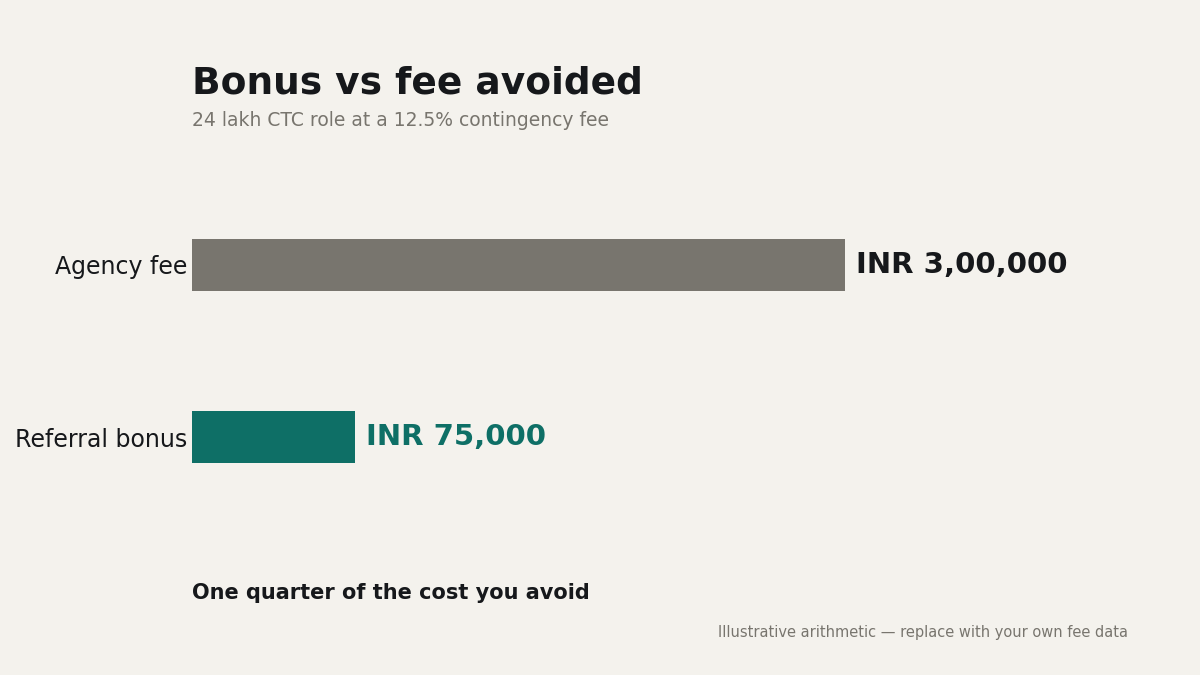
For sizing, benchmark against the fee you avoid rather than against what peers pay. Contingency recruitment fees in India typically run from around 8.33% of annual CTC (roughly one month’s salary) to 20% for specialist searches. On a ₹24 lakh role at a 12.5% fee, the agency route costs about ₹3 lakh. A ₹75,000 referral bonus is generous by employee standards and roughly a quarter of that cost and it’s the number to take to finance, because it frames the program as fee avoidance rather than incremental spend.
Two eligibility rules to settle in writing before launch, both of which cause disputes when left vague:
- Prior-submission rule. If the candidate already exists in the ATS from the last 6–12 months, is the referral void? Decide, and surface the answer before the employee submits, not after they claim.
- Ineligibility. Anyone with influence over the hiring decision recruiters, HR, the hiring manager on that requisition should be excluded from the bonus. It removes an obvious integrity question at zero cost.
Referral program engagement: running it as a campaign, not a policy
Sustained volume comes from a calendar. The engagement half of how to build an employee referral program is a campaign schedule, not a policy page: the programs that hold up past two quarters run a rotating monthly push on 8–12 roles, delivered into the team channel where the relevant engineers actually are, with a named owner and a visible scoreboard.
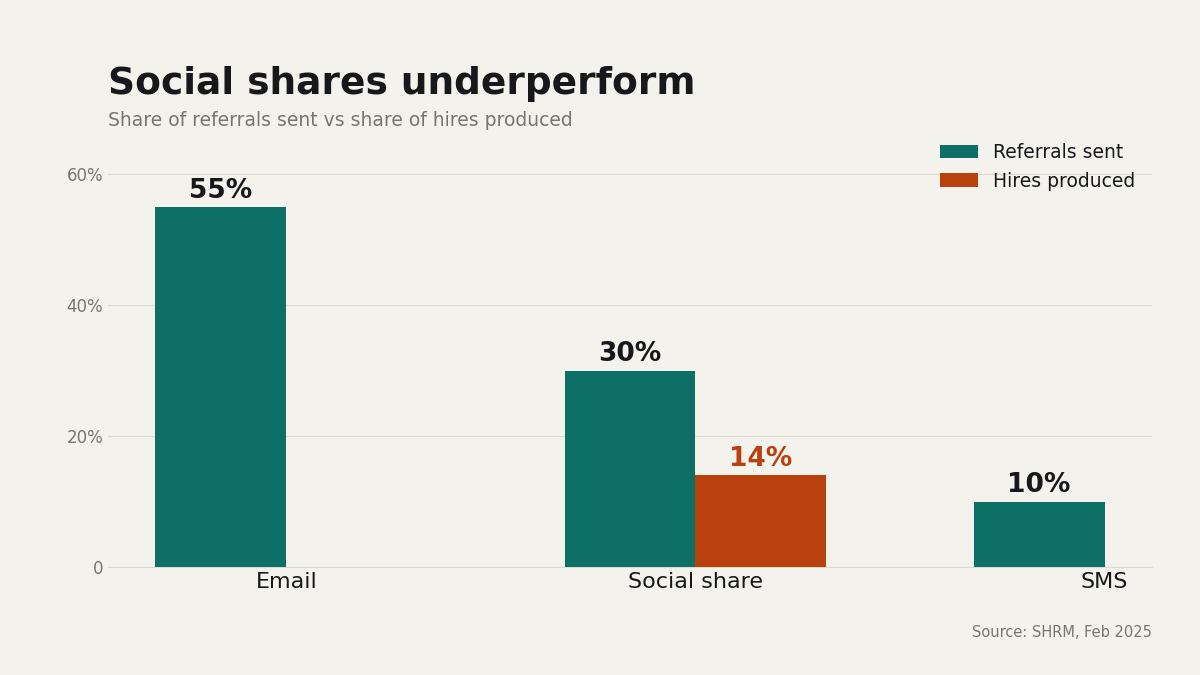
Channel choice matters more than most teams assume. In the SHRM-reported data, 55% of referrals came by email and 30% by social sharing but social sharing produced only 14% of hires. Broadcast posts inflate submission volume and depress referral-to-hire conversion rate. One-to-one referrals are the ones that convert, so structure campaigns to prompt direct nudges rather than link-sharing, and report the two channels separately or your dashboard will flatter you.
Leaderboards work, with one caveat from experience: rank on qualified referrals reaching interview, never on raw submissions. Rank on volume and you’ll get volume.
There’s an employer brand side effect worth budgeting for. The employees who refer most are usually the same people who post about the company externally and answer questions in industry communities, so the cost of treating referrers badly shows up on surfaces you don’t control.
Case studies: where referrals stop and pipeline starts
Somnoware (sleep diagnostics, 200+ hospitals). The constraint wasn’t sourcing it was cycle time, which is also the variable that quietly kills referral program engagement. Deploying AI-driven recruitment workflows cut manual effort by around 40% and halved the hiring cycle, which compresses exactly the response latency that stops referrers from referring twice.
Paytm (100+ engineers). No referral channel absorbs a burst of a hundred engineering roles; employee networks don’t scale that fast, and pushing a program that hard produces low-quality submissions and bonus disputes. That programme ran as a structured outbound engagement instead, and referrals covered the roles where network overlap was genuinely high. Knowing which roles belong in which channel is the decision, not choosing one channel and it’s the part of how to build an employee referral program that keeps the rest of the sourcing pipeline honest. More case studies sit behind that pattern, and teams that need to hire software developers at burst volume generally need both channels running in parallel.
Decision framework: which channel owns which requisition
| Channel | Realistic share of hires | Cost shape | Best used for |
| Employee referrals | 10–30% at steady state; higher at small headcount | Fixed bonus per hire; no ongoing spend | Roles with high network overlap; culture-sensitive hires |
| Inbound / job boards | Highest volume, lowest conversion | Low cost per applicant, high screening load | Generalist and high-applicant roles |
| Contingency agency | Ad hoc | ~8.33–20% of annual CTC per placement | One-off senior or rare-skill searches |
| Staffing / recruitment process outsourcing | Whatever the plan requires | Managed or per-seat; predictable | Burst hiring, multi-role scaling, new-geography builds |
The framework question is not “which is cheapest.” It’s which channel can carry the specific requisition inside the timeline you have, at an acceptable quality of hire. A referral program that covers 20% of hires is performing well; expecting it to cover 60% is what manufactures the month-two disappointment.
What most teams get wrong
If there is one line to carry out of this guide on how to build an employee referral program, it’s this: the bonus is not the problem, the queue is. In most failed programs we’ve reviewed, referred candidates sat behind cold applicants in the interview queue because hiring managers treated them as favours rather than as the highest-converting source in the funnel. Fix the queue and volume recovers without touching the incentive. Double the bonus and leave the queue alone, and you’ve just paid more for the same silence.
The second pattern is subtler and worth guarding against: referral pipelines inherit the shape of your existing team. Because referrals arrive pre-vouched, the scrutiny applied to them is often lighter than for other candidates which compounds sameness over time. Run referred candidates through the identical interview guide and scorecard. The channel earns speed, not exemptions.
Before you rebuild the program
If you’re rebuilding a referral program that stalled, the highest-value hour you can spend is auditing days-to-first-response on every referral submitted in the last two quarters. That number usually explains the decay on its own, and it costs nothing to pull.
If you want to pressure-test the channel mix before committing budget which roles referrals can realistically carry, which need outbound, and what the fee-avoidance maths actually looks like at your headcount, that’s a conversation we have regularly across staffing, RPO and GCC engagements. And if you’re still mapping out how to build an employee referral program from scratch, start with scope and response-time SLA and leave the bonus table for last. Reach us at supersourcing.com/contact-us or mayank@engineerbabu.com. No deck required; bring your requisition list.
FAQ: employee referral best practices teams ask about
What is a good employee referral rate?
Referrals delivering 20–30% of hires is a healthy steady state for most tech organisations; SHRM-reported analysis has put referrals above 30% of all hires and around 45% of internally sourced hires. Below 10% usually indicates a scope or response-time problem rather than an employee willingness problem.
How much should an employee referral bonus be?
Size it against the agency fee you avoid, not against peer benchmarks. With contingency fees typically running 8.33 — 20% of annual CTC, a bonus in the range of 20–30% of that avoided fee is generous to employees and cheap to the business. Split it 50% on joining, 50% at six months.
Why do employee referral programs fail after a few months?
The obvious-names backlog empties in weeks, and nothing re-prompts employees against specific open roles. Compounding it, slow feedback to referrers removes any reason to refer again. Both are process failures with process fixes: rotate a short requisition list monthly and enforce a 48-hour response SLA.
Should HR and hiring managers be eligible for referral bonuses?
No. Anyone who influences a hiring decision recruiters, HR, the hiring manager on that requisition should be ineligible. It costs nothing to exclude them and removes a conflict of interest that becomes very awkward to litigate after a payout is claimed.
How do you track employee referrals in an ATS?
Tag source-of-hire at submission, then report four fields: participation rate, repeat-referrer rate, referral-to-hire conversion, and days-to-first-response. Report email/direct referrals separately from social shares direct referrals convert far better, and blending them hides the decay.
When should we stop relying on referrals and bring in a partner?
When the requisition count outruns the network. If you’re filling more than a handful of roles per quarter in the same skill band, or standing up a team in a new location, referrals will cover a slice and outbound has to cover the rest. That’s the point of pressure-testing your plan.
