

Companies expanding engineering headcount across borders are running into the same wall: 87% of firms planning international expansion say meeting local tax and employment regulations will be their hardest operational challenge this year, and nearly three-quarters already lean on external experts for compliance and market entry. That single data point explains why the employer of record for hiring developers model has moved from a niche workaround to a default hiring channel for distributed engineering teams.
An engineering leader in Austin finds a backend engineer in Warsaw who’s exactly right for the role. The offer is verbal, the candidate is ready and then the hiring manager discovers the company has no legal entity in Poland, no payroll infrastructure to pay someone compliantly, and no fast way to build either. Six months ago, that gap killed the hire. Today, it’s a solved problem, and the solution is an employer of record.
An Employer of Record (EOR) acts as the legal employer on behalf of a company, handling critical responsibilities like payroll, taxes, benefits, and compliance with local labor laws. This allows businesses to hire talent in new countries without setting up a legal entity, significantly reducing time-to-hire and operational complexity. As highlighted in Global Employer of Record (EOR) importance and benefits, companies use EOR solutions to expand internationally faster while staying fully compliant with evolving employment regulations.
This guide covers the full mechanics: what an EOR actually does step by step, how it differs from setting up your own entity or hiring a contractor, what it costs in real numbers, how to run the onboarding and management lifecycle once you sign, and the failure patterns that experienced buyers watch for. By the end, a reader with zero prior exposure to global employment infrastructure should be able to run this process themselves from first deciding they need it, to managing a distributed engineering team through an EOR long-term.
Nothing here requires you to become an employment lawyer. It requires understanding the mechanics well enough to ask the right questions, read a contract critically, and avoid the mistakes that turn a fast hire into a compliance headache eighteen months later.
What Is an Employer of Record?
An employer of record for hiring developers is a third-party organization that becomes the legal employer of a worker on paper handling payroll, tax withholding, statutory benefits, and local labor law compliance while the hiring company directs the developer’s actual day-to-day work, projects, and output.
It is not:
- A staffing agency that simply places candidates and steps away once the placement is made
- A payroll processor that only cuts paychecks without taking on legal employer liability
- A co-employer in the PEO sense, where the client company must still maintain its own local registration in many jurisdictions
The distinction matters because it determines who carries legal risk. Under an EOR, the provider is the entity of record with the local government, meaning tax filings, statutory leave, termination notice requirements, and benefits enrollment run through them, not through the hiring company’s home-country HR system.
EOR vs PEO: The Key Difference
EOR vs PEO is the single most common point of confusion for first-time buyers, and it’s worth resolving before anything else. A Professional Employer Organization (PEO) enters a co-employment relationship; the client company remains the legal employer of record in the eyes of most regulators, and typically must already have a registered entity in that country. The PEO shares HR administration, but liability and registration obligations still sit substantially with the client.
An employer of record, by contrast, is the sole legal employer. That’s the structural reason an EOR works in countries where the hiring company has zero legal presence, while a PEO generally does not. If the plan is to hire one backend developer in a country you’ve never operated in, an EOR is almost always the right tool. If you already run a registered subsidiary and simply want help administering benefits and payroll for staff already on your books, a PEO can be the more cost-efficient choice. Providers that operate purely on the EOR model exist specifically for the first scenario of new-market hiring with no existing entity.
Why This Decision Matters: The Business Case
Choosing how to hire a developer abroad isn’t a paperwork detail; it changes cost structure, speed, and legal exposure in ways that compound over the life of the hire.
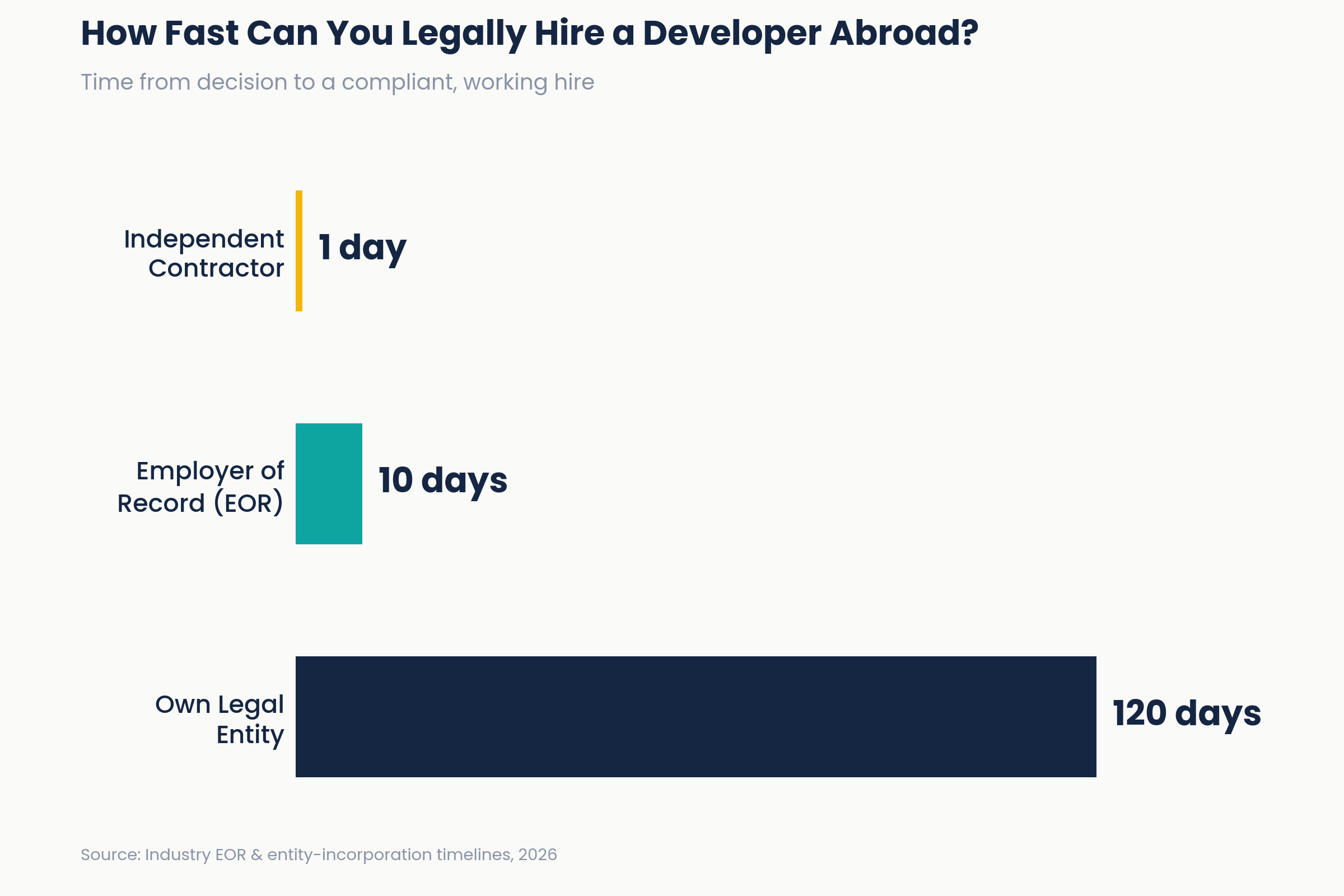
- Speed to productivity: Setting up a foreign legal entity typically takes 2-6 months depending on the country, plus additional weeks for opening a local bank account and registering for payroll taxes. An EOR arrangement can have a developer legally employed and receiving a compliant paycheck within 5-15 business days of signing.
- Cost avoidance on entity overhead: A foreign subsidiary carries recurring costs local accounting, registered agent fees, annual filings, a country-specific payroll system that can run $20,000-$60,000/year in fixed overhead before a single salary is paid. An EOR replaces that fixed cost with a variable, per-employee fee.
- Compliance risk transfer: Misclassifying a developer as an independent contractor when local law says they should be an employee is a genuine liability, not a theoretical one. In the U.S. alone, an estimated 10-30% of employers misclassify at least one worker, and enforcement has recovered tens of millions of dollars in back wages in recent years.
- Talent access: The Asia-Pacific region is now the fastest-growing hiring market for distributed employment arrangements, with growth estimates in the 10-17% CAGR range, driven largely by demand for engineering and technical talent.
- Retention through proper benefits: Developers hired on a compliant local contract with statutory leave, healthcare, and retirement contributions intact show materially lower early attrition than those hired on informal contractor arrangements with no safety net. Across the projects Supersourcing has delivered, joining rates on properly structured offers have consistently outperformed informal contractor placements.
The Core Problem Most Buyers Face
Most engineering leaders underestimate the complexity of hiring across borders by a wide margin often by 3-4x on both timeline and true cost. Three patterns show up repeatedly:
Timeline slippage. A team plans for a 2-week hire and discovers, mid-process, that the target country requires a signed employment contract in the local language, a mandatory probation clause, and a specific notice period before the offer can even go out. What looked like a 2-week hire becomes 6-8 weeks.
Cost surprises. Teams price a hire off gross salary alone and miss employer-side statutory costs social security contributions, mandatory 13th-month pay in some countries, health insurance mandates that add 20-45% on top of base salary depending on jurisdiction. That delta isn’t optional; it’s law.
Vetting gaps. Under time pressure, technical screening gets compressed or skipped, and cultural/communication fit is assumed rather than tested. This is the single largest driver of early attrition on distributed engineering hires, not skill gaps, but poor process fit discovered too late.
None of this is a reason to avoid global hiring. It’s a reason to run the process deliberately, which is what the rest of this guide walks through.
The A-to-Z Walkthrough: From Deciding You Need This to Managing It Long-Term
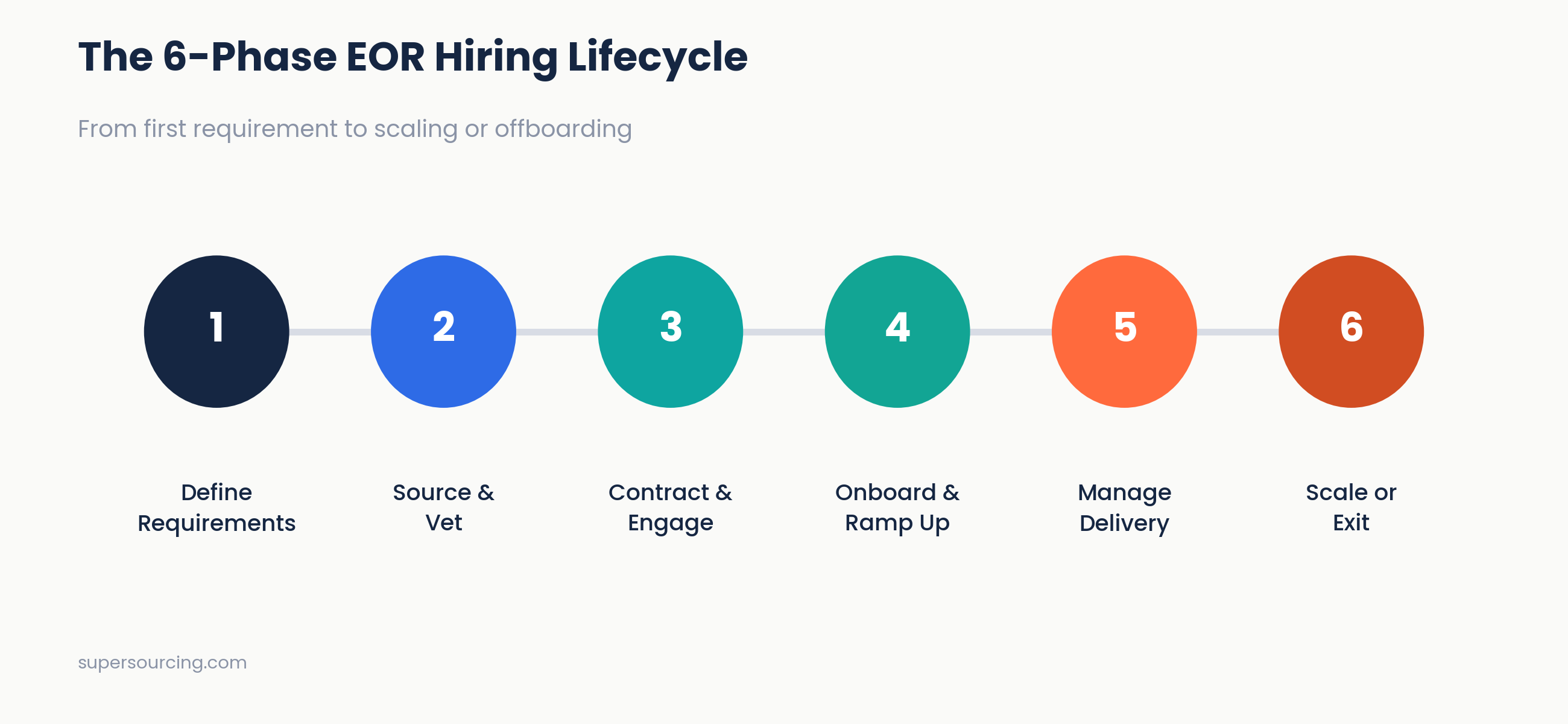
This is the full lifecycle. Each phase includes a checklist you can apply directly.
Phase 1: Defining Requirements
Before sourcing anyone, lock down four things in writing:
- Scope of work the specific stack, seniority level, and whether the role is dedicated full-time or project-based
- Target geography narrowed to 1-3 countries based on talent density, time-zone overlap, and cost band
- Budget band realistic local-market compensation, not home-country compensation discounted arbitrarily. A senior backend engineer in India typically commands ₹18-32 lakhs/year (~$22,000-$38,000), in Poland $35,000-$55,000/year, and in Latin America $28,000-$48,000/year, depending on stack and seniority.
- Timeline when the developer needs to be productive, not just hired
Checklist Requirements sign-off:
- Role scope and stack confirmed with the engineering manager, not just recruiting
- Target countries shortlisted (2-3 max, to avoid diluting sourcing effort)
- Budget band approved with employer-cost buffer of 20-45% added on top of base salary
- Success criteria for the first 90 days documented
A common mistake at this stage is anchoring the budget to home-country salary bands and then applying an arbitrary “discount” for the target country. That approach either overpays (wasting budget) or underpays (guaranteeing early attrition once the developer benchmarks their own offer against the local market). The more reliable approach is to research the actual local market rate for the specific stack and seniority level, then work employer-side statutory costs into the total budget from day one rather than discovering them at the offer stage.
Phase 2: Sourcing & Vetting
Good screening for a distributed developer hire goes beyond a resume and a live-coding round.
- Technical evaluation: A take-home or pair-programming exercise that mirrors real work, reviewed by someone who will actually work with the hire not solely by HR or an external recruiter
- Communication and async-work evaluation: Written communication quality, response cadence in a trial task, and comfort working across a 4-9 hour time-zone gap
- Reference and background checks: Verify employment history and, where legally permitted in the target country, run a criminal background check before finalizing an offer
Red flags to screen out early:
- Candidates unwilling to do any paid trial task or short technical conversation with the actual team
- Vague or inconsistent employment history across LinkedIn, resume, and reference calls
- No prior remote/distributed work experience combined with unrealistic availability claims (e.g., promising full overlap across a 12-hour time difference indefinitely)
A well-run process, from job description to interview-ready shortlist, typically takes 7-10 working days when sourcing is AI-assisted and pre-vetted talent pools are used, versus 4-6 weeks for a cold, unassisted search.
Structuring the technical evaluation: the strongest screening processes separate three distinct evaluations rather than collapsing them into a single interview: a scoped take-home exercise scored against a rubric, a live pairing session to observe real-time problem-solving, and a systems-design conversation for anything above mid-level seniority. Skipping the systems-design layer is the most common gap teams discover only after a senior hire struggles with architecture decisions on the job.
Cultural and process-fit evaluation deserves equal weight to technical skill for distributed roles specifically, because the failure mode for remote engineering hires is rarely “couldn’t code” it’s “couldn’t work asynchronously, over-communicated or under-communicated, or misjudged how independently to operate.” A short structured conversation focused on how the candidate has handled ambiguity, conflicting priorities, and time-zone-delayed feedback in past remote roles surfaces this far more reliably than asking about it directly.
Phase 3: Engagement Models & Contracts
Once you’ve picked a candidate, decide the legal structure of the relationship.
| Model | Who employs the developer | Typical use case |
| Employer of Record | The EOR provider (legally) | Full-time hire, no local entity |
| Staff augmentation via IT staffing firm | The staffing firm | Short/mid-term project capacity |
| Independent contractor | Self-employed, invoices directly | Short, clearly scoped project work |
| Own legal entity | The hiring company | Large, permanent country footprint (10+ hires) |
Whichever model you choose, the contract must nail down three things:
- IP assignment an explicit clause IT stating all code, designs, and work product created during employment belong to the hiring company, not the individual or the EOR
- Confidentiality and NDA terms enforceable under the developer’s local law, not just the hiring company’s home jurisdiction
- Termination and notice terms statutory notice periods vary widely, from as little as 1 week in some contractor-style arrangements to 30-90 days for tenured employees in parts of Europe and Latin America
Checklist Contract review before signing:
- IP assignment clause reviewed by legal, not assumed to be “standard”
- Notice period and severance terms confirmed for the specific country
- Non-compete enforceability checked (unenforceable in some jurisdictions regardless of what’s written)
- Compensation currency and FX-handling terms specified
Benefits structuring is the part most first-time buyers skip entirely, assuming the EOR “just handles it.” In practice, statutory minimums (health insurance, retirement contribution, paid leave) are a floor, not a competitive package. Developers evaluating multiple offers increasingly compare total benefits, not just base salary, so a hiring company relying solely on statutory minimums will lose close candidates to competitors offering supplemental health coverage, learning stipends, or equipment allowances layered on top of what the EOR administers by default. Confirm with the provider, before the offer goes out, exactly what’s statutory versus what’s negotiable on top.
Phase 4: Onboarding & Ramp-Up
The first two weeks determine whether a distributed hire ramps well or stalls.
- Week 1: Legal paperwork finalized through the EOR, equipment shipped or stipend issued, access provisioned (code repos, communication tools, CI/CD), and a dedicated onboarding buddy assigned
- Week 2: First small, shippable task assigned with a tight feedback loop not a multi-week project with no checkpoint
- Communication cadence: A recurring 1:1 with the engineering manager (weekly minimum) plus async standups logged in a shared tool, adjusted for time-zone overlap
Checklist Day-1 readiness:
- Laptop/equipment arrived and functional before start date
- All tool access provisioned and tested (not “requested”)
- First-week task scoped and ready, not decided on day one
- Local public holidays and working-hours norms for the country documented for the manager
The 3-day rule: if a new distributed hire hasn’t shipped or reviewed anything within their first three working days, ramp-up is already behind schedule, and the gap tends to widen rather than self-correct. The fix is almost always process, not the individual a scoped, low-risk task queued before day one, rather than a vague “get familiar with the codebase” instruction that leaves a new hire guessing at priorities across a time-zone gap where quick clarification isn’t possible.
Phase 5: Managing Delivery
Ongoing management of an EOR-employed developer looks like managing any other dedicated team member, with two additions specific to the model:
- Reporting cadence with the EOR provider: Confirm payroll runs, tax filings, and benefits enrollment on a monthly or quarterly cycle, and require visibility into compliance status, not just a payslip confirmation
- Performance KPIs: Sprint velocity, code review turnaround, and defect rate the same metrics used for any engineer, tracked in the same system as the rest of the team
Account management structure to expect from a good EOR partner:
- A single, named point of contact not a rotating support queue
- Escalation path for compliance questions with a response SLA under 48 hours
- Quarterly compliance summary per country of employment
Beyond the EOR relationship itself, engineering managers running distributed teams for the first time consistently underestimate how much documentation substitutes for hallway conversation. Decisions that would take five minutes to explain in person need to be written down clearly enough that a developer eight time zones away, working async, doesn’t lose a day waiting for clarification. Teams that invest in this upfront clear ticket descriptions, recorded architecture decisions, and written definition-of-done criteria see materially better velocity from distributed hires than teams that rely on informal, synchronous context-sharing.
Phase 6: Scaling or Exiting
As the distributed team grows, two decision points recur.
Adding headcount: Once you’re running 8-15+ employees in a single country through an EOR, run the entity-vs-EOR cost comparison again at that volume, a local entity often becomes cheaper despite the setup cost, because EOR per-head fees compound linearly while entity overhead is largely fixed.
Offboarding or replacement: A credible EOR provider offers a replacement guarantee typically 7-10 days if a hire isn’t working out within an initial period, without restarting the full sourcing and legal process. Offboarding itself must follow the local notice period and any severance obligation; skipping this step is one of the most common sources of post-exit legal claims.
Can an EOR Sponsor a Work Visa for a Developer?
This is a distinct scenario from standard cross-border EOR hiring, and it’s worth separating clearly. Most EOR arrangements assume the developer is working from their own country of residence, no relocation, no visa required, because the EOR employs them locally under that country’s laws. Visa sponsorship becomes relevant only when the developer is relocating to a different country to work in person or hybrid.
Some EOR providers do offer visa sponsorship as an add-on service in specific corridors, but it adds meaningfully to both cost and timeline, often 4-12 weeks depending on the destination country’s immigration backlog, plus government filing fees on top of the standard EOR fee.
Before assuming visa sponsorship is available, confirm directly with the provider which countries they support for it, since this is one of the most commonly overstated capabilities in EOR marketing material. If relocation isn’t a hard requirement for the role, keeping the developer employed remotely in their home country through a standard EOR arrangement is almost always faster and cheaper.
Case Studies
Fintech scale-up, 100+ engineering hires across two countries. A high-growth Indian fintech company needed to scale engineering headcount by triple digits within a single fiscal year while maintaining an under-1% drop-off rate on signed offers. Structured sourcing with a 7-10 working day shortlist cycle and dedicated account management kept the joining rate at 98% through the hiring surge.
Fast-scaling fintech platform, engineering hiring under pressure. A fintech and payments company facing aggressive product timelines needed backend and mobile engineers vetted and onboarded without slowing product velocity. AI-assisted sourcing against a pre-vetted top-2% talent pool compressed the job-description-to-shortlist window to under two weeks per role.
Healthtech recruitment automation project. A healthtech company needed to replace manual, inconsistent screening with a structured, repeatable vetting process across technical and non-technical roles. Standardizing the technical evaluation stage cut inconsistent hiring decisions and gave the hiring team a defensible, auditable process for every offer extended.
Comparison / Decision Framework: EOR vs Entity vs Contractor
Use this framework to decide which model fits your specific hiring volume and timeline.
| Factor | Employer of Record | Own Legal Entity | Independent Contractor |
| Setup time | 5-15 business days | 2-6 months | Immediate |
| Setup cost | Minimal to none | $10,000-$50,000+ | Minimal to none |
| Ongoing cost per hire | Salary + 10-20% EOR fee + statutory costs | Salary + statutory costs (no EOR markup) | Invoice amount only |
| Compliance risk | Low EOR carries employer liability | Low direct compliance ownership | High misclassification exposure |
| Best for | 1-15 hires per country | 15+ hires per country, long-term footprint | Short, clearly scoped project work |
| IP and confidentiality control | Strong, contractually defined | Strong, directly controlled | Weaker unless contract is airtight |
| Benefits and retention | Full statutory benefits | Full statutory benefits | Typically none |
The break-even point between EOR and entity setup is almost always headcount-driven, not time-driven: below roughly 10-15 employees in one country, the EOR route wins on total cost of ownership even over a 2-3 year horizon.
What Most Teams Get Wrong
They treat the EOR fee as the whole cost.
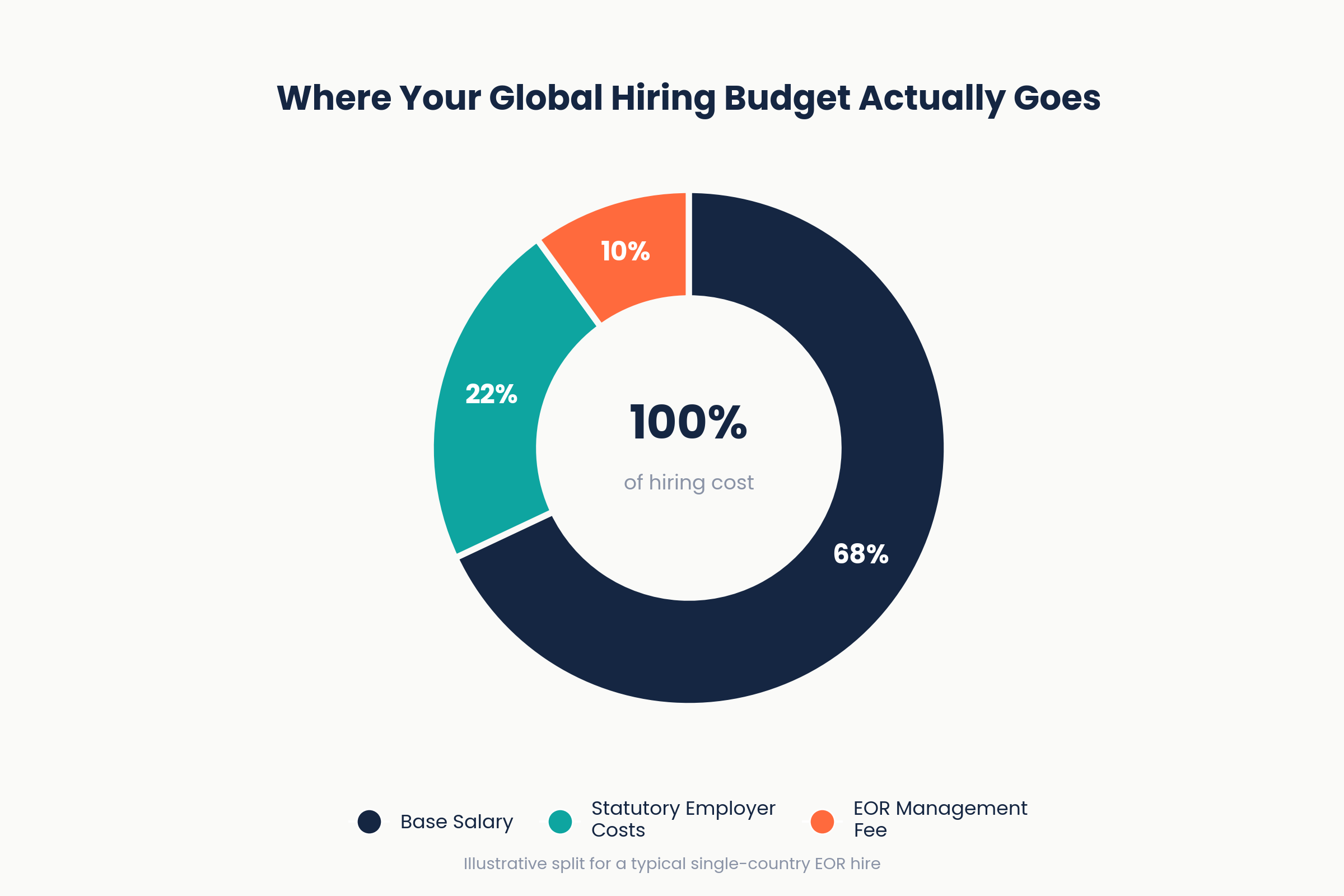
The provider’s per-employee fee is often 10-20% of gross salary, but statutory employer costs social security, health contributions, mandatory bonuses sit on top of that and vary by country. Teams that budget only the EOR fee are routinely surprised by the real number.
They skip the IP clause review because “the EOR handles contracts.”
The EOR drafts a compliant local employment contract; it does not automatically protect the hiring company’s IP ownership unless that clause is explicitly negotiated and reviewed by the hiring company’s own counsel.
They pick an EOR provider by price alone.
The cheapest quote often correlates with a partner model where the EOR subcontracts employment to a local third party adding a layer of risk and slower response times on compliance questions, versus a provider with its own in-country legal entity.
They under-invest in the first two weeks.
Distributed hires who don’t get a scoped, shippable task in week one show measurably slower ramp-up, regardless of how strong they tested in interviews.
They forget offboarding has legal weight.
Ending an EOR employment relationship isn’t the same as ending a contractor invoice statutory notice and severance rules apply, and skipping them is a common source of disputes that surface months after the exit.
Cost & Timeline Reality Check
Typical EOR cost structure:
- EOR management fee: $300-$800/month per employee, or 10-20% of gross salary, depending on provider and country
- Statutory employer costs on top of salary: 20-45% depending on jurisdiction (social security, health insurance, mandatory bonuses)
- One-time setup fee (if any): $0-$500 per employee with most modern providers
Typical timelines by scenario:
| Scenario | Realistic timeline |
| Sourcing to interview-ready shortlist | 7-10 working days |
| Offer accepted to legally employed via EOR | 5-15 business days |
| Own entity incorporation (as a comparison point) | 2-6 months |
| Replacement of a non-performing hire | 7-10 business days with a replacement guarantee |
What drives costs up: hiring in countries with mandatory 13th/14th-month pay, high employer social security rates (parts of Latin America and Southern Europe run higher than APAC), and rushed sourcing that increases early attrition and re-hiring cost.
What drives costs down: consolidating hires into fewer countries to negotiate better EOR volume rates, using structured technical vetting to reduce early attrition, and choosing countries with lower statutory overhead relative to talent quality several APAC markets remain particularly cost-efficient on this combination.
Regional cost tiers for comparison:
| Region | Typical employer statutory overhead | Notable cost driver |
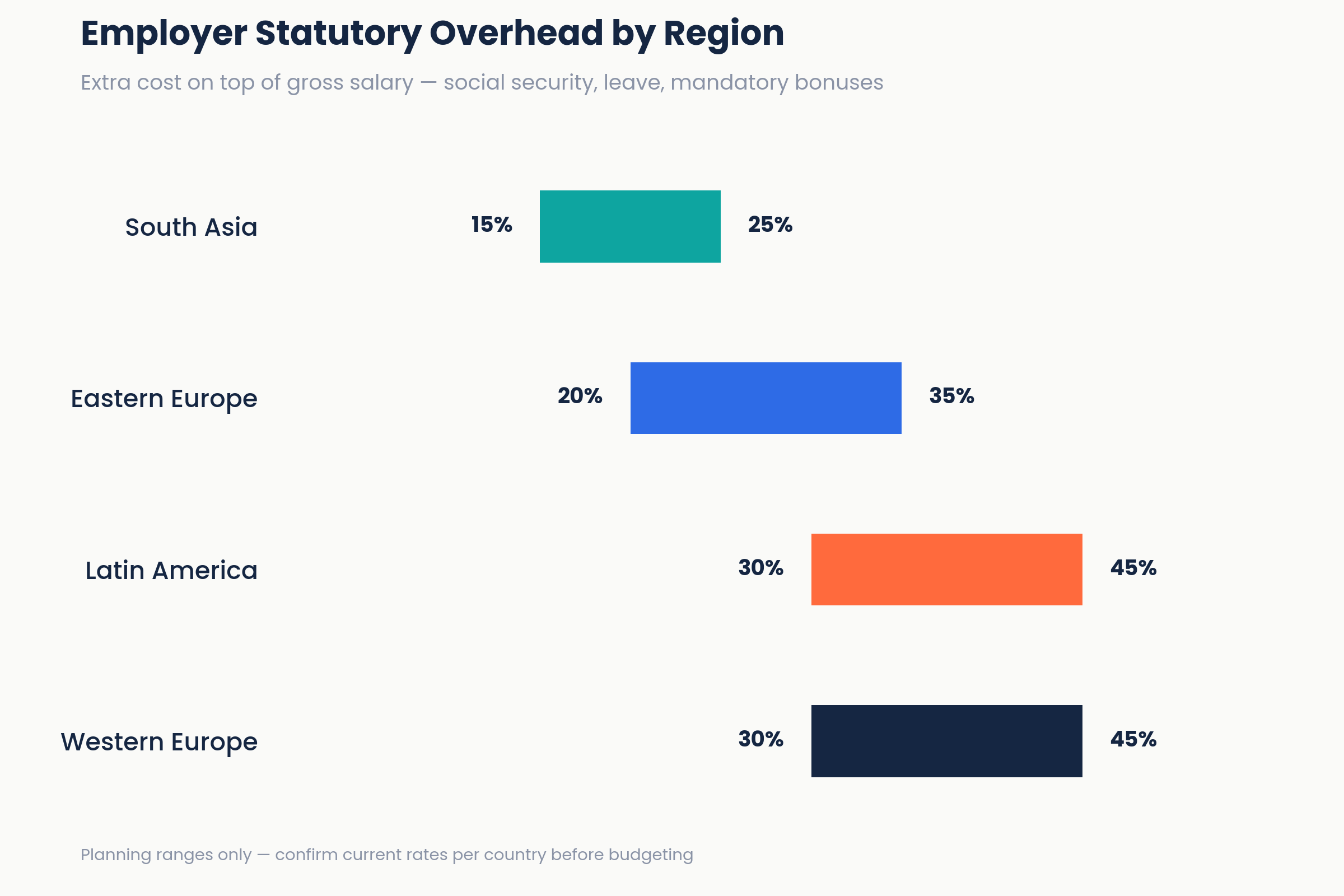
| South Asia (India, Philippines) | 15-25% on top of salary | Provident fund and gratuity obligations |
| Eastern Europe (Poland, Romania) | 20-35% on top of salary | Social security contribution rates |
| Latin America (Mexico, Colombia, Brazil) | 30-45% on top of salary | Mandatory 13th-month pay and severance funds |
| Western Europe (Germany, France) | 30-45% on top of salary | Higher statutory benefits and longer notice periods |
These bands shift with local law changes, so treat them as planning ranges, not fixed figures that confirm the current rate for the specific country before finalizing a budget.
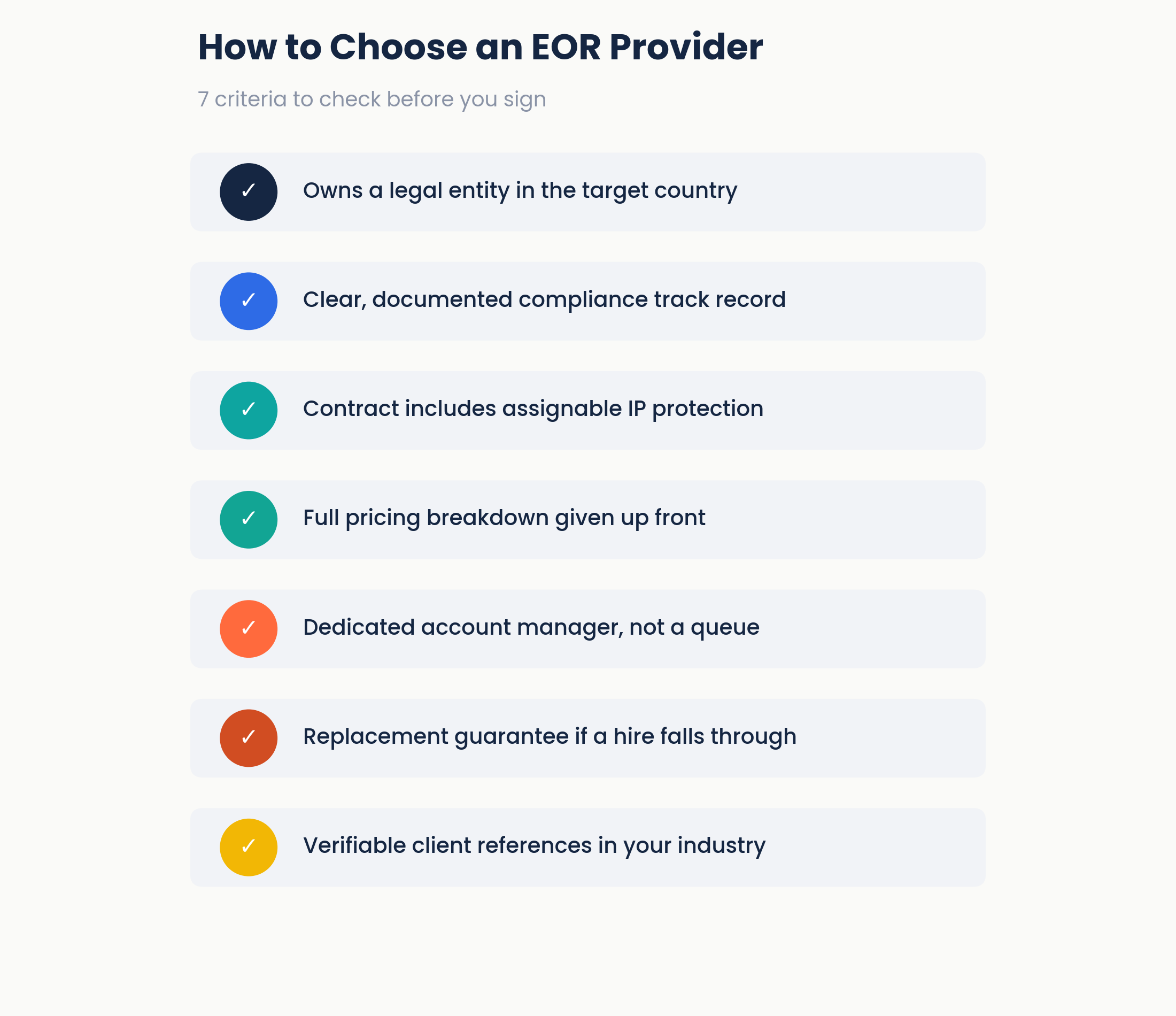
How to Choose an EOR Provider: The Checklist
Not all EOR providers carry the same risk profile. Before signing with one, run this checklist:
- Owned entity vs. partner model does the provider operate its own legal entity in the target country, or subcontract to a local third party? Owned entities generally mean faster response times and clearer accountability; partner models add a layer that can slow down compliance questions.
- Compliance track records ask directly how they handle statutory changes (minimum wage updates, new leave mandates) and how quickly those changes get reflected in active contracts.
- IP and confidentiality protection confirm the provider’s standard contract includes an assignable IP clause and NDA terms enforceable under the developer’s local law, not a generic template.
- Pricing transparency gets the full cost breakdown (management fee, statutory costs, any setup fee) in writing before signing, not just a headline number.
- Account management structure: a dedicated account manager beats a shared support queue, especially when a compliance question needs a same-week answer.
- Replacement and exit terms what happens, contractually, if a hire doesn’t work out in the first 90 days? A provider offering a replacement guarantee within 7-10 days removes a meaningful amount of downside risk.
- Client references in your target industry ask for examples of clients in a comparable sector and headcount range, not just a generic logo wall.
Supersourcing structures its EOR and staffing engagements around exactly these criteria: no shared bandwidth across clients, a dedicated account manager per engagement, NDA-backed IP protection built into the standard contract, and a 7-10 day replacement guarantee if a hire isn’t the right fit.
What to Do Next
If you’re mid-decision between an EOR, a contractor arrangement, and building your own entity, the fastest way to get unstuck isn’t more research, it’s running the numbers against your actual headcount plan and target countries. Supersourcing works through this exact framework with engineering leaders weekly: mapping requirements, shortlisting vetted developers within 7-10 working days, and structuring the employment model EOR, staff augmentation, or full GCC build around what your hiring volume actually justifies. If you’re evaluating this decision right now, get in touch and bring your headcount plan; that’s the one input that changes which model is right for you.
Frequently Asked Questions
What is an employer of record and how is it different from a staffing agency?
An EOR becomes the legal employer of the worker running payroll, tax, and compliance while the hiring company directs daily work. A staffing agency typically places a candidate and exits; it doesn’t take on ongoing legal employer liability the way an EOR does.
Is an EOR the same as a PEO?
No. A PEO is a co-employer arrangement that generally requires the client company to already have a local legal presence. An EOR is the sole legal employer, which is why it works even when the hiring company has no entity in that country at all.
How much does an EOR cost per developer?
Expect an EOR management fee of roughly 10-20% of gross salary, or a flat $300-$800/month per employee, plus statutory employer costs of 20-45% on top of salary depending on the country.
Can I hire a developer in another country without opening a local entity?
Yes this is the core function of an EOR. It’s the fastest legal path to employing someone in a country where you have no registered business presence.
What’s the risk of misclassifying a developer as a contractor?
Significant. U.S. enforcement data shows tens of millions of dollars recovered in back wages from misclassification cases in recent years, and penalties scale with willfulness from per-violation fines into six figures for repeated, deliberate misclassification.
How fast can an EOR get a developer employed and working?
Typically 5-15 business days from a signed offer to a compliant, active employment contract, compared to 2-6 months to stand up a foreign entity first.
Who owns the IP a developer builds under an EOR arrangement?
The hiring company, provided the employment contract includes an explicit IP assignment clause reviewed by the hiring company’s own legal counsel this doesn’t happen automatically just because an EOR is involved.
When does it make more sense to build a GCC instead of using an EOR?
Once headcount in a single country grows past roughly 15-20 employees, or when the work requires deep, long-term product ownership rather than augmentation, a Global Capability Center typically becomes more cost-effective India’s GCC ecosystem alone has grown to over 2,100 centers employing 2.36 million professionals, reflecting how quickly this model scales once volume justifies it. If you’re at that inflection point, it’s worth a direct conversation about what a GCC setup would look like for your specific headcount plan.
