

Somewhere between employee #20 and employee #40, most companies quietly cross a line: the EOR that made India hiring effortlessly becomes the most expensive line item in their people’s budget. The GCC vs EOR question is not “which model is better” it is “at what headcount, and for which kind of work, does the answer flip?” Companies that never run that math routinely overpay by $150,000–$400,000 a year in stacked platform fees, markups, and FX spreads, while also giving up direct IP ownership and employer branding in their fastest-growing talent market.
The flip is happening at scale. India’s captive ecosystem is no longer an enterprise-only club: mid-sized companies now operate roughly 480 GCCs about 27% of all centers in the country and 1 in 3 Fortune 500 companies already runs one, per Deloitte India. The economics that once required 500-person commitments now work at 25–50.
India’s GCC market is projected to grow from $64.6 billion (FY2024) to ~$99–105 billion by 2030, with GCC headcount crossing 2.5 million..
This guide is the full conversion playbook, not a feature comparison. It gives you the break-even model with real fee bands, the six-phase runbook from EOR audit to fully operational captive, the employee-transfer mechanics almost nobody documents (continuity of service, gratuity, ESOPs), and the failure patterns we see when teams convert too early or, far more often, three years too late.
TL;DR
This guide is for companies building teams in India who need to decide when to stop renting employment infrastructure and start owning it. It compares the GCC vs EOR operating models end to end, written for CTOs, CFOs, VPs of Engineering, and Heads of People who already have 10+ people on an EOR and are questioning the invoice.
The single most important number inside: for most companies, the cost crossover lands between 25 and 40 employees at 50 heads, typical EOR fees of $400–$700 per employee per month add up to $240,000–$420,000 a year, which is more than the entire fixed overhead of running a lean captive entity. Strategic factors like IP ownership can justify an EOR to GCC conversion even earlier.
By the end, you will be able to calculate your own break-even point, choose between direct setup and build-operate-transfer, and run a 6–9 month conversion without losing a single employee in the transfer. If you are mid-decision, this is the reference to bookmark.
What Is the GCC vs EOR Decision?
GCC vs EOR is the choice between two ways of employing a team in another country: an Employer of Record (EOR) legally employs your people through its own local entity for a per-employee fee, while a Global Capability Center (GCC, or captive) is your own incorporated subsidiary that employs them directly, giving you full control, IP ownership, and lower per-head cost at scale.
What this decision is not:
- Not EOR vs outsourcing. An outsourcing vendor owns the work output; an EOR only owns the employment paperwork. Your EOR team already works exclusively for you; the question is who holds the employment contract.
- Not GCC vs staff augmentation. Staff augmentation rents individual contractors through a third party; a GCC is a permanent, owned organization with its own P&L, leadership, and culture.
- Not a one-way door. Companies routinely run hybrid models captive for the core team, an EOR for new-country experiments and build-operate-transfer (BOT) exists precisely as a bridge between the two.
Why the GCC vs EOR Choice Matters: The Business Case
Getting this decision right (and timing it right) moves four hard numbers, not vague “efficiency”:
- Cost per employee. EOR platforms typically charge $400–$700 per employee per month for India (some premium providers exceed $1,000), plus FX spread of 1–3% on payroll and markups on benefits. On a 50-person team, fees alone run $240,000–$420,000 annually recurring, forever, and growing linearly with headcount. A captive replaces that linear fee with a largely fixed overhead base.
- IP and data ownership. In an EOR arrangement, employment contracts and in some jurisdictions, default IP assignments sit with a third party’s entity. For companies whose India team writes core product code or trains models on proprietary data, direct employment through your own entity is the clean chain of title that acquirers and enterprise customers audit for.
- Talent quality and retention. Senior engineers in India increasingly ask who the legal employer is. A captive lets you offer your own ESOPs, your own brand on the offer letter, gratuity continuity, and a visible career ladder that an EOR vs captive comparison usually ignores because they don’t fit in a pricing table. GCC attrition in well-run centers typically tracks below the Indian IT-services industry average.
- Compliance and PE risk allocation. An EOR absorbs day-to-day payroll compliance but does not eliminate permanent establishment risk for the parent sustained, integrated core-business activity in-country can create PE exposure regardless of who signs the payslip. A properly structured captive with an intercompany agreement and transfer pricing documentation converts an ambiguous risk into a defined, defensible tax position.
- Speed vs control trade-off, quantified. An EOR gets employee #1 productive in 1–2 weeks. A captive takes 3–6 months to stand up but then removes the per-head tax on every hire after that. The right question is which side of the break-even curve your 24-month headcount plan sits on.
The Core Problem: Why Most Teams Get the Timing Wrong
Timing failures in this decision are asymmetric and expensive in both directions. In roughly the pattern we see across engagements, teams underestimate the true cost of staying on an EOR by 2–3x, because they compare only the visible platform fee against entity costs and miss the stacked extras.
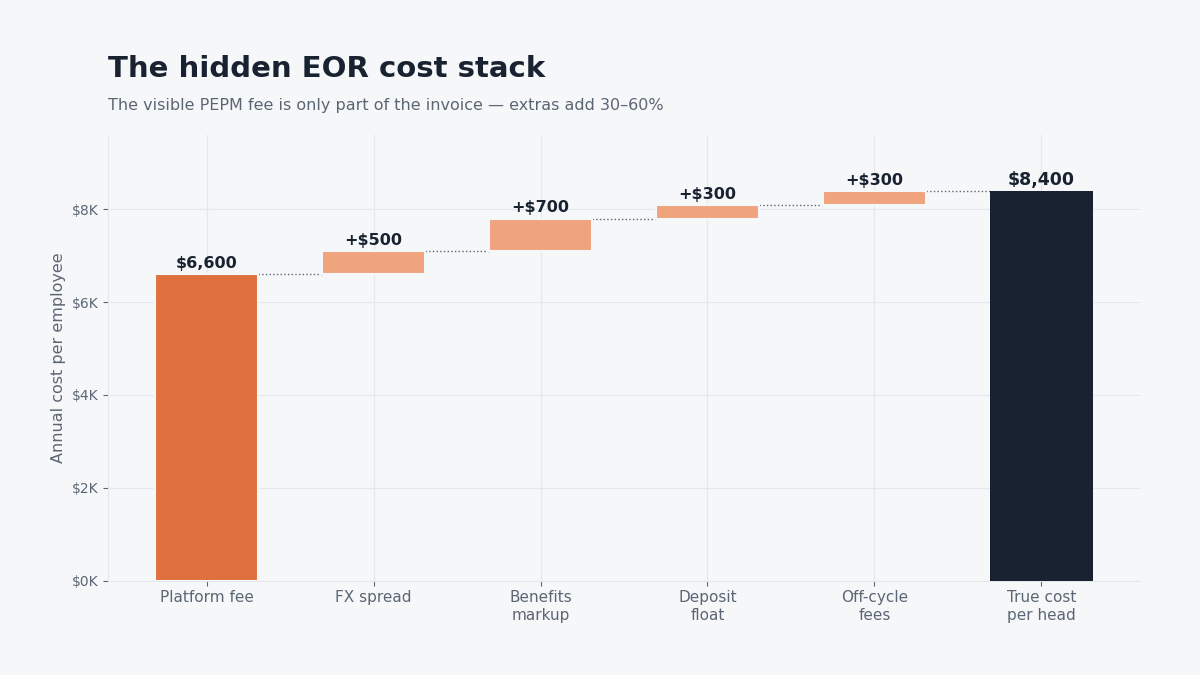
The hidden EOR cost stack (what the invoice doesn’t itemize clearly):
- PEPM platform fee $400–$700/employee/month is the visible line.
- FX spread 1–3% on every payroll run, often invisible because it’s baked into the conversion rate.
- Benefits markup group health, insurance, and allowances administered at a margin over direct-procurement cost.
- Salary benchmarking drift EORs optimize for compliance, not compensation efficiency; without your own local HR intelligence, offers drift 10–20% above or below market.
- Deposit/prefunding float many EORs hold 1–2 months of payroll as a deposit; that’s working capital earning nothing.
- Off-cycle and termination fees off-boarding, severance administration, and contract changes are frequently billed per event.
The opposite failure converting too early: a 12-person team that incorporates prematurely inherits ₹40–80 lakh (~$50K–$100K) a year of fixed compliance, finance, and admin overhead, plus 15–20% of a senior leader’s time consumed by entity operations instead of product. Below ~20 heads, that overhead usually exceeds the EOR fees it replaced.
Red flag: if your finance team cannot state your fully loaded cost per India employee fee, FX, benefits markup, deposits included within 10%, you are not yet equipped to make this decision. Build that number first; everything in the next section depends on it.
The EOR to GCC Conversion Walkthrough: From First Audit to Running Captive
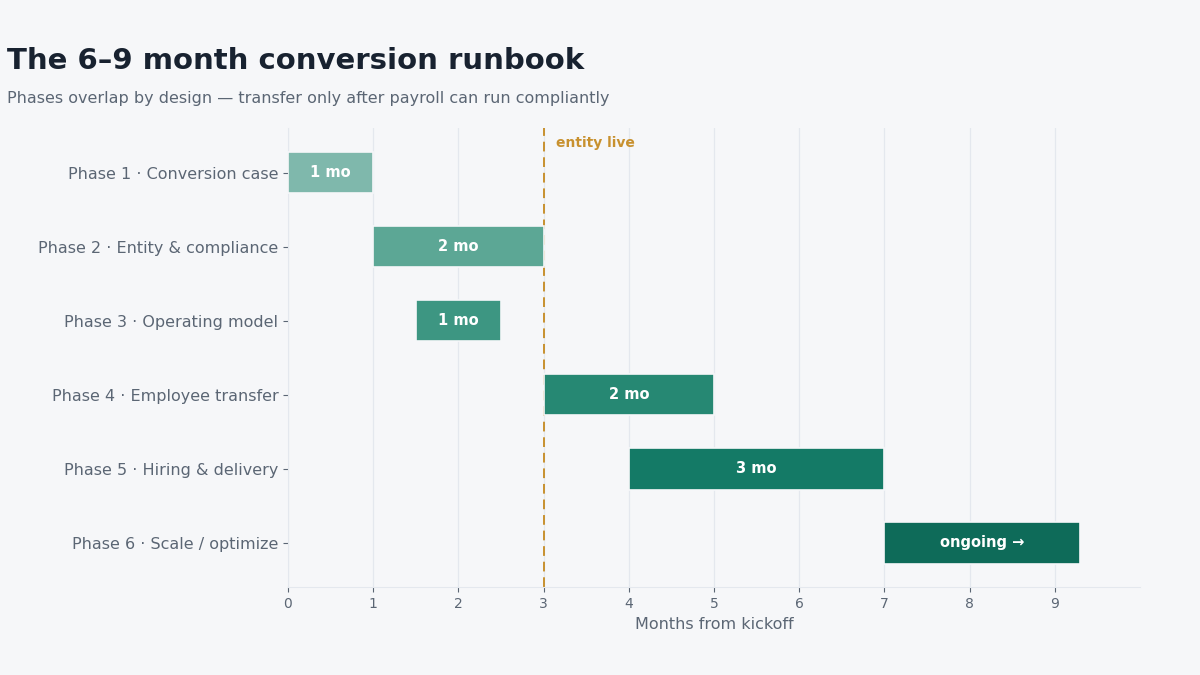
Six to nine months is the realistic end-to-end window for this move when it’s run properly. A structured EOR to GCC conversion breaks into six phases, sequenced so that employees experience zero payroll disruption on transfer day. Treat this as the runbook; each phase has a deliverable, a timeline, and a failure mode to avoid.
Phase 1 Build the Conversion Case (Weeks 1–4)
Decisions made on gut feel here get relitigated by the board later. Lock the numbers first.
The conversion-case checklist:
- Compute true EOR TCO. Pull 12 months of invoices. Sum PEPM fees + FX spread + benefits markup + deposits + one-off fees. Divide by average headcount for your real per-head annual cost (typically $5,500–$9,000/head/year in India once everything is counted).
- Model captive overhead at 3 headcount scenarios (current, +12 months, +24 months): entity compliance and secretarial (₹8–15 lakh/yr), finance & payroll ops (₹12–25 lakh/yr), HR/admin (₹15–30 lakh/yr), office or flex-space (₹60,000–1.2 lakh per seat per year in Tier-1 cities; 25–40% less in Tier-2), software and statutory insurance.
- Price the one-time conversion: incorporation and licenses (₹3–8 lakh), legal and transfer-agreement drafting (₹10–25 lakh), transfer bonuses or benefit true-ups if any (budget 0–1 month of payroll as contingency), recruiter/RPO fees for backfills.
- Score the strategic factors (0–5 each): IP sensitivity of the work, need for your own employer brand, ESOP importance to retention, data-residency or customer-compliance requirements, 24-month hiring velocity.
- Set the go/no-go rule in writing. Example: “Convert if projected 24-month headcount ≥ 30 AND captive TCO undercuts EOR TCO within 18 months, OR if IP-sensitivity score is 5 regardless of cost.”
The 24-month rule: run the break-even against where the headcount will be in 24 months, not where it is today. Conversion takes 6–9 months; deciding on today’s headcount means you’re perpetually one year behind your own economics.
Phase 2 Entity, Compliance, and Financial Architecture (Months 1–3)
India offers three practical structures for a captive; picking wrong is expensive to reverse.
Structure options:
- Private Limited Company (subsidiary) the default for 90%+ of GCCs. Full control, clean IP assignment, ESOP-compatible. Incorporation itself takes 2–4 weeks; being operational (bank account, PF/ESI registrations, payroll live) takes 8–14 weeks.
- LLP lighter compliance, but incompatible with most ESOP structures and viewed as non-standard by acquirers. Rarely right for a tech captive.
- Branch/Liaison office restrictive on activity scope and creates direct PE exposure for the parent. Generally avoid engineering work.
The compliance stack you now own (your EOR was doing all of this):
- Registrations: PAN, TAN, GST, Provident Fund (PF), ESI where applicable, Professional Tax, Shops & Establishments Act, and STPI/SEZ registration if you want export-linked benefits.
- Ongoing: monthly payroll withholding (TDS), PF/ESI remittances, POSH committee and policy (mandatory at 10+ employees), gratuity provisioning, annual ROC filings, statutory audit.
- Transfer pricing is the one most first-time operators miss. Your captive bills the parent on a cost-plus basis; margins in the ~15–18% band are common under India’s safe harbour framework. Get the intercompany services agreement and TP documentation done before the first invoice, not at audit time.
- FEMA compliance for the parent’s equity infusion and ongoing remittances.
Export-linked benefits worth evaluating (before you sign a lease, since location determines eligibility):
- STPI registration is the lightest-weight route for software-export units; enables soft filing for export invoices and works from ordinary commercial space.
- SEZ units are meaningful only at larger scale now that the original tax holiday has sunset for new units; the residual value is infrastructure and single-window compliance, and it locks you into SEZ-designated space.
- GIFT City (IFSC) is relevant primarily for fintech, treasury, and capital-markets functions rather than general engineering; a 10-year tax holiday window applies to qualifying IFSC units, but the eligible activity list is narrow. Don’t relocate an engineering captive to chase it.
The capital and banking sequence (frequently done out of order, causing 3–6 week delays):
- Incorporate and obtain PAN/TAN.
- Open the INR current account banks routinely take 2–4 weeks for foreign-parent subsidiaries because of enhanced KYC on the shareholding chain; start this the day the incorporation certificate arrives.
- Remit the initial equity infusion from the parent and file the FC-GPR reporting with RBI within 30 days of allotment; a missed FEMA filing here is the most common first compliance blemish on otherwise clean captives.
- Only then register for PF/ESI and run the first payroll; salaries paid from a director’s personal account “just to bridge one month” create audit questions for years.
Red flag: any advisor who quotes “entity setup in 2 weeks” is quoting incorporation, not operational readiness. Budget 3 months to first compliant payroll run. Teams that want the full document checklist should start from a standard reference on the legal documents required for GCCs in India before engaging counsel; it shortens the billable discovery phase considerably.
Phase 3 Choose the Operating Model: Direct, BOT, or Hybrid (Month 2, parallel)
Contract structure determines how much of Phases 2 and 4–5 you run yourself.
| Model | You own the entity | Speed to operational | Best when |
| Direct setup | From day 1 | 3–6 months | You have (or will hire) a senior India leader and in-house legal/finance bandwidth |
| Build-Operate-Transfer (BOT) | After transfer (typically 18–36 months) | 4–8 weeks to first hires | You want captive economics eventually but zero setup burden now; negotiate the transfer formula upfront |
| Hybrid (captive + EOR) | Captive for core team | Immediate for EOR portion | Core India team in the captive; EOR retained for <5-person experiments in other countries |
Contract terms to negotiate before signing anything:
- In a BOT: the transfer trigger, the per-employee or fixed transfer fee formula, and non-solicit carve-outs ambiguity here is the #1 source of BOT disputes.
- With your outgoing EOR: transition-assistance obligations, data handover format, deposit release timeline, and per-employee off-boarding fees (negotiate a bulk conversion rate; list-price termination fees across 40 people add up).
- IP assignment language that transfers cleanly from EOR contracts to your entity’s contracts with no gap in coverage.
Phase 4 The Employee Transfer (Months 3–5)
The transfer is where conversions succeed or bleed talent, and it is the least-documented part of the entire graduate from EOR to GCC journey. Employees are not “moved” ; each one resigns from the EOR’s entity and accepts a new offer from yours. Every detail of how that’s papered affects whether they say yes.
The zero-regression transfer checklist:
- Tripartite coordination. Align you, the EOR, and (where used) a transfer agreement so resignation and new-offer dates are synchronized target a payroll-cycle boundary so no one sees a split or delayed salary.
- Continuity of service. In India, gratuity vests at 4 years 240 days. Contractually recognize prior EOR service in the new contract, or fund the accrued gratuity liability. Breaking tenure resets this and employees know it is the single most common reason transfers get refused.
- Benefits parity or better. Match or beat group health cover, leave balances (carry them over explicitly), and any allowances. Publish a one-page “what changes / what doesn’t” comparison for every employee.
- ESOP migration. If EOR-era employees held phantom equity or parent-company options, re-paper them under the new entity’s plan with original vesting start dates preserved.
- Communication sequence: leadership announcement → manager 1:1s within 48 hours → written FAQ → individual offers with 1–2 weeks to sign → anonymous question channel. Run offers in one wave, not a trickle; partial transfers create a two-class team.
- Expect and plan for 0–10% voluntary attrition at transfer despite perfect execution; pre-brief your hiring pipeline for same-quarter backfills.
Transfer-week execution timeline (working backward from payroll day):
- T-minus 6 weeks: transfer agreement signed with the EOR; benefits broker briefed to mirror or upgrade current group cover with zero coverage gap.
- T-minus 4 weeks: announcement + manager 1:1s + individual offers out, each with the side-by-side comparison sheet attached.
- T-minus 2 weeks: all acceptances in; resignation letters to the EOR submitted in one batch; leave balances and gratuity accruals reconciled line by line against EOR records.
- T-minus 1 week: payroll dry run in your system with real data; IT access, laptops (if EOR-provided hardware is being swapped), and insurance cards ready.
- Day 0 (payroll boundary): EOR contracts end on the last day of the cycle; your contracts begin the next day. One employer per employee per day overlapping employment dates create dual-PF and tax complications that take quarters to unwind.
- T-plus 2 weeks: confirm first salary landed correctly for every single person, then hold a written retro on what confused people you will reuse this playbook for every future batch and every acquisition.
The 48-hour rule: every employee should hear the news from their manager within 48 hours of the announcement, with their individual numbers in hand. Rumor-gap is where attrition starts.
Phase 5 Stand Up the Hiring Engine and Run Delivery (Months 4–7)
Owning the entity means owning recruitment velocity the EOR never did your sourcing, but conversion is usually when teams first feel the absence of any institutional hiring muscle in India.
What a functioning captive hiring engine looks like:
- A calibrated hiring bar per role family, with structured technical + cultural evaluation (not “the US team interviews everyone over Zoom at 10 pm IST”).
- Time-to-shortlist measured in days, not months specialist partners routinely deliver interview-ready, vetted shortlists in 7–10 working days; if your internal loop takes 6+ weeks per role, the captive’s growth plan is fiction. This is where Supersourcing’s model AI-driven sourcing of the top 2% of vetted candidates, dedicated account managers, and a 7–10 day replacement guarantee is typically slotted in by teams that don’t want to build a full internal TA function on day one. Many converting companies bridge the first 12–18 months with recruitment process outsourcing rather than hiring 3–4 in-house recruiters immediately.
- Infra and platform roles hired early: a captive without its own DevOps and platform capability stays dependent on HQ for every deployment; most 30+ person centers hire DevOps engineers within the first two quarters for exactly this reason.
Delivery management cadence that survives time zones:
- Weekly metrics review on a fixed dashboard (velocity, quality, attrition risk, hiring funnel) 30 minutes, written pre-reads.
- A named India site leader with real decision rights by month 6; captives run remotely from HQ plateau early.
- Quarterly charter reviews: is the center still doing the work it was built for, or has it drifted into overflow tickets?
- KPI set from day 1: cost per employee vs the old EOR baseline, offer-acceptance rate (healthy: 85%+; best-in-class partners sustain a 98% joining rate), 90-day attrition, and engineering output metrics you already use at HQ.
Phase 6 Scale, Optimize, or Exit (Month 7 onward)
A captive is an asset you manage, not a project you finish.
Scaling levers:
- Tier-2 expansion cities like Ahmedabad, Coimbatore, and Indore offer 25–30% lower talent cost and materially lower attrition than saturated Tier-1 hubs; NASSCOM tracks accelerating GCC movement into these markets.
- Function expansion the standard maturity arc is engineering → QA/data → product → finance/analytics shared services; over 50% of India GCCs now operate as multi-functional transformation hubs, not single-function cost centers.
- Charter upgrades moving from “extension of HQ teams” to owned products/platforms is what separates GCCs that retain senior talent from those that churn it.
And the exit clause nobody plans: if strategy changes, a captive can be sold, merged, or wound down but Indian winding-up takes 6–12+ months with full severance obligations. Some companies exit by reverse-BOT: transferring the team to a services firm. Knowing this exists should make the build decision less frightening, not more casual.
Case Studies: What Conversion-Grade Hiring Looks Like
Pattern recognition beats theory, and the hiring engine is the make-or-break variable in every conversion. Three outcome-led examples from Supersourcing engagements and comparable scenarios:
Paytm 100+ engineers at captive velocity. Scaling a fintech engineering org by 100+ engineers demanded a pipeline that behaved like an owned hiring engine, not an agency drip. AI-driven sourcing against a top-2% vetted pool delivered interview-ready shortlists in 7–10 working days per role, sustaining hiring velocity that most first-year captives fail to reach with internal teams alone.
OkCredit engineering hiring without the drop-off tax. For high-competition backend and mobile roles, the metric that mattered was joining rate, not offer count. A structured vetting and engagement process held candidate joining at 98% with under 1% drop-off on contract roles, the difference between a headcount plan and a headcount outcome in a market where 30–40% offer reneges are common.
Somnoware recruitment automation for a lean healthtech team. With no internal TA function (the exact position most post-conversion captives are in), an RPO-style engagement with dedicated account management replaced the need to hire in-house recruiters in year one, keeping fixed people-ops overhead down during the most cash-sensitive phase of entity operation.
EOR vs Captive: The Decision Framework and Break-Even Chart
One chart and one scorecard are all this decision actually needs. A defensible EOR vs captive call is built from your own invoices; use the model below to sanity-check yours.
The break-even model (illustrative India, engineering-heavy team; label all assumptions when you present this internally):
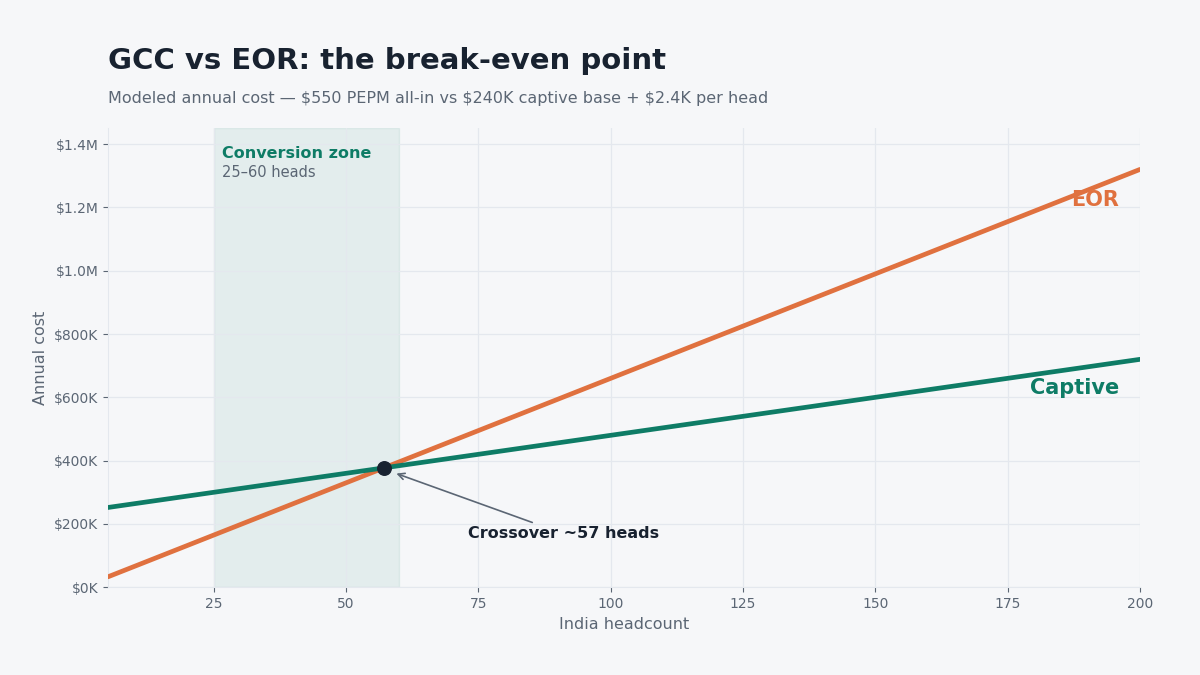
Assumptions: EOR all-in cost $550/employee/month ($6,600/head/year, mid-band once FX and markups are counted); captive fixed overhead $180K/year (compliance, finance, HR, admin, licenses) + $2,400/head/year variable (seat, software, statutory costs); one-time conversion cost $120K amortized over 24 months.
| Headcount | EOR annual cost | Captive annual cost (incl. amortized setup) | Cheaper model | Annual delta |
| 10 | $66,000 | $264,000 | EOR | −$198,000 |
| 20 | $132,000 | $288,000 | EOR | −$156,000 |
| 30 | $198,000 | $312,000 | EOR (gap closing) | −$114,000 |
| 40 | $264,000 | $336,000 | ≈ Crossover zone begins | −$72,000 |
| 50 | $330,000 | $360,000 | Near parity | −$30,000 |
| 60 | $396,000 | $384,000 | Captive | +$12,000 |
| 100 | $660,000 | $480,000 | Captive | +$180,000 |
| 200 | $1,320,000 | $720,000 | Captive | +$600,000 |
How to read it and why the “real” break-even is lower than the table shows:
- On pure modeled cost, crossover lands around 50–60 heads. But this model prices the captive conservatively and the EOR at mid-band. Teams paying $650–$700 PEPM, or running lean Tier-2 operations, see crossover at 25–40 heads. After the 24-month setup amortization ends, the captive line drops further.
- The table also prices strategic factors at zero. IP chain-of-title, own-brand ESOPs, and data-residency compliance each justify shifting your personal crossover 10–15 heads earlier.
- Publish this as your hero chart: headcount on the X-axis, annual cost on the Y-axis, two lines crossing in the 40–60 band with a shaded “conversion zone” from 25–60.
EOR vs Owning an Entity in India: The Factors the Spreadsheet Can’t Price
Cost crossover is necessary but not sufficient; several factors only reveal their weight after conversion. The ones that consistently matter:
- Who your candidates think they work for. Offer letters from “XYZ EOR Services Pvt Ltd” measurably depresses acceptance among senior engineers who’ve been burned by opaque intermediary arrangements before. Your own entity’s name on the contract is an employer-branding asset that compounds with every hire and every LinkedIn profile listing it.
- M&A and fundraise diligence. Acquirers and late-stage investors flag material engineering teams employed through third parties as a diligence item expect questions on IP assignment continuity and key-person retention. A clean captive removes an entire workstream from the data room.
- Optionality on the work itself. Regulated workloads (payments data, health records) and customer contracts with data-residency or sub-processor clauses are simpler to satisfy when the employing entity, the infrastructure, and the audit trail are all yours.
- Institutional learning. Every quarter on an EOR is a quarter of not building local HR judgment comp benchmarking instincts, notice-period negotiation norms, which colleges and companies your best people come from. That knowledge only accrues to owners.
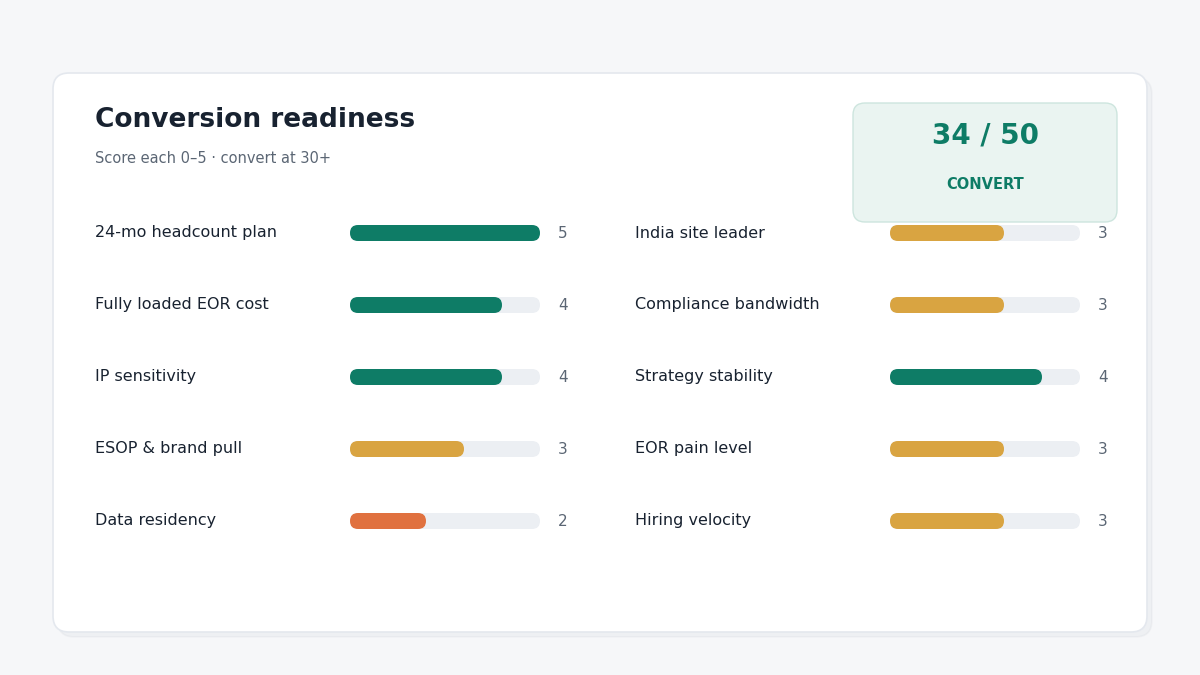
The 10-point scorecard (score each 0–5; convert at 30+):
- Projected 24-month India headcount (30+ heads = 5)
- Current fully loaded EOR cost per head vs modeled captive cost
- IP sensitivity of the work performed
- Importance of own-brand offers and ESOPs to your candidate pool
- Customer/regulatory data-residency requirements
- Availability of (or willingness to hire) a senior India site leader
- HQ finance/legal bandwidth to own compliance (or budget to outsource it)
- Stability of the India strategy over a 3-year horizon
- Pain level with current EOR (fees, service, benchmarking drift)
- Hiring velocity needed (10+ hires/year favors owning the engine)
When to build a captive in one sentence: convert when your 24-month plan clears ~30 heads and at least two strategic factors score 4–5 cost alone at today’s headcount is the weakest and most reversible justification on the list.
Cost & Timeline Reality Check
Concrete bands for the whole journey every figure below is a typical range for India engineering teams, not a quote; your city, seniority mix, and structure move these ±25%.
Ongoing cost comparison (per year):
- EOR route: $4,800–$8,400 per employee (fees + FX + markups). Zero fixed cost, pure variable. 50 people ≈ $240K–$420K/year.
- Captive route: ₹1.5–3 crore ($180K–$360K) fixed overhead for a 30–80 person center (compliance, finance/payroll ops, HR/admin, secretarial, audit) + ₹2–4 lakh ($2,400–$4,800) per head variable (seat, software, statutory). Tier-2 locations cut the variable line 25–40%.
- One-time conversion: ₹80 lakh–1.7 crore ($100K–$200K) all-in incorporation and licenses (₹3–8 lakh), legal/TP/transfer documentation (₹10–25 lakh), office fit-out or flex deposits, transfer contingency (0–1 month of payroll), and hiring-engine setup.
- BOT route: operator fees typically run 15–30% over direct-cost during the operating phase, plus a negotiated transfer fee you’re paying for deferral of effort, not lower cost.
Timeline by scenario:
| Scenario | Realistic timeline |
| Incorporation only | 2–4 weeks |
| Entity operational (bank, PF/ESI, payroll live) | 8–14 weeks |
| Full EOR→captive conversion, ≤30 employees | 6–7 months |
| Full conversion, 30–100 employees | 7–9 months |
| BOT: first hires productive | 4–8 weeks |
| BOT: ownership transfer | 18–36 months (per contract) |
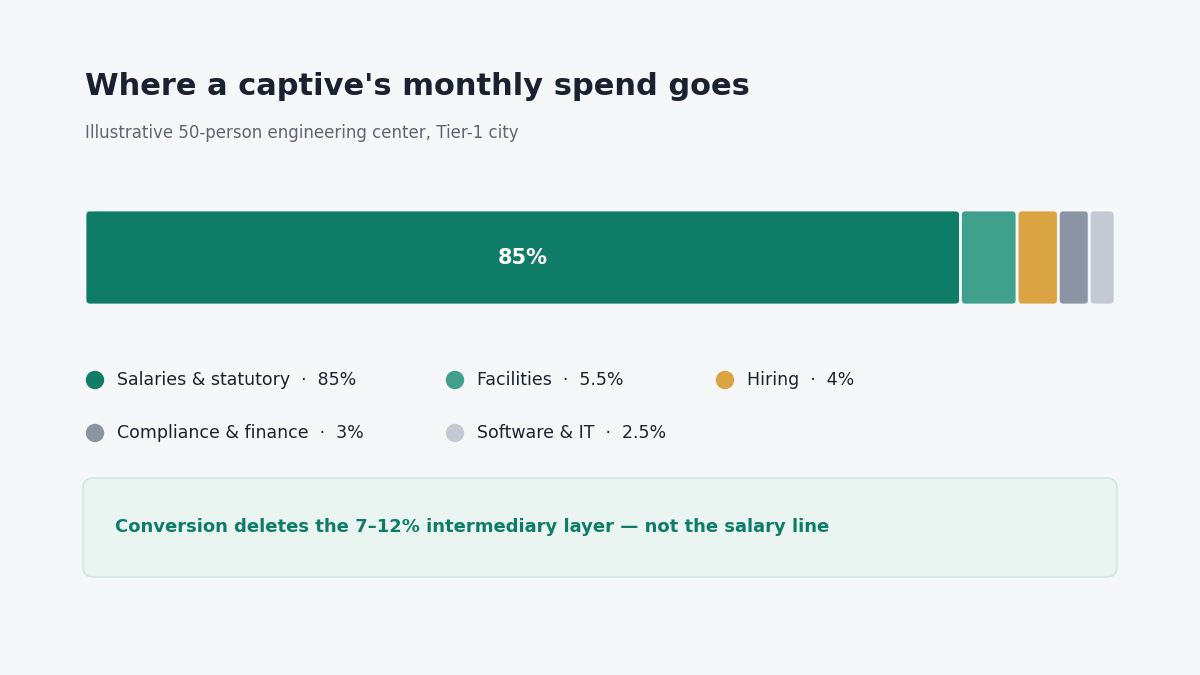
What a steady-state monthly captive P&L looks like (illustrative, 50-person engineering center, Tier-1 city):
- Salaries and statutory (PF, gratuity accrual, insurance): 82–88% of total spend this is the line the EOR never touched and the entity doesn’t change.
- Facilities (flex seats or leased space + utilities): 4–7%.
- Compliance, finance, and payroll operations (in-house or outsourced): 2–4%.
- Hiring (RPO/recruiter fees amortized, referral bonuses, assessments): 2–5% in growth quarters, near zero in freeze quarters.
- Software, IT, and admin: 2–3%.
Put differently: the conversion doesn’t shrink your biggest cost (people); it deletes a 7–12% intermediary layer sitting on top of it and converts the remainder from per-head fees into mostly fixed overhead you control. That’s also why the case weakens for teams that plan to shrink fixed overhead cuts the other way on the downslope.
What drives cost up: Tier-1 real estate, senior-heavy teams (gratuity/benefit true-ups scale with tenure and salary), litigation-averse over-lawyering, and rushed transfers that trigger retention bonuses.
What drives it down: Tier-2 location, flex-space instead of leased fit-outs, outsourced finance/compliance ops until ~80 heads, and RPO instead of an in-house TA team in years 1–2.
Where to Go From Here
If your team is in the 20–60 headcount band or will be within 24 months the next step is not incorporation paperwork. It is a break-even model built on your actual EOR invoices and a transfer plan your employees will say yes to.
That’s a working session, not a sales call: bring 12 months of EOR invoices and your 24-month hiring plan, and Supersourcing’s GCC team will map your crossover point, structure options (direct vs BOT), and a phase-by-phase conversion timeline against the runbook in this guide the same GCC setup services process used across 527+ delivered engagements.
Book the conversion assessment here
FAQ
What is the difference between a GCC and an EOR?
An EOR is a third party that legally employs your team through its own local entity for a monthly per-employee fee, while a GCC (captive) is your own subsidiary employing the team directly. The work and day-to-day management are yours in both models; what changes is who owns the employment contracts, the compliance burden, the IP chain of title, and the cost structure.
At what headcount does a captive become cheaper than an EOR?
On pure cost, crossover typically lands between 25 and 60 employees depending on your EOR’s all-in fee and how lean the captive runs 40–50 is a reasonable central estimate for mid-band assumptions. Strategic factors (IP ownership, own-brand ESOPs, data residency) justify converting 10–15 heads earlier than the pure-cost crossover.
How long does it take to convert from an EOR to a GCC in India?
Plan for 6–9 months end to end: 1 month for the business case, 2–3 months for an operational entity, 1–2 months for the employee transfer wave, and 2–3 months to stabilize payroll, hiring, and delivery. Incorporation alone takes 2–4 weeks, but incorporation is roughly 20% of the actual work.
Can you transfer EOR employees to your own company?
Yes, each employee resigns from the EOR’s entity and signs a new contract with yours, ideally synchronized on a payroll boundary via tripartite coordination. Done well (continuity of service recognized, benefits matched or improved, leave balances carried, ESOPs re-papered), voluntary attrition at transfer is typically 0–10%.
Do employees lose gratuity or benefits when moving from an EOR to a captive?
Only if you let them. Indian gratuity vests at 4 years 240 days of continuous service; the new contract should contractually recognize prior EOR tenure or the accrued liability should be funded at transfer. Publish a per-employee “what changes / what doesn’t” sheet benefit ambiguity, not benefit reduction, is what actually drives transfer refusals.
Is a build-operate-transfer model better than direct GCC setup?
BOT is better when you want captive economics eventually but have no India leadership or legal/finance bandwidth today first hires land in 4–8 weeks with ownership transferring in 18–36 months. Direct setup is cheaper overall (BOT operators charge 15–30% over direct cost) and right when you have or will hire a senior site leader. Negotiate the BOT transfer formula before signing, not at transfer time.
What are the risks of staying on an EOR too long?
Compounding fees (a 60-person team overpays roughly $150K–$400K a year versus a lean captive), weaker senior-talent conversion because offers carry a third party’s name, IP contracts held outside your entity, and zero accumulated employer brand or hiring muscle in your biggest talent market. None of these show up as a single alarming invoice that’s exactly why teams drift 2–3 years past their own break-even.
How do I know if my company is ready for an EOR to GCC conversion?
Run the 10-point scorecard in this guide: 24-month headcount projection, fully loaded EOR cost, IP sensitivity, ESOP importance, leadership availability, and compliance bandwidth. If you score 30+, the economics almost certainly work. The open questions become sequencing and transfer execution, which is where a partner who has run GCC setups end to end compresses months of first-time mistakes into a working plan.
