

Most hiring budgets compare the wrong two numbers: a recruiter’s salary against an RPO invoice. That comparison is off by 40–60% before you’ve made a single hire, because a salary is one line item and an internal recruiting function is eleven. The in-house recruiter vs RPO cost question is not “₹10 lakh salary vs ₹2.5 lakh monthly fee.” It is a 12-month cash-flow problem with ramp-up curves, tool licenses, agency backfill, hiring-manager hours, and vacancy costs on both sides of the ledger.
This guide runs that problem end to end. We take one realistic scenario: a funded product company that needs 30 technology hires in 12 months and simulate both paths month by month: what gets spent, when it gets spent, and how many offers are actually accepted by month 12. Then we generalize the model so you can plug in your own hiring volume, salary bands, and tool stack and get your own answer.
The market context makes this decision more consequential, not less. Recruitment outsourcing is no longer a niche fallback:
The global recruitment process outsourcing market is projected to grow from $8.82 billion to $36.79 billion by 2031, a 17.2% CAGR, one of the fastest-growing categories in HR services.
That growth is being driven by exactly the buyers reading this guide: engineering and operations leaders who discovered that building an internal talent acquisition function is slower and more expensive than the headcount plan assumed. By the end of this guide you will know whether that’s true for you, or whether you’re one of the profiles where building in-house is clearly the right call because there are several, and we name them.
No abstractions. Every section carries numbers, ranges, or a checklist you can act on this week.
TL;DR
This guide compares the true 12-month cost of building an internal recruiting function against outsourcing it, for teams planning roughly 10–50 technology hires. It is written for founders, engineering leaders, and finance owners who need to defend this line item and it covers the in-house recruiter vs RPO cost question with real cash-flow math, not a pros-and-cons list.
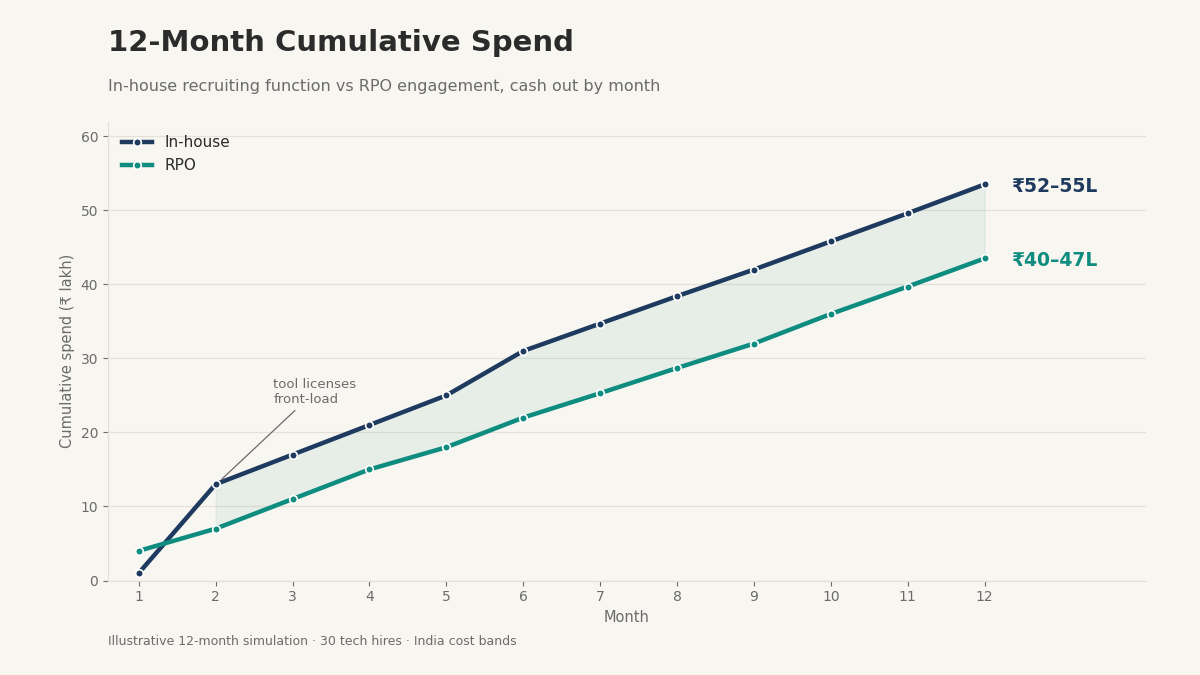
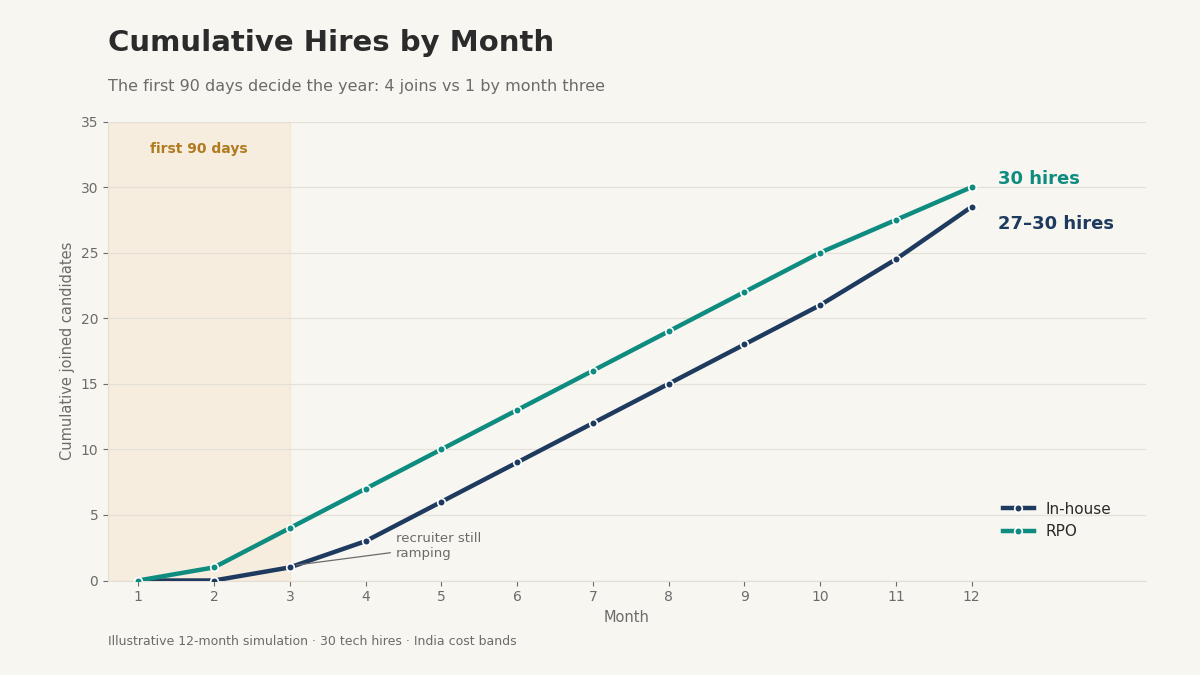
The headline from the simulation: for 30 tech hires in one year, the in-house path lands at roughly ₹52–55 lakh all-in while a typical RPO engagement lands at ₹40–47 lakh and the in-house option delivers its first hire two to three months later. The gap comes almost entirely from ramp time, tool licenses, and agency backfill, not from the recruiter's salary.
By the end, you will be able to build an in-house TA cost breakdown for your own numbers, price-check any RPO proposal line by line, and apply three decision rules that tell you which model or which hybrid fits your hiring volume. If you're mid-decision, the worksheet in the walkthrough is designed to be filled in during one finance meeting.
What Is the In-House Recruiter vs RPO Cost Comparison?
The in-house recruiter vs RPO cost comparison is a total-cost-of-ownership analysis that weighs the fully loaded expense of employing internal recruiters salary, tools, job advertising, management time, and agency backfill against the fees of recruitment process outsourcing, where an external partner runs sourcing, screening, and coordination for a management fee, a per-hire fee, or both.
What it is not:
- Not a recruiter-vs-agency comparison. Contingency agencies charge per placement (typically 8.33%–20% of annual CTC in India) with no ownership of your process. RPO takes over the process itself under an SLA different economics entirely. If you’re evaluating providers, start with how recruitment process outsourcing services are actually scoped.
- Not a quality-vs-cost trade-off by default. A well-run RPO and a well-run internal team can both deliver high offer-to-join ratios; the cost model is the variable, not the ceiling on quality.
- Not a one-time calculation. The answer flips at different hiring volumes which is why this guide simulates a full year rather than quoting a single per-hire figure.
Why This Decision Matters: The Business Case in Numbers
The cost of hiring a recruiter vs RPO touches four budget lines at once, and the swings are large enough to show up in a board deck:
- Direct cost per hire. SHRM benchmarks average US cost per hire at roughly $4,700, with employers estimating total replacement cost at 3–4x salary once ramp and vacancy effects are included (SHRM hyperlink the stat). In Indian tech hiring, blended per-hire costs typically land between ₹80,000 and ₹2.5 lakh depending on seniority and channel mix. A model that’s 30% more efficient across 30 hires is a ₹10–20 lakh annual difference.
- Speed and vacancy cost. SHRM’s benchmarking puts median time-to-fill around 44 days. Every open engineering seat delays roadmap output; teams that cut time-to-fill from ~45 days to ~15–20 days effectively recover 3–4 engineer-weeks of output per hire.
- Fixed vs variable cost structure. In-house recruiting is a fixed cost that persists through hiring freezes. RPO converts most of that to variable cost you can scale down within a notice period, a material difference if your hiring plan has ever been cut mid-year (most have).
- Risk concentration. One resigning in-house recruiter can stall an entire pipeline for 6–10 weeks. RPO spreads that risk across a bench, usually with contractual continuity obligations.
None of these numbers decides the question alone. Together they define what your simulation needs to capture which is exactly what the walkthrough below builds.
The Core Problem: Why Most Cost Comparisons Are Wrong by 2–3x
Buyers making this decision for the first time reliably make the same four modeling errors. We see these patterns in most engagements where a company arrives after a failed first attempt:
Error 1 Counting salary as the whole cost. A ₹10 lakh recruiter salary becomes ₹12.5 — 14 lakh fully loaded (PF, gratuity, insurance, laptop, seat), and the function around them adds ₹15–20 lakh in tools and advertising. Teams routinely underestimate the true in-house TA cost breakdown by 2–3x.
Error 2 Ignoring ramp time. You first spend 30–60 days hiring the recruiter, then the recruiter spends 45–90 days learning your roles, calibrating with hiring managers, and building a talent pipeline. Realistic first-offer timing is month 3–4, not week 2. Almost no in-house budget models zero output for the first quarter the simulation below does.
Error 3 Forgetting the agency backfill line. Even good internal teams route their hardest 15–30% of roles (staff engineers, niche stacks, leadership) to contingency agencies at ₹1.5 — 3 lakh per placement. That spend belongs inside the in-house column; leaving it out is the single most common way the comparison gets rigged.
Error 4 Comparing an RPO’s sticker fee against nothing. RPO proposals put every cost on one invoice, which makes them look expensive next to a salary that hides ten other line items. The fix is structural: put both models through the same 12-month, all-line-items template.
The consequence of these errors is predictable: companies build in-house on a ₹25 lakh assumption, spend ₹50+ lakh, deliver hires late, and then evaluate RPO from a weaker negotiating position mid-crisis. The walkthrough exists to prevent exactly that sequence.
The Walkthrough: Building and Running Your Own 12-Month Simulation
This is the full lifecycle from defining your hiring load to exiting or scaling whichever model you choose. Work through the six phases in order; each produces a number or a decision the next phase consumes.
Phase 1 Define the Hiring Load (the input every cost model depends on)
Before comparing models in a build vs outsource recruiting team decision, quantify what you’re actually buying. Four inputs drive everything downstream:
- Volume: Total hires over 12 months, split by quarter. 30 hires evenly spread is a different problem from 30 hires in Q1–Q2.
- Role mix and difficulty: List roles by scarcity tier. A plan to hire eight backend engineers, four frontend engineers, and a plan to hire DevOps engineers and data engineers has a very different sourcing cost than 30 QA roles scarce roles consume 2–4x more recruiter hours per hire.
- Salary bands: Per role, in ₹ or $. You need these to price agency backfill (percentage-based) and to estimate vacancy cost.
- Deadline sensitivity: Which roles block revenue or a committed roadmap? Those carry a real vacancy cost of roughly 1.5–2x weekly loaded salary in delayed output for senior roles.
The requisition-load rule: One competent tech recruiter sustainably closes 1.5–4 hires per month depending on role difficulty (closer to 1.5 for senior/niche, closer to 4 for high-volume junior roles). Divide your monthly hiring target by this range to get the recruiter headcount you’d actually need 30 hires/year at mixed seniority means 1.5 — 2 full-time recruiters, not the “one recruiter should handle it” assumption most plans start with.
Our simulation scenario (used through Phase 4): Funded product company, India-based engineering, 30 hires in 12 months 22 mid-level, 6 senior, 2 leadership average CTC ₹22 lakh, evenly loaded across quarters.
Phase 2 Price the In-House Path Honestly
How much does an in-house recruiter cost per year? Build the model from these eleven line items this is the complete checklist; if your spreadsheet has fewer rows, it’s optimistic:
- Recruiter salaries: ₹6–12 LPA mid-level, ₹12–20 LPA senior tech recruiters in India ($60k–85k base in the US).
- Loading factor: Multiply salary by 1.25–1.4x for statutory benefits, insurance, equipment, and seat cost.
- Recruitment of the recruiters: Someone has to hire them first typically 30–60 days of elapsed time plus ₹0.5 — 1.5 lakh in ads or a one-time agency fee.
- Sourcing tools: A LinkedIn Recruiter seat runs roughly ₹6–9 lakh/year in India ($9k–12k in the US). This is usually the second-largest line after salaries.
- ATS license: ₹1.5–6 lakh/year depending on tier (entry ATS vs enterprise suite).
- Job boards and database access: ₹1–3 lakh/year (Naukri, Instahyre, and equivalents).
- Assessment/interview platforms: ₹1–4 lakh/year for coding tests and structured interview tooling.
- Employer branding spend: Careers page, content, events ₹1–5 lakh/year even at modest ambition.
- Hiring-manager and leadership hours: Interview panels, debriefs, TA management. For 30 hires, 400–700 loaded hours is typical, booking it at ₹4–8 lakh even if it never hits an invoice.
- Agency backfill: Budget 15–30% of roles at ₹1.5–3 lakh per placement for the searches your team can’t crack.
- Attrition insurance: If a recruiter leaves mid-year (TA attrition is chronically high), add re-hiring cost and 6–10 weeks of stalled pipeline.
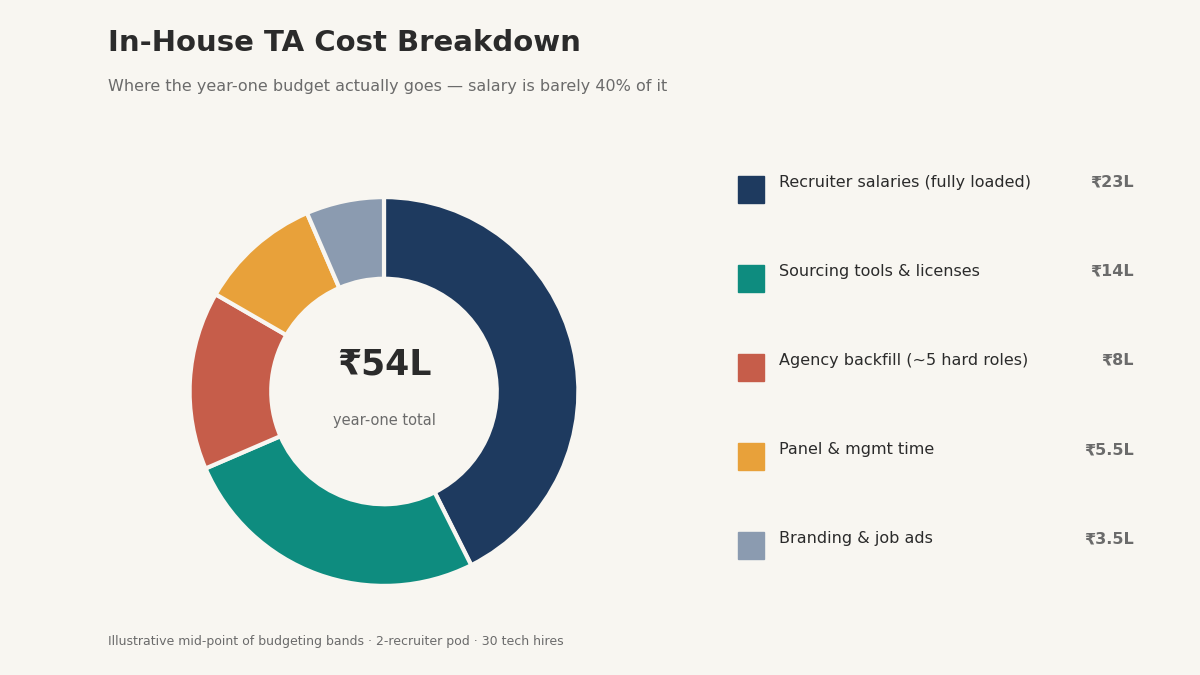
Simulation output for our scenario (2 recruiters): salaries ₹22–24L fully loaded, tools ₹13–16L, branding and ads ₹3–4L, management/panel time ₹5–7L, agency backfill on ~5 hard roles ₹8–11L. Year-one total: ₹52–55 lakh (~$62k–66k) for a realistic 27–30 completed hires an effective ₹1.7–2 lakh per hire.
Phase 3 Decode RPO Pricing Models
How is RPO priced? Every proposal you’ll see is a combination of four components knowing them is how you compare quotes line by line rather than by gut feel:
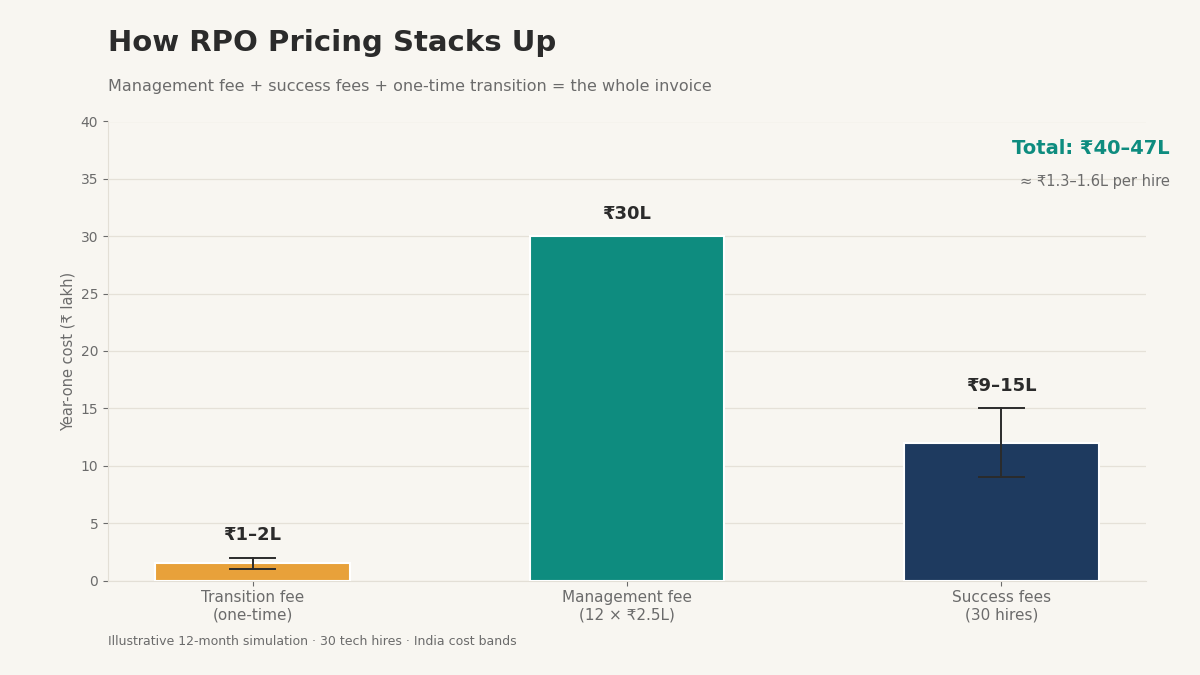
- Management fee: A fixed monthly retainer for the dedicated team typically ₹1.5–4 lakh/month for a pod serving 20–50 annual hires in India; enterprise programs run higher.
- Cost-per-hire fee: A success component per joined candidate is either a flat ₹30,000 — 1.2 lakh or 6–14% of CTC, well below the 8.33 — 20% contingency-agency norm because the retainer already covers effort.
- Transition/implementation fee: A one-time ₹1–3 lakh (sometimes waived) for process setup, ATS integration, and calibration.
- Pass-through costs: Job board or assessment licenses, if not bundled, always ask which tools are included; bundled LinkedIn/ATS access is a genuine ₹8–12 lakh swing.
Three engagement structures to know:
- Enterprise RPO: Full ownership of a hiring category under SLAs best at 25+ hires/year.
- Project RPO: Fixed scope, fixed window (“15 engineers in one quarter”) best for spikes.
- Recruiter-on-demand: Embedded recruiters billed monthly best when you want capacity without process transfer. Specialized IT RPO services typically offer all three and will tell you which fits if you share the Phase 1 inputs.
Red flag: Any proposal that can’t state its assumed hires-per-recruiter-per-month productivity number. If the vendor won’t show that math, the management fee has no anchor.
Contract terms that decide the real price (negotiate all five before signing):
- Replacement guarantee window 60–90 days is standard; strong providers replace a non-fit hire in 7–10 days rather than restarting the search clock.
- Exit notice period 30–60 days, with no lock-in beyond the first quarter.
- Candidate data ownership every profile sourced must live in your ATS or transfer at exit.
- SLA defines time-to-shortlist (7–10 working days from JD to interview-ready candidates is achievable with AI-assisted sourcing), interview-to-offer ratios, and joining-rate commitments.
- NDA and IP protection covering role details and compensation data.
Simulation output for our scenario: transition fee ₹1–2L, management fee ₹2.5L × 12 = ₹30L, success fee ₹30–50k × 30 hires = ₹9–15L. Year-one total: ₹40–47 lakh (~$48k–56k) for 30 hires an effective ₹1.3–1.6 lakh per hire.
Phase 4 Run the 12-Month Simulation Side by Side
This table is the heart of the RPO cost comparison worksheet in action. Costs are cumulative cash out; hires are cumulative joined candidates. In-house assumes recruiter #1 is hired in month 1 and joins in month 2; RPO assumes a 2–3 week go-live.
| Month | In-house: what’s happening | In-house cumulative cost | In-house cumulative hires | RPO: what’s happening | RPO cumulative cost | RPO cumulative hires |
| 1 | Sourcing your own recruiter; job ads live | ₹1L | 0 | Transition, calibration, sourcing starts wk 3 | ₹4L | 0 |
| 2 | Recruiter 1 joins; tools purchased (licenses front-loaded) | ₹13L | 0 | First shortlists in 7–10 working days; first offers out | ₹7L | 1 |
| 3 | Recruiter 1 ramping; recruiter 2 joins; first offers | ₹17L | 1 | Steady pipeline; ~3 joins/month | ₹11L | 4 |
| 4 | Pipeline building; first joins land | ₹21L | 3 | Full velocity | ₹15L | 7 |
| 5 | Both recruiters near full productivity | ₹25L | 6 | Full velocity | ₹18L | 10 |
| 6 | ~3 hires/month sustained; 2 hard roles sent to agency | ₹31L | 9 | Senior searches running in parallel | ₹22L | 13 |
| 7–9 | Steady state; agency fees hit on 3 placements | ₹42L | 18 | Steady state; leadership roles close | ₹32L | 21–22 |
| 10–12 | Final push; 2 more agency backfills; year-end true-up | ₹52–55L | 27–30 | Final cohort joins; contract review | ₹40–47L | 30 |
Three things the table reveals that no static comparison can:
- The first 90 days decide the year. By month 3, RPO has delivered 4 hires against in-house’s 1 and in-house has already spent more cash because tool licenses front-load. If your hiring plan is deadline-driven, this quarter is the whole argument.
- The in-house curve improves late. By months 10–12 the internal team’s marginal cost per hire approaches the RPO’s. This is why the multi-year picture (Phase 6) can flip the answer.
- Vacancy cost widens the real gap. The table shows cash only. Add the roadmap value of seats filled 6–8 weeks earlier across 30 hires and the effective year-one difference grows well beyond the ₹8–14 lakh cash delta.
Do this with your own numbers: Rebuild the table with your Phase 1 volume, your Phase 2 line items, and the median of two real RPO quotes from Phase 3. If you only steal one artifact from this guide, make it this table structure.
Phase 5 Onboard Whichever Model You Choose (the first 30 days)
Both paths fail the same way: a fast start on sourcing with no calibration. The first-two-weeks checklist, either model:
- Intake sessions per role family hiring manager, must-have vs trainable skills, two calibration profiles (“we’d hire this person / we wouldn’t”).
- Access provisioning ATS seats, JD repository, interview panels booked as recurring holds (panel availability, not sourcing, is the #1 onboarding friction we see in real engagements).
- Communication cadence a weekly 30-minute pipeline review plus a shared dashboard; daily Slack for offer-stage candidates only.
- Definitions of “shortlist-ready” agree in writing what a submitted candidate includes (assessment score, compensation expectation, notice period). This single document prevents 80% of month-two disputes.
- First-offer target date sets it explicitly (day 20–30 for RPO, day 60–75 for a new internal recruiter) so drift is visible immediately.
Red flag in week 3: volume without precision. Fifteen mediocre CVs per role means calibration failed to fix the intake, not the sourcing.
Phase 6 Manage, Scale, or Exit
Managing delivery track five KPIs monthly, either model:
- Time-to-shortlist (target: 7–10 working days for mainstream tech roles)
- Interview-to-offer ratio (healthy: 3–5 finalists per offer)
- Offer-to-join ratio (best-in-class programs sustain 90%+; India’s notice-period market makes this the metric to watch)
- 90-day retention of hires
- Cost per hire, computed monthly against your simulation variance over 15% for two consecutive months means the model, not the month, is wrong
Scaling: In-house scales in step functions (each new recruiter is a 3-month ramp); RPO scales within notice periods by expanding the pod. If your hiring plan doubles mid-year, this asymmetry usually matters more than the base price.
Exiting an RPO well: confirm candidate data transfer, hire 1–2 internal recruiters before the contract lapses (often from talent the RPO helped you meet), and keep a project-RPO clause for spikes.
Exiting in-house is harsher; it means letting people go, which is why the fixed-vs-variable point from the business case belongs in your risk register, not just your budget.
Case Studies: What the Numbers Look Like in Practice
These outcomes come from Supersourcing’s delivery work across 527+ IT projects, where the model described above dedicated pods, AI-assisted sourcing surfacing a vetted top-2% talent slice, 7–10 day shortlists runs at scale with a 98% candidate joining rate across engagements.
Paytm 100+ engineers without expanding internal TA. Facing a hiring plan north of 100 engineering roles, the fintech leaned on an outsourced pod rather than tripling its internal recruiting bench. Parallel pipelines across backend, frontend, and data roles kept hiring velocity aligned with quarterly headcount plans, the scale scenario where the RPO column in our simulation wins most decisively.
OkCredit engineering hiring without the ramp-up quarter. The SME-fintech needed engineering hires on startup timelines, where a 90-day internal-recruiter ramp was the difference between shipping and slipping. Outsourced sourcing and vetting delivered interview-ready shortlists inside the first sprint of the engagement, the “first 90 days” dynamic from Phase 4, played out in production.
Somnoware recruitment automation for a lean healthtech team. With no appetite for a permanent TA function, the company used an outsourced, automation-heavy pipeline to compress screening effort and keep candidate drop-off under 1% on contract roles the below-threshold volume profile where building in-house never pencils.
The Decision Framework: Build, Outsource, or Blend
Apply these three rules to your Phase 1 numbers before reading any vendor proposal. For the adjacent question of whether roles should be permanent at all, the IT staffing vs. in-house hiring comparison covers the employment-model side of the same decision.
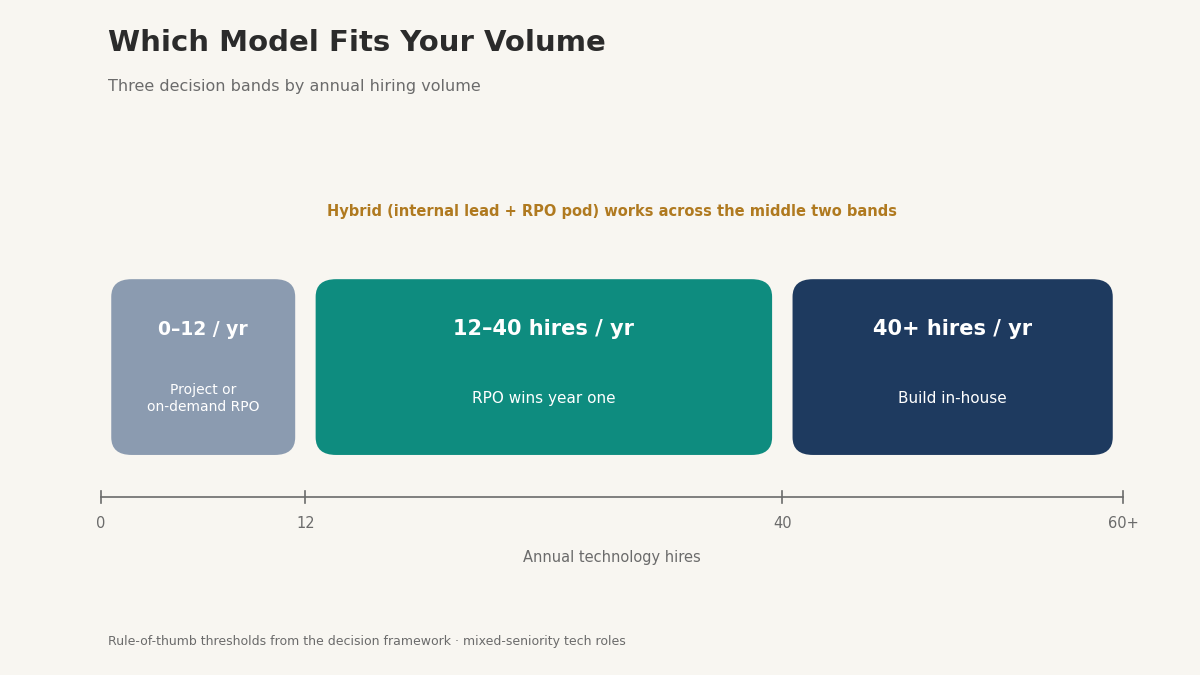
Rule 1 The volume threshold. Under ~10–12 hires/year, a full-time recruiter can’t be kept productive and enterprise RPO retainers don’t pencil either: use project RPO, recruiter-on-demand, or agencies. Between ~12 and 40 hires/year, RPO usually wins year one on cash and always wins on speed. Above ~40 sustained annual hires for 3+ years, building in-house (often seeded by an RPO transition) starts winning on marginal cost.
Rule 2 The volatility test. If your 12-month plan has >30% probability of being cut or doubled, weight variables cost heavily RPO or hybrid. Stable multi-year plans tolerate the fixed cost of a team.
Rule 3 The scarcity split. Whatever the model, your hardest 10–20% of roles (leadership, niche stacks) behave like retained search. Price them separately instead of letting them silently blow up either budget.
| Dimension | In-house recruiter(s) | RPO | Hybrid (internal lead + RPO pod) | Contingency agencies only |
| Year-1 cash for ~30 tech hires | ₹52–55L | ₹40–47L | ₹45–55L | ₹55–90L (8.33–20% of CTC × 30) |
| Time to first hire | 60–100 days | 25–45 days | 30–50 days | 30–60 days |
| Cost structure | Fixed | Mostly variable | Mixed | Fully variable |
| Process control & employer brand | Highest | High (with SLAs) | Highest | Low |
| Scaling speed | Step-function, slow | Days–weeks | Fast | Fast but expensive |
| Key risk | Recruiter attrition, ramp | Vendor dependence at exit | Coordination overhead | Cost blowout, no pipeline ownership |
The quiet winner in practice is the hybrid: one internal TA lead who owns strategy, employer branding, and offer negotiation, backed by an outsourced pod that provides sourcing and screening throughput. It combines the control that makes in-house attractive with the ramp-free capacity that makes RPO cheaper in year one.
What Most Teams Get Wrong
Opinionated, pattern-based, and drawn from watching this decision play out repeatedly:
They hire the recruiter before doing the math. The default motion is “we’re scaling post a recruiter JD.” The recruiter arrives with no tools, no calibrated process, and 20 open roles, then gets blamed for the ramp physics described in Phase 2. If the simulation says build, budget the function, not the person.
They treat the LinkedIn Recruiter seat as an afterthought. It’s frequently the second-largest line in the in-house column and the item most often “borrowed” from a founder’s personal account until compliance or scale breaks it. Any comparison that omits it is fiction.
They negotiate RPO fees and ignore RPO terms. A ₹25k discount on the management fee is worth far less than a 90-day replacement guarantee, candidate-data ownership at exit, and a hard time-to-shortlist SLA. The terms are the price.
They assume AI tooling closes the in-house gap for free. LinkedIn’s Future of Recruiting research finds only a minority of TA professionals have genuinely integrated generative AI into their workflow and those who do save roughly a day per week (LinkedIn hyperlink the stat). That saving is real but accrues to whoever operates the tooling well; an RPO running AI-assisted sourcing at scale captures it from day one, while a two-person internal team captures it in quarter three, if at all.
They model year one and decide forever. The right reading of the simulation is sequential: outsource the surge, learn the vendor’s process, then build in-house at the volume where fixed cost wins carrying the process documentation and talent pipeline with you. The build vs outsource framing is a false binary; the best operators treat it as a sequence.
Cost & Timeline Reality Check
The section with the most competing content skips: concrete tiers, in one place. All figures are typical market ranges for Indian tech hiring (US equivalents noted); treat them as budgeting bands, not quotes.
In-house function, annual (2-recruiter pod):
- Salaries fully loaded: ₹22–34L
- Tools (LinkedIn Recruiter, ATS, boards, assessments): ₹10–20L
- Branding + job advertising: ₹2–6L
- Management/panel time (loaded): ₹4–8L
- Agency backfill (15–30% of roles): ₹6–15L
- Total: ₹45–80L depending on seniority mix and discipline
RPO, annual (~30 hires):
- Transition fee: ₹0–3L one-time
- Management fee: ₹18–48L (₹1.5–4L/month)
- Success fees: ₹9–20L
- Total: ₹30–65L, with tool bundling worth ₹8–12L of the spread
Per-hire yardsticks: blended internal ₹1.7–2L+ in year one (falling toward ₹1–1.3L at steady state in later years) · RPO ₹1.2–1.6L · contingency agency ₹1.8–4.4L per placement on a ₹22L CTC. For short-term or contractor-heavy plans, the contract IT staffing cost model prices differently against hourly/monthly markups rather than per-hire fees.
Timeline yardsticks:
- RPO go-live: 2–4 weeks · first shortlists: 7–10 working days after go-live · first joins: weeks 6–10 (notice periods dominate)
- In-house: recruiter hired by week 6–8 · productive by week 16–20 · first joins: months 4–5
- What drives cost up in either model: senior/niche role concentration, multi-location hiring, weak interview-panel availability, uncompetitive salary bands (which inflate offers-declined and restart searches)
- What drives cost down: calibrated intake documents, bundled tooling, a warm employer brand, and honest requisition-load planning
Your Next Step
If you’re mid-decision, don’t start with a vendor pitch start with your own numbers. Rebuild the Phase 4 table with your hiring volume, salary bands, and tool stack this week; the answer usually becomes obvious by the time the cumulative-cost column is filled in.
If you’d rather pressure-test that worksheet against live market data real management-fee benchmarks, current shortlist timelines for your specific stack, and what a 7–10 day replacement guarantee looks like in contract language Supersourcing’s team will walk through your simulation line by line and tell you honestly which side of the volume threshold you’re on, including when the answer is “build it in-house.”
Bring your 12-month hiring plan and book a working session: https://supersourcing.com/contact-us/
FAQ
What is the average cost of an in-house recruiter?
In India, mid-level tech recruiters earn ₹6–12 LPA and senior recruiters ₹12–20 LPA; fully loaded, multiplied by 1.25 — 1.4x. But the recruiter is only 40–50% of the function’s cost tools, advertising, management time, and agency backfill typically double the figure. Budget the function, not the salary.
How is RPO priced?
Almost always as a monthly management fee (₹1.5 — 4 lakh for a mid-size program) plus a per-hire success fee (flat ₹30k–1.2L or 6–14% of CTC), sometimes with a one-time transition fee. Pure cost-per-hire and pure retainer models exist at the extremes; hybrids dominate because they align effort and outcomes.
Is RPO cheaper than hiring an internal recruiter?
In year one, at 12–40 hires, usually yes our 30-hire simulation lands at ₹40–47L for RPO versus ₹52–55L in-house, with hires arriving 6–8 weeks earlier. At sustained volumes above ~40 hires/year over multiple years, a well-run internal team becomes cheaper per hire. Volume and duration decide it, not ideology.
How many hires per year justify a full-time recruiter?
A tech recruiter closes roughly 1.5 — 4 hires per month depending on difficulty, call it 20–35 per year at mixed seniority. Below ~12 annual hires you’re paying for idle capacity; use on-demand models instead. Above that, one recruiter per 20–30 annual requisitions is a sane planning ratio.
How long does it take an in-house recruiter to ramp up?
Expect 45–90 days from joining to full productivity: learning role nuances, calibrating with hiring managers, and building pipeline. Add the 30–60 days it took to hire them, and realistic first joins land in month 4–5 the single biggest hidden cost in the in-house column.
What are the hidden costs of building an internal recruiting team?
The recurring five: sourcing-tool licenses (a LinkedIn Recruiter seat alone runs ₹6–9L/year), hiring-manager interview hours, agency backfill on hard roles, recruiter attrition and re-ramp, and vacancy cost from slower fills during ramp. Together they typically exceed the recruiter’s salary which is why the hidden costs of in-house recruiting deserve their own budget lines.
Can I combine in-house recruiting with RPO?
Yes, and hybrids are increasingly the default: an internal TA lead owns strategy, brand, and offers while an RPO pod supplies sourcing and screening throughput. It’s also the standard transition path to outsource the surge, then insource at the volume where fixed cost wins.
How do I compare RPO proposals fairly?
Normalize every quote into the same four rows: management fee, per-hire fee, transition fee, pass-through tool costs then demand each vendor’s assumed recruiter productivity and SLA terms (time-to-shortlist, replacement guarantee, data ownership at exit). If a proposal can’t be decomposed that way, that’s your answer. This is also a sensible agenda for a first consultation call: bring your Phase 1 numbers and pressure-test them against a provider’s live benchmarks.
