

Eighty-four percent of developers now use or plan to use AI tools in their daily work and the single biggest frustration they report, cited by 66%, is output that is almost right, but not quite. Another 45% say debugging AI-generated code takes longer than writing it themselves. Those numbers come from Stack Overflow’s 2025 Developer Survey of more than 49,000 engineers, and they quietly invalidate the assumption most hiring loops are built on.
The assumption is that writing correct code from a blank editor, unaided, under observation, is the scarce skill worth screening for. It isn’t anymore. The scarce skill is judgment: recognising the plausible-but-wrong answer, knowing which abstraction will survive contact with production, and being able to say why out loud. Almost no engineering interview loop measures that on purpose.
Gartner expects 90% AI code assistant adoption among enterprise software engineers by 2028, and at least 55% of software engineering teams to be actively building LLM-based features by 2027. The World Economic Forum’s Future of Jobs Report puts 39% of workers’ core skills as transformed or obsolete across the 2025–2030 window.
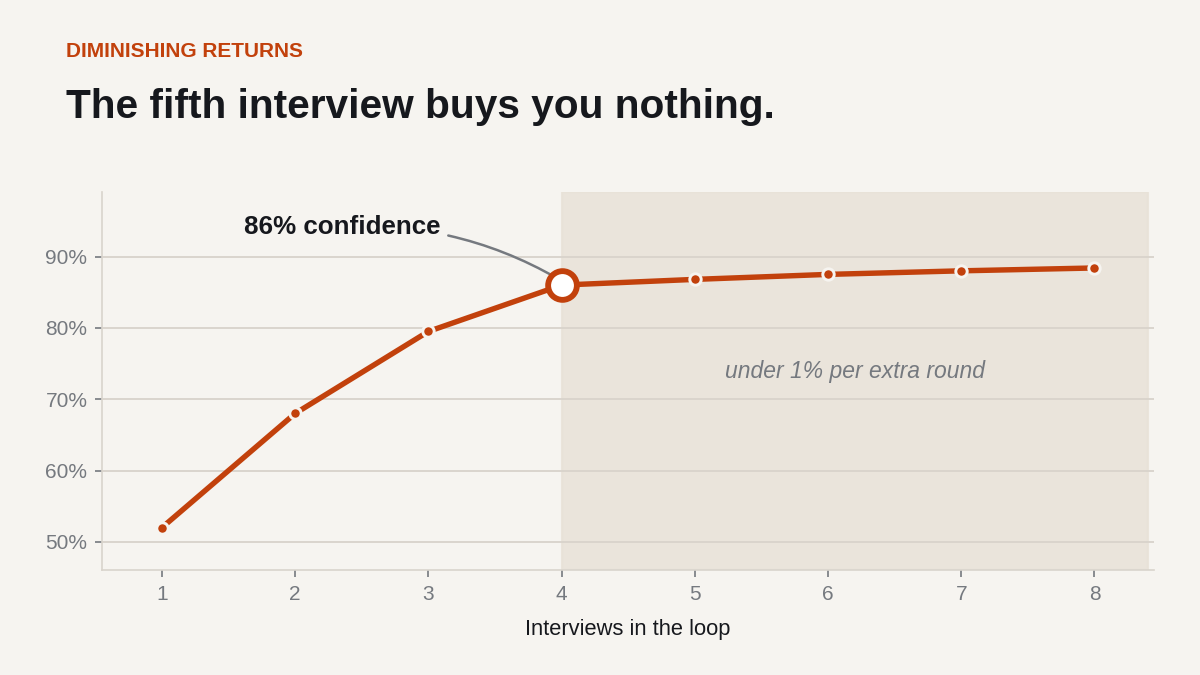
Here is the contrarian part. Most teams respond to weak hiring outcomes by adding rounds. Google’s own people analytics team ran the opposite experiment and found that four interviews predicted the hire/no-hire decision with roughly 86% confidence, and that panels of four reached the same conclusion as larger panels 95% of the time. Every round after the fourth brought less than a percentage point of accuracy while costing weeks of calendar time and a measurable share of the candidate pool.
So the goal when you design a technical interview process is not more coverage. It is more signal per hour, from fewer, sharper stages, scored against something written down before the candidate walked in. Teams that design a technical interview process well are optimising for exactly one variable: confidence gained per candidate-hour spent. This guide is the build spec: what each stage is for, what to score, what to cut, and where loops leak candidates.
TL;DR
This guide is a build spec for engineering leaders, founders, and talent teams who need to design a technical interview process that actually correlates with delivery, not one that just feels rigorous. It covers stage design, rubric construction, calibration, and the failure modes that show up after the offer.
The number that matters: four well-designed rounds get you to roughly 86% confidence on a hire decision. A fifth adds under 1%. Most loops that run six or seven stages are paying two extra weeks of calendar time for statistical noise, and losing their strongest candidates to faster competitors in the gap.
By the end you will have a defensible technical interview loop structure, a scoring rubric your panel can actually agree on, benchmarks for how long each stage should take, and a clear read on which of your current rounds to delete.
What Is a Technical Interview Process?
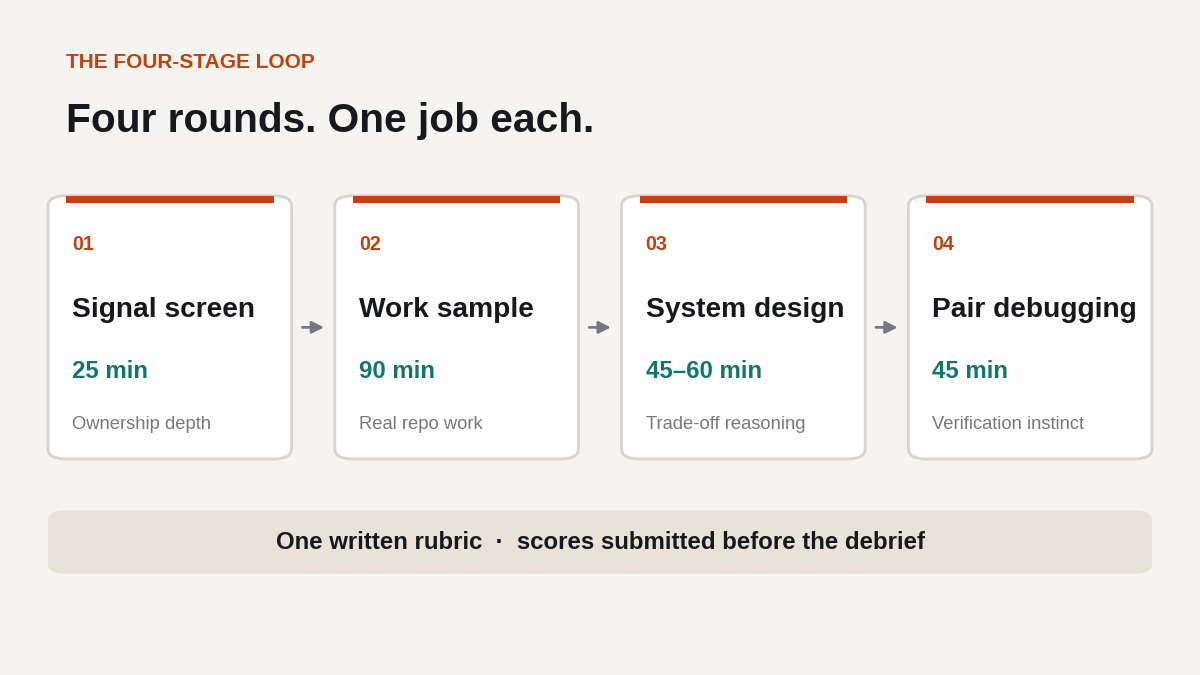
A technical interview process is the structured sequence of evaluation stages, screen, work sample, system design, and collaboration assessment that an engineering team uses to predict a candidate’s on-the-job performance. Each stage tests a distinct competency against a pre-written scoring rubric, and the combined scores, not any single interviewer’s impression, drive the hire decision.
Everything below is how to design a technical recruitment process that matches that definition in practice: four competencies, four stages, one written bar.
Why Most Engineering Interview Design Fails Before the First Round
Weak loops are rarely weak because the questions are bad. They are weak because nobody defined what a good answer looks like before the interview started. When the rubric lives in the interviewer’s head, three engineers assessing the same candidate are running three different exams. Before you design a technical interview process, someone has to decide what a good answer looks like in writing, in advance.
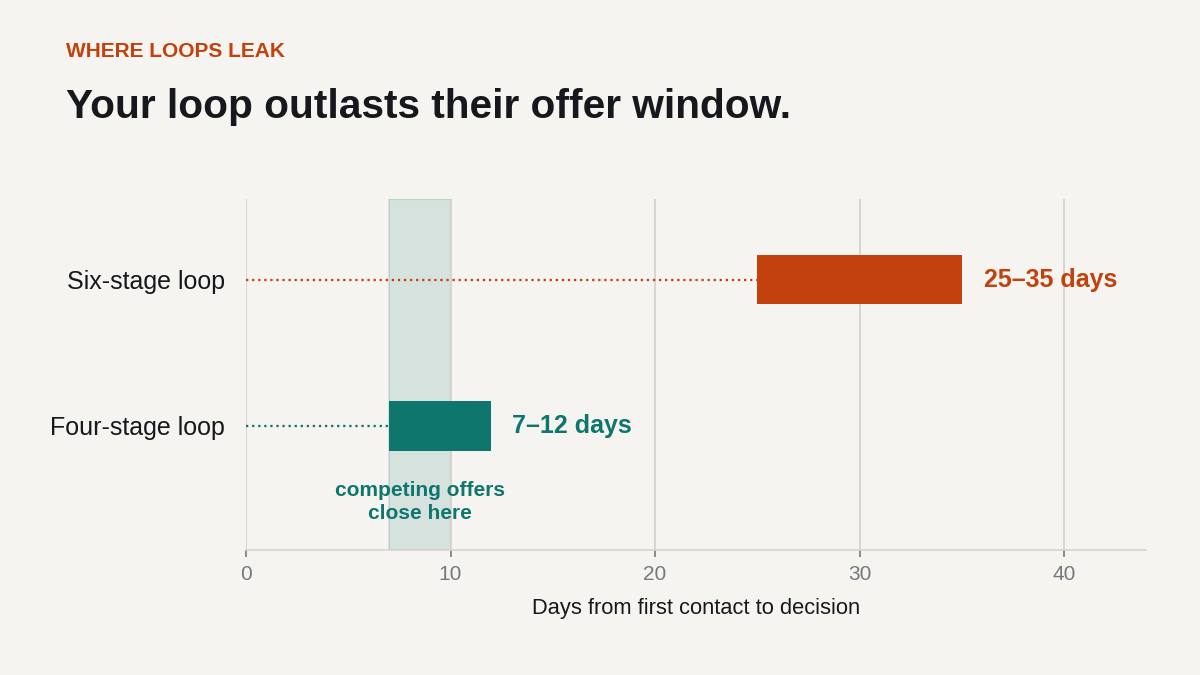
The cost shows up in three places, and it is larger than teams estimate usually by a factor of three to four. First, time-to-hire: a six-stage loop with two-day scheduling gaps between rounds runs 25–35 calendar days minimum, and strong engineers hold competing offers for 7–10 days, not 30. Second, false negatives: candidates who would have performed well but failed a round that measured recall under stress. Third, false positives that surface at day 45 of onboarding, when the cost of the mistake is a full quarter of team throughput.
There is also a quieter tax. Unstructured rounds produce debriefs where the loudest interviewer anchors the room in the first 90 seconds. Teams that design a technical interview process without written anchors end up relitigating the same disagreement every Friday. Google’s re:Work research on structured interviewing found the structured alternative both more predictive of job performance and roughly 40 minutes faster per interview for the interviewer, a rare case where the rigorous option is also the cheaper one.
How to Design a Technical Interview Process: The Four-Stage Loop
Four stages, each with one job. The instruction to design a technical interview process almost always arrives inside a company as “add another round” resists it. If you cannot articulate what a stage uniquely measures that no other stage measures, delete it. This is the core of a defensible technical interview loop structure, and it holds from Series A startups to GCC engineering pods of 200.
Stage 1 The 25-Minute Signal Screen
Not a culture chat. A tightly scoped conversation that tests one thing: can the candidate describe a system they built, at the level of specific trade-offs they chose and rejected? Ask what broke in production and what they changed afterward. Vague ownership language here correlates strongly with vague ownership later.
Cap it at 25 minutes and score it pass/fail on two axes with only depth of ownership and clarity of explanation. Anything longer is the second interview wearing a costume. Most dedicated teams who design a technical interview process for the first time over-invest here and under-invest in stage two.
Stage 2 The Work Sample, Scoped to 90 Minutes
Work samples remain the highest-signal stage available, but only when they resemble the actual job. Debugging an existing codebase beats implementing an algorithm from scratch, because reading unfamiliar code under time pressure is what the role actually involves. When you design a technical interview process around real repository work rather than puzzle solving, the correlation with first-quarter performance rises sharply.
Hard rules that hold up in practice: scope the task to 90 minutes and say so explicitly; provide a runnable repo, not a spec document; and if you take more than three hours of a candidate’s unpaid time, expect drop-off from exactly the senior people you want. Whether you’re screening backend generalists, hiring Python developers, or evaluating QA engineers, the sample should be a slice of week-one work.
Stage 3 The System Design Round, Scored on Trade-offs
Most system design rounds are graded on whether the candidate arrived at the interviewer’s preferred architecture. That is a taste test, not an assessment. Score instead on whether they surfaced constraints unprompted, named what they were trading away, and changed their design when you introduced a new requirement mid-conversation.
A candidate who proposes a simpler system and defends why should outscore one who names more technologies. In our review of loops we’ve rebuilt, the “names more technologies” bias is the single most common source of expensive false positives at senior level. If you design a technical interview process for staff-plus roles, this is the round that has to be rubric-driven or it becomes a personality match.
Stage 4 Collaboration Under Correction
The last of the developer interview stages measures something the first three cannot: how the candidate behaves when they’re wrong. Run a pair-debugging session on a failing test, and deliberately give one piece of incorrect guidance partway through.
What you’re scoring is whether they verify before accepting. Given that 46% of developers now report actively distrusting AI output while 84% use it anyway, verification instinct is no longer a soft skill; it is the primary defence against the “almost right” code that 66% of engineers say is their biggest daily frustration.
Any attempt to design a technical interview process for 2026 that skips this round is measuring a version of the job that no longer exists.
How to Build the Rubric (6-Step Process)
The rubric is what converts four conversations into a defensible decision. Build it before you design a technical interview process end to end not after the first candidate splits the panel.
- List 4–6 competencies the role actually requires, drawn from the last three tickets someone in that role shipped not from the job description.
- Assign each competency to exactly one stage. Overlap is how loops bloat from four rounds to seven.
- Write behavioural anchors for each score: what a 2, 3, and 4 look like in observable behaviour, not adjectives. “Identified the race condition without a hint” beats “strong debugging skills.”
- Fix the question set per stage. Same core questions for every candidate for that role; follow-ups can vary.
- Require written scores before the debrief. Interviewers submit independently, then discuss. This kills anchoring.
- Recalibrate quarterly against the performance of hires from the last two quarters. A rubric that never changes is a rubric nobody is checking.
Adjusting the Loop for Remote and Distributed Panels
When the panel and the candidate are in different time zones, the constraint stops being interviewer availability and becomes elapsed calendar time. Compress the loop into two sittings rather than four, and publish the full sequence to the candidate up front.
Teams that hire remote developers at scale consistently report that schedule transparency, not process length, is what determines drop-off. The same holds when you design a technical interview process for an offshore engineering pod or a GCC team spun up from zero.
What This Looks Like in Practice
A fintech engineering team running a five-round loop with a 31-day median cycle rebuilt it against this structure: screen, repo-based work sample, system design, and a pairing round, with written scores mandatory pre-debrief. Cycle time compressed to a single-digit number of working days from shortlist to decision, and the metric that mattered to them the offer-to-accept ratio moved because candidates stopped receiving competing offers mid-loop.
The pattern repeats in IT staffing engagements. Across 527+ delivered IT projects, the loops that hold a 98% candidate joining rate and under 1% drop-off on contract roles share one trait: the rubric exists in writing before sourcing begins, so the shortlist is assembled against the same bar the panel will use.
Sourcing and evaluation are the same project, which is why the sequence to design a technical interview process should start before the first CV is opened. Supersourcing typically moves from job description to interview-ready shortlist in 7–10 working days for exactly this reason the evaluation criteria are frozen before the search starts, not negotiated after three candidates have already been rejected.
Which Stage Format Actually Gives You Signal
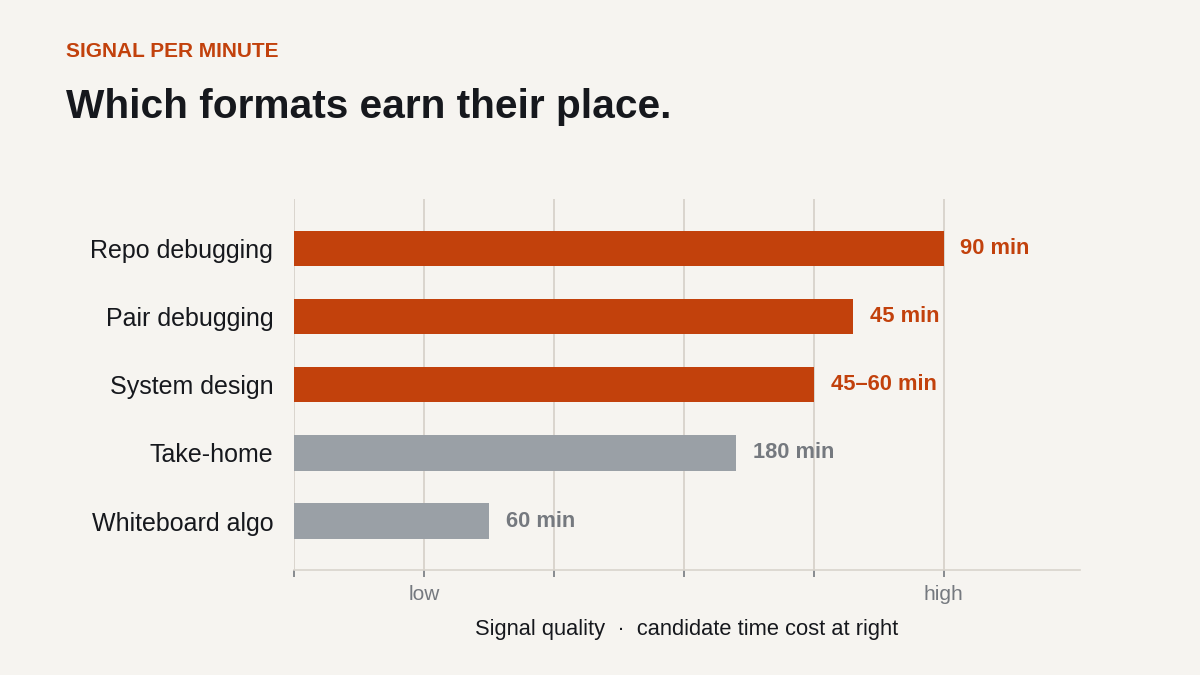
Use this to decide what to keep. The right interview process for developers trades some signal depth for cycle speed at the top of the funnel, and buys it back in the middle. Use the table to decide which formats survive when you design a technical interview process from scratch.
| Stage format | Signal quality | Candidate cost | Best used for |
| Live algorithm whiteboard | Low for most roles | 60 min, high stress | Rarely justified outside algorithm-heavy infra roles |
| Take-home assignment | High if scoped ≤3 hrs | 3+ hrs unpaid | Mid-level ICs; drops off badly at senior level |
| Repo debugging (live) | Highest per minute | 90 min | Almost every backend, frontend, and QA role |
| System design discussion | High at senior level | 45–60 min | Senior, staff, and architect hires |
| Pair-debugging round | High for judgment | 45 min | Every role, as the final stage |
Before You Rebuild Your Loop
If you’re about to redesign your loop, run one audit first: pull your last 10 hires, score them against the rubric you currently use, and check whether the rubric would have predicted their actual performance. If it wouldn’t have, the problem isn’t your questions.
Teams that want to pressure-test a loop before committing engineering hours to it can walk through the structure with a team that has helped design a technical interview process across 527+ delivered IT projects and hundreds of engineering hires. No pitch, no obligation, bring your current stages and we’ll tell you which two to delete.
Reach us: mayank@engineerbabu.com · supersourcing.com/contact-us
FAQ
What are the stages of a technical interview process?
Four stages carry nearly all the predictive weight: a short signal screen, a scoped work sample, a system design conversation, and a collaboration or pair-debugging round. Each should test one competency that no other stage tests. Additional rounds, culture panels, second manager screens, founder chats rarely add measurable accuracy and reliably add calendar time. Design a technical interview process around those four and treat every extra stage as something that must justify itself.
How many interview rounds are too many?
More than five, in almost every case. Google’s internal analysis found four interviews reached roughly 86% confidence on the hire decision, with each additional round contributing under one percentage point. Beyond five rounds you are trading real candidates for statistical noise, particularly at senior level where competing offers close within 7–10 days.
Are take-home assignments better than live coding interviews?
Take-homes produce better signals when they are scoped under three hours and mirror real work. Live repo debugging often produces more signal per minute and eliminates the “who really wrote this” problem. The practical answer for most teams: use a live, repo-based sample, and reserve take-homes for roles where deep asynchronous work is the job.
How do you reduce bias in technical interviews?
Standardise the question set per role, write behavioural anchors for each score band, and require interviewers to submit written scores before any group discussion. Google’s re:Work research found structured interviews both more predictive of job performance and less prone to demographic disparities than unstructured formats and about 40 minutes cheaper per interview for the interviewer. Standardisation is the cheapest fairness mechanism available to anyone who has to design a technical interview process under time pressure.
How long should a technical hiring loop take end to end?
From first contact to decision, 7–12 working days is achievable and 15 should be your ceiling. The rounds themselves consume around four hours; everything else is scheduled. Compressing the loop into two sittings and pre-booking panel slots removes most of the elapsed time without removing any assessment.
How do you interview developers who use AI coding tools?
Let them use the tools, then evaluate the verification behaviour. Seed a subtly incorrect suggestion and score whether they test it before shipping it. With 84% of developers using AI tooling and 66% naming almost-correct output as their top frustration, an engineer’s ability to catch that failure mode is now a core competency, not a bonus.
Should we outsource parts of the loop?
Screening and scheduling are the two stages that scale poorly in-house and consume the most engineering hours. Teams hiring at volume typically keep stages 2–4 internal and move sourcing and first-pass screening to recruitment process outsourcing or dedicated IT staffing services, keeping the rubric and the final call in-house.
