

Introduction
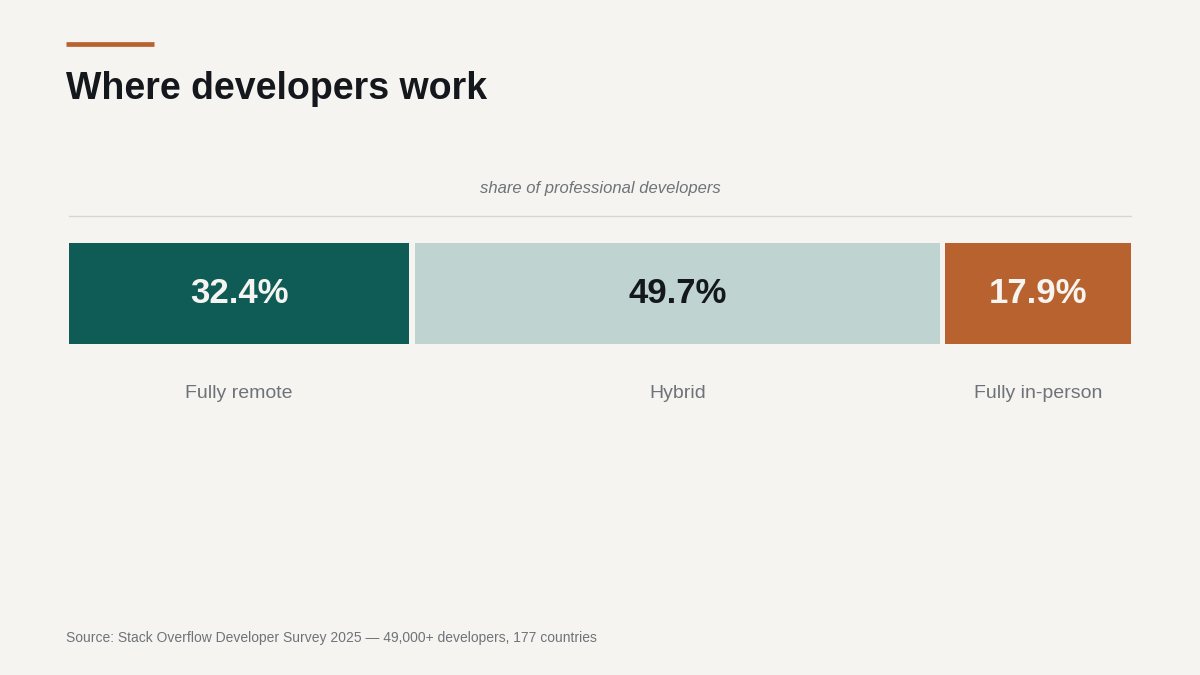
Three-quarters of the world’s professional developers no longer work from an office five days a week. According to the Stack Overflow Developer Survey 2025, which polled more than 49,000 developers across 177 countries, 32.4% work fully remote and only 17.9% are fully in-person the rest are somewhere in between. The distributed engineering team stopped being an experiment several years ago. What has not caught up is the operating manual.
Most companies still assemble remote teams using a co-located playbook with the office deleted. They post the same job description, run the same four interview rounds, hand over the same laptop-and-login onboarding, and then wonder why the third hire took five months and the second one left in eight.
Gartner predicts that through 2026, the atrophy of critical-thinking skills from generative AI use will push 50% of global organizations to require “AI-free” skills assessments and Gartner explicitly warns this will lengthen hiring processes and intensify competition for candidates with proven judgment. Every remote interview loop designed before 2025 is now structurally obsolete.
That prediction matters more for distributed hiring than for anyone else. When you cannot watch someone think on a whiteboard, your evaluation signal is whatever your process is capable of extracting through a screen and most processes extract very little.
This playbook is the sequence that works. Building a remote engineering team from scratch is a six-phase operation with defined inputs, budgets, and failure modes at each step: define the roles, source the pipeline, vet against a scorecard, choose an engagement model, onboard to first commit, then instrument and scale. Skip a phase and it does not disappear; it resurfaces later, more expensively, usually as attrition.
Read it in order. Every phase includes the numbers most guides leave out.
TL;DR
This is a complete, sequential guide to building a remote engineering team from scratch written for founders, CTOs, and hiring leaders who have decided to go distributed and now need the execution detail. It covers role definition, sourcing, vetting, contracts, onboarding, performance management, and scaling.
The single number to hold onto: a well-run pipeline moves from job description to interview-ready shortlist in 7–10 working days, while most in-house first-time remote searches take 60–90 days per role. That gap is not talent scarcity. It is a process.
By the end, you will be able to name your first five hires and justify the order, build a remote team structure that survives its own growth, price the team in both ₹ and $ before you commit budget, and recognise the three specific failure patterns that kill distributed teams in month four.
What Is a Remote Engineering Team?
A remote engineering team is a group of software engineers, employed or contracted, who build and operate a product from distributed locations coordinated through written documentation, version control, and asynchronous rituals rather than shared physical space. Ownership of code review and deployment authority sits with the team itself, not with a central office.
Three things it is regularly confused with:
- It is not outsourcing. Outsourcing transfers a defined scope and its outcomes to a vendor. A remote engineering team reports into your engineering org, follows your architecture decisions, and appears on your roadmap. The accountability stays with you.
- It is not a freelance bench. Freelancers are engaged per deliverable and optimise for deliverable completion. A team member is engaged for capability and optimises for system health refactors, on-call, documentation, mentoring. Those are different economic incentives, and they produce different codebases.
- It is not a hybrid team with the office subtracted. Hybrid teams default to synchronous decision-making and treat writing as overhead. Remote-first teams treat writing as the primary artifact. Retrofitting one into the other is the single most common structural mistake in the category.
Why It Matters: The Business Case
The decision to go distributed is usually framed as a cost decision. It is actually four separate decisions: cost, speed, access, and risk and they move independently.
- Cost arbitrage is real but narrower than the pitch. A senior engineer costing $140,000–$190,000 fully loaded in the US or Western Europe maps to roughly ₹28–50 lakh per year in India for comparable seniority, which typically lands as a 40–60% reduction in fully loaded cost. It is not the 80% number that gets quoted, because the honest calculation includes account management, equipment, compliance, and a genuine market-rate salary rather than a lowball one.
- Speed is where the larger gain sits, and almost nobody prices it. In most first-time in-house remote searches we see, a single mid-to-senior backend role takes 60–90 days from opening to signed offer. A pre-vetted pipeline compresses the front half of that to 7–10 working days to an interview-ready shortlist. Across five roles, that is roughly a quarter of engineering capacity recovered.
- Access changes what you can build, not just what you can afford. A company hiring within commuting distance of one metro is choosing from that metro. A company hiring remotely is choosing from a global pool which is the only reason a 15-person startup can staff a Kubernetes platform engineer and an ML engineer in the same quarter.
- Risk moves in both directions. Distributed teams reduce concentration risk (one office, one labour market, one power grid) and increase coordination risk. The failure mode is not “people slack off.” It is a decision taken in an unrecorded call that three people never hear about.
A functional remote team structure compounds all four. A dysfunctional one converts the cost saving into rework, and the speed saving into attrition. The rest of this guide is about which one you end up with.
The Core Problem: What Actually Goes Wrong
The failures in distributed engineering teams are boringly consistent. They are almost never about technical skill, and they cluster in five places.
- The requirement is a wish list, not a role. First-time remote job descriptions average 11–14 “required” skills. In practice, two or three determine whether the person succeeds. Every additional requirement shrinks the qualified pool, extends the search, and raises the price for signals you will never use.
- The timeline is underestimated by 3–4x. Teams budget three weeks for a hire that historically takes 60–90 days in-house, then compress the vetting to catch up. The compressed vetting is what produces the month-four departure, which restarts the whole clock.
- Vetting measures the wrong thing. A candidate who can solve a graph problem on a shared screen has demonstrated that they can solve a graph problem on a shared screen. Nothing in that round predicts whether they will write a clear PR description, escalate a blocker on day three instead of day eight, or make a defensible decision without a tap on the shoulder. Those are the actual remote competencies, and they need to be tested directly.
- Onboarding stops at access provisioning. Laptop, SSO, repo access, welcome call and then silence. The metric that matters is time-to-first-commit; in well-run engagements it lands inside 3–5 working days, and in badly run ones it stretches past three weeks while nobody notices because nobody is measuring it.
- Nobody defines “working.” Without agreed output metrics, managers substitute proxies, response latency in chat, hours visibly online, calendar density. Those proxies are the fastest known way to lose a strong senior engineer, and they are the reason a distributed team can look busy for two quarters and ship nothing.
The pattern worth remembering: in engagements we have run, the hire that fails is rarely the hire that interviewed badly. It is the hire that interviewed well against criteria that had nothing to do with the job.
The Walkthrough: Six Phases From Zero to a Functioning Team
This is the operational core of the guide. If you want to know how to build a remote dev team without repeating other people’s expensive mistakes, work through these six phases in sequence each one produces an artifact the next phase consumes. The sequence below is the whole of building a remote engineering team from scratch: there is no seventh phase, and there is no phase that reorders safely.
Phase 1 Defining Requirements: Roles, Scope, and Budget Bands
Most teams start with “we need two backend engineers.” That is a capacity statement, not a requirement. A requirement specifies what the person owns, what they decide alone, and what changes about the product because they joined and getting this wrong is the most expensive single error available in building a remote engineering team from scratch, because every downstream cost inherits it.
Start by writing the outcome, not the stack. “Own the payments service, cut checkout p95 latency below 400ms, and get us to PCI readiness by Q3” is a hireable requirement. “Strong Node.js developer, 5+ years” is a search filter.
What should my first 5 engineering hires be?
Order matters more than the titles. This sequence assumes a pre- or early-product-market-fit company building a web or mobile product:
- Founding full-stack generalist. Ships end to end schema, API, UI, deploy. Hired for judgment and shipping speed, not depth. This person’s real job is reducing uncertainty about what to build.
- Second full-stack or backend engineer. The purpose of hire #2 is removing the single point of failure created by hire #1. Two engineers who can review each other’s code is a step change; one engineer with a longer to-do list is not.
- Product-minded frontend engineer. Once the API surface stabilises, the frontend becomes the bottleneck on iteration speed. Hire someone who argues about interaction detail, not someone who implements handoffs.
- Platform / DevOps engineers are often fractional first. CI/CD, observability, environments, and cost control. Below roughly eight engineers, this is frequently a two-to-three-day-a-week engagement rather than a full-time seat, and it is one of the highest-leverage roles to bring in early. This is the point where teams commonly hire DevOps engineers on a contract basis before converting.
- Engineering lead or senior IC with mentoring range. Not a manager for four people. A senior who sets review standards, runs the technical bar, and can be trusted with an architecture decision while you are asleep.
Red flag: if hire #1 or #2 is a specialist, a dedicated data engineer, a mobile-only developer, and SRE . The roadmap is probably being written by an investor deck rather than by the product. Specialists before generalists is the most reliable early-stage staffing error there is.
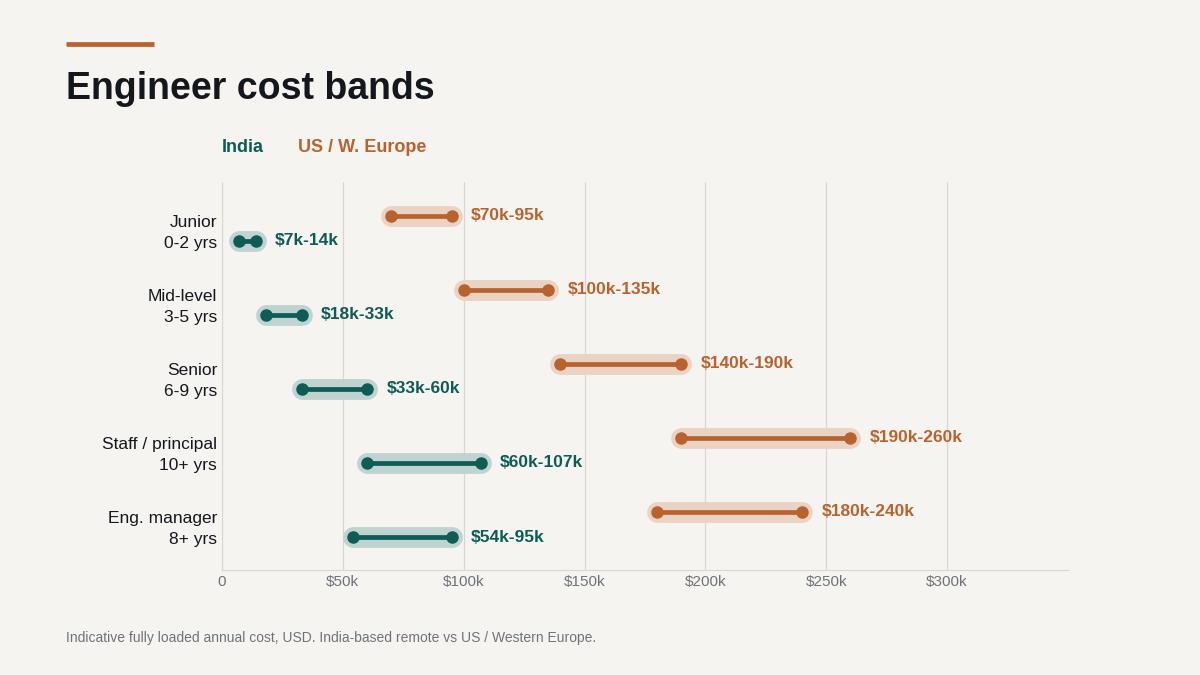
Budget bands before you write the job description. Indicative fully loaded annual ranges, India-based remote engineers, mid-2026 market:
| Level | Experience | India (₹ / year) | India ($ / year, indicative) | US/W. Europe equivalent ($) |
| Junior engineer | 0–2 yrs | ₹6–12 lakh | $7k–14k | $70k–95k |
| Mid-level engineer | 3–5 yrs | ₹15–28 lakh | $18k–33k | $100k–135k |
| Senior engineer | 6–9 yrs | ₹28–50 lakh | $33k–60k | $140k–190k |
| Staff / principal | 10+ yrs | ₹50–90 lakh | $60k–107k | $190k–260k |
| Engineering manager | 8+ yrs | ₹45–80 lakh | $54k–95k | $180k–240k |
These are market ranges, not quotes they move with city, stack scarcity, and whether you are competing against a Global Capability Centre for the same candidate. AI/ML, platform, and security roles routinely price 15–25% above the band for equivalent years. Specialist backend stacks are the clearest example: teams that need to hire Node.js developers with real distributed-systems depth should expect to pay at the top of the senior band, not the middle.
Phase 1 exit checklist do not open a search until all six are true:
- Each role has a one-sentence ownership statement and a 90-day outcome
- “Required” skills are cut to a maximum of four; everything else is listed as nice-to-have
- Salary band agreed in writing with whoever controls budget
- Required time-zone overlap window stated in hours, not vibes (“4 hours overlap with 9am–6pm CET”)
- Interview loop designed and scorecard written before the first candidate enters it
- Named decision-maker for the offer, with authority to move without a committee
Phase 2 Sourcing and Vetting: Where the Pipeline Actually Comes From
Sourcing quality determines everything downstream, and the channel mix for distributed roles looks nothing like local recruiting. Ranked by what we consistently see convert for engineering roles:
- Referrals from your existing engineers highest conversion, lowest volume, and it dries up after roughly the first five hires.
- Targeted outbound to passive candidates the top 2% of the market is almost never applying. It responds to a specific, technical message about a specific problem.
- Pre-vetted talent partners trade sourcing cost for speed; the value is entirely in whether the vetting is real. This is the fastest route when a role is blocking a release, and it is why most teams that need to hire remote developers at short notice use a partner for the first shortlist and inbound for the long tail.
- Niche communities and open source are slow, but the signal quality is exceptional because you can read the work before you read the CV.
- General job boards highest volume, lowest signal-to-noise. Budget screening time accordingly, or don’t use them.
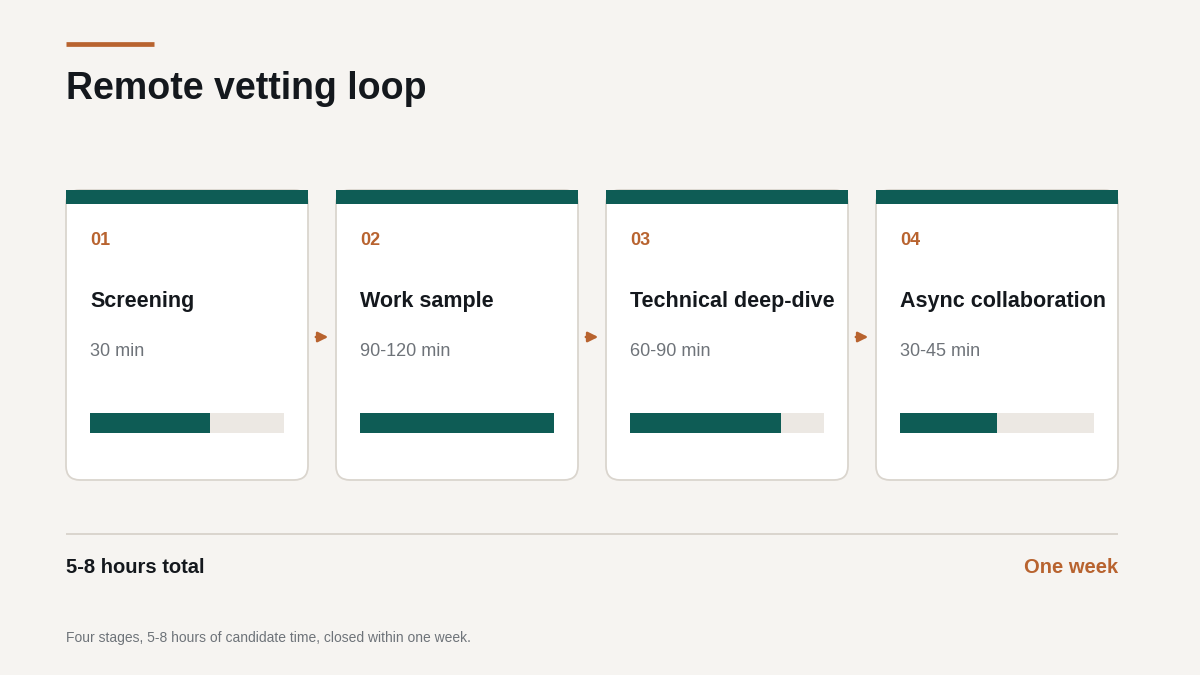
What good vetting looks like. A defensible remote loop has four stages and takes 5–8 hours of candidate time total. More than that and your acceptance rate falls; less and you are guessing.
- Screening (30 min). Motivation, compensation alignment, notice period, overlap availability. Kill early on misalignment. It is not rude, it is respectful of everyone’s time.
- Work-sample or take-home (90–120 min, paid or capped). A realistic slice of your actual codebase problems. Never an algorithm puzzle unrelated to the job. Cap it hard and honour the cap.
- Technical deep-dive with a live component (60–90 min). Walk through their submission, then extend it. This is where you observe reasoning under mild pressure, the closest available proxy for how they behave when production breaks. Given Gartner’s warning about AI-assisted candidates, the extension step is now the round that carries the most signal: anyone can generate a solution, far fewer can defend and modify one.
- Async collaboration test (30–45 min). Give a deliberately ambiguous ticket in writing. Score the questions they ask, the assumptions they document, and the clarity of their written update. This single round predicts remote success better than any technical stage.
Red flags that reliably predict a bad remote hire:
- Explains past architecture decisions only in outcomes, never in trade-offs considered and rejected
- Cannot describe a specific disagreement with a previous manager or peer and how it resolved
- Written responses are noticeably less coherent than verbal ones in a written-first team, that gap widens under pressure
- Vague on why they left the last two roles
- Never asks a question about the product, the users, or the technical constraints across four conversations
The background-verification detail nobody plans for: in India-based hiring, background verification and notice-period serving are the two most common causes of a signed offer slipping. Notice periods of 30–90 days are standard, and buyouts are negotiable but rarely free.
Build it into the plan a 98% joining rate is achievable, but only if the offer stage is managed as actively as the interview stage.
Phase 3 Engagement Models and Contracts: The Part That Decides Who Owns the Code
Choosing an engagement model is a legal and financial decision disguised as an HR one. There are four viable structures, and the differences that matter are control, IP, and how fast you can reverse the decision.
| Model | Best for | Cost profile | Control | Reversibility |
| Direct employment (own entity / EOR) | Long-horizon core roles | Highest total cost; lowest per-hour | Full | Slow notice periods, severance |
| Dedicated team (partner-employed, exclusive to you) | Building a durable team fast | Mid; single blended rate | High you direct the work | Moderate; typically 30–60 day notice |
| Staff augmentation | Filling a named skill gap in a live sprint | Mid-to-high hourly | High on task, low on career | Fast |
| Project-based / fixed scope | Bounded, well-specified deliverables | Lowest risk, highest per-unit | Low vendor controls method | Ends at delivery |
The contract clauses that actually matter. In a decade of these engagements, the same five terms account for nearly every dispute:
- IP assignment. All compensated work must vest in you, explicitly, including work products created by a partner’s employees. Verify the chain assigned from individual engineer to partner to you. A gap anywhere in that chain is a gap in your ownership.
- NDA coverage down to the individual. A company-level NDA that does not bind the specific engineers touching your data is decorative.
- Replacement terms with a stated clock. “Best efforts” is unenforceable. A defined window for example, replacement within 7–10 days if a hire is not the right fit is the difference between a recoverable mistake and a lost quarter.
- Exclusivity and no shared bandwidth. Confirm in writing that the engineer is dedicated to your team and not split across accounts. Shared bandwidth is the most common hidden cost in offshore engagements, and it is invisible until velocity inexplicably halves.
- Data residency and compliance. If you handle regulated data, name the standard SOC 2, GDPR, India’s DPDP Act, HIPAA and specify where data physically sits. Retrofitting compliance onto a live team costs multiples of building it in.
Negotiation point most buyers miss: ask for the replacement guarantee and the notice period to be asymmetric in your favour, a short notice period for you to exit, a defined replacement obligation on the partner.
Providers who are confident in their vetting agree to this readily. Providers who resist are telling you something about their bench.
Phase 4 Onboarding and Ramp-Up: The First Two Weeks Decide the First Year
Ramp-up is the phase with the widest gap between best and worst practice, and the cheapest to fix. Remote engineering onboarding succeeds or fails on one metric: how many days until the new engineer merges something real into the main branch.
The first-two-weeks structure that works:
Days 1–2 Access and orientation.
- All access provisioned before day one: SSO, repo, CI, staging, observability dashboards, ticketing, on-call tooling. Provisioning on day one costs a full day and signals disorganisation.
- A written “how we work” document: decision-making norms, escalation paths, review expectations, meeting policy, response-time expectations by channel.
- Introduce the named onboarding buddy as a peer, not the manager with a standing 15-minute daily slot for the first two weeks.
Days 3–5 First merge. 4. Assign a pre-selected starter ticket: real, small, and touching the deployment pipeline end to end. The goal is not the ticket. The goal is proving the path from the local environment to production works for this person. 5. Target time-to-first-commit inside 3–5 working days. If day six arrives with nothing merged, the blocker is environmental or social, and it is the manager’s problem, not the engineer’s.
Days 6–10 Context loading. 6. Three structured 30-minute sessions: product and user context, architecture and its history, and the current roadmap with the reasoning behind the sequencing. 7. First code review given by the new hire, not just received. Reviewing forces a codebase tour nothing else replicates.
Days 11–14 Ownership handoff. 8. Assign a small but genuinely owned area, a service, a feature surface, a test suite. Ownership before day 15. 9. End-of-fortnight written retro from the new hire on what was confusing. This document is the single best input for improving the next onboarding, and it expires the same person cannot write it again in a month.
The onboarding friction almost nobody anticipates: the local development environment. In a large share of the engagements we have run, the biggest week-one time sink is not context or communication, it is getting a mature codebase running on a new machine across a network, a VPN, and an undocumented dependency. A containerised, one-command dev environment pays for itself on the second hire and every hire after.
Communication cadence to set in week one, in writing:
- Async by default; a meeting requires a stated decision to be made
- Daily written standup in a channel, not a call three lines, blockers first
- One 30-minute weekly team sync inside the overlap window
- Weekly 1:1, manager to engineer, non-negotiable and never cancelled
- Documented decisions in a searchable location; a decision taken on a call and not written down did not happen
Phase 5 Managing Delivery: KPIs That Survive Scrutiny
Managing distributed engineers means replacing observation with instrumentation. The mistake is instrumenting activity. Activity metrics commits per day, lines of code, hours online are trivially gamed and actively harmful to senior talent.
The four DORA metrics, plus three human ones. Track outcomes at the team level and behaviour at the individual level:
- Deployment frequency how often you ship to production
- Lead time for changes commit to production
- Change failure rate percentage of deployments causing a degradation
- Mean time to restore how fast you recover
- PR review latency median hours from open to first substantive review. The most underrated distributed-team metric; when this exceeds 24 hours, everything else silently degrades.
- Escalation speed: how long a blocked engineer stays blocked before asking. Should be hours, not days. Culturally set, not tooled.
- Documentation contributes to a leading indicator of whether the team is building institutional knowledge or personal knowledge.
Reporting cadence that does not become theatre:
| Cadence | Forum | Content | Owner |
| Daily | Written channel standup | Progress, blockers, asks | Each engineer |
| Weekly | 30-min team sync + written summary | Sprint state, risks, decisions needed | Engineering lead |
| Bi-weekly | 1:1 | Growth, friction, feedback both directions | Manager |
| Monthly | Metrics review | DORA trend, review latency, attrition signals | Engineering lead + account manager |
| Quarterly | Business review | Roadmap vs. delivered, headcount plan, cost per outcome | Leadership |
Span of control: one engineering manager per 6–8 remote engineers is the practical ceiling. Co-located managers stretch to 10 because hallway feedback substitutes for structure. Remote, the structure is all there is, and past eight the 1:1s get cancelled first.
Account management structure matters more than buyers expect. Where a partner is involved, insist on a named, dedicated account manager rather than a rotating queue; the difference shows up in week three of the first problem, not in the sales process. In the delivery model Supersourcing runs, that dedicated ownership is deliberately paired with the replacement clock from Phase 3, because a guarantee is only as good as the person accountable for triggering it.
Phase 6 Scaling or Exiting: Adding Headcount Without Breaking the Team
Scaling a remote engineering team is not a linear extension of hiring. Communication paths grow quadratically while headcount grows linearly, and there are three specific thresholds where structure has to change.
The three break points:
- At ~8 engineers: a single team stops working. Split into two pods with distinct ownership boundaries and a named lead each. Delaying this past ten is the most common structural failure in growing distributed teams.
- At ~15 engineers: informal quality control stops working. You now need a written engineering ladder, a promotion process, an on-call rotation with runbooks, and a dedicated quality function. This is typically the point where teams hire QA engineers rather than distributing testing across feature developers.
- At ~30–40 engineers: the partner-led or augmented model starts costing more than it saves, and a captive structure becomes worth modelling. India’s Global Capability Centre ecosystem is the mainstream destination here: NASSCOM reports 1,760+ GCCs employing over 1.9 million professionals, with projections of 2,100–2,200 centres and nearly $100 billion in revenue by 2030.
Scaling checklist per additional pod:
- Ownership boundary documented which services, which surfaces, which on-call
- Named lead with decision authority, not a coordinator
- Independent deployment path so pods do not block each other
- Onboarding runbook updated by the most recent hire
- Overlap window recalculated two pods in two time zones need an explicit handoff protocol
Offboarding and replacement plan it before you need it. A clean exit takes 2–3 weeks and has five components: knowledge transfer sessions recorded, documentation updated by the departing engineer, access revoked on a checklist, ownership formally reassigned, and an honest exit conversation. A replacement inside a 7–10 day window only works if the knowledge transfer happened; the guarantee covers the seat, not the context.
Distinguish regret from unregretted attrition. Total attrition is a vanity metric. Losing an engineer you would have fought to keep is a signal about your management. Losing one you would not is your vetting working late.
Case Studies
Three engagements from Supersourcing’s delivery history, led with the metric.
100+ engineers hired for Paytm without a delivery slip. A fintech scale-up needed to add over 100 engineers across backend, frontend, and platform roles inside a compressed window, the kind of volume where quality normally collapses first. The engagement ran on parallel pipelines per role family rather than a single sequential funnel, with a dedicated account manager owning the shortlist quality bar. All roles were closed on schedule, and the client’s summary of the outcome was that engineers arrived experienced and, critically, communicated well, which in a remote hiring programme of that size is the harder of the two.
Swiggy: engineering scale-up under consumer-scale load. A food-delivery platform operating at national scale needed sustained engineering throughput while product velocity was already at maximum. Rather than a single large intake, the hiring ran continuously against a pre-vetted pool, keeping time-to-shortlist inside the 7–10 working day cycle so that team growth tracked roadmap demand instead of trailing it by a quarter.
Somnoware: recruitment automation for a healthtech engineering team. A healthcare technology company needed specialised engineering talent where the constraint was domain-adjacent screening, not volume. AI-assisted profile matching narrowed to the top 2% before any human interview, which shifted the bottleneck from screening capacity to interview scheduling the correct place for it to sit. The measurable outcome was a materially shorter shortlist-to-interview cycle and a joining rate consistent with the 98% figure across the portfolio.
Comparison and Decision Framework: Choose Your Path in Four Questions
There is no universally correct model. Four structures cover essentially every approach to building a remote engineering team from scratch, and which one is correct for you is determined by four variables: how well you can specify the work, how long you need the capability, how much management capacity you have, and how fast you need to move.
| Dimension | In-house recruiting | Freelance / marketplace | Staff augmentation | Dedicated remote team |
| Time to first productive week | 60–90 days | 3–10 days | 10–20 days | 7–10 days to shortlist; 2–4 weeks to productive |
| Cost per engineer | Highest (salary + recruiting 15–25% + overhead) | Lowest headline, highest variance | Mid-to-high hourly | Mid, predictable blended rate |
| Control over the work | Full | Low | High on task | High |
| IP clarity | Strongest | Weakest verify per contract | Contract-dependent | Strong if assignment chain is clean |
| Continuity risk | Low | Very high | Moderate | Low with replacement terms |
| Management overhead on you | Highest | High | Moderate | Lowest |
| Best fit | Core long-term roles, 12+ month horizon | Bounded one-off work | A named skill gap in a live sprint | Building a durable team quickly |
Apply it with four questions, in order:
- Can you write the acceptance criteria today? If yes and the scope ends, project-based or freelance is efficient. If not, you need a team, not a deliverable.
- Will you still need this capability in 12 months? Yes points toward employment or a dedicated team. No points toward augmentation.
- Do you have an engineering manager with spare capacity? If not, do not choose the model that maximises your management load. This is the question most often skipped, and it is the one that predicts failure most reliably.
- What breaks if this role is unfilled for another 60 days? If the answer is a revenue-bearing release, speed dominates and a pre-vetted pipeline through an enterprise IT staffing company in India or a comparable partner is the rational route. If the answer is “nothing urgent,” run the in-house search properly and take the time.
Blended is normal, not a compromise. The most durable structure we see at 15–30 engineers is a core of directly employed senior engineers and leads, surrounded by a dedicated partner-employed team, with augmentation used surgically for scarce skills. Purity is not a virtue here.
What Most Teams Get Wrong
The quotable version: most failed remote engineering teams were not hired badly, they were managed as if they were co-located. The company kept synchronous decision-making, treated documentation as overhead, and measured presence instead of output. The hiring was fine. The operating model was imported unchanged from an office, and distributed work punishes that specific import harder than any other mistake.
Five patterns, in the order they show up:
- Hiring the cheapest acceptable engineer instead of the most senior affordable one. Two mid-level engineers at ₹18 lakh each are not equivalent to one senior at ₹36 lakh in a remote setting. Seniority in distributed teams is largely a measure of how little supervision the work requires which is the exact scarce resource. The savings are real and the coordination cost usually exceeds it.
- Optimising the interview loop for false-positive avoidance only. Long loops with many gates reduce bad hires and reduce good hires faster. Every additional stage costs you top candidates, who have other offers. Four stages, 5–8 hours, one week end to end. Anything longer is not rigour, it is indecision with a process diagram.
- Treating time-zone overlap as a preference. Under two hours of daily overlap, decision latency compounds until every non-trivial question costs a day. Either commit to genuinely async operation written decisions, documented context, no synchronous dependencies or mandate four hours of overlap. The unacknowledged middle is where teams quietly stall.
- Deferring the first process document until it is needed. By the time you need an engineering ladder, an on-call rotation, or a written review standard, you needed it two months ago and are now retrofitting it onto people who have already formed expectations. Write the thin version at five engineers; it takes an afternoon.
- Confusing a vendor relationship with a team relationship. Engineers who are told they are “the vendor’s resources” behave like it. Engineers included in product context, roadmap reasoning, and retros behave like owners. The contract structure is a legal artifact and should be invisible in daily operation.
The contrarian one: velocity dropping in month two is usually a good sign. It means the new engineers found the problems in your codebase that your existing team had normalised. Teams that panic and push for output at that point buy back the velocity and keep the debt.
Cost and Timeline Reality Check
Budget conversations fail because two different numbers get conflated: the cost of the engineer and the cost of the hiring. A realistic remote hiring roadmap prices both, plus the cost of the seat sitting empty while you search. Anyone costing out building a remote engineering team from scratch needs all three lines in the same spreadsheet, or the plan is wrong by a full quarter before it starts.
The 0–6–12–24 Month Growth Timeline
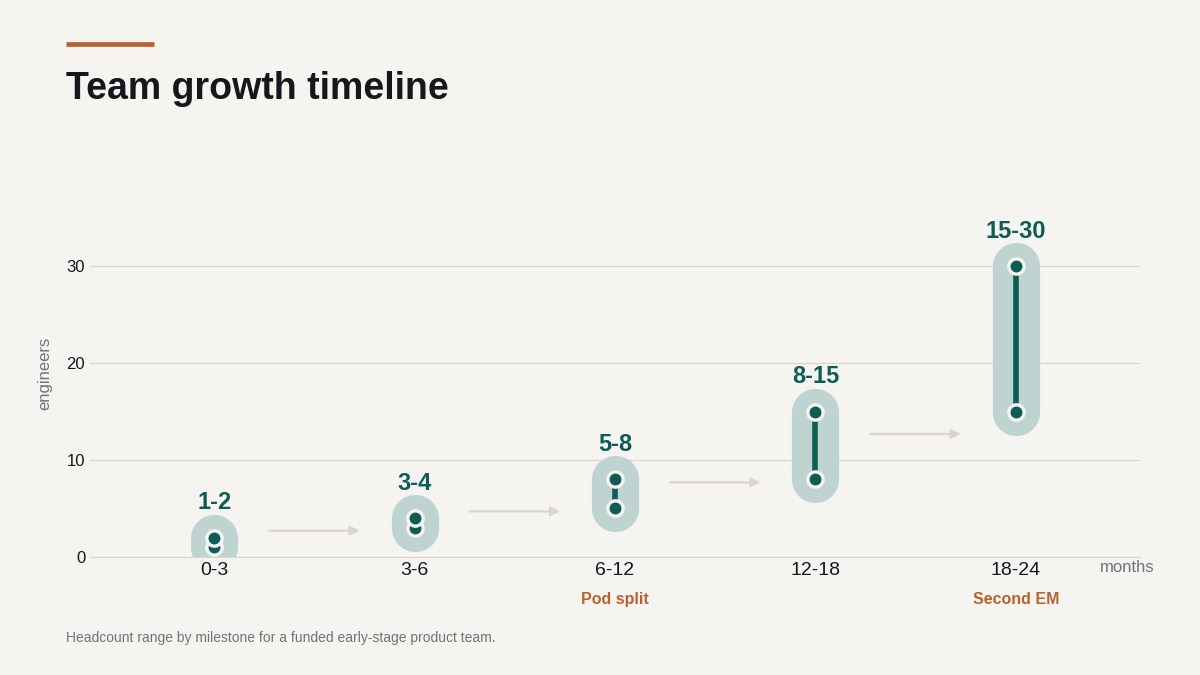
This is the shape of team growth that holds up in practice for a funded early-stage company building a single product. Treat it as a planning skeleton, not a prescription.
| Milestone | Team size | Roles added | What must exist by now | Indicative annual run rate (India-based) |
| Month 0–3 | 1–2 | Founding full-stack; second full-stack/backend | Repo, CI, staging, written “how we work” doc | ₹35–60 lakh · $42k–72k |
| Month 3–6 | 3–4 | Frontend engineer; fractional DevOps | One-command dev environment; PR review standard; time-to-first-commit tracked | ₹70 lakh–1.2 cr · $84k–145k |
| Month 6–12 | 5–8 | Senior IC / engineering lead; second backend; QA | Engineering ladder v1; on-call rotation; DORA baseline | ₹1.5–2.8 cr · $180k–335k |
| Month 12–18 | 8–15 | Pod split; platform engineer; data engineer | Two pods with independent deploy paths; promotion process | ₹3–5.5 cr · $360k–660k |
| Month 18–24 | 15–30 | Second EM; security/SRE; specialists | Quarterly business review; captive-vs-partner cost model built | ₹6–12 cr · $720k–1.4M |
What Hiring Itself Costs
| Route | Cost basis | Typical range | Time to interview-ready shortlist |
| In-house recruiter (salaried) | Fixed + tooling | ₹12–25 lakh/yr + ATS and sourcing tools | 30–60 days per role initially |
| Contingency recruitment agency | % of first-year CTC | 8.33%–20% of annual salary | 3–6 weeks |
| Pre-vetted talent partner | Blended monthly rate or placement fee | Varies by model; typically bundles vetting, account management, replacement cover | 7–10 working days |
| Job boards + internal screening | Per-post + your engineers’ time | Low cash cost, 15–25 hours of senior engineering time per hire | 4–10 weeks, highly variable |
What drives cost up:
- Scarce stack combinations (Rust + distributed systems; ML infrastructure; embedded + cloud)
- Regulatory or clearance requirements fintech and healthtech screening adds 1–2 weeks and narrows the pool
- Sub-4-hour overlap demands for US Pacific or similar; you are paying for inconvenience
- Competing directly with a GCC for the same candidate in the same city
- Interview loops longer than two weeks measured in lost candidates, not in rupees, but it is the largest hidden cost in the table
What drives cost down:
- Genuine flexibility on location within a region
- Accepting a strong 4-of-5 skill match with a ramp plan instead of chasing a 5-of-5
- Batching related roles into one search rather than sequencing them
- Converting proven contract engineers to full-time after a defined period
- An honest, published salary band vague bands cost you two weeks of mutual discovery per candidate
The timeline claims to hold vendors to: 7–10 working days from job description to interview-ready shortlist is achievable and demonstrated. Twenty-four-hour promises usually mean an unvetted bench. If a partner cannot describe their vetting stages in specific detail, the speed is coming from somewhere, and it is coming from the vetting.
Where to Take This Next
If you are mid-decision, the highest-value next step is not more research. It is pressure-testing your Phase 1 output because every downstream cost is set there. Take your role list, your four required skills per role, your salary bands, and your required overlap window, and have someone who has closed these roles at volume tell you where the market will disagree with you.
That conversation is worth having whether you hire through a partner or run the search yourself. Typical output: which of your roles is mispriced, which requirement is silently halving your pool, and a realistic date for each seat being productive rather than filled.
Bring your role list and constraints to a 30-minute call with the Supersourcing team: https://supersourcing.com/contact-us/
No obligation, no deck. If the answer is that you should run this in-house, that is a legitimate outcome of the call and you will leave with the roadmap either way.
FAQ
How long does it take to build a remote engineering team from scratch?
A functioning three-to-four person team typically takes 3–6 months end to end. Individual roles close in 7–10 working days to shortlist and 2–4 weeks to a signed offer through a pre-vetted pipeline, or 60–90 days through a first-time in-house search. Notice periods of 30–90 days in markets like India then sit on top of that plan the offer stage, not just the search.
What should my first five engineering hires be?
Two full-stack generalists first, then a product-minded frontend engineer, then platform/DevOps (often fractional below eight engineers), then a senior IC or engineering lead. The ordering principle is to remove single points of failure before adding specialisation. Hiring a specialist at position one or two is the most common early-stage staffing error.
How much does it cost to hire offshore developers in India?
Indicative fully loaded annual bands for remote India-based engineers run ₹6–12 lakh for juniors, ₹15–28 lakh for mid-level, ₹28–50 lakh for seniors, and ₹50–90 lakh for staff-level. That typically represents a 40–60% reduction against US or Western European equivalents. AI/ML, platform, and security roles price 15–25% above band.
Should I hire contractors or full-time employees for a remote team?
Contract for bounded skill gaps and for capability you may not need in twelve months; employ or use a dedicated team model for core long-term roles. The deciding question is not cost, it is whether you can write acceptance criteria today. If you cannot, you need a team member rather than a deliverable. Misclassifying a de facto employee as a contractor is a real legal exposure in most jurisdictions.
How do you interview remote engineers effectively?
Four stages, 5–8 hours of candidate time, closed within one week: screening, a capped work-sample on a realistic problem, a technical deep-dive that extends their own submission live, and an async collaboration test using a deliberately ambiguous written ticket. The extension round matters more than it used to. Gartner expects half of global organisations to require AI-free skills assessment through 2026 precisely because generating a solution and defending one are now different skills.
How do you measure remote engineering performance without surveillance?
Track the four DORA metrics at team level deployment frequency, lead time for changes, change failure rate, mean time to restore plus PR review latency, escalation speed, and documentation contribution. Never track hours online, commit counts, or chat responsiveness. Activity proxies are gamed within a fortnight and drive away exactly the senior engineers you cannot easily replace.
What is the biggest risk when building a remote engineering team from scratch, and how do you cover it?
The dominant risk is a wrong hire discovered in month two, because it costs the salary plus the search plus the lost quarter. Cover it contractually rather than optimistically: a defined replacement window for example, a replacement within 7–10 days if the fit is wrong converts an unrecoverable mistake into a scheduling inconvenience. Insist on a stated clock, not “best efforts.”
When should we stop using a partner and build our own centre?
Model it seriously at 30–40 engineers, when partner margin starts exceeding the cost of your own entity, compliance, and HR function. Below that, a dedicated partner-employed team is usually cheaper and considerably faster. The transition is also a hiring problem in itself, which is where a consultation is genuinely useful; the entity, payroll, and leadership hiring sequence has a right order and an expensive wrong one.
