

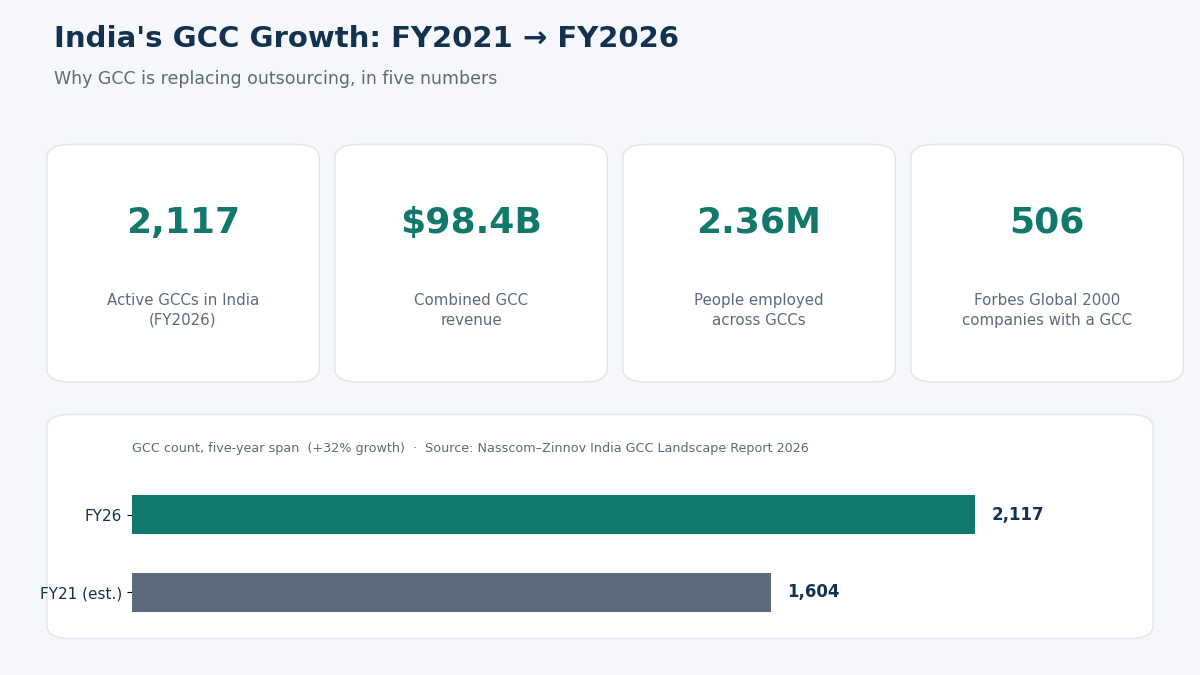
India now runs 2,117 Global Capability Centers, up 32% since FY2021, generating $98.4 billion in revenue and employing 2.36 million people and 506 of the Forbes Global 2000 already operate one. That is not a niche operating model anymore. That is the default way large enterprises are choosing to build offshore technology capability, and the traditional IT outsourcing contract is losing ground to it.
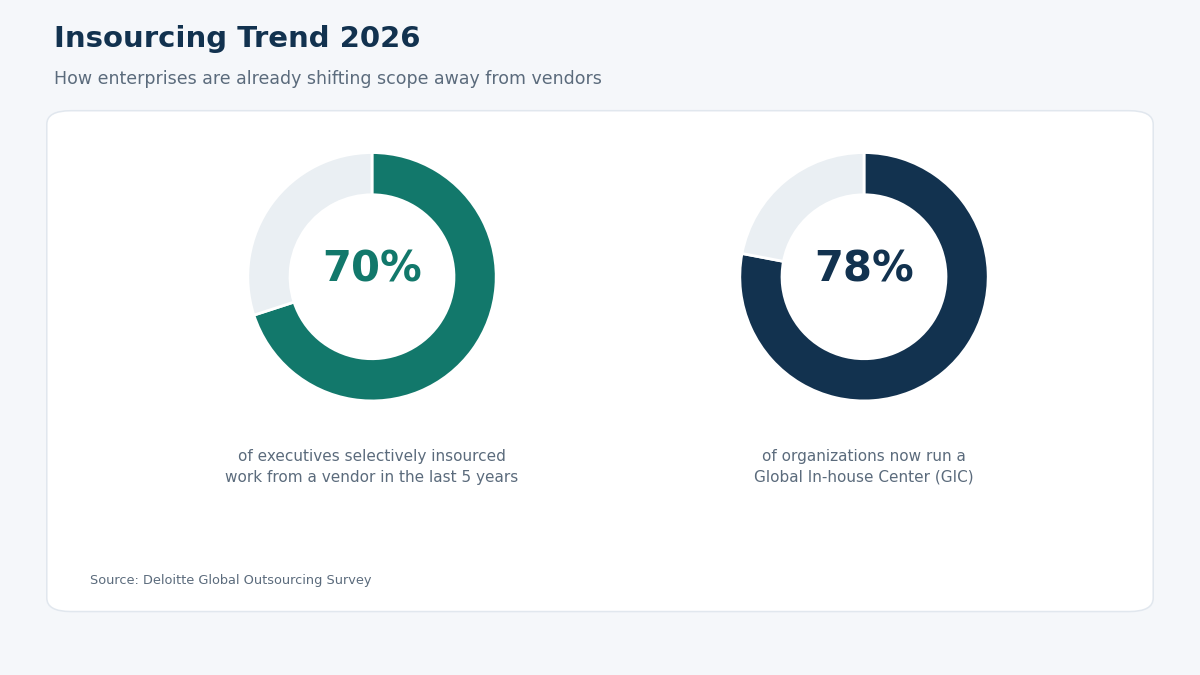
The shift shows up in a second data point that matters just as much: 70% of executives have selectively insourced work that used to sit with a third-party vendor over the last five years, and 78% of organizations surveyed now run a Global In-house Center.
Enterprises are not abandoning external partners entirely; they are pulling core product and platform work in-house while keeping specialized, variable-demand work outsourced. That’s the real story behind why GCC is replacing outsourcing, and it’s a more nuanced shift than most vendor decks admit.
This guide breaks down what’s actually driving that shift, where outsourcing still wins, and how to evaluate whether a captive center makes sense for your organization before you sign or renew a multi-year outsourcing contract.
TL;DR
This guide is for engineering leaders, CHROs, and operating executives deciding between a GCC vs traditional outsourcing for their next phase of offshore growth. It covers why the shift is happening, where outsourcing still wins, and how to run the decision without guessing.
The single biggest number to hold onto: India's GCC base grew 32% in five years to 2,117 centers, while 70% of enterprises surveyed have pulled at least some scope back in-house from vendors over that same window. That's not a fad, it's a structural reallocation of where product work gets done.
By the end, you'll be able to map your own function against a clear decision framework, avoid the three mistakes that sink most first-time GCC builds, and know exactly which questions to ask before choosing between a captive center and an outsourcing partner.
What Is a Global Capability Center (GCC)?
A global capability center is a wholly owned offshore unit that an enterprise sets up to run core product engineering, R&D, analytics, or operations directly under its own management, IP, and hiring rather than through a third-party vendor. Unlike outsourcing, the enterprise owns the team, the process, and the intellectual property outright.
The Core Problem: Outsourcing Was Built for a Different Kind of Work
Traditional IT outsourcing was designed to hand off well-defined, repeatable work ticket resolution, application maintenance, and QA cycles to a vendor optimized for throughput and cost per hour. That model still works when the scope is genuinely commoditized.
It breaks down when the work involves product decisions, proprietary algorithms, or fast iteration cycles, because a vendor’s incentive is billable hours, not your roadmap velocity.
Most enterprises underestimate this mismatch by a wide margin: they sign a 2–3 year outsourcing contract assuming stable scope, then find themselves renegotiating SOWs every quarter as the actual work shifts from maintenance to product ownership.
Three specific frictions show up again and again in engagements we’ve reviewed:
- IP ambiguity. Vendor contracts routinely leave code ownership, model weights, or proprietary process documentation in a gray zone fine for a support ticketing system, risky for a core recommendation engine.
- Shared bandwidth. Vendor teams are staffed across multiple clients simultaneously; your “dedicated” pod can quietly lose 20–30% of its effective capacity to a competing account during a crunch.
- Knowledge walk-out risk. When a vendor rotates staff off your account which happens on almost every multi-year contract the institutional knowledge about your codebase leaves with them, and you have no lever to stop it.
None of this makes outsourcing obsolete. It makes it the wrong tool for work that’s strategic rather than transactional, which is exactly the work enterprises are pulling in-house, and exactly why gcc is replacing outsourcing for anything tied to roadmap ownership.
GCC Growth Drivers: What’s Actually Behind the Shift
The decline of IT outsourcing as the default offshore model isn’t a single cause of its four converging pressures, each strong enough on its own to justify insourcing part of the stack.
1. Product ownership economics
Nearly all GCCs established after FY2021 launched with a product or portfolio mandate from day one, rather than following the older “crawl-walk-run” path that started with basic support work. Enterprises have realized that if a function is going to own roadmap decisions, it needs organizational authority a vendor contract structurally can’t grant.
2. AI capability concentration
More than 1,200 GCCs in India have already embedded AI and machine learning capabilities, backed by over 250 dedicated Centres of Excellence and roughly 250,000 AI professionals. Enterprises building AI-native products want that talent reporting into their own engineering org, not routed through a vendor’s shared bench.
3. Cost arbitrage without the markup
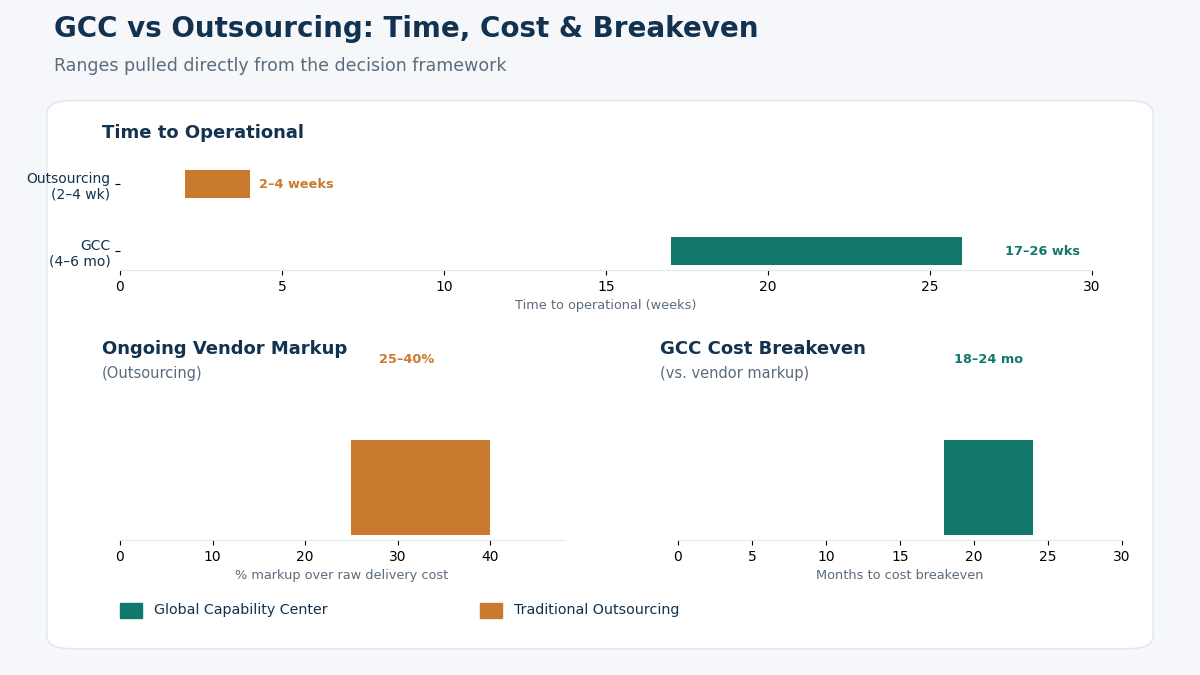
A GCC removes the vendor margin layer typically 25–40% on top of raw delivery cost in a traditional staffing or BPO contract while still capturing India’s wage arbitrage. At scale, that difference compounds fast enough to fund the center’s own real estate and compliance overhead within 18–24 months for most mid-size builds.
4. Talent brand and retention
Owning the employer brand directly (rather than being “the client account” inside a vendor) measurably improves retention. Engineers increasingly prefer to be hired by the enterprise itself, not by a staffing partner acting as an intermediary which shows up in lower attrition on captive teams versus comparable vendor-staffed pods.
How to Evaluate Whether a GCC Fits Your Function
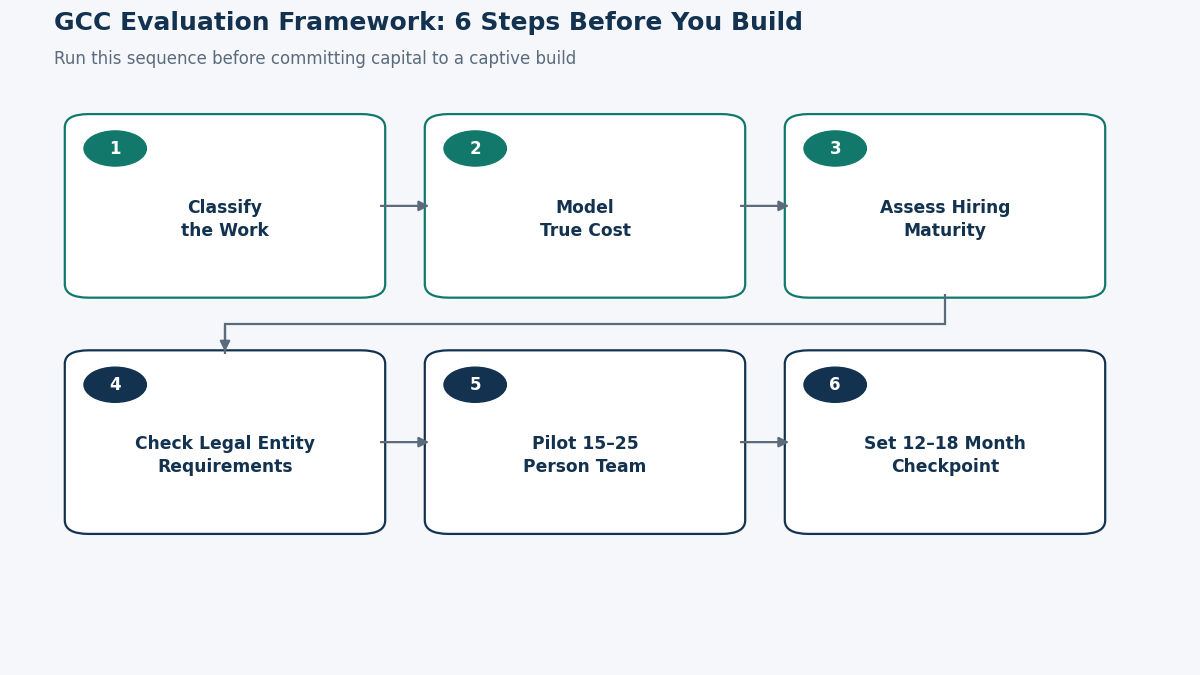
Run this sequence before committing capital to a captive build:
- Classify the work. Split your offshore scope into “core/strategic” and “commoditized/support.” Only the first category is a strong GCC candidate.
- Model true cost, not headline cost. Include real estate, compliance, legal entity setup, and management overhead against the vendor markup you’d otherwise pay.
- Assess your India (or target-market) hiring maturity. A GCC needs a local HR, legal, and recruiting function either built in-house or delivered through an IT staffing services partner during ramp-up.
- Check your legal entity requirements. GCCs in India typically require a private limited company or LLP structure, tax registrations, and labor-law compliance from day one, not something to improvise mid-hire.
- Pilot with a 15–25 person core team before scaling past 100, so process and reporting lines are proven before headcount multiplies.
- Set a 12–18 month maturity checkpoint to re-evaluate scope, comparing actual delivered output against what an outsourcing contract for the same scope would have cost.
Case Study: Fintech Platform Team Shifting From Vendor to Captive
A fintech company running core transaction-risk logic through a traditional outsourcing vendor found that release cycles were consistently 3–4x longer than planned because every scope change required a new SOW negotiation. After transitioning that function into a dedicated captive pod while keeping QA and support outsourced release cadence returned to a predictable two-week cycle, the company retained full IP ownership of its risk models for the first time.
A healthtech company building an AI-assisted diagnostics tool faced the opposite problem: it needed to hire machine learning engineers-level talent fast, before its own India entity was fully set up. It used a staffing-led ramp contract-to-hire engineers operating under NDA-backed IP protection to get a working pod in place inside two weeks, then converted the core team into its own GCC once the legal entity was live.
That sequencing (staff first, incorporate in parallel, convert later) is now a common pattern for enterprises that don’t want to wait 4–6 months for entity setup before they can start delivering.
GCC vs Traditional Outsourcing: A Decision Framework
| Factor | Global Capability Center | Traditional Outsourcing |
| IP ownership | Enterprise owns it outright | Often ambiguous, contract-dependent |
| Team dedication | 100% dedicated, direct reporting | Shared bandwidth across vendor’s client base |
| Cost structure | Lower long-run cost, higher setup cost | Lower setup cost, ongoing vendor markup |
| Time to operational | 4–6 months (entity + hiring) | 2–4 weeks (contract signature) |
| Best for | Core product, R&D, proprietary systems | Support, QA, well-defined repeatable work |
| Talent control | Direct hiring, retention, and career pathing | Vendor controls staffing decisions |
Neither column wins outright. Most mature enterprises run both models in parallel: a GCC for strategic scope, an outsourcing or recruitment process outsourcing partner for elastic, non-core demand. Read that way, why gcc is replacing outsourcing becomes less about a total switch and more about which column each function belongs in.
What Most Teams Get Wrong
The single most common mistake isn’t choosing outsourcing or a GCC, it’s treating the decision as permanent and binary. Teams pick one model, lock into a 3-year contract or a full captive build, and then discover 12 months in that half their scope belongs on the other side of the table.
The second mistake is underestimating GCC setup timelines. Enterprises budget for hiring but not for the legal, tax, and compliance sequencing that has to happen before the first offer letter goes out, which is exactly where a GCC setup services partner earns its fee, by running entity setup and initial hiring in parallel instead of sequentially.
The third, and most expensive, mistake: building a GCC without first validating that the work is genuinely strategic. A captive center built to run routine ticket queues just recreates a vendor relationship with worse economics and none of the flexibility you’ve traded a monthly invoice for a fixed cost base and a lease you can’t easily exit.
Understanding why gcc is replacing outsourcing for some functions and not others is what separates a smart build from an expensive real-estate mistake.
Where to Go From Here
Understanding why gcc is replacing outsourcing only matters if you can apply it to your own org chart. If you’re weighing gcc vs traditional outsourcing for your next phase of offshore growth, the honest answer is usually “some of both” the work is figuring out which scope belongs on which side.
Supersourcing has run this evaluation across enterprise and scale-up engagements spanning fintech, healthtech, and SaaS, from initial staffing through full GCC setup, with dedicated account management and a 7–10 day replacement guarantee on any hire that isn’t a fit.
If you want to pressure-test your own GCC-vs-outsourcing math before committing to either path, reach out at mayank@engineerbabu.com or visit supersourcing.com or go straight to the contact page to talk through your specific scope.
Frequently Asked Questions
Why are companies moving from outsourcing to GCCs?
Primarily because core product and AI work needs direct ownership, dedicated (not shared) bandwidth, and clean IP control none of which a standard vendor contract structurally provides. That’s the short answer to why gcc is replacing outsourcing for strategic scope. Support and QA work, by contrast, still gets outsourced because it’s genuinely commoditized.
What is the real difference between a GCC and an outsourcing vendor?
A GCC is a wholly owned offshore entity the enterprise hires into directly; an outsourcing vendor is a third party that staffs and manages the work under its own employment and IP terms. Ownership, control, and IP rights are the dividing line, not just location or cost.
Is a GCC actually cheaper than outsourcing?
At a scale typically 80+ people a GCC usually beats outsourcing on total cost because it removes the vendor markup. Below that scale, setup and compliance overhead often make outsourcing or staff augmentation the more economical starting point.
How long does it take to set up a GCC compared to signing an outsourcing contract?
A GCC typically takes 4–6 months from legal entity registration to a working core team; an outsourcing contract can be signed and staffed in 2–4 weeks. That timeline gap is why many enterprises staff first through contract talent, then convert to a GCC once the entity is live.
Will GCCs replace outsourcing completely?
Despite the rise in insourcing, investment in third-party outsourcing continues to grow. The realistic pattern is a split model: strategic work moves in-house, transactional work stays outsourced.
What are the biggest risks of setting up a GCC?
Underestimating compliance and entity-setup timelines, over-hiring before process is proven, and building a captive team for work that wasn’t strategic enough to justify the fixed cost base in the first place.
What legal documents are required to set up a GCC in India?
At minimum: a registered legal entity (typically a private limited company), GST and tax registrations, labor-law compliance filings, and if the parent company is transferring IP or data a clear intercompany agreement covering ownership and cross-border data transfer.
