

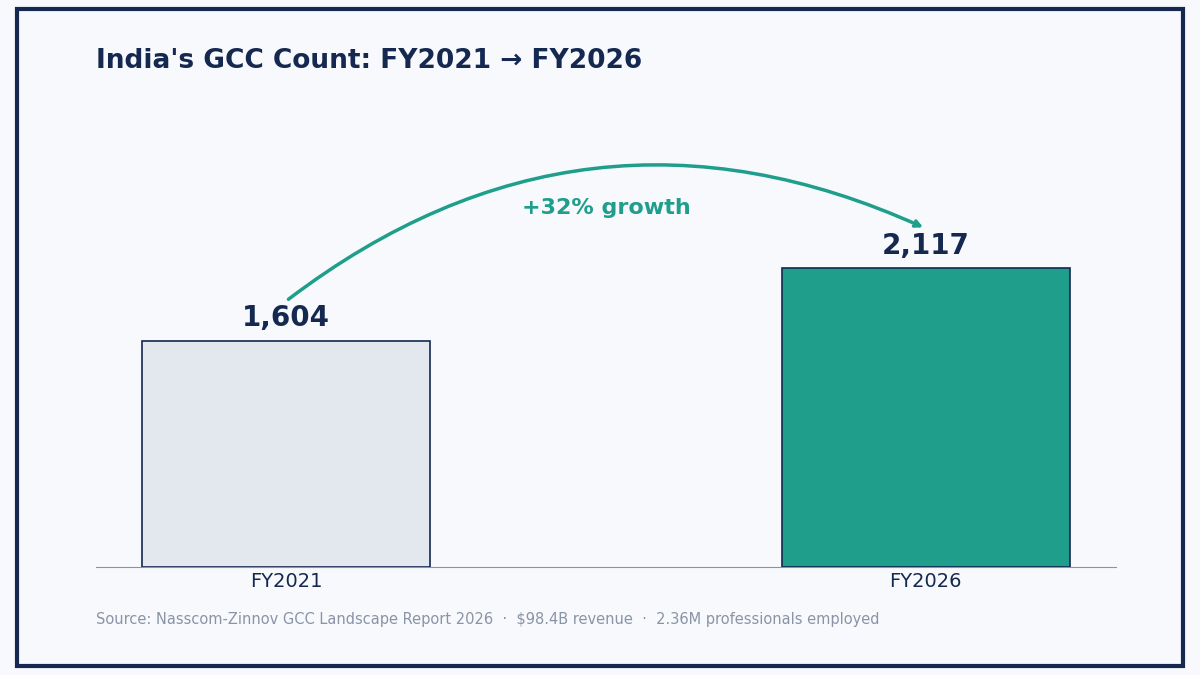
Most Global Capability Centers don’t fail because the business case was wrong. They stall because someone assumed a step was “obvious” and skipped it and that step turns out to be the one blocking payroll, work visas, or a signed lease. India added GCCs at a rate that pushed the total past 2,117 centers in FY26, generating close to $98.4 billion in revenue and employing 2.36 million professionals, a 32% jump in center count since FY2021. That growth has compressed timelines. What used to be an 18-month build is now expected in 6-9 months, and the checklist that worked in 2019 is missing at least a dozen items that matter in 2026.
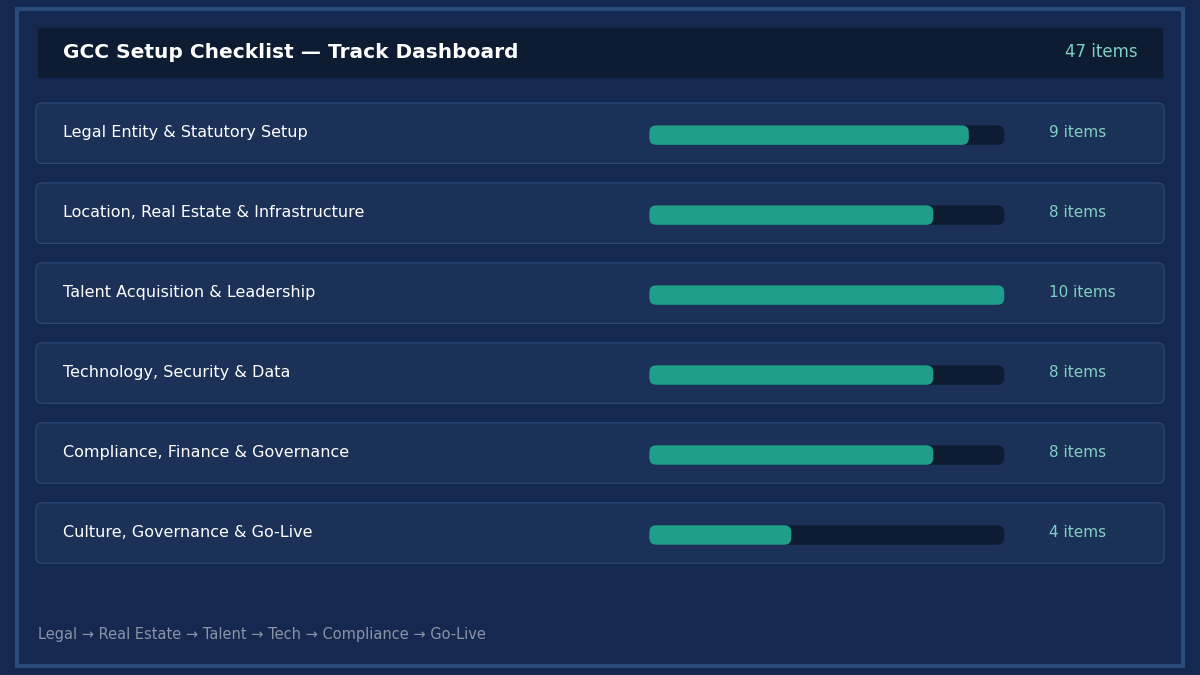
This guide is an updated checklist of 47 items across legal setup, hiring, infrastructure, technology, compliance, and governance, organized in the order enterprises actually need to execute them, not the order a generic template lists them in. It’s built from patterns we’ve seen repeat across dozens of GCC launches: the same three or four mistakes account for most of the delays, and they’re rarely the ones leadership teams are watching for.
A properly sequenced GCC setup checklist removes the guesswork between “we’ve approved the business case” and “the center is operational.” Skip the sequencing and you end up running hiring, entity registration, and office fit-out in parallel with no dependency map which is exactly how a 6-month plan turns into 11 months.
TL;DR:
This guide is a complete GCC setup checklist for CXOs, HR leaders, and program managers planning a Global Capability Center in India whether you're building from scratch or evaluating a capability center setup steps partner. It covers the legal, real estate, hiring, technology, and compliance work that has to happen before day one.
The single biggest number to know going in: entity registration and statutory compliance alone typically take 8-12 weeks in India, and teams that start hiring before that clock starts almost always end up idle-paying signed candidates who have nowhere to report.
By the end of this guide, you'll be able to sequence your own 47-step plan, spot the three gaps that derail most timelines, and know exactly which decisions need to be locked before you sign a lease or post a single job requisition.
What Is a GCC Setup Checklist?
A GCC setup checklist is a sequenced list of legal, operational, financial, and talent milestones an enterprise must complete to launch a fully functioning Global Capability Center from entity incorporation and statutory registrations through office readiness, technology provisioning, and the first hiring cohort going live.
The Core Problem: Why GCC Timelines Slip
Most enterprises underestimate GCC setup time by 3-4x, not because the individual steps are hard, but because they’re planned as a single linear project instead of five parallel tracks: legal, real estate, technology, talent, and compliance that each have their own dependencies and their own failure points.
A wholly owned subsidiary in India needs a minimum of two directors, one of whom must be an Indian resident, before the Ministry of Corporate Affairs will even process incorporation. That single requirement routinely adds 3-4 weeks when the parent company hasn’t identified a resident director in advance. Multiply that kind of unplanned dependency across five tracks and a 6-month plan becomes a 10-month plan without anyone on the dedicated team doing anything obviously wrong. This is exactly the gap a sequenced GCC setup checklist is meant to close.
The teams that hit their launch date treat the checklist as a dependency map, not a to-do list. Legal entity formation gates banking, which gates payroll registration, which gates the first hire’s offer letter. Real estate fit-out gates network provisioning, which gates the security audit, which gates go-live for any regulated workload. Sequence these wrong and you pay for idle real estate, idle signed candidates, or both.
The 47-Item GCC Readiness Checklist
This is organized as a capability center setup steps framework across six tracks. Run them in parallel, but respect the dependencies flagged in each section that’s where most delays actually originate. If you’ve been searching for a straight answer on how to set up a GCC instead of a marketing overview, this sequence is it.
Legal Entity & Statutory Setup (Items 1-9)
- Decide entity structure wholly owned subsidiary, branch office, or build-operate-transfer (BOT) with a partner.
- Reserve the company name with the Ministry of Corporate Affairs (MCA).
- Appoint a resident director (mandatory for a private limited entity).
- File incorporation documents (SPICe+ form) and obtain the Certificate of Incorporation.
- Apply for PAN and TAN for the new entity.
- Register for GST if the entity will invoice or transact domestically.
- Register under the Shops and Establishments Act for the state of operation.
- Register for Provident Fund (EPFO) and Employee State Insurance (ESIC) mandatory once headcount crosses statutory thresholds.
- Open a corporate bank account and complete FEMA-compliant fund inflow from the parent entity.
Location, Real Estate & Infrastructure (Items 10-17)
- Shortlist 3-4 candidate cities based on talent density, cost, and vertical specialization (Bengaluru and Hyderabad still dominate for engineering-heavy GCCs; Pune and Chennai for a mixed engineering-and-BFSI mandate).
- Model total cost of occupancy rent, common area maintenance, fit-out, and escalation clauses not just headline rent per seat.
- Decide managed office vs. traditional lease vs. co-working for the first 12-18 months.
- Negotiate lease terms with a lock-in that matches your headcount ramp, not your Year 1 plan alone.
- Commission office design and fit-out, sized for 18-24 months of projected headcount, not day-one headcount.
- Provision enterprise-grade internet redundancy (minimum two ISPs, diverse last-mile paths).
- Set up physical access control and visitor management aligned to your parent company’s global security policy.
- Plan for a phased move-in if fit-out and hiring timelines don’t align, don’t let real estate become the bottleneck for talent that’s ready to start.
Talent Acquisition & Leadership (Items 18-27)
- Hire the country/site leader first this role gates almost every other hiring decision and should be filled 8-10 weeks before the broader ramp begins.
- Define the org structure and reporting lines to the global parent before opening requisitions.
- Build role-level job descriptions calibrated to local market compensation, not parent-company benchmarks.
- Deciding build vs. partner for sourcing an internal TA function takes 3-4 months to become productive from zero; an experienced partner can deliver an interview-ready shortlist in 7-10 working days once role specs are locked.
- Set salary bands using current local market data, refreshed quarterly India tech comp has moved fast enough that a 2024 benchmark understates 2026 offers.
- Design the interview process and calibrate panels across time zones with the parent company.
- Build an offer approval workflow that doesn’t require sign-off from someone in a different time zone for every single hire.
- Plan onboarding content and access provisioning before the first hire’s start date, not during their first week.
- Set a retention and career-pathing framework GCC attrition in India runs materially higher for centers with no visible growth path.
- Establish a replacement or backfill process for early attrition in the first 90 days, when it’s most costly to the ramp.
Technology, Security & Data (Items 28-35)
- Decide on network architecture dedicated MPLS/VPN vs. cloud-native connectivity to the parent’s environment.
- Provision identity and access management aligned to the parent’s IAM stack, not a parallel system.
- Complete a data residency and data classification review of what can live in India, what must stay onshore, and why.
- Run a security audit against the parent company’s global InfoSec policy before any production access is granted.
- Set up device procurement and endpoint management for the first hiring cohort.
- Establish SOC/monitoring coverage for the new site, even at low initial headcount.
- Integrate HRIS, payroll, and time-tracking systems with the parent’s global stack.
- Build a documented disaster recovery and business continuity plan specific to the India site.
Compliance, Finance & Governance (Items 36-43)
- Set transfer pricing policy between the parent and the India entity that has direct tax exposure if done incorrectly or late.
- Register for professional tax in the state of operation.
- Set up statutory audit and bookkeeping cadence with a local firm.
- Define a delegation of authority (DOA) matrix for local spend approval.
- Draft and localize employment contracts, leave policy, and India-specific benefits (gratuity, PF, insurance).
- Set up a local grievance and POSH (Prevention of Sexual Harassment) committee legally mandated, not optional.
- Build a vendor management framework for the local vendors you’ll need facilities, IT staffing, and legal.
- Establish a monthly and quarterly reporting cadence to the parent’s finance and governance teams.
Culture, Governance & Go-Live Readiness (Items 44-47)
- Run a pre-launch stakeholder alignment session between the parent leadership and the new site leader on mandate, scope, and success metrics.
- Pilot the first project or workstream with a small cohort before scaling headcount.
- Set a 90-day post-launch review checkpoint; most course corrections are cheapest inside this window.
- Document the full playbook so your second location doesn’t relearn the same 46 lessons.
How This Plays Out in Practice
A fintech enterprise scaling its India engineering function needed a working center inside 90 days to support a Q1 product launch. The bottleneck wasn’t sourcing candidates; it was that the office lease and IT security audit hadn’t been sequenced against the hiring ramp, leaving eight signed engineers with no secured access on their start date. Re-sequencing real estate and InfoSec ahead of the offer stage closed that gap for the following cohort.
A healthtech company building a 40-person GCC over two quarters treated legal entity setup and hiring as fully independent tracks running on the same calendar. The result was three senior hires who’d resigned from their previous roles sitting idle for five weeks waiting on PF and ESIC registration to clear an entirely avoidable cost that a dependency-mapped GCC launch plan would have flagged in week one.
Build vs. Partner vs. Hybrid: A Decision Framework
| Approach | Speed to Operational | Control | Best Fit |
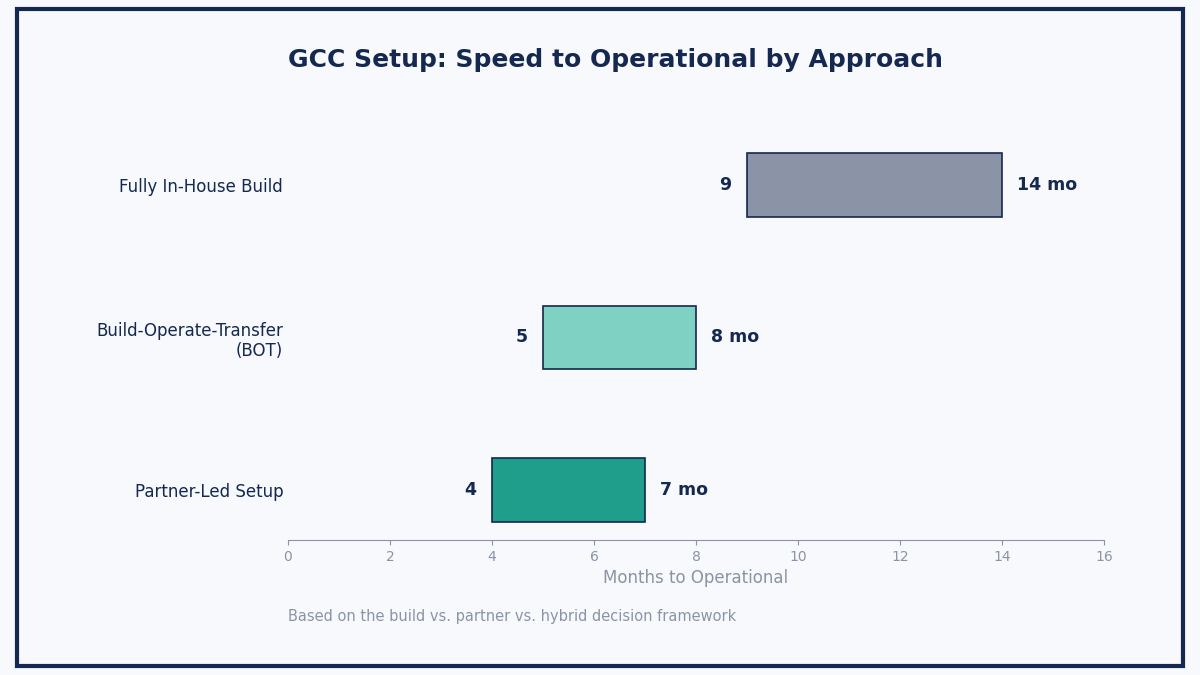
| Fully in-house build | Slowest (9-14 months) | Highest | Enterprises with existing India legal/HR infrastructure |
| Build-Operate-Transfer (BOT) | Moderate (5-8 months) | Transfers over time | First-time India entrants wanting eventual full ownership |
| Partner-led setup with GCC consulting support | Fastest (4-7 months) | Shared, with defined handover | Enterprises prioritizing speed and reduced execution risk |
Choose based on how much execution risk your organization is willing to hold internally versus transfer to a partner with repeat experience across the same 47 steps. Whichever path you choose, the underlying GCC setup checklist doesn’t change only who executes each line item.
What Most Teams Get Wrong
The most common mistake isn’t in any single checklist item; it’s treating leadership hiring as just another requisition instead of the critical-path item it actually is. A site leader hired late means every other hiring decision, vendor negotiation, and stakeholder alignment session waits on someone who isn’t in the building yet. Teams that hire the site leader 8-10 weeks before the broader ramp consistently launch faster than teams that try to hire the whole org chart in parallel.
The second pattern: compensation benchmarking done once, at the business-case stage, and never revisited. India tech salaries for AI, cloud, and platform roles moved enough between 2024 and 2026 that a stale benchmark either loses candidates at offer stage or overpays a role the market has since repriced downward. Refresh bands quarterly, not annually.
The third: no documented GCC readiness checklist owner. When legal, real estate, HR, and IT each own their own track with no single point tracking cross-track dependencies, delays get discovered at the point of failure on a new hire’s first day instead of six weeks earlier when they were still fixable. A single owner running the full GCC setup checklist end to end is the cheapest insurance policy in the entire launch.
Where to Go From Here
If you’re mid-way through building your own GCC setup checklist and want a second set of eyes on the sequencing before you lock a lease or open requisitions, Supersourcing has run this process across dozens of GCC engagements in India, with dedicated account managers and NDA-backed IP protection built into every setup. Reach out at mayank@engineerbabu.com or start at supersourcing.com or go straight to the contact page if you already know what you need reviewed.
Frequently Asked Questions
How long does it take to set up a GCC in India?
A lean GCC with 20-50 roles typically takes 4-7 months from approved business case to operational site when tracks run in parallel with a dedicated program owner. Entity registration alone takes 8-12 weeks and should start before any other track, since almost everything else banking, payroll, hiring depends on it.
What is the cost to set up a GCC in India?
Setup cost varies widely by city, headcount, and real estate model, typically ranging from ₹40-80 lakhs for legal, compliance, and initial office fit-out for a sub-50-person center, excluding ongoing payroll and rent. Tier-1 cities like Bengaluru and Mumbai carry higher real estate costs than Pune, Chennai, or emerging hubs like Coimbatore.
What legal documents are required for GCCs in India?
A GCC needs a Certificate of Incorporation, PAN, TAN, GST registration (if applicable), Shops and Establishments registration, EPFO and ESIC registration, and a board-approved delegation of authority matrix, along with FEMA-compliant documentation for fund transfers from the parent entity.
How is a GCC different from IT outsourcing or staffing?
A GCC is a wholly owned or majority-controlled extension of the parent company, giving direct control over IP, hiring, and culture. IT outsourcing and staffing engage a third party’s employees or contractors for defined deliverables, trading direct control for speed and lower setup overhead. The two models solve different problems and aren’t interchangeable.
Which Indian cities are best for setting up a GCC?
Bengaluru and Hyderabad remain the deepest talent pools for engineering-heavy centers; Pune and Chennai suit a mixed engineering-and-BFSI mandate; Ahmedabad, Coimbatore, and GIFT City are emerging options for specialized functions like semiconductors, GIS, and fintech, often at a lower real estate cost.
Do you need a local entity before hiring anyone in India?
Yes employment contracts, payroll, PF, and ESIC registrations all require an incorporated local entity. Some enterprises hire an initial site leader through an employer-of-record arrangement to start earlier, but broader hiring should wait until entity setup and statutory registrations are complete.
Should we run this checklist ourselves or bring in a GCC setup partner?
That depends on whether your organization already has India-specific legal, HR, and real estate expertise in-house. Enterprises without that muscle typically move faster with a partner who has run this exact sequence before the framework above works either way, but the execution risk shifts depending on who owns each track.
